Your complete guide to the Montgomery County Moderately Priced Dwelling Unit (MPDU) program. Learn eligibility, how to apply, and the rules for 2026.
July 14, 2026
Montgomery County Moderately Priced Dwelling Unit Guide 2026
Your complete guide to the Montgomery County Moderately Priced Dwelling Unit (MPDU) program. Learn eligibility, how to apply, and the rules for 2026.
You may be staring at home prices or rents in Montgomery County and wondering whether there's any realistic path left for a middle-income household. Maybe you work nearby, your family is already rooted here, or you've spent months doing the math only to watch the numbers stop making sense. That's where the Montgomery County Moderately Priced Dwelling Unit, usually called the MPDU program, comes in.
The program exists because the county recognized a simple problem decades ago. New housing in strong job markets often becomes too expensive for many of the people who keep those places running. Teachers, nurses, public employees, service workers, and first-time buyers can be priced out of the same communities they serve. If you want a broader view of the housing affordability problem, that overview is a useful companion to what's happening locally.
Montgomery County responded early. The MPDU program was implemented in 1973 and, from then through 2023, it produced 17,028 units, which the county describes as the largest production volume among comparable inclusionary zoning programs nationwide. In 2023 alone, 354 new MPDUs were produced according to Montgomery Planning's MPDU program overview. If you want to place this guide in a broader policy context, this explanation of housing affordability policy helps frame why programs like this matter.
Table of Contents
- Your Path to Affordable Housing in Montgomery County
- What Is the MPDU Program
- How to Qualify and Apply for an MPDU
- Your Obligations as an MPDU Owner or Renter
- How Developers Contribute to the MPDU Program
- MPDUs as Secured Land-Use Rights
- Common MPDU Questions and Where to Get Help
Your Path to Affordable Housing in Montgomery County
A lot of first-time buyers come to this program carrying two emotions at once. They're hopeful because they've heard there's a below-market option in the county. They're skeptical because affordable housing programs often sound simple at first and complicated the moment paperwork begins.
That reaction is reasonable. The MPDU program is both a housing opportunity and a legal structure. It tries to keep homes attainable in places where land values rise quickly. So if the rules seem detailed, that's not accidental. The county is trying to protect access over time, not just create a one-time discount.
Consider a common local situation. A household earns a steady income, has decent credit, and wants to stay near work, school, relatives, or transit. On paper, they're doing many of the “right” things. But each market-rate listing still feels out of reach. The MPDU program was built for exactly that kind of middle ground.
Many buyers don't need a lecture on why housing is hard. They need a path that turns “maybe someday” into a real application.
The practical value of MPDUs is that they aren't an occasional charity unit or a one-off pilot. They're built into county rules for development, and that gives households something sturdier to work with. You're not depending entirely on luck, a private donor, or a temporary grant cycle. You're using a standing public system.
For hopeful applicants, that means this guide should be read in the same way you'd read a home inspection report. Calmly. Line by line. The promise of an MPDU is real, but so are the conditions attached to it. If you understand both, you can avoid the two biggest mistakes people make: assuming the program is easier than it is, or assuming it's too complex to try.
What Is the MPDU Program
A new apartment building goes up near transit, shops, and schools. The builder gains the right to use valuable land more intensively. Montgomery County's MPDU program says part of that added value must also serve households who would otherwise be priced out.
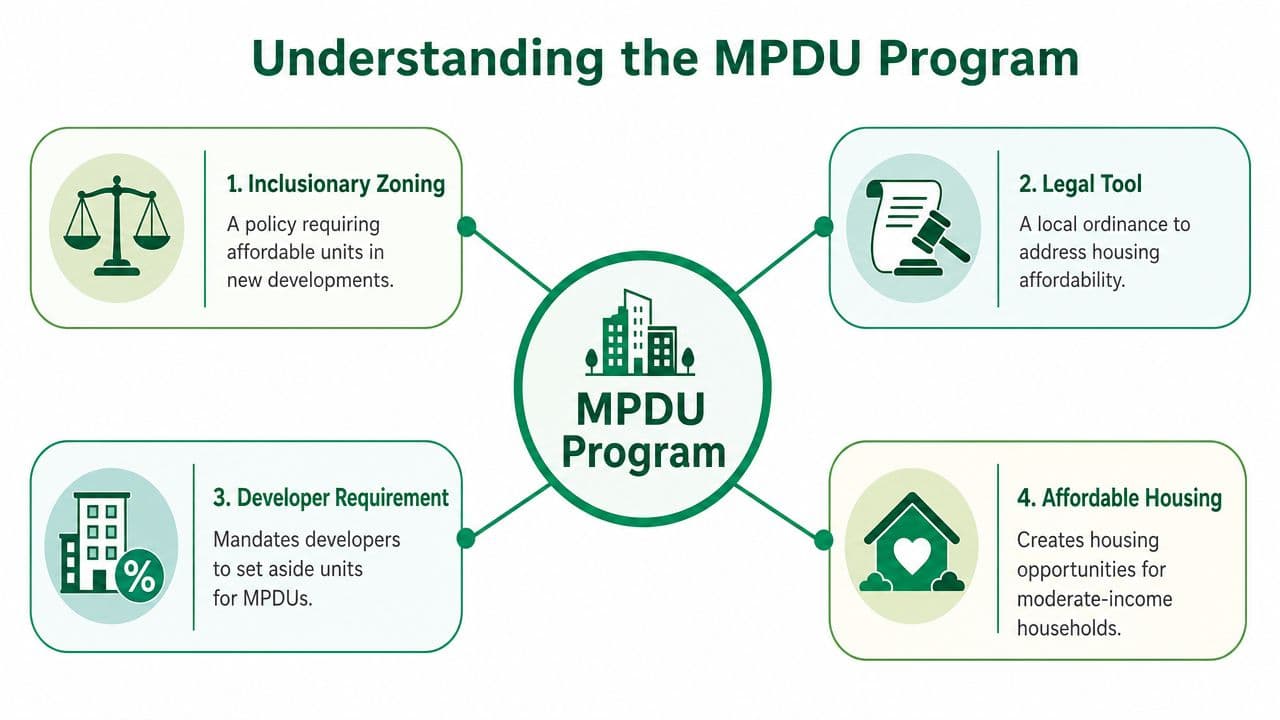
The MPDU program is a form of inclusionary zoning. In plain terms, when a private developer builds a qualifying project, county law requires a share of the homes to be offered at below-market prices or rents to moderate-income households.
That design matters because housing prices reflect more than construction cost. A large part of the price comes from location. Land near jobs, strong schools, parks, and transit carries extra value because many people want access to the same places. The county uses the MPDU rules to claim part of that location value for a public purpose.
This is the piece many housing guides skip. The program is not only a discount program. It is also a rule about land-use rights. If zoning gives a property owner the ability to build homes in a high-value area, the county can attach conditions to that right. One condition is long-term affordability.
That is different from a land-value tax, even though both start from the same economic insight. A land-value tax collects some of a site's value through taxes. The MPDU program collects some of that value through on-site affordable homes and long-term restrictions. One works through the tax bill. The other works through development rules and recorded obligations tied to the unit.
A helpful comparison is a community land trust approach to permanent affordability. The legal structure is different, but the public logic is similar. Private households can live in and use the home, while the community keeps an ongoing say in how affordability is preserved over time.
Montgomery County describes the MPDU program as one of the nation's first mandatory inclusionary zoning laws, created in 1973. Under the county's current framework, new private developments with at least 20 units must set aside at least 12.5% of the homes as MPDUs, and that share rises to 15% in designated high-income planning areas. The same county overview explains that for-sale units and high-rise apartments are priced for households earning up to 70% of Area Median Income, while garden-style rental apartments are priced for households earning up to 65% of Area Median Income. It also notes that 40% of MPDUs must be offered to the Housing Opportunities Commission and certain nonprofit housing agencies, according to Montgomery Planning's MPDU program page.
Those rules show the county's larger goal. The program places affordable homes inside regular development instead of treating affordability as a separate side project. It also tries to keep the benefit in place over time, which is why MPDUs come with resale, rental, and occupancy rules.
Here is the plain-language version:
- For households: MPDUs can offer a path into neighborhoods where market prices would otherwise block access.
- For neighborhoods: Mixed-income living becomes more realistic because affordability is built into new growth.
- For the county: Development rights come with public obligations, not only private gain.
- For future applicants: The affordability benefit is meant to last beyond the first lease-up or first sale.
Practical rule: An MPDU is a regulated home created through zoning law, with both benefits and continuing obligations attached from the start.
How to Qualify and Apply for an MPDU
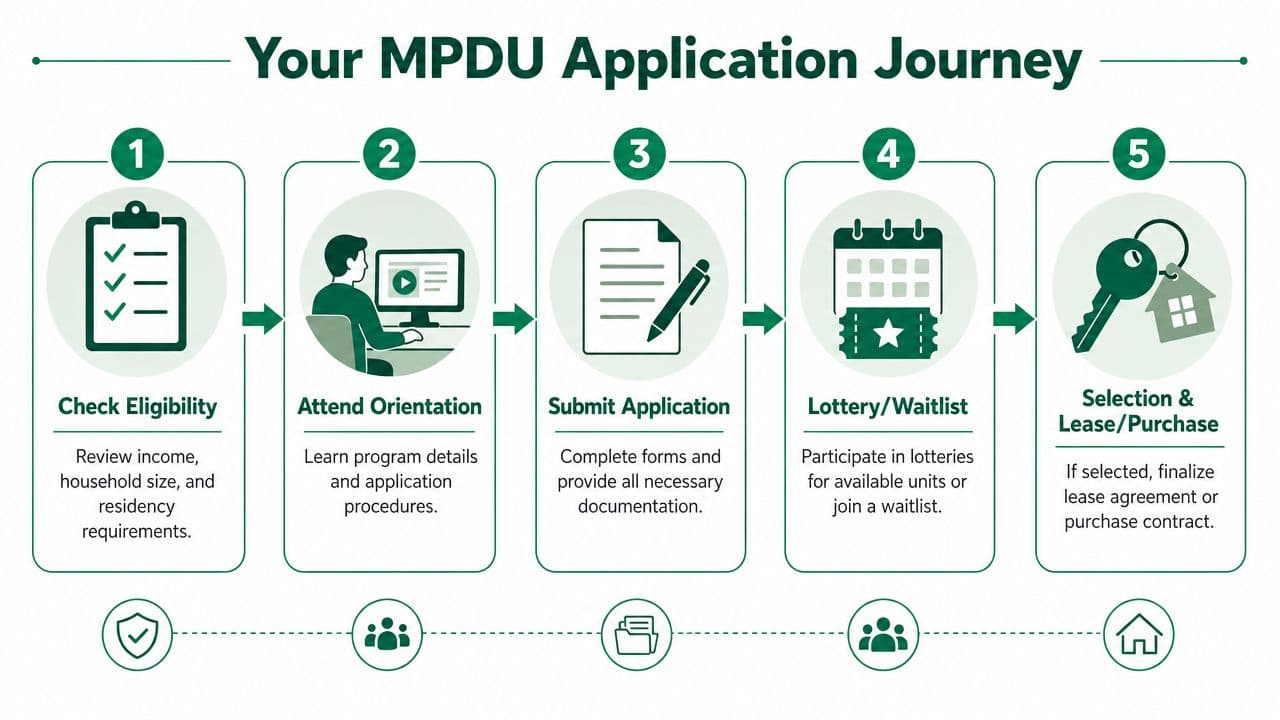
For most households, the process feels more manageable once you stop thinking of it as one giant hurdle. It's really a sequence. Check eligibility. Learn the rules. Gather documents. Enter the process correctly. Then stay realistic about timing and cash.
What to check before you apply
Start with the basic fit. Are you applying for a rental or a purchase? Are you looking at a garden apartment, a high-rise apartment, or a for-sale home? The income standards and pricing approach differ by unit type, so the first mistake is treating every MPDU like it works the same way.
You'll also want to confirm household details and document readiness. Applicants usually need records that prove identity, income, and household composition. If your paperwork is inconsistent across tax forms, pay stubs, bank records, or employment letters, delays can follow.
A simple way to think about this stage is below.
| Area to review | Why it matters |
|---|---|
| Household income | The program is income-restricted, so earnings must fit the unit type |
| Household size | Eligibility and unit matching often depend on who will live there |
| Unit type | Rental and ownership paths work differently |
| Documents | Missing paperwork can stall an otherwise valid application |
| Financing readiness | For buyers, approval on paper isn't the same as being cash-ready |
The application path in plain language
Most applicants move through the process in a familiar order:
- Check current program rules through the county's housing channels and unit listings.
- Complete the required orientation so you understand the program before joining the pipeline.
- Prepare your records carefully, especially if your income changes month to month.
- Apply for available units or enter the lottery process when appropriate.
- Respond quickly if contacted, because housing opportunities often move faster than people expect.
The orientation step matters more than many buyers think. It's where the county explains what an MPDU is, what restrictions apply, and what ownership or tenancy will look like after move-in. That's also where many people realize they were focusing only on monthly affordability and not on upfront readiness.
The part many buyers underestimate
This is the issue I most often see misunderstood. Official materials may make the program sound accessible at the minimum income threshold, but first-time buyers need to look beyond the headline.
While official FAQs state a $40,000 gross income is required, buyers also need a mortgage qualification of at least $150,000 and approximately $9,900 in immediate savings for down payments and closing costs, a cash burden that often gets less attention in general summaries.
If you're close to the minimum income floor but don't have liquid savings, the barrier may not be monthly payment. It may be the cash needed before you ever get the keys.
That doesn't mean the program isn't worthwhile. It means you should prepare for it thoroughly. A household can qualify in one sense and still struggle in another. Imagine being approved to enter a race while still needing proper shoes at the starting line.
A few practical habits help:
- Save specifically for transaction costs: Don't treat all savings as interchangeable.
- Talk to a lender early: Buyers need to know whether they can qualify for the mortgage amount the program expects.
- Keep income records clean: Overtime, contract work, and irregular pay can complicate file review.
- Read every restriction before choosing a unit: A lower price today comes with long-term conditions tomorrow.
For renters, the financial path is often more straightforward than for buyers. For buyers, the front-end cash hurdle can be a significant gatekeeper. That's why patience and preparation matter just as much as eligibility.
Your Obligations as an MPDU Owner or Renter
You get the keys to an MPDU home, settle in, and start making plans. Then a question comes up. If this is your home, why are there resale rules, occupancy rules, or paperwork after move-in?
The short answer is that an MPDU is not only a home. It is also a long-term affordability commitment tied to a land-use benefit the county helped create. The county allowed development to go forward under rules that reserved some homes at below-market prices. In exchange, those homes keep conditions that protect the next eligible household too. That is the practical side of the program, and it also reflects a broader idea behind land value capture and public claims on development-created value.
Why restrictions stay with the home
For owners, the key idea is the control period. During that period, resale is limited so the home does not quickly turn into a full market-rate asset. If that happened right away, the public benefit would vanish after one sale.
A simple way to read the rule is this: the program gives one household access to homeownership at a lower entry price, and in return that household agrees not to convert that discount into a private windfall during the restricted period. That can feel unfamiliar because standard homeownership advice often assumes that maximizing appreciation is the goal. MPDU ownership works differently. It gives you stability, predictable rules, and a lower purchase price, while preserving affordability for the next buyer.
This is one place where the economics matter. A land-value tax tries to recapture some location value through the tax system each year. The MPDU program uses a different tool. It places affordability conditions directly on certain homes created through the development process. One approach taxes land value broadly. The other secures part of that value as below-market housing over time.
What owners and renters should expect
Owners should treat the home as a place to live first, with program rules attached to it. Renters should expect compliance rules that keep the unit serving the households the program is meant to reach.
That means a few practical responsibilities come with participation:
- Owners should expect resale limits. The home does not operate like a conventional investment property during the control period.
- Improvement credits are limited. Not every dollar spent on upgrades will come back through a future sale price.
- Renters should expect ongoing eligibility and occupancy compliance when program rules require it.
- Everyone should keep organized records. Good documentation helps with renewals, reviews, and future sale or lease questions.
Understanding these rules as the mechanism for long-term affordability, rather than as penalties, clarifies their purpose.
For concerned residents, that point matters too. The restrictions are how the county makes one affordability intervention last beyond the first household. For hopeful buyers and renters, the message is simpler. Read the rules carefully, ask questions early, and enter the program with the right expectation. You are getting a real housing opportunity, but you are also helping preserve a scarce land-use benefit for whoever comes next.
How Developers Contribute to the MPDU Program
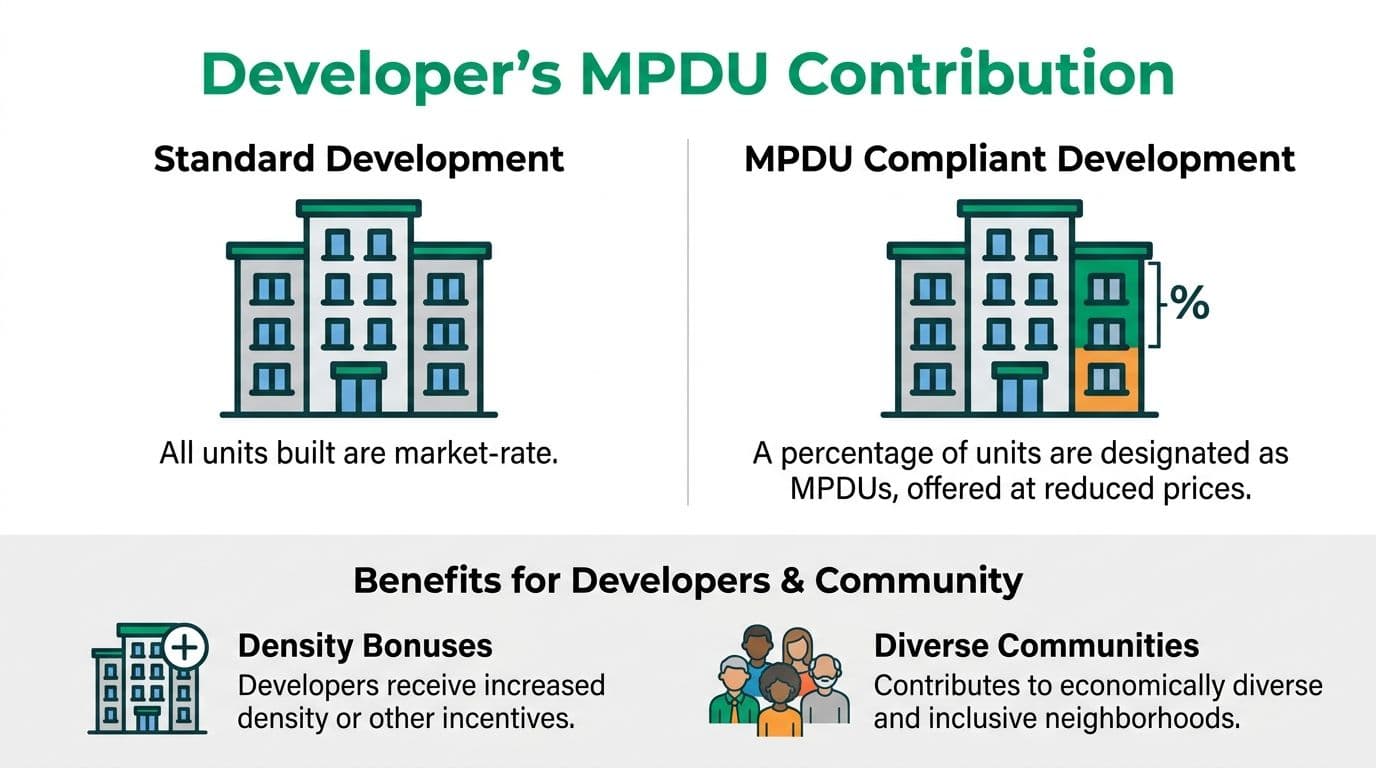
A developer lines up land, financing, and a proposed building. Before the first foundation is poured, county law already shapes part of what that site must provide. In Montgomery County, the MPDU program ties some development approvals to an affordability requirement, so moderate-income housing is built into the project itself rather than added later.
The basic set-aside rule
The starting rule is straightforward. Many qualifying developments must set aside 12.5% of units as MPDUs, and some planning areas face a 15% requirement under standards described in the Montgomery Planning Board staff report on MPDU planning areas.
That rule makes more sense if you view development rights as something the public helps create. A parcel becomes more valuable because of zoning, roads, schools, parks, transit, and access to jobs. Those advantages are not created by the builder alone. The county is saying that when private development benefits from those community-made location advantages, part of the project should remain within reach for moderate-income households.
That is also why the program is useful to compare with policies that capture land value through public rules. A tax collects some of that location value in money. The MPDU program collects part of it in housing units with lasting affordability rules attached.
Why some areas require more
Bill 38-17, passed in 2018, created the higher 15% set-aside for certain planning areas that meet the law's income-based test.
The idea is not complicated. Land in stronger housing markets usually carries more location value. Buyers pay more to live near high-performing schools, transportation options, established amenities, and major job centers. When that market strength is higher, the county asks for a larger affordability contribution from qualifying projects in those designated areas.
Here, the land-use-rights logic becomes clearer. The county is not merely charging a fee and walking away. It is attaching a condition to how some of the homes on that site may enter the market, so a slice of the development continues to serve moderate-income households over time.
Where residents often get confused
Residents often get confused about which specific developments fall under the higher 15% requirement. People may look at a place that feels expensive and assume the stronger rule automatically applies there.
The law is narrower than that. The higher requirement applies only in planning areas that meet the formal designation criteria. So a development can sit in an area that seems affluent in everyday conversation and still follow the baseline rule if the site is outside a legally designated planning area.
A simple way to understand it is to separate market reputation from legal boundaries. Market reputation tells you how a place feels. Legal boundaries decide which MPDU set-aside rule applies.
A neighborhood can seem expensive without falling under the higher MPDU requirement. The controlling question is whether the development is inside a planning area that the law designates for the 15% rule.
That distinction matters for both residents and first-time buyers. It explains why affordable units may appear in one new project but not at the share a neighbor expected. It also shows how the MPDU program works as a planning tool. The county is not treating every high-price area the same by instinct or reputation. It is assigning affordability obligations through defined land-use rules.
MPDUs as Secured Land-Use Rights

Most guides stop at eligibility and resale rules. They tell you what happens, but not why the system is designed this way. The deeper logic is that an MPDU secures a continuing land-use right for the community.
What land-use rights mean here
Land-use rights are the legal claims that shape how a site may be used and who benefits from that use. In ordinary conversation, people talk as if buying a home means buying every future gain tied to that location. Planning law has never worked that way. Zoning, easements, setbacks, public access rules, and deed restrictions all place conditions on land use.
An MPDU uses that same legal reality for an affordability purpose. The county allows private occupancy and private transfer, but it preserves a public claim that the location should continue serving moderate-income households. This overview of what a land-use right is helps if the phrase feels abstract.
The county's resale controls show this clearly. During the control period, owners can't convert community-created location value into unrestricted private gain. The site remains partly dedicated to an affordability function through legal conditions attached to the property.
Why I prefer this to land-value taxes in this context
I prefer land-use rights over land-value taxes in this specific setting because they are direct. A tax captures value through annual payment. A land-use right captures value by setting durable rules for who gets to benefit from a location and on what terms.
For MPDUs, that directness matters. The county doesn't need to estimate and collect a yearly land charge from the homeowner in order to preserve affordability. It secures the result in the deed-restricted use of the home itself. The county's orientation materials state that resale price controls during the control period limit improvement credit to 10% of the original MPDU purchase price and require future sales to remain at reduced prices in the DHCA orientation document.
That makes the control period easier to understand if you stop seeing it as a penalty. It's an enforcement tool for a pre-committed public purpose. The land under that home sits in a valuable county location shaped by schools, roads, safety, parks, and nearby jobs. The community is saying, in effect, that part of that value should remain available to moderate-income households over time.
This is why the MPDU model is more than discounted housing. It is a practical example of secured land-use rights in action.
Common MPDU Questions and Where to Get Help
After people learn the basics, their questions usually become more personal. They want to know how strict the rules are, what happens if life changes, and where to get a reliable answer instead of a rumor.
Can I already own property
That depends on the specific ownership rules attached to the program path you're pursuing and how the county applies them at the time you apply. Treat this as a rule to verify directly through the county's current application materials, not through neighborhood chatter or social media summaries.
What if my income changes later
For renters, income changes may matter for continued program compliance, depending on the lease and recertification requirements tied to the unit. For owners, the bigger long-term issue is usually not later income but later resale, refinancing, and compliance with the deed restrictions.
How do I know what documents matter
Start by assembling a clean file before you chase a unit. Households often lose time because names, addresses, income records, or account balances don't line up across documents. If you're moving toward ownership, understanding the legal chain of title also helps. This plain-language guide to properly acquiring a property deed is useful background for first-time buyers who want to understand what ownership paperwork represents.
Where should I go for official help
Use the county's official housing channels first, especially for current orientation access, application steps, and intake questions. If you want outside help thinking through the policy side of affordability, local land economics, or broader housing reform questions, you can also contact a policy advisory team here.
A short checklist can keep you grounded:
- Use official county materials for current rules: Program details can change administratively.
- Keep a dedicated folder for your records: That includes income, bank statements, identification, and correspondence.
- Ask about restrictions before you commit: Don't wait until contract stage to learn what resale or occupancy rules apply.
- Write down every deadline: Housing opportunities often move on a fixed timeline even when the overall process feels slow.
The best mindset is steady, not rushed. An MPDU can be a genuine path into Montgomery County housing, but it rewards careful readers and prepared applicants.
If your city, agency, or organization is trying to make housing more affordable without penalizing productive work and construction, Unitism® offers research, policy design, education, and implementation support grounded in land economics. It helps public leaders understand tools like land-use rights, land-value capture, and related reforms in plain language so they can build housing systems that stay fair over time.