Explore a complete guide to housing affordability policy. Learn supply, demand & land-value capture solutions for equitable, fiscally sound communities.
June 24, 2026
Housing Affordability Policy: Solutions for 2026
Explore a complete guide to housing affordability policy. Learn supply, demand & land-value capture solutions for equitable, fiscally sound communities.

The most important housing affordability statistic in the United States isn't only that prices are high. It's that the price system now reflects something deeper than construction cost. As of early 2026, the typical U.S. home value sat in the mid-$300,000s and has risen sharply over the past several years 1, while housing costs in most counties have pulled away from what local incomes can support.
That changes how national committees should think about housing affordability policy. If the core problem were too few subsidies, a larger subsidy regime would solve it. If the problem were only zoning, deregulation alone would solve it. Both matter. Neither is sufficient. The missing variable is land.
A public finance approach has to distinguish land from labor and capital. Buildings are produced. Labor is compensated. Land, especially well-located urban land, is fixed. Once policymakers separate those three factors, the current policy failure becomes easier to see. Conventional housing affordability policy often tries to ease payment burdens while leaving the underlying land price dynamic largely intact.
Table of Contents
- The Unwinnable Race Between Housing Costs and Incomes
- Why Housing Is Unaffordable The Land Value Equation
- A Survey of Housing Affordability Policy Instruments
- Land Value Capture A Powerful Solution
- Designing a Sustainable Policy Framework
- Evaluating Policy Impact Fiscal and Social Metrics
- Next Steps for Building Affordable Communities
The Unwinnable Race Between Housing Costs and Incomes
The current affordability debate often understates the severity of the break between prices and earning power. As of early 2026, the typical U.S. home value remained in the mid-$300,000s after several years of rapid appreciation 1, while high mortgage rates have reinforced a lock-in effect that keeps existing owners from selling and further constrains supply across much of the country 2.
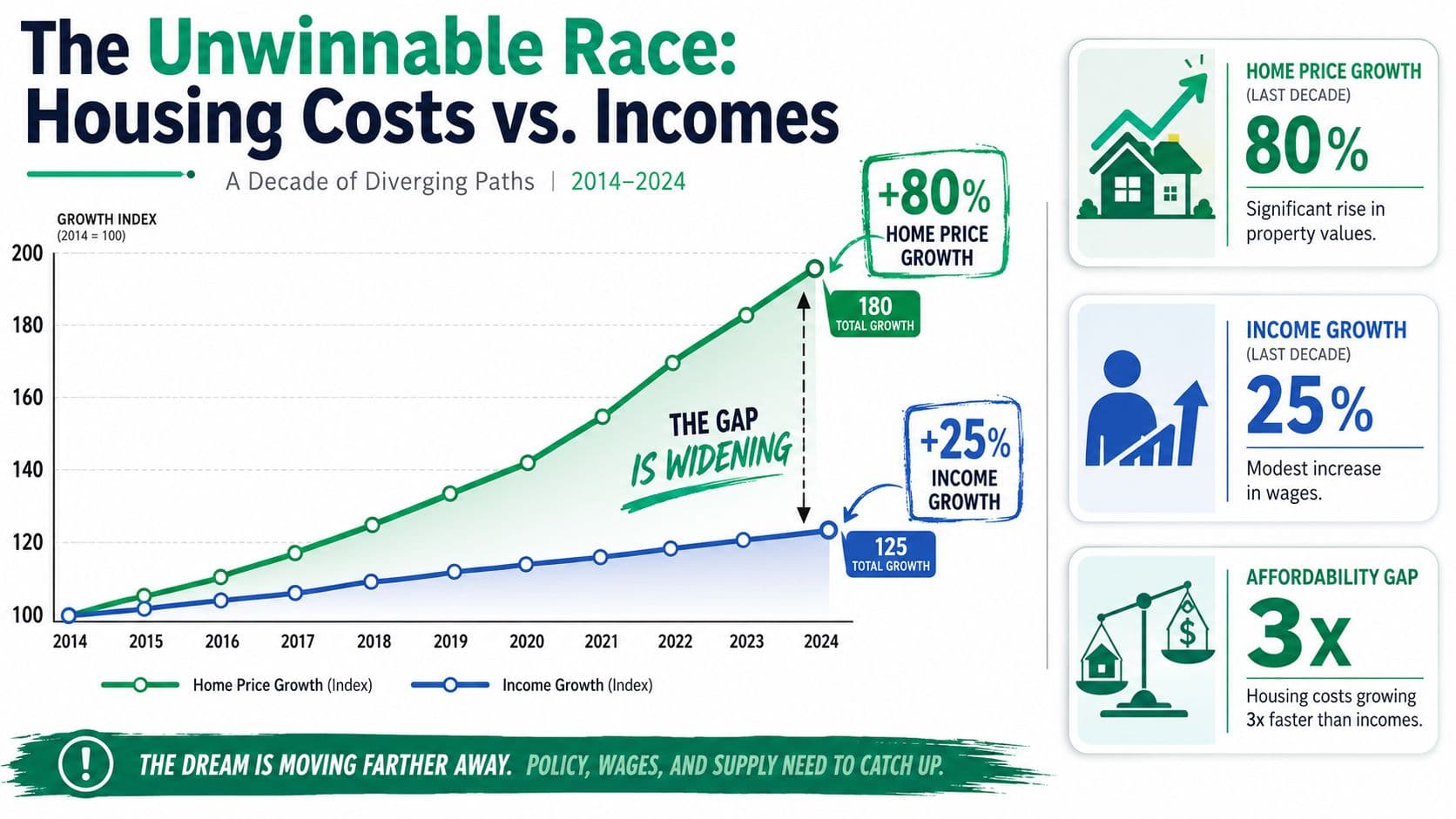
That pattern matters fiscally, not just socially. When households need a larger share of income to buy or rent, labor mobility weakens, household balance sheets tighten, and pressure builds for repeated public intervention. First-time buyers face the steepest barrier because they don't benefit from legacy equity or an earlier low-rate mortgage.
A structural problem, not a temporary cycle
National housing affordability policy still leans on familiar tools. Legislators debate buyer assistance, rental aid, tax credits, zoning reform, and construction programs. Those measures can help at the margin, but the observed divergence between home values and local incomes suggests that the problem isn't merely cyclical.
The deeper issue is that prices for access to location have risen faster than the incomes generated in those locations. That is why affordability keeps deteriorating even when policymakers expand support programs. Anyone trying to understand future rental market conditions should read the ownership and rental markets together, because pressure in one spills into the other.
Housing stress doesn't begin when a city runs out of buildings. It begins when the price of location detaches from what local work can sustain.
Why the standard toolkit keeps falling short
A committee focused only on supply and demand in aggregate can miss the fiscal mechanics underneath the market. If subsidies raise effective purchasing power but the location premium remains untaxed and scarce sites can be held for gain, some of that public support is capitalized into higher land values. If zoning is loosened but the tax system still penalizes construction more than land hoarding, buildout won't match the legal potential.
That is why the affordability race feels unwinnable to households. The state keeps intervening downstream while the land market keeps repricing upstream.
Why Housing Is Unaffordable The Land Value Equation
The cleanest way to understand housing costs is to separate labor, capital, and land. Labor builds homes. Capital finances and equips construction. Land provides the location. Standard policy analysis often merges the last two, as if the price of a home mostly reflects the cost of producing a structure. It doesn't.
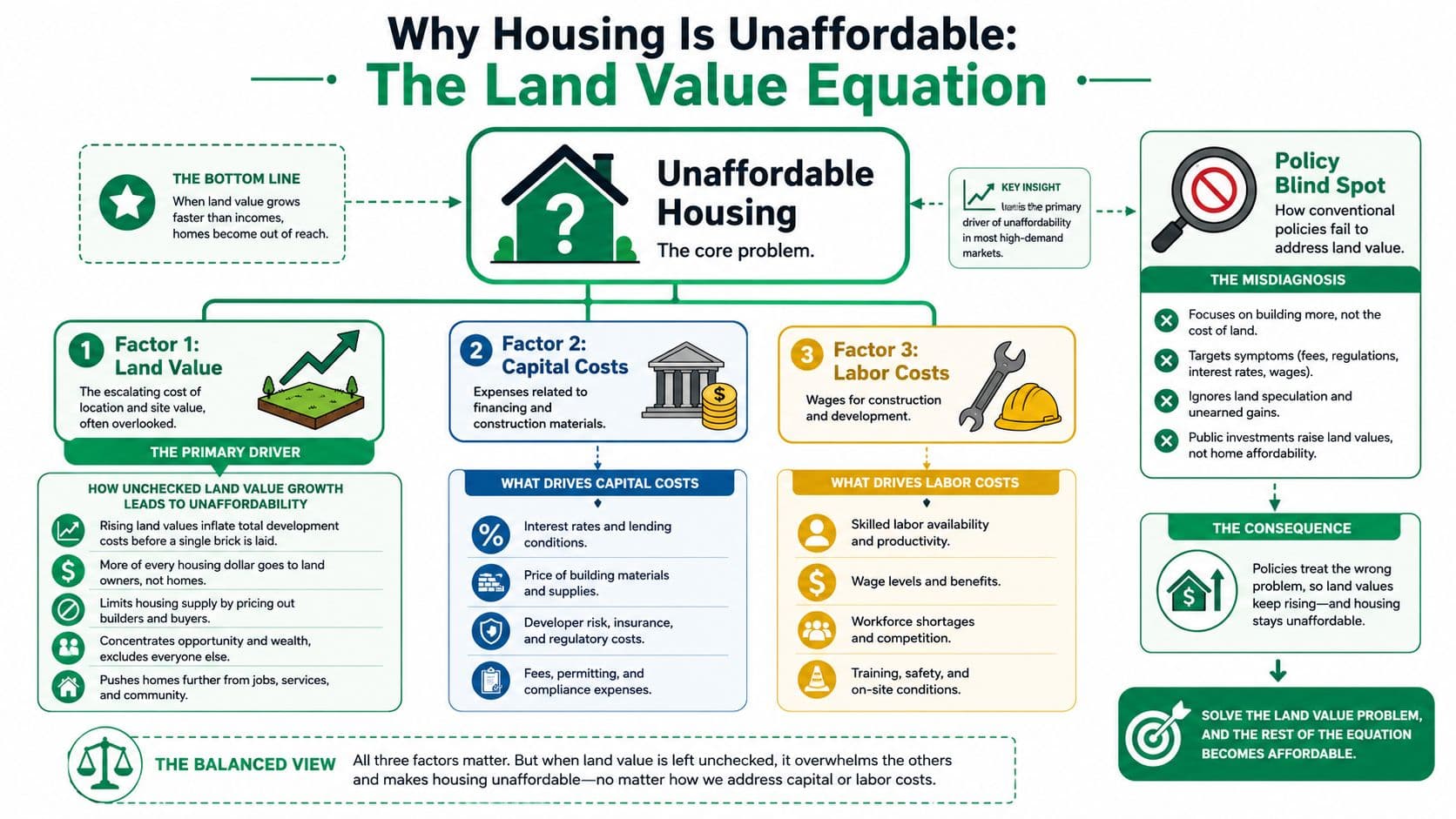
In high-cost metropolitan markets, land can account for a large and rising share of a home's price, with construction costs making up a smaller portion. Federal data indicate that the U.S. land share of single-family house value rose from about 37 percent in 2012 to roughly 40 percent in 2022 3, and land-use regulation, rather than construction cost alone, accounts for much of the high price of homes in the most expensive U.S. markets 4. Singapore, by contrast, actively captures land value through a 99-year leasehold public-housing system that aims to keep ownership affordable relative to incomes 5. Those comparisons don't prove every Singapore policy should be copied. They do illustrate that land policy and affordability are tightly linked.
The Monopoly board problem
A useful analogy is Monopoly. The buildings matter, but the game turns on who controls the board. Housing markets work similarly. Contractors can produce more units than they can produce land in desirable locations. When the value of that location is allowed to accumulate privately without effective public capture, the price of access rises faster than the price of construction.
That helps explain why so many affordability debates feel misdiagnosed. Policymakers often talk as if every increase in housing cost must come from materials, wages, financing, or regulation. Those inputs matter. But they don't explain why the location component can dominate the total price.
For a fuller conceptual explanation, the framework in why housing is unaffordable is useful because it separates the site from the structure rather than treating real estate as one undifferentiated asset.
Why tax policy keeps amplifying the problem
Most tax systems charge improvements and often spare the underlying land rent. That creates a distorted signal. Owners who build more can face a higher tax bill because they improved the site productively. Owners who sit on underused urban land can wait for appreciation with less fiscal pressure.
Practical rule: If a tax system charges construction more heavily than land hoarding, it will suppress some building and protect some speculation.
Once a committee sees that distinction, the policy gap becomes obvious. Many affordability programs respond to the symptoms of high land prices while preserving the institutional conditions that allow those land prices to escalate.
A Survey of Housing Affordability Policy Instruments
Housing affordability policy usually falls into three broad families. Each serves a different purpose. The problem is that public debate often treats them as substitutes when they're not.
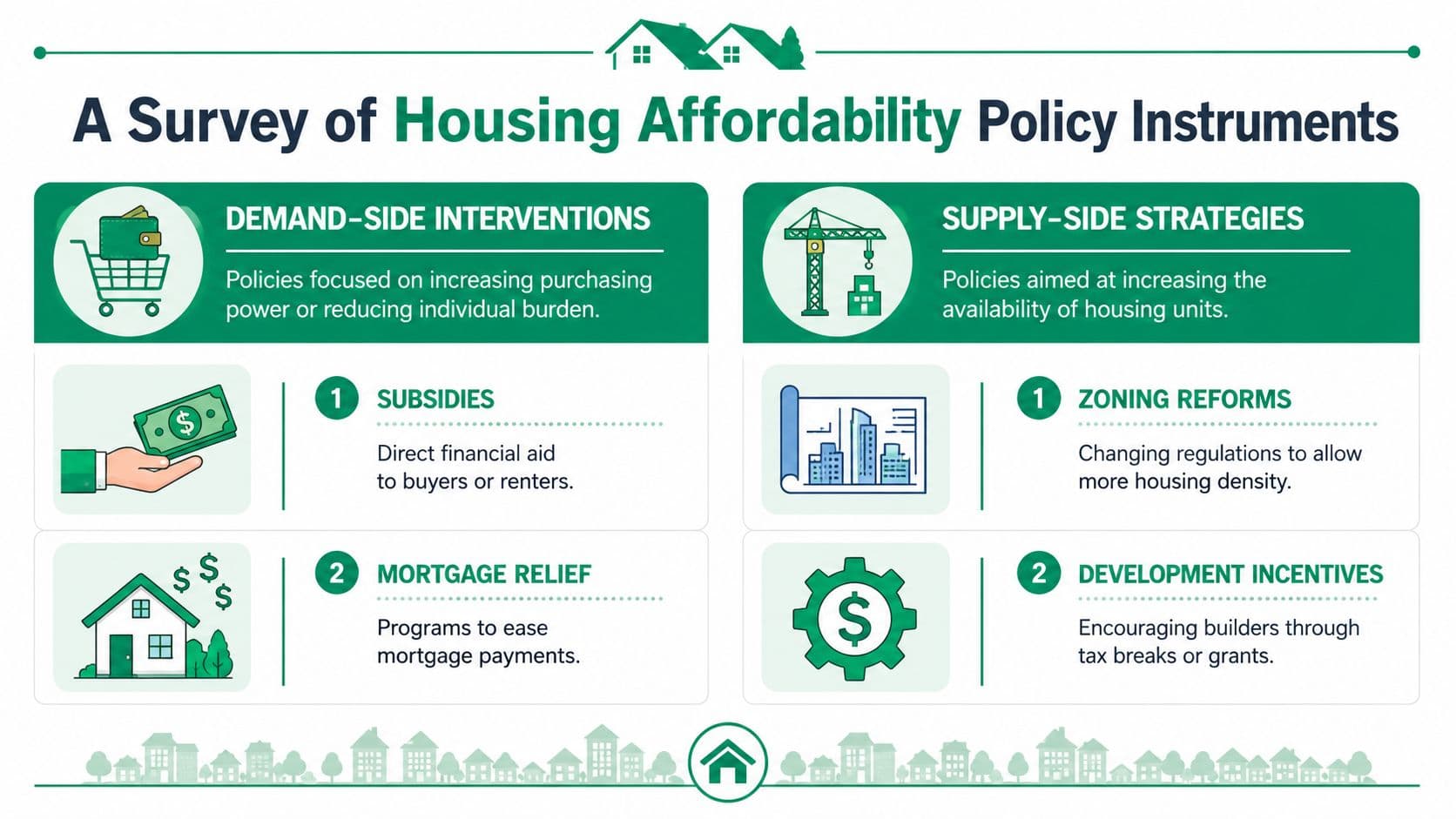
The first family is demand-side support. The second is supply-side reform. The third is land-based fiscal reform. That third category remains the least discussed, even though research cited by the National Low Income Housing Coalition estimates that the shortage of affordable housing costs the American economy about $2 trillion a year in lower wages and productivity 6, an estimate that traces to work showing how housing-supply constraints in productive cities misallocate labor and lower U.S. growth 7.
Three policy families
Demand-side interventions include rental assistance, down-payment support, mortgage relief, and tax credits aimed at households. These tools can prevent immediate hardship. They are often necessary in a crisis. But when supply is constrained and land values are rising, they can also push more purchasing power into a market that can't absorb it cleanly.
Supply-side strategies include zoning reform, permitting reform, public construction support, and incentives for new development. These policies matter because legal and procedural barriers can suppress output. For readers interested in the physical delivery side of new housing, understanding modular duplex costs in Chicago offers a practical example of how design and build choices affect project feasibility at the unit level.
Land-based fiscal reforms include site-value taxation, land leasing models, and other methods that capture the rental value of land rather than taxing work or improvements more heavily. This family of tools doesn't replace supply reform or direct support. It changes the incentive structure under both.
The rent-seeking dynamic is central here. Rent-seeking in economics is a useful lens because it clarifies how gains from scarce location can be captured without corresponding productive activity.
Comparison of Housing Policy Instrument Types
| Policy Category | Primary Focus | Examples | Common Limitation |
|---|---|---|---|
| Demand-side interventions | Increase household purchasing power or reduce immediate burden | Rental assistance, buyer subsidies, mortgage relief | Can be capitalized into prices when supply and land access remain constrained |
| Supply-side strategies | Increase the number of units or lower barriers to development | Zoning reform, permitting reform, construction incentives | May not fully deliver affordability if land holding remains rewarded |
| Land-based fiscal reforms | Shift incentives toward productive land use and public capture of location value | Site-value taxation, land leasing, land-value capture instruments | Require valuation capacity, transition design, and political explanation |
The overlooked coordination problem
Most policy packages overinvest in the first two families and underdesign the third. That leads to a recurring pattern. Governments subsidize households, encourage builders, and then watch part of the gain leak into land prices.
A stronger national framework would treat these instruments as complements with a clear order of operations. Protect households. Remove barriers to new supply. Then correct the tax base so public action doesn't keep inflating private land gains.
Land Value Capture A Powerful Solution
Land-value capture works because it taxes the value of location rather than penalizing construction on that location. That sounds technical, but the mechanism is straightforward. Two adjacent lots can have similar site value even if one holds a well-maintained building and the other sits vacant. A conventional property tax often punishes the owner who builds. A site-value tax shifts attention to the underlying land.
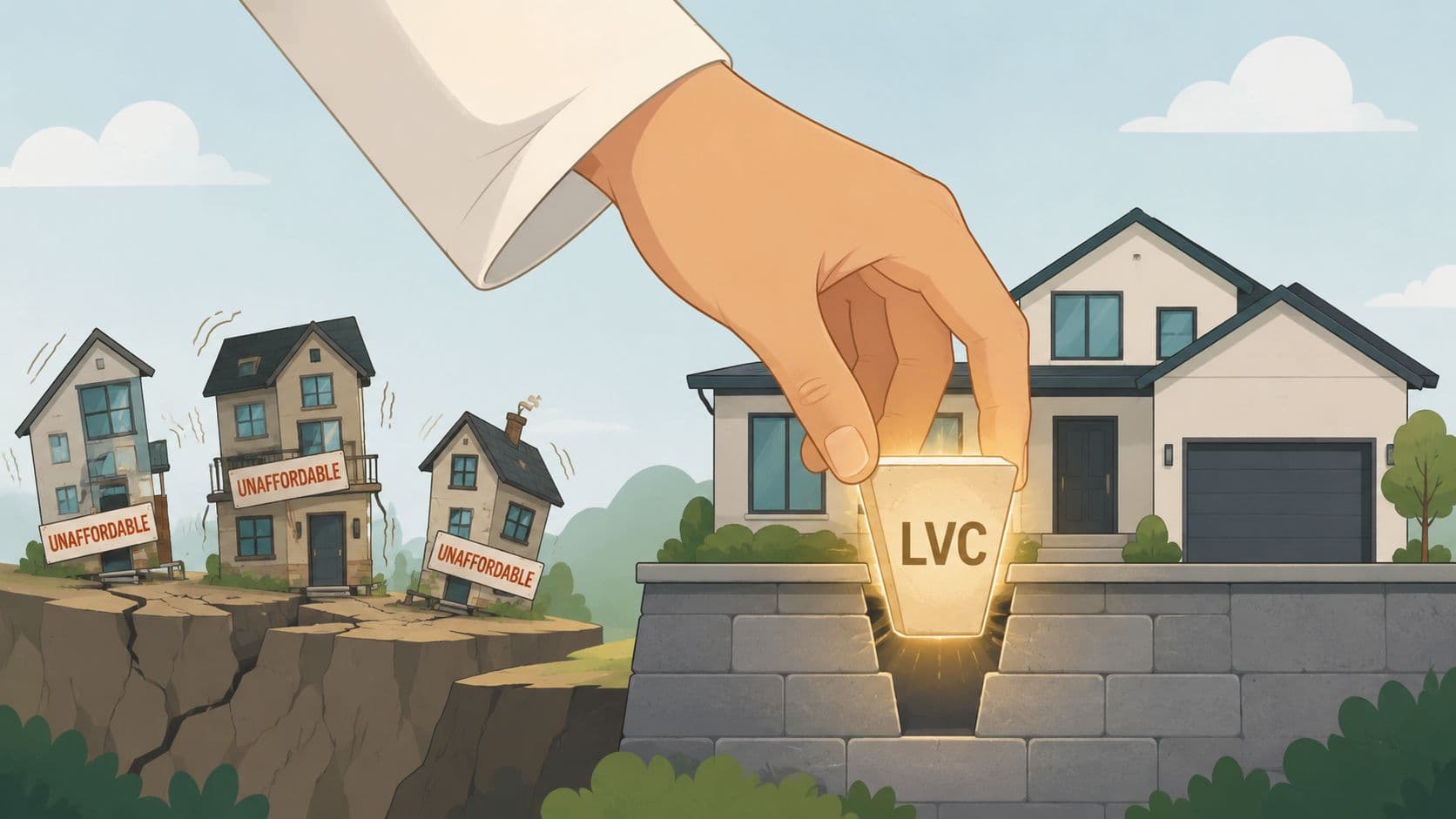
That difference changes incentives quickly. If owners know they'll face a carrying cost on valuable, underused sites whether they build or not, some will develop, some will sell, and some will stop waiting for unearned appreciation. The state doesn't need to guess which parcel should move first. The tax signal does the sorting.
Why the tax base matters
Empirical evidence indicates that shifting toward taxing land rather than buildings can raise construction and density. Studies of two-rate property taxation find that cities taxing structures lightly and land more heavily enjoy significantly higher levels of construction than they would under a single-rate tax 8, Pittsburgh's shift toward taxing land more than buildings was associated with a downtown building boom 9, and evidence from Pennsylvania suggests land-value taxation raises density and curbs urban sprawl 10. Jurisdictions such as the Australian Capital Territory have pursued analogous reforms, including transitioning away from transaction taxes such as stamp duty 11.
This is why land-value capture explained isn't merely an academic subject for economists. It's a practical design question for finance ministries. When governments tax buildings heavily, they weaken the return on adding floor space. When they shift toward land value, they reduce the penalty on productive investment.
What the evidence implies for national policy
A committee should treat land-value capture as a fiscal foundation, not a niche add-on. It can support affordability in three ways:
- It discourages speculation: Owners pay for withholding prime sites from productive use.
- It favors infill over vacancy: Developers face less tax punishment for building.
- It supports steadier public revenue: Land value is less dependent on transaction cycles than taxes tied to sales activity.
The strongest feature of land-value capture is that it aligns private incentives with the public goal of more homes in the right places.
That doesn't mean it solves everything. Tenant protections, social housing, infrastructure, and planning reform still matter. But without changing how governments treat land, many other interventions will keep working uphill.
Designing a Sustainable Policy Framework
A sustainable framework has to be administratively credible before it can be politically durable. Governments don't need to replace an entire property tax system overnight. They do need a phased transition that measures land separately, models distributional effects, and shows the public why the new base is fairer.
A phased transition works better than a fiscal shock
The first step is technical. Jurisdictions need a land valuation framework that distinguishes site value from improvement value across parcel types. That requires assessors, cadastre integration, appeals procedures, and a defensible methodology. The practical challenge isn't whether land can be valued. It can. The challenge is whether valuation standards are transparent enough to sustain trust.
The second step is fiscal modeling. Ministries should test several transition scenarios: partial rate shifts, phased exemptions, revenue-neutral conversions, and targeted protections for vulnerable households. The public will ask who pays more, who pays less, and what happens to local revenue. Those questions need quantified answers before legislation advances.
For policymakers working through the mechanics, calculate land value is a useful technical reference point because implementation rises or falls on valuation discipline.
Political durability depends on clarity
The third step is communication. Opposition often comes from confusion, not only from interest groups. If the reform is presented as a new tax, it will struggle. If it is explained as a shift away from taxing work and construction toward taxing location value, the rationale becomes clearer.
A durable rollout usually includes:
- Clear distribution tables: Show which property types gain or lose under the shift.
- Administrative pilots: Test assessments and billing in selected jurisdictions before a full rollout.
- Appeals and safeguards: Create visible correction channels so assessors don't become the story.
- Public benefit earmarks: Tie part of the revenue to affordable housing, infrastructure, or tax reduction elsewhere.
Reform succeeds when officials can show not only that the economics are sound, but that the billing system is legible to ordinary taxpayers.
Evaluating Policy Impact Fiscal and Social Metrics
Good housing affordability policy needs better scorekeeping. Counting units is useful, but it doesn't tell a finance ministry whether the reform reduced speculative holding, stabilized revenue, or improved affordability relative to income.
What to measure beyond unit counts
A stronger evaluation framework should track several outcomes at once:
- Land-to-income movement: If the ratio keeps rising, affordability pressure remains embedded in the market.
- Infill and redevelopment activity: Productive reuse of urban land is a better sign than growth at the fringe alone.
- Fiscal stability: Revenue should become less exposed to transaction swings and boom-bust real estate cycles.
- Permit mix and site activation: Committees should monitor whether underused parcels move into use.
The purpose isn't to create a larger dashboard for its own sake. It is to test whether the policy changed incentives in the land market, not merely spending levels in the housing budget.
Why distribution matters
Distributional analysis is just as important as aggregate performance. A policy can raise supply and still fail socially if gains accrue mainly to incumbent landowners or higher-income households. Governments should ask whether lower-income renters, first-time buyers, and workers near jobs experienced meaningful relief.
One practical way to communicate these effects is through scenario tools that show how location value shapes public revenue and household outcomes. Your land dividend is relevant here because it illustrates the distributional logic behind capturing site value and recycling the gains publicly.
A mature evaluation framework should also watch for unintended effects. If reform reduces taxes on buildings but land assessments lag market conditions, the incentive signal will weaken. If social protections aren't layered in, vulnerable households may not share early gains.
Next Steps for Building Affordable Communities
The committee's central choice isn't whether to support affordability. Public opinion has already settled that question. In a national survey, 76 percent of Americans said housing affordability is a growing problem, and 79 percent supported funding to help local communities build and maintain permanently affordable housing 12.
The choice is whether to keep treating affordability as a spending problem alone, or to recognize it as a public finance and land economics problem. Subsidies, tenant protections, and supply reform should remain part of the toolkit. But they won't be enough if governments continue to tax production more reliably than they capture location value.
A more effective housing affordability policy would do three things at once. It would protect households under pressure. It would expand supply where demand is strongest. And it would change the fiscal treatment of land so that public action no longer feeds private land inflation.
That is the practical implication of tri-factor economics. Housing becomes more affordable when governments stop treating land as just another form of capital and start treating it as the fixed base around which fair taxation, efficient development, and long-run social stability must be built.
Frequently Asked Questions
Why do housing subsidies and zoning reform often fail to make homes more affordable?
Subsidies and zoning reform address real problems, but on their own they leave the land market untouched. When governments raise households’ purchasing power through subsidies while scarce, well-located sites can still be held for gain, part of that public support gets capitalized into higher land prices instead of lower housing costs. Likewise, loosening zoning won’t deliver full buildout if the tax system still penalizes construction more than land hoarding. Affordability keeps deteriorating because the state intervenes downstream while the land market keeps repricing upstream, which is why land-based fiscal reform has to sit alongside demand and supply measures rather than being treated as optional.
What is land-value capture and how does it improve housing affordability?
Land-value capture taxes the value of a location rather than penalizing the buildings on it, so two adjacent lots with similar site value are treated alike whether one is developed and the other sits vacant. That shift changes incentives quickly. Owners facing a carrying cost on valuable but underused land are nudged to build, sell, or stop waiting for unearned appreciation, and the tax signal sorts which parcels move first without the state having to guess. In practice this discourages speculation, favors infill over vacancy, and produces steadier public revenue that is less exposed to boom-bust transaction cycles, all of which support more homes in the places where they’re most needed.
How can a government roll out land-value reform without causing a fiscal shock?
A credible rollout is phased rather than abrupt, and it rests on three steps. First, jurisdictions need a transparent valuation framework that separates site value from improvement value, supported by assessors, cadastre integration, and clear appeals procedures. Second, ministries should model several transition scenarios, such as partial rate shifts, phased exemptions, and revenue-neutral conversions, so they can answer who pays more, who pays less, and what happens to local revenue before legislation advances. Third, the reform has to be communicated as a shift away from taxing work and construction toward taxing location value, paired with distribution tables, administrative pilots, visible safeguards, and public benefit earmarks so that the billing system stays legible to ordinary taxpayers.
Unitism® helps governments, policy teams, and civic institutions design land-value reform that is technically credible and publicly legible. If you're evaluating how to align housing affordability, fiscal stability, and tax reform, explore Unitism® for research, valuation methods, implementation support, and practical tools grounded in land economics.