Learn what is land value tax, how it works, the evidence behind it, and how it differs from land leases and land-use rights in this clear 2026 guide.
August 27, 2026
What Is Land Value Tax: A Practical Explainer for 2026
Learn what is land value tax, how it works, the evidence behind it, and how it differs from land leases and land-use rights in this clear 2026 guide.
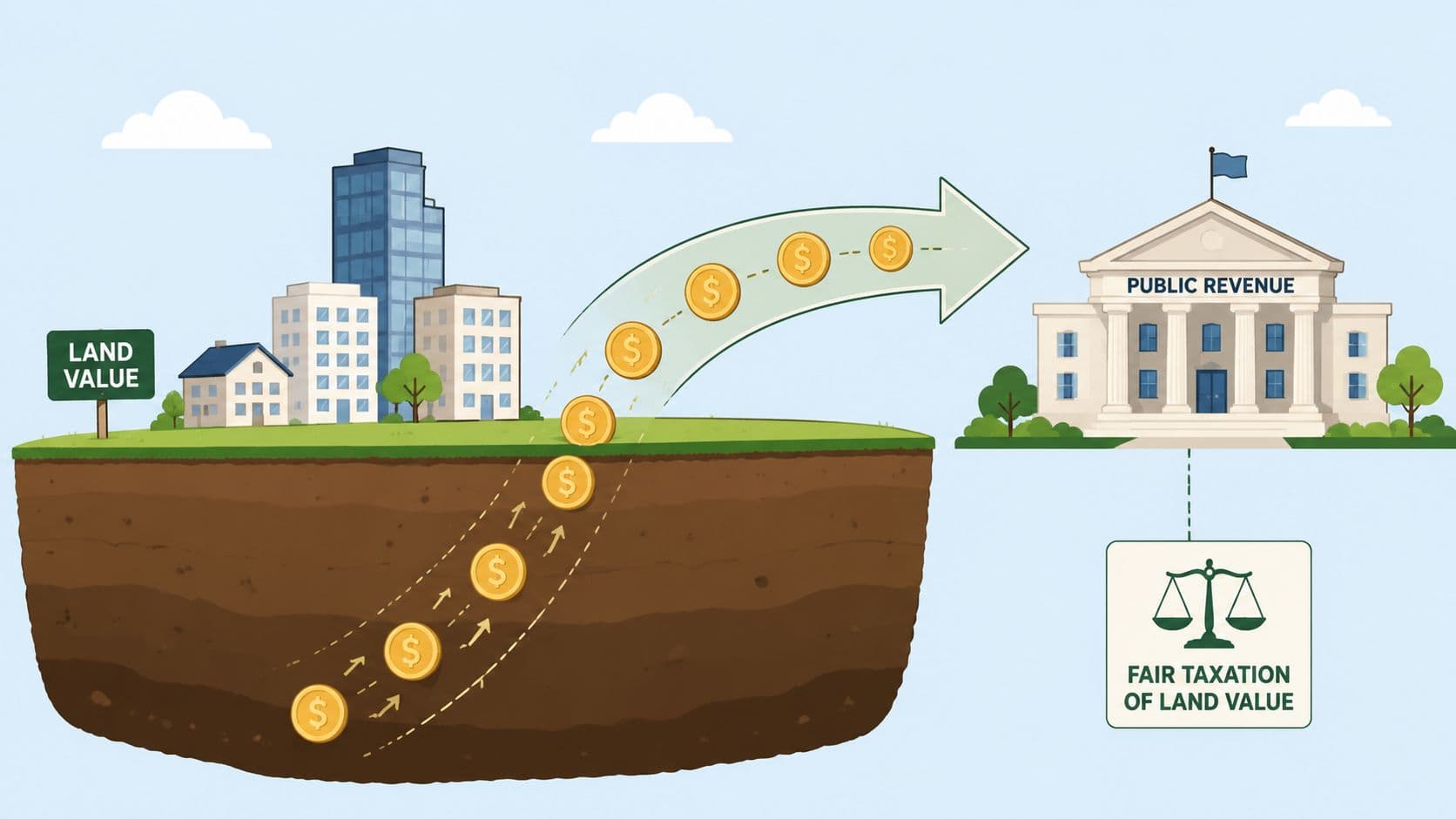
What if the central question in property taxation isn't how much a building is worth, but how much value comes from the site beneath it? That distinction changes the answer to what is land value tax, who should pay it, and whether a tax system encourages construction or rewards someone for leaving well-located land idle.
Land value tax, or LVT, applies to the unimproved value of land. It separates the site from the house, factory, office, or other improvements standing on it. The idea sounds simple, but the practical result depends on valuation quality, the frequency of repricing, housing rules, and whether policymakers choose an annual tax, a fixed lease, or a land-use right.
Table of Contents
- What Land Value Tax Actually Means
- The Tri-Factor Economics Behind the Tax
- How Land Value Tax Differs From Land Leases and Land-Use Rights
- What International Precedents Reveal in Practice
- Designing and Implementing the Tax Well
- Distributional Impacts and Common Objections Answered
- Next Steps for Policymakers and Curious Readers
What Land Value Tax Actually Means
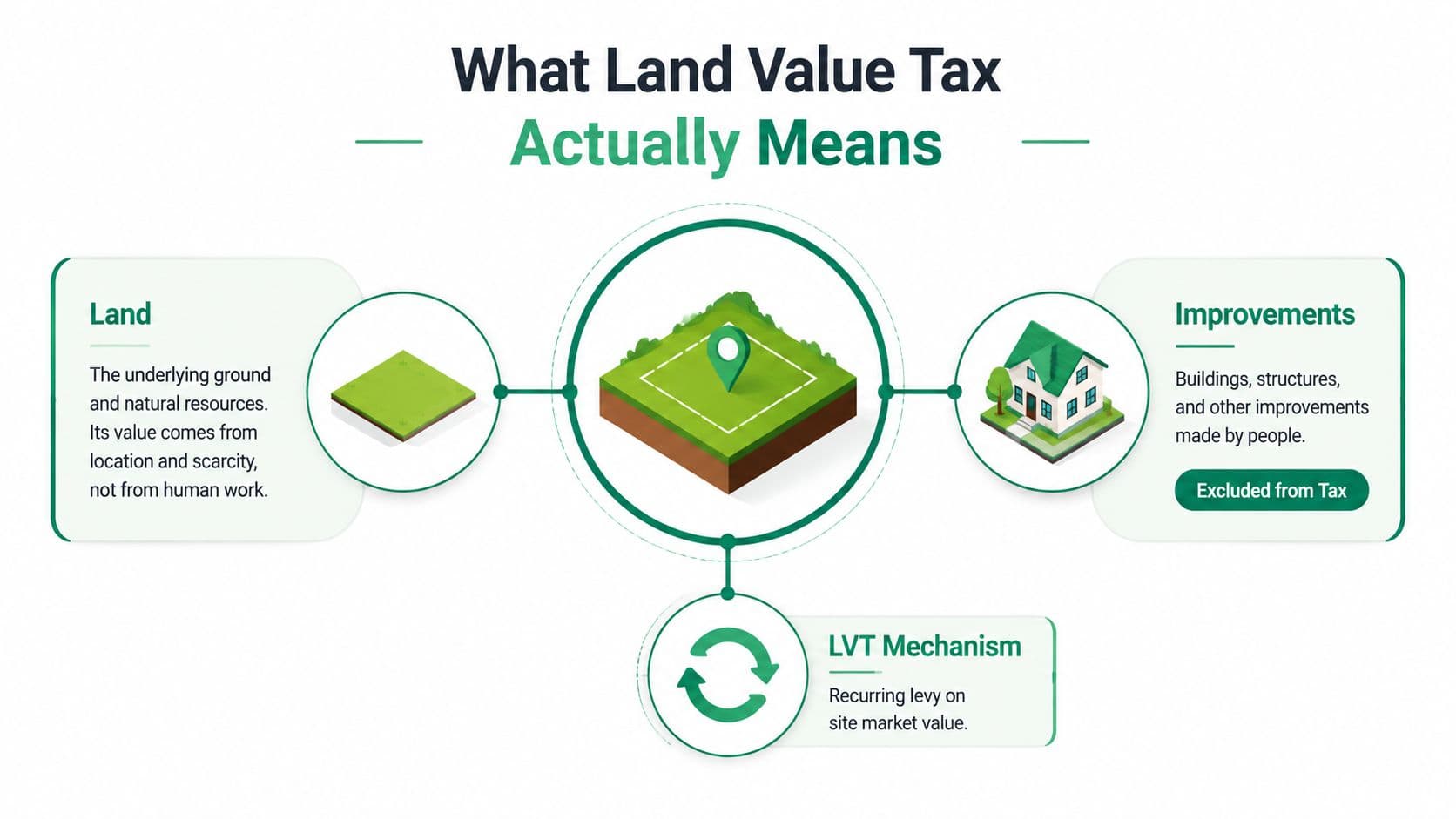
Start with the boundary between land and improvements. Land means the site itself, including its location and development potential. Improvements include buildings, extensions, paving, utilities installed on the parcel, and other work that increases the usefulness of the site. Movable equipment and business capital sit outside both categories.
Land value tax is a recurring levy on the estimated market value of the site alone. It doesn't tax the building that an owner constructs on that site. Victoria's State Revenue Office makes this distinction explicitly: site value covers land only, while capital improved value includes land, buildings, and other improvements. Its land tax applies the relevant rate to the taxable land value, not to the combined value of land and structures. See this plain-language comparison of land value tax and property tax for the boundary between the two bases.
That means LVT isn't:
- A combined property tax: A conventional property tax can assess land and buildings together. LVT deliberately separates them.
- A purchase fee: The tax recurs while the site is held. It isn't a one-time charge imposed only when ownership changes.
- A wage tax: The base is land value, not labor income.
- A tax on construction: A new kitchen, additional floor, or repaired roof can raise a property's usefulness without raising the taxable site value under a pure LVT.
The practical test: If an owner improves the building but leaves the site's location and permitted development potential unchanged, a pure LVT shouldn't penalize that improvement.
The distinction matters because taxing a new kitchen can make home improvement less attractive, much as taxing a new production line can make investment less attractive. Taxing the ground beneath the kitchen doesn't make cooking harder or reduce the amount of land available. It captures the value associated with location while leaving the owner's productive work outside the base.
A workable system still has difficult questions. Assessors must estimate the land's value as if it were vacant and available for its legally permitted use. Officials must decide whether to use a pure land tax or a split-rate system, how often to reassess parcels, and how to protect households with limited cash income. The incidence question also needs care. Theory predicts capitalization into lower land prices, but the housing outcome for renters depends on supply, zoning, vacancy, and local market conditions.
The Tri-Factor Economics Behind the Tax
A finance ministry can analyze production through three broad factors: land, labor, and capital. Labor means human effort and skill. Capital means tools, machines, buildings, and produced assets. Land means nature's fixed surface and the access, location, and resources associated with it.
Urban land becomes valuable because people, businesses, infrastructure, and public decisions make a location useful. An owner may hold the title, but the surrounding transport network, customers, schools, public safety, and neighboring investment help create much of the site's market value. LVT attempts to return part of that location-based surplus to the public rather than taxing the work and capital that make the site productive.
Land also has a distinctive supply characteristic. A city can't manufacture more of the same central location when a tax is introduced. Owners can change their use of a parcel, sell it, or develop it, but the physical supply of that location doesn't disappear because the government charges for its value. That makes land a different tax base from wages or new construction.
| Factor | Supply elasticity | Deadweight loss from taxing it | Typical observed distortion |
|---|---|---|---|
| Land | Low, because location is fixed | Generally limited by the fixed supply | Vacant holding, speculation, and underuse |
| Labor | People can adjust hours, occupations, or participation | Can reduce work incentives | Less work or movement into untaxed activity |
| Capital | Investment can be delayed, relocated, or reduced | Can discourage productive investment | Less construction, equipment, or enterprise |
The efficiency argument isn't that every land tax automatically works. A low charge may leave speculative holding largely unchanged, while a poorly designed assessment can shift burdens unfairly. Technical reviews report that land-value taxes can affect development timing and land use when the charge is high enough to change the cost of holding an idle site. They also find that results vary with valuation, planning rules, tax rates, and market conditions, as summarized in this overview of land economics and the review of land-value taxation evidence.
Vacant parcels beside new infrastructure, low-density development in high-demand areas, and land held for appreciation all raise the same diagnostic question: is the owner paying enough to reflect the opportunity cost of leaving the site underused? LVT doesn't force a particular building onto every parcel. It changes the holding calculation, making productive use or sale more attractive when the current land charge is too low.
How Land Value Tax Differs From Land Leases and Land-Use Rights
LVT is often confused with a land lease because both can collect value from land. Their repricing mechanisms differ, and that difference determines who bears risk.
A fixed-term land lease grants control for a defined period at a fixed price, either paid upfront or according to a contract. A renewable lease gives certainty during the term, but it can postpone the market adjustment until renewal. If the contracted lease rate falls far below the market value created by surrounding growth, renewal can close the accumulated gap in one major repricing. A non-renewable lease creates a different problem. As its end approaches, refinancing and resale can become harder because buyers and lenders have less time to recover the value of the remaining term.
Fixed leases, in effect, don't correctly price risk as conditions change. They postpone risk until a contract boundary.
Indefinite land-use rights resemble leases in that they separate control of land from outright ownership, but they have no expiration. The important feature in this comparison is annual repricing. Because the right is repriced regularly, buyers and sellers can transact without waiting for a distant renewal date. This structure prices land more continuously and doesn't burden entrepreneurship or productive enterprises in the same way a charge on buildings or business activity would.
China illustrates why the legal form matters. Residential land-use rights are typically granted for up to 70 years, industrial rights for 50 years, and commercial, tourist, and recreational rights for 40 years, according to this Library of Congress summary of Chinese real property law. Residential rights renew automatically at expiration, although the statute doesn't clearly state whether a new granting fee applies. Legal commentary also describes residential rights as different from ordinary fixed-term leases because the term can extend automatically, while other renewals may require another payment to government.
The Wenzhou episode showed the danger of an unclear renewal rule. In 2016, a proposed renewal charge was reported at about half of a home's appraised value. Another example described a renewal fee above RMB 100,000 for a home valued at RMB 1 million, illustrating how an apparently distant expiration can create a major repricing problem. Those figures come from this analysis of the Wenzhou land-use-rights episode.
| Instrument | Repricing mechanism | Revenue profile | Who captures land appreciation |
|---|---|---|---|
| LVT | Recurring assessment, usually annual billing | Ongoing public revenue | Public sector shares value as it emerges |
| Fixed-term land lease | Fixed contract price, with adjustment at renewal if renewable | Upfront or contractual revenue, followed by renewal risk | Initial grantor captures some value, holder may capture later gains |
| Indefinite land-use right | No expiration, with regular repricing in the stated model | Continuing charges or periodic public capture | Public sector can share recurring location value without a lease cliff |
A fixed lease can look affordable until renewal. An indefinite right can provide tenure but still leave the public underpaid if repricing doesn't occur. LVT keeps the claim recurring and transparent. The fair comparison isn't the nominal rate. It is who reprices the land, when repricing occurs, and whether the public captures community-created appreciation. This explanation of long-term land leases helps separate term length from annual land valuation.
What International Precedents Reveal in Practice
International experience shows that land and property taxes aren't merely classroom proposals. They remain concentrated at the local level, where municipalities often use place-based tax bases to fund public services. A comparative review of 25 countries found that land and property taxes can account for local revenue shares ranging from single digits to more than 50%, depending on the country and its fiscal structure, according to the Chicago Federal Reserve review.
The aggregate amounts are usually modest but meaningful. IMF-linked evidence reports that recurrent taxes on immovable property in OECD countries have remained broadly stable at about 1% of GDP since 1965, while total property taxes have stayed a little below 2% of GDP over that period. A separate policy summary found an average land value tax rate of about 0.6% across surveyed cases. In Europe, Denmark, Slovenia, and Estonia have the highest revenue raised exclusively from land taxes, each at around 1% of GDP and about 2.5% of total tax revenue, as documented in the IMF-linked fiscal analysis.
Those figures establish scale, not uniform success. A jurisdiction can collect land-based revenue and still struggle with assessment accuracy, exemptions, political resistance, or planning constraints.
| Jurisdiction | LVT approach | Effective rate | Year | Documented outcome |
|---|---|---|---|---|
| Denmark | Land and property taxation with a distinct land component | Land-only revenue around 1% of GDP nationally | Historical and current practice | Demonstrates durable local revenue use |
| Estonia | Land-only taxation | Around 1% of GDP among the highest European land-tax examples | Current international evidence | Shows that a land-only base can be administered nationally |
| Pennsylvania municipalities | Split-rate experiments | Varies by municipality | Ongoing local practice | Illustrates selective shifting from buildings toward land |
| Singapore | Long-term leasehold land allocation | Contract-specific | Ongoing system | Demonstrates the scale and risk of fixed-term repricing |
| Australian Capital Territory | Land-value-based rating transition | Jurisdiction-specific | 2012 transition | Shows how a hybrid land-value system can replace another local base |
The same evaluation questions apply everywhere. Does the system produce predictable revenue? Does it reduce the reward for leaving valuable land idle? Can officials separate land value from improvement value with defensible methods? And can residents understand their bills well enough to challenge errors without losing confidence in the system?
The evidence review on land taxation is cautious for good reason. Higher site-value charges have been associated with reduced speculation, lower vacancy, and faster or denser development in some studies, but the Welsh government's review emphasizes local and context-dependent effects. Planning permissions, market demand, parcel data, and enforcement determine whether a tax signal produces redevelopment or just creates a new bill for an owner who can't legally build.
Designing and Implementing the Tax Well
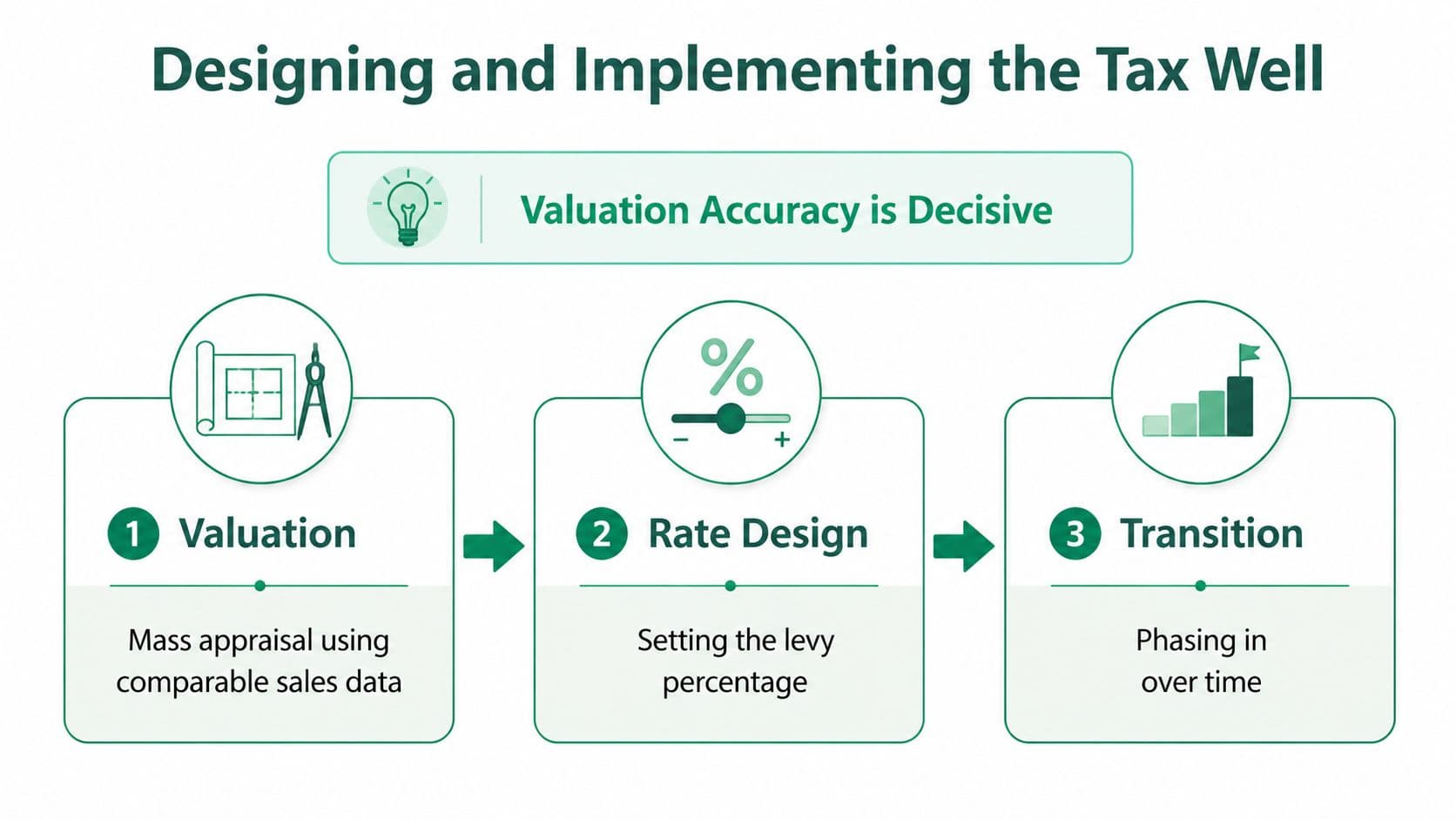
A land value tax succeeds or fails administratively before the first bill arrives. Three tasks determine whether the system works in practice: valuation, rate design, and transition. Each addresses a different question. What is the site worth, how should the charge affect behavior, and how can existing contracts and household finances adjust?
Valuation must separate the site from the structure
Assessors need parcel records, cadastral maps, comparable sales, planning information, and models estimating what the land would be worth without its current building. Mass appraisal methods can help officials apply consistent rules across many parcels, but the model must distinguish land value from improvement value. Dividing a combined sale price by assumption can misstate both components.
Periodic reassessment matters because land demand changes. A city that updates values only after a long delay may create sudden corrections when transit, zoning, or public investment changes nearby sites. Appeals procedures should let owners inspect the assumptions, comparable parcels, and permitted-use information behind an assessment. Computer-assisted mass appraisal guidance can help officials assess how these methods support consistency and review.
Rate design sets the incentive
Policymakers can choose a pure land tax or a split-rate system, which taxes land more heavily and buildings more lightly. They may aim for revenue neutrality by replacing an existing property tax without raising the total levy, or replace other taxes with LVT over time. The appropriate choice depends on legal authority, the fiscal gap, and the distributional objective.
The rate must also fit local rules. Zoning boundaries, agricultural classifications, exemptions, and neighborhood development capacity can change how a charge affects a parcel. If planning rules prohibit the use reflected in the assessment, the tax becomes a penalty rather than an incentive to develop. Valuation and planning therefore need to be reviewed together.
Transition protects balance sheets
Existing owners, lenders, leaseholders, and holders of land-use rights made decisions under current rules. A transition might grandfather some assessments, phase in higher rates over five to ten years, or provide targeted relief for households with limited cash flow. These are policy options, not universal requirements. Officials should test them against actual cash-flow data.
Administrative rule: A transparent, reviewable land assessment matters more than an elegant tax formula that residents and officials cannot verify.
Mortgage portfolios and fixed-term land leases need explicit treatment. A rapid shift can change collateral values, contract economics, and expected resale proceeds even when total government revenue stays unchanged. Indefinite land-use rights also require clear repricing rules, because the fairness of a land charge depends on how changing site values are reflected in both taxes and access terms.
A transition plan should include lender consultation, published parcel-level methodology, and stress testing for owners with substantial land wealth but modest income. The main constraint is administrative capacity, not ideology. Jurisdictions with strong political support but no reliable land-improvement split should prepare the data before announcing a rate.
Distributional Impacts and Common Objections Answered
LVT raises legitimate questions for renters, mortgaged owners, farmers, and people whose wealth is tied to land. The distributional analysis must distinguish the tax bill, changes in land prices, rent outcomes, and households' ability to pay. Incidence is not automatic.
Will owners pass the tax to renters?
Economic theory generally holds that a land tax is capitalized into lower land prices rather than added fully to rents. Direct rental-market evidence remains limited, and tenant outcomes depend on housing supply rules. If zoning blocks new homes, vacancies stay high, or landlords face unusually inelastic demand, renters may see little immediate relief. This housing distribution analysis explains why capitalization theory and the tenant experience are related but separate questions.
The practical answer is conditional. LVT can reduce what buyers will pay for a site, while rents continue to reflect supply, competition, and demand. Policymakers should model asset-price effects and rent outcomes together, rather than promise every tenant a direct bill reduction. A fixed-term lease or an indefinite land-use right can produce a similar distributional issue if its terms do not reprice land as location values change. The mechanism for updating the charge matters as much as the stated rate.
Is valuation too disputable?
Land valuation is contestable because assessors estimate a hypothetical vacant-site value, rather than read a number directly from a transaction. The objection has force where parcel records are incomplete or permitted uses are unclear. It becomes more manageable when governments publish methods, use mass appraisal, maintain comparable-sales databases, and offer an accessible appeals process.
Victoria's separation of site value from capital improved value provides a concrete administrative model. Each jurisdiction still needs rules suited to its property records and legal system. Assessors should also explain how they treat leases and land-use rights, since a nominally low charge can still misstate value if repricing is delayed.
Will mortgaged owners face a shock?
Yes, especially if annual charges rise on low-density or high-value sites while building values receive relief. A rapid repricing can affect cash flow, collateral values, and expected resale proceeds. Governments can respond with gradual implementation, targeted deferrals, credits, or revenue recycling. Relief needs careful limits, because a permanent exemption may preserve the land-holding advantage the reform seeks to correct.
Can elected officials sustain it?
Resistance grows when owners see a new charge without a visible reduction elsewhere or a public benefit. A transparent revenue target, public calculators, neighborhood examples, and a staged pilot can make distributional effects easier to assess. Broadening the base may support lower rates on other taxes, but a fiscal model must demonstrate that result.
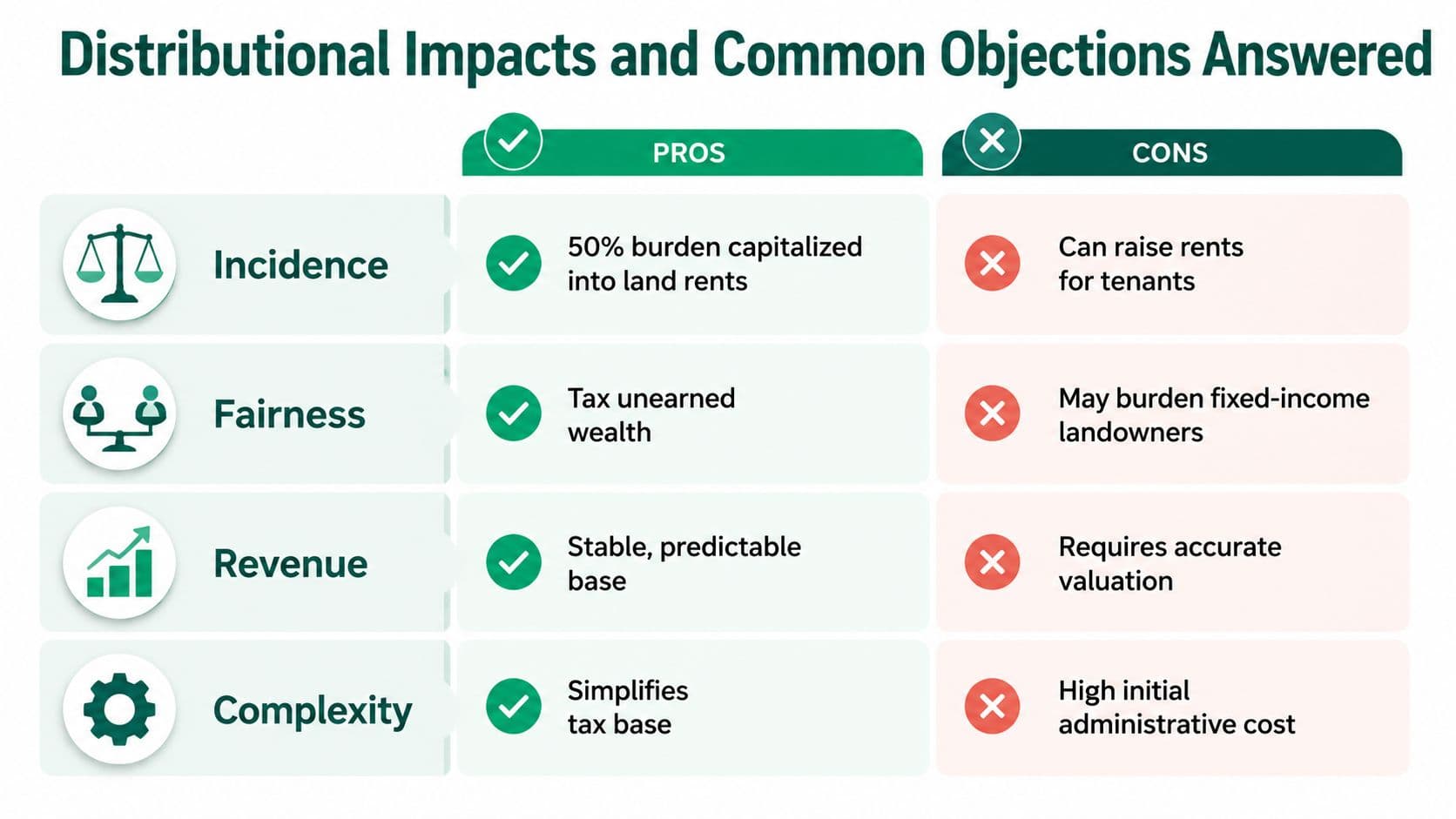
The strongest case for LVT is qualified. It can tax location-based value without taxing buildings or labor, but fair results require reliable assessment, compatible planning rules, and repricing arrangements that reflect changing site values. It may improve housing affordability, yet tenant outcomes depend on how much additional housing the market can legally provide.
Next Steps for Policymakers and Curious Readers
A government considering LVT should treat it as a delivery project with named outputs, not as a slogan.
-
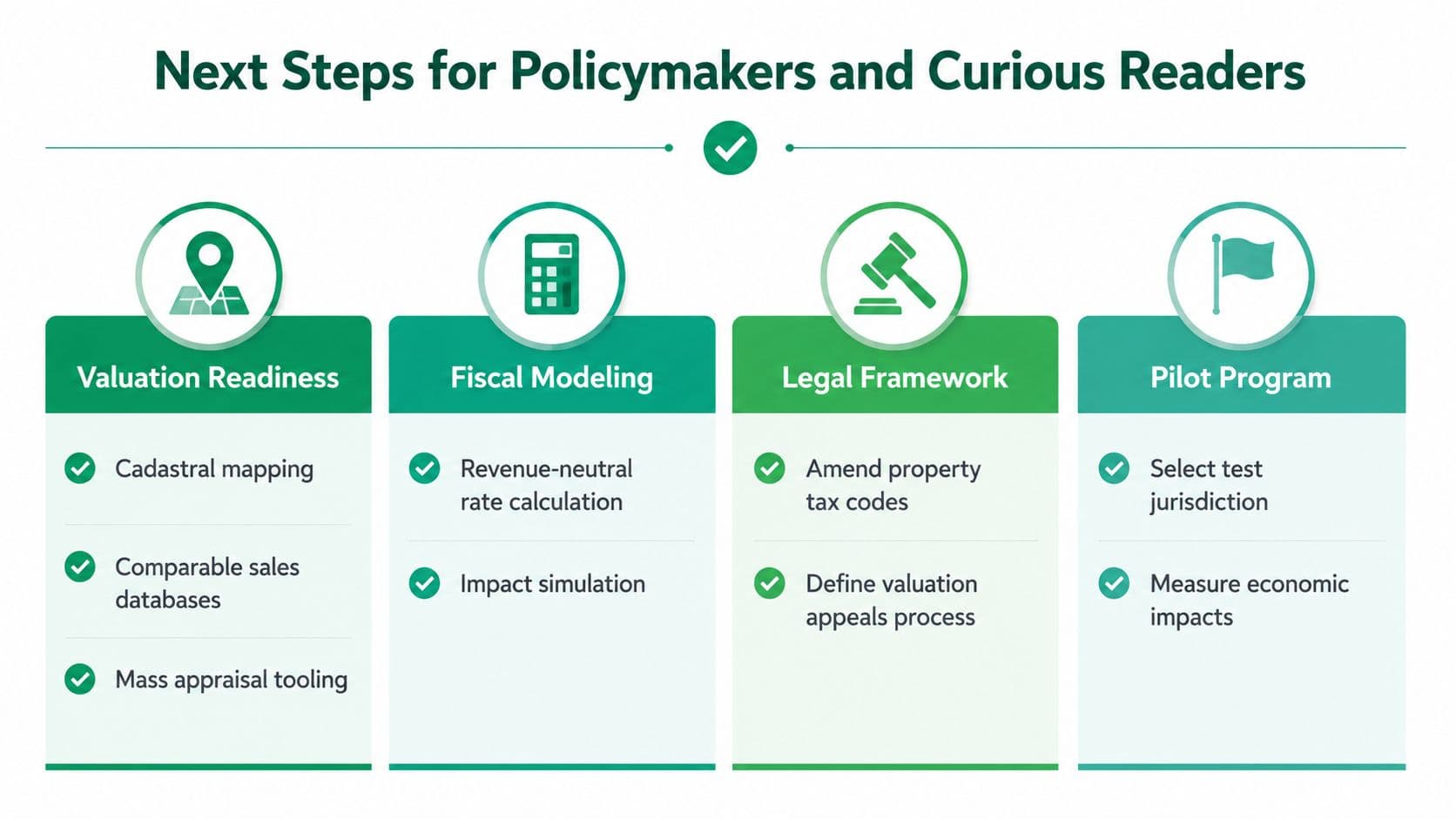
Build valuation readiness. The cadastral agency should audit parcel maps, standardize comparable-sales data, and test mass-appraisal tools that separate site and improvement values. The output should be a valuation readiness report identifying missing records, model limitations, and the parcels requiring manual review.
-
Model the fiscal effects. The finance ministry should calculate rates under revenue-neutral and revenue-replacement options, then run distributional simulations for homeowners, tenants, landlords, businesses, farmers, lenders, and leaseholders. The deliverable should be a microsimulation dataset with assumptions that outside reviewers can inspect.
-
Explain the bill before issuing it. Municipal staff should publish a valuation calculator, sample assessments, an appeals guide, and plain-language briefings for landlords, farmers, lenders, and community groups. The result should be a public FAQ that answers not only “what is land value tax,” but also why a parcel's building value is excluded and how a disputed assessment can be reviewed.
-
Start with a bounded pilot. Elected officials can select one district, agree on staggered rate increases, and pre-register outcome measures such as transaction volumes, permit counts, vacancy patterns, and revenue variance. A signed pilot memorandum of understanding should assign responsibilities, publish the evaluation timetable, and define the conditions for expansion.
Curious readers can apply the same discipline at home. Look at how a local authority values land, whether it combines buildings and sites, how often it reassesses, and what planning rules permit on underused parcels. Those details reveal whether a proposed reform would change incentives or just rename an existing property charge.
Unitism® helps governments, cities, and organizations design land-value taxation, assess site values, model fiscal and distributional effects, and plan practical transitions. Visit Unitism® to explore research, valuation methods, implementation support, and plain-language tools for turning land-value policy into an accountable public program.