Learn what intergenerational equity means, how tri-factor economics and land-value capture advance it, and which metrics and dashboards track real progress.
August 28, 2026
Intergenerational Equity: A Practical Policy Guide
Learn what intergenerational equity means, how tri-factor economics and land-value capture advance it, and which metrics and dashboards track real progress.
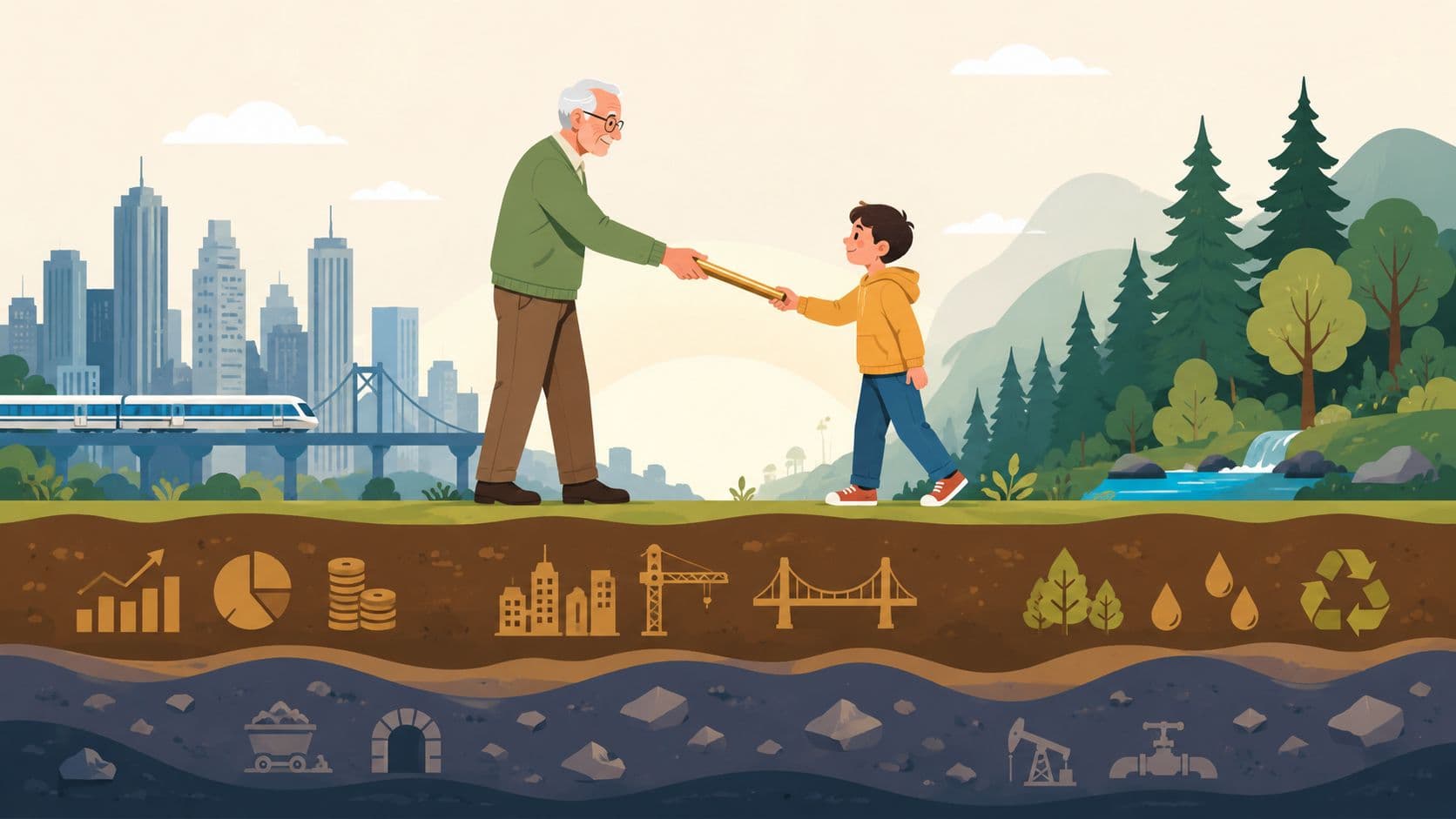
Who decides what today's policymakers owe people who can't vote, can't lobby, and may not yet exist? Conventional discussions often answer with a moral principle: protect future generations. That answer matters, but it isn't enough. Intergenerational equity becomes useful only when governments can measure whether current policies preserve or diminish the resources, fiscal capacity, opportunities, and institutional trust inherited by those who come next.
Land sits at the center of that practical question. Its value comes partly from nature, location, infrastructure, public decisions, and community activity, yet ownership can transfer those gains privately across generations. A policy guide therefore has to examine not only climate and pensions, but also how land is priced, taxed, leased, and passed on.
Table of Contents
- What Intergenerational Equity Really Means
- How the Concept Evolved Into Policy
- Normative Frameworks and Metrics That Matter
- Tri-Factor Economics and the Land Connection
- Land Leases, Land-Use Rights, and Land-Value Taxes Compared
- Real-World Precedents Across Seven Jurisdictions
- Phased Implementation From Valuation to Public Buy-In
- Dashboards, Indicators, and Common Questions
What Intergenerational Equity Really Means
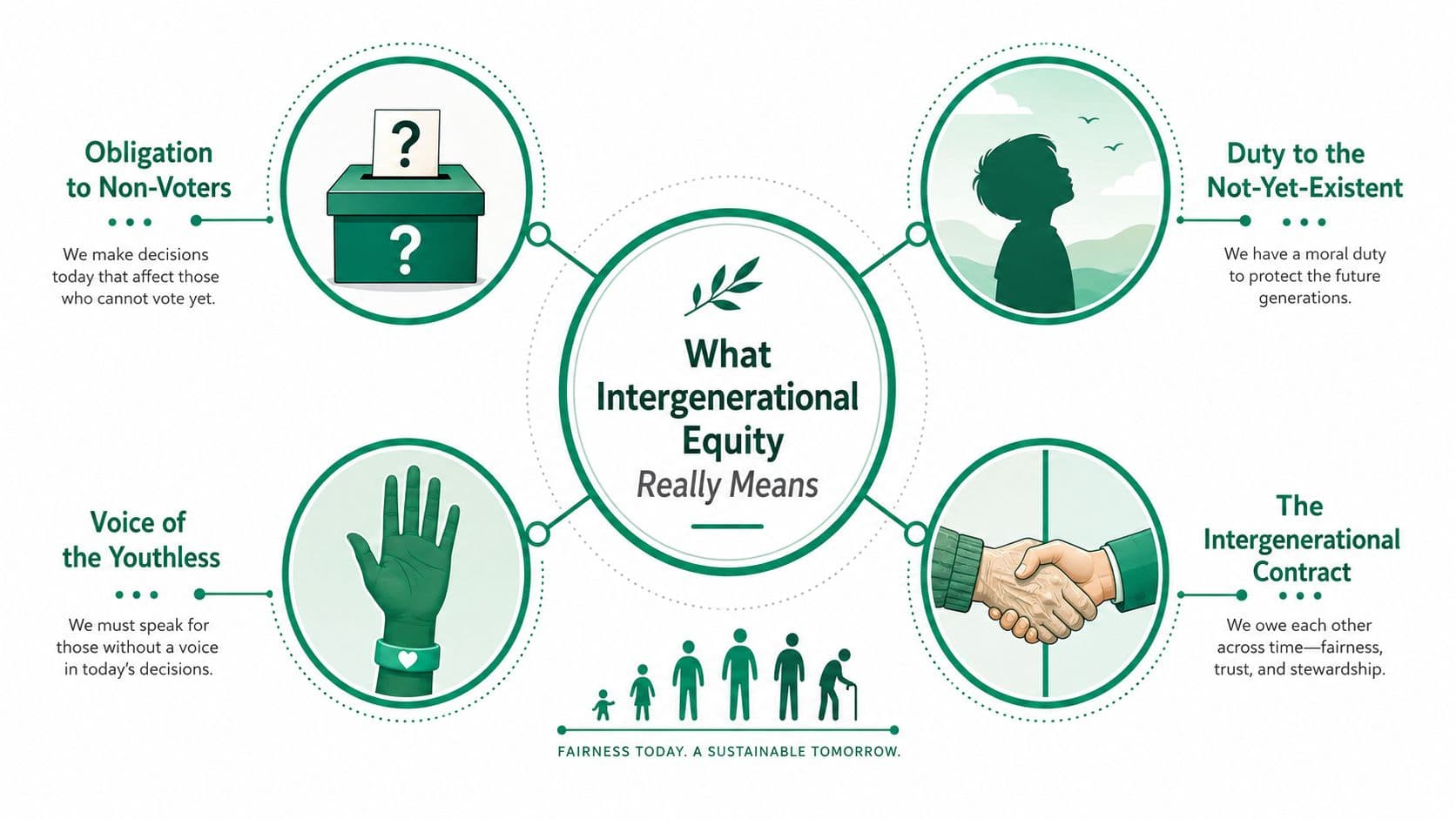
Intergenerational equity asks whether each generation receives a fair inheritance from the one before it. The inheritance includes more than money. It can include natural resources, public infrastructure, fiscal room, social institutions, and the capacity to make choices without repairing damage created by earlier decisions.
The concept has a clear environmental foundation. Principle 1 of the 1972 Stockholm Declaration described a “solemn responsibility” to protect and improve the environment for present and future generations, while OECD materials connected that responsibility with leaving the next generation a legacy no less valuable than what was inherited. The OECD discussion of intergenerational responsibility124/En/pdf) also links the principle to sustainable use of natural resources.
That time-based dimension distinguishes intergenerational equity from ordinary distributional fairness. Distributional analysis asks how benefits and burdens are shared among people living today, often across income groups. Intergenerational equity asks how those benefits and burdens are allocated between cohorts separated by time. A policy can reduce inequality among current households while still leaving future residents with depleted ecosystems, unaffordable housing, or unsustainable public liabilities.
The relay baton
A relay team offers a useful analogy. Each runner has a temporary role, but the race continues beyond that runner's turn. A responsible handoff doesn't require the next runner to receive exactly the same circumstances. It requires the baton to arrive intact, with enough momentum for the next leg.
That means policymakers need concrete tests:
- Natural inheritance: Are ecosystems and natural assets being maintained?
- Fiscal inheritance: Will future governments retain capacity to fund public services?
- Opportunity inheritance: Can young people enter housing, work, and civic life without depending entirely on parental wealth?
- Institutional inheritance: Do public bodies still command trust and possess the tools needed for long-term decisions?
The practical argument developed here is that land policy connects all four tests. A system that allows land appreciation to be privately captured can increase inherited wealth for owners while making access harder for non-owners. A system that taxes work and productive investment more heavily because it leaves land rents untapped can also weaken present opportunities and future fiscal capacity. The relationship between markets and public institutions is explored further in capitalism as an economic system.
How the Concept Evolved Into Policy
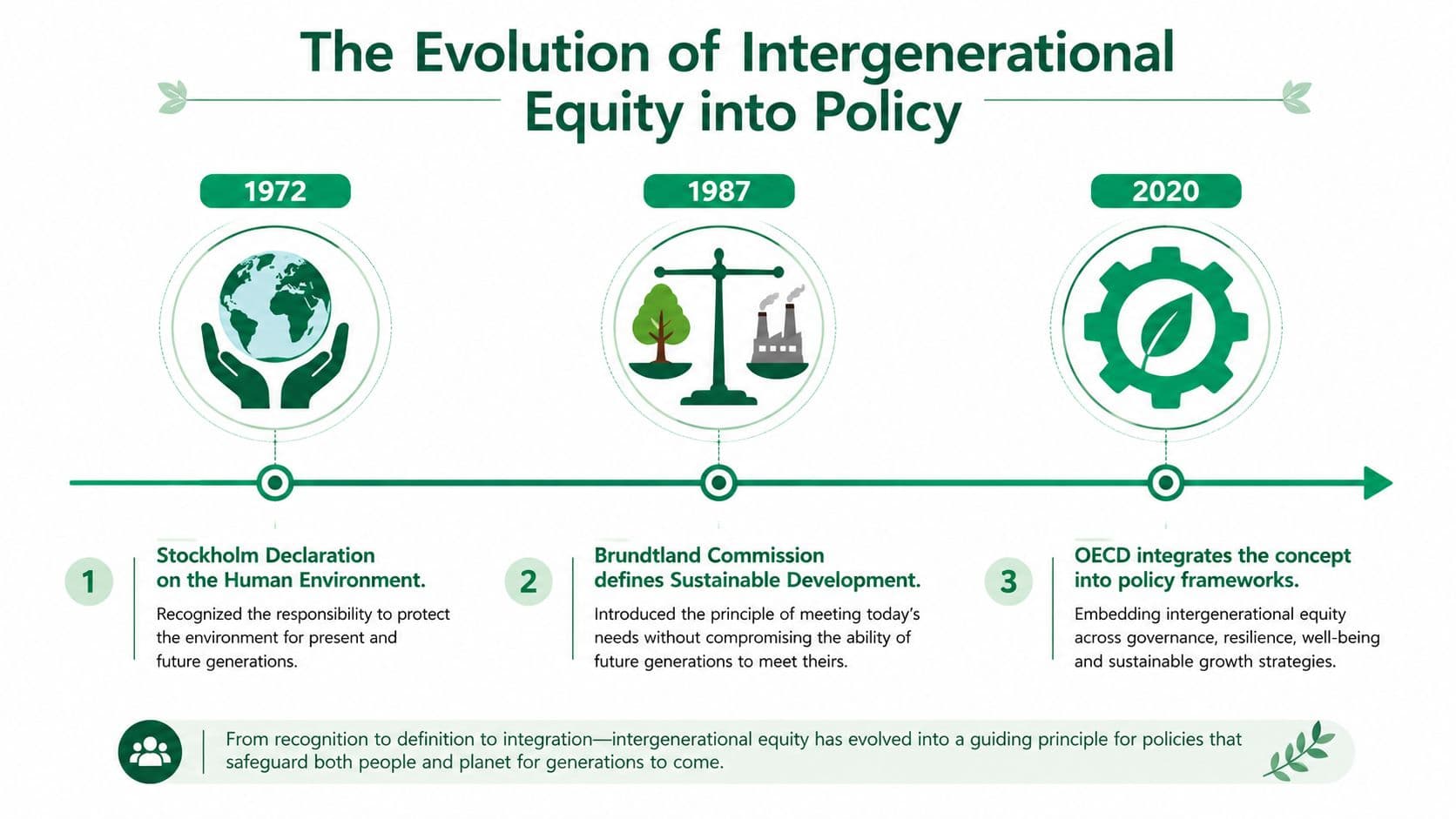
How did an ethical duty become something governments can assess? The answer lies in a gradual shift from broad environmental principle to administrative testing. Intergenerational equity entered modern environmental policy through the 1972 Stockholm Conference, where governments placed responsibility for future conditions inside an international declaration on the human environment. Its language was broad, yet it challenged officials to treat environmental damage as a public decision with consequences beyond one political cycle.
The Brundtland Commission's 1987 definition of sustainable development widened the frame. Present wellbeing had to be considered alongside the ability of future people to meet their needs. Development, social welfare, and environmental stewardship therefore became connected policy questions rather than separate goals.
Formal governance frameworks made the idea more operational. Officials could examine how a decision changes public assets, debt, youth participation, housing access, labor-market entry, and natural resources over time. Land policy gives this shift a measurable setting: how land is priced, taxed, and transferred can shape who receives wealth, who bears fiscal costs, and who can access opportunity. Administrative readiness can even be tested through precedents such as England's window tax and its practical delivery.
From principle to governance benchmark
The OECD's 2020 comparative review examined 42 national governments plus the European Union. It was described as the first comparative assessment of policies, laws, institutional capacities, and governance tools focused on young people and intergenerational justice. Its benchmarks addressed three practical areas:
- Supporting young people's transition into autonomous life.
- Improving participation and representation in public life.
- Delivering fair policy outcomes across generations.
The OECD governance review places intergenerational equity inside performance assessment. Governments can ask whether young people can establish independent lives, participate meaningfully in public decisions, and share fairly in policy benefits while carrying a fair proportion of risks.
Institutional recognition continued when the UN System's Common Principles on Future Generations were approved by the High-Level Committee on Programmes in March 2023 and endorsed by the UN System Chief Executives Board in May 2023. An ethical idea had become a system-wide policy norm.
Fiscal policy belongs in the same assessment. UN public-administration guidance treats debt management as a distributional question, warning against passing unsustainable liabilities and reduced fiscal space to future generations. The UN guidance on long-term public debt management presents borrowing as fairer when it creates productive or natural-capital assets instead of merely postponing repayment burdens.
Normative Frameworks and Metrics That Matter
A framework defines what fairness requires. A metric tests whether a policy produces that result. The first supplies direction; the second prevents intergenerational equity from becoming a general moral statement without an operational test.
The UN DESA framing distributes benefits, risks, and costs between present and future generations across socioeconomic sectors. This approach treats the future as a set of groups with different interests, rather than as one abstract population. Housing, employment, public debt, environmental risks, and access to assets can affect cohorts in unequal ways. A distributional analysis can show who receives gains, who carries risks, and which obligations are transferred.
The OECD adds an environmental-economics perspective. It defines intergenerational equity through fairness in the intertemporal distribution of natural assets and the rights to exploit them. Together, these frameworks turn a moral principle into questions that public metrics can answer.
| Framework | Source / Author | Decision-Relevant Metric | What It Measures |
|---|---|---|---|
| Distributional | UN DESA | Intergenerational wealth transfers | How assets, risks, and obligations move between cohorts |
| Fiscal | OECD and UN public-administration guidance | Public debt-to-asset position and long-term fiscal sustainability | Whether liabilities reduce future fiscal capacity |
| Environmental | OECD environmental economics | Adjusted net savings | Whether national wealth is maintained after resource depletion and environmental damage |
| Institutional | OECD governance approach | Long-term fiscal sustainability indicator | Whether institutions test policies against future effects |
Turning principles into decisions
A distributional assessment should separate parental wealth from earnings mobility. The distinction matters because a 2025 U.S. Census working paper found housing capital to be substantially more persistent across generations than earnings, while the White-Black gap in housing capital widened across the parental wealth distribution. The Census working paper on intergenerational housing capital identifies asset ownership as a major channel through which advantages pass between generations.
Fiscal analysis can test contingent liabilities, future repayment burdens, and whether borrowing creates assets that future residents can use. Environmental analysis can track whether natural wealth is maintained, instead of relying on economic output alone. Institutional analysis can ask whether a ministry, budget office, or commissioner has authority to challenge short-term decisions.
These tests also prepare policymakers to examine how value is created, collected, and transferred. Tri-factor economics, which separates land, labor, and capital, provides that connection by clarifying where public revenue originates, who receives economic gains, and which assets become inherited advantages.
Tri-Factor Economics and the Land Connection
Every economy relies on three broad production factors: land, labor, and capital. Land means the natural and locational endowment, including sites, resources, and access to valuable places. Labor means human effort, knowledge, and skill. Capital means produced tools, buildings, infrastructure, and financial wealth.
A three-legged stool makes the relationship intuitive. Remove one leg and the stool becomes unstable. Treat the legs as if they were interchangeable, and the policy diagnosis becomes distorted.
Three inputs, three policy questions
Labor is usually rewarded through wages, salaries, and professional income. Capital is rewarded through interest, profits, dividends, and asset appreciation. Land generates rent because people value access to locations and natural opportunities that no individual manufactured.
That distinction matters for inheritance. A machine can wear out. A business can lose customers. Skills can become obsolete. A well-located site, by contrast, can gain value when a community builds transport, schools, utilities, jobs, and public safety around it. The private owner may receive that increase even when the surrounding community created much of the value.
The land economics explainer helps separate the site from the structures and activities placed upon it. This separation is essential for intergenerational equity because taxing buildings or work can discourage production, while leaving location rent untapped can reward passive holding and concentrate inherited wealth.
Diagnostic rule: Before asking who should pay, identify whether the taxable value comes from human effort, produced capital, or access to land and nature.
Why mispricing spreads the burden
When governments fail to capture land rent, they still need revenue. They may rely more heavily on taxes on wages, transactions, construction, or business activity. Those charges can make employment, investment, and building more expensive, while landowners retain publicly created appreciation.
The result is not automatically unjust in every case, but it creates a clear intergenerational risk. Existing owners can pass on land wealth, while younger households without family assets face higher entry costs. Tri-factor economics turns that concern into a policy question: which factor creates the value, and who should receive the resulting rent?
Land Leases, Land-Use Rights, and Land-Value Taxes Compared
These instruments are often grouped together, but they don't perform the same economic function. A land lease grants use for a defined term, either renewable or non-renewable, usually at a fixed price. A land-use right, in the strict sense used here, has no expiration, requires no renewal, and is repriced annually. A land-value tax charges the site's unimproved value on a recurring basis.
The distinction is important because fixed prices postpone risk rather than correctly price it. A renewable lease provides certainty until its term ends. If the lease rate falls behind market conditions, the accumulated gap may be closed through a sudden repricing. A non-renewable lease can become harder to refinance and sell as its remaining term shortens. Neither arrangement automatically produces annual alignment with current land value.
A fixed-term lease is therefore not a land-use right merely because someone uses that label. If it expires, requires renewal, or keeps a fixed price, it remains a fixed lease.
| Criterion | Ground Lease | Land-Use Right | Land-Value Tax |
|---|---|---|---|
| Duration | Defined term, renewable or non-renewable | Indefinite | Indefinite ownership with recurring liability |
| Price adjustment | Fixed or renegotiated at specified points | Annual repricing | Annual assessment of unimproved land value |
| Public value recovery | Depends on lease terms | Recovers value through recurring payment or charge | Recovers land rent through taxation |
| Transferability | Can weaken as expiry approaches | Easier to buy and sell because no renewal is needed | Ownership transfers with the tax obligation |
| Main risk | Risk is postponed until repricing or expiry | Assessment quality and administration | Valuation, exemptions, and political design |
Japan provides a concrete legal contrast. Its Act on Land and Building Leases recognizes a fixed-term land lease lasting at least 50 years, and parties may agree to exclude renewal, construction-based extension, and a building-purchase claim at the end of the lease. The Japanese statute on fixed-term land leases shows what a non-renewable arrangement looks like.
Renewal-based mechanics operate differently. Under Japan's lease law, a renewed land lease generally lasts 10 years, or 20 years for the first renewal after establishing a land lease right, unless the parties agree to a longer term. The Japanese renewal provisions illustrate why renewal preserves access only until a later repricing or renegotiation point.
Norway's tax treatment makes another distinction explicit. For a leased plot, the tax authority assesses the owner's right to annual ground rent rather than the plot's underlying value. For the 2023 income year, the capitalized value uses a factor of 10, calculated by multiplying annual ground rent by that factor, as explained in Norway's guidance on leased plots.
A land-value tax, by contrast, doesn't wait for a lease to expire. It updates the public claim on site value as conditions change. That makes it more responsive, though it requires reliable valuation, transparent appeals, and safeguards for households with limited cash income. The policy discussion around long-term leases is developed further in 99-year land leases.
Real-World Precedents Across Seven Jurisdictions
Jurisdictions use different instruments because their legal systems, administrative capacity, and political histories differ. The useful comparison isn't to label one model universally correct. It's to identify what each arrangement reveals about public value, recurring revenue, and transmission across generations.
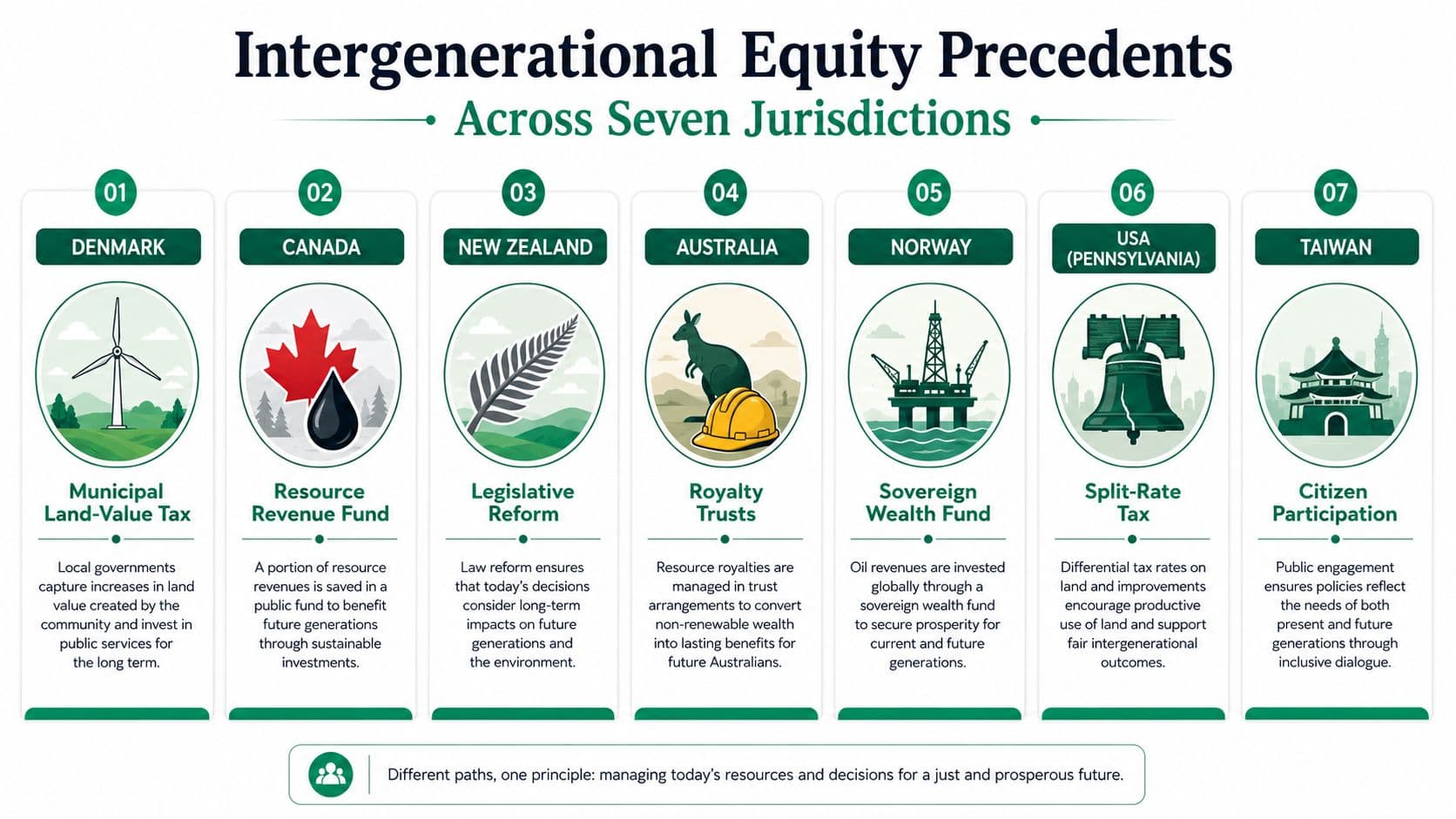
Denmark is often associated with municipal land-value taxation, where recurring charges connect public revenue to site value. Estonia's post-1991 land reform offers a different story, involving the repricing and reorganization of holdings after the Soviet period. Singapore demonstrates the fiscal power of leasehold land management, while also showing the limits of fixed rents when land values change faster than contract terms.
The broader lesson is that a policy can be fiscally effective without fully solving intergenerational access. A fixed lease can generate public revenue at the point of allocation, but it may still allow later value changes to escape regular public capture. An annual land charge keeps the connection active.
Resource rents and public saving
Alaska's Permanent Fund illustrates how resource rents can be converted into a cross-generational financial asset. The principle is straightforward: a finite natural endowment can support a fund or dividend rather than being consumed entirely by the current budget.
Norway's sovereign wealth fund follows the same broad intergenerational logic at a larger institutional scale. Resource revenue becomes a financial portfolio designed to preserve value beyond the period of extraction. The policy question is not how much revenue arrives today, but whether the public retains an asset after the natural resource income declines.
Canberra's leasehold system provides an Australian counterpoint, including stewardship reforms associated with 2024. Allentown, Pennsylvania, is commonly discussed for its two-tier property-tax experiment, which separates treatment of land from buildings and offers a small-scale example of changing the tax base.
Taiwan adds a recurring land-tax precedent with explicit statutory rates. Its basic land value tax rate is 1%, self-use residential land can qualify for 0.2%, and progressive rates reach 5.5% on the portion exceeding twenty times the starting cumulative value. The statute also provides a 40% reduction in the land value increment tax portion above the minimum rate for land held over 40 years, as set out in Taiwan's land value tax law.
These examples shouldn't be treated as plug-and-play templates. They are institutional evidence that land and resource value can be assessed through leases, taxes, funds, or hybrid systems. The equity test remains consistent: does the public recover a fair share of value, and does that share support people who don't already own the asset?
Phased Implementation From Valuation to Public Buy-In
A workable reform starts with administration, not slogans. Governments need a sequence that allows technical evidence, distributional analysis, legislation, and public communication to reinforce one another.
Five connected stages
-
Establish the cadastral baseline.
A land agency, finance ministry, and planning department map parcels, audit zoning, and distinguish current-use value from highest-and-best-use value. The deliverable is a verified valuation base. The decision gate is agreement on data quality, exemptions, and appeal procedures. -
Select the policy mix.
Officials compare a split-rate tax, leasehold conversion, betterment levy, or related land-value capture tool against local administrative capacity. The deliverable is a revenue and incidence design. The gate is confirmation that the instrument can be administered without relying on opaque assumptions. -
Model distributional effects.
Fiscal analysts project effects across age cohorts, income deciles, homeowners, renters, smallholders, landlords, and developers. Static analysis can show immediate incidence, while microsimulation can test transition paths. The gate is a published assessment of who gains, who pays, and what relief is required. -
Draft enabling legislation.
Legislators define assessment powers, appeals, revenue earmarks, transition relief, and review mechanisms. Sunset clauses can force reconsideration rather than allowing temporary measures to become permanent by neglect. The decision gate is legal compatibility and administrative readiness. -
Build public understanding.
Municipalities and national agencies use town halls, property-tax bill inserts, a public dashboard, and a dedicated ombudsperson. Residents need examples showing how land value is assessed, how buildings are treated, and where revenue goes. The final gate is not universal enthusiasm. It's whether people can verify the rules and challenge errors.
A reform team should assign owners and deadlines to every deliverable. Valuers shouldn't be left to solve legislative questions, and legislators shouldn't set rates without distributional evidence. The workflow works when each stage produces information the next stage can use.
Dashboards, Indicators, and Common Questions
A public dashboard can turn intergenerational equity into an accountability system. It should show whether land value, public revenue, fiscal liabilities, and cohort outcomes are moving together, rather than presenting a single composite score that hides tradeoffs.
| Indicator | Data Source | Visualization |
|---|---|---|
| Land-value-to-GDP ratio | Cadastral valuations and national accounts | Trend line |
| Share of land rent captured publicly | Tax records and public accounts | Stacked bars |
| Generational balance sheet | Public balance sheet and trust assets | Net-liability trend |
| Youth and future-generations budget allocation | Budget documents | Cohort comparison bars |
| Revenue earmark compliance rate | Treasury and audit records | Progress dashboard |
Refresh schedules should match the data. Valuation maps may update on an assessment cycle, revenue measures can follow fiscal reporting, and budget allocations should be visible when the legislature approves them. Choropleth maps can show capture intensity by district, while stacked bars can reveal incidence across cohorts and tenure types.
Several questions recur. Do land-value taxes raise rents? The answer depends on market conditions, tax design, supply, and how landlords respond. A public assessment should model both owner-occupied and rented property rather than assume one universal effect.
Are compensation clauses constitutional? That requires jurisdiction-specific legal analysis. Policymakers should publish the legal basis for valuation, appeals, transition relief, and any treatment of acquired interests.
How are smallholders protected? Governments can examine deferrals, hardship rules, thresholds, and payment arrangements, while preserving the principle that site value remains visible. How should revenue be spent? Earmarks can direct funds toward public services, debt reduction, infrastructure, environmental protection, or transfers that benefit people without inherited land wealth.
Unitism® offers land valuation assessments, distributional and fiscal modeling, policy design, implementation support, and public education for governments and organizations considering land-value reform. Visit Unitism® to explore how land and nature rents can be measured and directed toward fairer outcomes across generations.