Explore the new sovereign wealth fund Canada launched in 2026, how it compares to provincial funds, and what policy design options shape its future.
August 9, 2026
Sovereign Wealth Fund Canada: The Complete 2026 Guide
Explore the new sovereign wealth fund Canada launched in 2026, how it compares to provincial funds, and what policy design options shape its future.

Canada launched its first federal sovereign wealth fund in April 2026 with C$25 billion in initial capital, but that starting pool is still less than 1% of Canada's GDP. It is a meaningful policy milestone, yet it's small relative to the federal budget and far smaller than the trillion-dollar funds that usually define the category.
The new vehicle, the Canada Strong Fund, matters less for its size than for what it signals about federal fiscal strategy. Ottawa is no longer talking only about grants, tax policy, or regulation, it is trying to build a state-backed balance sheet that can co-invest in domestic assets and, if it works, compound over time. The harder question is whether that makes it a sovereign wealth fund in the classic sense, or a development vehicle wearing sovereign wealth language.
Table of Contents
- Canada Enters the Sovereign Wealth Fund Arena
- What Sovereign Wealth Funds Do
- Mapping Canada's Existing Wealth Management Vehicles
- Is the Canada Strong Fund Really a Sovereign Wealth Fund
- Lessons from Norway Alaska and Singapore
- Governance and Fiscal Design Options for Canada
- Connecting Sovereign Wealth to Land Value and Resource Dividends
Canada Enters the Sovereign Wealth Fund Arena
Canada's first federal sovereign wealth fund arrived in April 2026 with a headline figure of C$25 billion over three years. Reuters reported that the amount was about US$18.38 billion at announcement-time exchange rates, which helps anchor the scale without overstating its effect on Canada's fiscal position. The more relevant benchmark is domestic. Commentary on the launch noted that C$25 billion over 3 years is about 1.4% of annual federal spending and less than 1% of GDP, so the fund is politically conspicuous and fiscally limited at the same time, according to the launch analysis in GFMag and the accompanying commentary on scale.
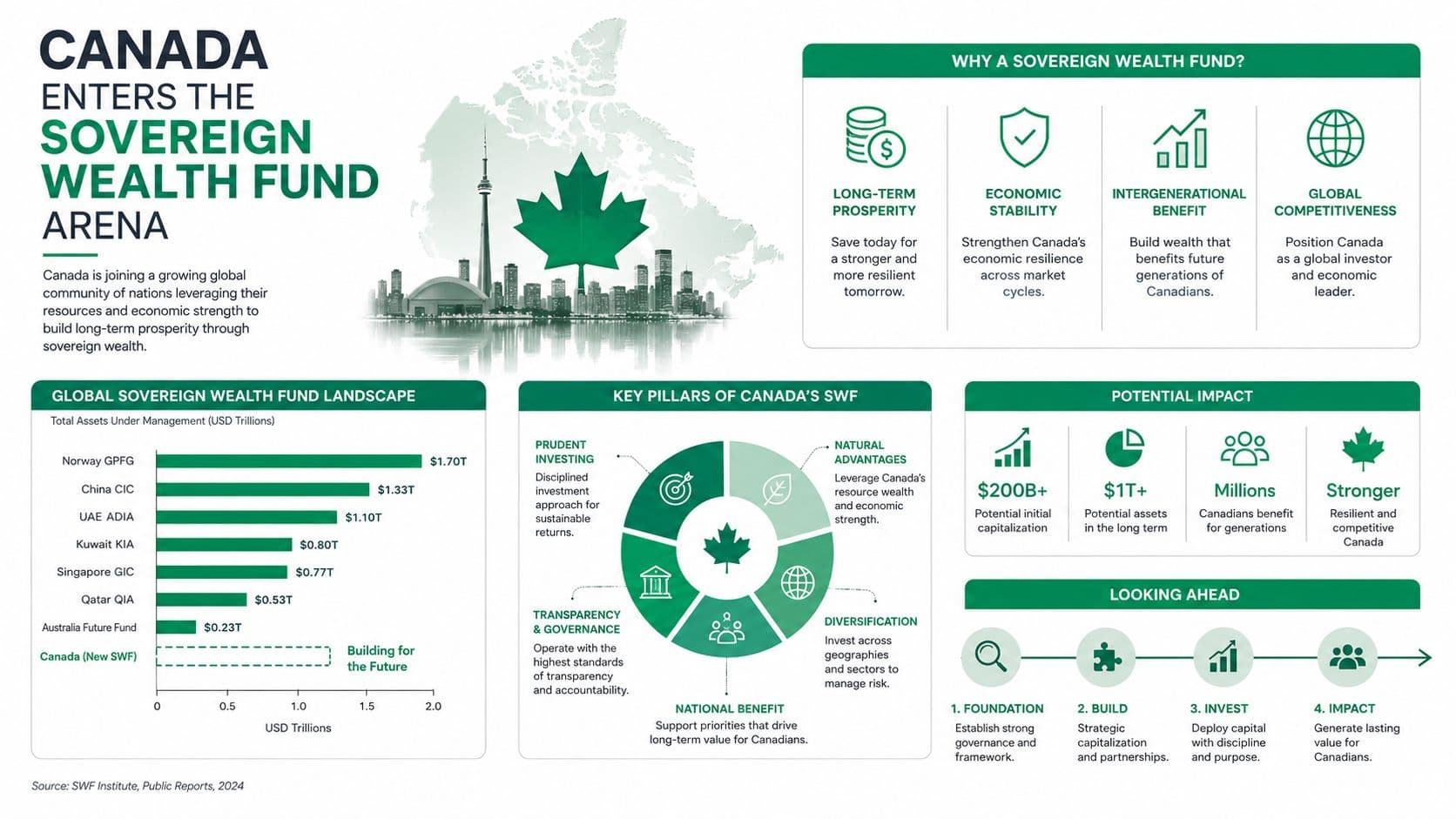
The basic design
The government says the Canada Strong Fund is an arms-length Crown corporation with a CEO and an independent board, and that it will co-invest with the private sector in strategic domestic assets such as infrastructure, critical minerals, energy, and advanced manufacturing. Ottawa's framing is straightforward. This is meant to be a national savings and investment vehicle, not a grants program, and the fund is supposed to earn commercial returns while supporting domestic capacity, as outlined in the federal announcement at Canada's Department of Finance.
That structure sets the test. A small fund can still matter if it changes how Canada allocates risk, which projects can attract private capital, and which co-investors are willing to come in alongside government. It cannot, by itself, fix weak productivity, remove capital constraints across the economy, or substitute for a broader industrial strategy.
Canada's fiscal strategy also needs a clearer investment logic than a simple headline commitment. For a wider discussion of what durable public balance-sheet management requires, see fiscal sustainability and public investment design. The practical question is whether this vehicle is being used to preserve public wealth, steer domestic development, or do both. Those goals are not identical, and the trade-offs become sharper once the fund is asked to behave like a policy tool rather than a passive pool of assets.
A useful reading of the launch is that Ottawa wants a more active role in capital allocation. That is a policy choice, not proof of effectiveness. It is also not yet evidence that the vehicle will outperform direct public investment. The core issue is whether the label fits the machinery. That distinction determines whether analysts should compare it to a sovereign wealth fund, an infrastructure fund, or a state development bank.
What Sovereign Wealth Funds Do
A sovereign wealth fund is a government account managed with market-facing principles. In the classic model, the state channels a surplus from resource revenue or external balances into a professionally managed pool, then uses that pool to stabilize the economy, preserve wealth for future generations, or diversify national income. The objective goes beyond spending less today. The goal is to convert a volatile or temporary stream into a durable financial asset.
Three broad models
The simplest way to sort these funds is by function.
- Stabilization funds smooth volatile commodity or export income.
- Savings funds accumulate wealth for future generations.
- Strategic investment funds back national priorities, often with a domestic development angle.
Those categories can overlap, but they are not interchangeable. A stabilization fund protects the budget from commodity cycles. A savings fund works more like an intergenerational endowment. A strategic fund can resemble industrial policy with a balance sheet.
Classic sovereign wealth funds are usually funded by resource windfalls or current-account surpluses, then invested in diversified assets, often abroad, to limit overheating at home and preserve macroeconomic flexibility. That foreign diversification is not a cosmetic detail. It sits at the center of the economic logic. When the state invests surplus wealth offshore, it avoids bidding up domestic asset prices even further.
The cleanest test is simple. If the state borrows at home and invests at home, the vehicle starts to look less like a classic sovereign wealth fund and more like a development institution.
That distinction matters in Canada's case. The Canada Strong Fund is being justified partly as an investment platform, but its design choices pull it away from the textbook sovereign wealth model. The more it emphasizes domestic equity stakes and national project selection, the more readers should evaluate it against development finance rather than sovereign wealth theory. That lens also brings in capital formation, which is where public balance sheets shape the private economy. For a broader framework on how public wealth is formed and classified, see the discussion of capital formation and the asset manager ranking for banks, which helps situate the scale and role of institutional capital management in Canada.
Mapping Canada's Existing Wealth Management Vehicles
Canada is not entering public capital management from zero. It already has a long history of institutions that hold, grow, or deploy public wealth, but they do very different jobs. That matters because the Canada Strong Fund is stepping into a crowded design space, not an empty one.
A short comparative map
| Fund | Type | Primary Mandate | Funding Source |
|---|---|---|---|
| Alberta Heritage Savings Trust Fund | Provincial resource fund | Save and invest resource wealth | Resource revenues |
| CPP Investment Board | Pension reserve vehicle | Invest retirement assets for beneficiaries | CPP contributions |
| Caisse de dépôt et placement du Québec | Provincial institutional investor | Manage public-sector savings and support long-term returns | Pension and institutional pools |
| Smaller provincial resource funds | Resource or savings funds | Preserve and invest provincial public wealth | Provincial resource-linked revenues |
The Alberta Heritage Savings Trust Fund is the clearest Canadian example of a resource-revenue savings vehicle. It reflects a classic provincial instinct, turn finite resource income into a financial asset. The CPP Investment Board is different again. It is not a sovereign wealth fund in the usual political sense, because its job is to invest pension assets for contributors, not to pursue a national industrial strategy.
The Caisse de dépôt et placement du Québec sits in yet another category. It is a powerful institutional investor with public purposes, but it is anchored in Quebec's savings and pension ecosystem rather than federal industrial policy. Smaller provincial resource funds add more evidence that Canada already knows how to build public investment entities, just not always under one governing logic.
The important lesson is that “public money managed professionally” is not one model. A sovereign wealth fund, a pension reserve fund, a provincial development investor, and a resource savings vehicle can all sit on the same continuum without serving the same purpose. For readers comparing scale and governance across major managers, the asset manager ranking for banks is a useful external benchmark for how concentration, scale, and institutional power are usually discussed in finance.
Canada's new federal fund therefore has to be judged against domestic precedent, not just against foreign giants. The country already has institutions that protect savings, invest capital, and manage public exposure. The question is whether the Canada Strong Fund adds a new capability, or duplicates functions already covered elsewhere.
Is the Canada Strong Fund Really a Sovereign Wealth Fund
The strongest criticism of the Canada Strong Fund is not its scale. It is the fit between the label and the design. Independent commentary argues that classic sovereign wealth funds are usually capitalized by surpluses and used to invest in diversified, often foreign, assets for stabilization, while Canada's new vehicle is being financed by borrowing C$25 billion and directed mainly into Canadian projects. That gap changes the risk profile, the policy goal, and the right comparator, as discussed by the C.D. Howe Institute.
The core tension
A sovereign wealth fund is a government account managed with market-facing principles, not a name attached to a public account. If the state borrows to seed the fund, Canada is not converting surplus wealth into a portfolio. It is swapping one public liability for another public asset and hoping the asset earns enough to justify the cost. That can be rational, but it does not follow the textbook sovereign wealth pattern.
The home bias creates a second tension. If the fund stays heavily focused on Canada, the public sector is deciding which domestic projects deserve equity capital while competing with private capital for the same opportunities. That can help large projects that are capital constrained. It can also crowd out private investment, blur political and commercial goals, and weaken the discipline that makes an investment fund credible in the first place.
The unanswered question is the one policymakers should care about most. What evidence shows that a debt-financed, home-biased vehicle will outperform issuing public debt and funding projects directly? Existing coverage raises the question, but it rarely answers it with comparable return data, governance evidence, or crowding-out analysis.
Analyst's test: if the state cannot specify why equity through a fund is better than direct fiscal spending, the fund's label is doing more work than its design.
The government's own language points toward a domestic development model. The Canada Strong Fund is meant to co-invest alongside the private sector, use an independent board, and back national projects. That may be sensible policy. The more accurate description may be a hybrid, part public investment corporation, part industrial strategy vehicle, part future savings account if asset recycling later expands the capital base.
For additional context on how public resource wealth is framed in policy debates, the glossary entry on resource rent helps clarify why the source of capital matters as much as where it is deployed.
Lessons from Norway Alaska and Singapore
Three international models matter because each solves a different problem. Norway shows how to turn resource wealth into durable financial assets without letting the domestic economy overheat. Alaska shows how direct citizen ownership can make resource wealth politically resilient. Singapore shows that the state can combine strategic domestic investment with broad diversification if governance is disciplined.
What Canada can borrow and what it can't
Norway's Government Pension Fund Global is the cleanest example of resource-revenue sterilization. The state saves offshore, limits domestic distortion, and uses fiscal rules to keep politics away from the portfolio as much as possible. That lesson applies to Canada if Ottawa wants long-run wealth rather than only project finance.
Alaska's Permanent Fund points in a different direction. Its dividend logic gives citizens a visible claim on resource wealth, which makes the model politically durable. Canada does not need to copy the dividend mechanism to learn from it. It does need to ask whether the public will support a fund more strongly if people can see a direct connection between national wealth and household benefit.
Singapore's Temasek and GIC show that the state can be an active investor without becoming sloppy. One institution can support domestic development, another can diversify globally, and both can coexist under strong governance. That dual structure is especially relevant for Canada because federal politics, provincial jurisdiction, and regional resource politics all pull investment policy in different directions.
The lesson is not “copy Norway” or “copy Singapore.” The lesson is to choose the right mix of stabilization, public ownership, and strategic investment for a federal system. Canada's challenge is bigger than asset selection. It has to reconcile domestic development goals with a portfolio that doesn't become hostage to local politics or overheated national priorities.
A second lesson is more uncomfortable. The most admired funds tend to have explicit rules that politicians can't casually rewrite. Without that discipline, even a well-intentioned fund can drift into a permanent financing tool for whatever project is politically convenient.
Governance and Fiscal Design Options for Canada
Governance will matter more than branding. If the Canada Strong Fund succeeds, it will be because the institution was insulated from short-term political pressure and given a mandate that investors, taxpayers, and provinces could understand. If it fails, the reason will probably be blurred objectives, weak reporting, or a changing definition of “nation-building.”
Design choices that actually matter
The fund's arms-length structure is a good start, but not enough by itself. An independent board should have a clear duty to judge investments on commercial and strategic grounds, not on ministerial mood. That means public reporting on mandate, portfolio mix, risk tolerance, and whether deals are intended to crowd in private capital or substitute for it.
Fiscal rules matter too. If the fund is meant to compound, then contribution and withdrawal rules should be explicit rather than ad hoc. Resource revenue linkages, surplus-based top-ups, or asset-recycling mechanisms all make more sense than treating the fund as a generic political account. Reuters reported that Carney described expansion over time through asset recycling and reinvestment, which suggests the capital base could grow if those mechanics are implemented.
A simple governance checklist would look like this.
- Clear mandate: separate commercial return objectives from symbolic nation-building language.
- Independent board: protect investment decisions from day-to-day politics.
- Transparent reporting: disclose sector exposure, co-investment terms, and benchmark performance.
- Disciplined capital rules: define how funds enter and leave the vehicle.
- Diversification discipline: keep domestic development from becoming concentration risk.
For readers interested in board oversight mechanics, effective corporate governance is a relevant reference point because the same principles, accountability, transparency, and disciplined oversight, apply whether the entity is public or private.
The strongest funds are boring in structure and selective in mission.
That principle matters because Canada's new fund is walking into a political environment that wants visible projects fast. Visible projects are not the same thing as durable returns. If Ottawa wants public confidence, it should publish a governance framework that makes it hard to confuse industrial policy with patronage.
For a clean treatment of the fiscal side, the discussion of truth in taxation is relevant because public vehicles work better when citizens can see the cost of capital, not just the political headline.
Connecting Sovereign Wealth to Land Value and Resource Dividends
Canada's debate over sovereign wealth is too narrow. Public wealth can be built not only through a fund, but also through stronger capture of land value and resource rents. That broader frame changes the policy question from where to place public capital to what public values are being monetized, and who keeps the gains.
Why land and resource policy belong in the same conversation
A land-value tax applies to the unimproved value of land, which is different from a lease system based on land-use rights. Under the land-use rights model described here, rights are effectively land leases that are repriced annually, do not expire, and can be bought and sold at relatively low cost. The mechanism is therefore not a recurring tax on land value, and it does not itself create transferable lease rights. The policy effect is different, even when the distributional goals overlap.
That distinction matters because Canada's fiscal toolkit often treats land as if it were just another asset class. It is not. Land value is partly created by community investment, infrastructure, planning decisions, and public services. Capturing some of that value can produce a steadier revenue stream than relying only on market cycles or one-off borrowing.
Resource dividend models point in the same direction. If the public owns the underlying resource base, a portion of the economic rent can be paid out, saved, or reinvested through a public vehicle. That logic sits close to the political economy behind sovereign wealth, but it is often clearer because it starts with the source of value, not just the destination of capital. For a practical reference on how this kind of distributional design can work, see your land dividend model.
The deeper connection is straightforward. Canada's new fund would be stronger if it sat inside a broader architecture of land-value capture, resource dividends, and disciplined public investment. That would make the country less dependent on debt-financed project selection and better able to turn underlying natural and spatial value into durable national wealth.
Mainstream coverage often misses a basic point. Sovereign wealth is not only about managing what the state already has. It is also about deciding which forms of rent the state should collect, preserve, and return to citizens. That is where Canada's long-term fiscal debate really sits.
Unitism® works with governments and policy teams that want to turn land, resource, and public balance-sheet questions into practical fiscal design. If this topic matters to your work, visit Unitism® to explore land-value capture, resource dividend models, and public wealth strategies that fit Canada's fiscal reality.