Explore speculative real estate and its impact on land reform. This guide offers key insights for policymakers in 2026.
August 15, 2026
Speculative Real Estate: A Guide to Land Reform
Explore speculative real estate and its impact on land reform. This guide offers key insights for policymakers in 2026.

The U.S. housing boom offers a stark warning about speculative real estate. The Case-Shiller 20-city price index rose 76% in real terms from January 2000 to March 2006, then fell 36% from March 2006 to May 2009. Even after the collapse, real prices remained 7% above their level at the turn of the millennium, a cycle large enough to reshape household finances, construction decisions, and public policy. (Historical analysis of the U.S. housing bubble)
The important question isn't whether some buyers behaved recklessly. It's where expectations became embedded in land prices, how that pressure reduced productive use, and which policy instruments can redirect unearned site value toward housing and public purposes. A useful analysis must distinguish buildings from land, taxation from property rights, and productive investment from strategic underuse.
Table of Contents
- Why Speculative Real Estate Keeps Ending in Crisis
- Defining Speculative Real Estate and the Land Beneath It
- How Speculation Shows Up in Land Markets
- Land-Value Taxes and Land-Use Rights Compared
- International Precedents and What They Actually Prove
- Designing a Reform Stack with Tri-Factor Economics
- Implementation Realities and How to Make Reform Stick
Why Speculative Real Estate Keeps Ending in Crisis
The U.S. housing cycle shows how measurable land-market expectations can turn into a crisis. Between January 2000 and March 2006, the Case-Shiller 20-city index rose 76% in real terms. By May 2009, it had lost 36% of its real value from the peak, although prices remained 7% above their level at the start of 2000. (Case-Shiller analysis and historical context)
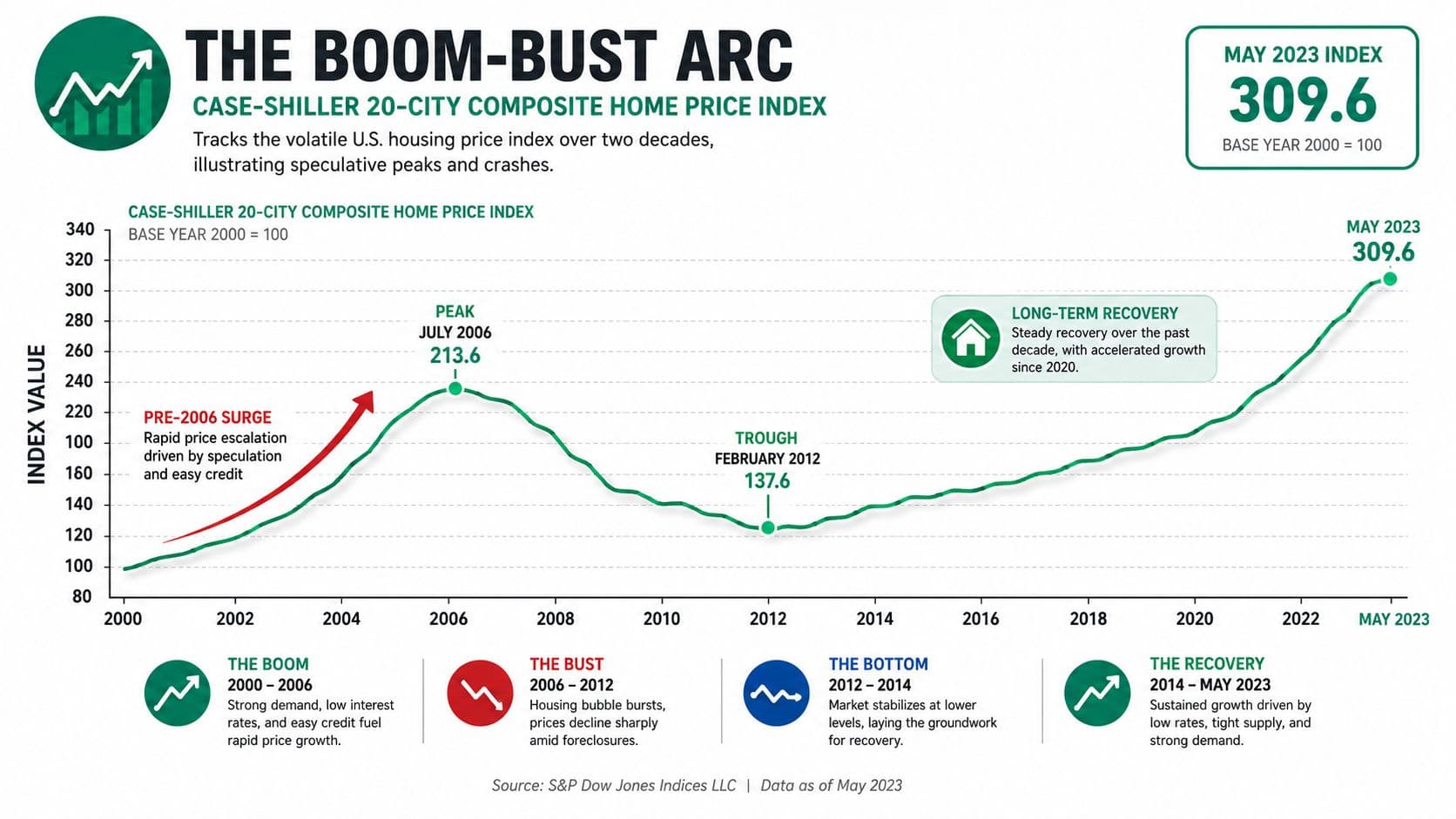
The scale of the reversal matters, but the expectations behind it matter more. Surveyed households in U.S. metropolitan markets expected annual home-price appreciation over the next decade ranging from 11.7% in Milwaukee to 15.7% in San Francisco. Those forecasts exceeded what ordinary housing use and rental income could plausibly support. They converted anticipated future gains into current land prices.
The recurring American pattern
Historical research places the early-2000s boom within a longer American pattern that includes frontier land markets, urban expansion, and major booms in Chicago and Los Angeles. Repetition across different periods points to a recurring pricing mechanism rather than a single lending failure. Whenever buyers capitalize expected future gains into today's price, speculation can reappear.
Land gives that mechanism unusual persistence. Buildings can be repaired, replaced, or expanded. A site cannot be reproduced in the same location. Where demand concentrates and planning rules restrict development, buyers compete for access to a fixed factor. Expectations therefore become embedded in the site premium, not merely in the structure.
Analytical rule: Track the price of the site separately from the building's cost and condition. Speculative pressure becomes visible in that separation.
The issue also belongs to the broader study of rent-seeking in economics, not only to debates about financial misconduct. An individual purchaser may act rationally while many owners collectively divert land from productive use. Waiting can appear attractive when profits may come from public infrastructure, rezoning, or population growth rather than from construction or improved services.
That distinction gives policymakers a practical diagnostic. Compare site-price growth with rents, construction costs, vacancy, permitting, and the pace at which serviced land enters use. A widening gap signals that expectations, restricted access, or strategic holding may be driving value beyond current productive returns.
The crisis begins before prices fall. It starts when anticipated appreciation justifies withholding sites, and when policymakers treat rising collateral values as evidence of rising productive capacity. Land-value capture can address the unearned site gain, while land-use rights determine what owners may build or hold. They are related tools, but they solve different parts of the problem.
Defining Speculative Real Estate and the Land Beneath It
Speculative real estate means buying or holding land or property primarily to profit from expected future price increases rather than from current use, rental service, or productive development. The University of Minnesota law review describes land speculation in these terms and links it to higher land prices and the removal of land from productive use. (University of Minnesota analysis of land speculation)
That definition doesn't condemn every investment. A developer who acquires a site, secures approvals, finances construction, and creates housing is taking development risk. The concern arises when ownership earns a gain mainly because the surrounding community becomes more valuable while the owner contributes little or delays use.
Separate the structure from the site
Think of a building as a custom apple cart. It has a construction cost, a useful life, and a condition that can be inspected. The land beneath it is the supply of apples in the cart analogy. In a high-demand location, those apples are scarce, and their value can rise even if the cart itself deteriorates.
The analogy is imperfect, but it captures the central accounting problem. A home's sale price combines the value of its structure with the value of access to a particular site. If policymakers tax or regulate the building while ignoring the site premium, they can penalize construction without reducing the reward for holding scarce land.
The land-speculation glossary offers a useful vocabulary for separating these components. The distinction also helps readers interpret newer forms of ownership. For a comparative discussion of tokenized property and emerging digital claims, Web3 asset class insights can add context, but digital packaging doesn't eliminate the underlying question of who controls scarce land and who receives its rising location value.
Why land economics treats site value differently
Land isn't produced by private effort in the same way as a building, machine, or software system. Its market value reflects location, accessibility, public infrastructure, legal permissions, and the activity of nearby residents and businesses. Those influences can create a rental value that exists independently of the owner's improvements.
This is why land speculation can raise prices while leaving productive capacity unchanged. An owner may gain from a new rail station or a zoning change without having built the station or delivered the planning decision. The policy challenge is to distinguish that socially generated site value from the return that rewards construction, maintenance, and entrepreneurship.
How Speculation Shows Up in Land Markets
Land speculation becomes a policy problem when it produces a measurable gap between a site's price and the activity occurring on it. A major U.S. land-market study found that land prices in several cities quadrupled between 2000 and 2006, rising from about $150,000 per acre to $650,000 per acre before giving back those gains. During the same boom, land prices often rose faster than house prices. (Kellogg land-market study)
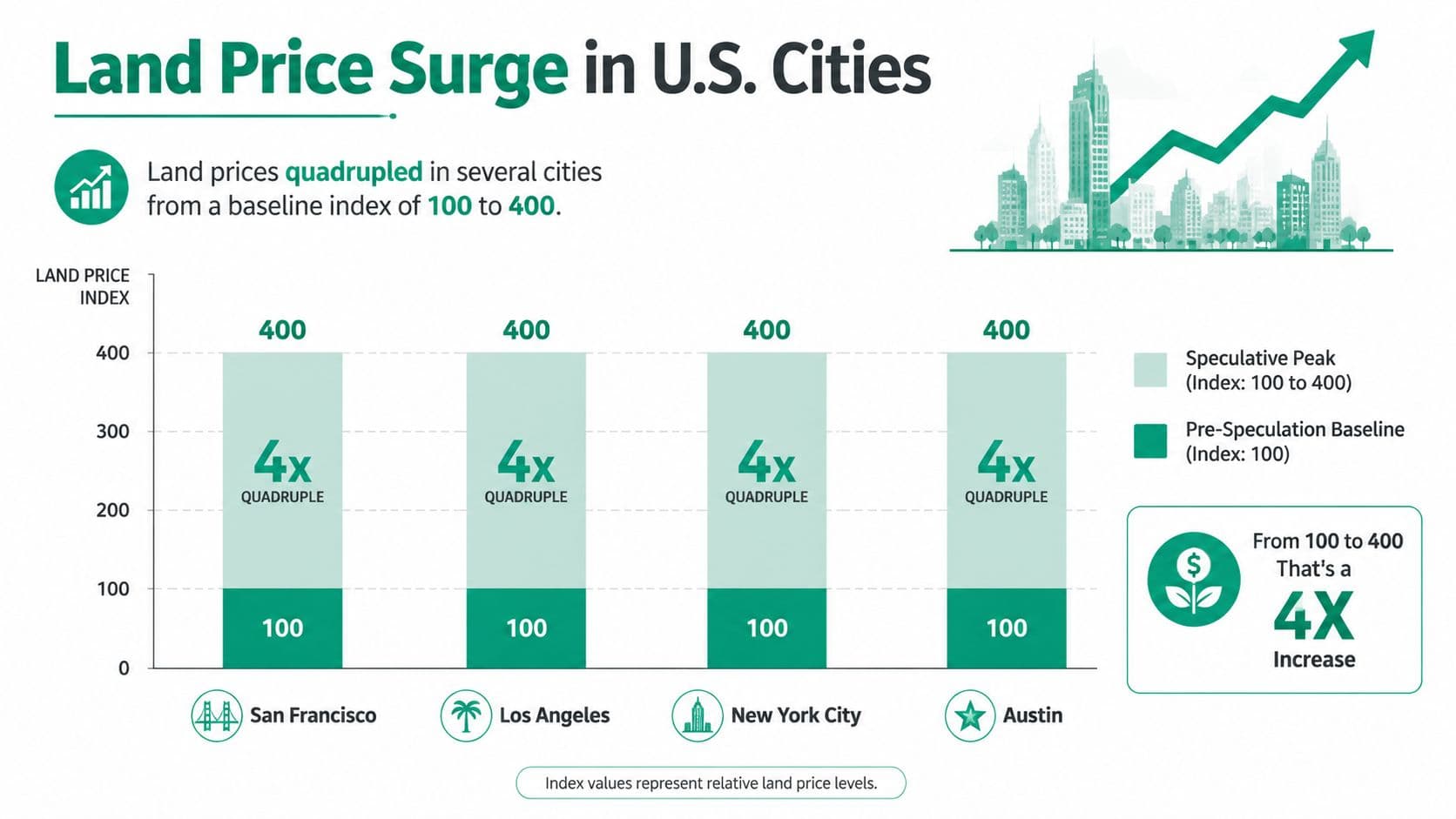
Construction costs do not need to rise at the same pace for land values to surge. In supply-constrained markets, buyers capitalize expected scarcity into site prices. Owners can therefore receive substantial gains without adding floor space, improving structures, or expanding productive capacity.
Three indicators for a working diagnosis
A high-price map cannot distinguish productive investment from strategic holding. Policymakers should examine several signals together:
-
Turnover: Measure how often residential and development parcels change hands. Low turnover can reflect uncertainty or financing pressure. Persistent low turnover alongside rising prices suggests that owners may prefer waiting to selling or building.
-
Vacancy and underdevelopment: Compare permitted intensity with occupancy, floor area, and development status. A site surrounded by strong demand but used below its permitted or economically viable intensity warrants closer examination than an ordinary vacant parcel.
-
Price-to-rent divergence: Compare capitalized sale prices with the rental income supported by current use. A widening gap indicates that buyers may be paying for expected appreciation rather than present operating returns.
No single indicator proves land banking. Low turnover may reflect illiquidity, vacancy may result from permitting delays or poor building conditions, and high prices may reflect genuine development value. The combination of low turnover, persistent underuse, and prices unsupported by current rents provides a stronger speculative profile.
The intensity gap
Parcel-level and utility-data studies identify underuse gaps of about $400,000 per quarter-acre in San Francisco and $150,000 to $200,000 in Los Angeles, New York, and Seattle. These estimates show how the option value of waiting can exceed the return from immediate development in high-demand markets. (Evidence on speculative vacancy and underuse)
Australia's housing system review supplies a separate supply-side signal. Residential land sales remained close to decade lows in 2024, indicating that weak land turnover can restrict housing production even while demand remains strong. (Australian housing system review)
For policy analysis, the threshold is operational rather than moral. Speculation becomes land banking when an owner repeatedly withholds a site, its market value rises faster than its productive use, and the holding decision reduces available development without a credible operational reason. These indicators can guide monitoring before a price surge becomes a broader housing or financial crisis.
Land-Value Taxes and Land-Use Rights Compared
A land-value tax and land-use rights target different points in the land market. A land-value tax is a recurring public charge based on a site's annual rental value, assessed according to its optimum permitted use. Its purpose is to reduce the financial advantage of holding idle or underused land and to bring private holding decisions closer to productive use. UK parliamentary evidence on land-value taxation
Land-use rights are legal rights to occupy, use, and transfer access to land. They can be structured as leases with annual repricing and no fixed expiration in the repricing mechanism. Because the charge adjusts to current conditions, buyers can acquire use rights without paying the full capitalized price of outright ownership. Singapore's land-law framework distinguishes a lease from ownership: a lease grants exclusive possession and use in exchange for rent. Singapore land-law framework
| Feature | Land-Value Tax | Land-Use Rights |
|---|---|---|
| Core function | Collects public revenue from site rental value | Defines a transferable right to use land |
| Legal form | Recurring tax applied to land value | Lease or comparable use-right arrangement |
| Pricing mechanism | Assesses annual rental value, often by optimum permitted use | Reprices the use right through ground rent |
| Ownership | Can operate alongside private ownership | Separates use and transfer from outright freehold ownership |
| Speculation channel | Reduces gains from holding land only for appreciation | Reduces upfront access costs and limits passive ownership value |
| Primary policy question | How should society collect site rent? | Who receives the right to use land, and on what terms? |
The distinction affects the policy model. A land-value tax changes the return on retaining a privately owned site. A land-use-right system changes the holder's legal relationship with the site. The first is primarily a fiscal instrument. The second is a property-rights instrument.
Readers comparing national tax systems can consult the World Property Investor tax guide, provided they keep the instruments separate. A lease can have a low entry cost and annual repricing without being a land-value tax. A land-value tax can also operate under private ownership without creating leasehold rights.
The tools can still work as a package. Land-use rights can reduce the cost of access and transfer, while land-value capture can direct publicly created site value toward public services. Policymakers should model them separately, then test their combined effect on holding costs, development timing, tenure, and public revenue. Outcomes depend on valuation quality, legal design, and administrative capacity. A clearer comparison of the two tax approaches appears in this land-value tax versus property tax analysis.
International Precedents and What They Actually Prove
International examples are useful only when policymakers identify the institutional feature being tested. Denmark and Estonia are often associated with site-value taxation. Their relevance lies in showing that land can be assessed separately from buildings, not in proving that one national model can be transferred unchanged to every city.
Estonia's modern cadastre demonstrates the administrative value of reliable parcel records. Digitization alone does not resolve valuation disputes. Governments need a defensible register of sites, rights, improvements, and permitted uses before they can assess land rent consistently. That register also gives analysts the data needed to track holding periods, development delays, and changes in site value.
Singapore illustrates a different institutional route. Long-term state land leases let the government structure land-use rights and retain a role in allocating scarce sites. Singapore's legal framework shows how a lease can grant exclusive possession and use in exchange for rent, while government-linked materials describe lease terms whose value is expressed as a percentage of freehold value. (Singapore land-law framework) The example establishes that access rights can be separated from outright ownership. It does not establish that every leasehold system captures publicly created value effectively.
Evidence with different transferability
Canberra offers a leasehold example under a different constitutional and political arrangement. Alaska and Norway provide resource-dividend analogues, showing how rental value from nature can be shared with the public. Natural-resource governance, however, does not map perfectly onto urban land taxation, where valuation, planning permissions, and local services shape site value.
Allentown demonstrates the political difficulty of partial transitions. A city can change the relative treatment of land and buildings, yet property owners, assessors, developers, and elected officials experience that shift differently. The transition therefore requires more than a sound tax formula. It requires credible assessments, clear phase-in rules, and institutions able to manage distributional effects.
The New Zealand Treasury paper presents a broader theoretical case for taxing unimproved land values. It connects that approach with limiting speculation, improving housing affordability, encouraging efficient land use, reducing urban sprawl and environmental burden, and lowering the risk of real-estate bubbles without undermining economic growth. (New Zealand Treasury paper on land and housing)
Transferability test: Ask which mechanism a precedent demonstrates, which institutions make it workable, and which outcomes remain dependent on local law, data, and politics.
These cases do not provide a single proof of reform. Together, they show that governments can separate land from improvements, define use rights independently of freehold ownership, distribute natural rents, and adjust tax bases. Their broader lesson is methodological: test each instrument against measurable indicators, then assess whether local law, administrative capacity, and political incentives can support the intended result.
Designing a Reform Stack with Tri-Factor Economics
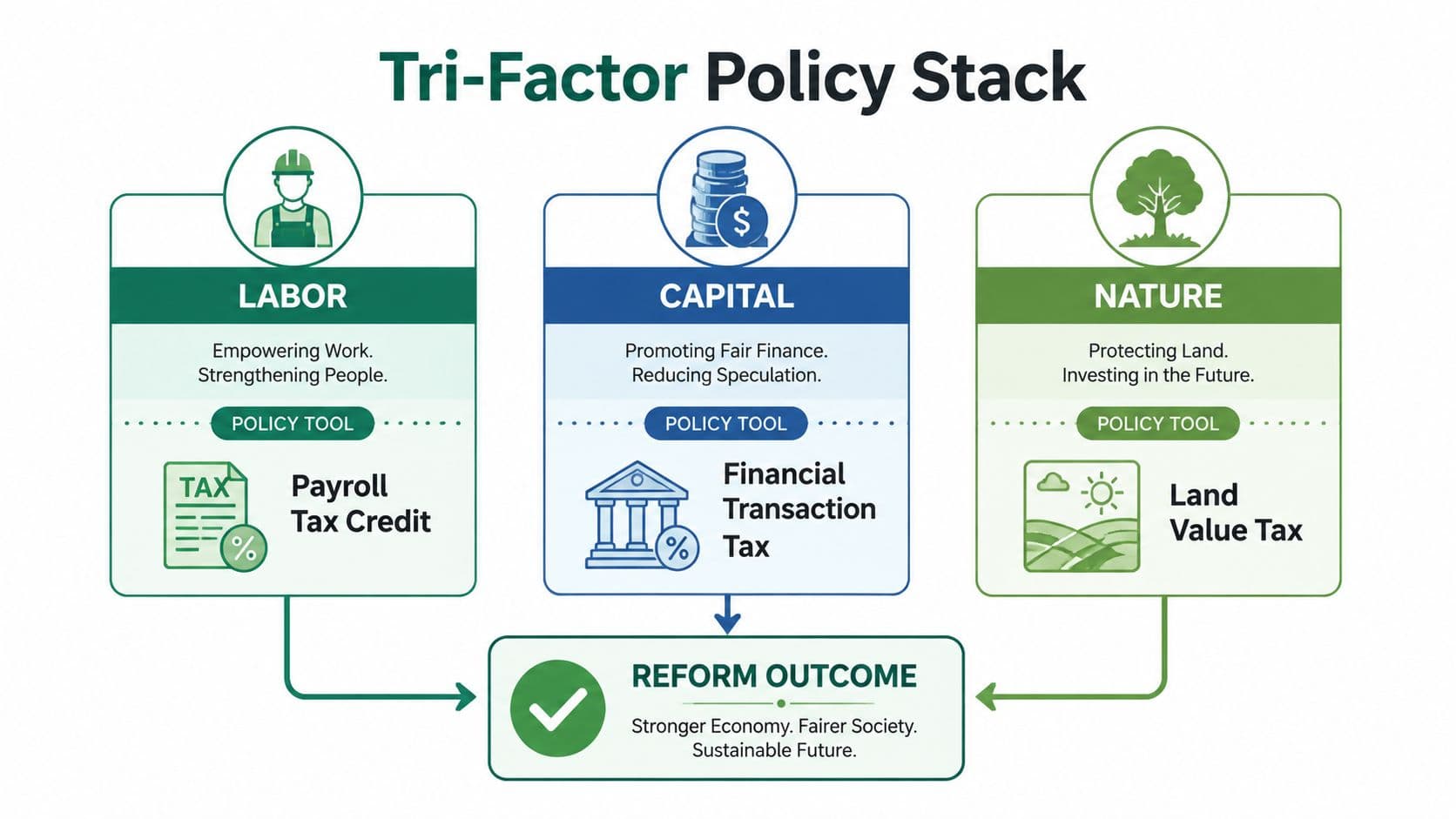
Tri-factor economics separates labor, capital, and nature because each produces value through a different mechanism. Labor contributes effort and skills. Capital includes produced assets and financial investment. Nature includes land and natural resources, whose rental value reflects scarcity, location, and public decisions such as infrastructure provision or zoning.
This separation turns reform into a sequence of testable choices. Policymakers first estimate the rental value of sites and natural resources. They then decide how much should fund public services or return to residents through dividends. The final step is to adjust rates so revenue depends less on work and productive improvements, and more on socially generated land value.
Match the instrument to the factor
A site-value tax captures the rental value of land. It targets returns created by location and scarcity, rather than taxing the building that supplies housing or the work that generates income. Land-value capture therefore concerns the distribution of site value. It does not, by itself, define who may build, at what density, or for which use.
A resource dividend distributes rental value from nature to the public. Alaska and Norway offer relevant analogues, but resource-sharing arrangements depend on the resource, ownership rules, and fiscal institutions.
Rate reform changes the composition of public revenue. Lower taxes on wages or productive improvements can alter investment incentives, while a land-based charge makes passive holding less attractive. Earlier evidence also links unimproved land taxation with affordability, more efficient land use, less sprawl, and lower exposure to property bubbles.
The modelling sequence should mirror these economic distinctions:
-
Build the valuation base: Combine cadastral records, sales evidence, permitted-use data, infrastructure access, and rental observations to estimate site values separately from improvements.
-
Model distributional effects: Identify how alternative rates and transition paths affect households, landowners, renters, developers, and public bodies.
-
Test fiscal substitution: Examine whether land-based revenue can replace charges on wages, construction, or productive capital. The model should not assume that every existing tax can disappear immediately.
-
Design the transition: Consider thresholds, credits, deferrals, or staged rate changes where sudden liabilities could create liquidity or political problems.
-
Prepare delivery systems: Integrate the cadastre, assessments, appeals, billing, payment, exemption checks, and public explanations before legislation takes effect.
Land-use rights belong in the same reform package, but they remain a distinct instrument. A tax can capture publicly created land value without changing development permissions. Conversely, clearer use rights can raise site values even before a government introduces land-value capture. Analysts should therefore model permitted intensity, approval certainty, and infrastructure access alongside tax liabilities, then identify which policy produces each change.
A finance ministry also needs stakeholder engagement tied to measurable questions. Residents need to understand assessments. Planners need to see how permitted intensity affects site value. Developers need certainty about holding costs and approvals. Elected officials need transparent fiscal and distributional models.
For policy that connects economic decisions with ecological limits, guidance on designing with nature offers a related perspective. Unitism® provides land valuation assessments, distributional and fiscal impact modelling, legislative and administrative design, cadastre integration, education, and public-facing materials for organizations examining this type of reform.
Implementation Realities and How to Make Reform Stick
A tax rate does not enforce itself. British Columbia's speculation and vacancy tax applies in 59 communities, requires annual declarations from owners in taxable areas, and was tightened for 2026, with rates reaching 3% for foreign owners and 1% for Canadian citizens and permanent residents. (British Columbia speculation and vacancy tax)
The administrative lesson is direct. Governments need reliable ownership records, occupancy evidence, exemption checks, declaration workflows, appeals, and payment systems. Higher rates cannot address scarcity if officials cannot verify vacancy or identify the beneficial owner.
Supply conditions require the same discipline. Australia's housing review found that residential land sales remained close to decade lows in 2024, suggesting that weak turnover can constrain construction even when demand is strong. Policymakers should track turnover, vacancy, permitted intensity, and price-to-rent divergence together. No single indicator establishes speculation.
Implementation also depends on legitimacy. Clear assessment rules and public explanations should show residents what they owe, why the charge exists, and how revenue is used. Truth in taxation principles provide a practical standard for that disclosure.
Unitism® helps governments, cities, and organizations assess land values, model distributional and fiscal effects, and design land-value capture with workable administrative processes. Unitism® provides research, policy design support, valuation methods, and implementation tools for reducing speculative holding while protecting productive work and construction.