What is land value? Learn how site value is measured, what drives it, and how it funds public services without taxing work.
September 14, 2026
What Is Land Value and Why It Shapes Housing Costs
What is land value? Learn how site value is measured, what drives it, and how it funds public services without taxing work.

Land value is the market value of a site itself, separate from its buildings or other improvements. It is measured as a stock, distinct from flow measures such as rent and GDP, and it can change sharply when governments build infrastructure or alter zoning.
You may have seen the puzzle without naming it. Two houses can look almost identical, use similar materials, and offer similar floor space, yet sell for dramatically different prices. One sits near a rail station, jobs, parks, and desirable schools. The other has fewer connections and weaker development prospects. The building explains part of the price. The location explains much of the rest.
That difference is land value. It helps explain why housing can become unaffordable even when construction methods are familiar, why a new transit line can enrich nearby owners, and why a city can face fiscal pressure while private landowners receive large gains from public decisions. For a plain-language introduction to the wider housing problem, see this guide to why housing is unaffordable.
The subject also requires careful labels. Land-value taxes, fixed land leases, and true land-use rights are not interchangeable. They assign risk, collect value, and affect investment in different ways. Unitism's tri-factor lens adds another useful distinction by separating labor, capital, and nature, rather than treating every source of wealth as if it came from the same economic process.
By the end, you'll be able to identify what belongs to the site, understand how appraisers estimate it, recognize the forces that raise or lower it, and compare policy choices without confusing a building with the ground beneath it.
Table of Contents
- Introduction Why Land Value Matters More Than You Think
- What Land Value Really Means
- What Drives Land Value Up or Down
- How Land Value Is Measured in Practice
- Land Value Tax vs Land Leases vs Land Use Rights Compared
- Why Land Value Matters for Public Finance and Unitism
- International Precedents and Next Steps for Reform
Introduction Why Land Value Matters More Than You Think
Suppose a family is choosing between two homes. The houses are the same size, have similar kitchens, and were built to comparable standards. One costs far more because it's close to a train station, a busy employment center, and a well-used public park. The other stands in a place with fewer services and tighter restrictions on what can be built.
The family isn't only buying walls, windows, and a roof. It's buying access to a location. That access is reflected in the price of the site, even when the listing presents the property as one combined asset.
The hidden part of a property price
A property price usually bundles together at least two things:
- The building, which is a produced improvement created through labor, materials, design, and finance.
- The land, which is the site and the location advantages attached to it.
Economists and statistical agencies treat land as a distinct balance-sheet asset. The OECD describes land as a subcomponent of natural resources and explains that housing wealth usually combines a dwelling with its underlying land. This is why the question “what is land value” matters before policymakers debate property taxes, housing supply, or public investment. The relevant OECD guide to land estimation also cautions that land value is a stock, while GDP and rent are flows. Comparing them requires care.
A building can deteriorate, be renovated, or be replaced. The site remains in place, but its value can rise or fall as people, firms, and governments change the surrounding area.
Practical rule: Before asking whether a home is expensive to build, ask how much of its price comes from the location.
That question changes the policy conversation. A government may spend public money on roads, water systems, or mass transit, then watch nearby land prices rise. A planning authority may permit denser construction, making the same site more productive. If the public creates part of that gain, policymakers need a way to measure it and decide whether some of it should support public services.
Unitism's approach starts with this separation. Labor produces work, capital consists of produced tools and improvements, and nature supplies land and other natural opportunities. Keeping those factors distinct makes it easier to see which taxes discourage production and which charges collect value created by location and community activity.
What Land Value Really Means
Land value is the market value of a site itself, excluding buildings and other improvements. A property sale often combines several components, so appraisal and tax policy must separate the ground from what people have built on it.
A vacant parcel makes the distinction clear. Its price reflects location, access, permitted uses, physical characteristics, and expected future benefits. If a house occupies the parcel, the buyer pays for both the structure and the site. The economic question is how much of the combined price belongs to each.
A simple residual calculation shows the logic. If a house sells for 400,000 and replacing its structure would cost 250,000, the remaining 150,000 is an estimate of the market's price for the site. The result is not automatically exact. It depends on the quality of the building-cost estimate and the available market evidence.
Stock versus flow
A stock is measured at a point in time. The market value of a site on a particular date is a stock. A flow is measured across a period, such as rent received during a year, construction spending, or GDP. Guidance on national accounts and land estimation treats land as an asset recorded at a point in time, which helps distinguish its value from income generated over time.
Land rent relates to land value but is not identical to it. Rent is the recurring income a site can generate. Land value is the capitalized market price of the opportunity to own or control that site. One resembles an annual stream, while the other is the amount paid for the underlying asset.
That difference matters for policy. Total property value includes structures, while unimproved land value isolates the site. A charge intended to reach location value can otherwise collect from a kitchen renovation, a new factory, or another productive improvement.
Why the distinction changes decisions
A building can lose value as it ages even while its site becomes more valuable because a neighborhood gains access, activity, or development potential. Treating the whole property price as land value can therefore distort appraisal, taxation, and housing analysis.
The land economics guide from Unitism explains the relationship between site value, land rent, and improvements. Unitism's tri-factor lens keeps the categories separate: labor produces work, capital consists of produced tools and improvements, and nature supplies land and other natural opportunities.
For practical analysis:
- Identify the whole property price.
- Estimate the value of the building and other improvements.
- Treat the remaining site component as an estimate of land value.
This separation gives citizens and policymakers a clearer basis for deciding which value comes from production and which comes from the location itself.
What Drives Land Value Up or Down
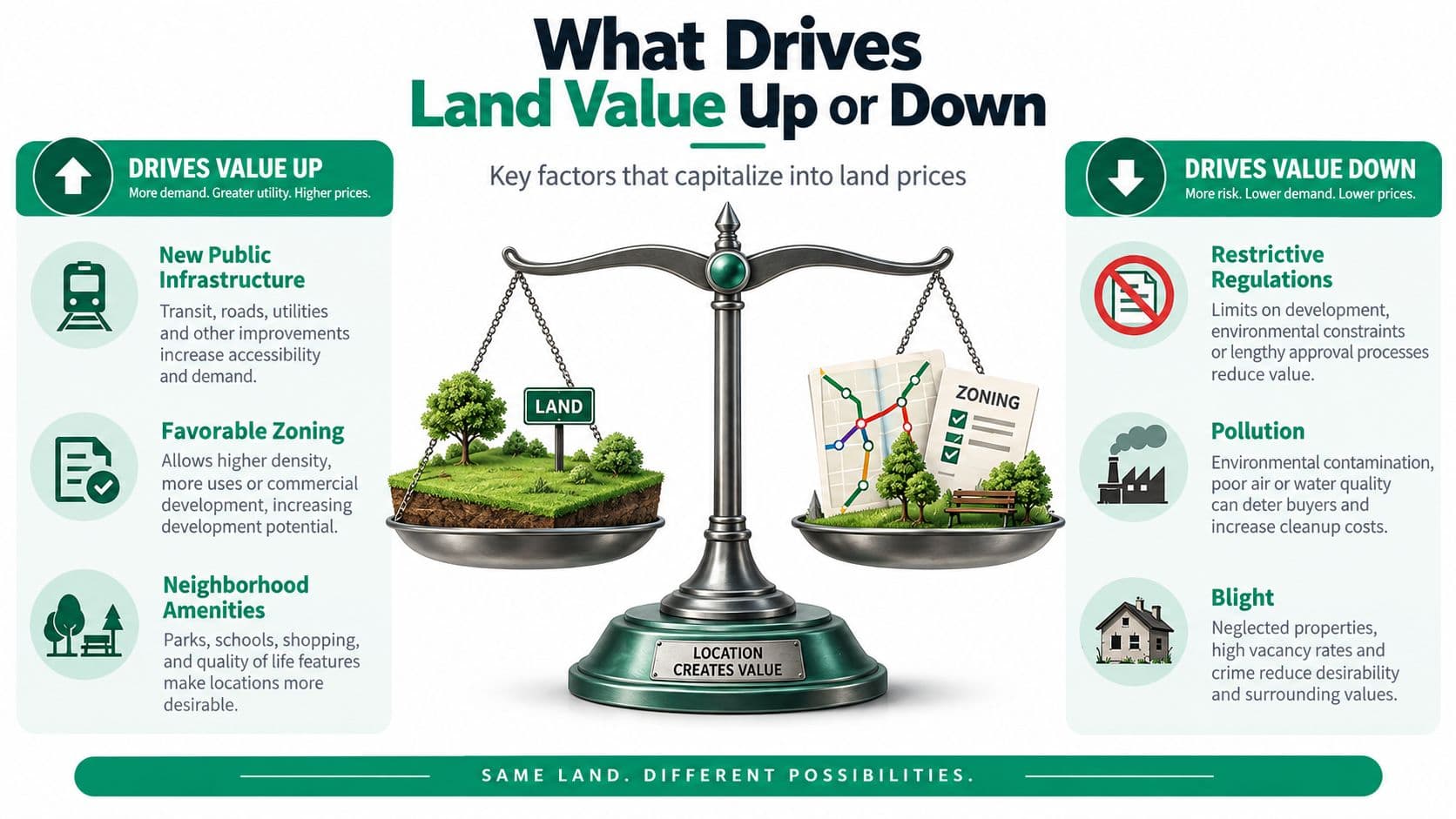
A vacant site beside a planned metro station may become more valuable before construction starts. Land value changes when the advantages or disadvantages of a location change. Public decisions, private activity, environmental conditions, and expectations about future use all affect what buyers will pay.
Public infrastructure becomes a site advantage
A new road can shorten journeys. A water connection can make development feasible. Mass transit can bring workers, customers, and residents within easier reach of a site. Buyers may build these expected benefits into the price of nearby land, so public investment can raise private site values before the resulting infrastructure is complete.
For a worked example of how public investment translates into private site prices, see this land value uplift explainer. The World Bank material on land-value capture and transport finance describes land-value capture as a public financing method that shares the increase created by government decisions or infrastructure investment. It also discusses Hong Kong SAR and Tokyo as long-running examples connected with transit finance and urban development.
Zoning changes the same calculation. Permission for apartments, offices, shops, or greater building intensity can increase the income a site may support. A restriction can reduce that potential. The soil and boundary lines may remain unchanged, while the location's permitted economic use shifts.
Suppose a city announces a metro station in 2024 and opens it in 2028. Nearby asking prices may respond to the announcement rather than the opening, which makes the valuation date important when officials design a capture policy.
Amenities and ecological conditions
Parks, cultural facilities, schools, employment centers, and reliable services can make a location more attractive. Pollution, flood exposure, poor access, and blight can work in the opposite direction. Each factor changes the benefits or costs faced by occupants and businesses.
A price-only account leaves out another dimension. Land can provide ecosystem services, biodiversity, green space, climate protection, and social benefits that a private sale does not fully price. The land economics teaching material from Boston University presents land as an ecological and social asset as well as an economic one.
Unitism's tri-factor lens helps separate these effects. Labor creates work, capital provides produced tools and improvements, and nature supplies land and other natural opportunities. A city-funded station may raise a site's private value, while a protected green corridor may provide benefits that do not appear fully in its sale price.
Officials therefore need to examine both private uplift and public benefits before choosing direct funding, land-value capture, a recurring land charge, or a combination of tools.
How Land Value Is Measured in Practice
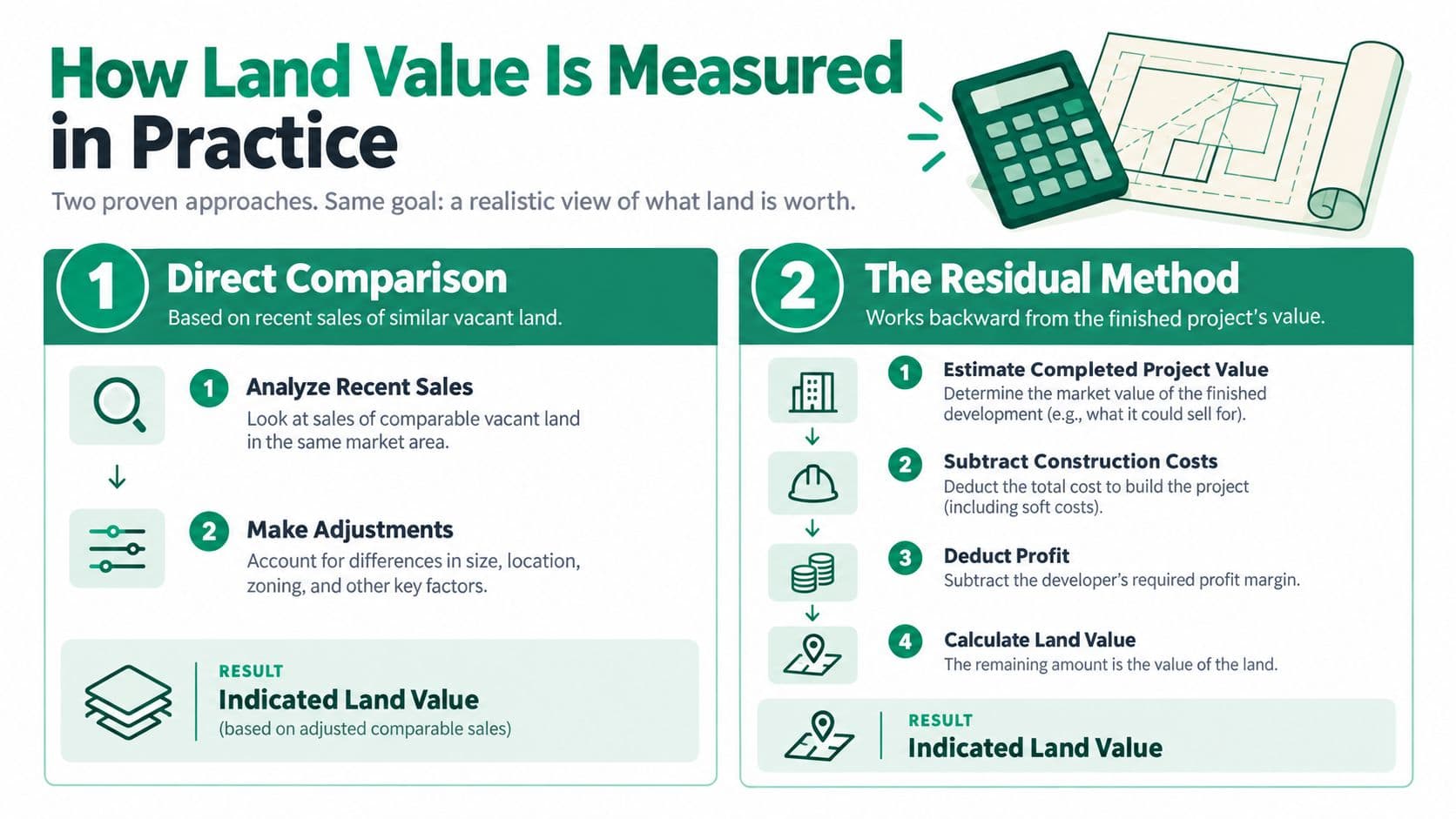
Appraisers don't rely on one universal technique. They choose a method based on the property, the available evidence, and the question being asked. A vacant urban parcel, an old house, and a proposed development may require different approaches.
Direct comparison
The most intuitive method compares the site with recent sales of similar vacant land. An appraiser examines differences in size, location, access, permitted use, physical condition, and development potential, then adjusts the comparison.
The reasoning looks like this:
- Find comparable vacant sites.
- Review their sale prices and transaction conditions.
- Adjust for meaningful differences.
- Apply the evidence to the site being valued.
This works best when a market has enough relevant vacant-land transactions. It becomes harder when sites are unusual, sales are scarce, or each parcel has a different regulatory or physical profile.
Residual valuation
A second approach starts with the completed property rather than an empty site. The appraiser estimates the total property value and subtracts the value of the building or its replacement cost. The U.S. Bureau of Economic Analysis notes that this residual approach is most accurate for newer properties, because the building value can be estimated more cleanly before it's removed from the transaction price. The OECD and Eurostat land-estimation guide explains this distinction within national accounting.
Development appraisal uses a related residual calculation. Start with the project's gross development value, then subtract construction costs, finance, fees, and the developer's required profit. The remaining amount is the residual land value, or the maximum a rational buyer can pay while still meeting the target return. This method is described in commercial land-value guidance from CCIM.
Benchmarking for public decisions
Policy viability assessments may use benchmark land value, which isn't the highest speculative price a seller hopes to receive. England's guidance describes a benchmark based on existing use value plus a premium for the landowner. The calculation can also account for abnormal costs, site-specific infrastructure, and professional fees, all of which reduce the residual available for land. The official benchmark land-value guidelines explain why this threshold is intended to represent a reasonable landowner decision rather than an unlimited speculative expectation.
For large portfolios, mass appraisal methods can help public agencies apply consistent models across many sites. The result still requires testing, transparent assumptions, and regular updates. A valuation is useful only when decision-makers understand what it includes, what it excludes, and how sensitive it is to changes in zoning, infrastructure, costs, and market expectations.
Land Value Tax vs Land Leases vs Land Use Rights Compared
These instruments can sound similar because each concerns the value of land. Their mechanics differ sharply.
A land-value tax is a recurring charge based on land value or land area. A fixed land lease grants use for a specified term at a fixed price. A true land-use right, as defined in this comparison, has no expiration, requires no renewal, and is repriced annually.
| Feature | Land Value Tax | Fixed Land Lease | True Land Use Right |
|---|---|---|---|
| Basic mechanism | Recurring charge based on land value or area | Fixed-price use for a renewable or non-renewable term | Indefinite right with annual repricing |
| Expiration | No lease expiry, although the tax rules can change | Yes, unless renewed | No |
| Price updates | Reassessed or updated through the tax system | Usually fixed until renewal or renegotiation | Repriced each year |
| Risk timing | Priced continuously | Deferred until renewal or reflected in declining marketability | Updated continuously |
| Effect on transfer | Depends on administration and tax design | Can become harder to refinance or sell as expiry approaches | Can be bought and sold at low cost because no term remains to run down |
| Main fiscal character | Public revenue from site value | Contract payment to a lessor | Ongoing land charge or payment linked to current site value |
Fixed leases postpone risk
Land leases may be renewable or non-renewable fixed-term leases with a fixed price. A renewable lease gives the user certainty only until the term ends. At expiry, the accumulated gap between the fixed lease rate and the market can be closed in one major repricing.
A non-renewable lease creates a different problem. As the remaining term shortens, lenders and buyers may become less willing to finance or purchase the interest. The asset can become progressively harder to refinance and sell. In both cases, the fixed price doesn't correctly price risk as conditions change. It postpones risk.
True land-use rights update continuously
A true land-use right is different from an ordinary lease under the criteria used here. It must be repriced each year, require no renewal, and never expire. Because the price reflects current conditions rather than the remaining length of a fixed term, people can transfer the right at lower cost without waiting for a large end-of-term adjustment.
China provides a useful example of why terminology matters. Chinese state-owned urban land-use rights are granted for fixed statutory terms that vary by use, including 70 years for residential land, 50 years for industrial land, and 40 years for commercial or retail land, as described in China leasehold guidance from JunHe-20230228.pdf). Those are fixed-term arrangements, so they shouldn't automatically be called true land-use rights in this policy framework.
A related analysis of Chinese land arrangements distinguishes land-use rights from ordinary leases and emphasizes that a fixed lease shouldn't receive the indefinite label unless it is annually repriced and doesn't expire.
The annual-charge contrast
China's urban land-use tax illustrates the recurring model. The charge is levied annually on users within relevant jurisdictions and calculated from occupied area multiplied by a fixed per-square-meter rate set by local government, according to this CESifo working paper on China's urban land-use tax.
The exact tax base can vary across systems, but the central contrast remains:
- Land-value tax collects a recurring public charge.
- Fixed land leases lock terms and defer repricing.
- True land-use rights keep the right indefinite while updating its price annually.
Calling a fixed lease a “land-use right” doesn't change its risk. Labels should follow the mechanics.
Why Land Value Matters for Public Finance and Unitism
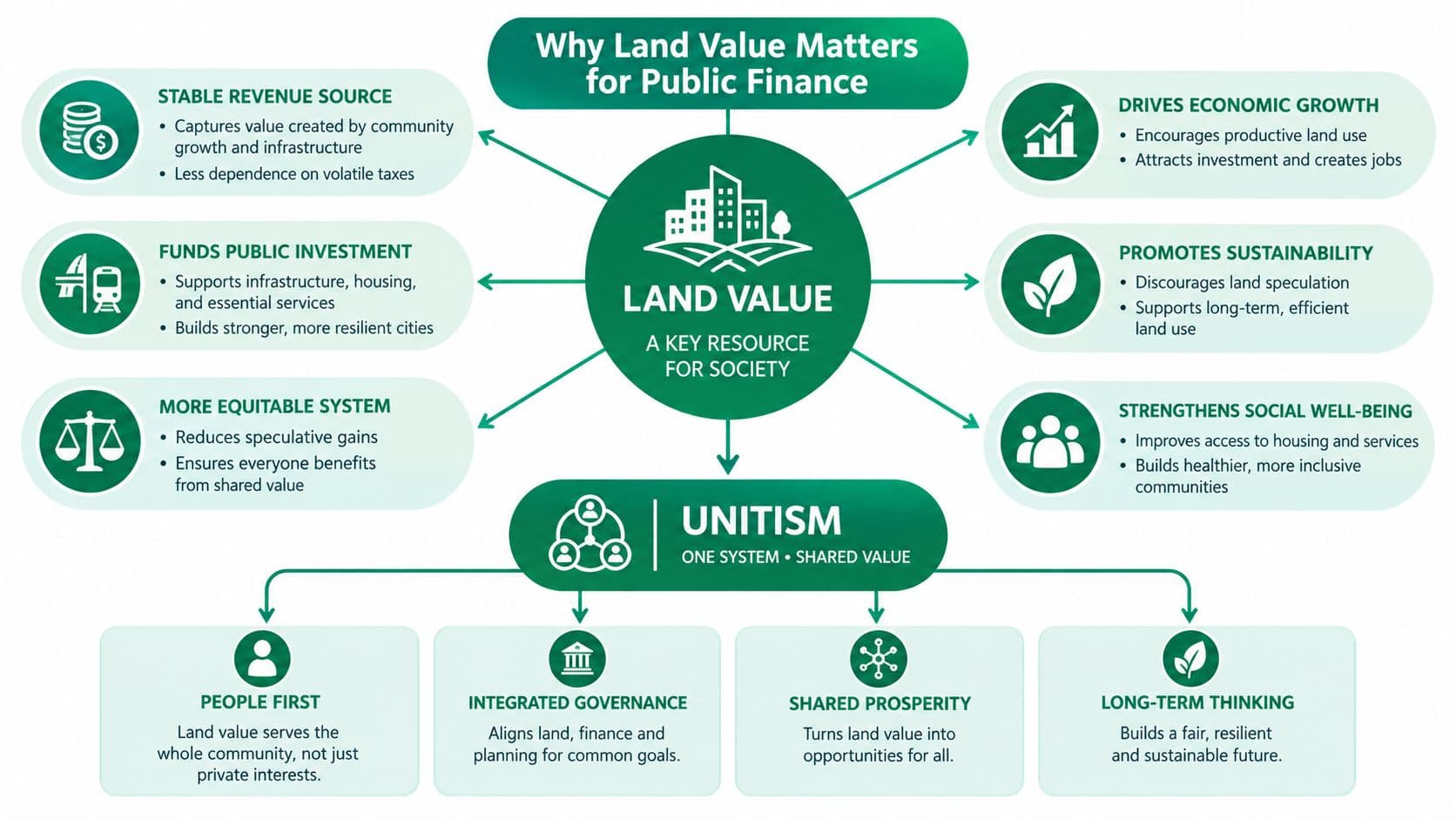
Public finance becomes clearer when policymakers separate labor, capital, and nature. Labor includes human effort and skill. Capital includes produced assets such as buildings, machinery, and infrastructure. Nature includes land and the location opportunities that communities use but don't create through individual construction.
Unitism calls this separation tri-factor economics. Its central fiscal insight is that land rent can represent value generated by nature, population, infrastructure, public institutions, and shared economic activity. A tax on wages can reduce the reward for working. A tax on buildings can make construction and improvement less attractive. A charge on land value targets a different base, one that exists because a site has a particular location and use potential.
Changing incentives
Consider two vacant sites in a growing district. If the owner can hold an underused site without facing a meaningful land-based charge, waiting for a higher future price may appear attractive. A recurring charge tied to site value changes that calculation. The owner may develop, sell, lease productively, or accept a lower holding return.
That mechanism can support several policy objectives:
- Discourage speculative holding: Owners face an ongoing cost for valuable sites, rather than receiving the full benefit of community-created appreciation.
- Encourage infill: A well-located but underused parcel becomes harder to hold idle.
- Protect productive investment: A charge on land value doesn't rise merely because an owner adds a building or improves a site.
- Support compact development: When location costs are visible, cities can make better choices about infrastructure and land use.
- Broaden public revenue: Governments can connect part of their revenue base to the value they help create through services and investment.
The Unitism explanation of land-value tax frames this policy as part of a broader effort to reduce taxes on work and productive capital while sharing the rental value of land and nature.
Policy test: If a proposed charge makes it more expensive to work, build, or improve, ask whether it is taxing production rather than collecting location value.
Land-based policy still requires careful administration. Assessments must be transparent, appeals must be available, and transition rules must address existing owners and different property types. Distributional modeling matters because land values vary sharply between neighborhoods, and a fair reform needs to show who pays, who benefits, and how public services change.
The broader promise isn't that land taxation solves every housing or fiscal problem by itself. It's that separating the factors gives policymakers better levers. They can design charges that recover public-created value without treating a new home, a business investment, or a worker's earnings as the problem.
International Precedents and Next Steps for Reform
Land-based policies have appeared in Denmark, Estonia, Singapore, Alaska, Canberra, Norway, and Allentown, Pennsylvania. Their arrangements differ. Denmark and Estonia illustrate recurring land taxation, Singapore shows how public ownership can place land into long-term leases, and Canberra demonstrates planning through public control of land release. Norway, Alaska, and Allentown provide other models for sharing resource or site value through public finance. These cases show that land policy can connect scarce locations with community revenue, but each requires examination of its legal rules, valuation system, and administrative capacity.
Transit development offers a separate precedent. Tokyo's private railway companies have often combined rail construction with nearby housing and commercial development, allowing transport investment and land development to reinforce each other. The model shows why infrastructure decisions can change surrounding land value, and why public policy must examine who receives that increase.
A city or ministry can begin with six questions:
- Map the asset: Separate land from buildings and improvements.
- Identify value drivers: Record infrastructure, zoning, amenities, risks, and constraints.
- Test valuation methods: Compare vacant-land evidence with residual and mass-appraisal models.
- Model distribution: Show effects on households, businesses, landowners, tenants, and agencies.
- Design a transition: Set assessment, appeal, collection, and implementation procedures.
- Explain the change: Give residents, officials, and investors clear guidance.
Unitism® offers land valuation assessment, fiscal and distributional modeling, policy design, implementation support, education, and interactive tools for examining how labor, capital, and nature shape location value. These services can support decisions about housing costs, public revenue, and land-use reform.