Explore the history of property taxation from ancient civilizations to modern reforms. Learn how tax systems evolved and what they mean today.
September 4, 2026
History of Property Taxation: A Complete Guide
Explore the history of property taxation from ancient civilizations to modern reforms. Learn how tax systems evolved and what they mean today.
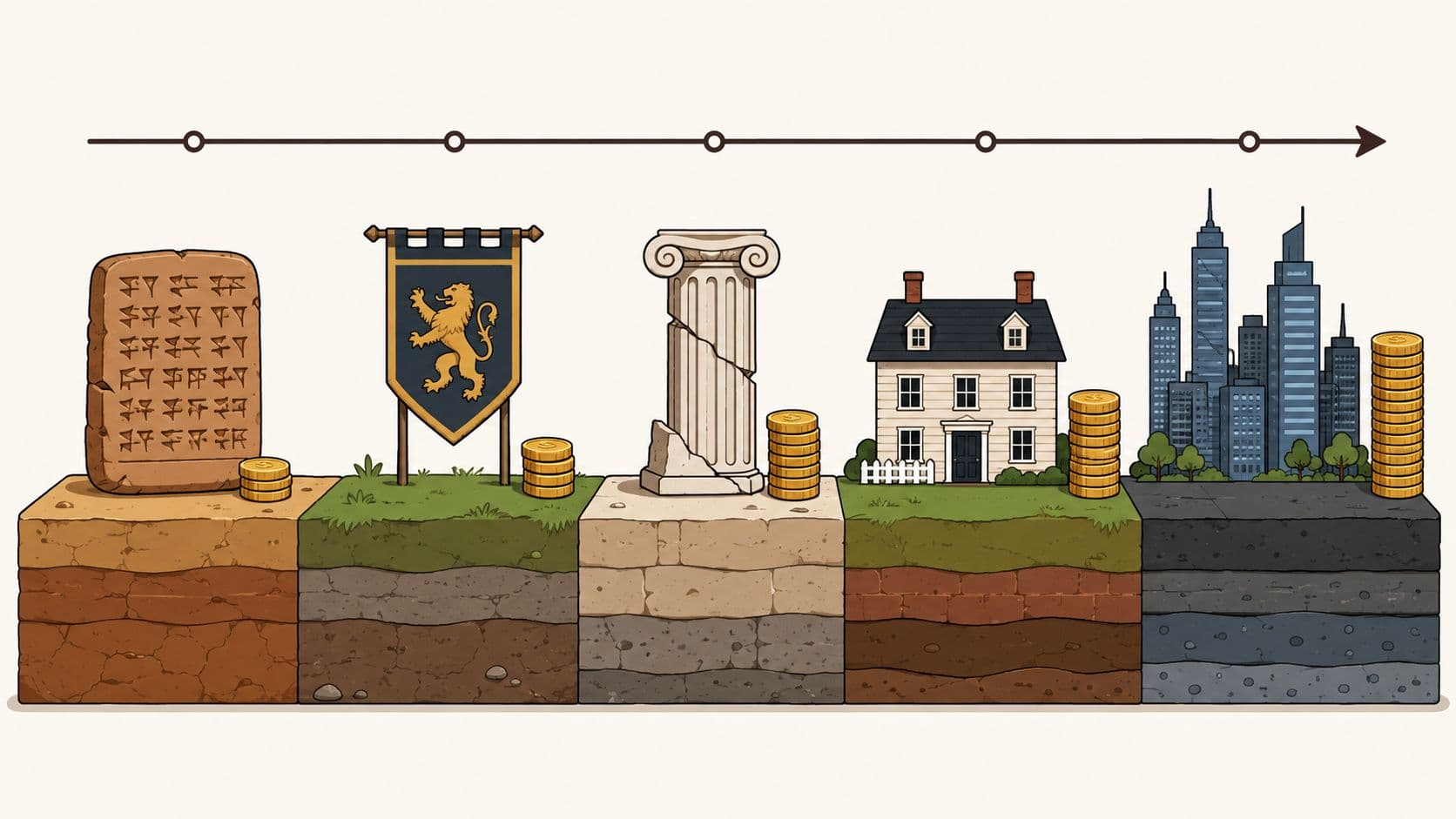
Property tax is far older than modern governments. The earliest known tax records date to about 6,000 BCE, when clay tablets from Lagash in Mesopotamia documented economic obligations. Thousands of years later, property-based assessment still finances local services, but the taxable base has changed repeatedly, from crops and livestock to land, buildings, financial assets, and eventually real estate alone. The history of property taxation is therefore also a history of measurement, political power, and competing ideas about who creates value.
Table of Contents
- Ancient Origins and the Birth of the Property Tax
- From Feudal Dues to Annual Rates and How the Modern Base Was Built
- Classical Doctrines and Why Economists Began Arguing for Land Rent
- The American Experiment and From Colonial Levies to a Mass Fiscal Machine
- The Valuation Gap and the Recurring Fairness Crisis
- Land Leases Versus Land-Use Rights and the Case for Land-Value Taxation
- Modern Precedents Worth Studying
- What History Teaches Modern Tax Designers
Ancient Origins and the Birth of the Property Tax
In Lagash, priestly administrators used clay tablets to record land transfers, crop yields, and levies owed by households. These records weren't modern tax bills, but they reveal the administrative breakthrough that made taxation possible: officials could connect a household, an economic resource, and a public obligation in a durable record. The earliest known tax records date to about 6,000 BCE, according to this brief history of property taxation.
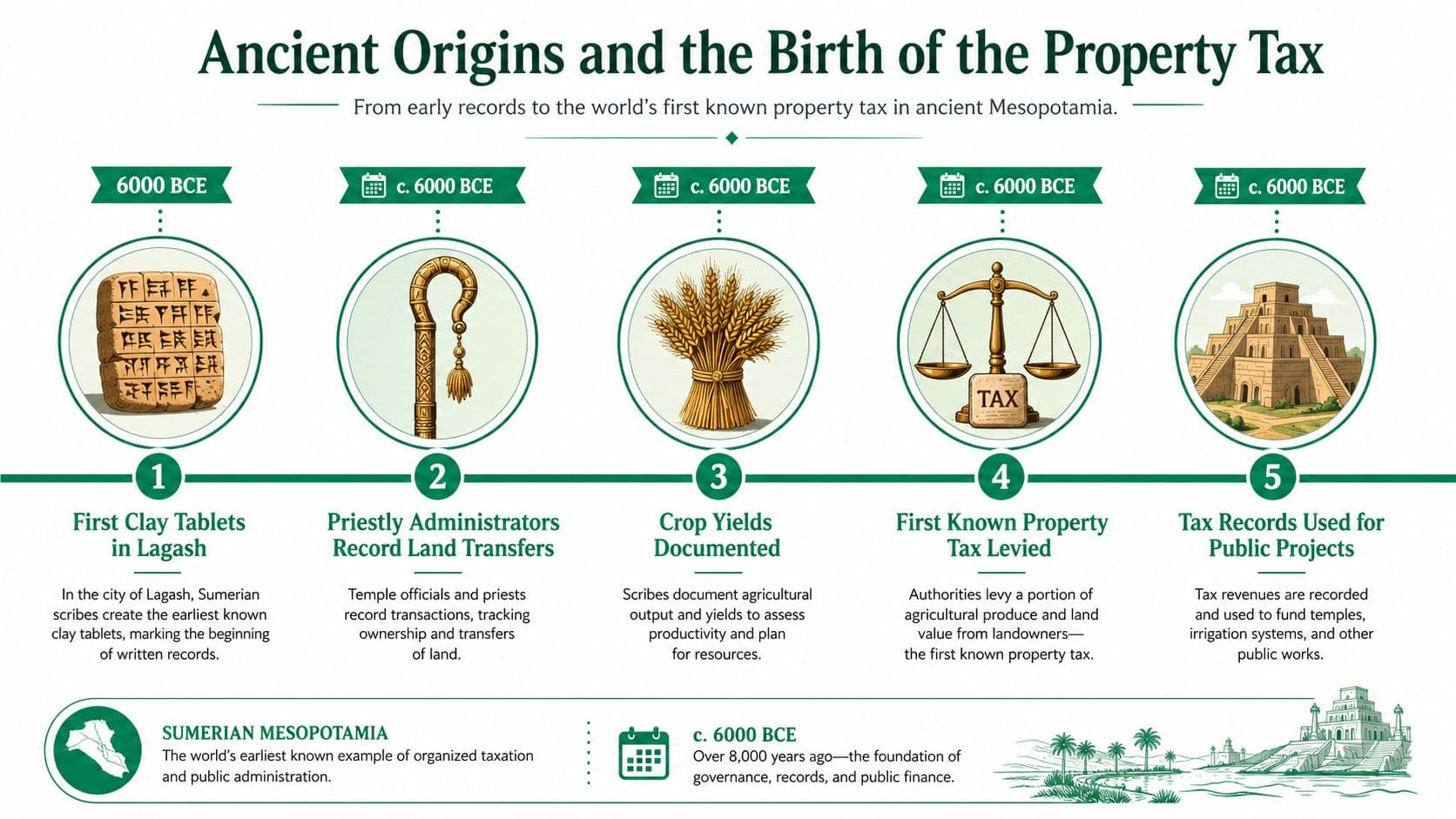
The practical question was simple: what could officials observe and assess? In agricultural societies, harvests often provided a clearer measure than an abstract land value. Egyptian administration, for example, relied on grain and labor obligations under pharaonic authority. A household might contribute produce or work to support public and religious projects, so the state measured economic capacity through what people cultivated and delivered.
Athens offers a clearer connection to direct property taxation. Under Solon, around 596 BCE, Athens recorded one of the first direct property taxes. Solon's reforms also addressed debt bondage and organized citizens by property class, helping replace irregular aristocratic extraction with a more predictable political and fiscal order. The historical record on property taxation links this early Athenian example to the longer development of property-based assessment.
Historical insight: A tax system becomes durable when officials can identify the base, record the obligation, and collect it repeatedly.
Rome later used the tributum, a property-linked levy that helped citizens fund war. The Roman example shows why property taxes often emerge before modern income taxes: land and visible goods are easier for a government to identify than earnings that move between accounts or arise from complex trade.
These early systems weren't neutral. Conquerors, temples, aristocrats, and rulers decided who owed what. Yet they established a lasting pattern. Occasional tribute gradually gave way to recorded obligations linked to productive resources and assessed value, the administrative foundation on which later municipal finance would be built. That intellectual movement would eventually inform the meaning of physiocrats, who treated land and its surplus as a distinct source of public revenue.
From Feudal Dues to Annual Rates and How the Modern Base Was Built
A medieval fief didn't usually generate a neat annual tax bill. Obligations moved upward through labor, farm goods, customary service, and sometimes money. Because each manor operated through local arrangements, the ruler's claim could be difficult to compare across communities. The system resembled irregular household gifts more than a standardized subscription.
The tithe introduced greater regularity in one important sphere. Agricultural producers paid 10% of their produce to the church, creating a recognizable rule across parishes. It still wasn't a property tax in the modern municipal sense, but it demonstrated the administrative value of a recurring, measurable claim.
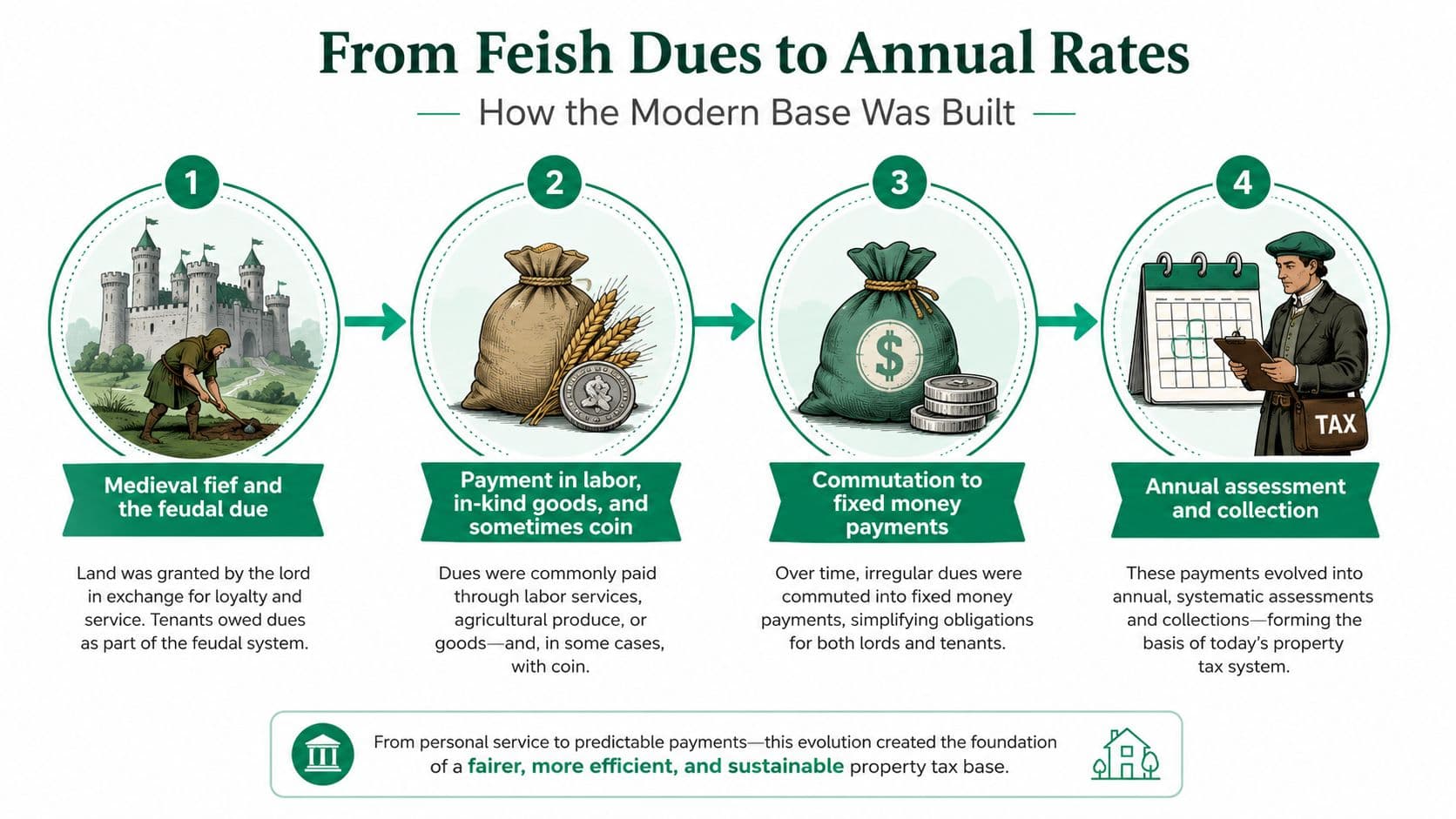
From custom to a recurring base
Early modern England moved closer to the modern model by linking local revenue to occupied property. The Elizabethan Poor Rate of 1601 funded relief through an annual charge based on the value of occupied land and buildings. The rate created a repeatable local finance mechanism, a direct ancestor of later council-tax traditions.
The analogy is useful. A feudal due was like asking for whatever a household could provide whenever a lord demanded it. An annual rate was closer to fixed monthly billing. Officials still had to determine value, but the obligation became more predictable for both the payer and the local authority.
The British system later developed into “rates” based on the annual rental value of property. In the 14th and 15th centuries, British assessors already used ownership or occupancy to judge ability to pay, according to the documented history of property-tax assessment.
The American general property tax
Across the Atlantic, the United States expanded the concept into a broad general property tax. The base could include land, buildings, inventory, and personal property rather than real estate alone. This approach treated a household or business's declared property as a rough proxy for wealth, creating a single assessment system for multiple asset types.
That breadth mattered because it made local government less dependent on occasional gifts, compulsory labor, or narrow levies. Roads, schools, and public services needed recurring revenue, and annual assessment offered a practical way to plan it.
Classical Doctrines and Why Economists Began Arguing for Land Rent
By the seventeenth and eighteenth centuries, economists increasingly separated land rent from returns to labor and produced capital. The distinction addressed a practical policy problem. A tax on a building can discourage construction, while a charge on the underlying site targets value created by location, scarcity, and surrounding society rather than by the owner's improvements.
The Physiocrats offered one of the earliest systematic arguments. In their tableau économique, they claimed that land generated the economy's net product and proposed a single tax on land rent. Their reasoning rested on agricultural surplus. After labor and other costs were paid, they viewed the remaining return as a suitable source of public revenue.
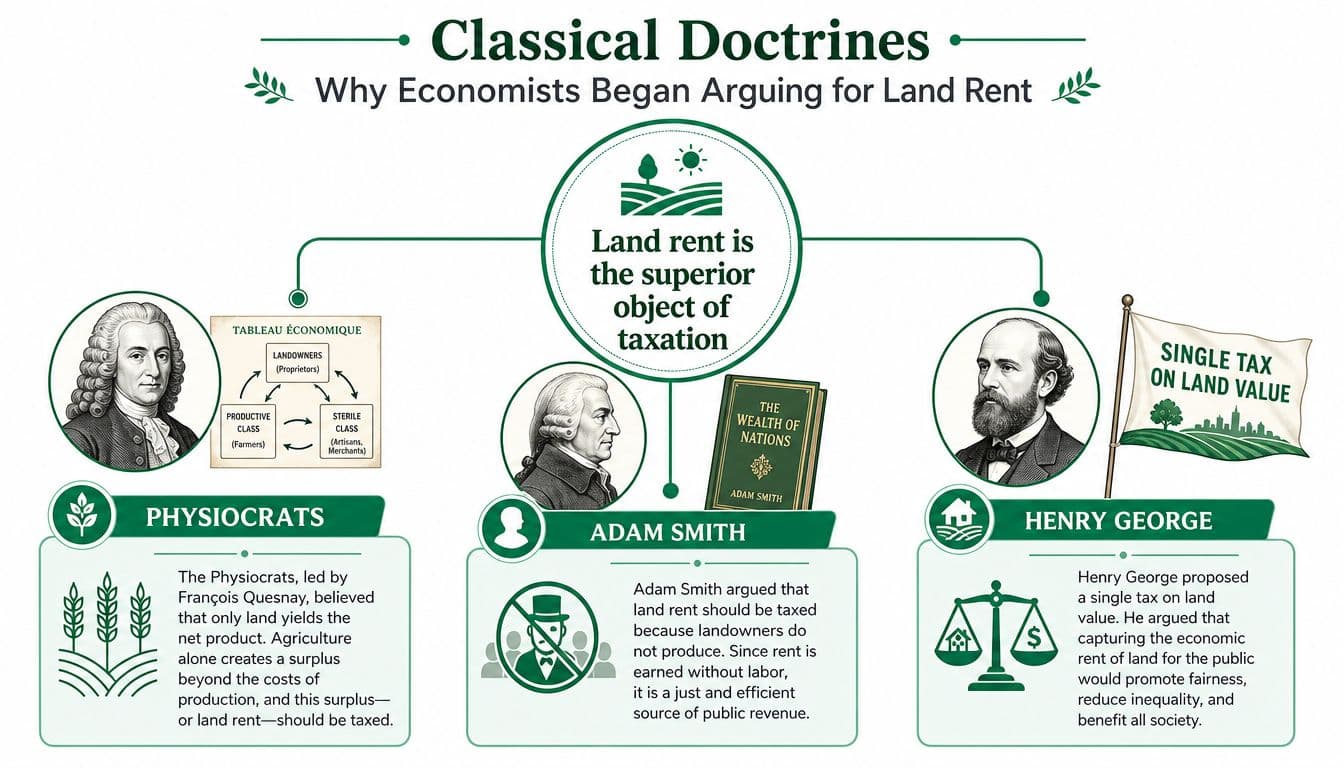
Smith and the difference between rent and production
Adam Smith developed a related argument in The Wealth of Nations. He distinguished ground rent from returns to capital and labor, and regarded taxes on land rent as comparatively less harmful because the supply of land does not respond to taxation as the supply of work, machinery, or buildings can.
A factory owner may delay expansion when taxes raise construction costs. A landowner cannot move a well-located site elsewhere. The comparison clarifies why later reformers focused on site value. The land economics explanation of value and rent provides a modern account of the distinction.
Ricardo's intuitive breakthrough
David Ricardo's theory of differential rent made the idea easier to see. Two sites can produce different rents even when farmers use similar labor and tools, because one is more fertile or better located. The extra return reflects relative advantage and scarcity, not necessarily the owner's productive effort.
A tax on this location-based surplus can therefore target rent without directly taxing the barn, machinery, or worker. This is the logic behind a site-value tax, an annual levy on the unimproved value of land that excludes buildings and other improvements, as described in the policy analysis of site-value taxation.
Henry George carried the argument into mass politics through Progress and Poverty and the Single Tax movement. He proposed recovering land value for public purposes while reducing taxes on productive activity. Smith, Ricardo, and George therefore connect directly to the modern reform debate. A fixed-term land lease gives an occupant a price and security for an agreed period, while an annual land-use charge reprices the location's value as conditions change. Confusing those arrangements can obscure the policy choice. The central question is whether government should tax what owners build, or primarily the site value that communities help create.
The American Experiment and From Colonial Levies to a Mass Fiscal Machine
Colonial governments financed public needs through poll taxes, estate taxes, customs duties, and local levies. After independence, property taxes gained importance because state and local governments needed a broad base for roads, schools, and other services, without a strong national income-tax system.
By 1796, land was taxed in 14 of the 15 states, while inventory, or stock in trade, was taxed in only 4 states, according to the history of the U.S. property tax. Land functioned like a visible anchor for public finance. Officials could identify it, assign ownership, and connect it to the place receiving public services.
Expansion into a general property tax
During the nineteenth and early twentieth centuries, the American system reached its widest intended scope. The general property tax covered real estate and, in principle, personal property such as inventory and financial assets. Assessors often struggled with assets that could be concealed or moved, so legal breadth did not guarantee practical coverage.
The fiscal scale still grew. Local general property-tax receipts rose from about 2% of GDP in the 1850s to 5% in the 1920s, as documented in the historical account of U.S. property taxation. By 1902, property taxes represented about 57% of state revenues and 73% of local revenues, according to this economic history of wealth and property taxation.
The American experience shows that a locally administered property base can scale, but scale does not guarantee equal treatment.
Why the base narrowed
As wealth became more mobile and intangible, the broad system came under pressure. Cash, bonds, receivables, and business equity were difficult to verify, while land and buildings remained visible. Many jurisdictions gradually phased out taxes on intangibles and other personal property, leaving real estate at the center of the modern property tax.
That shift also changed the tax's policy meaning. Earlier officials aimed at a broad declaration of wealth. Later systems concentrated mainly on sites and structures, even as financial wealth became harder to observe. Rural economies and the Great Depression exposed another problem: an assessment could assign a high value to property without providing the owner with current income to pay the bill.
This narrowing helps explain a distinction that remains important in land-value-tax debates. A real-estate base combines the site with improvements such as buildings, while a site-value base isolates the location's underlying value. The historical move toward visible land and structures did not create an annual price for land-use rights alone. A fixed-term lease can hold a land price and occupancy right for an agreed period, whereas an annual land-value charge reprices the site as surrounding conditions change. The American experience therefore shows both why land became the dependable tax base and why separating land value from improvements became a distinct reform question.
The Valuation Gap and the Recurring Fairness Crisis
Property-tax disputes often appear to concern rates, yet the deeper issue is valuation. If an assessor records a property below its market value, the nominal rate gives an incomplete picture. Two owners may face the same rate while paying different effective shares of their property's worth.
Historical evidence shows how persistent this gap became. The U.S. average assessment ratio fell from about 83% in 1850 to roughly 40% by the early twentieth century, according to the World Bank's analysis of historical wealth taxation. Infrequent revaluations, political pressure on assessors, incomplete records, and unequal treatment of property classes widened the distance between assessed and market values.
Why under-assessment damages legitimacy
Under-assessment can favor owners whose properties receive advantageous treatment, rather than owners who use land productively. It can also leave accumulated appreciation outside public scrutiny. When governments exclude intangible assets while relying heavily on real estate, the system no longer resembles the broad wealth tax that earlier American general property taxes sought to establish.
The distinction among land, buildings, and movable assets helps explain this history. A guide to real and personal property clarifies why administrators found visible, immovable assets easier to identify and tax than other forms of wealth.
Historical tax rolls and modern records allow researchers to trace wealth accumulation and regional inequality across long periods. They also show why assessment capacity, cadastral records, and compliance procedures shape fairness. Relief programs may help owners with limited cash income, but relief cannot repair a tax base that consistently undervalues some properties or excludes significant forms of wealth.
Communication affects legitimacy as well. For real-estate professionals explaining valuation, development, or policy changes, PR guide for real estate announcements offers practical guidance on presenting those changes clearly. Residents judge a tax system not only by the bill, but also by whether they can understand how officials reached the assessed value. That question leads directly to the modern dispute over land value, fixed-term leases, and annually repriced land-use rights.
Land Leases Versus Land-Use Rights and the Case for Land-Value Taxation
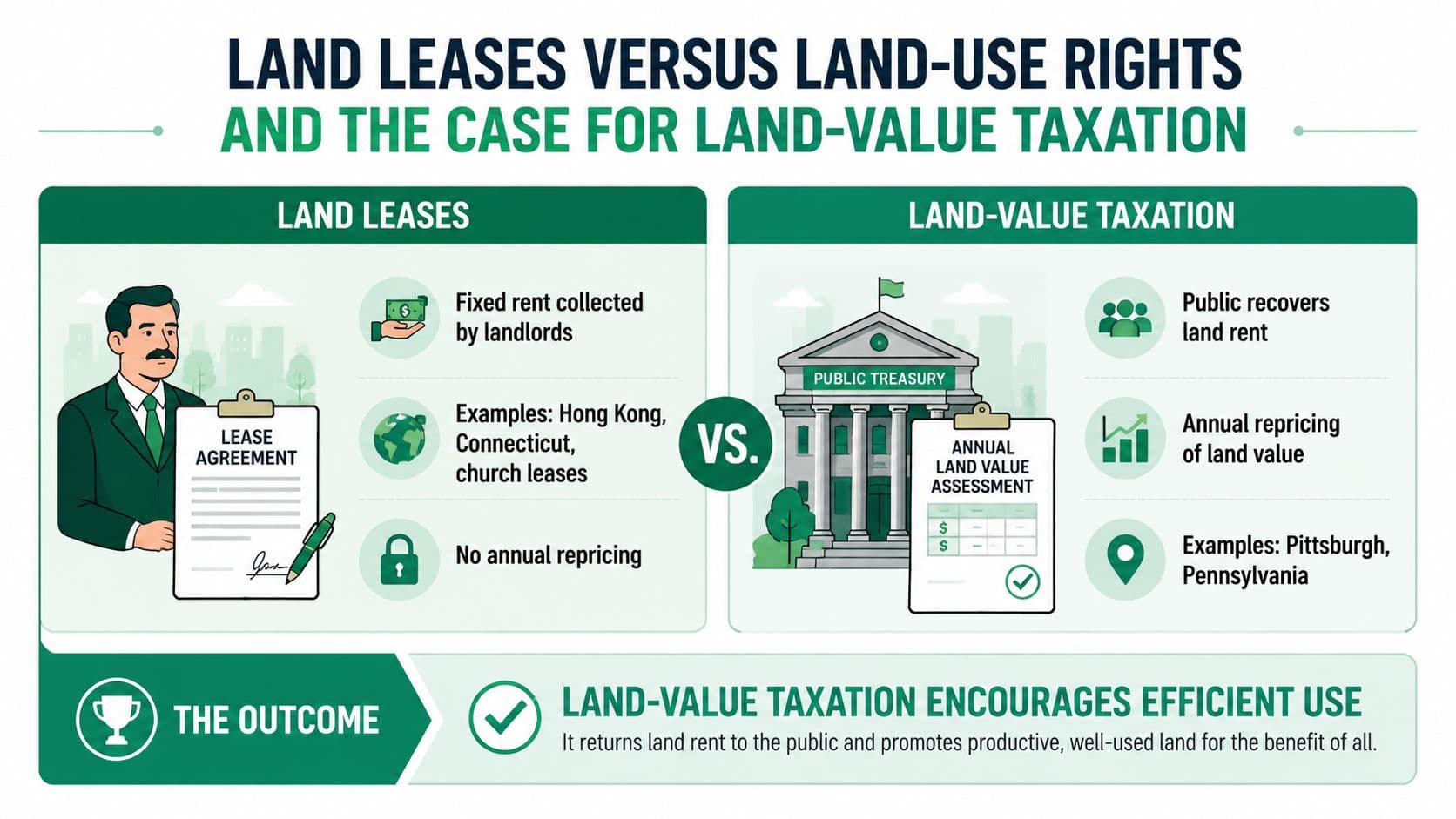
A land-value tax and a land lease can both be described as ways to collect land rent, but they aren't the same institution. A site-value tax is an annual recurring levy on the unimproved value of a site, excluding buildings and improvements. A lease is a private or public contract that grants use for a fixed price and a defined term.
That difference becomes important when comparing fixed-term leases with land-use rights. A fixed lease may be renewable or non-renewable, but its price is fixed during the term. A renewable lease provides certainty only until renewal, when the accumulated gap between the lease rate and market value can close through a major repricing. A non-renewable lease becomes progressively harder to refinance or sell as expiry approaches.
Fixed leases, in effect, postpone risk rather than pricing it continuously.
The terminology matters
A land-use right can resemble a lease because it grants control over land without transferring underlying ownership. But under the definition used here, it has three essential features:
- Annual repricing: The right is repriced each year to reflect current land value.
- No renewal requirement: The holder doesn't need to negotiate a new term to continue using the site.
- No expiry: The right doesn't end after a fixed period.
Sometimes fixed leases are called “land-use rights,” but they're still fixed leases if they expire, require renewal, or retain a fixed price. China's modern system illustrates the distinction from another angle. The government retains ownership of the underlying land, while residential land-use rights can last up to 70 years, industrial rights up to 50 years, and commercial rights up to 40 years, according to this legal analysis of China's land-use-right system. Those time limits make the arrangement a fixed-term right, not an indefinite annually repriced right under the criteria above.
Why land-value taxation differs
A land-value tax lets the public recover land rent through an annual charge rather than a landlord collecting a fixed contractual rent. Because the charge follows site value, it can capture location advantages created by public infrastructure, population, and economic activity without taxing the building itself.
The parliamentary description of annual land-value taxation ties the charge to the annual rental value of a site under its optimum permitted use and argues that it makes idle development sites more costly to hold. The evidence on annual land-value taxation and site use captures the policy logic.
Annual repricing also reduces the need for a large, unpredictable adjustment at lease expiry. People can buy and sell annually repriced land-use rights at lower transaction cost than fixed-term rights because the right doesn't deteriorate toward expiration. A clear overview of land-value tax develops this distinction between land rent, improvements, and public revenue.
Modern Precedents Worth Studying
Modern examples are useful less as templates than as administrative tests. Denmark, Estonia, Singapore, and Pennsylvania approach land and property valuation through different institutional arrangements, yet each raises the same practical questions: What counts as the base? Who updates the value? How can owners appeal? How does the government protect revenue without punishing construction?
Four institutional lessons
Denmark's experience with land-value taxation highlights the importance of reassessment frequency, transition rules, and political communication. A reform can be economically coherent and still fail if taxpayers don't understand how the burden changes.
Estonia demonstrates the value of a nationally coordinated cadastre and valuation system. Consistent mapping and records improve comparability, although market-based valuation still requires administrative capacity and regular maintenance.
Singapore uses statutory values and differentiated rates in its annual property-tax system. Its model shows how a city-state can vary fiscal pressure by property type, but it also depends on clear rules and credible valuation institutions.
Pennsylvania's split-roll debates expose a different trade-off. Taxing land and improvements at different weights can shift pressure toward site value, yet assessment uniformity, local revenue needs, and possible base erosion still determine whether the reform works.
| Jurisdiction | Primary Design Feature | Notable Lesson | Key Caution |
|---|---|---|---|
| Denmark | Land-value taxation traditions | Transition design and communication shape durability | Revaluation can create political resistance |
| Estonia | Coordinated cadastre and valuation | Shared data improves consistency | Valuation still needs administrative capacity |
| Singapore | Statutory values and differentiated rates | Clear categories can target fiscal pressure | Centralized systems may not transfer directly |
| Pennsylvania | Different treatment of land and buildings | Split assessment can shift the burden toward sites | Local revenue and uniformity remain difficult |
Property-tax history also contains earlier warnings about narrow tax bases and visible assets, including England's window tax history. The enduring lesson is institutional rather than numerical. Stable systems need clear valuation standards, periodic updates, accessible appeals, relief for owners with constrained cash flow, and coordination between mapping agencies and local governments.
What History Teaches Modern Tax Designers
The history of property taxation shows why the instrument survives. Land and buildings are visible, tied to a jurisdiction, and connected to the public services that shape their value. Yet visibility alone doesn't make a tax fair. Legitimacy depends on current assessments, consistent rules, transparent appeals, and a credible explanation of who pays.
Ancient levies began as practical responses to state finance, labor demands, and public administration. Medieval and early modern rates gradually turned customary obligations into recurring charges. The American experience then demonstrated the strength of a broad local base, while also exposing the consequences of outdated and uneven valuation.
Five design principles
-
Measure the base before setting the rate. A low rate on unreliable assessments can be less equitable than a higher rate applied consistently to current values.
-
Separate land from improvements. A building reflects labor, materials, design, and investment. The site's location value arises from scarcity and surrounding community activity. Treating them as identical can discourage construction.
-
Update values predictably. The IMF's review of a state-leased land system in Nairobi reports that revaluations are required every 5 years, while in practice they're carried out every 3 years, illustrating how land-based administration depends on frequent reassessment. The IMF review of land taxation and revaluation provides that comparison.
-
Build relief into the system. Owners with valuable land but limited current income may need deferrals, payment plans, or targeted exemptions. Relief should be transparent and limited enough to preserve the base.
-
Monitor distributional effects. Reassessment can shift burdens sharply between neighborhoods, generations, and property types. Governments need public reporting and accessible appeal procedures before changes become crises.
Unitism® offers one policy framework for applying these principles through land valuation assessments, cadastral data, fiscal-impact modeling, land-value capture design, and implementation support. Its tri-factor economics approach distinguishes land, labor, and capital, helping policymakers evaluate whether a charge falls on location value, productive investment, or work.
Land-value taxation can make holding an idle development site more costly while shielding buildings from the same burden. It won't automatically replace every other revenue source, and history warns against abrupt transitions. Phased rates, predictable review points, reliable valuation, and distributional monitoring are what turn an attractive theory into workable public finance.
If you're evaluating property-tax reform, start by mapping the current base, valuation cycle, exemptions, appeals process, and likely distributional effects. Visit Unitism® to explore practical land-value reform resources, valuation methods, and implementation support grounded in the long history of property taxation.