Explore mass appraisal methods including hedonic models, machine learning, and accuracy metrics. Learn how modern valuation supports land-value taxation
August 22, 2026
Mass Appraisal Methods: A Complete Guide to Modern Valuation
Explore mass appraisal methods including hedonic models, machine learning, and accuracy metrics. Learn how modern valuation supports land-value taxation

The most popular advice about mass appraisal methods is incomplete: choose a more advanced algorithm, add more data, and accuracy will follow. In public valuation systems, that sequence often fails. A complex model can still produce unequal assessments when property records are wrong, sales data are poorly governed, analysts can't explain the adjustments, or outdated software forces staff to rely on manual workarounds.
Mass appraisal is therefore more than a statistical exercise. It's a public operating system for estimating values across a jurisdiction, maintaining the assessment roll, testing fairness, and defending decisions when owners appeal. The practical question isn't only which model performs best in a spreadsheet. It's whether the entire institution can produce values that are accurate, uniform, explainable, and repeatable.
Table of Contents
- Why Algorithms Alone Do Not Fix Broken Appraisals
- Core Concepts Behind Mass Appraisal Methods
- Data Requirements and Accuracy Benchmarks
- Comparing Traditional Models and Machine Learning Approaches
- Mass Appraisal and Land-Value Taxation Systems
- Implementation Readiness and Modernization Steps
- Real-World Precedents and the Future of Valuation
Why Algorithms Alone Do Not Fix Broken Appraisals
Buying a machine-learning platform does not repair a weak appraisal system. The model still depends on reliable property characteristics, current market evidence, consistent definitions, trained staff, documented procedures, and independent review. Without those conditions, a new algorithm can process defective inputs faster while giving the appearance of progress.
Professional guidance puts data quality at the center of mass appraisal. Reappraisals should occur at least every 4 to 6 years, and more often when ratio studies show declining performance. Continuous measurements, including living area and exterior wall height, should be accurate within 5%. Coded categorical or binary fields should reach at least 95% accuracy. These are operating requirements, not cosmetic improvements. A wrong measurement or property classification enters the model as evidence, affecting the assessment of one property and the uniformity of the entire roll. The IAAO guidance on developing mass appraisal models explains why the input layer requires attention equal to model design.

The operational bottleneck
Legacy technology creates another failure point. A 2026 organizational review of a county appraisal system identified outdated software, weak documentation, training deficiencies, and dependence on legacy practices as weaknesses in daily operations. The public review of that county appraisal system reinforces a practical lesson: advanced models cannot compensate for an institution that is not prepared to operate them.
Staff need a controlled method for correcting records, approving model changes, preserving earlier versions, and explaining results to property owners. Responsibility must also be assigned across field inspection, sales verification, valuation review, and appeal resolution. If no one can identify who changed a field or why a coefficient was updated, the jurisdiction cannot produce a convincing audit trail.
Governance affects fairness as well. Unclear rules may let owners with more time, expertise, or political access obtain corrections that comparable owners never receive. That pattern resembles rent-seeking in economics, where institutional access can matter as much as productive contribution.
Practical rule: Treat the appraisal roll, data dictionary, model code, validation records, and appeal procedures as one operating system. Improving only the algorithm leaves the public process incomplete.
Core Concepts Behind Mass Appraisal Methods
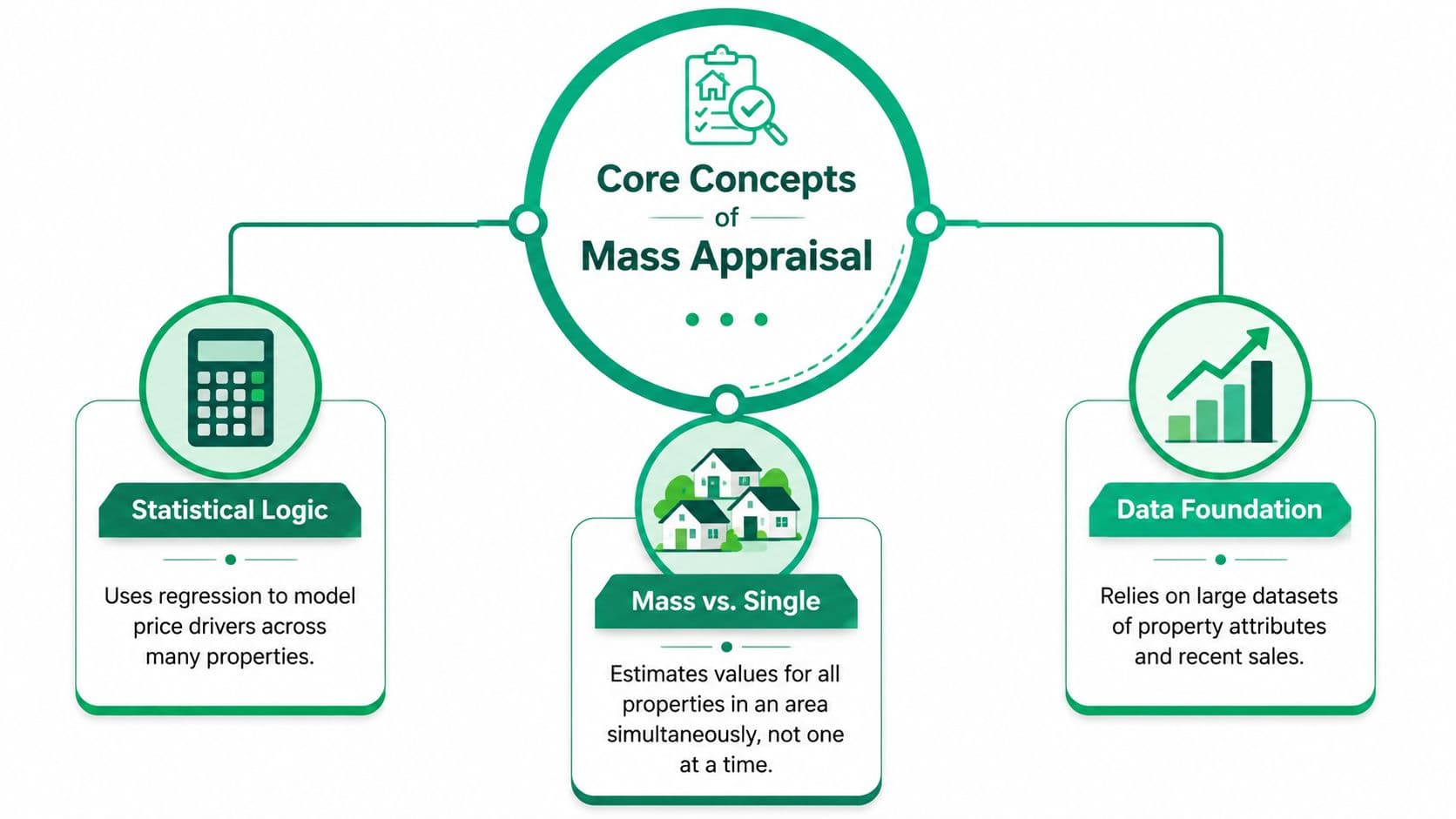
Mass appraisal estimates the value of many properties as of a common valuation date. A single-property appraisal focuses on one parcel and can investigate its particular condition, design, and market context. A mass appraisal system instead identifies patterns across a population, then applies those patterns consistently to properties with comparable characteristics.
The process begins with a data foundation. Analysts assemble property attributes, verified transactions, location variables, and property-type classifications. They then define a model that relates observed sale prices to those characteristics. The system produces estimates for groups of properties, and valuers test whether the results are reasonable and equitable.
Three model families
Hedonic regression treats a property as a bundle of characteristics. Living area, location, age, building quality, lot attributes, and other variables help explain observed prices. The model estimates the contribution of each factor while holding other factors constant. Policymakers often value this approach because the logic can be documented and discussed.
Repeated-sales models follow the same property across multiple transactions. Rather than comparing different properties directly, the method studies how the price of a particular property changes between sales. It can help isolate market movement, but it requires sufficient repeat transactions and careful treatment of renovations, changes in condition, and unusual sales.
Machine learning approaches search for complex relationships that may not fit a simple equation. A tree-based model, neural network, or ensemble can identify interactions between location, property attributes, and market conditions. That flexibility can help in heterogeneous markets, but it can also make the result harder to explain and easier to overfit.
The choice depends on the market and the evidence available. A stable area with well-defined variables may benefit from an interpretable regression model. A market with nonlinear location effects may justify machine learning, provided the jurisdiction has enough observations and strong holdout testing. A low-sales market may require conservative modeling because limited transactions weaken confidence in any statistical pattern.
Mass appraisal doesn't eliminate professional judgment. It organizes that judgment, applies it across the roll, and creates a framework for testing whether similar properties receive similar treatment. The field connects naturally with what land economics means for valuation policy, because the analyst must distinguish the value of the site from the value created by buildings, labor, and capital.
Data Requirements and Accuracy Benchmarks
Mass appraisal fails in the registry before it fails in the algorithm. If a property record describes an old extension, an incorrect parcel boundary, or a missing sale condition, even a well-designed model applies false inputs consistently. Reliable systems therefore begin with records that reflect properties as they exist. Core fields include living area, exterior wall height, building characteristics, land attributes, location, transaction details, and market dates. Geographic data can show neighborhood effects, access conditions, zoning influences, and other spatial relationships, provided parcel boundaries and classifications remain current.
Data quality needs operating rules, not general intentions. Continuous or measurement variables should be accurate within 5%, while coded categorical or binary fields should reach at least 95% accuracy, according to IAAO guidance on model development and data capture. Officials should turn those expectations into a data dictionary, field procedures, validation checks, correction logs, and escalation rules. Legacy systems often make this harder because definitions, identifiers, and update schedules differ across departments.
Reading the performance measures
A ratio study compares assessed values with indicators of market value. The median assessment ratio shows the general level of appraisal. A median below the accepted range suggests underassessment, while a median above it suggests overassessment.
Uniformity requires a wider view. The coefficient of dispersion, or COD, shows how far individual ratios vary around the median. The price-related differential, or PRD, helps identify whether lower- and higher-value properties receive different treatment. Each measure addresses a separate risk, so a jurisdiction should not rely on one fit statistic.
| Metric | Target range | What it measures |
|---|---|---|
| Median assessment ratio | 0.90 to 1.10 | Overall level of appraisal |
| PRD | Near 1.00 | Regressivity or progressivity across value bands |
| COD | Often in the low teens for broad property populations | Dispersion and uniformity |
These benchmarks are set out in IAAO mass appraisal guidance. Results outside tolerance can point to several different causes: an overdue reappraisal cycle, a flawed model, a problematic data segment, or market areas that no longer support calibration. A satisfactory median can coexist with unequal treatment if dispersion remains wide.
Protecting the validation process
Validation must use evidence the model has not already absorbed. Reusing the same sales for model development and ratio studies can make performance appear stronger because the model has effectively seen the answers. Holdout or later sales provide a more credible test, although limited-sales markets require officials to explain uncertainty plainly.
Machine learning increases the need for this separation. Independent validation should combine goodness-of-fit checks, holdout testing, and appraisal theory. Governance also matters: staff need documented approval steps, version control, and a record of corrections so reviewers can trace how an assessment was produced.
For policymakers building a site-value database, methods for calculating land value require a clear separation between land evidence and improvement evidence. That distinction supports consistent valuation and helps officials assess whether a later tax design distributes obligations fairly.
Comparing Traditional Models and Machine Learning Approaches
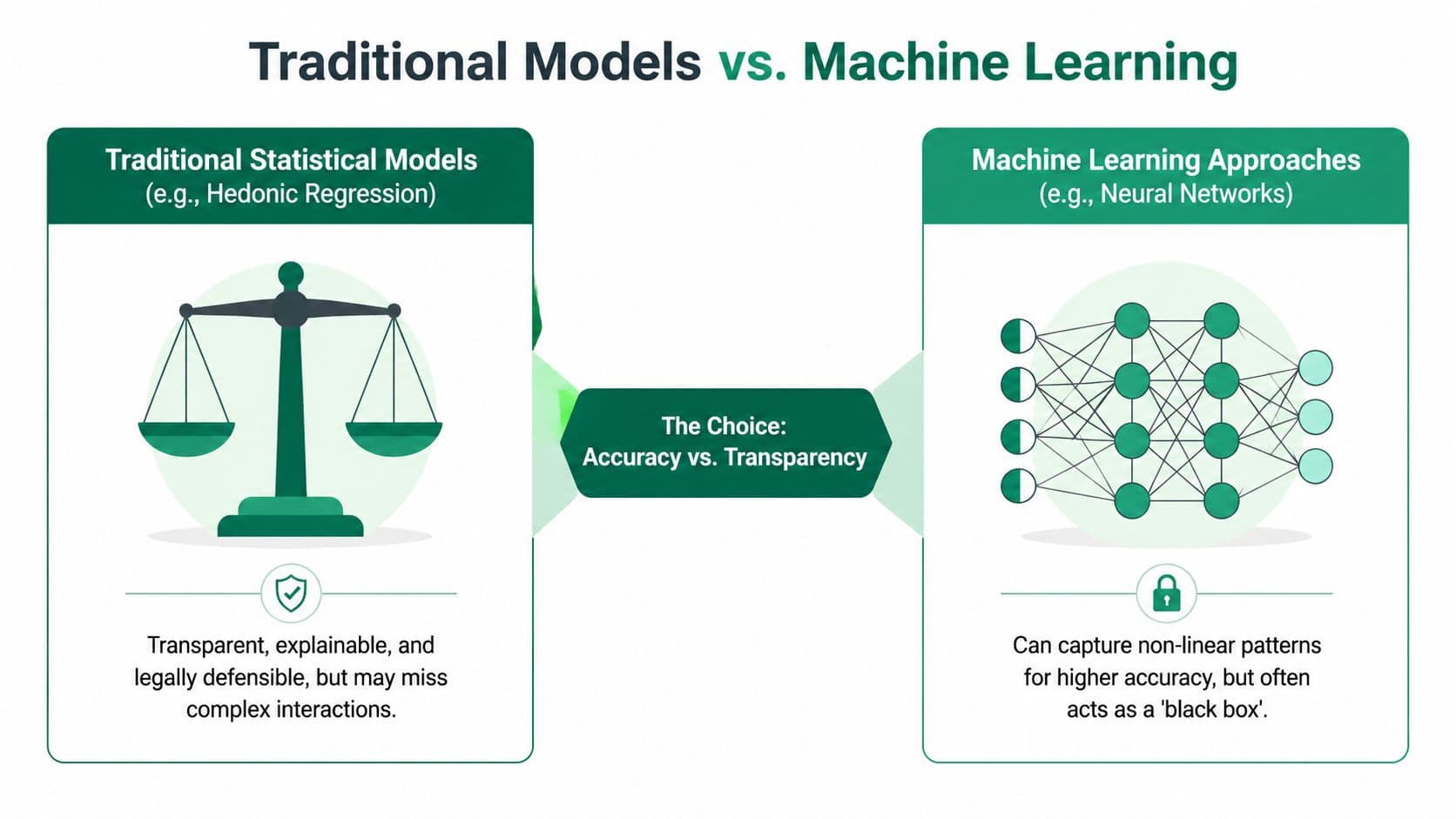
The decision between traditional statistical models and machine learning isn't a contest between old and new. It's a governance choice shaped by data volume, market complexity, legal requirements, staff capabilities, and the public's need to understand an assessment.
Hedonic regression offers a visible chain of reasoning. Analysts can document the variables, inspect coefficients, test assumptions, and explain why a location or property characteristic affects the estimate. That transparency supports review, appeals, and legislative oversight. Its limitation is rigidity. A poorly specified regression may miss nonlinear relationships or interactions among variables.
Machine learning can capture those relationships without requiring analysts to specify every functional form in advance. It may recognize that a feature matters differently across locations or property types. The trade-off is interpretability. A model can produce strong predictive results while making it difficult for a property owner or elected official to understand the path from record data to assessed value.
A practical comparison
| Decision factor | Traditional statistical models | Machine learning approaches |
|---|---|---|
| Explanation | Coefficients and rules are easier to communicate | Outputs may require specialized interpretive tools |
| Pattern detection | Strong when relationships are specified well | Can capture nonlinear and interacting effects |
| Overfitting control | Still necessary, but familiar to many analysts | Essential, especially with small samples |
| Governance burden | Easier to document in conventional formats | Requires model versioning, feature tracking, and explainability controls |
| Legal defensibility | Often supported by transparent reasoning | Depends heavily on validation and documentation |
The danger of overfitting grows in lower-sales markets, where small samples can make ratio studies less reliable. A model may fit historical observations closely while performing poorly on later transactions. Independent validation, sensitivity testing, and segment-level review are safeguards, not optional extras. Sensitivity analysis techniques can help officials identify which assumptions materially change the result.
A useful external reference point is the ability to compare Redfin home value estimates through RealtyAPI.io. Such comparisons can help analysts understand how different automated valuation outputs are presented, but a public assessment system still needs its own verified data, statutory framework, and audit trail. A consumer-facing estimate and a tax assessment serve different purposes.
Recent public-sector work shows the frontier moving toward granular land valuation using supervised and unsupervised AI. That direction is promising, but procurement should begin with documentation, data ownership, validation rights, and staff training. Officials shouldn't buy an opaque model before deciding how they'll govern it.
Mass Appraisal and Land-Value Taxation Systems
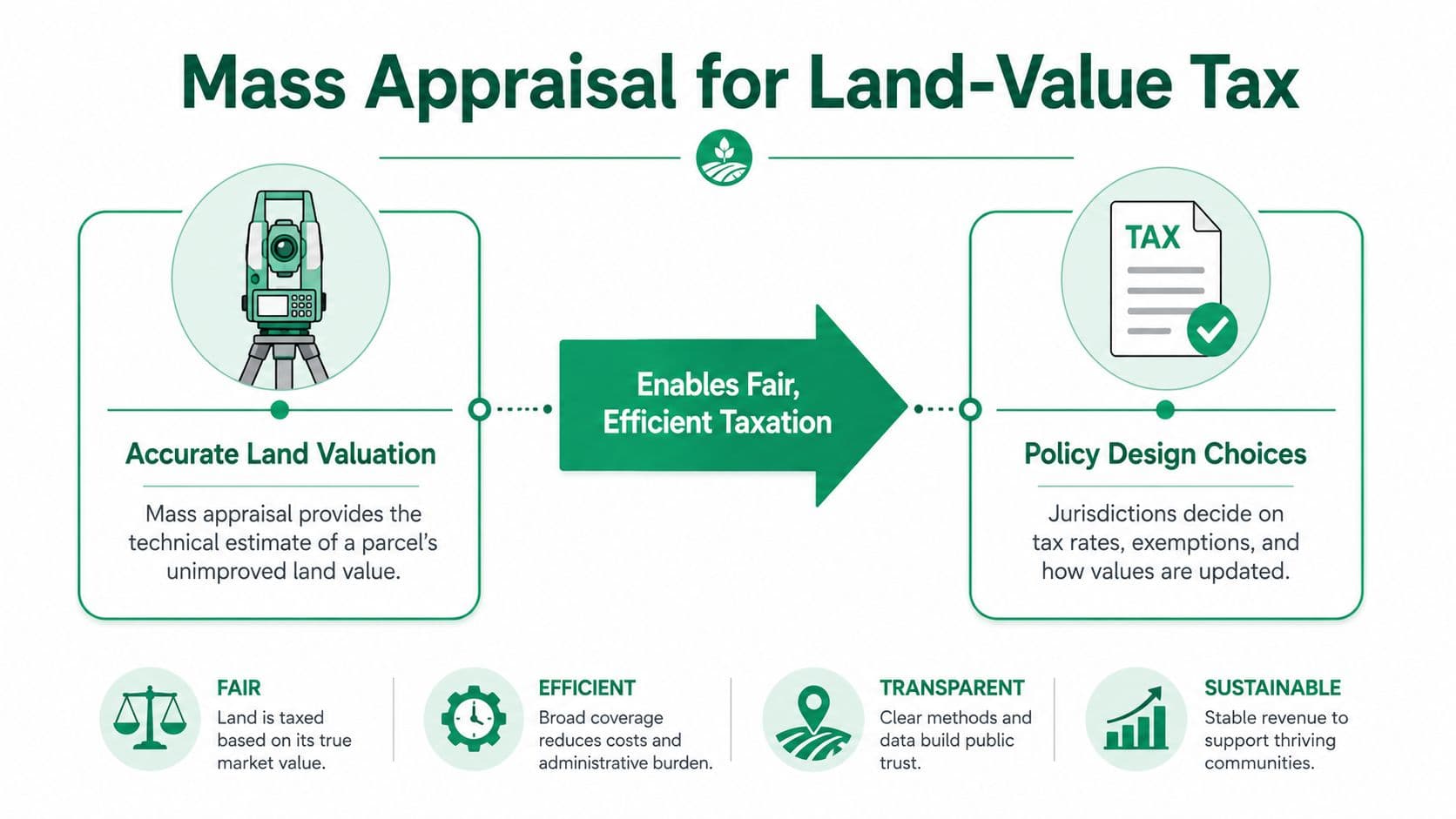
Mass appraisal can supply the evidence needed for a land-value tax, but valuation and policy aren't the same decision. Land-value taxation applies a levy to unimproved land, meaning the tax base is the site's value and excludes buildings and other improvements. The valuation office estimates the base. Legislators decide rates, exemptions, collection rules, and transition arrangements.
That distinction matters because land can be priced through several different institutional mechanisms. A tax on site value is a public charge on the underlying location. A land lease is a contractual arrangement that grants use for a defined term, usually at a fixed price. A land-use right is a separate tenure structure whose economic value and renewal or repricing rules depend on the governing system.
Fixed leases postpone risk
Land leases can be renewable or non-renewable fixed-term contracts with a fixed price. A renewable lease provides certainty during its term, but that certainty ends at renewal. If the contractual rent falls below the market level, the gap can accumulate until the parties close it through a major repricing. The lease has postponed risk rather than correctly priced it.
A non-renewable lease creates a different problem. As the remaining term shortens, buyers and lenders may find the asset harder to finance, refinance, or sell. The fixed price doesn't continuously reflect changing land conditions, so the market must account for the unresolved risk through the lease's remaining duration.
New Zealand provides a concrete example. Under the New Zealand Land Act 1948 renewable lease structure, a renewable lease lasts 33 years, with a perpetual right of renewal for the same term. The initial annual rent for the first 11 years is 4.5% of the land's rental value as determined by the Board, and rent is re-determined for later periods. The structure illustrates how a fixed payment can offer stability, then expose the parties to repricing at a reset.
Land-use rights and site-value charges
China's system demonstrates time-limited land-use rights rather than indefinite ownership. Residential rights are commonly granted for 70 years, industrial rights for 50 years, and commercial rights for 40 years. Sales of those rights are described as term leases of land-use rights, with lease payments going to government revenue, and the associated dataset contains more than 3 million parcel-level observations from 2000 to 2022. The MIT material on China's urban land system shows why duration is central to the economics of these markets.
The claim that land-use rights are indefinite leases needs careful qualification. In some systems, perpetual usufruct or comparable rights are repriced periodically from current land value. A peer-reviewed analysis reports that annual fees can be updated using a fixed percentage of current market value, with updates occurring no more than once every three years. The analysis of ground lease pricing and perpetual usufruct fees demonstrates the key mechanism: periodic repricing keeps the charge connected to market land value rather than freezing it for the full tenure.
For a plain-language comparison, this insight on home valuation helps distinguish valuation concepts that are often confused. The policy distinction remains decisive: a land-value tax targets unimproved site value, a fixed lease charges a contractual rent for a term, and a periodically repriced land-use right links payment more closely to current land value. The comparison between land-value tax and property tax clarifies why excluding buildings can change incentives for construction and productive use.
Implementation Readiness and Modernization Steps
A jurisdiction should assess readiness before selecting a model. The central question is whether officials can maintain a trustworthy flow of parcel data, market evidence, model decisions, and public explanations.
Start with the records
Create a single data dictionary for every field used in valuation. Define what counts as living area, how exterior wall height is measured, how property condition is coded, and which sales are excluded from calibration. Then assign ownership for correcting each field and retain a change history.
A practical readiness review should ask:
- Data stewardship: Can staff identify the source, age, definition, and responsible owner for every material variable?
- Market evidence: Can analysts verify whether a transaction reflects an arm's-length market exchange and record the reason for excluding unusual sales?
- Spatial integrity: Do parcel boundaries, addresses, land-use codes, and geographic layers align across the CAMA system and GIS?
- Quality control: Does the workflow flag missing, contradictory, or improbable records before they enter the model?
- Appeal handling: Can the agency trace an assessment back to the input records, model version, and review decision?
Modernize the institution, not just the software
Replace undocumented manual adjustments with controlled procedures. Version model specifications, preserve prior assessment rolls, record approvals, and require independent validation before production use. Staff training should cover data collection, statistical interpretation, model limitations, and communication with owners, not merely button-clicking in a vendor platform.
Recent UK guidance emphasizes that large-scale valuation depends first on accurate property and sales data, with analysts and valuers collaborating to build and refine models. That collaboration should be designed into the workflow. Analysts understand statistical behavior, valuers understand market context, and field staff see the property conditions that administrative records miss.
Public communication also needs structure. Publish plain-language explanations of the valuation date, key inputs, review process, and appeal evidence. Give owners a defined route to correct factual records, while applying approved corrections consistently across comparable properties.
Only after these foundations work should a jurisdiction consider more advanced land-specific modeling. A useful modernization sequence is clean the roll, standardize definitions, establish governance, validate the current model, train staff, publish explanations, then test advanced methods. The model becomes more valuable when the institution can tell people how it works and prove that it treats comparable properties consistently.
Real-World Precedents and the Future of Valuation
International precedents show that mass appraisal is shaped by institutions as much as by algorithms. The next challenge is building systems that can update parcel values consistently when records, tenure rules, and administrative responsibilities differ across jurisdictions.
Recent Welsh procurement testing of supervised and unsupervised AI for granular land valuation points toward stricter validation standards. Future procurements may require agencies to test models against representative parcels, document failure cases, compare results with established methods, and show how human reviewers resolve disagreements. The important shift is procedural: AI would be assessed as part of a public valuation service, not as a software feature that can be accepted without scrutiny.
Parcel-level valuation also requires institutional reform. Agencies may need shared data standards across tax, planning, and land registries, clear authority for correcting records, and funding for recurring model review. Legacy systems often store ownership, use, and building information in incompatible formats. Without a common structure, even a well-designed model produces uneven treatment.
Transparency rules could change public engagement as well. Governments may face stronger expectations to publish model documentation, identify the inputs that affect values, and explain how automated assessments can be challenged. Public trust will depend on whether those explanations help owners detect errors and officials correct them consistently.
Unitism® helps governments and civic organizations design land-value assessments, data frameworks, policy models, and implementation workflows that connect valuation with practical land-based reform. Visit Unitism® to explore plain-language resources and advisory support for building a transparent, defensible land valuation system.