Explore the Rondo Community Land Trust, its anti-displacement mission, housing and commercial projects, and how its CLT model creates lasting affordability.
August 6, 2026
Rondo Community Land Trust: History, Model, and Impact
Explore the Rondo Community Land Trust, its anti-displacement mission, housing and commercial projects, and how its CLT model creates lasting affordability.

A concrete fix can tell you a lot about a neighborhood's politics. In St. Paul's Rondo area, the answer to displacement was not just a housing program, it was a land trust built to keep land out of speculation and keep local people in place.
Table of Contents
- The Displacement That Sparked a Land Trust
- How the Community Land Trust Ownership Model Works
- Rondo CLT Growth and Portfolio Expansion
- Affordable Commercial Space for Small Businesses
- Measuring Anti-Displacement Outcomes
- Land-Value Reform and Municipal Finance Connections
- Getting Involved and Accessing Resources
The Displacement That Sparked a Land Trust
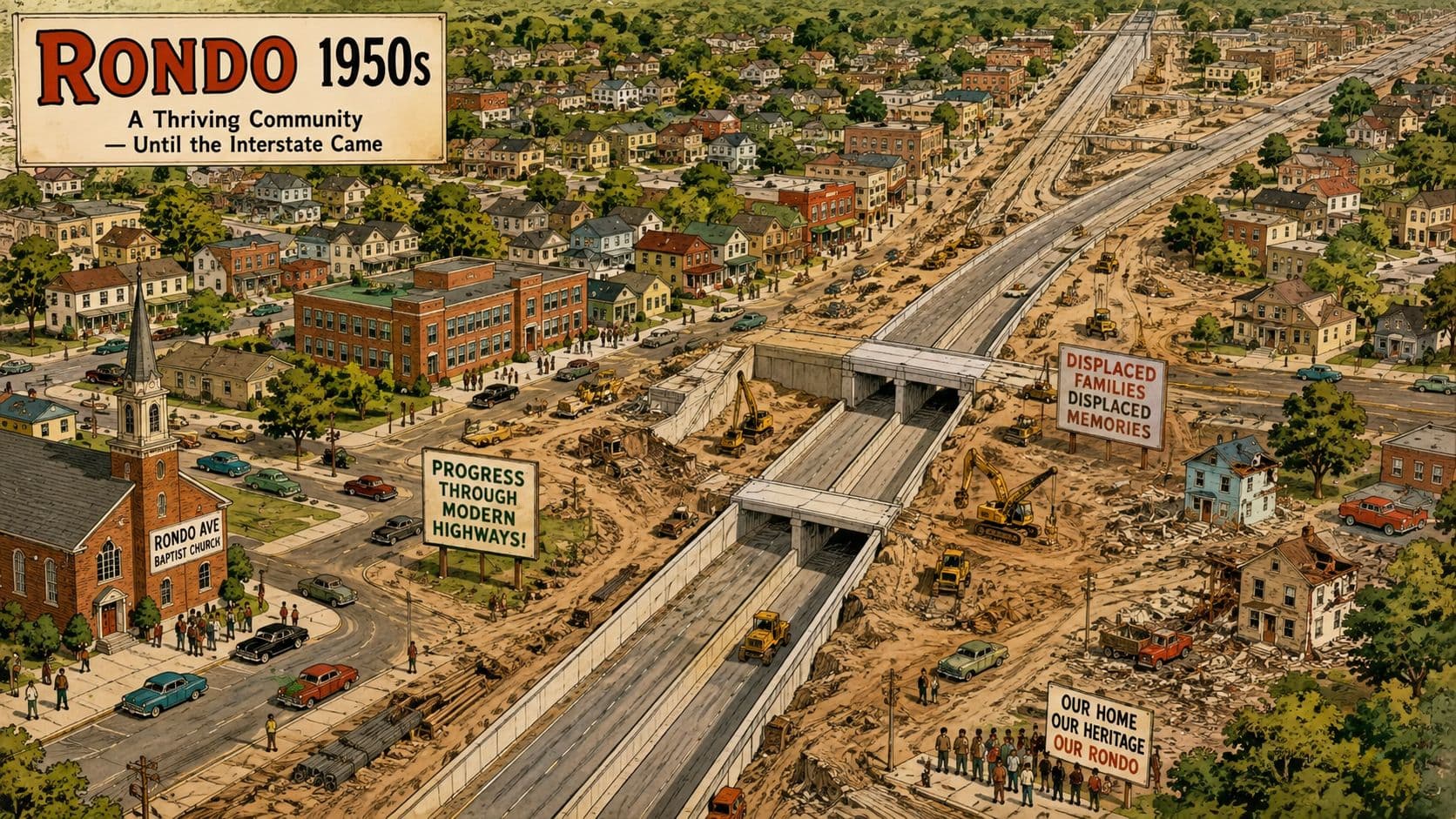
Rondo's story starts with loss. Highway construction cut through a thriving Black neighborhood in St. Paul, breaking apart homes, businesses, and the social networks that made daily life work. The community response was not to accept permanent erosion, but to create an institution that could hold land for the long term and protect access for people who had already been pushed aside.
Rondo Community Land Trust was formed in 1993 in response to that displacement and began providing permanently affordable housing in St. Paul through the community land trust model. A later university case study found that it had grown to about 60 homes, with roughly half located in the original Rondo neighborhood (university case study). That footprint is modest compared with citywide housing systems, but its location matters because it ties the organization directly to the geography of harm.
Why the origin story still matters
Planners sometimes treat displacement as a chapter that ends once a project is completed. Rondo shows the opposite. The neighborhood's history still shapes where housing is built, who the trust tries to serve, and why reparative language appears so often in its public materials.
The point is not nostalgia. It is continuity. When a community loses land to a highway, then loses market stability to rising costs, a land trust becomes a way to reconnect policy with place rather than letting the next cycle of reinvestment repeat the last one.
For readers comparing models of neighborhood repair, understanding why housing is unaffordable helps explain why land-based interventions matter so much. If you also need a practical screening framework for housing access, trust and screening standards can be useful for thinking about fairness and accountability in resident selection.
Practical rule: If a housing tool does not change the rules around land, it usually cannot change displacement very much.
That is why Rondo's mission reads differently from a standard affordable housing program. It is not just trying to add units, it is trying to prevent the same land from being priced out of the same community again.
How the Community Land Trust Ownership Model Works
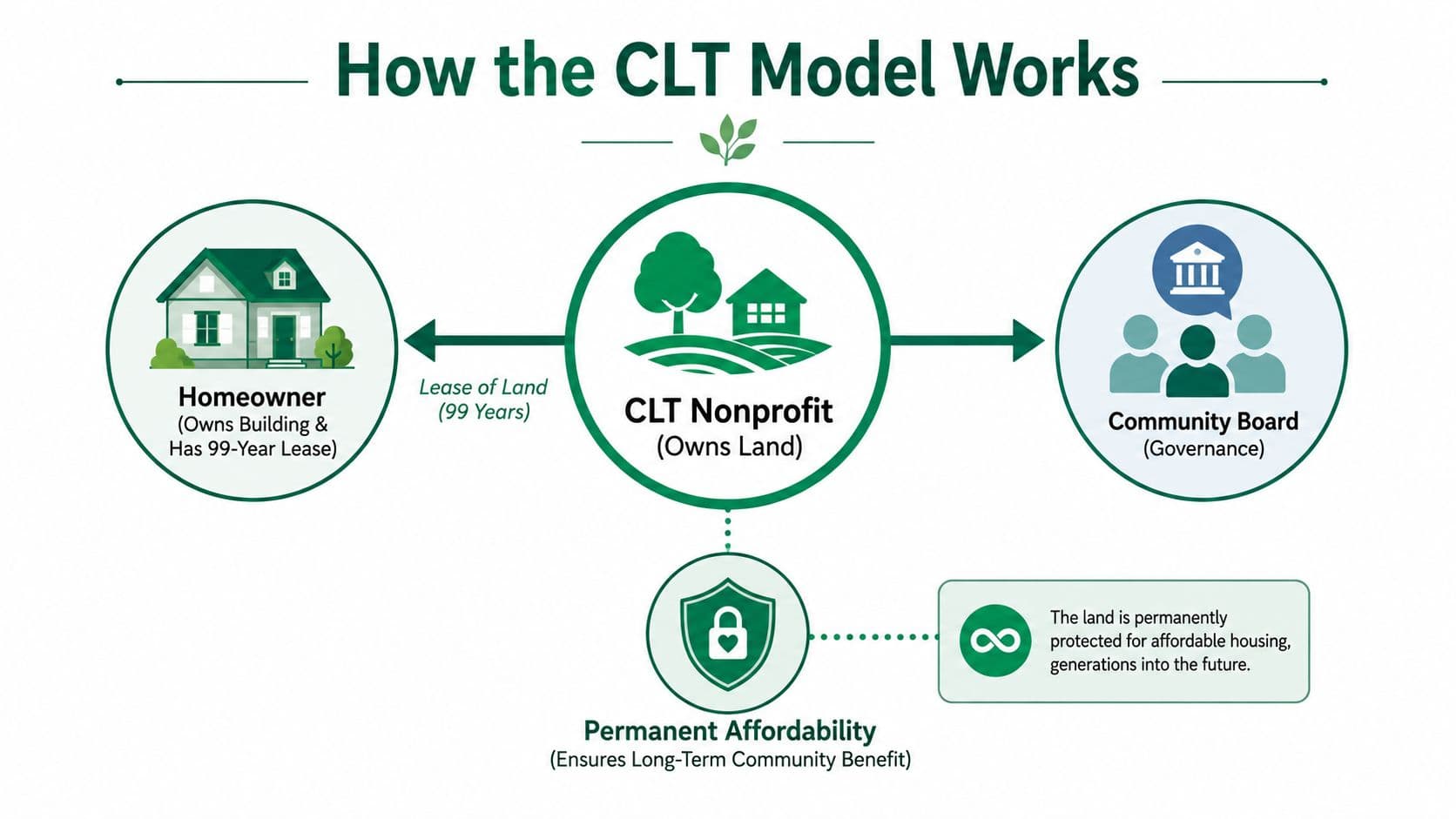
A community land trust works by splitting what people usually think of as one package. The nonprofit owns the land. The resident buys the building or other improvements on top of it, then signs a 99-year ground lease with resale restrictions that keep the unit affordable for the next buyer (Rondo CLT about us). That structure looks unusual at first, but it is the core reason the model can preserve affordability over time.
The simplest way to think about it
Think of it as buying a house while leasing the ground beneath it from a guardian who promises never to sell the land into speculation. You still get the practical benefits of ownership on the structure, including mortgage finance on the home itself, but you do not have to purchase the land at full market price. That lowers the entry cost and keeps a one-time subsidy from disappearing after the first sale.
The lease matters as much as the ownership split. It sets the long-term rules, including how resale works, so that affordability is not a temporary discount. Instead, the home stays in a controlled affordability pool for future buyers, which helps a public subsidy reach more than one household over time.
Why this differs from conventional ownership
Conventional homeownership bundles land and structure together. When land values rise, the owner captures that gain, but the next buyer also pays more. In a CLT, the land is removed from that speculative cycle. That does not erase market pressure, but it does change how value is shared and who gets to keep using the property.
For municipal planners, that distinction is the key policy insight. A CLT does not rely on permanent public operating subsidy to hold down rent in the way some rental programs do. It uses land control, resale limits, and nonprofit stewardship to preserve affordability as an asset class, not just as a short-term service.
A guide to how a land bank works can help clarify how public land control differs from CLT stewardship, even when the policy goals overlap. And if you want a deeper look at the governance side of this model, Homestead Community Land Trust offers a useful point of comparison for shared-equity housing.
The key question is not whether residents can build stability. It is whether the rules keep that stability in the neighborhood after the first sale.
That is where Rondo's structure becomes more than a financing trick. It turns ownership into a community asset with a built-in anti-speculation rule.
Rondo CLT Growth and Portfolio Expansion
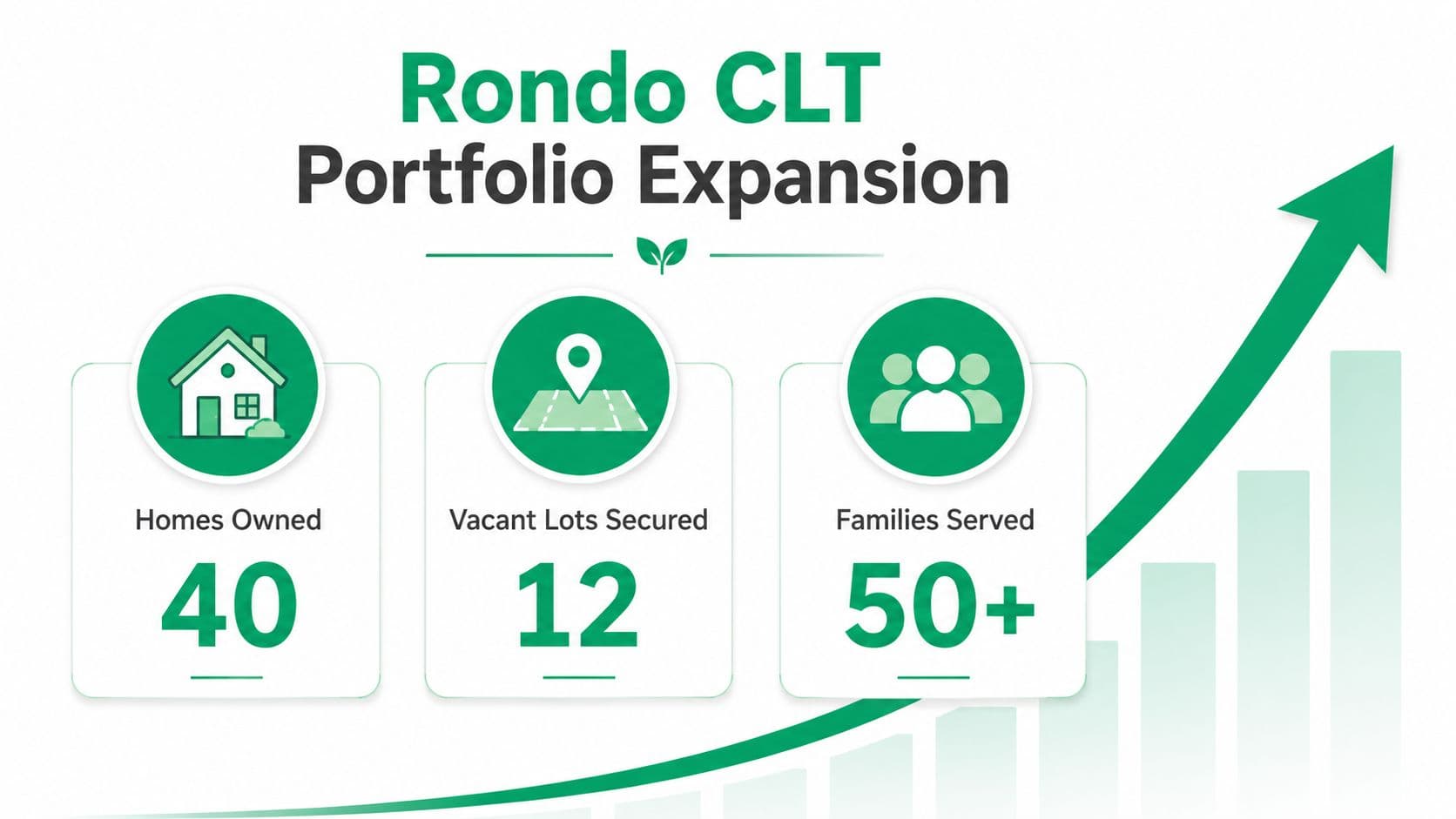
Rondo's growth makes sense only when you look at it as an institution, not as a single project. A Minneapolis Fed profile says its annual operating budget grew from $300,000 to more than $9.8 million, it raised over $30 million for community development, added 160 housing units, and created 45,000 square feet of commercial space (Minneapolis Fed profile). Its own site reports 153 permanently affordable housing units and 20+ additional units under construction.
For planners, those numbers do more than signal size. They show an organization with enough administrative capacity to manage development, asset stewardship, and partnerships over time. They also suggest that Rondo is no longer only preserving scattered homes, it is holding a portfolio that can shape neighborhood conditions.
The commercial square footage matters for the same reason. It shows that affordability policy is not limited to bedrooms and kitchens. When a land trust also preserves business space, it can influence the daily life of a corridor, not just the housing market around it.
Reuse, rehab, and land stewardship
Rondo's building-move and rehab program gives another view of scale. Community Wealth reports that the program has moved 12 buildings, created 15 housing units, and diverted more than 15 million pounds of waste from landfills (Community Wealth). That is a concrete example of how a land trust can treat existing structures as assets worth preserving rather than discarding.
Data clue: In land policy, scale is not only about how many units get built. It is also about how many existing assets a group can bring back into use.
That matters for city budgets, too. Reuse can complement new construction, especially in neighborhoods where every new project carries political and physical tradeoffs. For readers comparing public land tools, a guide to how a land bank works helps show how public land control differs from CLT stewardship, even when the policy goals overlap.
Rondo's expansion suggests a model that mixes preservation, development, and commercial stewardship instead of relying on only one delivery strategy. The result is a portfolio that looks more like neighborhood infrastructure than a simple housing inventory. That is why planners often find CLTs useful to study, even before they are ready to replicate the model at full scale.
Affordable Commercial Space for Small Businesses
A renovated storefront can keep a block alive just as surely as a preserved house can keep a family rooted. Rondo makes that point plainly, because its work is not limited to homeownership. It also holds space for businesses, and that matters in neighborhoods where commercial rent increases can push out the shops, services, and gathering places that give a corridor its identity.
The Selby Milton Victoria Project as a business case
Rondo CLT and Trellis Co. completed the Selby Milton Victoria Project in 2015, building two mixed-use buildings that included 9,300 square feet of affordable commercial space along with affordable senior housing (Anti-Displacement Project profile). The commercial space is leased to small local and BIPOC-owned businesses at below-market rates of about $7 per square foot.
The practical effect is easy to miss if the conversation stays focused on housing alone. The trust is shaping where people work, shop, and build neighborhood income, not just where they live. For a corridor marked by historic displacement, that can mean the difference between a stable local business base and a block that turns over every time rents climb.
That commercial role also helps explain why some community land trust work feels different from standard redevelopment. Business owners need predictable overhead so they can hire staff, order inventory, and make improvements without fearing that a lease renewal will erase those investments. Residential models often get more attention, but a storefront that stays affordable can anchor daily life in the same way a home can anchor a household.
Why commercial affordability is harder to explain
Residential CLTs are easier to describe because the basic idea, shared equity, is familiar. Commercial affordability is more complicated because a business depends on rent, foot traffic, access to capital, and lease length at the same time. Rondo's public materials say it preserves permanently affordable commercial space, yet the operating details are still less visible than the housing side, which leaves planners and advocates with a real information gap.
A useful way to read that model is through land-value capture. The question is whether rising land value is being held for neighborhood use or pulled into speculative ownership. Rondo keeps that value conversation local, which is why its commercial strategy deserves attention alongside its residential one.
Commercial affordability is strongest when rent stability is treated as infrastructure, not as charity.
That point also helps readers looking for how to find affordable housing understand the broader policy logic. A neighborhood that protects homes but loses its storefronts still loses part of its social fabric, because residents then face longer trips for basic goods and fewer chances to support local ownership. Rondo's approach shows that a CLT can preserve economic space as well as residential space, which is especially important in mixed-use areas under pressure from rising land costs.
Measuring Anti-Displacement Outcomes
Rondo's reparative mission is clear. What is less clear, from the public record, is whether that mission has been measured with the same rigor as the housing it produces. Recent coverage says the organization is applying a reparative framework, centering right-to-return for people displaced by historic redevelopment, and serving households up to 80% area median income (Rondo coverage). That is an important commitment, but mission statements are not the same thing as longitudinal outcomes.
What we can say, and what we can't
The public materials do not show cumulative numbers for household retention, business retention, net wealth gains for CLT homeowners, or how many formerly displaced residents have returned. That gap matters because anti-displacement is a measurable claim, not just an ethical one. If an organization says it is repairing harm, planners should want to know how much harm has been reversed, slowed, or not repeated.
A distributional lens helps. A policy can preserve affordability and still leave the deeper displacement story unresolved if the people most affected never return or cannot stay long enough to benefit. For a compact discussion of that issue in public policy terms, distributional analysis is the right framework.
The harder question for the CLT field
Community land trusts are often praised for keeping homes affordable and reducing speculative turnover. That is real, but neighborhood repair is a bigger test. The question is whether a CLT at the scale of a historic displacement zone can materially reverse the social and economic losses that followed redevelopment, or whether it mainly slows further loss.
If you are looking for housing access rather than ownership policy, how to find affordable housing can help frame the resident search process, but it does not answer the deeper evaluation problem. Rondo's own story makes that distinction clear. The organization's work is significant, yet the public evidence still leaves room for better measurement.
A reparative housing model deserves reparative data, not just reparative language.
That is the most important policy takeaway here. Cities that fund or partner with CLTs should ask for outcomes over time, not just unit counts. Without that, everyone is left guessing how much displacement was undone.
Land-Value Reform and Municipal Finance Connections
Rondo sits inside a broader policy conversation about how land should be priced, taxed, and shared. For municipal finance teams, the parallel is useful. A community land trust does at neighborhood scale what land-value reform tries to do at system scale, it reduces the reward for speculative holding and keeps more value tied to use rather than windfall appreciation.
Where CLTs and land-value taxes meet
Land-value taxes capture the rental value of land for public benefit while reducing taxes on buildings and productive work. That logic overlaps with CLTs because both approaches try to separate land value from the rest of property value. In Rondo's case, the nonprofit holds land permanently, which means the land itself is not treated as a speculative asset for resale.
That overlap should not be confused with land-use rights. Land-use rights are land leases that are repriced annually with no expiration dates, and because they are repriced annually, people can buy and sell them for a low cost. They differ from land-value taxes, which are a public revenue tool, not a tradable lease structure. The distinction matters because one is a tax policy and the other is a tenure arrangement.
For planners and budget staff, the common thread is value recovery. If land gains are socially produced, whether by transit investment, zoning change, or neighborhood reinvestment, public institutions have options for sharing that value more fairly. CLTs are one of those options, especially when the goal is direct anti-displacement rather than general revenue capture.
Why this comparison matters for cities
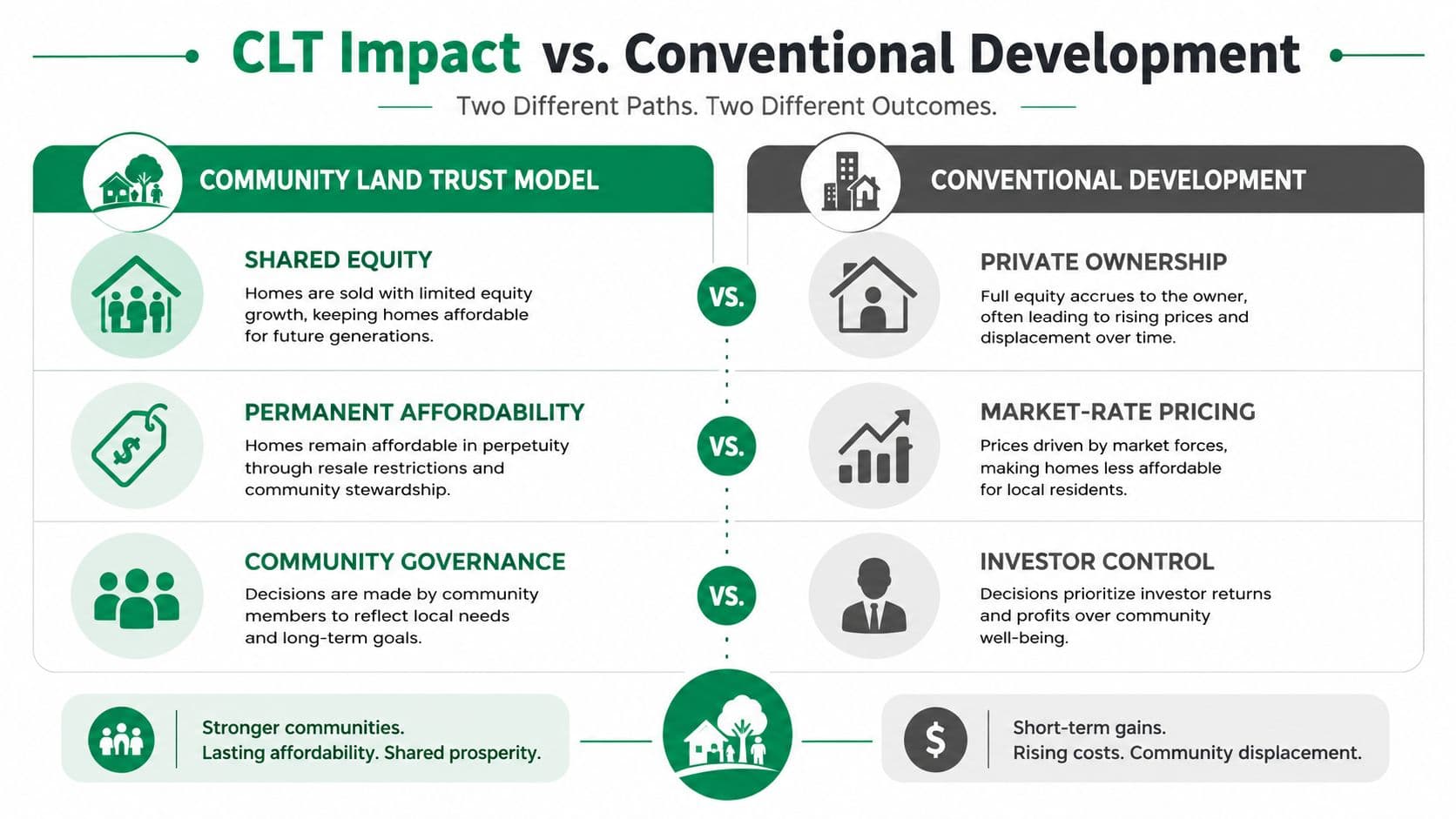
Conventional development usually maximizes private ownership and market-rate pricing. A CLT like Rondo uses shared equity, permanent affordability, and community governance instead. That difference does not just affect who benefits from appreciation, it affects whether neighborhoods can hold onto residents and businesses when land values rise.
The larger lesson is simple. If a city wants more than temporary affordability, it has to think about land control, not only subsidy size. Rondo is one practical example of that principle in action.
Getting Involved and Accessing Resources
If you are a resident, the first step is to look at Rondo CLT's public materials and housing information directly on its website (Rondo Community Land Trust). If you are a small business owner, focus on the commercial affordability side as well, because that is where the trust's mixed-use strategy becomes most visible.
Practical ways to engage
- Residents and homebuyers: Review the organization's housing model, then ask how the ground lease, resale rules, and eligibility standards fit your long-term plans.
- Business owners: Ask specifically about commercial space availability, lease duration, and how rent stability is structured for tenants.
- Researchers and planners: Compare Rondo's reported portfolio growth, commercial space preservation, and anti-displacement framing against the outcomes you would want to measure over time.
- Donors and civic partners: Look for projects that combine housing, commercial space, and rehabilitation, since that is where Rondo's model appears most distinct.
If you want a broader policy context for neighborhood affordability and land economics, Unitism® offers research, policy design, valuation methods, education, and implementation support for land-based fiscal reform. It's a useful place to turn when you want to connect housing, municipal finance, and anti-speculation policy without losing the details. Visit Unitism® to explore how land-value reform tools can support the same kind of long-term affordability work Rondo Community Land Trust is advancing.