Learn the economics of infrastructure — how investment lifts land values, drives growth, and funds public finance through land value capture.
September 23, 2026
Economics of Infrastructure and How It Shapes Land Value
Learn the economics of infrastructure — how investment lifts land values, drives growth, and funds public finance through land value capture.
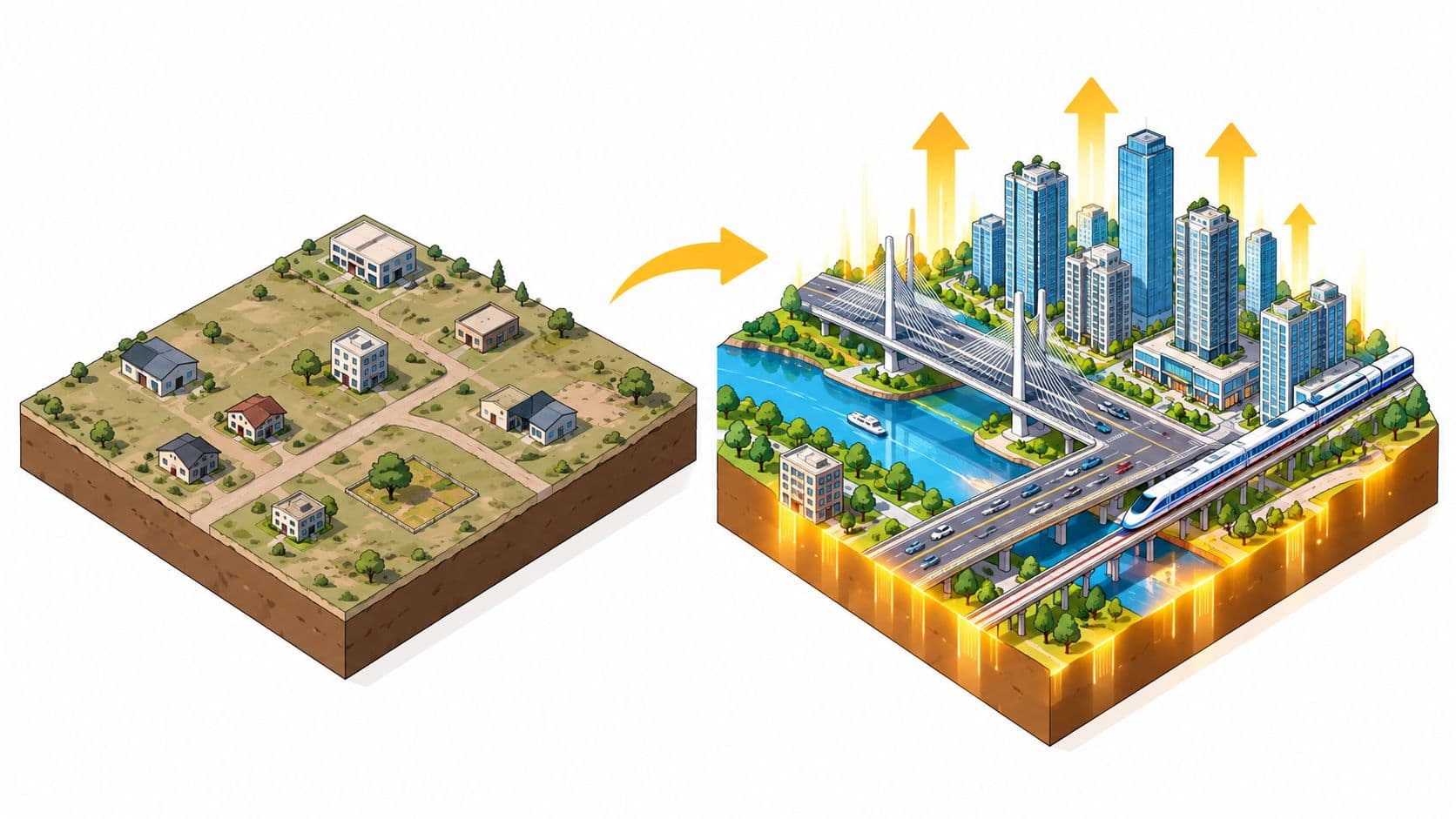
You know the moment. A new road opens, a rail stop begins serving commuters, or a utility upgrade finally reaches a district that's been sitting underused for years. Before a single new building goes up, the ground around it can feel more valuable, because access, convenience, and future possibility have changed.
That's the heart of the economics of infrastructure. It isn't only about concrete, steel, or wires. It's about how public works change the value of places, who captures that value, and whether public finance can recover part of it fairly and predictably. For a useful companion piece on another utility sector, the logic behind water utility funding and valuation shows how valuation questions shape investment choices beyond transport and roads.
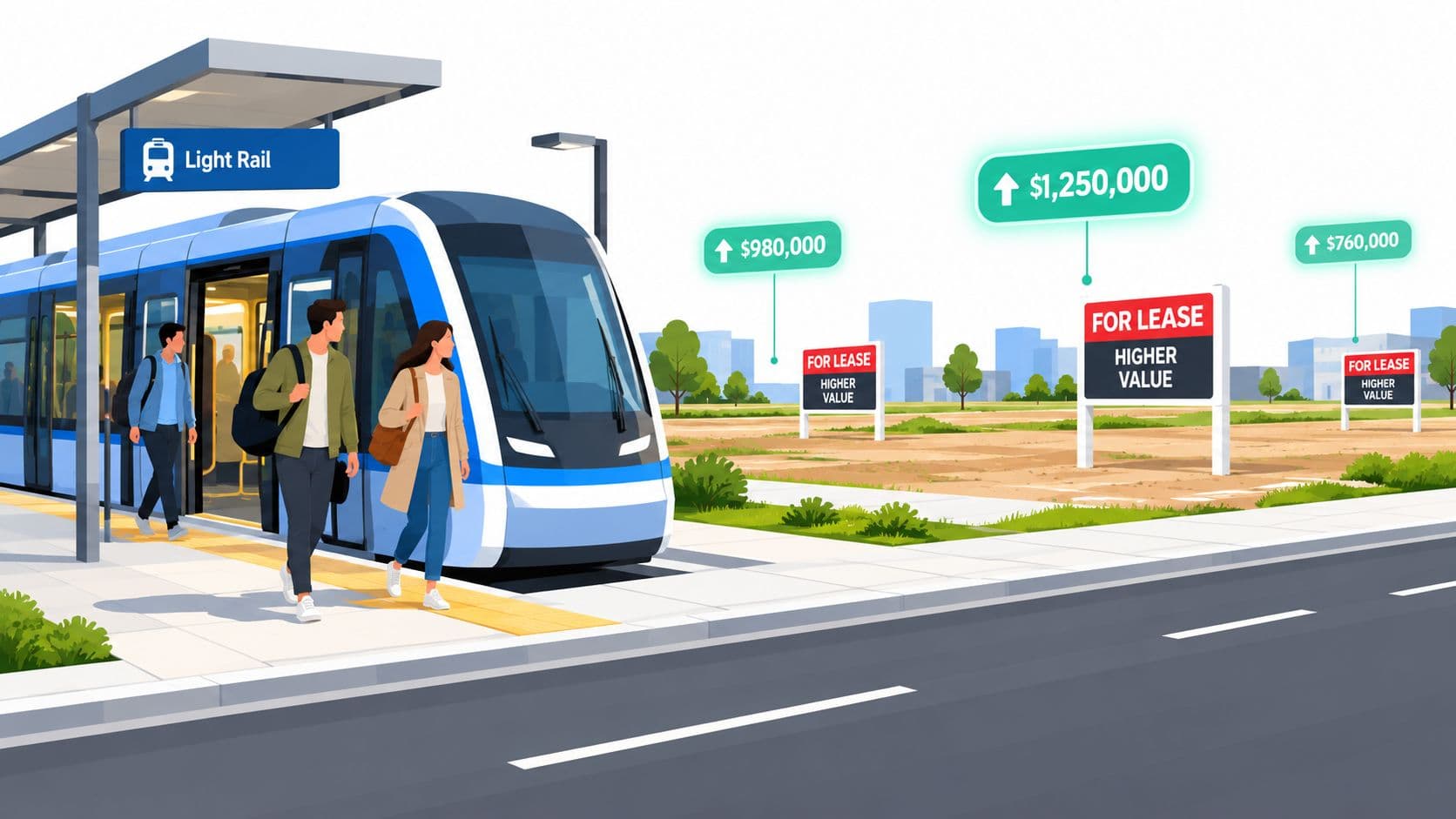
For readers who want a simple reference point, the basic idea of land value is captured well in this Unitism overview of land value. The key is that infrastructure often changes the worth of the site itself, not just the structures sitting on it.
Table of Contents
- Introduction Why Infrastructure Economics Matters Now
- Understanding Tri-Factor Economics and the Role of Land
- How Infrastructure Creates Value and Lifts Land Prices
- The Scale and Timing of Infrastructure Investment
- Comparing Land-Value Tax Land Leases and Land-Use Rights
- From Uplift to Public Finance Who Pays Who Benefits and When It Pencils Out
- Conclusion Building Stable Public Finance With Land Value
Introduction Why Infrastructure Economics Matters Now
A transit extension is approved, and nearby parcels quickly draw interest from developers, tenants, and speculators. The buildings may be unchanged, yet the sites can support easier travel, broader customer access, and new development options. Infrastructure finance therefore concerns land and public revenue as much as engineering.
Global estimates point to more than US$100 trillion in infrastructure needs through 2040, led by transport and logistics, energy and power, digital systems, social infrastructure, water and waste, agriculture, and defense. The breakdown assigns US$36 trillion to transport and logistics, US$23 trillion to energy and power, US$19 trillion to digital infrastructure, US$16 trillion to social infrastructure, US$6 trillion to water and waste, US$5 trillion to agriculture, and US$2 trillion to defense. The World Bank working paper provides the underlying estimate.
The public question is straightforward: if public funds or regulated utility revenues improve a place, who receives the gain, and who should contribute to the cost? A road, rail line, port, power system, or digital network may produce different operating revenues, but each can raise the usefulness of nearby land. That increase may appear in land prices before it appears in new buildings or business activity.
A similar valuation problem arises in water utility funding and valuation, where investment decisions depend on separating service assets from the value they create.
Practical rule: when a project makes a site easier to reach, serve, or develop, some of its benefit usually appears first in the site's value.
For a plain-language reference, this overview of land value explains why the site itself can gain value even when its structures remain unchanged.
Understanding Tri-Factor Economics and the Role of Land
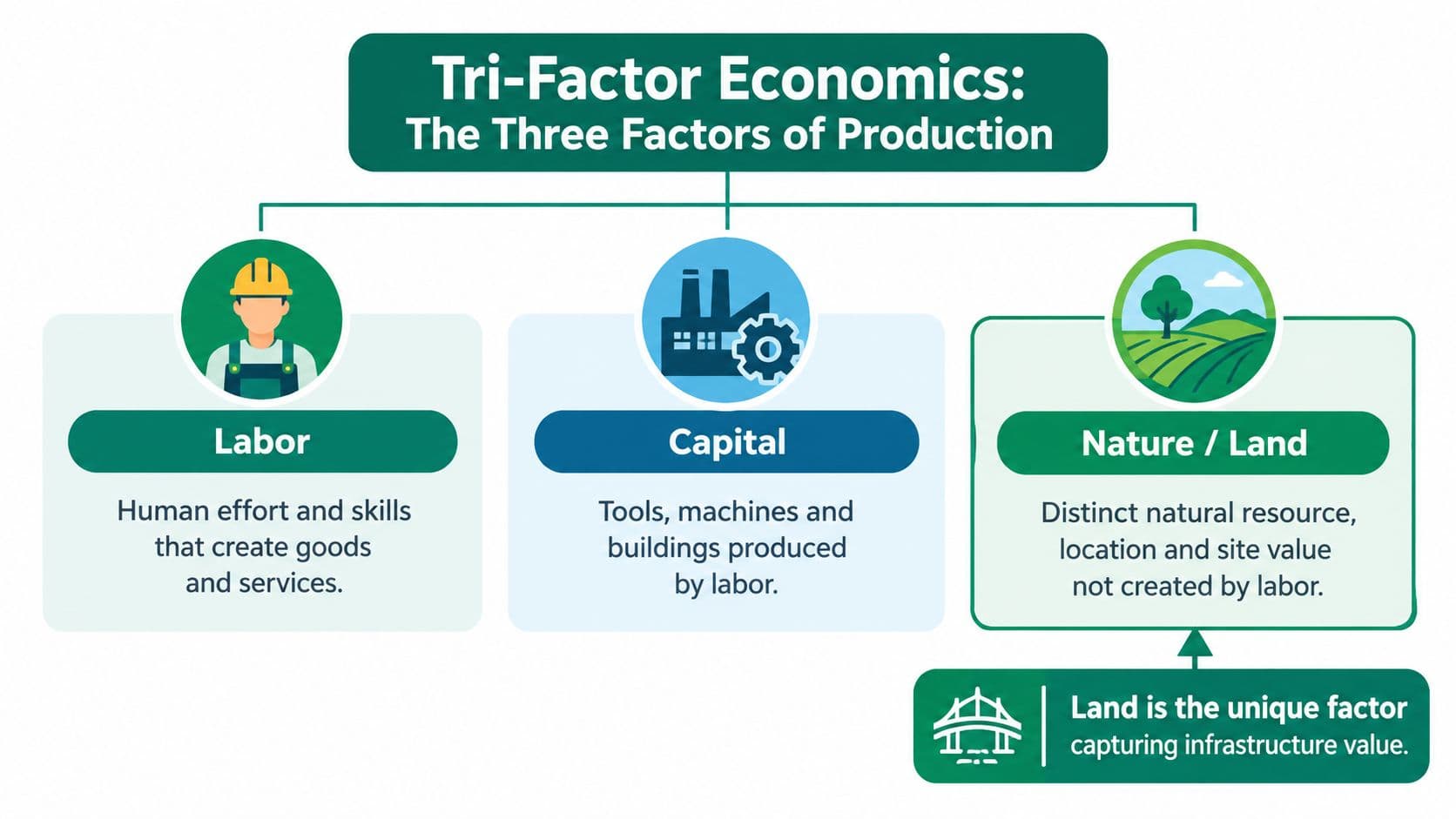
A clean way to separate the pieces is to treat production as three different factors, labor, capital, and nature / land. Labor is people's effort and skill. Capital is the tools, machines, and buildings created by labor. Nature or land is the site itself, the location, the ground, the access, and the natural setting that no one manufactured.
Think of a bakery. The baker's skill is labor, the ovens and counters are capital, and the corner lot near steady foot traffic is land. If the city upgrades the road outside, the oven doesn't get better just because traffic is smoother. What changes is the site's usefulness, which is why land value can rise even when the building is unchanged.
That distinction matters because infrastructure usually works on the land side of the equation. A new station, utility line, bridge, or road doesn't become part of the building's productive equipment in a simple way. Instead, it improves the site's access and usability, which is why the economic benefit often shows up as a higher rental value for location. For a compact reference on this framework, Unitism's land, labor, and capital overview is a useful companion.
Why this separation solves common confusion
Many policy debates blur the site and the structure together. That leads to bad questions, like asking whether a road “pays for itself” only through tolls or fares. The more important question is whether the road raises the value of nearby sites enough that part of that uplift can be recovered for public use.
Useful check: when people talk about “development benefits,” ask whether they mean the building, the business, or the location. Those are not the same thing.
The tri-factor lens also explains why land behaves differently from output. You can produce more goods with better machinery or more skilled workers, but you can't produce more of a specific site in the same way. That scarcity is why infrastructure-driven access gains matter so much in public finance.
How Infrastructure Creates Value and Lifts Land Prices
A new rail stop can change a neighborhood before a single building changes. Workers reach more jobs, firms reach more customers, and suppliers can operate closer together. A road reduces travel time, a utility extension prepares a parcel for denser use, and each improvement lowers the friction of using that location. The resulting access can raise what people are willing to pay for the site.
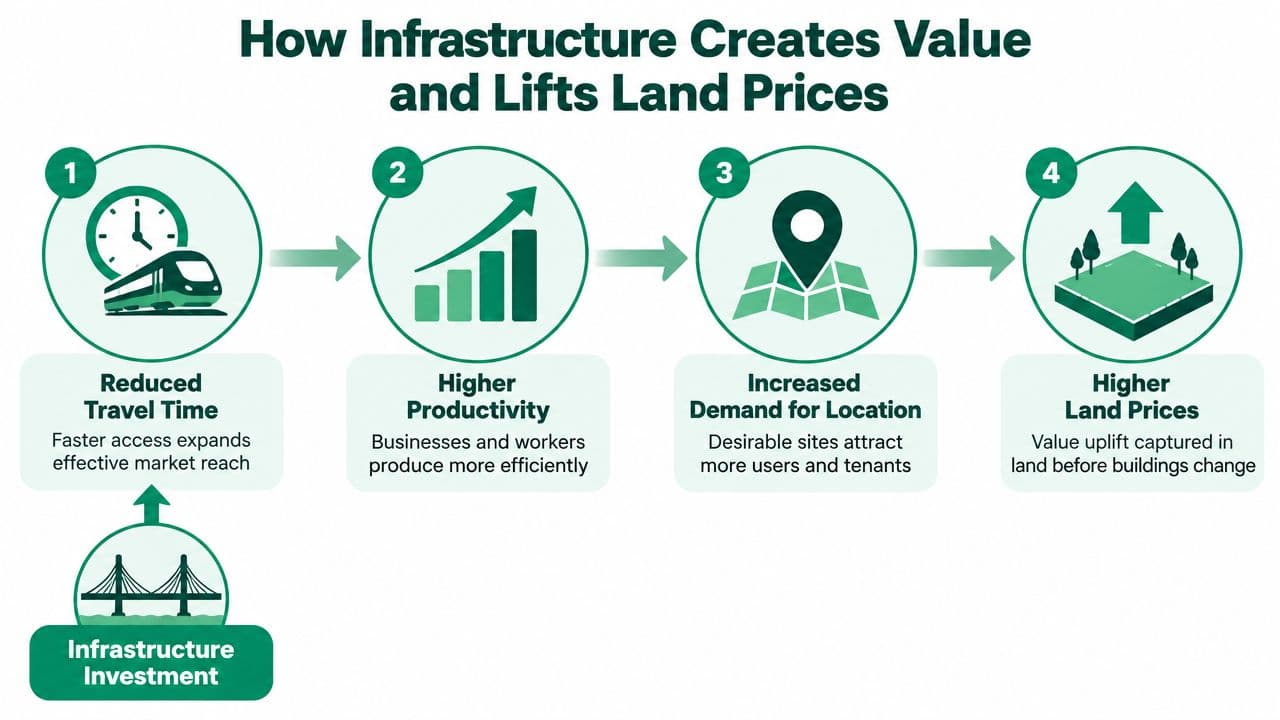
The deeper mechanism is agglomeration. By reducing generalized travel costs, infrastructure expands the market that a site can serve. Businesses gain access to more customers and workers, while related activities can cluster more closely. In OECD-linked analysis, including agglomeration increased the local benefits of CrossRail by about 20%. Direct benefits from a bus subsidy in South Yorkshire rose by about 3% when agglomeration was included [ITF-OECD paper].
Land prices therefore respond to more than saved minutes. Infrastructure changes the pattern of activity around a site. Retailers value additional foot traffic, logistics firms value reliable access, and households value shorter commutes. Their competing bids can raise the value of the location, even if the existing structure remains unchanged.
Transit-oriented development shows how place-based planning makes this process visible. Better transit moves people, then reshapes demand for land around stations. Digital coordination can support related planning work, as discussed in Blocsys Technologies' overview of powering smart cities growth.
What to watch on the ground
Rising lease inquiries and stronger redevelopment interest signal that access gains are being priced into location. Higher willingness to finance nearby projects points in the same direction. Together, these observations show that infrastructure has become a location advantage, not only a public service.
Public systems can seek to recover part of this uplift and reinvest it. The OECD's land value capture work frames the increase as a shared result of public investment, collective demand, and local governance. The landowner may receive the higher value, but did not create that value alone.
The Scale and Timing of Infrastructure Investment
A new rail line, power network, or water system may require heavy spending before residents and businesses see its full value. The project then provides services for many years. This timing gap makes infrastructure a balance-sheet decision: governments pay early, while operating benefits, productivity gains, and higher land values arrive gradually.
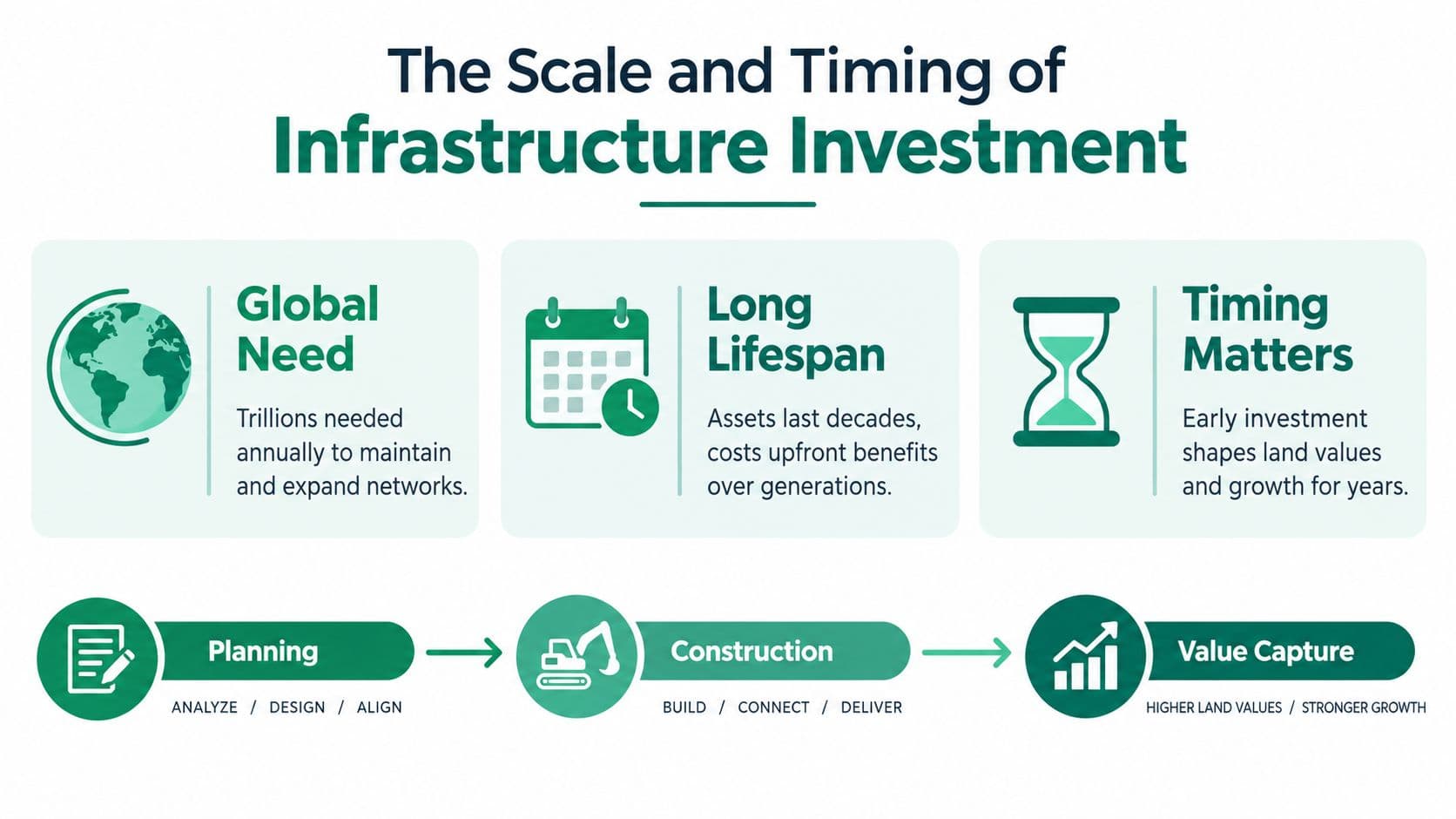
The central question is therefore not only how much a government spends. It is whether construction, demand, and financing arrive in a workable sequence. A road built before development may remain lightly used for years. The same road built after congestion has become severe may cost more and fail to support growth when firms and households need it.
For governments planning large programs, this overview of phased implementation explains how sequencing can align early works with later capacity. Phasing can also spread borrowing, construction risk, and service expansion across time, although delaying a project may postpone the land-value gains that help justify it.
Historical comparisons provide a useful scale marker without repeating global spending forecasts. In the United States, official statistics indicated that infrastructure's total stock relative to GDP and the flow of new investment were near historical averages, even as the composition changed. Analysts also estimated that proposed spending could raise total US infrastructure investment to around 4.5% of GDP, a level associated with the early 1970s [Goldman Sachs research note].
That benchmark matters because infrastructure intensity can influence a wider growth cycle. Transport affects access, energy systems affect production, digital networks affect coordination, and social infrastructure affects where households and firms can operate. Each category reaches the economy through a different route.
AI-related construction shows how a new infrastructure cycle can enter GDP measurements quickly. The same cycle also changes employment, access, land prices, and public budgets. Separating land from built capital helps policymakers see when an upfront outlay is creating a durable public asset, and when it is mainly transferring value to nearby landowners.
Comparing Land-Value Tax Land Leases and Land-Use Rights
These three instruments are easy to mix up, but they do different jobs. Land-value tax is a levy on unimproved land value that disregards buildings and improvements, and the US FHWA also describes it as an annual charge on the rental value of land [FHWA land value tax fact sheet]. Land leases are fixed-price, fixed-term arrangements. Land-use rights are different again, because they are indefinite, never expire, require no renewal, and are repriced annually to current land value [Unitism explanation of land-use rights].
Choosing Between Land-Value Tax Leases and Land-Use Rights
| Feature | Land-Value Tax | Land Lease | Land-Use Right |
|---|---|---|---|
| Pricing basis | Unimproved land value | Fixed price for a fixed term | Repriced annually to current land value |
| Expiration | No expiration as a tax system | Expires at the end of the term | No expiration |
| Renewal required | No | Yes for renewable leases, no for non-renewable leases | No |
| Risk pricing | Tracks site value through assessment | Often postpones risk rather than pricing it correctly | Prices land appropriately each year |
| Transferability | Tax does not transfer like an asset | Can be harder to sell or refinance near expiry | Low-cost transfer because the price is updated annually |
Land leases have real downsides. A renewable lease gives certainty only until the term ends, then the accumulated gap between the lease rate and the market is closed in one repricing event. A non-renewable lease gets harder to refinance and sell as expiry approaches. In that sense, fixed leases don't correctly price risk, they postpone it.
That's why a fixed lease should not be mislabeled as a land-use right. A true land-use right is indefinite, has no expiration, requires no renewal, and is repriced annually. Because of that annual repricing, access costs stay aligned with changing site value, and transfer can remain relatively low cost. For readers comparing term structures in more detail, Unitism's discussion of 99-year land leases helps clarify why fixed-term language can be misleading.
Bottom line: if the price is locked for years and only resets at renewal, it's a lease. If it updates every year and never expires, it functions as a land-use right.
The policy choice matters for entrepreneurship. Fixed-term arrangements can burden new uses when the repricing arrives all at once. Annual repricing is more transparent, and it tends to fit the site-value logic better.
From Uplift to Public Finance Who Pays Who Benefits and When It Pencils Out
The hard question isn't whether infrastructure creates value. It's who captures that value first, and whether the public can recover some of it without distorting productive activity. That's where beneficiary-pays logic enters. If a bridge, station, or utility extension raises the value of nearby land, it's reasonable to ask whether part of that windfall should help fund the project itself.
The equity issue is often skipped. Landowners can see capital gains. Tenants may face higher rents. Taxpayers can still carry the bill if governments don't recover enough of the uplift. World Bank materials note that infrastructure can generate capital gains for landholders, and beneficiary-pays logic can justify recovering part of those windfalls for public goods [World Bank value capture paper]. In practice, the distribution depends on local institutions and timing.
Why the revenue forecast is harder than the theory
A U.S. federal guide says revenue potential depends on the project's interaction with regional socioeconomic factors, land-use patterns, and the local real-estate market, and that agencies usually need specialized market studies rather than generic rules of thumb [FHWA revenue potential guide]. That's the part many public discussions miss. The theory is broad, but the forecast is local.
The OECD's framing of land value capture is helpful because it recognizes value recovery as a public finance tool, not just a planning slogan. Yet the practical question remains whether the design fits the market. In urban edges, where growth conditions are uneven, the same tool can produce very different outcomes. Research on places such as São Paulo, Addis Ababa, and Hyderabad shows that enabling conditions and governance shape who wins and who loses.
If the land market is thin or the legal rules are weak, the capture mechanism can look elegant on paper and underperform in practice.
That's why agglomeration effects matter in fiscal design too. If benefits are understated, the public may underinvest. If they're overstated, governments can promise more revenue than the site can support. The right answer is project-specific modeling, not slogans.
Conclusion Building Stable Public Finance With Land Value
Infrastructure is not just spending. It is land-value creation with long tails. Once you separate labor, capital, and nature, the policy picture gets clearer. Public works often raise the worth of locations first, and if governments ignore that uplift, they leave money on the table and push more of the bill onto work and productive investment.
The practical distinctions matter. Land-value tax treats unimproved site value as the base. Land leases can delay risk and create renewal shocks. Land-use rights, when they are annual, indefinite, and non-expiring, keep access costs aligned with site value and make transfer easier. For fiscal planning, the test is whether the instrument prices land appropriately, stabilizes revenue, and avoids penalizing building and entrepreneurship.
The main lesson is simple. Treat infrastructure as a value-creating system, not only a cost center. Then ask the next question carefully, where does the value sit, who captures it, and what mechanism can return a fair share to the public without slowing useful investment?
Unitism® supports governments, cities, and organizations with land valuation, policy design, distributional modeling, and implementation support for land-based public finance. If you're working on infrastructure funding, land-value capture, or tax reform, visit Unitism® to see how its tools and advisory work can help turn site value into stable public revenue.