Learn how mineral rights taxation captures resource rent, from royalties to severance taxes, valuation methods and reform options.
September 19, 2026
Mineral Rights Taxation Explained for Better Policy
Learn how mineral rights taxation captures resource rent, from royalties to severance taxes, valuation methods and reform options.
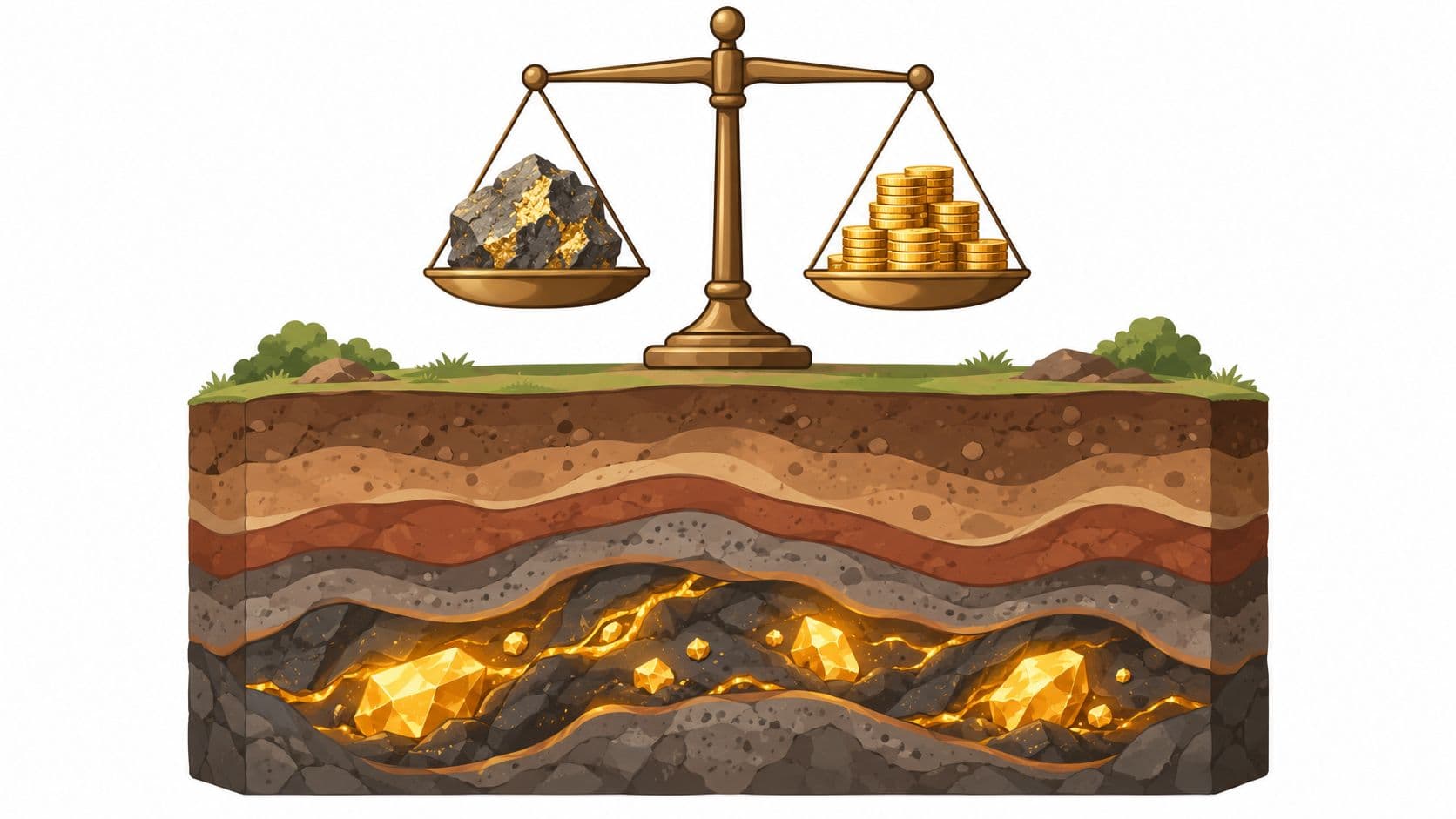
A finance ministry in a mining region often faces a strange budget problem. Schools, roads, and water systems need steady funding, but mineral revenue arrives in waves. When prices rise, governments feel rich. When output falls or disputes delay payments, the same government scrambles to fill the gap, often by taxing payroll, trade, or buildings more heavily than it should.
That pattern exposes a basic confusion. Many tax systems still blur together income from work, returns to investment, and economic rent from nature. Mineral deposits are not produced by the firm, the worker, or the local shopkeeper. They exist because of geology. Once that distinction becomes clear, mineral rights taxation stops looking like just another industry tax and starts looking like a question of how the public should share the value of a finite natural asset.
A tri-factor view helps. Labor earns wages. Capital earns returns for building and risking funds. Nature, including mineral deposits, generates location and resource rent. If a government wants revenue with less damage to employment and investment, it should look closely at how it captures that third component. That's the same logic behind land value as a public revenue base, though minerals add their own valuation and timing problems.
Table of Contents
- Introduction to Mineral Rights Taxation and Why It Matters
- What Mineral Rights Taxation Is and What It Aims to Achieve
- How Royalties Severance Taxes and Site Value Approaches Compare
- Valuing Mineral Rights and Estimating Revenue Reliably
- Who Pays Who Gains and How Fiscal Stability Is Affected
- International Precedents and Why Leases Differ From Land Use Rights
- Implementing Mineral Rights Taxation Step by Step
Introduction to Mineral Rights Taxation and Why It Matters
Consider two neighboring jurisdictions with the same ore body. One taxes extraction poorly, waits for booms, and then raises general taxes when the boom fades. The other builds a system that captures resource rent more predictably and uses it to reduce pressure on work and enterprise. The geology is the same. The fiscal design is not.
That's why mineral rights taxation matters. It shapes who receives the value of extraction, when the public gets paid, and how much distortion falls on the wider economy. Poor design can encourage speculation in subsurface rights, reward delay, and leave local communities with heavy infrastructure costs but unstable public revenue.
The policy question beneath the tax question
For ministries and cities, the issue isn't how to charge miners more. It's how to distinguish payment for access to nature from taxes that penalize hiring, building, processing, and reinvestment.
A practical way to think about it is to separate three questions:
- What is being charged for: Is the state charging for the privilege of taking a publicly relevant natural asset, for business income, or for holding a valuable site?
- When is the charge triggered: At extraction, at sale, annually through assessment, or through a combination?
- Who bears the burden: The operator, the royalty owner, the local community through underfunded services, or workers and consumers through substitute taxes?
Mineral policy often fails when governments debate rates before they decide what base they are actually trying to charge.
Why older ideas still matter
Mineral taxation has deep roots. The IMF notes that in Roman law, the government and landowner each received one-tenth of mined minerals, creating a combined 20% royalty, and the British Crown later adopted the idea of paying for the privilege of extraction. The same IMF source explains that modern mineral royalties are usually ad valorem, that actual rates vary widely from 2% to 30%, and that a common global range is 5% to 10% in countries using royalties. It also notes that royalties were historically the main form of mineral taxation, before many countries shifted from the 1950s onward toward hybrids combining royalties with ordinary taxes, with fiscal burdens generally rising in the post-OPEC 1970s and 1980s (IMF discussion of mineral royalty history and modern regimes).
Those historical facts matter because today's debates are usually presented as technical. They are not. They are about whether public finance will continue to lean on labor and capital, or whether it will recover more of the rent tied to nature.
What Mineral Rights Taxation Is and What It Aims to Achieve
Start with a simple analogy. If someone taxes the fruit picker's wages, they tax labor. If someone taxes the trucks, crushers, and shafts, they tax capital. If someone charges for access to a naturally valuable deposit, they are trying to capture resource rent.
That's the heart of mineral rights taxation. It aims to claim part of the value that comes from exclusive access to minerals in the ground, rather than from the effort of extracting them alone. This is why debates often get tangled. People use the word “tax” for several different things that don't behave the same way.
Three objectives usually sit underneath the label
Governments usually want some mix of these outcomes:
-
Public sharing of mineral rent
A mineral deposit is scarce and location-bound. If a private party can extract and sell it, the public usually has a claim on part of that value. -
Lower distortion than broad taxes on work and investment
If revenue comes from natural rent, governments can rely less on taxes that discourage hiring, construction, or productive reinvestment. -
Better stewardship and timing
The design can discourage speculative holding of rights and can shape whether firms rush extraction, high-grade selectively, or delay development.
Why the words royalty tax and rent are not interchangeable
A royalty is usually framed as payment for the right to extract. A tax may target income, production, value, or property. A resource-rent instrument aims more directly at surplus after costs and normal returns.
That distinction is often skipped, but it matters. Indian policy debate in 2025 to 2026 revisited whether royalty is a tax, while a 2025 NIPFP paper notes that the Supreme Court had made clear royalty is not a tax. The same policy discussion also states that states currently impose around 14 taxes, charges, and fees on mining, showing that royalty is only one part of a wider fiscal stack (NIPFP working paper on royalty, tax distinction, and the broader mining charge structure).
Readers who want a compact conceptual definition of this surplus can use Unitism's glossary entry on resource rent.
Practical rule: If a government doesn't distinguish payment for extraction rights from taxes on income and investment, it can end up discouraging production while still failing to capture much rent.
How Royalties Severance Taxes and Site Value Approaches Compare
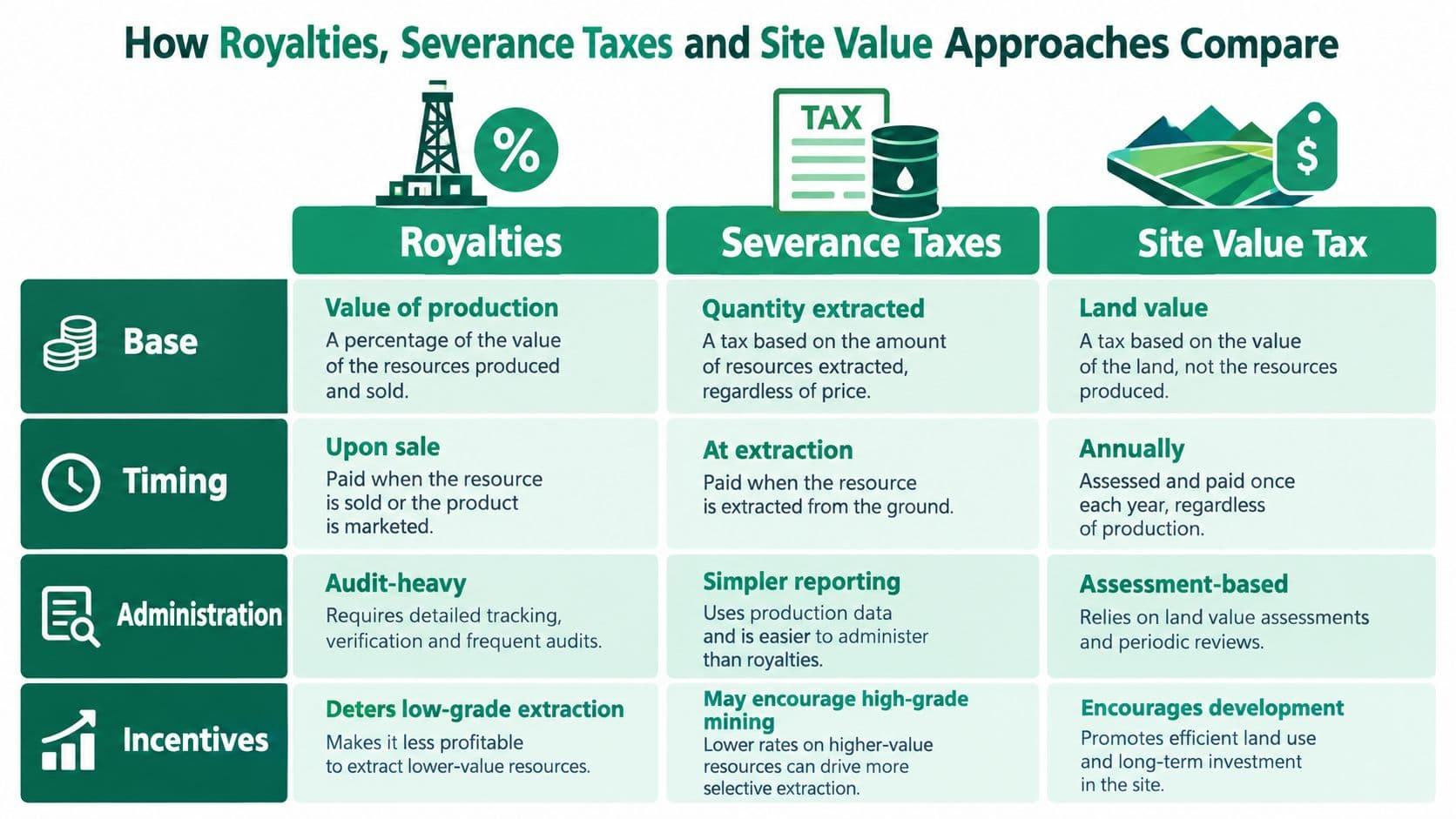
Different instruments answer different fiscal questions. Royalties ask, “What should be paid for extracting value?” Severance taxes ask, “What charge should arise when physical removal occurs?” Site value approaches ask, “What is the annual value of controlling this natural opportunity, whether or not current accounting profits are high?”
Side by side differences
| Choosing Among Mineral Fiscal Instruments | Tax Base and Trigger | Strengths | Risks and Distortions |
|---|---|---|---|
| Royalties | Usually based on production value, often triggered by production and sale | Familiar, visible, can yield revenue early | Can burden marginal output because payment is due even when project economics are weak |
| Severance taxes | Triggered when minerals are extracted | Clear extraction event, administratively direct in many systems | Can reward short-term extraction choices rather than careful resource timing |
| Site value approaches | Annual charge on the value of the mineral-bearing opportunity or site | Closer to rent capture from nature, less tied to improvements and effort | Requires credible valuation capacity and regular repricing |
Administration matters as much as theory
An elegant tax that can't be administered will fail. Royalties often require close attention to sales value, transfer pricing, deductions, and classification disputes. That's one reason operators often invest heavily in documentation and controls. A practical guide like RNC Group's note on how to prepare for a royalty audit is useful because audit readiness is not a side issue in royalty systems. It is part of the system.
Severance taxes are often simpler in trigger logic because extraction itself activates the charge. But simplicity at the trigger stage doesn't remove disputes over valuation categories, allowable processing distinctions, or measurement at the wellhead or mine gate.
The strategic contrast
A royalty or severance tax follows production. A site value approach starts earlier by asking what the right itself is worth over time. That can reduce speculative holding because the holder faces an ongoing charge tied to the value of exclusive control, not just a payment when output finally arrives.
This is why some reformers connect mineral rights taxation to broader land-value thinking. The annual charge is not mainly about punishing activity. It is about pricing control over a scarce natural asset more accurately.
If the policy goal is stable public revenue with lighter taxes on labor and machinery, governments should be cautious about relying only on production-triggered instruments.
Valuing Mineral Rights and Estimating Revenue Reliably
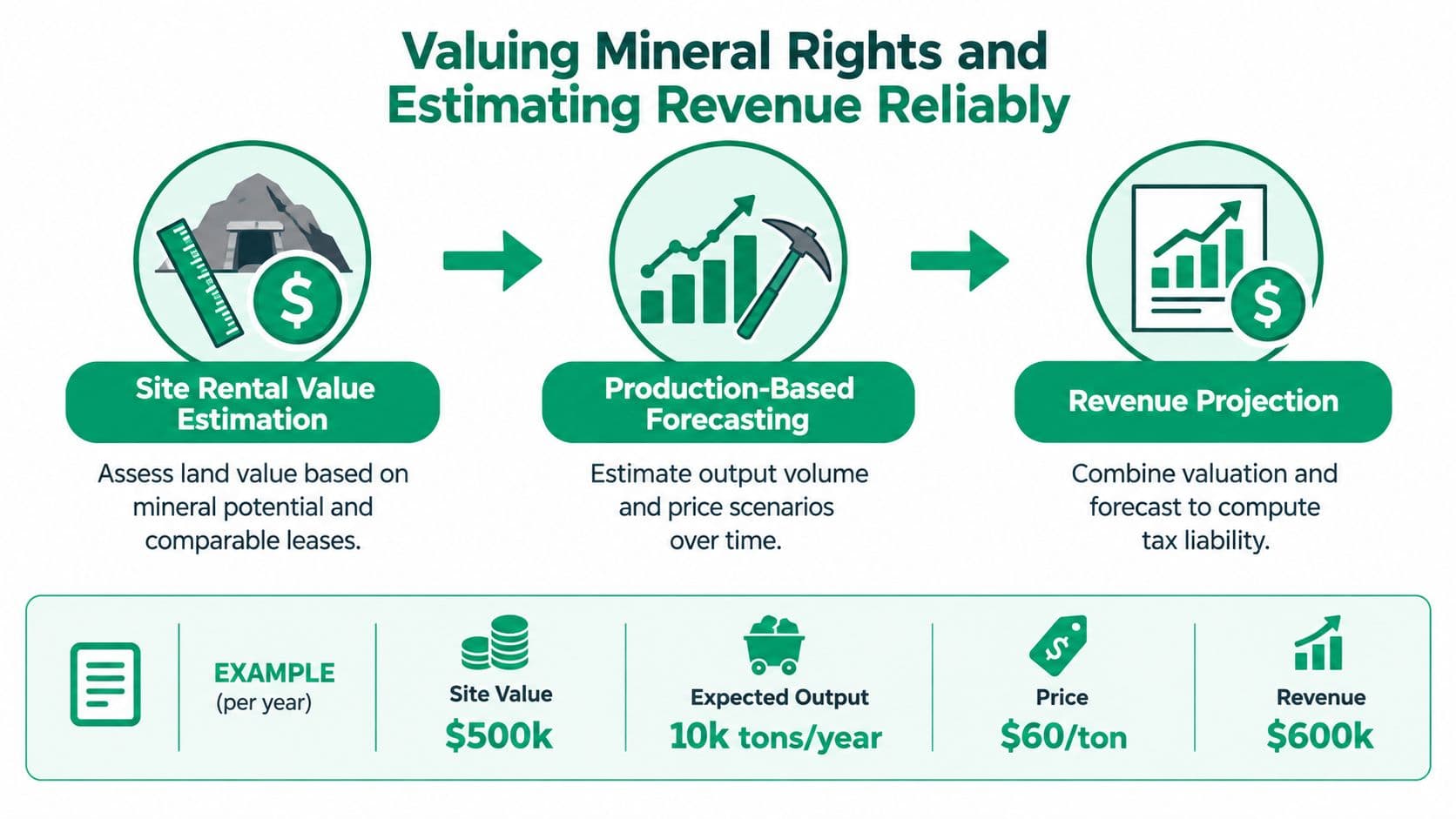
Valuation is where many mineral tax systems become fragile. In boom periods, officials tend to assume today's prices will persist. In downturns, they can overcorrect and understate long-run value. Neither helps budgeting.
Reliable valuation starts by separating the site opportunity from the operating business. The first asks what the mineral-bearing right is worth because of geology, access, and legal permission. The second asks what production may generate under realistic output and price conditions.
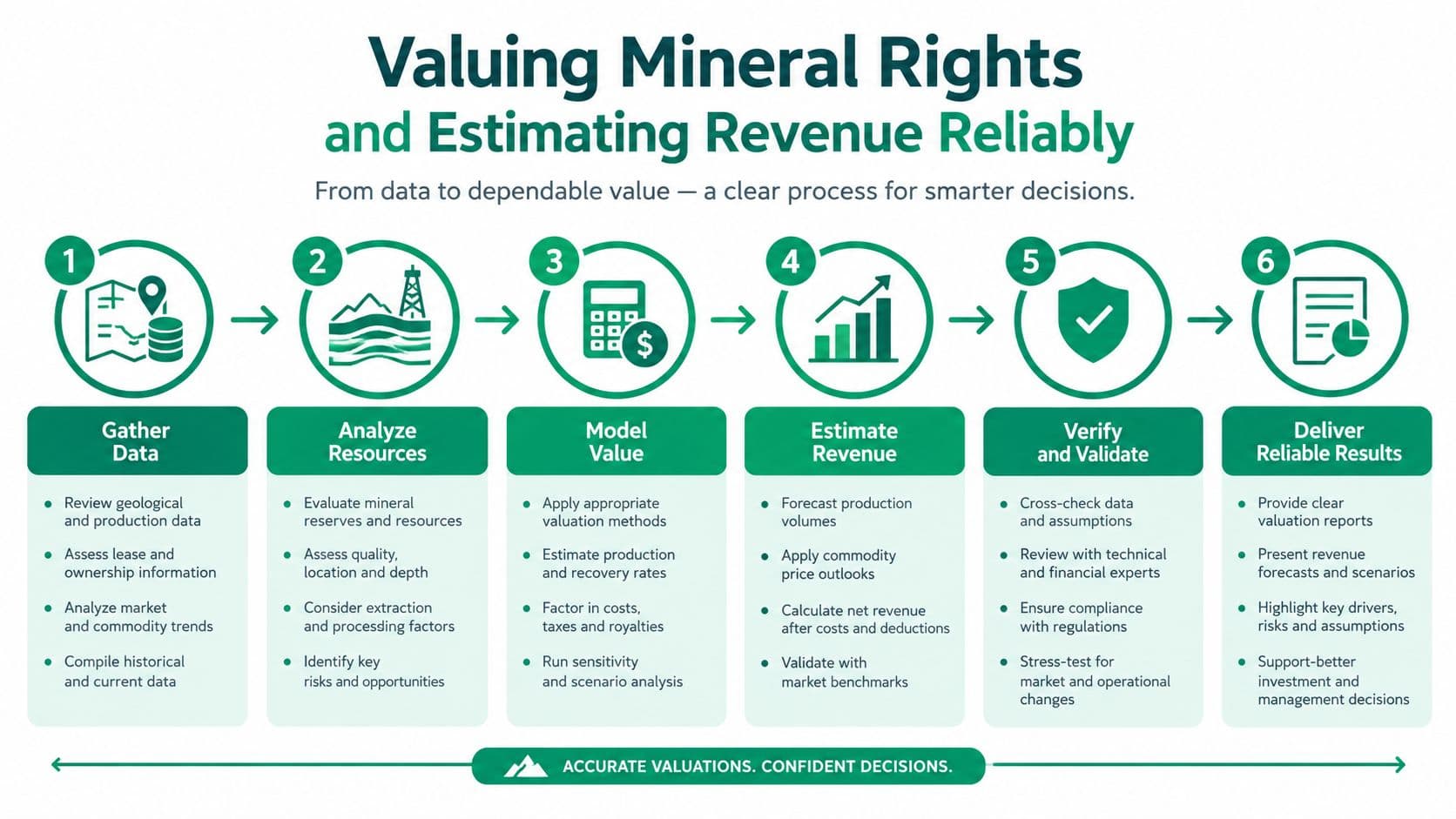
A grounded valuation workflow
A ministry or city usually needs several linked datasets rather than one master number:
- Cadastre and title records to identify who controls which rights
- Production records to observe actual extraction and timing
- Geological and comparable rights data to estimate relative site value
- Payment classifications to separate royalty, rent, tax, and fee streams
The model should also be repriced regularly. In resource systems, stale assumptions don't stay harmless. They create hidden subsidies for some right holders and sudden fiscal shocks later.
Why annual repricing improves judgment
Annual repricing doesn't eliminate disagreement, but it does reduce the buildup of mismatch between public charges and current opportunity value. That's one reason annual updating is so important in related natural-rights fields, including water rights valuation.
Use conservative production cases for budgeting and separate them from policy valuation. Budgeting asks what will probably be collected. Policy valuation asks what the right is worth under a coherent public framework.
A common forecasting mistake
Governments often mix together three very different questions:
- Current output measurement
- Future price assumptions
- Underlying right value
When those are collapsed into one spreadsheet, a temporary commodity upswing can be mistaken for a permanent rise in taxable capacity. Better systems keep them separate, then test different scenarios openly.
For practical administration, that also means documenting when a charge is tied to units extracted, gross value, or underlying right value. Those bases generate different revenue paths and different legal disputes.
Who Pays Who Gains and How Fiscal Stability Is Affected
The burden of mineral rights taxation rarely lands in one place. It is spread across owners, operators, governments, and local communities, sometimes visibly and sometimes through changed behavior.
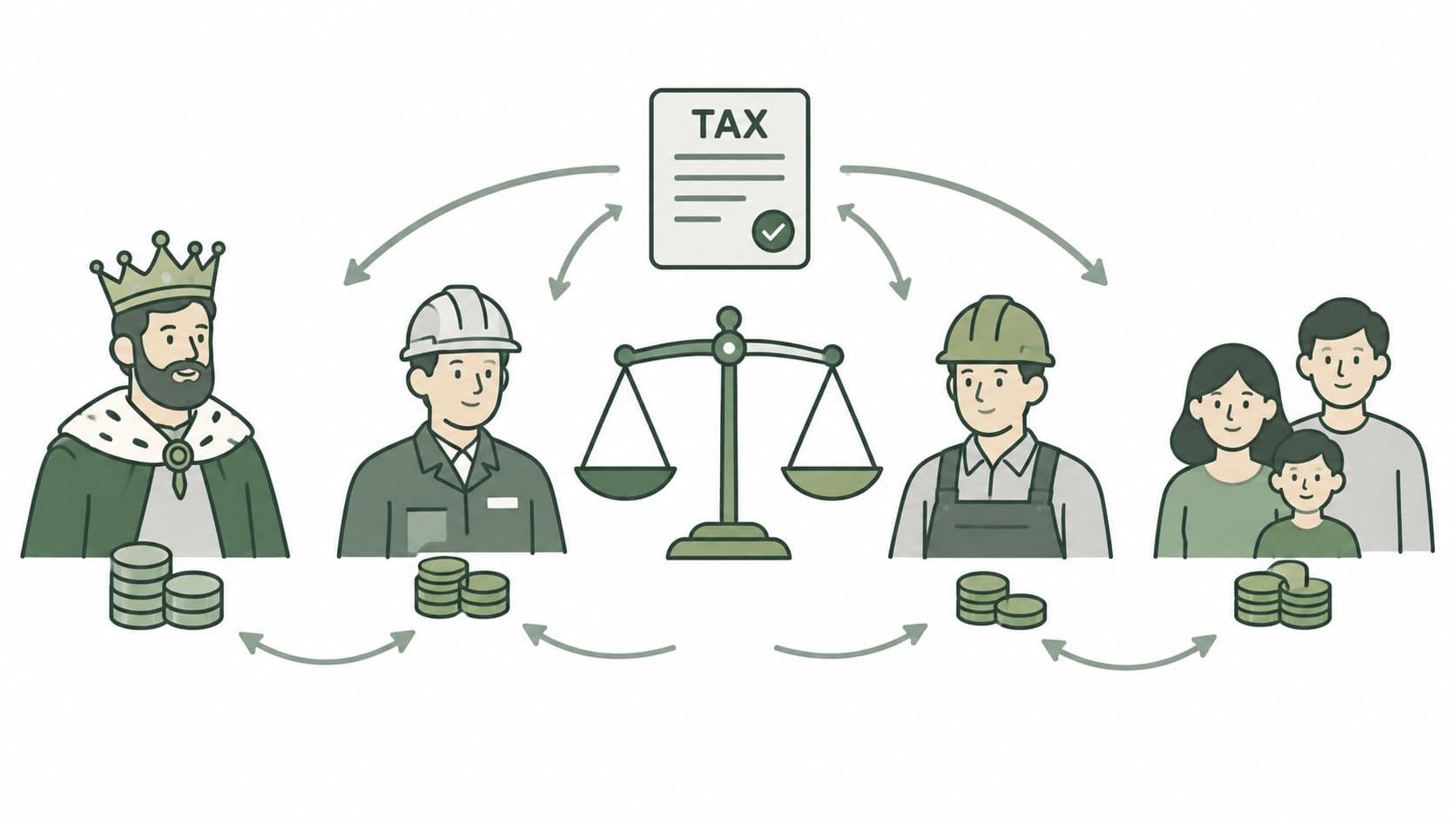
The first layer is legal liability
In the United States, mineral-rights income is often split across at least three layers. Federal income tax applies to royalties. State severance or production taxes apply when minerals are extracted. In some jurisdictions, local ad valorem property tax can apply to producing mineral interests. That layering means production can trigger a state charge immediately, while the same stream also faces federal income tax and may raise local assessed value once the interest becomes producing (overview of layered taxation and timing issues for mineral rights).
For local governments, that interaction matters because a producing field may increase expectations for service delivery long before revenue becomes smooth and predictable.
The second layer is tax treatment of the owner
Federal depletion rules can change effective burden. Under U.S. law, a qualifying mineral-rights holder receiving royalty income can generally claim a 15% percentage depletion deduction from gross income from the property, but it cannot exceed 100% of taxable income from that mineral property, and for oil and gas properties it also cannot exceed 65% of the taxpayer's taxable income from all sources, all computed without depletion (26 U.S. Code § 613 on percentage depletion limits).
That means two owners with similar royalty checks may not face the same after-tax result. Basis, other income, and eligibility matter.
The third layer is timing and cash flow
Advanced royalties create their own timing issue. The same MineralView explanation notes that cost depletion for advanced royalties follows a unit-of-production logic under federal rules, so prepaid royalties are recovered as units are extracted rather than immediately expensed. For operators and royalty owners, that timing difference can materially change cash-flow planning.
A broad land-and-nature perspective helps here. Land and water as shared value bases are easier to discuss coherently when governments stop treating every revenue stream as if it were ordinary business income.
Who tends to gain from better design
- Communities: They can receive a steadier public share of extraction value instead of relying so heavily on taxes that discourage local enterprise.
- Operators with long planning horizons: They benefit when fiscal rules are clearer and payment categories are less arbitrary.
- Governments: They can smooth fiscal exposure and reduce the temptation to plug revenue gaps with poorly targeted taxes.
Who may resist change
Not every resistance is ideological. Some actors benefit from ambiguity, especially where overlapping charges make liabilities negotiable, delayed, or contestable.
When a ministry models reform, it should test not only total revenue but also who pays earlier, who pays later, and who gains from reduced taxes elsewhere.
International Precedents and Why Leases Differ From Land Use Rights
Historical precedent shows that mineral fiscal systems often evolve away from taxing ownership in crude ways and toward instruments that follow extraction or resource value more directly. In Minnesota, a 1923 law imposed a 6% tax on royalties received, and the state later replaced a property tax on taconite deposits with a production tax in 1941. The royalty tax itself was later repealed in 1987, effective after December 31, 1989. In Wyoming, the first severance tax on a wide group of minerals was imposed in 1969 at a 1% rate based on property tax valuation, and the Permanent Wyoming Mineral Trust Fund was later created with a 1.5% severance tax on coal, oil, natural gas, oil shale, and designated minerals (Minnesota legislative history summarizing mineral tax milestones in Minnesota and Wyoming).
That arc is instructive. Policymakers gradually moved from taxing rights and royalties in one way toward taxing extraction and resource value more directly. But another confusion often enters the discussion when governments also use leases, concessions, or “land-use rights” in resource administration.
Fixed leases are not the same as true land-use rights
A land lease is a renewable or non-renewable fixed-term arrangement with a fixed price. Renewable leases provide certainty only until the term ends, at which point the accumulated gap between the lease rate and the market can be closed all at once in a major repricing. Non-renewable fixed leases become progressively harder to refinance and sell as expiry approaches, because fixed prices postpone risk instead of pricing it continuously. Unitism's explanations of land leases over long terms such as 99-year arrangements are useful here because long duration doesn't change the underlying fixed-term problem.
A genuine land-use right is different. One source describes it as indefinite, requiring no renewal, not expiring, and being repriced each year. It explicitly says that annual repricing is what distinguishes it from a short commercial lease, even when both are casually called land-use rights (definition of a genuine land-use right and why annual repricing matters).
Why the distinction matters in mineral policy
If you call a fixed lease a land-use right, you hide a major pricing issue. Fixed leases postpone risk. They let the gap between contractual payment and actual opportunity value build up, then force a disruptive repricing later. True land-use rights don't work that way because the payment adjusts each year and the right doesn't expire.
For ministries studying public estate practice, tools like tender alerts for Crown Estate can help track how public rights are offered and managed in practice. The larger policy lesson is simpler: don't confuse a long fixed contract with a properly repriced right to use a site.
Implementing Mineral Rights Taxation Step by Step
Reform works best when governments treat mineral rights taxation as an administrative system, not just a rate decision. The legislation, cadastre, valuation model, accounting categories, and public explanation all have to line up.
A workable sequence
-
Build the rights map first
Confirm title, boundaries, extraction permissions, and producing status. If the registry is unclear, every later argument about value will become harder. -
Separate payment categories in law and reporting
Royalty, severance charge, rent-style payment, and ordinary income tax should not be blended in vague language. Clear classification reduces litigation and improves forecasting. -
Create a repricing calendar
Annual updating matters, especially where the public wants to capture changing opportunity value rather than only taxing realized output. -
Model distribution before passing reform
Governments should test who pays more, who pays less, and whether taxes on buildings, transactions, or other productive activity can be reduced as resource rent capture improves.
The land-rights lesson worth carrying over
Under the strict economic definition used in Unitism's materials, a true land-use right differs from a fixed lease because it has no expiration, needs no renewal, and is repriced annually. That annual repricing also allows people to buy and sell the right at low cost while keeping payment aligned with current land value (commercial property valuation and the strict definition of land-use rights).
That principle translates well to mineral-bearing land. Where governments want ongoing rent capture without sudden cliff-edge repricing, annual updating is usually more coherent than long fixed terms.
Administrative checklist
- Draft for classification clarity: spell out what is a royalty, what is a tax, and what is a rent-style charge.
- Link cadastre to finance systems: revenue agencies and land or mining registries need shared identifiers.
- Train assessors and auditors: valuation disputes often begin with inconsistent terminology.
- Phase the transition: if broader reform aims to reduce taxes on work or buildings, sequence the changes so the public can see the swap.
- Use tools where they fit: one option is Unitism®, which offers valuation assessments, policy design, fiscal modeling, implementation support, and training for land-and-nature revenue reform in government settings.
A good reform won't eliminate political conflict. It will make the conflict more honest. The debate will move from confusion over labels to clearer choices about rent capture, stewardship, and the tax base a society wants to rely on.
If you're working on mineral rights taxation, land-value capture, or the design of annually repriced natural-right systems, Unitism® offers research, valuation methods, policy design, implementation support, and training for governments and civic institutions. Its tri-factor approach helps ministries and cities separate taxes on labor and capital from charges on land and nature, so reforms can be designed with clearer economic logic and better administrative fit.