Learn residual land value with the GDV formula, worked examples, sensitivity tests and how it shapes site-value taxation and policy.
September 17, 2026
Residual Land Value Explained with Formulas and Examples
Learn residual land value with the GDV formula, worked examples, sensitivity tests and how it shapes site-value taxation and policy.
You're reviewing a development site with an attractive asking price, a planning deadline approaching, and a spreadsheet that seems to support the deal. The seller sees the land as worth the asking price. Your lender wants confidence in repayment. Your planning team is still refining the scheme. The decision you need to make is simpler and harder at the same time: what can you afford to pay for the site while keeping the project viable?
That question leads to residual land value. It isn't a forecast of what the seller hopes to receive, and it isn't automatically the same as a recent transaction price. It's a back-solving method that starts with the value of the completed development, subtracts every relevant cost and the developer's required profit, and leaves the amount available for land.
The method connects land prices directly to development feasibility. If construction costs rise, finance becomes more expensive, sales values weaken, or planning obligations increase, the amount left for land can fall even when the site itself hasn't changed. For anyone assessing a purchase, approving a scheme, negotiating a contribution, or designing land policy, that relationship matters.
A practical explanation of what land value means can help establish the broader context, while sellers facing a complex appraisal may also benefit from expert valuation help for sellers. The sections that follow build from the basic formula to worked examples, sensitivity testing, tenure choices, and the tools practitioners use to make residual appraisals more realistic.
Table of Contents
- Introduction Why Land Value Is What Is Left Over
- What Residual Land Value Means and How It Works
- How to Calculate Residual Land Value Step by Step
- Worked Examples and Sensitivity Analysis That Show Risk
- How Residual Land Value Shapes Site Value Taxation and Tenure Choices
- Tools and Models Practitioners Use for Residual Appraisals
- Conclusion Making Better Land Decisions With Residual Thinking
Introduction Why Land Value Is What Is Left Over
A developer is assessing a site for housing, shops, offices, or another use. The proposed scheme indicates how many units the land might support and what those completed units could sell for or earn. That expected completed value must cover construction, professional fees, finance, marketing, contingencies, infrastructure, planning obligations, and the return required for taking development risk.
The land value appears only after those claims have been allowed for.
Land is therefore the residual claimant in the appraisal. The builder receives construction costs, consultants receive fees, the lender receives finance costs, public authorities may receive required contributions, and the developer retains the required profit. The amount left for the site is the residual land value.
The UK government's financial viability guidance describes the relationship as gross development value minus total development costs, including developer profit. The residual can represent development profit or land value, depending on which variable the appraisal is solving for.
Consider a completed project expected to sell for £10 million. If total costs and required profit reach £8.5 million, the residual land value is £1.5 million. The developer can compare that ceiling with the seller's asking price before deciding whether the scheme supports a bid.
The calculation is a decision tool, not a promise of price. A higher profit hurdle, more expensive finance, weaker sales values, or heavier planning obligations compresses the amount available for land. Two appraisals of the same site can therefore produce different results when they use different assumptions about risk, timing, funding, or policy costs.
For wider context, what land value means explains the broader concept, while sellers dealing with a complex appraisal may seek expert valuation help for sellers.
Residual land value remains a feasibility benchmark for a particular scheme and assumptions. It does not capture every alternative use, uncertain planning outcome, abnormal cost, or option to develop later. It answers what the proposed scheme could support under its stated conditions, rather than setting a permanent market price for every possible future use.
What Residual Land Value Means and How It Works
A developer agrees to buy a site, then the sales market softens before construction starts. The project may still be physically possible, yet the amount available for land can fall sharply. Residual land value is designed to expose that changing ceiling.
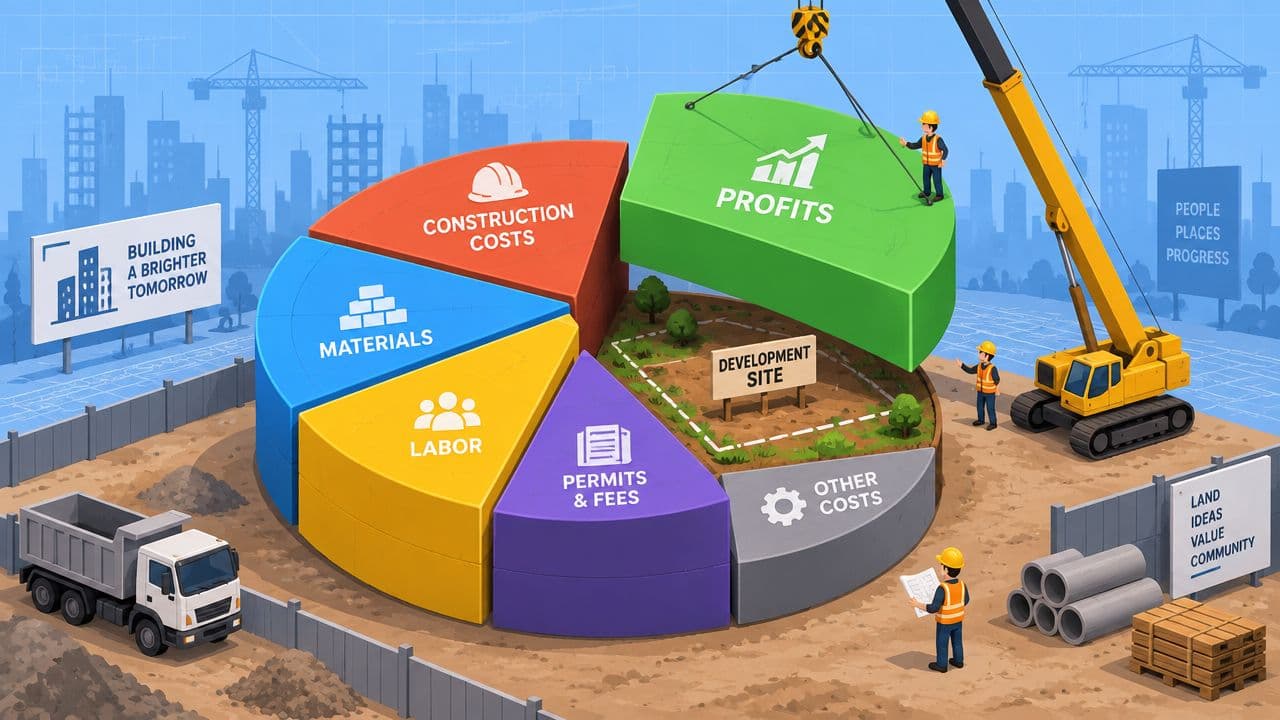
A development's completed value is the whole pie, represented by gross development value, or GDV. Construction, consultants, finance, public obligations, and the developer's required profit each take a slice. Land receives what remains after those claims are allowed for.
Core definition: Residual land value is the amount left after deducting total development costs, including developer profit, from the gross development value.
The UK viability framework applies this residual logic to housing-led development appraisal. The University of Reading's residual land value research shows that the method can also be applied repeatedly through market cycles, rather than treated as a one-off calculation. Its time series tracked apartments from 1995 to 2016 and commercial land uses from 1997 to mid-2017, supporting longer-term analysis of development performance and viability.
The two ways to use the residual
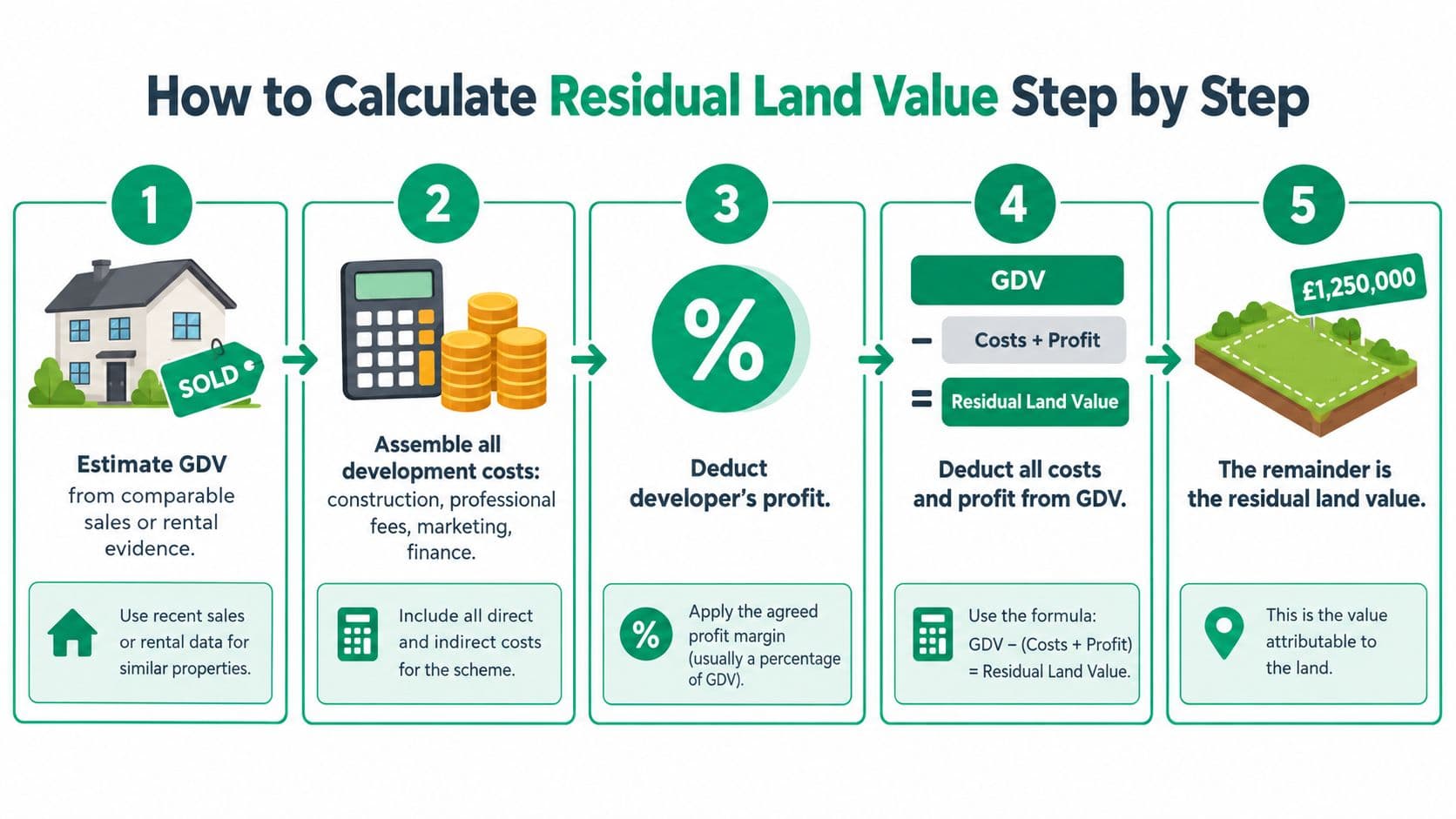
The same appraisal can answer different questions. If the land price is known, it can show the profit left after the other costs. If the profit hurdle is fixed, it can show the maximum land price the scheme can support. The arithmetic stays the same, but the decision changes.
Residual land value = GDV − total development costs − developer profit
Total development costs cover the complete cost stack, not only the building contract. Depending on the scheme, they may include professional fees, finance, marketing, contingencies, infrastructure, abnormal site work, and planning-related contributions. Leaving out a cost does not create value. It transfers that cost into an understated risk or an overstated land bid.
Finance costs and profit hurdles make the formula a live risk-adjusted tool. A longer programme, higher borrowing cost, weaker sales evidence, or heavier policy burden reduces the amount available for land. Two appraisals of the same site can therefore diverge because they use different assumptions about timing, funding, risk, or the required return.
The proposed use must also be tested. Highest and best use asks whether a use is legally permissible, physically possible, financially feasible, and capable of producing the best supported outcome. A guide to highest and best use helps frame that opening decision, since the wrong scheme produces the wrong residual.
The final figure is conditional, not a permanent market price. It depends on the scheme, timing, cost evidence, sales or rental assumptions, finance structure, and profit hurdle. It can guide negotiations, but market evidence and professional valuation judgment remain necessary.
How to Calculate Residual Land Value Step by Step
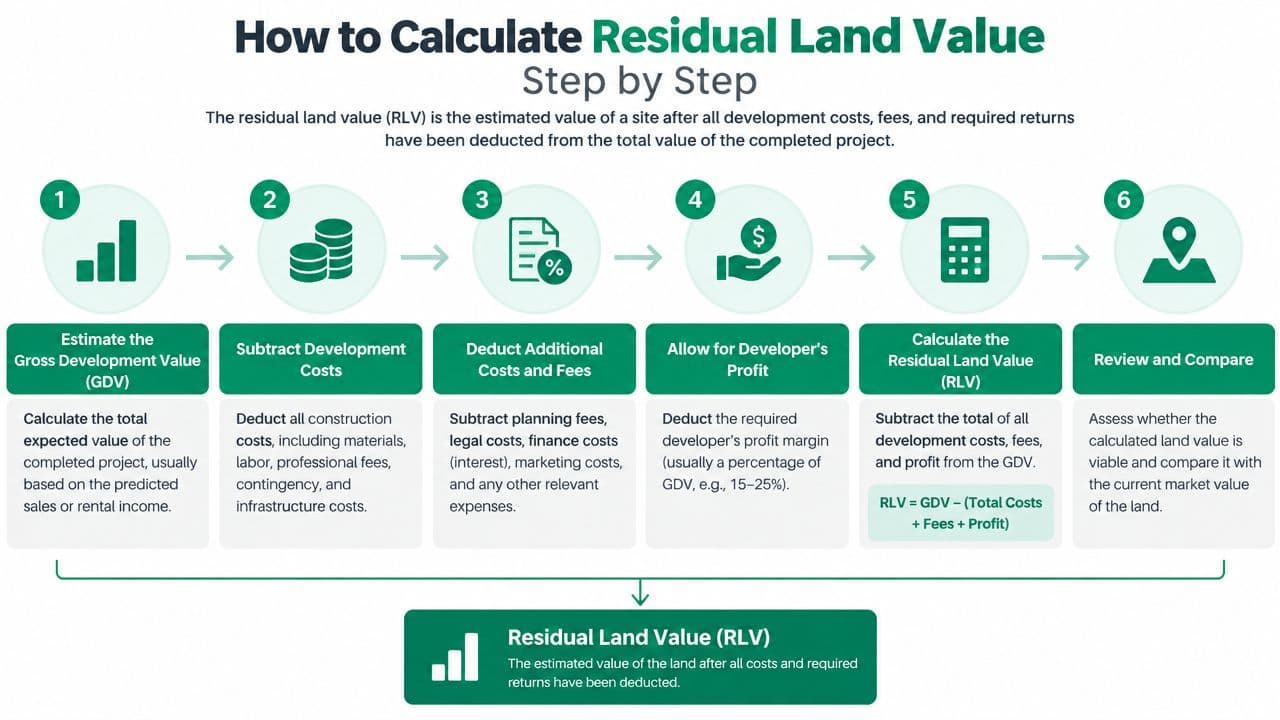
A reliable residual appraisal is less about typing a formula into a spreadsheet and more about controlling the assumptions behind each input. Follow the calculation in a fixed order, document the evidence, and make sure every cost appears once.
Start with the completed value
Estimate GDV from appropriate sales evidence for housing or from rental and investment evidence for income-producing property. The estimate should reflect the proposed specification, unit mix, timing, location, and market positioning. A high headline price based on an unsuitable comparison can inflate the entire residual.
For a phased commercial or mixed-use scheme, don't treat all income as if it arrives on the first day. Model the timing of sales, leases, or disposals, because delayed receipts increase exposure to finance and holding costs.
Build the full cost stack
List construction, demolition, remediation, infrastructure, professional fees, marketing, legal costs, finance, contingencies, and public-realm or compliance requirements where they apply. Abnormal site costs deserve particular attention because they can consume land value quickly.
A useful audit question is: if this cost appeared tomorrow, where would it sit in the appraisal? If the answer is “nowhere,” the model is incomplete.
Add the return requirement
Developer profit isn't an optional reward added after the calculation. It's part of the cost of undertaking the project. The required margin reflects risk, time, complexity, and the alternative uses of the developer's capital.
Finance assumptions also need to match the cash-flow profile. A simple total-cost estimate may hide the difference between costs paid early and sales received later. Time and phasing affect the amount of funding required and therefore the residual available for land.
Back-solve and test the benchmark
Subtract the costs and required profit from GDV. The remainder is the residual land value for that scenario. Then compare it with the site's existing use value plus an appropriate premium when testing whether the landowner has a reason to release the site, as described in guidance on calculating land value.
Avoid two common errors:
- Omitting profit: This makes the land appear to support a higher price than a developer can reasonably accept.
- Double counting costs: A contingency or contribution included in one line shouldn't be added again elsewhere.
- Mixing dates: Values and costs should be aligned to the same appraisal date or adjusted consistently.
- Confusing viability with market price: The residual describes the scheme's capacity, not necessarily the price another bidder will pay.
The strongest appraisal records the source, date, and reasoning for every material assumption. That documentation makes disagreements easier to diagnose. Two parties may not disagree about the formula at all. They may be using different GDV, cost, timing, or profit inputs.
Worked Examples and Sensitivity Analysis That Show Risk
Consider a straightforward housing scheme. Suppose the expected completed value is £10 million, while construction, fees, finance, contingencies, infrastructure, and other development costs total £7 million. If the required developer profit is £1.5 million, the residual land value is:
£10 million − £7 million − £1.5 million = £1.5 million
That figure is the maximum supported land value under those assumptions, not a promise that the site will sell for it.
Now consider a mixed-use scheme with phased sales. The completed value is still assessed from the proposed homes and commercial space, but receipts arrive over time. The appraisal must recognize that construction and professional costs may arise before later units are sold. If finance costs rise during the holding period, the residual falls even if the eventual sale values remain unchanged.
The following table shows the direction of the result without pretending that every site reacts by the same amount:
| Input Changed | Base Assumption | Stressed Assumption | Impact on Residual |
|---|---|---|---|
| Sales value | Supported GDV estimate | Lower supported GDV | Residual falls because the top line shrinks |
| Construction cost | Current cost plan | Cost overruns or inflation | Residual falls as more value pays for construction |
| Finance cost | Agreed finance assumptions | Higher rates or longer funding period | Residual falls through increased financing cost |
| Profit hurdle | Required developer return | Higher required return | Residual falls because profit takes a larger slice |
| Planning obligations | Known contribution package | Larger contribution or added infrastructure | Residual falls as the cost stack expands |
| Density | Proposed scheme | Higher or lower density | Residual may rise or fall depending on added value and added cost |
The key lesson is asymmetry. A small improvement in GDV can increase the residual, but a modest cost increase can remove land value because the land sits at the end of the calculation. A developer comparing two bids should therefore compare the assumptions behind each bid, not just the final number.
sensitivity analysis techniques become practical rather than decorative. Test lower sales values, higher build costs, longer delivery periods, different finance conditions, profit hurdles, and policy burdens. Then identify the point at which the scheme no longer clears the viability threshold.
Practical rule: Treat the residual as a range of outcomes around a base case, not as a single figure with false precision.
Two appraisals of the same site can diverge sharply for legitimate reasons. One team may assume faster sales and lower finance costs. Another may allow for abnormal works, a longer programme, or a higher return for risk. Neither team has changed the land. They've changed the economic story the land must support.
How Residual Land Value Shapes Site Value Taxation and Tenure Choices
Residual appraisal helps policymakers understand how much development value a site can support after project costs and profit. That makes it relevant to site-value taxation, land-value capture, and tests of planning obligations. A policy that takes too much of the residual can make a viable scheme fail. A policy that ignores the residual may leave public value uncaptured or encourage landowners to hold sites while waiting for higher prices.
The appraisal doesn't decide the policy by itself. It gives officials a way to model how a charge, contribution, or tax interacts with development feasibility. The same logic also clarifies why tenure design matters.
Fixed leases and true land-use rights
A land lease can be renewable or non-renewable, but under the framework described here it has a fixed term and fixed price. A renewable lease offers certainty only until the term ends. At renewal, the accumulated gap between the fixed lease rate and the market can close in a single major repricing. A non-renewable lease becomes progressively harder to refinance and sell as the remaining term shortens.
Fixed leases don't correctly price risk. They postpone it.
A true land-use right is different. It has no expiration, requires no renewal, and is repriced annually. Because the charge adjusts each year, holders can buy and sell the rights at low cost, while the annual price reflects changing land conditions. Under this definition, land-use rights price land appropriately without placing the same refinancing cliff on entrepreneurs and productive enterprises.
Sometimes fixed leases are called “land-use rights,” but the label isn't enough. Unless the arrangement is repriced each year, requires no renewal, and doesn't expire, it remains a fixed lease for this comparison.
Real-world tenure distinctions
China's land-use rights are commonly transferred for fixed terms that vary by use, including up to 70 years for residential land, 40 years for commercial land, and 50 years for industrial and other uses, according to China lease and land-use guidance-20230228.pdf). Those are time-limited rights, not indefinite annually repriced land-use rights.
Hong Kong provides a different renewal example. Certain leases on Hong Kong Island and in Kowloon that expired before 30 June 1997 without a renewal option could be renewed at an annual rent equal to 3% of rateable value, without an additional premium, as explained by the Hong Kong land tenure overview. The Lands Department also describes new leases in land exchanges as usually lasting 50 years from grant, with annual rent equal to 3% of rateable value and adjusted as rateable value changes, according to Hong Kong lease modification guidance.
China's transfer taxation illustrates another mechanism. Land appreciation tax applies to gains from disposing of land-use rights at progressive rates from 30% to 60%, while deed tax applies to assignments or sales using the transaction price or an assessed market-referring value, as summarized by China tax guidance. These mechanisms are tied to transfers of time-limited land-use rights, not to perpetual annually repriced rights.
Tools and Models Practitioners Use for Residual Appraisals
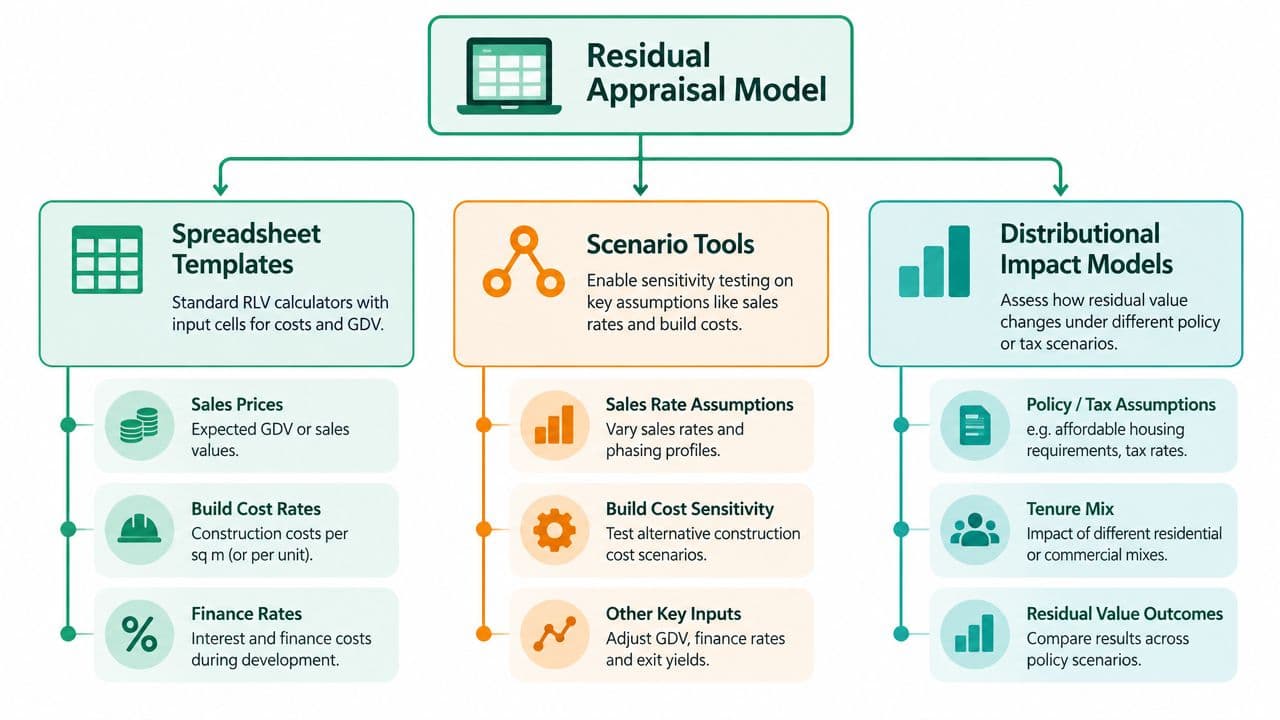
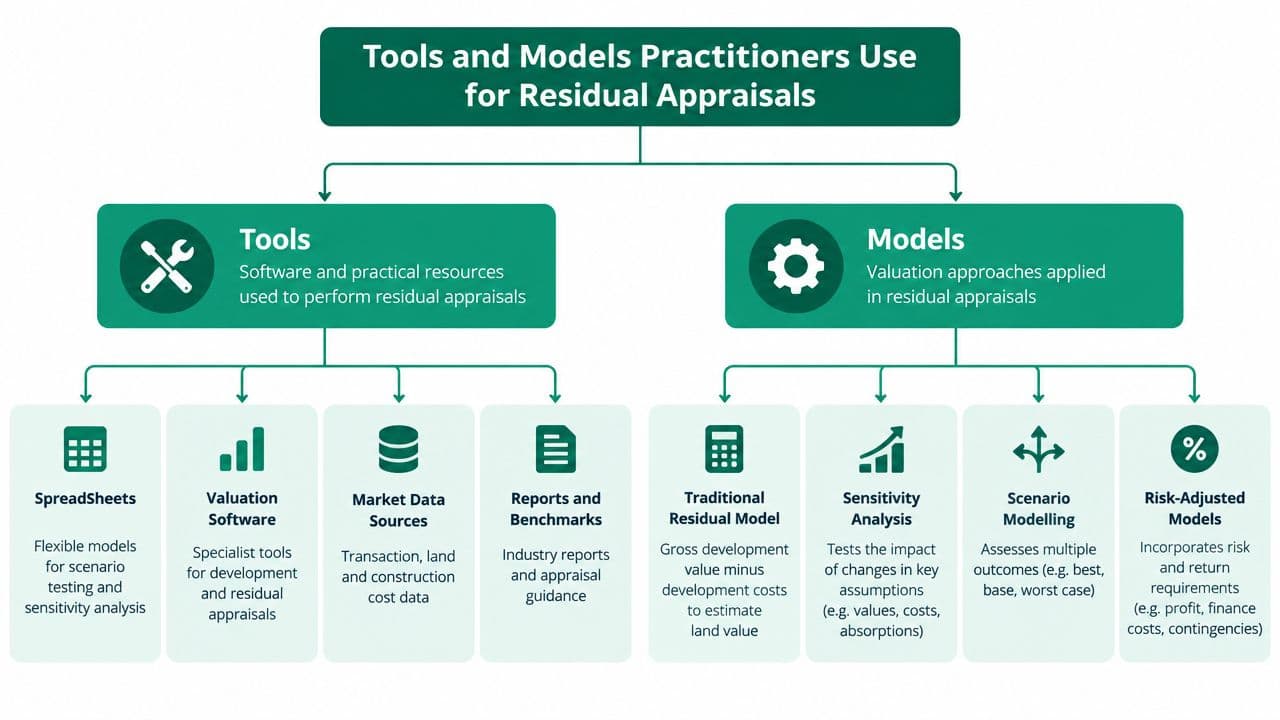
A residual appraisal starts in a spreadsheet, but a credible decision process needs more than a single output cell. Practitioners combine market evidence, cost plans, cash-flow timing, scenario analysis, and policy modeling so users can see which assumptions drive the result.
The basic data layer
A workable model needs evidence for GDV, construction costs, professional fees, finance, programme, contingencies, and abnormal works. For larger portfolios or public-sector decisions, a cadastre or parcel database can connect individual sites with planning designations, existing uses, infrastructure, and ownership information.
The model should separate inputs from calculations. Users need to see which cells contain observed evidence, which contain professional judgments, and which are generated by formulas. That distinction supports review and prevents a forecast from appearing more certain than its inputs justify.
Scenario and distributional tools
Scenario tools let a team compare a base case with slower sales, higher build costs, alternative density, different policy charges, or a changed profit hurdle. Interactive charts can show where residual value becomes negative or where a scheme falls below a benchmark land value.
Distributional models take the analysis further. They can examine how a land-value charge affects landowners, developers, public revenue, housing delivery, and existing users. For governments and cities, that perspective is essential because a policy can produce a positive residual in one location and undermine feasibility in another.
Unitism® provides valuation methods, policy design, distributional and fiscal impact modeling, implementation support, education, and interactive tools for organizations examining land value and land-based charges. Its scenario modeling software guidance is relevant when a static spreadsheet needs to become a transparent, inspectable scenario model.
The right tool depends on the decision. A small acquisition may need a carefully documented spreadsheet and professional review. A municipal reform may need parcel-level data, fiscal projections, distributional analysis, legislative design, and a phased implementation plan. In both cases, transparency matters more than visual complexity.
Conclusion Making Better Land Decisions With Residual Thinking
Residual land value is best understood as a live, risk-adjusted feasibility benchmark. The basic relationship is straightforward:
Residual land value = gross development value − total development costs − developer profit
The difficult work lies in deciding what belongs in each term. GDV must reflect credible sales or rental evidence. Costs must include the whole development stack. Finance must reflect timing. Profit must compensate for risk. Planning obligations and abnormal works must appear before the land price is calculated, not after the bid has been agreed.
Before relying on a residual, check:
- Value evidence: Does GDV match the proposed use, quality, timing, and market?
- Cost completeness: Are construction, fees, finance, contingencies, infrastructure, and compliance costs included?
- Risk allowance: Have abnormal works and delivery uncertainty been tested?
- Profit hurdle: Is the required return explicit rather than hidden?
- Holding period: Does the model reflect when costs are paid and receipts arrive?
- Policy effect: Does the scheme still work after taxes, contributions, or land-value charges?
- Benchmark: Does the result support a credible comparison with existing use value plus a premium?
A single residual can conceal more than it reveals if the assumptions remain invisible. A set of scenarios shows whether the site is marginal or dependent on one optimistic forecast. That distinction helps buyers bid responsibly, sellers understand valuation evidence, and policymakers design charges that capture value without making productive development impossible.
Residual thinking also changes the broader conversation about land. It links prices to what a site can support, clarifies how risk is allocated, and provides a common language for developers, valuers, planners, lenders, and public authorities.
If you're evaluating a site, designing a land-value policy, or building a transparent scenario model, visit Unitism® to explore valuation methods, fiscal-impact tools, and implementation support. Use the residual approach to test who gains, who pays, and which assumptions determine whether development remains viable.