Learn what is natural capital, the stocks of land, water and forests that generate services, and why public finance and land policy depend on them.
November 13, 2026
What Is Natural Capital? a Clear Guide for 2026
Learn what is natural capital, the stocks of land, water and forests that generate services, and why public finance and land policy depend on them.

Natural capital is the world's stock of natural resources and ecosystems, including forests, water, soil, minerals and biodiversity, valued for the services those assets provide to people and businesses. Nearly half of global gross domestic product is linked to biodiversity and ecosystem services, which is a formal way of saying that nature appears in every payroll, harvest and utility bill.
So why does a forest sit on a national balance sheet at close to nothing until someone fells it? Why does a wetland that has absorbed floodwater for a village for two centuries count as an asset only after it's drained and the insurance premiums climb? The gap isn't sentiment. It's bookkeeping. We count what gets sold and ignore what keeps producing.
Table of Contents
- What Natural Capital Is and the Services It Provides
- Public Finance and Measurement of Natural Capital
- Where Valuation Ends and Judgement Begins
- Economic Rent and the Land-Value Link
- How Strong Is the Evidence for Land Charges
- Land Leases, Land-Use Rights and How to Check Them
What Natural Capital Is and the Services It Provides
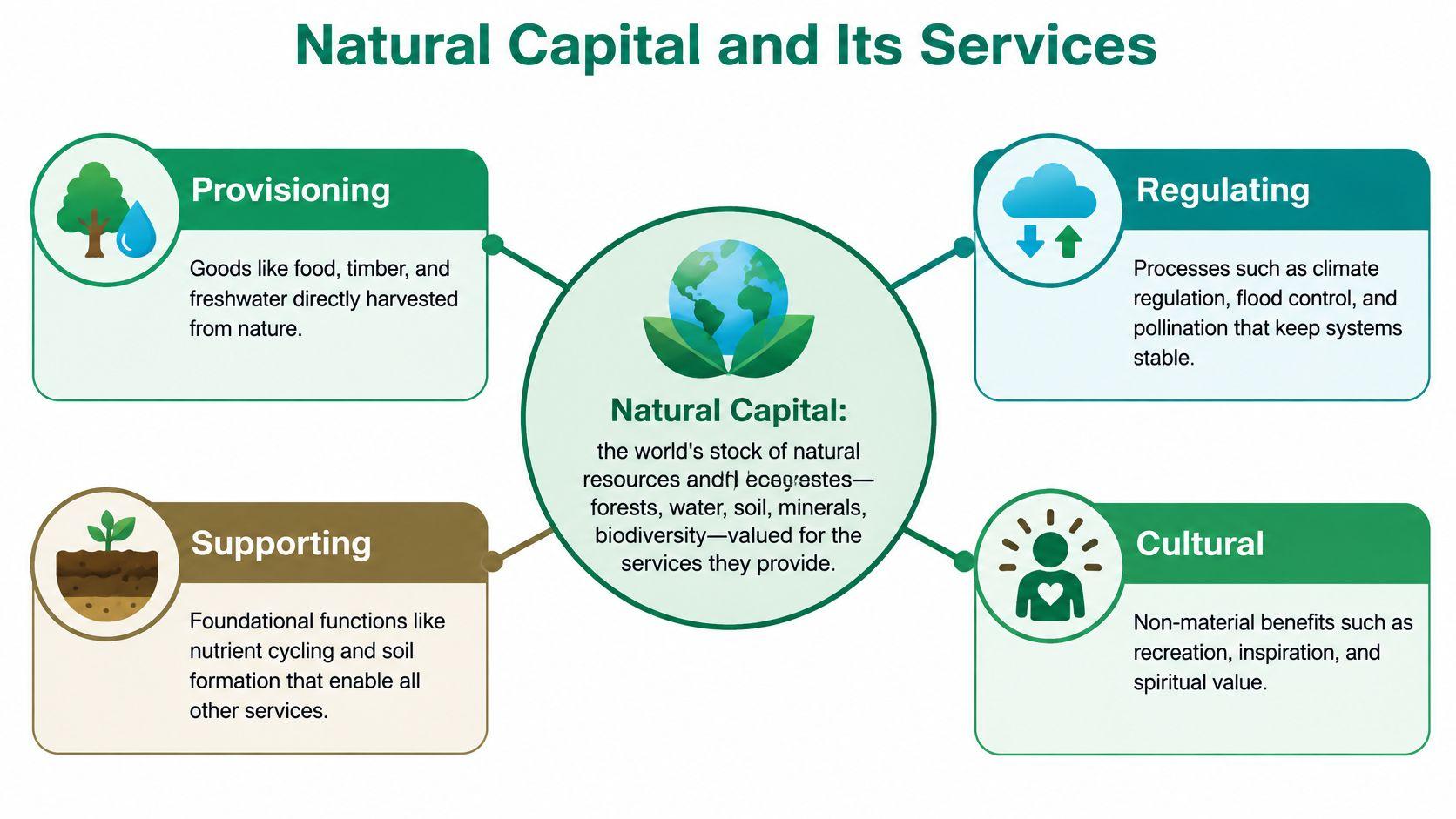
What does a natural asset provide beyond the material it contains? A forest supplies timber, for example, but it can also store carbon, filter water and reduce flood risk. Those ongoing benefits are services. Natural capital accounting considers both the asset and the condition that determines how well it can provide them.
An inventory might record the area of a forest or the volume of timber. It cannot, by itself, show whether the forest's capacity is improving or declining, or who relies on its services. That distinction matters: the same area of woodland can provide very different benefits depending on its condition.
Three Kinds of Service Nature Supplies
- Provisioning services provide physical goods, including crops, fish, timber and drinking water. These are often the easiest to observe because they may be bought and sold.
- Regulating services help control natural processes, through pollination, erosion reduction, flood protection and climate regulation. Their value may appear as costs avoided rather than as a direct payment.
- Cultural services include recreation, scenic beauty and heritage. A coastline can attract visitors; a city park can offer a place to walk and gather.
Some frameworks also identify supporting services, such as nutrient cycling and soil formation. These processes sustain other services, even when their effects are not immediately visible.
The World Bank's natural capital programme estimates that partial ecosystem collapse could cost the global economy approximately $2.7 trillion a year by 2030, with annual GDP losses of up to 10% in low-income countries. It also identifies agriculture, forestry, fisheries, aquaculture, utilities, construction and energy as sectors substantially dependent on ecosystem services. Nature, in other words, contributes to production as well as recreation.
The Stock and Flow Split Does the Real Work
The distinction between an asset and what it provides makes the accounting easier to follow. Forests, aquifers, soils, wetlands and fisheries are asset stocks. Timber, water, flood protection and fish catch are examples of the service flows they can generate. If the stock's condition worsens, future flows may fall.
| Asset stock | Service flows | What degradation does |
|---|---|---|
| Forests | Timber harvests, carbon sequestration, recreation | Clearing or degradation reduces future timber and carbon capacity |
| Aquifers | Water provision | Depletion reduces water available for later use |
| Soils | Crop-supporting function, erosion control | Erosion reduces productive capacity |
| Wetlands | Flood protection, habitat | Draining removes the flood buffer |
| Fisheries | Fish catch | Overfishing reduces future catches |
Physical extent alone can conceal a decline in condition. A forest may cover the same area while its soil thins, its mix of species changes and its ability to support watershed functions weakens. Measurement therefore needs to track condition as well as extent. Monitoring systems and data pipelines are part of environmental policy because they help collect and report that information. Kagool's view on tech-driven sustainability offers a perspective on technology and sustainability.
Working rule: To understand a service flow, identify who receives it. Without that, the account describes an asset but leaves its benefits unclear.
A practical first step is to list the natural assets in a region, name the services each provides and note who receives them. A coastal city might depend on wetlands for flood protection, nearby waters for fish and its coastline for tourism. The steps used to value ecosystem services show how analysts can then translate a service into a monetary estimate, where the available evidence allows it.
Public Finance and Measurement of Natural Capital
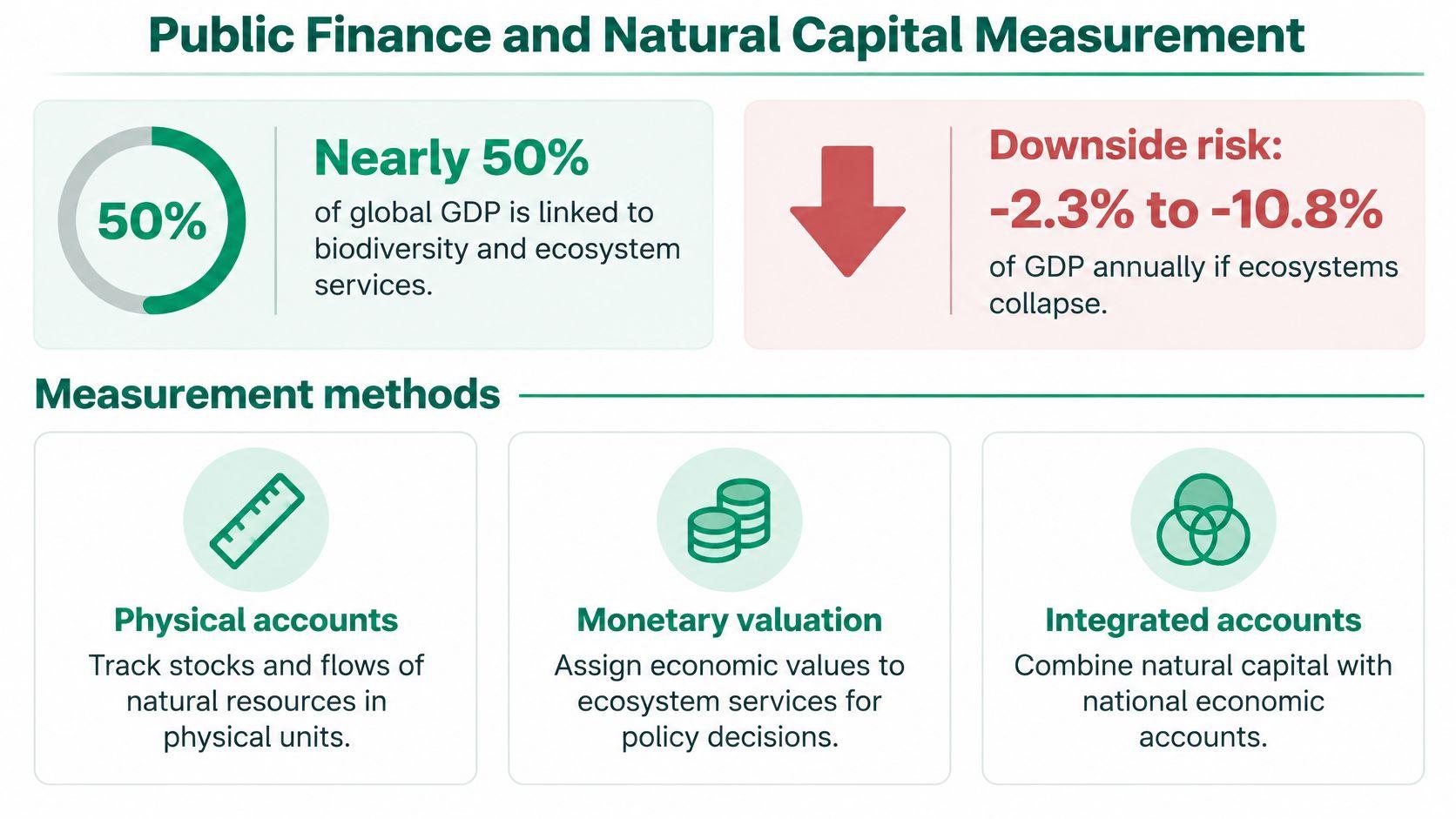
How does a change in an ecosystem become visible in a public budget? Ecosystem accounting work from the United Nations treats the link between nature and output as a fiscal question: nearly half of global gross domestic product depends on biodiversity and ecosystem services (Introduction to Ecosystem Accounting). When ecosystems weaken, the effects can reach public finances through disaster spending, health costs and higher input prices for farmers and utilities.
Sustainable income depends on maintaining the asset base, not maximizing current output. A good year can make the two goals look alike. Over time, however, production may rise even as natural assets decline, leaving future budgets to meet higher costs.
The Chain From a Drained Wetland to a Budget Line
Consider a wetland that is drained for development. The budget consequences emerge through several connected steps:
- A physical change occurs. Land-use change, pollution, extraction or infrastructure alters an ecosystem's extent or condition.
- Service flows change. Flood protection, water provision or pollination may become less reliable or decline.
- Costs shift. Production costs, health outcomes, disaster risk, household welfare and public expenditure can all be affected.
- Wealth changes. Total wealth analysis can capture the resulting change, even when it is absent from conventional output measures.
GDP measures economic production, but it does not show whether that production came at the cost of natural assets. A country can record growth while soils thin or aquifers fall, with consequences for the cost of running its economy later.
The headline measure and the fiscal risk are different parts of the same picture.
What the 2021 Statistical Standard Changed
In March 2021, the United Nations Statistical Commission adopted the System of Environmental-Economic Accounting, Ecosystem Accounting as an international statistical framework (UN SEEA methodology). It organizes information on habitats, ecosystem services, changes in ecosystem assets and their links to economic activity. Physical accounts record extent, condition and service flows; monetary accounts estimate the economic value of services.
Before adoption, more than 34 countries were already compiling ecosystem accounts experimentally. The UN's NCAVES project had also piloted ecosystem accounting in Brazil, China, India, Mexico and South Africa from 2017. Adoption gave governments a recognized statistical framework for relating ecological change to infrastructure, fiscal, land-use and development decisions.
| Account type | What it records | Main limitation |
|---|---|---|
| Ecosystem extent and condition | Area and health of habitats and landscapes | Mapping gaps and inconsistent condition data |
| Service flow accounts | Annual flows such as water provision, flood protection and pollination | Quantifying services is difficult and often data-limited |
| Monetary asset accounts | Estimated value of expected future service flows | Depends on assumptions and uncertain prices |
| Biodiversity indicators | Species and habitat condition behind ecosystem services | Thresholds and cumulative impacts are hard to measure |
A practical starting point is to track the assets with the greatest fiscal significance, including land, water, forests, minerals, pollution and ecosystem condition. Publish physical indicators alongside any monetary estimates, so readers can see the evidence and assumptions separately. Connecting land and water accounts with a city's revenue and spending records can help show where ecological changes may affect public finances.
Where Valuation Ends and Judgement Begins
How should a government decide when a natural asset matters but its value cannot be captured by a reliable price?
Measurement and monetization answer different questions. Physical accounts can record the extent and condition of ecosystems, while monetary estimates put a value on some of the services they provide. Both approaches have limits: maps may be incomplete, service flows difficult to quantify, and ecological condition uncertain (official guidance on natural-capital accounting).
A missing price does not make an account useless. Physical measures can show which places support flood protection, reveal dependencies that a ministry had not considered, and identify gaps in the evidence. A council can use information about a catchment's role in flood protection to compare options even when there is no agreed monetary value per hectare.
Biodiversity Is a Condition, Not a Spare Asset
Biodiversity describes the variety and condition of life in natural systems. It also supports the goods and services those systems provide, so a monetary total for services cannot capture everything biodiversity represents. In particular, a gain measured in money does not establish that irreversible biodiversity loss elsewhere has been compensated for. Thresholds and cumulative impacts can be difficult to measure, and some values may not be meaningfully expressed as a price (Capitals Coalition guidance on biodiversity).
A practical decision checklist:
- What physical features and ecological conditions are being measured?
- Which benefits are valued in money, and which remain outside the estimate?
- How certain are the measurements and assumptions?
- Who benefits from a decision, and who bears its costs?
- Could a monetary gain conceal an irreversible or poorly measured loss?
For a land decision, methods of land valuation can help distinguish physical condition from market price. Water presents a related question: a low price does not necessarily indicate dependable supply. The discussion of how water valuation shapes utility careers raises the topic of water's value, but price and reliability should be assessed as separate considerations.
Publish physical indicators and confidence levels alongside any monetary estimate. That gives decision-makers a clearer view of what the numbers capture, and what still requires judgement.
Economic Rent and the Land-Value Link
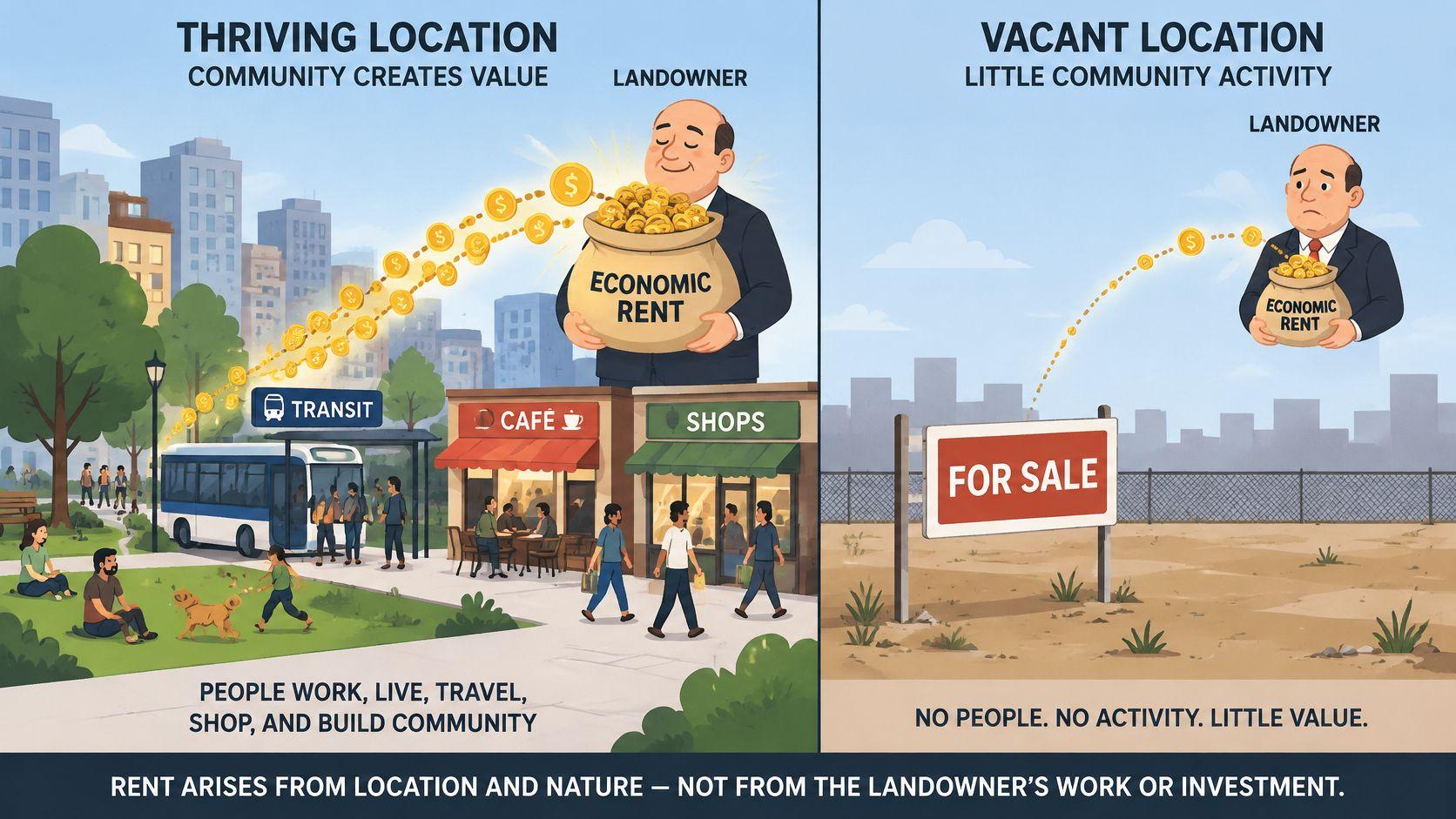
Why can a site become more valuable even when its owner has done nothing to improve it? Economic rent is income from owning a desirable location or natural resource, rather than from work or investment. Nature and the surrounding community create this value, while it accrues to whoever holds the title.
Consider a city plot that gains value as a subway stop, a school and shops develop nearby. The owner did not create those surrounding benefits, yet the increase in land value flows to the owner. Martin Adams's work addresses how value created by the community can flow to private owners rather than back to the public.
What a Land-Value Tax Actually Taxes
A land-value tax applies to the value of the site itself, excluding buildings and other improvements. Under a two-rate property tax, the rate on land is higher and the rate on improvements is lower. Harrisburg, Pennsylvania, provides a worked example: land was taxed at 28.67 mills and improvements at 4.78 mills, a 6-to-1 ratio (Lincoln Institute of Land Policy).
The distinction affects building decisions. A tax on buildings raises the cost of adding floors or maintaining structures. A tax on site value leaves the return from those improvements untaxed, changing the financial incentive to build.
Studies of split-rate taxation in Pennsylvania found an association with increased residential construction, though the measured effects were modest and difficult to assess reliably across implementations. Applying a land charge also depends on keeping valuations current, setting rates, and coordinating valuation with land-use planning and public understanding.
A land charge is therefore a valuation and rate structure, not a slogan. It taxes an assessed figure, which must be kept up to date.
A land-value charge and a fixed lease allocate changes in value differently. The charge tracks the site's assessed value over time. A fixed lease holds the payment steady for a defined term, with the accumulated difference settled at expiry. The distinction becomes clearer through the economics of land value: one arrangement adjusts as values change, while the other fixes the price for a period.
How Strong Is the Evidence for Land Charges
Land-charge evidence is not uniform, and anyone reading it should grade it. Four pieces of evidence carry most of the argument, and each one proves less than a headline suggests.
| Evidence | Finding | What it cannot show |
|---|---|---|
| Harrisburg, Pennsylvania | Land taxed at 28.67 mills and improvements at 4.78 mills, a 6-to-1 split-rate ratio | A rate structure, not an outcome study |
| Pennsylvania studies by Plassmann and Tideman | Split-rate taxation linked to about 3% to 4% more residential construction, using building-permit data | Effects were modest and hard to measure reliably in many implementations |
| Danish municipal comparison | Persistent land-tax differences showed zero effect on residential home prices and no measurable effect on development, mobility or homeownership | Results for one country's conditions only |
| Peer-reviewed economic experiment | A model with a uniform property-tax rate of 0.90 and a land-value-tax rate of 0.20 produced more revenue and less sprawl | Observed behaviour in the experiment did not consistently match the model's predictions |
Read the ratings rather than the numbers. The Harrisburg figures describe a design choice, not a result. The Pennsylvania construction effects are real in the studies but small, and small effects resist measurement in places where implementation was timid. The Danish result is the cleanest null finding available and still speaks to one country's institutional setting, its assessment practice and its housing market. The experiment shows a mechanism working in a parameterized model while people in the room behave less predictably than the model assumes.
What survives all four is narrow and useful: shifting the tax base from structures to site value changes the marginal payoff between holding land idle and developing it, and annual reassessment is what keeps the charge aligned with the market. What the evidence does not support is the stronger claim that a land charge alone ends speculation or lowers housing costs.
Land Leases, Land-Use Rights and How to Check Them
The same label can describe very different arrangements. A lease may end on a set date, while another form of land-use right may continue under different terms. To understand the difference, check what the agreement says about duration, payment, renewal and transfer.
| Feature | Renewable fixed lease | Non-renewable fixed lease | Land-use right |
|---|---|---|---|
| Term | Fixed, with renewal possible | Fixed, with no renewal | Depends on the jurisdiction and agreement |
| Price | Fixed for the term | Fixed for the term | May be linked to current site value |
| Renewal | Required or available at term end | Not available | Depends on the jurisdiction and agreement |
| Risk at end of term | The gap between the lease payment and market value may be addressed at renewal | The approaching expiry can affect refinancing and resale | Depends on the terms and how payments are set |
| Buying and selling | Remaining term may affect the price | Shorter remaining term may make refinancing and resale harder | Depends on transfer rules and payment terms |
A fixed lease can postpone a change in payment rather than remove the risk. With a renewable lease, the terms may be revisited when the lease ends. With a non-renewable lease, the remaining term matters to a buyer because the right will eventually expire.
Why Annual Repricing Changes the Economics
Annual repricing ties the payment more closely to the current value of the site. If a right also has no expiry and requires no renewal, it avoids the particular uncertainty created by a fixed lease ending. These are useful features to check, not a universal definition of a land-use right. Legal terms and arrangements vary by jurisdiction. For an overview of what a land-use right is, start with the right's legal and practical features rather than its label.
The payment mechanism also affects incentives. If a site's charge reflects its current value, holding valuable land unused does not preserve a low payment just because the contract was signed earlier. The effect depends on how the site is valued and how the arrangement is administered.
A right does not qualify by label alone. Check whether it expires, whether renewal is required, and whether its payment is reassessed. The answers vary by jurisdiction and contract.
A Checklist You Can Run on Any Land Arrangement
- Check the term. Does the document set an expiry date? If so, note when the right ends and what happens then.
- Check the price mechanism. Is payment fixed for a period, or recalculated against current site value?
- Check renewal. Must the holder renew, renegotiate or apply for an extension? Find out what changes if they do.
- Check transferability. Can the right be sold or transferred, and do the remaining term or payment rules affect its value?
- Check the legal label against the terms. Terminology varies by jurisdiction, so read the operative clauses, not just the document title. Before a transaction, confirm the title and tax treatment with appropriate local advice. A property due-diligence guide sets out title and tax verification steps, though the applicable requirements depend on the jurisdiction.
Use the answers to describe the arrangement precisely: for example, a fixed-term lease with renewal, or a right whose payment is reassessed annually. When no single price can capture the arrangement, its duration, payment rules and transfer conditions still provide a practical basis for comparison.
Unitism's tri-factor economics distinguishes labour, capital and nature as separate sources of wealth. Its work on land-value reform examines how land and natural wealth can contribute to public services while reducing taxes on work and productive capital. Martin Adams, author of Land: A New Framework for a Thriving World, works to translate economic insights into practical frameworks for governments and organizations.
Unitism supports governments, cities and organizations with research, policy design, valuation methods, education and implementation support. For land arrangements, that work can include assessing site rental values and modelling how a proposed policy affects revenue and different groups. Explore the Unitism® framework for more on its approach.