Your complete guide to DC real estate assessments. Understand how your property is valued, how to appeal, and the impact on your property taxes in 2026.
July 21, 2026
DC Real Estate Assessments: A 2026 Homeowner's Guide
Your complete guide to DC real estate assessments. Understand how your property is valued, how to appeal, and the impact on your property taxes in 2026.

Your assessment notice shows up, and the first reaction is usually simple: Why did they value my property like this? If you're a homeowner, landlord, or neighborhood advocate in the District, that question matters because DC real estate assessments don't just shape tax bills. They also reveal how the city thinks about land, buildings, redevelopment, and who bears the cost of holding valuable urban space.
Recipients typically open the notice, scan the big number, and stop there. That's understandable. The District's system is technical, and the language can feel written for appraisers rather than residents. But once you understand a few core ideas, the notice becomes much easier to read. You can tell what the city is valuing, how that value connects to taxes, when an appeal makes sense, and why DC's approach matters beyond your own parcel.
Table of Contents
- Your 2026 DC Assessment Notice Arrived Now What
- How DC Determines Your Property's Market Value
- Finding and Understanding Your Assessment Data
- How Your Assessment Translates into Property Taxes
- The Step by Step DC Assessment Appeal Process
- Policy Insights Land Value and DC's Economy
- Key Takeaways for DC Property Owners
Your 2026 DC Assessment Notice Arrived Now What
A typical homeowner opens the envelope, sees an assessed value that looks higher or lower than expected, and immediately jumps to the tax bill. That instinct makes sense, but it's better to pause and treat the notice as a data document first. The notice is telling you how the Office of Tax and Revenue views your property in the current assessment cycle, not just what you might owe later.
That distinction matters because you may agree with the tax policy and still disagree with the valuation. Or you may accept the valuation and still want to understand why your tax outcome differs from your neighbor's. Those are different questions, and DC's system answers them in different places.
Practical rule: Read the notice in this order. Property details first, value breakdown second, tax implications third.
Start by checking the basics. Is the property class right? Does the record appear to reflect the parcel you own? If the notice separates land and improvements, pay attention to both pieces rather than only the total. In DC, that split isn't a side detail. It's one of the most important features of the system.
For readers who want to visualize how location shapes site value, a land value mapping tool like this interactive value map can help you think more clearly about why two similar buildings can sit on very different land values.
A lot of confusion comes from mixing up three separate ideas:
- Assessment is the city's estimate of market value for the property.
- Taxation is the rate structure applied to that assessed value.
- Appeal rights are your procedural path if the assessment looks wrong.
Homeowners usually feel more in control once they separate those questions. Policy advocates should do the same. The same assessment roll that affects one household's notice also provides a window into how DC prices land, penalizes long-term vacancy, and creates the raw material for debates about land-value reform.
How DC Determines Your Property's Market Value
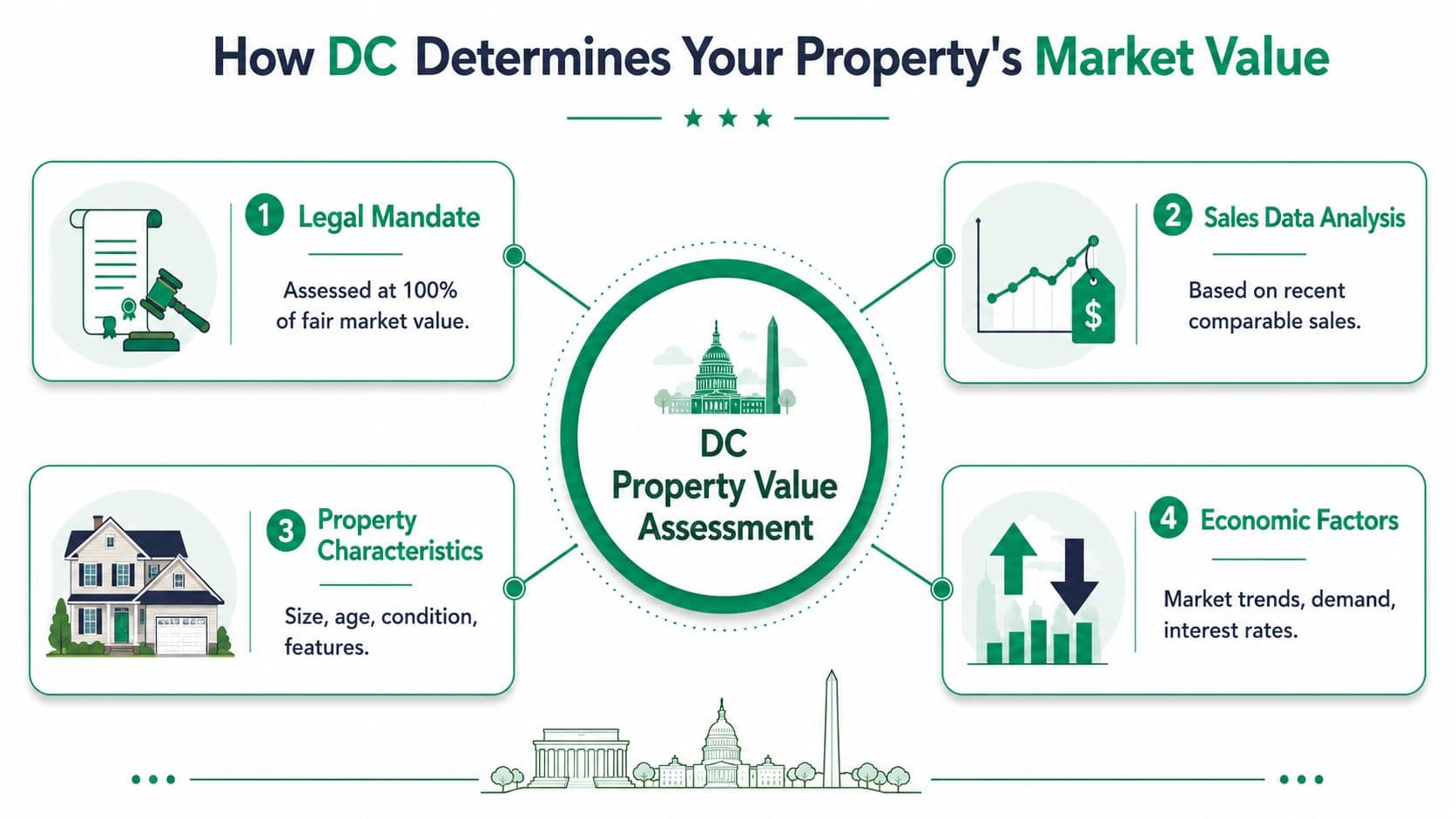
The District uses a demanding standard. All real property is assessed annually at 100 percent of its current market value, with value set as of January 1, and in the most recent cycle the Office of Tax and Revenue appraised 209,608 properties across taxable, exempt, and possessory interest categories, according to the DC Office of Tax and Revenue release on the assessment cycle.
What the legal standard means
Some jurisdictions assess property at only a fraction of estimated market value. DC doesn't. The legal rule requires the assessor to aim at the full fair market value itself. That pushes the system toward current conditions rather than older benchmarks.
In plain language, OTR isn't asking, "What was this roughly worth some years ago?" It's asking, "What is this property worth in the market as of the valuation date?" That creates a more direct connection between assessments and actual market conditions.
The law also shapes the method. Because DC has to assess a very large number of parcels at current market value, it uses mass appraisal rather than handcrafted appraisals for every parcel. The District's published assessor materials describe a time-trending approach that stratifies values by use code and adjusts subneighborhood values annually using market data, as outlined in the Assessor Reference Materials.
Why mass appraisal is necessary
Mass appraisal sounds abstract, but the logic is straightforward. If one appraiser had to individually inspect and fully narrate every parcel in the District each year, the system would grind to a halt. Instead, OTR groups properties by relevant characteristics and neighborhood patterns, then updates values using observed market evidence and trends.
Think of it this way:
- Comparable sales help anchor value. If similar properties in a comparable setting have been trading at higher or lower levels, the model should detect that.
- Property characteristics matter. Size, use, condition, and physical features still influence the result.
- Neighborhood movement matters too. Time-trending lets the assessor adjust for changing local market conditions instead of freezing values in older assumptions.
For investors and analysts, outside market data tools can provide context when you're studying neighborhoods. A practical example is this guide to finding investment properties via Zillow scraping, which shows how some market participants organize listing data to compare values across areas. That isn't the same thing as an official assessment, but it helps explain the kind of pattern analysis people often try to replicate informally.
Why the land and building split matters
DC requires a separate valuation of land and improvements. That's unusually important. In many places, owners focus only on the total assessed value. In DC, the split gives you a clearer picture of what part of the property's value comes from the site itself and what part comes from the structure on it.
That distinction matters for two reasons.
First, it improves interpretation. A modest building on a highly valued site tells a different story from a costly building on lower-valued land. Second, it opens the door to better policy analysis. If a city wants to understand whether rising prices come from neighborhood land demand or from actual capital investment in structures, it needs that split.
If you want a clearer feel for how analysts estimate the site portion, this explainer on how to calculate land value is useful background.
Separate land and building values don't just help with tax administration. They also make it possible to ask a deeper question: are people paying for construction, or for access to a location the whole community helps create?
Finding and Understanding Your Assessment Data
The fastest way to get oriented is to look up your parcel record and compare it with the notice in your hand. Don't rely on memory. Owners often remember the old number, the mortgage appraisal, or a recent listing price, and those don't necessarily match the current assessment record.

What to look for first
When you pull up your property data, start with the parts most likely to drive confusion:
- Property identification. Make sure the parcel and address line up with the property you own.
- Classification. A wrong class can lead to the wrong tax treatment.
- Assessment breakdown. Look for total assessed value and any separate land and improvement values.
- Recorded characteristics. If key physical details appear wrong, that can affect the final number.
A good habit is to compare your parcel with nearby properties that are similar. Not just same block, but same general use, similar lot situation, and comparable building type. If you want a broader set of practical resources for analyzing land and tax questions, the Unitism tools library is a helpful starting point.
How to read land value and improvement value
Here's where many readers get stuck. They assume land value means what the lot would sell for in a vacant condition tomorrow. Sometimes it approximates that idea, but in an assessment context it's better to think of it as the value attributed to the site as distinct from the structure.
Improvement value refers to the building or other built features. If your total value rose, the change could come from either side. That matters. A jump in land value often reflects stronger demand for the location. A jump in improvement value may reflect physical changes, corrected records, or a different interpretation of the structure.
When you're checking comparable properties, ask narrower questions than "Is my total too high?"
Try questions like these:
- Does my land value look out of line with nearby lots in a similar setting?
- Does my building value fit the condition, size, and style of the structure?
- Does another property seem lower because it's in a different class or physical state?
The strongest assessment review starts with a mismatch you can point to on paper, not a feeling that the number seems unfair.
That same discipline helps policy advocates too. If you want to critique DC real estate assessments as a system, begin with the data fields themselves. What the city measures determines what the city can debate.
How Your Assessment Translates into Property Taxes
A common DC homeowner experience goes like this. You open the assessment notice, see that the market value rose, and assume the tax bill will rise by the same percentage. That is often wrong.
The assessment is one input into the tax bill, not the bill itself. A useful comparison is income taxes. Your earnings matter, but your final tax also depends on brackets, credits, and eligibility rules. DC property taxes work in a similar way. The city starts with assessed value, then applies a property class, a tax rate, and any relief the owner qualifies for.
The rate structure in one view
DC taxes different kinds of property at different rates, and the gap is large enough to shape behavior, not just raise revenue. The District's real property tax rates page shows a standard residential rate, tiered nonresidential rates, and much higher rates for vacant and blighted property.
| Property Class | Description | Tax Rate |
|---|---|---|
| Residential | Standard residential real property | $0.85 per $100 of assessed value |
| Nonresidential | First portion of assessed value | $1.65 per $100 of assessed value for the first $5 million |
| Nonresidential | Middle portion of assessed value | $1.77 per $100 of assessed value for value between $5 million and $10 million |
| Nonresidential | Upper portion of assessed value | $1.89 per $100 of assessed value for value exceeding $10 million |
| Class 3 | Vacant real property | $5.00 per $100 of assessed value |
| Class 4 | Blighted real property | $10.00 per $100 of assessed value |
Those last two classes stand out. DC taxes vacant and blighted property at rates far above the ordinary residential rate. That is a policy signal as much as a revenue tool. The city is making it expensive to hold urban land in an underused condition.
Why similar assessments can produce different tax bills
Two houses can have similar assessed market values and still generate different bills. The reason is usually classification or relief, not a mystery in the math.
For many owner-occupants, the homestead rules matter as much as the headline assessment number. An eligible homeowner may receive protections that limit how fast taxable value rises even when market assessment rises faster. If you want the homeowner side explained in plain English, this guide to the District of Columbia homestead exemption is a useful reference.
That difference matters in practice. One owner may be taxed on a value that reflects homeowner protections. Another owner, with a similar house but no qualifying relief, may be taxed on more of the current assessed value. So the right question is not only, "What is my assessment?" It is also, "What portion of that assessment is being taxed under my property's class and eligibility status?"
Why this matters beyond your own bill
DC's system is unusually useful as a case study in land-value reform. Earlier in the article, we looked at how DC separately reports land value and improvement value. Here, you can see the policy side of that structure. The city does not merely measure land separately. It also taxes some forms of land holding, especially vacant and blighted property, much more heavily.
That approach reflects a basic public finance idea. Location value often comes from the city around the parcel. Transit, schools, job access, public safety, zoning, and nearby private investment all raise what a site is worth. A tax system that places heavier pressure on underused land tries to recover part of that socially created value and push land toward active use.
For homeowners, the practical lesson is simple. Your assessment notice tells you the city's estimate of value. Your tax bill is the result of value, classification, tax rate, and any relief attached to the property. Understanding all four parts is what turns a confusing notice into something you can evaluate.
The Step by Step DC Assessment Appeal Process
If your assessment looks wrong, the worst move is to file an appeal based only on frustration. DC's process expects facts, and the official guidance says successful appeals require meaningful and accurate supporting information with a factual basis rather than mere opinion, as stated on the District's assessment appeal rights page.
Start with facts not frustration
Before you file anything, compare your parcel record against reality. Check for physical errors, classification problems, or evidence that similar properties are treated differently in ways that may matter. If you have market evidence, organize it before you begin.
The strongest appeal arguments usually look like one of these:
- A factual record problem. The property record includes an error in characteristics or condition.
- A valuation mismatch. Comparable evidence suggests the market value conclusion is off.
- A classification issue. The property is placed in the wrong category for tax purposes.
Good appeals don't say, "I think this should be lower." They say, "Here is the record, here is the conflicting evidence, and here is the correction requested."
The required path for appeals
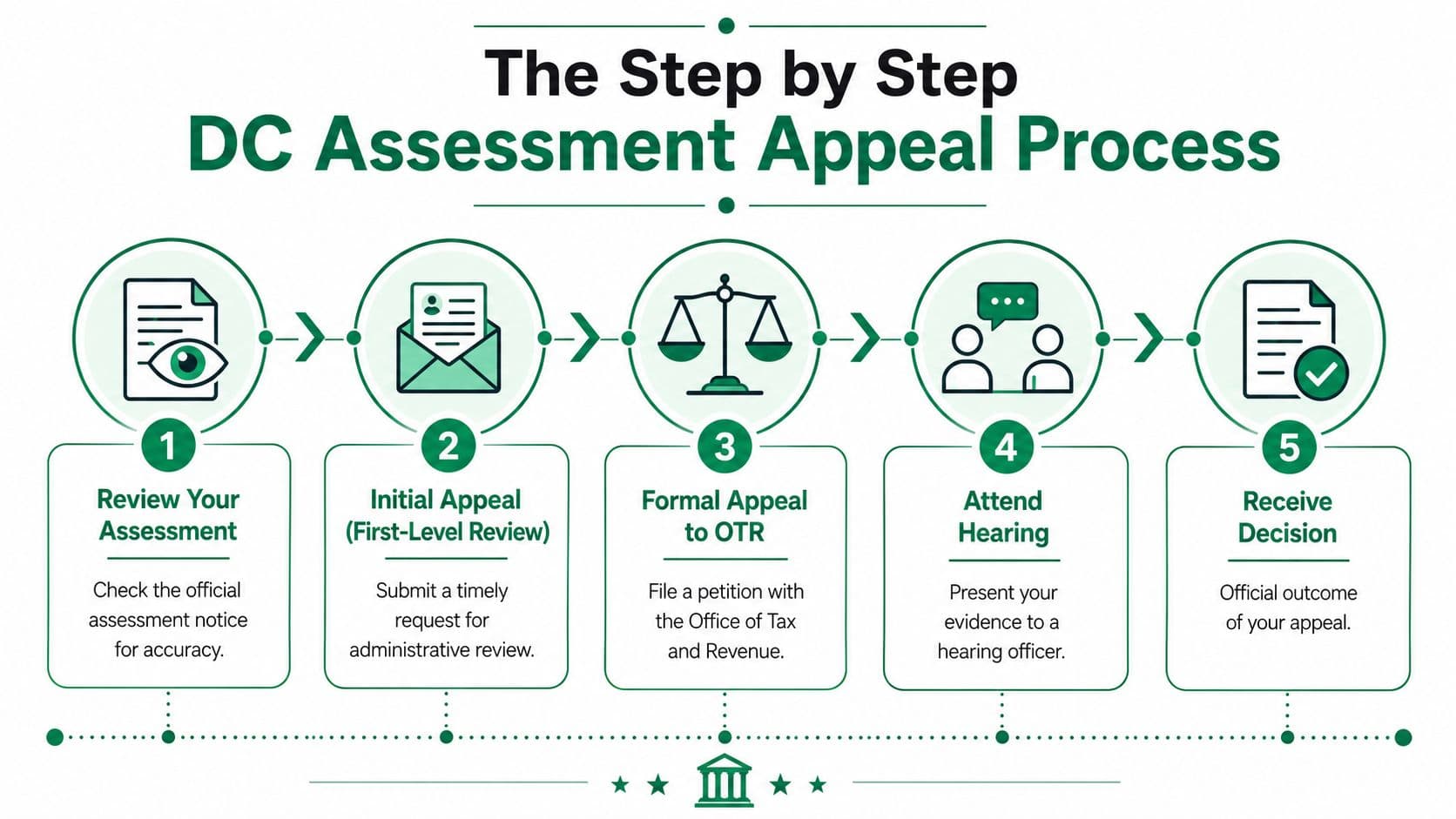
DC requires an administrative review first. You begin through MyTax.DC.gov. If you aren't satisfied with that result, you may appeal to the Real Property Tax Appeals Commission (RPTAC). The deadline for filing with RPTAC is strict: 45 days from the date of the administrative appeal decision notice.
A clean way to think about the sequence is this:
- Review the notice carefully. Identify the specific issue.
- File the first-level administrative review. This is mandatory.
- Wait for the administrative decision. Read it closely, not just the outcome.
- If necessary, file with RPTAC within the 45-day window.
- If needed, seek further review in Superior Court.
That final judicial option exists, but most owners should focus first on building a coherent factual record before they think about court.
What evidence tends to help
OTR's standard is practical. It wants support, not general dissatisfaction. Useful materials may include comparable sales, income information where relevant, or documentation about the property's actual condition. The key is to connect the evidence to the assessment issue you're raising.
If you prepare for an appeal, keep these habits in mind:
- Be specific. Point to the exact line item or valuation issue.
- Use comparable properties carefully. Similarity matters more than proximity alone.
- Stay organized. A short, clear package usually works better than a long pile of unrelated material.
- Meet deadlines. Strong evidence won't rescue a late filing.
People often assume appeals are only for large commercial owners. That's wrong. Any owner who can document an error or a meaningful valuation problem should take the process seriously.
Policy Insights Land Value and DC's Economy
DC is more than a tax administration case. It's also a useful example of how assessment design shapes urban economics. The city's separate land and building valuation, together with steep taxes on vacant and blighted property, creates a framework that looks much closer to land-value reform than a conventional procedural guide would suggest.

DC as a practical land value case study
When a city separately values land and buildings, it can see more clearly whether price pressure comes from location or from constructed capital. When that same city taxes vacant and blighted property at far higher rates than ordinary residential property, it is signaling that idle urban land imposes a public cost.
That doesn't mean DC has solved the problem. In fact, there is an important evidence gap. Existing analysis often fails to show how DC's high vacant land tax rates of $5/100 for vacant and $10/100 for blighted affect vacancy rates or redevelopment timelines in key neighborhoods, leaving policymakers and civic organizations without the data they need for reform arguments, as noted on the DC real property FAQs page.
For readers comparing systems, a broader conceptual guide to the difference between land-value tax and property tax can help. DC sits in an interesting middle ground. It still taxes property broadly, but parts of its structure already reflect land-focused principles.
Land value taxes and land use rights are not the same
Discussions frequently become muddled regarding this topic. A land-value tax is a tax on the assessed value of land. The owner keeps title, and the tax system charges against the site value.
Land-use rights are different. Land-use rights are land leases that are repriced annually with no expiration dates. Because they are repriced annually, people can buy and sell land-use rights for a low cost. Economically, that can reduce the upfront price attached to control of a site, because the ongoing public charge captures the location value over time rather than capitalizing it into a large purchase price.
That distinction matters for reform debates. A city may move toward stronger land-value taxation without adopting a land-use-rights system. Or it may explore land-use-rights frameworks as a more structural alternative. DC's current assessment practice doesn't create land-use rights, but its land and improvement split makes that conversation more concrete because it already separates the site from the building in administrative terms.
A city can't design good land policy if it treats the site and the structure as though they create value in the same way. They don't.
Key Takeaways for DC Property Owners
A DC assessment notice is more than an annual tax document. It is also a public signal about how the city sees the value of your location, your building, and the way each should contribute to public revenue.
For homeowners, that means two jobs. First, protect your own position by checking whether the city described your property accurately and valued it reasonably. Second, read the notice as a small policy document. DC's separate land and improvement values show, in plain administrative form, a basic economic idea: the site and the structure do not create value in the same way. A renovated kitchen reflects private investment. A higher land value often reflects public investment, neighborhood demand, zoning, transit access, and job growth.
That distinction matters well beyond one tax bill.
If DC taxes land more heavily, especially vacant or underused land, it is applying a practical version of land-value reform. The city is saying that holding a valuable site idle should cost more, while adding or maintaining buildings is a different kind of economic activity. For property owners, that helps explain why the land line on an assessment record deserves as much attention as the total value. For policy advocates, it makes DC a useful case study. The assessment system is not just measuring property. It is shaping incentives around use, vacancy, and investment.
So the final takeaway is broader than "check your notice and file on time." Those steps matter, but they are only the household-level response. The larger lesson is that assessment systems are one of the main places where tax administration meets city-building. If residents understand how DC separates land from improvements, and how those values feed into taxes, they are in a better position to argue for fair treatment on their own parcel and better policy across the District.
Unitism® helps governments, researchers, and civic leaders understand how land values shape housing costs, tax policy, and public revenue. If you want deeper analysis on land valuation, land-value capture, or practical reform design, visit Unitism®.