Explore construction incentives from tax credits to schedule bonuses. Learn how design shapes outcomes and what works in practice.
August 13, 2026
Construction Incentives: Design, Effects, and Real Cases
Explore construction incentives from tax credits to schedule bonuses. Learn how design shapes outcomes and what works in practice.

88% of U.S. construction companies said they offered incentive compensation, but only 21% called those programs very effective. That gap matters because it shows how often incentives exist on paper without clearly changing behavior in practice. In construction, incentives are not a single tool. They are a design space that can mean a contract bonus for early completion, a tax regime that shapes sector behavior, or a place-based fiscal instrument tied to land and community outcomes.
The hard question is not whether a project should offer an incentive. It is what the incentive rewards, who captures the gain, and how anyone will know whether it worked. Those answers change with the level at which the incentive operates, and they also change the value pool being used to pay for the effect. A contract bonus usually comes out of the project budget. A tax incentive changes after-tax returns. A place-based instrument shifts gains through land use, development timing, and public revenue.
Romania shows why that distinction matters. A construction tax incentive can coincide with sustained activity rather than a one-time bump, but the policy signal only makes sense if it is separated from the broader movement in the sector. That is why the same word, incentive, covers mechanics that operate on different time horizons and pull from different pools of value.
Table of Contents
- What Construction Incentives Actually Are
- Contract-Level Incentives and How They Change Project Behavior
- Schedule, Cost, and Performance Bonuses Compared
- Infrastructure Incentives That Convert Delay Into a Price Signal
- Tax Incentives, Land Value, and the Unitism Frame
- Why Headline Incentives Often Miss Retention and Leakage
- A Designer's Checklist for Construction Incentives
- Choosing the Right Incentive for the Job
What Construction Incentives Actually Are
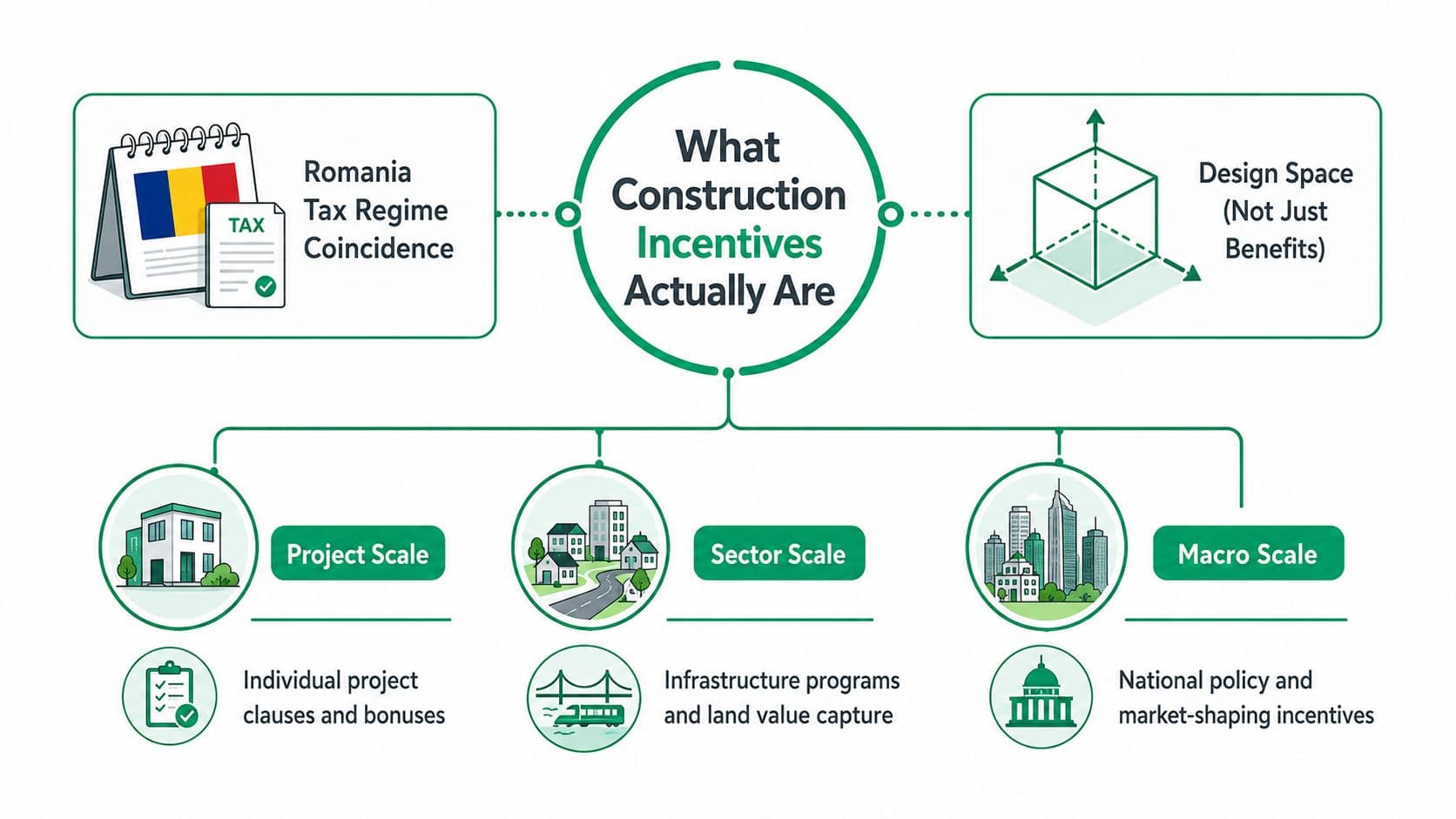
That Romanian example highlights a critical distinction. A tax incentive can coincide with broader sector movement, so the policy question is not whether activity rose after the measure appeared, but whether the incentive changed behavior in a way that can be separated from the wider market trend. The same word, incentive, can describe tools that operate at different levels of the system and draw from different pools of value.
Three scales, one label
At the project scale, incentives sit inside procurement contracts. Owners use them to shape contractor behavior on a single job, often by tying pay to early completion, savings, quality, or functionality. At the sector scale, governments use tax rules, credits, and wage-linked relief to influence how firms hire, invest, or expand capacity. At the macro or place-based scale, incentives are used to affect where development happens, how land is used, and which communities receive activity first.
That taxonomy matters because each scale uses a different value pool. A contract bonus usually comes from the project budget. A tax incentive changes after-tax returns. A place-based instrument can shift gains through land value, permitting access, or local fiscal treatment. If those are treated as one category, the core design problem disappears from view.
Practical rule: always ask whether the incentive is paying for speed, capacity, or location. Those are different policy goals, and they require different measurements.
Why the same word hides different mechanics
A bonus for early completion only makes sense if time has measurable cost on that site. A wage credit only makes sense if labor supply or workforce access is the constraint. A place-based incentive only makes sense if the developer's economics are blocked by location-specific barriers. The label is shared, but the mechanism is not.
That is why the useful questions are so specific. What behavior is being rewarded? Who gets the benefit, the contractor, the firm, the worker, or the landowner? What metric will prove the result? Once those questions are on the table, construction incentives stops being a loose phrase and becomes a set of design choices.
Contract-Level Incentives and How They Change Project Behavior
The most concrete form of construction incentives sits in the contract itself. In that setting, the incentive isn't an add-on gift. It's an adjustment to the contractor's fee, written so the contractor's financial outcome moves with the owner's project objective, which is how the Construction Industry Institute frames incentives in contract administration (Construction Industry Institute).
The three mechanics that show up in contracts
Contract incentives usually fall into three buckets. Share-of-savings incentives split verified savings between owner and contractor. Schedule incentives pay for early completion. Technical performance bonuses reward outcomes like quality or functionality, not just cost or date.
A contractor can respond differently to each one. A savings-sharing clause pushes the team to reduce waste, rework, or overdesign. A schedule bonus pushes the team to organize labor, equipment, and sequencing around the deadline. A technical-performance bonus pushes attention toward specifications the owner cares about, including areas that don't show up in the bid price.
The empirical value of this structure is that it's measurable. In a U.S. building-project study, cost-based incentives reduced cost overruns by 5.3% and schedule overruns by 8.4% (study abstractSC.1943-5576.0000312)). That finding matters because it ties the incentive to a real project outcome instead of general motivation.
If the target isn't measurable, the incentive usually drifts toward theater. If the target is measurable, the contract can discipline behavior.
What each mechanism rewards and suppresses
A share-of-savings clause rewards coordination and cost discipline, but it can also tempt teams to cut corners if the owner doesn't verify quality. A schedule bonus rewards speed, but it can compress work into a risky window if safety or inspection capacity isn't protected. A technical bonus rewards performance that would otherwise be underpriced, but it's only useful when the owner can define and test the target clearly.
That's why the mechanics matter as much as the payment. The clause is the policy.
Reading a procurement clause like an analyst
If a contract says the contractor earns more for early handover, you're looking at a schedule incentive. If the payment depends on actual savings against a baseline, it's a share-of-savings structure. If the bonus depends on quality, durability, or functionality, it's a technical-performance clause. A good procurement team should be able to point to the trigger, the measurement method, and the cap without improvising.
For teams benchmarking project execution, a practical companion is top KPIs for construction businesses, because the right incentive only works when the reporting system can see the same outcomes the contract is trying to move.
Schedule, Cost, and Performance Bonuses Compared
The three contract-level mechanics solve different problems, so treating them as interchangeable is where incentive design goes wrong. A contractor won't respond to a quality bonus the same way it responds to a completion bonus, and an owner shouldn't expect one metric to cover every outcome.
| Mechanic | What It Rewards | Typical Trigger | Primary Failure Mode |
|---|---|---|---|
| Share-of-savings | Verified reduction in project cost | Savings below a baseline estimate | Cutting scope or quality to manufacture savings |
| Schedule bonus | Early completion or milestone delivery | Handover before an agreed date | Speed gains that increase rework or safety risk |
| Technical performance bonus | Quality, functionality, or other non-cost targets | Passing tests or exceeding defined specifications | Vague criteria that are hard to verify |
A technical-performance bonus is often the least understood. The literature notes that these bonuses can apply to a wide range of performance areas, which means they're not limited to speed or budget. They can be used when an owner wants better functionality, stronger durability, or another output that a simple cost target would miss.
That flexibility is also why they're underused. They require the owner to define the result carefully, gather evidence, and defend the measurement. Many procurement teams prefer the cleaner optics of a date-based bonus even when the project's real problem is not time, but quality or interface risk.
A broader problem is that many contracts only reward one dimension. A project can finish early and still leave the owner with defects. It can save money and still underperform in functionality. Good design separates the metric from the slogan.
For readers comparing project controls and incentive effects, the right question isn't whether a bonus exists. It's whether the bonus matches the failure mode the owner is trying to prevent. If delay is the issue, don't use a quality clause to solve it. If quality is the issue, don't pretend a finish-date target will do the whole job.
Infrastructure Incentives That Convert Delay Into a Price Signal
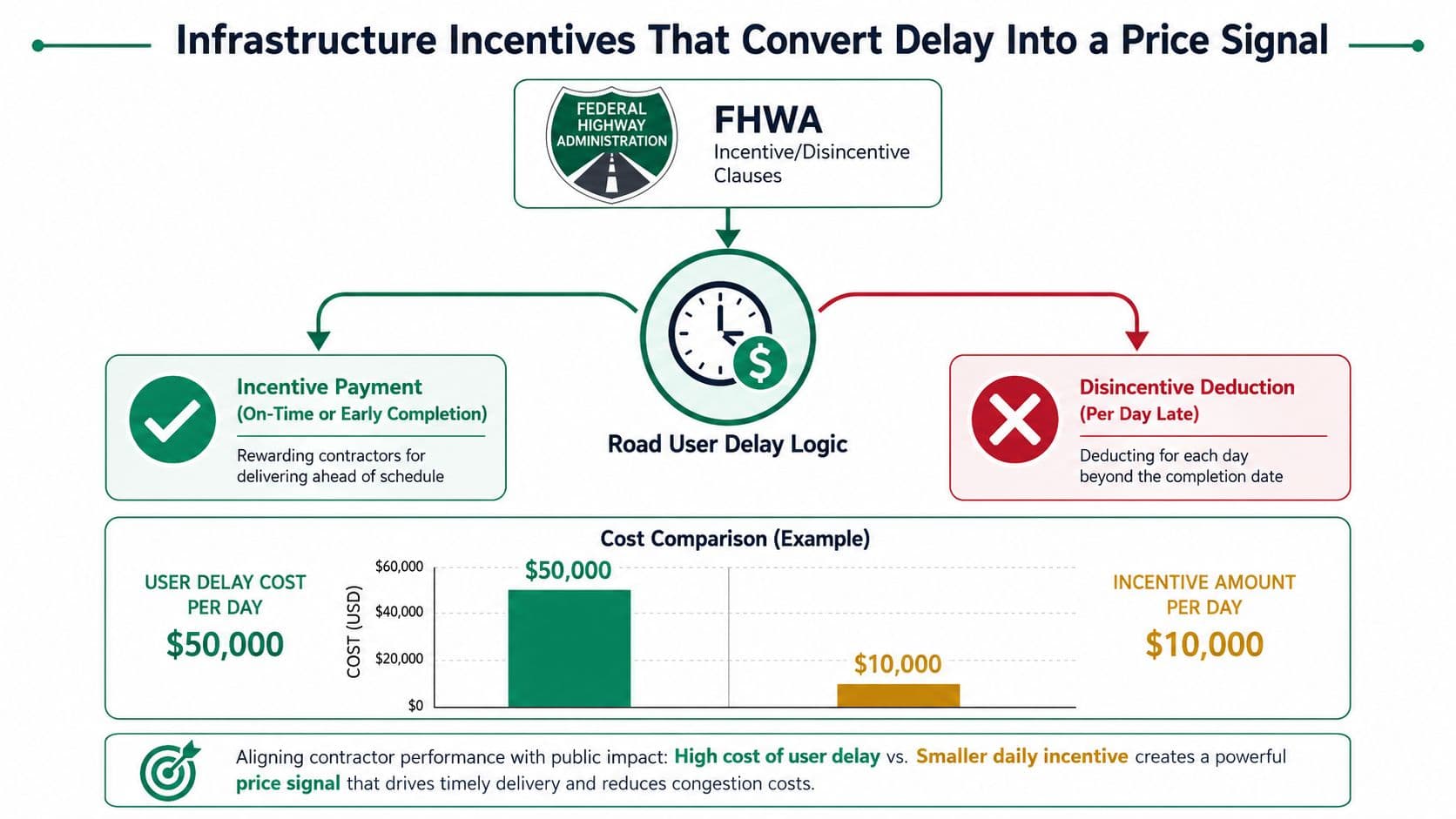
At the infrastructure scale, the logic becomes more explicit. The Federal Highway Administration says the daily incentive rate in incentive/disincentive clauses should be based on traffic safety, traffic maintenance, and road-user delay costs, and it recommends that the incentive rate not exceed the disincentive rate, with a 5% cap of total contract amount as the recommended maximum incentive payment (FHWA guidance). That is not a generic bonus. It is a price signal built from the public cost of delay.
Why road-user delay changes the math
Highway work affects more than the contractor's payroll. Each extra day changes driver time, freight movement, detour length, and safety exposure. The incentive exists to make earlier completion financially rational when the social cost of delay is high enough to justify it.
The same logic appears in state practice. Michigan DOT ties the incentive per day to road-user delay costs and limits total incentive availability to 5% of estimated construction costs, as reflected in the FHWA guidance above. The ceiling matters because it keeps the payment from turning into open-ended acceleration spending.
How designers calibrate the payment
State transportation guidance usually follows a sequence. Set the schedule baseline. Quantify work-zone impacts on road users. Apply a discount factor to split benefits between agency and contractor. Then set daily and maximum incentive and disincentive amounts within budget constraints. That sequence forces the designer to compare the cost of acceleration with the value of reopening sooner.
Practical rule: if the daily incentive is not anchored to a real external cost, it is just a faster-sounding bonus.
That is also why these clauses differ from ordinary contractor incentives. They do not just reward effort. They convert a public delay cost into a project-level payment decision.
For readers who want the financial side of schedule compression laid out in plain terms, a useful companion is this guide to construction delays, because delay only becomes actionable when the cost structure is visible.
The core idea is straightforward. The owner should pay for acceleration only when the value of earlier completion, measured through user delay and safety impacts, exceeds the extra construction cost. That is the economic test underneath the clause.
You can also see how funding logic fits into broader program design in this infrastructure funding overview.
Tax Incentives, Land Value, and the Unitism Frame
Tax incentives sit on a different layer than contract bonuses. They don't usually tell a contractor how to build one project faster. They change the after-tax return to investment, hiring, or location choice, which is why the same policy can encourage broad activity or channel activity toward a specific place.
Land-use rights are not land-value taxes
The land policy distinction matters here. Land-use rights are leaseholds, not taxes. In Singapore's standard model, government land is commonly sold on leases of 30, 60, or 99 years, and the leaseholder can transfer the remaining lease under prevailing rules, which makes it a property right with an expiry date rather than a recurring levy (land policy literature). A land-value tax is different. It is a recurring tax on land value, not a leasehold instrument.
That difference matters because a construction incentive can be designed against either base, but it will behave differently depending on which one a jurisdiction uses. A credit layered on top of a lease system can affect redevelopment timing. The same credit in a tax system can alter holding costs and investment signals. The policy label looks similar, the underlying mechanics do not.
What sector incentives do to place and price
Some sector-level incentives are broad, aimed at stimulating activity across an entire market. Others are targeted, aimed at a place, a use, or a workforce segment. The common result is that they can raise development value somewhere, but not always where policymakers expect.
That is why place-based incentives deserve scrutiny. A credit can improve feasibility on paper while landowners capture part of the gain through higher asking prices. It can also just shift a project that was already coming to a favored site. In those cases, the policy changes timing or location more than it changes total construction.
For readers comparing current tax practice with policy design, 2026 construction tax deductions is a useful reference point because it shows how construction reliefs are often framed as accounting advantages, even when the actual policy effect is behavioral.
The key question isn't whether a tax break exists. It's whether it changes the margin that actually constrains building.
The tri-factor frame is helpful here because it separates labor, capital, and nature. If the incentive reduces friction on labor, it's a workforce lever. If it lowers the cost of capital, it's a financing lever. If it shifts value into land, it's a site-value lever. That's the cleanest way to tell what the policy is really moving.
For a more direct comparison between recurring land taxes and land-based charges, see land value tax versus property tax.
Why Headline Incentives Often Miss Retention and Leakage
The strongest critique of construction incentives is not that they fail to attract attention. It's that they often fail at retention and capture. A hiring or training credit can bring people in, but it still leaves the harder question of whether employers can keep them once the incentive ends.
Workforce incentives need staying power
The U.S. Department of Transportation's 2024 best-practices guide pushes agencies toward tracking workforce demographics, providing childcare and transportation support, and giving additional funding to sites that hire apprentices or graduates from programs serving underrepresented populations (USDOT best-practices guide). That's a meaningful shift. It signals that access alone isn't enough. Employers also need the support structures that let workers remain employed and progress.
The practical issue is simple. If the policy only pays for the hire, but not the pipeline behind the hire, then the incentive may buy a short burst of labor rather than a durable workforce expansion. Reporting and wraparound services are not optional extras in that model. They're part of the incentive's real design.
Place-based incentives can leak into land value
The other critique is leakage. A place-based credit can improve project economics without creating much new construction if landowners, not builders, capture the gain. It can also move activity into a designated area without solving the underlying bottleneck.
Illinois' 2024 amendment is useful because it ties tax credits to wages paid to construction workers on eligible projects, with a higher credit rate in underserved areas (Illinois amendment). That reflects a more location-sensitive approach. The policy is not just “build more,” it's “build here, and use the wage channel to support local employment.”
For a broader lens on why incentives can become rent capture devices if the design is loose, the logic is covered in rent seeking in economics.
The design lesson is sharp. Any announcement that says “credit,” “subsidy,” or “incentive” should trigger two questions. Who will still benefit after the headline period ends? And where will the gain land, in workers, builders, or landowners? If those answers are vague, the policy is probably vague too.
A Designer's Checklist for Construction Incentives
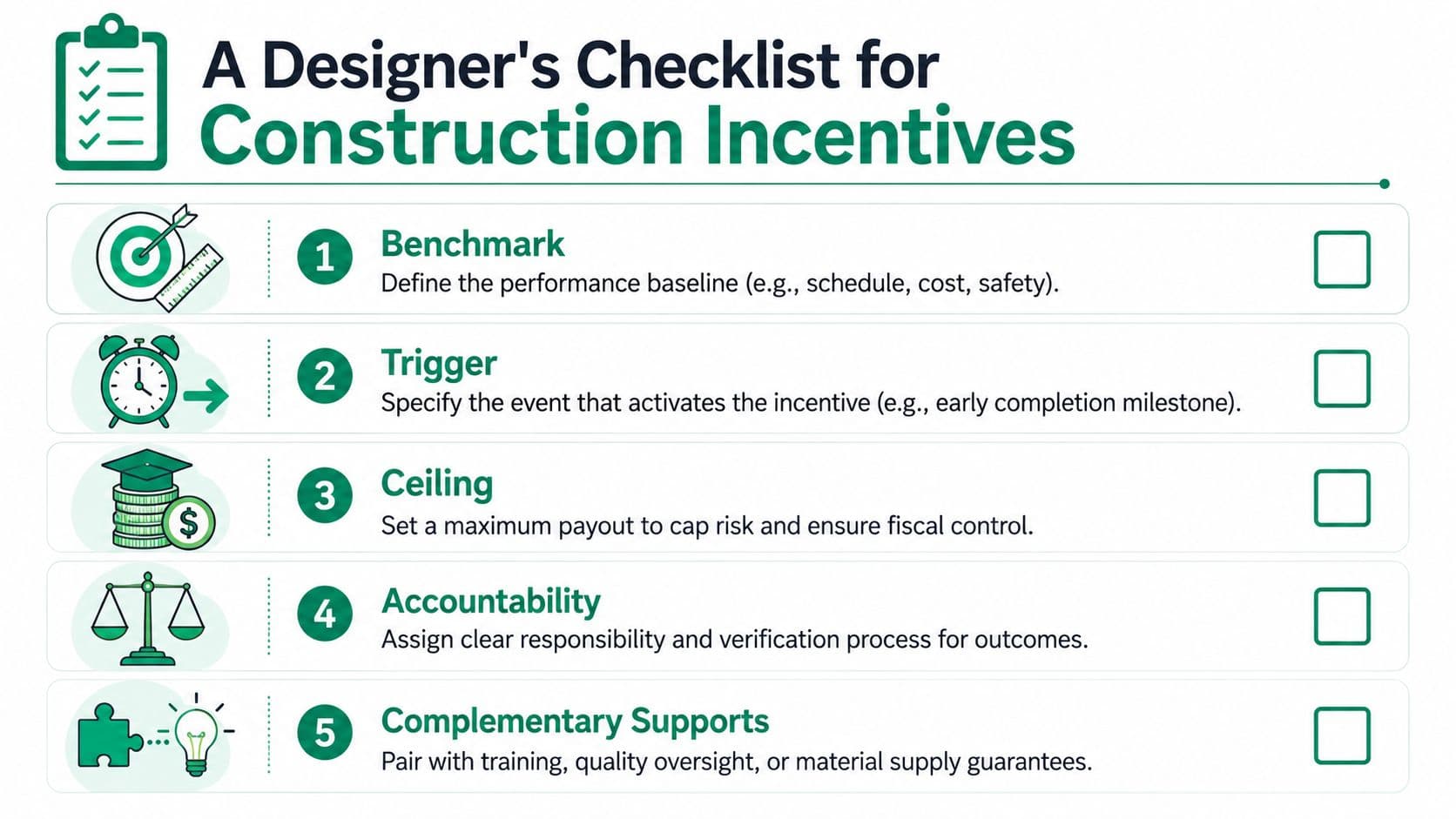
The most useful way to evaluate construction incentives is to treat them as an engineering problem, not a slogan. The survey of U.S. construction firms showed 88% offered incentive compensation, yet only 21% said it was very effective, which strongly suggests the weak point is usually design, not enthusiasm (survey report).
Five tests before you sign the incentive
- Benchmark: Define the baseline before the work starts. If the project can't show where it began, it can't prove improvement.
- Trigger: Specify the exact event that pays the incentive, such as a milestone date or verified savings threshold.
- Ceiling: Put a cap on exposure. The FHWA's 5% ceiling is a good reminder that unlimited upside usually means weak discipline.
- Accountability: Name who verifies the outcome and what document proves it.
- Complementary supports: Pair the incentive with the supports it needs, such as training, quality oversight, or supply assurance.
The failure point is usually the benchmark
The benchmark is where many programs wobble. If the baseline is shaky, every later claim is shaky too. That's why the low share of firms using market data to calibrate incentives in the survey matters. Programs can look active while still lacking a credible reference point.
For a broader policy lens on how systems reward buildings, land, and infrastructure rather than just transactions, see designing with nature.
A good checklist doesn't make the decision for you. It tells you where the design can fail. If a proposal can't answer those five items clearly, it isn't ready.
Choosing the Right Incentive for the Job
Choosing among construction incentives starts with the binding constraint, not the label on the program. A contract clause fits when the problem is contractor behavior on a single job. A tax regime fits when the problem is firm investment or workforce access. A place-based instrument fits when the goal is to shape location choice or community outcomes. The same word covers tools that operate on different time horizons and pull from different value pools.
Four decisions before you pick an instrument
First, define the behavior. Speed, cost discipline, hiring, training, and location choice do not mean the same thing, so they do not justify the same incentive. Second, identify the value pool. Is the payment coming from the project budget, from foregone tax revenue, or from land-related value? Third, name the measurement. Without a metric, there is no accountability. Fourth, check for leakage. If landowners, incumbents, or short-term hires capture most of the gain, the policy misses its purpose.
The land-value frame sharpens that last question. If revenue is shifted toward land value, incentives can reward work and building without leaning so hard on speculation. That is a core principle of land value capture, which gives public policy a way to align private gain with public benefit. If a jurisdiction relies on leases rather than recurring land taxes, the incentive has to be judged inside that lease structure, because the fiscal channel is different even when the project itself looks the same.
The best incentive is the one that changes the binding constraint, not the one that sounds largest on paper.
That is the conclusion that follows from the contract evidence, the highway guidance, and the sector tax cases. Incentives work when they are tied to measurable costs and protected against capture. They fail when they are treated as a generic subsidy category.
If you are evaluating a proposal, start with the mechanism, not the headline. Unitism® helps policymakers, researchers, and practitioners separate labor, capital, and nature so they can see where value is created, where it leaks, and which incentive design is worth funding. Visit Unitism® to explore land-value reform, incentive design, and the policy tools that make construction reward productive work instead of speculation.