Explore biodiversity conservation policy in 2026 with clear guidance on threats, financing, land-value tools, and design steps for governments and cities.
August 7, 2026
Biodiversity Conservation: A Policy Guide for 2026
Explore biodiversity conservation policy in 2026 with clear guidance on threats, financing, land-value tools, and design steps for governments and cities.
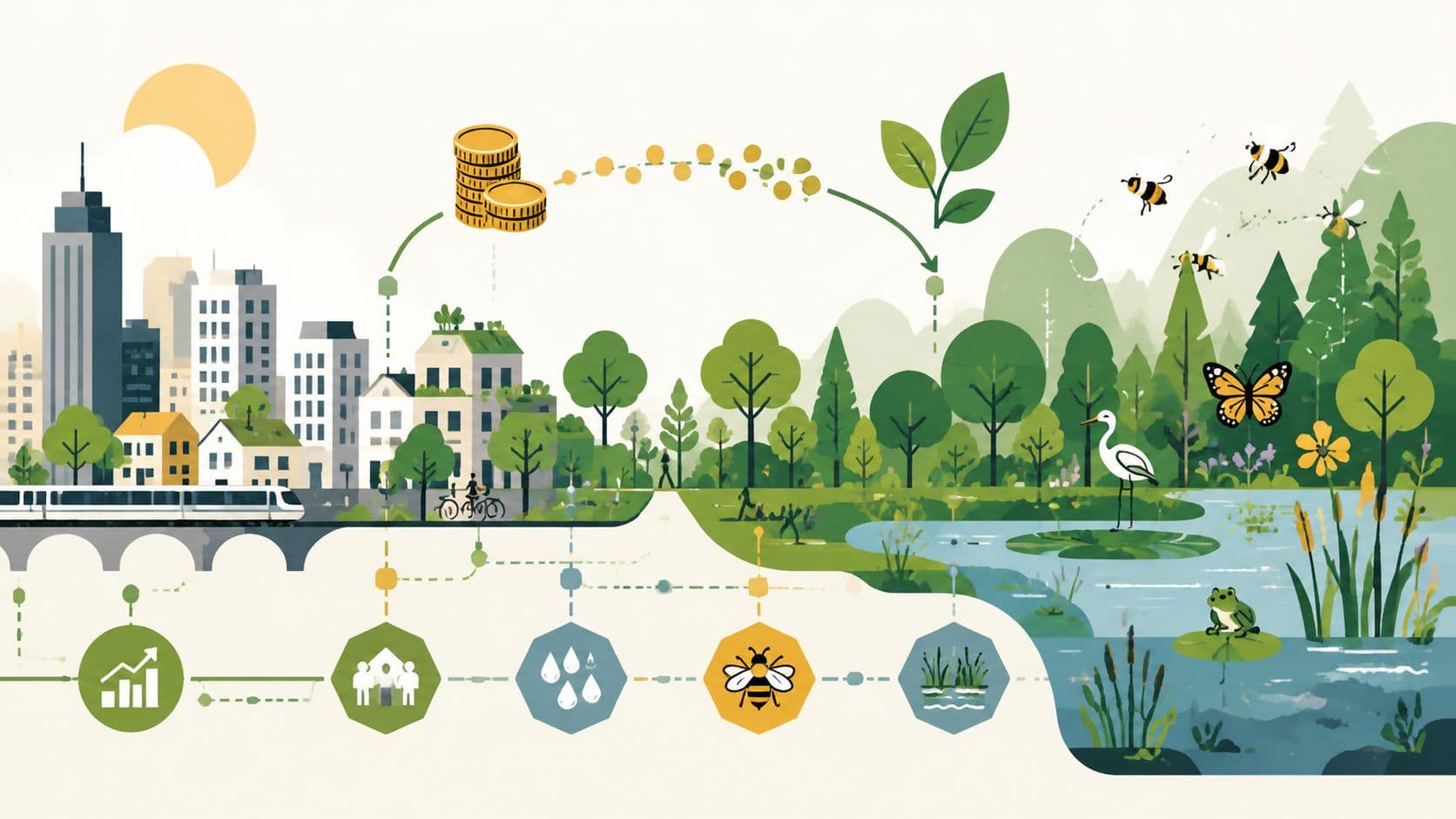
Stop treating biodiversity conservation as a nature charity case. In practice, it's a land, pricing, and fiscal policy problem, because the cheapest way to destroy habitat is to keep land underpriced, leave rents uncaptured, and let speculation outbid stewardship. That is why conservation keeps losing to roads, sprawl, idle holdings, and weak enforcement, even though the stakes are obvious, food security, climate stability, and medicine supply all depend on intact ecosystems, not just scenic views.
The policy response has to start with the blunt truth: if governments price land badly, they get bad land use, and bad land use is where biodiversity disappears first. Finance ministries should read this as a balance sheet issue, not an environmental sidebar. The right question is not whether conservation is noble. The right question is which revenue, tenure, and regulatory settings make conservation cheaper than destruction.
Table of Contents
- Why Biodiversity Conservation Is a Land and Pricing Problem
- The Core Concepts Behind Biodiversity Conservation
- The Main Drivers of Biodiversity Loss in 2026
- Measuring and Monitoring Biodiversity Outcomes
- Policy and Regulatory Tools That Work
- Financing Conservation Through Land-Value Capture and Resource Dividends
- What Other Jurisdictions Have Already Done
- A 12-Month Action Plan for Finance Ministries and Cities
Why Biodiversity Conservation Is a Land and Pricing Problem
A finance ministry should start with a blunt fact. When a city leaves a vacant parcel idle beside sensitive habitat because holding land is cheap, the budget loses twice. It loses tax capacity from the idle site, and it loses ecosystem value when development spills outward into forests, wetlands, or coastal buffers.
That is the central failure in biodiversity conservation. Land is priced as if its ecological value did not exist. Underpriced land invites speculation, slow development, and sprawl. It also makes it easier for politically connected owners to sit on land near protected areas until a road, subdivision, or mine becomes more profitable than preservation.
The public case for action is not abstract. The WHO says more than 75% of global food crops depend on pollinators, and pollinators contribute US$235–577 billion annually to global agricultural output, while forests store 80% of terrestrial biodiversity and absorb about 2.6 billion tonnes of carbon dioxide each year (WHO biodiversity fact sheet). Conservation is therefore about food systems, climate, and the security of future medicines, not just wildlife.
Practical rule: if land can be held cheaply, conservation will lose to delay, speculation, and conversion.
That is why the first policy lever is not a park poster, it is the price signal. The second is tenure. If governments want better outcomes, they need land markets, leases, and resource rents to reward stewardship instead of waiting for destruction to become profitable. The logic is straightforward enough that any policy team working through land and water governance should see it immediately, habitat quality depends on who controls the ground and what it costs to hold it.
Pricing also matters inside the conservation system itself. Protected land that sits below its true economic value attracts pressure from developers, speculators, and politically connected holders who can wait out weak enforcement. Where the state underprices land, it subsidizes conversion and then pays again for restoration, flood control, and service replacement after the damage is done.
Ministers should treat this as a fiscal issue, not a niche environmental one. If you want fewer losses at the edge of protected areas, you need fewer incentives to idle land, speculate on land, and externalize ecological damage. For teams assessing the cost side of that work, check extraction API pricing before building the monitoring tools that make land use and enforcement easier to track.
The Core Concepts Behind Biodiversity Conservation
Treat ecosystems like critical infrastructure. Bridges, power lines, and water systems all need maintenance or they fail. Nature works the same way, only the maintenance is often invisible until it stops, and then the costs show up in food prices, flood damage, or failed harvests.
Biodiversity and natural capital
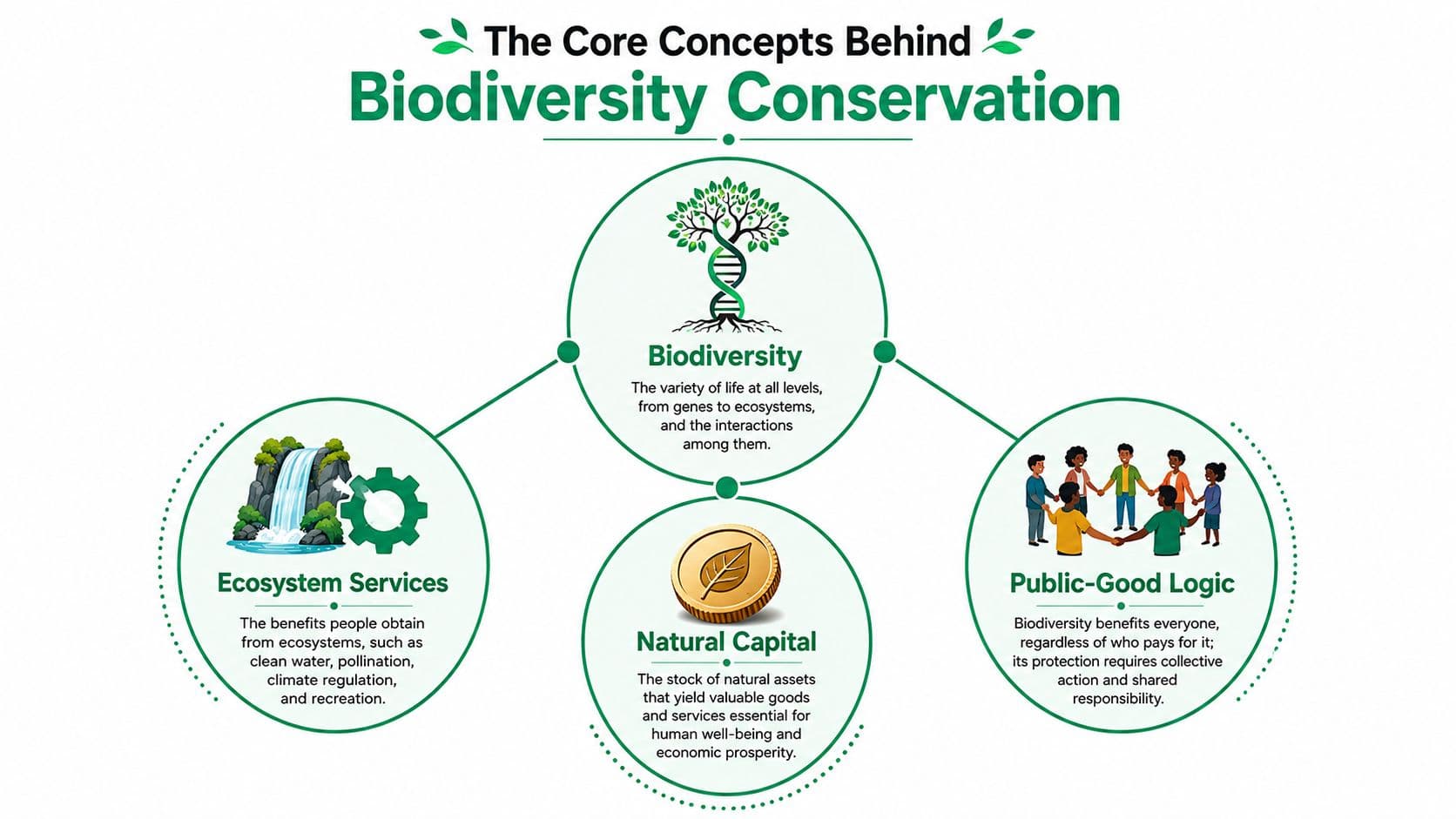
Biodiversity is the variety of life across genes, species, and ecosystems. Natural capital is the stock of that living system, forests, wetlands, reefs, soils, and the species inside them. If the stock is degraded, the flow of benefits falls later, sometimes after a long delay that policymakers mistake for safety.
That distinction matters for budgeting. A bridge report tracks the asset and the service it delivers. Biodiversity policy should do the same. When a forest is cut or a reef is damaged, the country doesn't just lose scenery, it loses stored ecological value.
Ecosystem services and the public-good problem
The useful idea is ecosystem services, the benefits people get from nature. Pollination, water filtration, carbon storage, flood buffering, and genetic resources all belong in that category. The WHO notes that more than 50% of modern medicines are derived from natural sources, including antibiotics from fungi and painkillers from plant compounds (WHO biodiversity fact sheet).
That makes conservation a public good. Private owners can capture profits from clearing, overfishing, or conversion, while the broader public bears the losses. Markets underprovide conservation on their own because the people who benefit most from intact ecosystems are rarely the same people who pay for them. That is why governments need taxation, regulation, protected areas, and monitoring, not just goodwill.
A clean policy rule follows from that logic.
Budget rule: finance biodiversity as infrastructure protection, not as discretionary environmental spending.
The Main Drivers of Biodiversity Loss in 2026
The direct drivers are well known, and the ranking matters. The Royal Society identifies land-use change as the leading driver of biodiversity loss, accounting for an estimated 30% of global biodiversity decline, with overexploitation contributing about 20% (Royal Society evidence review). That tells ministers where the biggest impact can be made.
The drivers do not act in isolation. Land conversion opens habitats to roads and extraction. Overexploitation strips the resource base. Pollution degrades the edge conditions that species need to survive. Climate change shifts ranges faster than some ecosystems can adapt. Invasive species exploit disturbed systems. But if you want the first fiscal lever, land-use change is the one.
Direct Drivers of Global Biodiversity Decline
| Driver | Estimated share of decline | Underlying failure |
|---|---|---|
| Land-use change | 30% | Underpriced conversion and weak land allocation |
| Overexploitation | 20% | Weak property rights, quotas, and enforcement |
| Climate change | Not quantified here | Carbon and adaptation externalities |
| Pollution | Not quantified here | Unpriced externalities |
| Invasive species | Not quantified here | Weak biosecurity and monitoring |
The land-use story is the one finance ministries can act on fastest. If agricultural expansion, logging, and speculative urban growth are cheaper than retaining habitat, biodiversity loses before conservation agencies even enter the room. That is why the current model rewards conversion instead of restraint.
The data show the same pattern over time. The UN Statistics Division reports that over the past 35 years, global forests shrank by 203.1 million hectares, including a loss of 41 million hectares since 2015 (UN SDG Goal 15 report). The broader trend is visible in the forest share of global land, which fell from 31.9% in 2000 to 31.2% in 2020 (UN SDG Goal 15 report). That is not a measurement problem, it's a land allocation problem.
Measuring and Monitoring Biodiversity Outcomes
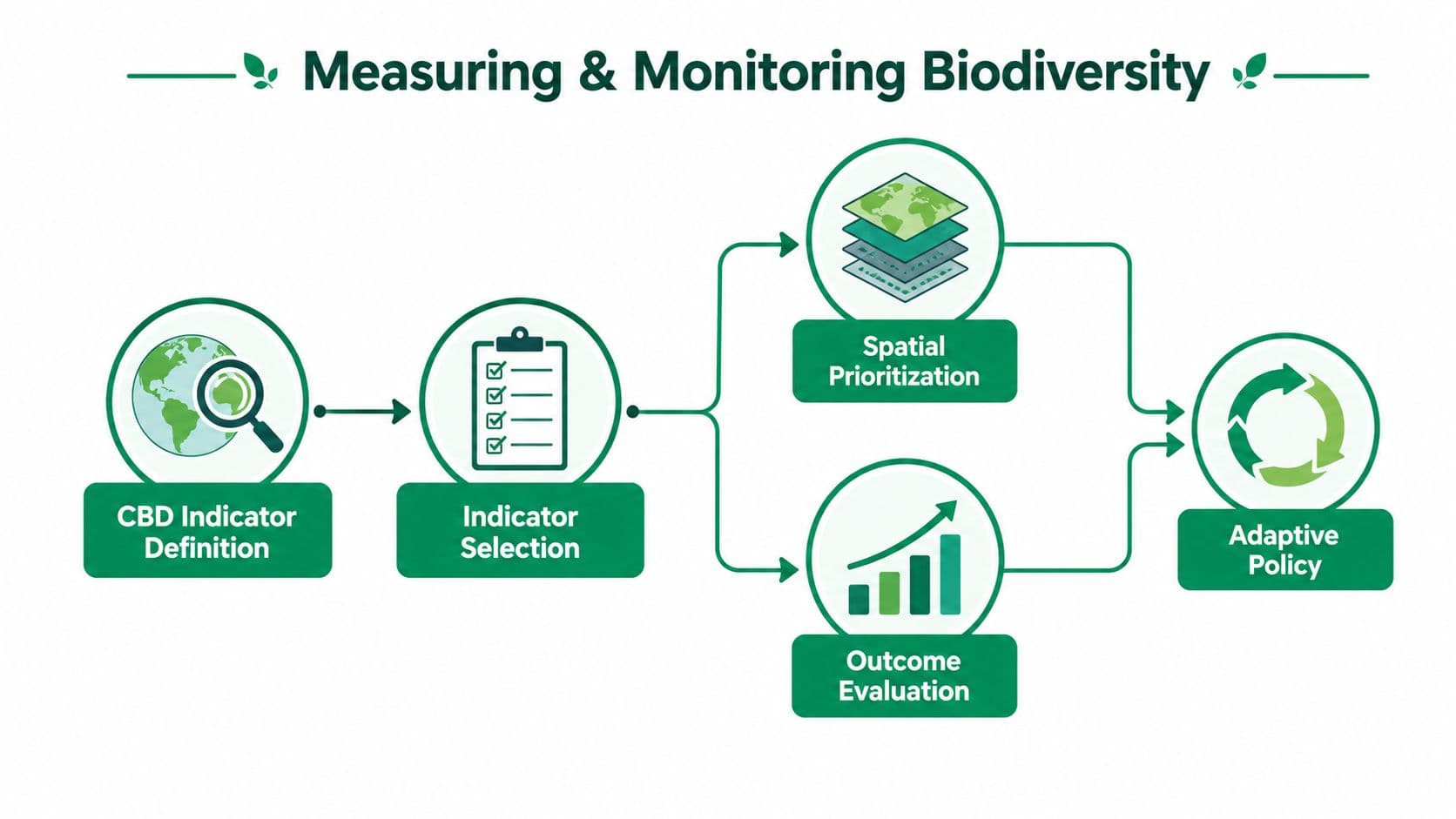
Governments do not need perfect biodiversity data before they act. They need a small set of indicators they can maintain, and they need spatial priorities that change as conditions change. The CBD defines a biodiversity indicator as a quantitative or qualitative variable used to measure a biodiversity attribute or assess progress toward a conservation objective, which is the right standard for policy design (CBD indicator guidance).
The practical move is to choose indicators that already have administrative pipelines. Forest area share, restored area, water stress, and sustainable fish-stock levels are all used in global systems because they connect an action to a state change. If you can't explain how a metric maps to a decision, don't put it in the dashboard.
Spatial prioritization beats random expansion
The CAPTAIN AI study is useful because it translated a hard policy question into operational logic. It found that the CAPTAIN approach protected significantly more species from extinction than random or naive area selection, and that regular monitoring, even with citizen-science-level inaccuracy, improved outcomes by updating priority maps as conditions changed (Nature Sustainability). The point is not that AI replaces planning. The point is that budget-constrained planning works better when it is targeted.
That matters for ministries because money is never unlimited. If a government expands protected areas without spatial logic, it can spend heavily and still miss the species and habitats most at risk. If it monitors and re-prioritizes, it can redirect scarce funds before loss becomes irreversible.
Start with two or three indicators, not twenty. If the data pipeline already exists, the metric is usable.
For governments and planners working on ecosystem-service valuation, the discipline is the same. Measure the asset, map the pressure, update the priority. That is enough to move from symbolic conservation to managed conservation.
Policy and Regulatory Tools That Work
The strongest conservation tools are the ones that change what land users can do on the ground. The recent Science review found that conservation action improved biodiversity or at least slowed its decline in 66% of cases analyzed, and the most effective interventions were invasive-species control, habitat-loss reduction and restoration, protected areas, and sustainable management (Science review). That should end the idea that conservation is unproven.
Implementation is where policy usually fails. A 2024 Nature study found that 58% of 5,963 threatened terrestrial species lacked meaningful habitat protection or any documented conservation intervention, and a CBD fact sheet said only 43% of key biodiversity areas were covered by protected areas, up from 29% in 2000. That is a protection gap, not a science gap.
Which instruments move outcomes
Protected areas matter because they stop conversion outright. Species and habitat laws matter because they create legal liability for damage. Environmental impact assessment matters when it blocks bad projects, not when it becomes paperwork. Payments for ecosystem services can help when they are targeted, but they are weak if they just subsidize business as usual. Restoration targets help only if the budget and tenure are credible.
The best tools reduce habitat loss directly. The next best tools reduce the financial reward for damaging sites. Local rules can do that through zoning, setbacks, and other use limits, as shown in zoning and setbacks explained, but the deeper lesson is simpler, rules work when they shape land value and land use, not when they sit in a binder.
A short warning is warranted. Nearly half of the world's most critical biodiversity sites remain unidentified, which means many conservation maps are still incomplete. If a government does not know where its most important sites are, it will protect the wrong places first. That is why habitat plans, cadastre quality, and funding priorities need to be read together, including in work such as habitat conservation plans.
Financing Conservation Through Land-Value Capture and Resource Dividends
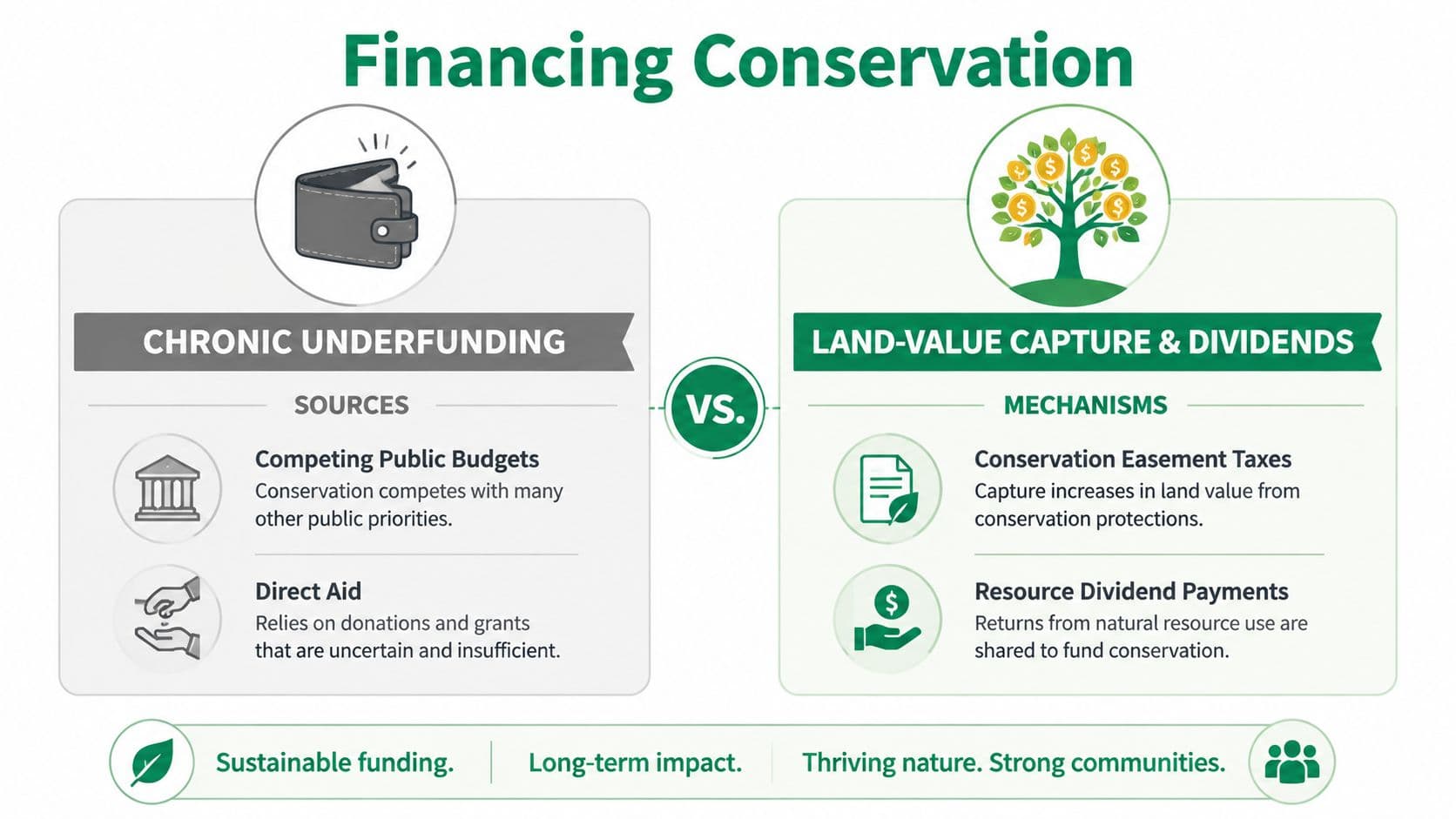
Most biodiversity policy stays timid because it asks conservation to compete for annual budget scraps while the rents created by land scarcity, natural amenities, and resource extraction flow into private hands. That is backwards. If the public builds the infrastructure, legal order, and service networks that make land valuable, the public should capture more of that value and direct it to conservation.
Land-value taxes, land-use rights, and what differs between them
A land-value tax charges owners on the value of the site itself, not on the buildings standing on it. That penalizes speculation and rewards development on already-served land. It is a clean way to make idle or underused plots more expensive to sit on.
Land-use rights work differently. They are land leases that are repriced annually and do not expire. Because they can be bought and sold at relatively low cost, they are often easier to introduce politically than a sharp one-time revaluation, while still letting the public recover land value over time.
The conservation effect follows directly. When holding land becomes costlier, underused urban sites are more likely to be brought into productive use, sprawl slows, and pressure eases on habitat at the edge of cities. That gives governments more room to protect or acquire ecologically important land rather than subsidizing leapfrog development. For a practical planning link, see open space preservation, which sits squarely in this same land-value logic.
Resource dividends and rent reform
Resource dividends are the second major tool. Alaska's Permanent Fund model shows the logic clearly, cash returns from shared resource rents can support public legitimacy while keeping the underlying resource value in public hands. Norway's sovereign wealth approach does something related at a larger scale, capturing oil and fisheries rents for national benefit. The conservation lesson is plain, if extraction is going to happen, the rent should fund public resilience, not private gain.
The third tool is rate reform. Shift taxation away from buildings and transactions, and toward land-based charges. That reduces the penalty on construction and productive investment while making it more expensive to sit on scarce sites. A finance ministry that wants cleaner growth should prefer a tax system that discourages speculation and rewards infill.
For teams evaluating implementation options, Unitism® provides economic rent research, valuation support, and policy design for land-value capture and resource-dividend reforms. That is useful when a ministry wants numbers, draft language, and transition design in the same file.
What Other Jurisdictions Have Already Done
Denmark has used split-rate property taxation to lower taxes on buildings while raising them on land values. That kind of design rewards construction and makes it less attractive to hold prime urban land idle. It's the right direction if you want development to absorb demand before it pushes into ecological frontiers.
Estonia used a land tax approach that helped reactivate idle urban plots. The result mattered because it shifted behavior at the margin, and that's where land policy usually wins or loses. If a site is expensive to sit on, owners either use it or sell it.
Singapore shows how leasehold can work at scale. Its long-term ground-lease system reprices land-use rights while keeping the underlying land in public control, which gives the state a strong fiscal and planning lever. Canberra's leasehold land model works on a similar principle, capturing land value for the public while steering urban form.
Alaska's Permanent Fund dividend is the clearest example of a resource dividend in practice. It treats oil rents as a public asset and returns part of that value to residents. Norway's sovereign wealth approach extends the same logic through oil and fisheries, using resource rents to support long-run national stability rather than leaving them as a one-off windfall.
Allentown, Pennsylvania is a smaller but useful reminder that land-value taxation can improve development outcomes in a real city, not just in theory. The point is not that one model fits every jurisdiction. The point is that different fiscal systems can be re-engineered to make land hoarding less attractive and public stewardship more affordable.
For a broader land-tenure lens, what is a land trust is worth reviewing alongside these cases, because ownership structure shapes conservation outcomes just as much as the tax base does.
A 12-Month Action Plan for Finance Ministries and Cities
A finance ministry should make one decision first, whether land is going to be taxed and priced as a productive public asset or left as a speculation vehicle. Once that is settled, the first dataset to assemble is the cadastre, with site values separated from building values where possible, plus the location of protected areas and threatened habitats. The first stakeholder to brief is the treasury minister, because without treasury buy-in, environmental agencies will be stuck asking for small grants instead of structural reform.
A city planning department should choose one pilot district near ecological pressure. Then it should build an idle-site register, connect it to parcel data, and test a land-value capture district that funds restoration or habitat buffering. The first deliverable to publish is a map of underused land, priority habitat, and the proposed fiscal or regulatory change, so residents can see where value is being captured and where protection will be funded.
What to do in year one
- Finance ministry: draft a revenue-neutral reform package that shifts part of the tax base toward land value and away from building or transaction taxes.
- City planners: integrate cadastre, zoning, and habitat data into one working map before asking for new budgets.
- Budget teams: model who pays, who gains, and which sites become cheaper to develop if land holding is priced properly.
- Conservation agencies: publish a short list of the most threatened sites and the legal instrument that will protect each one.
- Public finance staff: identify hidden dependence on transaction taxes that rewards churn instead of efficient land use.
The warning signs are easy to spot. If the valuation office is understaffed, reform will stall. If the budget depends heavily on transaction taxes, the system is still rewarding turnover instead of productive use. If speculative holding is expanding near protected areas, conservation is already being priced out.
Conservation works better when finance ministries treat land as a scarce public asset, not a free option for delay. Start with the cadastre, the valuation rules, and one pilot district, then publish the first map before the year is out. If you want the fiscal mechanics, valuation support, and transition design handled in one place, visit Unitism® and use it as a working partner for the land-value reform side of biodiversity conservation.