Massachusetts community solar under SMART: 3,200 MW, a $0.07/kWh adder, who actually saves, and how towns can host a project.
October 29, 2026
Massachusetts Community Solar: Rules, Credits and Savings
Massachusetts community solar under SMART: 3,200 MW, a $0.07/kWh adder, who actually saves, and how towns can host a project.
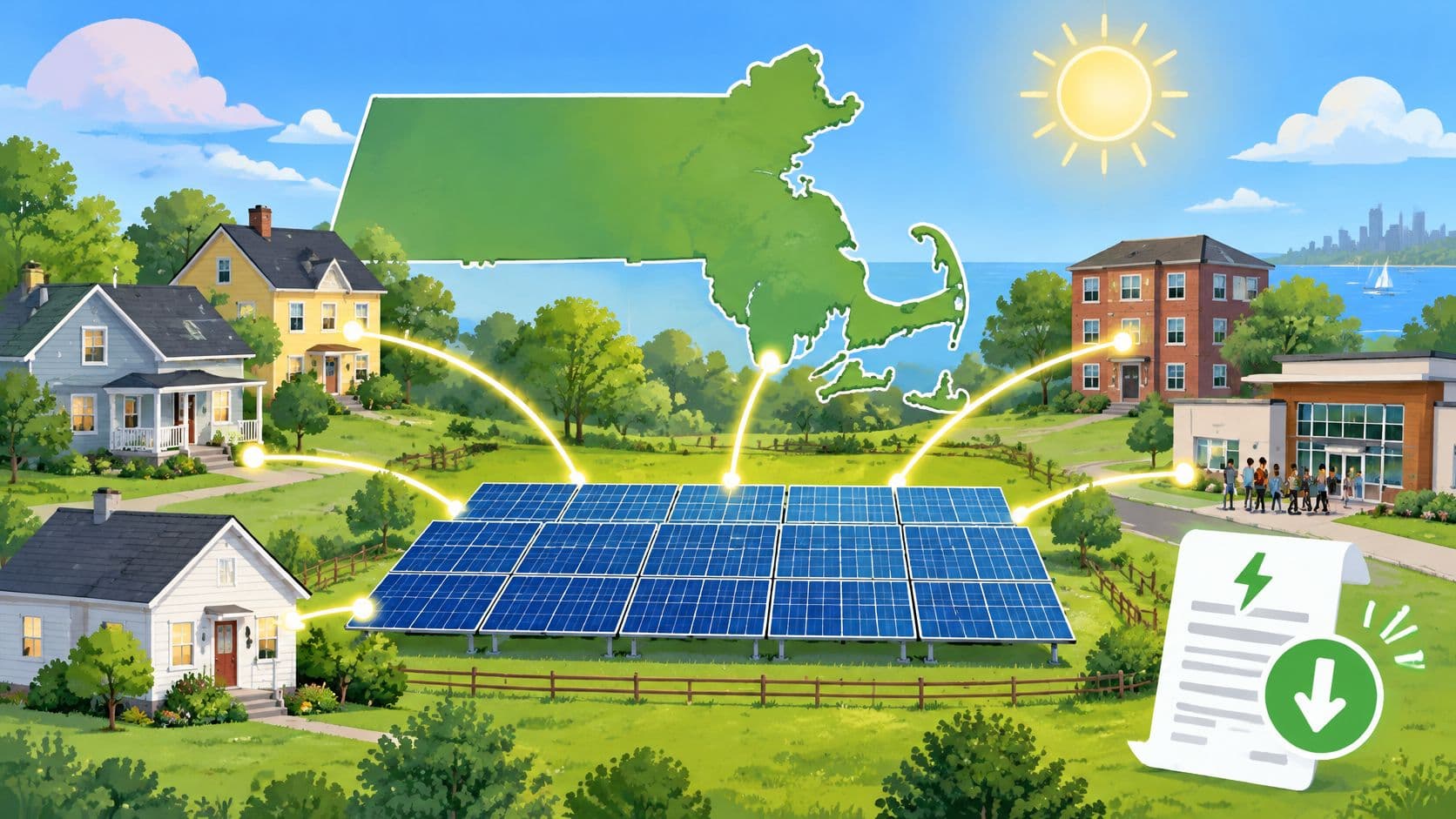
Massachusetts reached approximately 1 gigawatt AC of cumulative community-solar capacity in 2023, a milestone described in the National Laboratory of the Rockies community solar history. That's not pilot scale. It's a state policy, a utility billing system, and a land market working together, and sometimes against each other. A headline discount tells you almost none of that. You need the tariff math, the disclosure form, the number of bills you'll receive, and the contract under the panels before you can judge whether Massachusetts Community Solar will save you money or serve your town well.
Table of Contents
- Massachusetts Community Solar by the Numbers
- How a Shared Array Becomes a Bill Credit
- Who Can Join and Which Sites Qualify
- When a Solar Discount Fails to Save Money
- Why Two Bills Still Block Real Access
- How Towns Host Projects and Price the Land
- Choose a Subscription, a Site, or a Reform
Massachusetts Community Solar by the Numbers
Massachusetts had 1,054 MWac of community solar capacity as of June 2025, according to the U.S. Department of Energy's National Laboratory of the Rockies community solar page. That figure marks an established market, where projects depend on utility billing systems, subscriber management, financing, and sites that pass interconnection review.
The program behind much of that growth is the Solar Massachusetts Renewable Target, or SMART. It uses declining capacity blocks: as blocks fill, the base compensation rate generally falls. Two similar arrays can therefore receive different rates because they entered the program at different times or in different utility territories. That difference can affect the revenue available for subscriber discounts and land payments.
The Rules You Will Actually Look Up
The snapshot separates program terms from the claims a subscriber needs to test. Read the compensation rows as project economics, not as a promise that your bill will fall.
Massachusetts community solar program snapshot
| Rule | Current figure | What it changes |
|---|---|---|
| Installed community solar | 1,054 MWac as of June 2025 | Shows the market has substantial operating capacity |
| SMART new-solar target | 3,200 MW in declining blocks | Later blocks generally have lower base rates |
| Community shared solar adder | $0.07 per kWh | Adds to the base rate before the value of energy is subtracted |
| Compensation term above 25 kW AC | 20 years | Sets the compensation period for larger shared facilities |
| Compensation term of 25 kW AC or less | 10 years | Sets a shorter term; 20 to 35% of each block is reserved for these units |
| SMART 3.0 community solar set-aside | At least 15% of annual tariff generation | Reserves program capacity for shared projects |
| Low-income enrollment | At least 40% of each community solar project | Sets a minimum share of project subscribers |
| Annual rate-change limit | 20% of the prior year or $0.01/kWh, whichever is greater | Limits how quickly published rates can change |
The table describes program rules and project revenue. It does not establish a subscriber's net savings. A discount advertised by a provider is a price offer; whether it produces savings depends on the credit, the subscription charge, and the terms disclosed in the agreement.
For a nonprofit or municipality seeking support for early work such as site screening or subscriber outreach, the Grantlas directory of Massachusetts funders can help identify funders by location. Tariff revenue begins with generation, so it does not itself cover predevelopment work before a project is built.
A statewide capacity total shows that projects exist. It cannot tell a household whether a particular subscription will lower its total costs.
How a Shared Array Becomes a Bill Credit
Think of a shared garden. One plot of land holds the array, many households claim a share of what it produces, and nobody needs a suitable roof at home. That's the core fit for Massachusetts Community Solar. Renters, condo owners, households with shaded roofs, and families who can't finance a private system can still take a share. The panels sit elsewhere. The credit travels through the utility account.
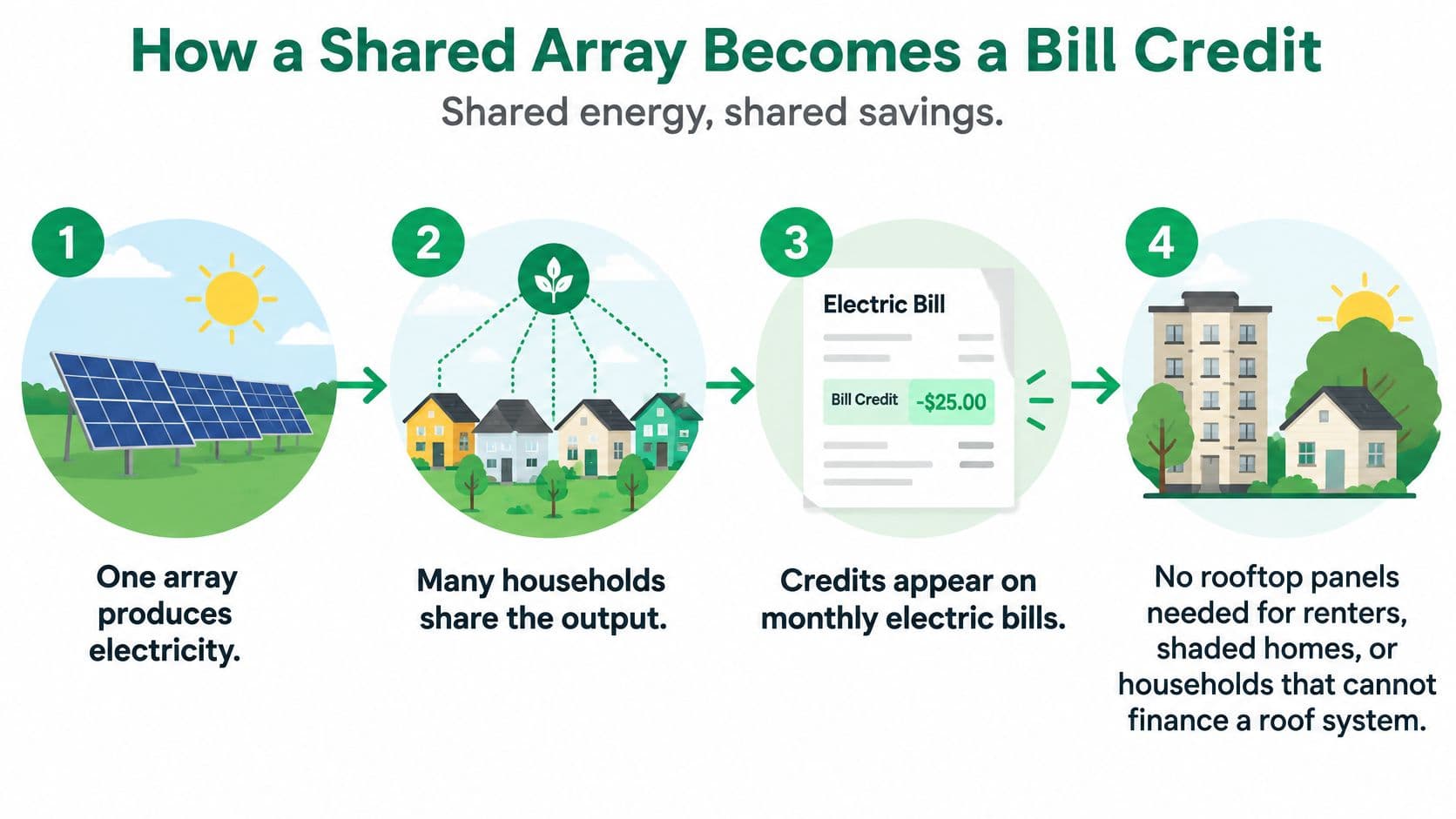
The garden analogy explains access. It doesn't explain money. For that, you need the project formula, because the project's revenue sets the ceiling for every subscriber discount.
The Formula in Plain Order
The Massachusetts SMART program overview states the community solar payment formula as incentive payment = (base compensation rate + applicable adders) × metered generation − value of energy, for a program designed to support 3,200 MW of new solar capacity with a community-shared-solar adder currently at $0.07/kWh. Each term does a distinct job, and confusing them is where most readers get lost.
- Base compensation rate: This stands in for the project's required all-in revenue. It isn't one statewide price. It shifts with project size, utility territory, and the capacity block the application lands in, and later blocks generally pay less.
- Adders: These stack on top of the base rate for features the state wants more of. Community shared solar, low-income service, public-entity offtakers, storage, and certain sites can each change revenue in a material way.
- Metered generation: The project gets paid on kilowatt-hours it produces, not on nameplate promises. Snow, outages, and underperformance reduce this number directly.
- Value of energy: This amount is subtracted so the project doesn't get paid twice for electricity already valued through retail or wholesale mechanisms. It's a deduction, not a bonus.
Say a developer models a mid-sized array on a capped landfill. The base rate might look thin on its own. Add the community shared solar adder and a site adder, and the project pencils. Remove one adder because the offtaker mix changes, and the same panels on the same land no longer support the same subscriber discount. Nothing about the sunshine changed. The tariff stack did.
From Project Revenue to Your Statement
On your side of the meter, the utility allocates a bill credit tied to your share of generation. You then typically pay the project for part of that credit under your subscription agreement. Your net result is the gap between what the credit removes from the utility bill and what you pay the project, after any charges the credit doesn't touch.
Modeling rule: Keep gross generation, avoided-energy value, tariff revenue, adder eligibility, subscriber discount, operating costs, and interconnection costs on separate lines. A single percent-off slogan flattens all of them into a claim nobody can audit.
That's the habit to carry into every sales conversation. Ask which line moves if generation dips, if the value of energy changes, or if the project loses an adder. If the salesperson can only repeat the headline discount, you don't have an answer yet.
Who Can Join and Which Sites Qualify
Start with the customer, not the array. A subscriber doesn't need to own the building or have a sunny roof. That's the whole point of the shared model, and it opens the door to renters and to households in multifamily buildings where a private installation was never realistic. Your utility territory matters more than your roofline, because credits move through your existing electric account.
Low-income eligibility has its own path. Under SMART 3.0, a household can qualify through participation in another needs-based program or through self-attestation, and qualifying properties extend to shelters and certain assisted or deed-restricted housing. Market-rate customers can also subscribe. Don't merge those two groups in your head. The stronger savings protection applies to eligible low-income customers, and that distinction decides how much risk you carry as an ordinary subscriber.
Why Territory and Size Decide the Offer
The SMART regulation at 225 CMR 20 allocates SMART capacity among investor-owned utility territories in proportion to historical electric load, reserves between 20% and 35% of each block for projects of 25 kW AC or less, and sets a 20-year compensation term for projects larger than 25 kW against 10 years at or below that size. Available capacity therefore isn't a single statewide pool you can draw from anywhere. A project in one territory can be full while another territory still has room.
Size creates a real tradeoff. A larger facility gains the longer term and can spread fixed costs across more kilowatts, which lowers unit cost. In exchange, it takes on harder interconnection studies, more subscribers to recruit and retain, and stricter site qualification. A small project is simpler to place but has half the compensation horizon to recover its costs. Readers comparing state designs will see a different balance in the account of how Maryland structures its community solar program, which is a useful reminder that these are policy choices, not physical laws.
Sites the Tariff Rewards
Compensation also differentiates by location. Massachusetts offers location-based adders for buildings, brownfields, landfills, canopies, agricultural sites, and floating solar. That list is a siting instruction disguised as a price list. The state will pay more to put panels where land is already disturbed or built on, and it will pay comparatively less to convert open greenfield land.
- Previously developed land: A brownfield or landfill can improve eligibility, raise tariff revenue, and reduce fights over farmland or forest, though remediation and engineering costs need honest pricing.
- Built-environment sites: Rooftops and parking canopies stack energy on land already in use, which fits compact development, but structural and construction costs run higher per kilowatt.
- Greenfield sites: A cheap open field looks simple on a spreadsheet. It can still fight the adder design, local zoning, and neighbors who don't want open land converted.
Before a municipality offers a parcel, it should run five checks in order. Confirm the utility territory and open block capacity, place the project in the right size band, match the site to an adder, price the interconnection path, and name the likely offtakers. Skipping the last check is common and costly. An array without a credible subscriber plan is a generation asset looking for its revenue.
When a Solar Discount Fails to Save Money
Start with the sentence most advertisements skip. The Massachusetts community solar customer disclosure form states that a subscription may not reduce total electricity costs for ordinary customers because savings depend on market conditions and the credit-purchase agreement, and only eligible low-income customers are guaranteed net savings under Department of Energy Resources rules. Read that twice. The state requires the warning because the warning is sometimes true.
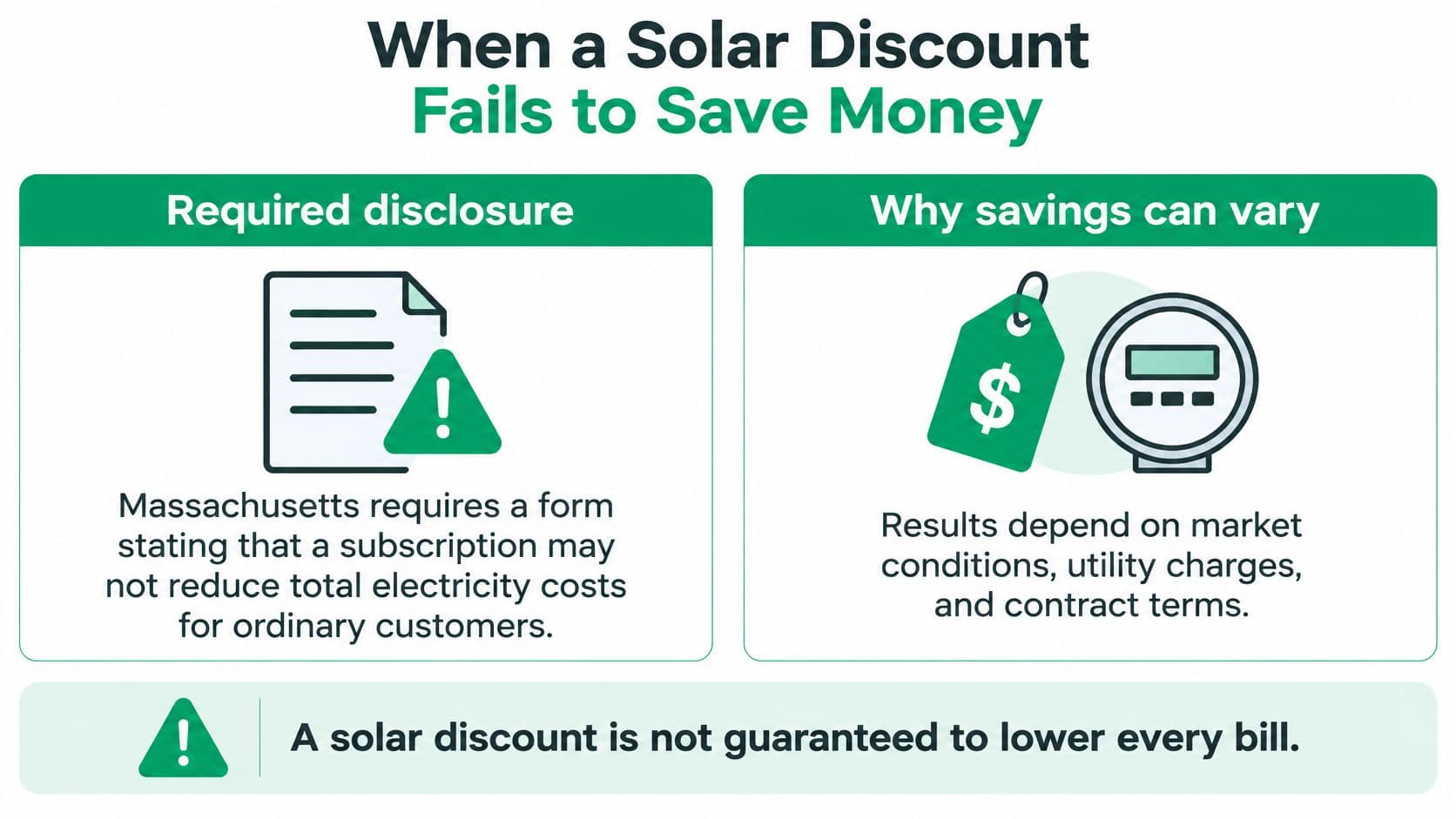
A discount percentage describes one transaction. Your bill is several transactions stacked together. Until you separate them, you can't tell whether the discount survives contact with the rest of the statement.
Build the Bill From Its Pieces
Take a hypothetical household. The utility still charges for supply and delivery on the electricity it uses. A solar credit posts against part of that charge, based on the household's allocated share of generation. The household then pays the project for a portion of that credit. Taxes and fixed charges may remain partly or fully untouched by the credit. Net savings, if any, is what's left after all four pieces settle. It isn't the number on the postcard.
What can erase a community solar discount
| Bill piece | Guaranteed help | Who carries the risk |
|---|---|---|
| Utility supply and delivery charges | No | Customer if rates or fixed charges stay high |
| Solar credit on the utility bill | No for ordinary customers | Customer when generation, allocation, or credit timing falls short |
| Payment to the project | No | Customer under the credit-purchase agreement |
| Taxes and fixed charges | Often not fully offset | Usually the customer |
| Ordinary subscriber net bill | Not guaranteed | Customer if rates fall or credits lag |
| Eligible low-income subscriber net bill | Yes, net savings required by DOER rules | Program rules rather than the sales claim |
Now run three situations against that table. First, retail electricity rates fall. A credit tied to those rates can shrink, while your subscription payment structure may not shrink at the same pace, and the gap that produced your savings narrows or closes. Second, credits arrive late or go missing in a given month. You can owe the project before the offset appears on the utility side, which turns a paper saving into a cash-flow problem. Third, you try to leave. Cancellation terms, notice periods, or exit fees can impose their own cost on a deal that already stopped working.
Households that want to stress-test these scenarios need a baseline for what they'd pay without solar, and working through how to estimate utilities cost before you sign anything gives you that comparison point. Without a baseline, a projected saving is just a number floating free of your actual usage.
Don't ask whether enrollment is open. Ask what your guaranteed worst-case cost is, and who bears the loss if electricity prices drop.
SMART 3.0 adds consumer-protection provisions and a minimum low-income participation requirement. Neither change makes every market-rate subscription financially beneficial. So go through any contract with a pen and mark the provisions that can erase a projected saving, including rate linkage, escalators, credit timing, fees, and exit terms. Distinguish guaranteed savings, which the contract or program rules must deliver, from projected savings, which are a forecast wearing confident clothing. If a provider can't tell you which lines are guaranteed, treat the whole offer as projected.
Why Two Bills Still Block Real Access
Two statements can turn a promised discount into a monthly coordination task. Massachusetts community-solar customers commonly receive a utility bill showing the solar credit and a separate project bill charging for part of that credit. The statements may arrive at different times, and the credit can vary with generation.
Reporting on Eversource's Springfield-area single-bill test says the utility has begun testing single-bill net crediting with 11 projects while the Department of Public Utilities considers broader implementation. The test shows that billing friction is receiving attention, but it is not a statewide fix. Subscribers should check whether the option is available to them.
How Two Statements Do Damage
With two bills, a household must match the utility credit to the project charge, then track two due dates. A mismatch or late credit can make a projected saving harder to realize, especially for renters, low-income households, people with limited English proficiency, and anyone managing irregular income.
Single-bill net crediting puts the project charge and solar credit on one utility statement. That reduces the number of bills to reconcile, though the offer's actual value still depends on its terms. A headline discount alone does not show what a household will pay.
The 40 Percent Rule Meets Real Households
The Massachusetts SMART program overview says SMART 3.0 requires every community solar project to enroll at least 40% low-income customers. That requirement sets a participation target; it does not by itself explain how enrollment works or whether subscribers can manage the billing arrangement. Questions about land-use policy and who it serves belong to a broader discussion, but enrollment equity also depends on clear terms and billing that households can follow.
Automatic enrollment may reach households that do not respond to marketing, while opt-in enrollment makes consent explicit. Each approach has trade-offs. A useful test is whether subscribers understand the arrangement and can stay enrolled without billing confusion. If households leave after struggling with the bills, meeting a roster target has not secured lasting access.
Before signing, ask in writing whether you will receive one bill or two, when the credit appears relative to the project charge, and how to exit. The answers show how the subscription works beyond its advertised discount.
How Towns Host Projects and Price the Land
A town, school, or nonprofit can play three distinct roles in Massachusetts Community Solar, and mixing them up produces muddled decisions. It can subscribe its public accounts to an existing project. It can host an array on public or institutional land. Or it can shape zoning so preferred sites move faster than greenfield conversion. Each role carries different risk, and only the hosting role puts the land contract at the center.
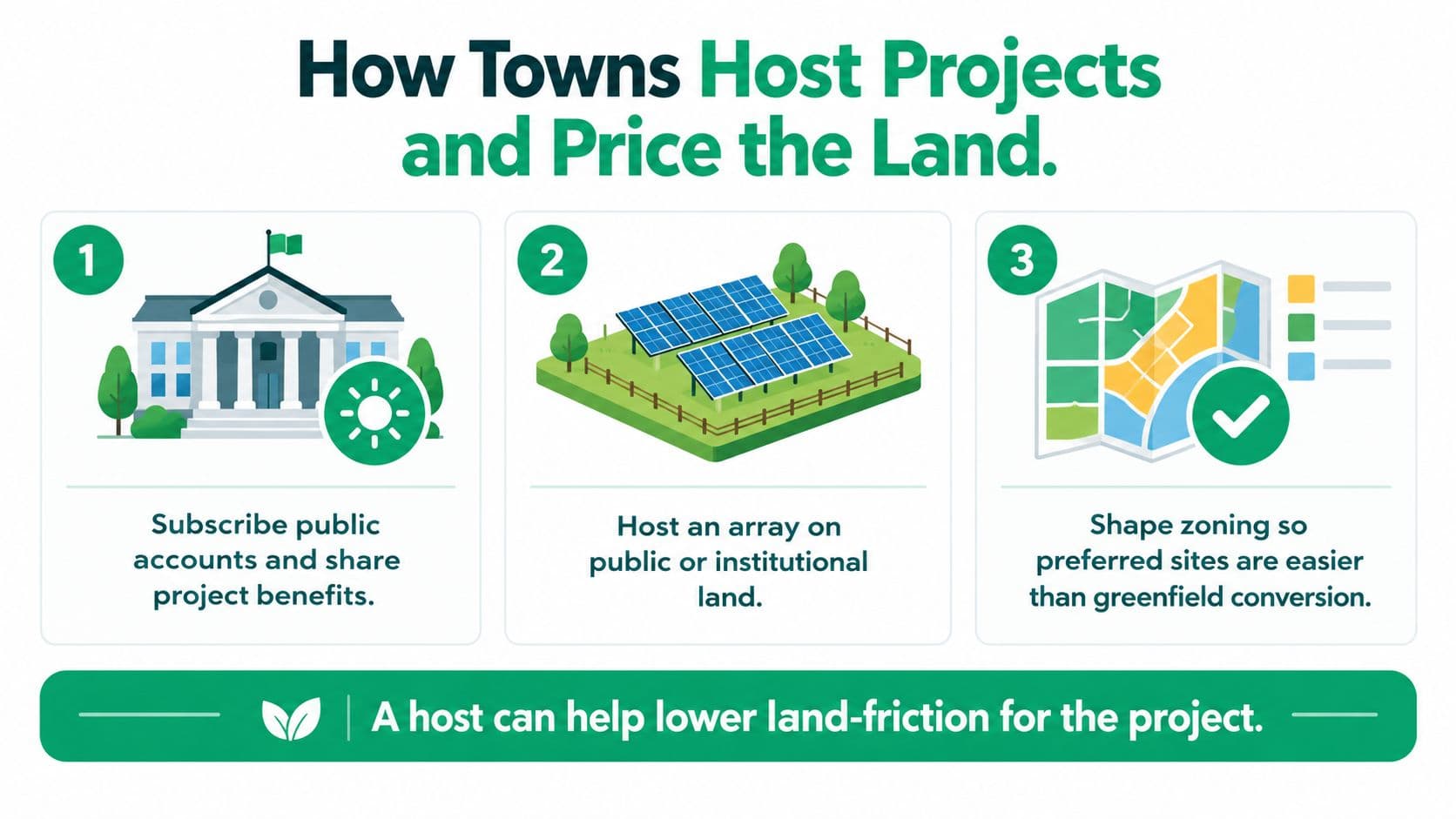
A host should first match the parcel to the adders the tariff already rewards, including buildings, brownfields, landfills, canopies, farms, and floating solar. Then it must decide how the land itself gets priced over the life of the tariff. That decision outlasts the ribbon cutting, and it's where three instruments that sound similar behave very differently.
Leases Postpone Risk Instead of Pricing It
A land lease is a renewable or non-renewable fixed-term contract at a fixed price. A renewable lease feels certain only until the term ends. At renewal, the entire accumulated gap between the old lease rate and the current market closes at once in a single major repricing, which can break a project's economics in one signature. A non-renewable lease avoids that cliff by walking toward a wall instead. As the end approaches, the asset sitting on the land becomes progressively harder to refinance and sell, because a buyer is purchasing a shrinking right. Either way, a fixed lease doesn't price risk correctly. It postpones risk and delivers it later, larger. The mechanics behind that squeeze connect directly to the broader account of land holding costs and how they shape what gets built.
Land-Use Rights and Land Value Taxes Are Different Tools
A land-use right resembles a lease in that someone pays for use of a site. It's different only when three conditions hold together. It must be repriced each year, it must require no renewal, and it must not expire. Annual repricing keeps the charge close to current site value, so there's no accumulated gap waiting to detonate, and people can buy and sell the right at low cost. The site price stays honest, and productive enterprises aren't stuck carrying a stale rent or bracing for a cliff. Sometimes a fixed lease gets labeled a land-use right in negotiation. It isn't one. If it expires, needs renewal, or holds its price for a fixed term, it's still just a fixed lease, whatever the cover page calls it.
A land value tax is a third thing entirely. It's a public charge on the value of the site itself, not on the panels, buildings, or other improvements placed on it. A land value tax rewards good use of land, makes speculation unprofitable, and returns to the community the value it created. In our framing, communities fund themselves from land value instead of taxing work, so a solar developer isn't penalized for adding capital to a site while an idle, well-located parcel can't sit untaxed and wait. A related option is a community land trust, a model where people own their homes while the community owns the land beneath them.
For a solar host, the lease is a private fixed bet, a true land-use right reprices the site every year without expiring, and a land value charge captures site value without taxing the solar capital on top of it.
Choose a Subscription, a Site, or a Reform
A headline solar discount is only a starting point. Households, host organizations, and policymakers each face a different decision, and each needs its own test.
A household should check the worst-case bill before subscribing. Confirm whether net savings are guaranteed for your customer class, whether you will receive one bill or two, and which charges remain if electricity prices fall. If the contract can cost you money in that scenario and exiting is expensive, the advertised discount may not be a reliable saving.
A town or nonprofit should assess whether a site qualifies for an incentive and whether its land arrangement works for the array's full life. The lease sets who pays for the site and how long those terms hold. Operators building a project pipeline can also draw on practical accounts of growing a UK renewables company, while keeping Massachusetts site and subscriber requirements in view.
A policymaker should judge low-income enrollment rules by how billing, opt-in consent, and retention work in practice. Incentives should also account for whether a project uses already developed land. These choices connect to the economics of infrastructure and how public charges shape private building.
Unitism's land-value tax applies to land value, not buildings or improvements, and returns the revenue to the community. Collecting economic rent for public purposes can fund services, reduce taxes on labour and business, and reduce inequality. Unitism supports this work by assessing land values, designing collection policies, and modeling who gains and who pays.
For a community weighing a solar site, a lease, or a land value charge, Unitism® can assess site values, design collection policies, and model who gains and who pays. Start with a land-value assessment grounded in your community's parcels.