Unlock the definition of private property rights: legal, economic, bundle of rights, and 2026 policy implications explained.
July 18, 2026
Definition of Private Property Rights: Legal & Economic View
Unlock the definition of private property rights: legal, economic, bundle of rights, and 2026 policy implications explained.

Most advice on property rights starts from the wrong premise. It treats ownership as if it were a single, absolute power: yours to use, defend, sell, or leave idle. That view is politically convenient, but analytically weak. For a finance minister, it obscures the fundamental question, which isn't whether private property exists, but which rights are being protected, over what kind of asset, and with what fiscal consequences.
The legal and economic record points to a more precise definition of private property rights. In the Western legal tradition, ownership is best understood as a bundle of rights, not one indivisible entitlement, as outlined by Britannica's discussion of Western property law. That same tradition also makes clear that ownership has never been unlimited. Roman law framed property as the right to use what is one's own within the limits of law, with public safety above all. That older principle matters now because modern housing stress, urban land speculation, and fiscal imbalance all turn on where private control should end and public claims should begin.
A serious definition of private property rights must therefore do more than restate legal doctrine. It must distinguish land from capital. Once that distinction is made, several policy debates look different. Housing unaffordability no longer appears to be only a construction problem. Tax reform no longer needs to lean so heavily on labor and productive investment. And the case for preferring land-use rights over simple land-value taxes becomes easier to understand.
Table of Contents
- Rethinking Ownership What Are Private Property Rights
- Unpacking the Bundle of Rights
- The Critical Distinction Land vs Capital
- The Inherent Limits of Private Property
- Policy Solutions Based on a Clearer Definition
- From Land Value Tax to Land Use Rights
- Conclusion Redefining Rights for a Thriving World
Rethinking Ownership What Are Private Property Rights
The policy mistake starts with a category error. Governments often tax and regulate land and capital as if they were the same kind of asset. They are not. A workable definition of private property rights must therefore do more than describe legal control. It must specify which claims attach to a natural opportunity, such as a site, and which attach to value created by human effort, such as buildings, machinery, or other improvements.
That distinction changes the fiscal analysis.
For a finance ministry, property rights determine who is allowed to collect income from scarcity, who bears tax on investment, and which gains arise from public action rather than private production. A rail extension, a rezoning decision, or a new school can raise the value of nearby land without any action by the titleholder. A workshop expansion or apartment renovation reflects capital formation. If policy treats both gains as one undifferentiated return to "property," it taxes what the economy needs more of and leaves location rents lightly touched.
This is one reason housing markets can look irrational while remaining legally coherent. The owner of a well-located plot may receive rising returns because the surrounding community grows richer and public infrastructure improves. The owner of a factory or housing improvement earns a different kind of return, tied more directly to cost, risk, and upkeep. Combining those income streams under a single label hides the part of value that society itself helps create.
The legal form also matters less than the actual allocation of claims. In shared ownership properties, occupancy, resale conditions, equity participation, and payment obligations are divided across parties. The arrangement shows why "ownership" is an unreliable guide for policy unless the underlying rights are specified in detail.
A similar line of analysis appears in the Unitism and Georgism guide on land and produced wealth. Its practical insight is straightforward. Land is fixed in supply. Capital is produced, maintained, and expanded through effort and investment. Once that separation is kept clear, debates over tax design, planning, compensation, and housing supply become easier to frame and harder to distort.
A minister does not need a philosophical theory of ownership. A minister needs a definition that distinguishes private reward for productive activity from private capture of publicly generated land value. That is the starting point for better housing policy and a more stable revenue base.
Unpacking the Bundle of Rights
The cleanest way to define private property rights is to break ownership into parts. Economists formalize the bundle as control of use (C), claim to generated value (V), exclusion of others (E), and transferability (T), and they emphasize that exclusion and transfer are what create direct incentives for productive investment, as set out in LSE teaching material on property rights.
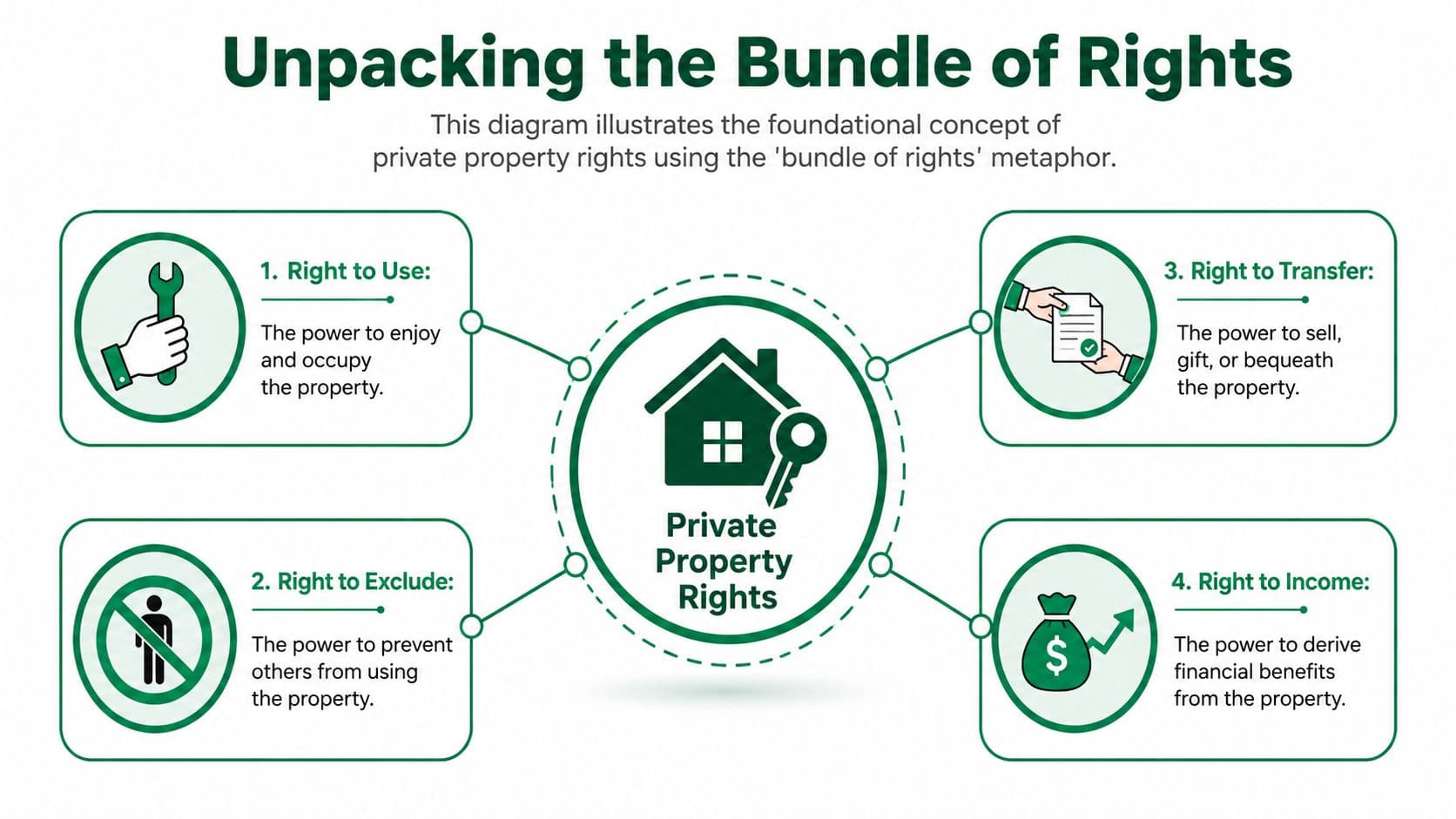
Why ownership is divisible
A property right is not one switch that is either on or off. Governments, courts, landlords, lenders, heirs, and tenants often hold different sticks in the same bundle. A lease, a mortgage covenant, a planning permit, or an easement can split rights without eliminating ownership altogether.
That is why the term “private property” can mislead. It sounds monolithic. In reality, it is modular.
A useful comparison is usufruct, where a person may use an asset and enjoy its fruits without holding the full power to dispose of it. The concept is explained clearly in this guide to usufruct. It shows that legal systems routinely separate use from ultimate title.
The four core powers
| Right | What it means in practice | Why it matters |
|---|---|---|
| Use | Living in a home, farming a field, operating a workshop | Gives the holder control over day-to-day decisions |
| Exclude | Keeping trespassers out or limiting unauthorized access | Creates security and supports investment |
| Transfer | Selling, gifting, or bequeathing the asset | Allows exchange and reallocates assets to new users |
| Income | Renting out a property or collecting returns from its use | Connects ownership to financial benefit |
The bundle metaphor matters because different sticks raise different policy questions.
- Use rights concern occupancy, production, and management.
- Exclusion rights concern boundaries, access, and enforceability.
- Transfer rights shape liquidity, inheritance, and market pricing.
- Income rights determine who receives the return generated by the asset.
A minister shouldn't ask whether private property is being respected in the abstract. The minister should ask which stick is at issue, and whether that stick serves production, speculation, or simple legal clarity.
That framing becomes decisive when the asset in question is land rather than a produced good. The same legal language can apply to both, but the economic consequences aren't the same.
The Critical Distinction Land vs Capital
Most definitions of private property rights are technically correct but economically incomplete. They describe ownership powers without distinguishing land from capital. That omission creates policy errors.
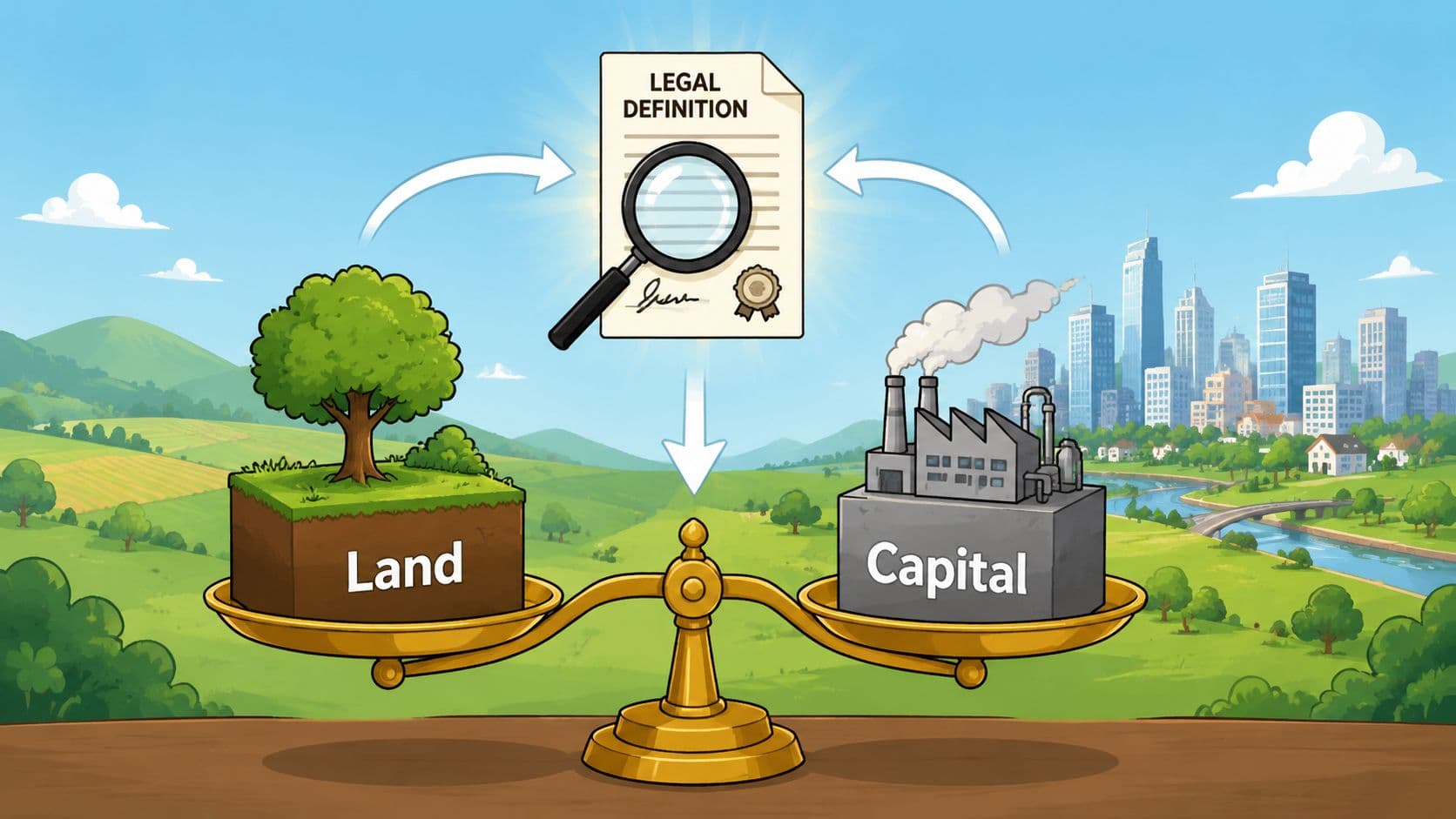
Land is nature. Capital is produced. The two should not be merged under one fiscal logic.

Why land is not produced
Capital includes buildings, machinery, tools, and other man-made improvements. It is created by labor, financed by saving or credit, and expanded through investment. Land is different. It is not produced by human effort, and no market participant can increase its supply.
That difference is not semantic. It changes the source of value. The worth of a machine usually reflects design, maintenance, and productive use. The worth of a parcel in a central district often reflects surrounding population, public infrastructure, legal permissions, and scarcity of location.
Readers who want a compact explanation of produced assets can consult this glossary entry on capital. It helps clarify why taxing buildings and taxing sites have different effects.
Why this distinction changes housing policy
A 2024 OECD study found that land price inflation, not construction costs, accounts for over 60% of housing unaffordability in major markets, according to the summary cited at Study.com's overview of private property in economics. That single point changes the policy lens. If land inflation is doing most of the damage, then supply-side discussion focused only on materials, labor shortages, or construction regulation is incomplete.
Consider the difference in incentives:
- A tax on buildings can discourage renovation, extension, or redevelopment.
- A rising site value can reward owners for waiting rather than building.
- A planning gain can inflate land prices before any productive activity occurs.
The definition of private property rights warrants refinement. The right to exclude others from a factory and the right to exclude others from a prime urban site are not socially equivalent, even if both are legally recognizable forms of ownership. One protects a produced asset. The other often captures value generated by the surrounding community.
When policy collapses land and capital into one category, it ends up taxing what people build and leaving undertaxed what society creates around them.
That is the quiet engine behind speculative holding, land banking, and much of the housing debate. The standard bundle-of-rights model remains useful, but it doesn't answer the minister's practical question: which part of the return comes from private effort, and which part comes from exclusive control over location?
The Inherent Limits of Private Property
Ownership always operates inside a legal perimeter. Nuisance law, zoning, environmental controls, building standards, and compulsory acquisition all limit what owners may do. That isn't a deviation from private property. It's part of its operating system.
The Roman-law inheritance already established that public safety stands above unfettered use. Modern law applies that principle through more elaborate institutions.
Public law has always shaped ownership
A landowner can't lawfully use a parcel in any manner that harms neighbors or defeats a valid public rule. A factory owner may hold title to land and buildings, but that title doesn't erase health standards or planning law. A homeowner may own a structure, but not an unlimited right to alter it regardless of fire codes or local restrictions.
These constraints are often mischaracterized as interference with ownership. In reality, they help define the scope of the right itself. Without them, one owner's rights would quickly destroy another's.
A short way to state the principle is this:
- Property needs enforcement by public institutions.
- Enforcement requires boundaries that courts and agencies can apply.
- Those boundaries reflect public purposes, not just private claims.
Why compensation debates are often misframed
The hardest cases arise when regulation changes value without transferring title. That is where debates over regulatory takings begin. Yet those debates often fail to separate land from improvements.
Data cited in LSE material referencing Urban Institute findings shows that in 2023, 78% of just compensation claims involved improvements (capital), while land-value depreciation caused by public decisions is rarely compensated. The imbalance is revealing. Public authorities often pay when they affect built assets, but they seldom reclaim value when public action raises land values.
That asymmetry has two consequences.
- Private actors often keep gains created by rezoning, transport links, or infrastructure.
- The public often carries losses or compensation obligations tied to capital improvements.
For a finance ministry, that is not just a legal anomaly. It is a fiscal design problem. If governments compensate heavily for impacts on improvements but fail to recover publicly created site gains, they socialize costs while allowing private capture of location value.
A concise critique of this pattern appears in the discussion of rent-seeking in economics, which helps distinguish productive return from gains derived mainly from control over scarcity.
Policy Solutions Based on a Clearer Definition
Once the definition of private property rights is clarified, a practical policy direction follows. Governments should protect private claims to labor and productive capital more carefully than private claims to socially created land value.
That doesn't require hostility to ownership. It requires better targeting.
From ownership theory to fiscal design
The core policy mistake is taxing productive additions while under-collecting from exclusive claims over high-value locations. A better approach is to recover part of the rental value generated by public order, infrastructure, legal protection, and community growth.
This logic is stronger than a narrow tax argument because it follows directly from the asset distinction. If a return comes from a building, machinery, or other improvement, it is closely tied to private effort, risk, and maintenance. If a return comes primarily from location scarcity and public investment, the case for public recovery is stronger.
That is why land value capture is better understood as a correction to the definition of ownership in practice. It recognizes that a titleholder may validly control a site, but not necessarily keep the full stream of value produced by everyone around that site.
What a finance ministry should target
A workable fiscal framework would usually favor the following sequence:
- Reduce taxes on work and improvements. These taxes can suppress production, hiring, repair, and urban renewal.
- Recover publicly created site value. This aligns revenue with the benefits that public action creates.
- Reward active use over passive holding. Owners who build, operate, or improve should face lighter penalties than those who sit on scarce locations.
- Integrate planning and revenue. Land-use policy and fiscal policy should reinforce each other rather than operate as separate silos.
Policy test: When a public action raises site value, can the public recover part of that gain without discouraging construction or employment?
That question often produces better answers than broad arguments over whether taxation is “pro” or “anti” property. A key consideration is whether the state is taxing production or recapturing value it helped create.
This is why the next distinction matters. Even among land-based instruments, some are more precise than others.
From Land Value Tax to Land Use Rights
A tax on land value is often presented as the end point of reform. In practice, it is often an intermediate step. The more complete approach is to define rights over land differently from the start, so that access, duration, use conditions, and public payment are built into the tenure system rather than added later through taxation.
The distinction matters because land and capital are not the same asset. A building is produced and maintained by private effort. A location is not. Where policy treats both as if they were ordinary private property, it tends to tax construction too heavily and capture land rents too weakly. That combination can feed housing scarcity and leave public budgets dependent on less efficient taxes.
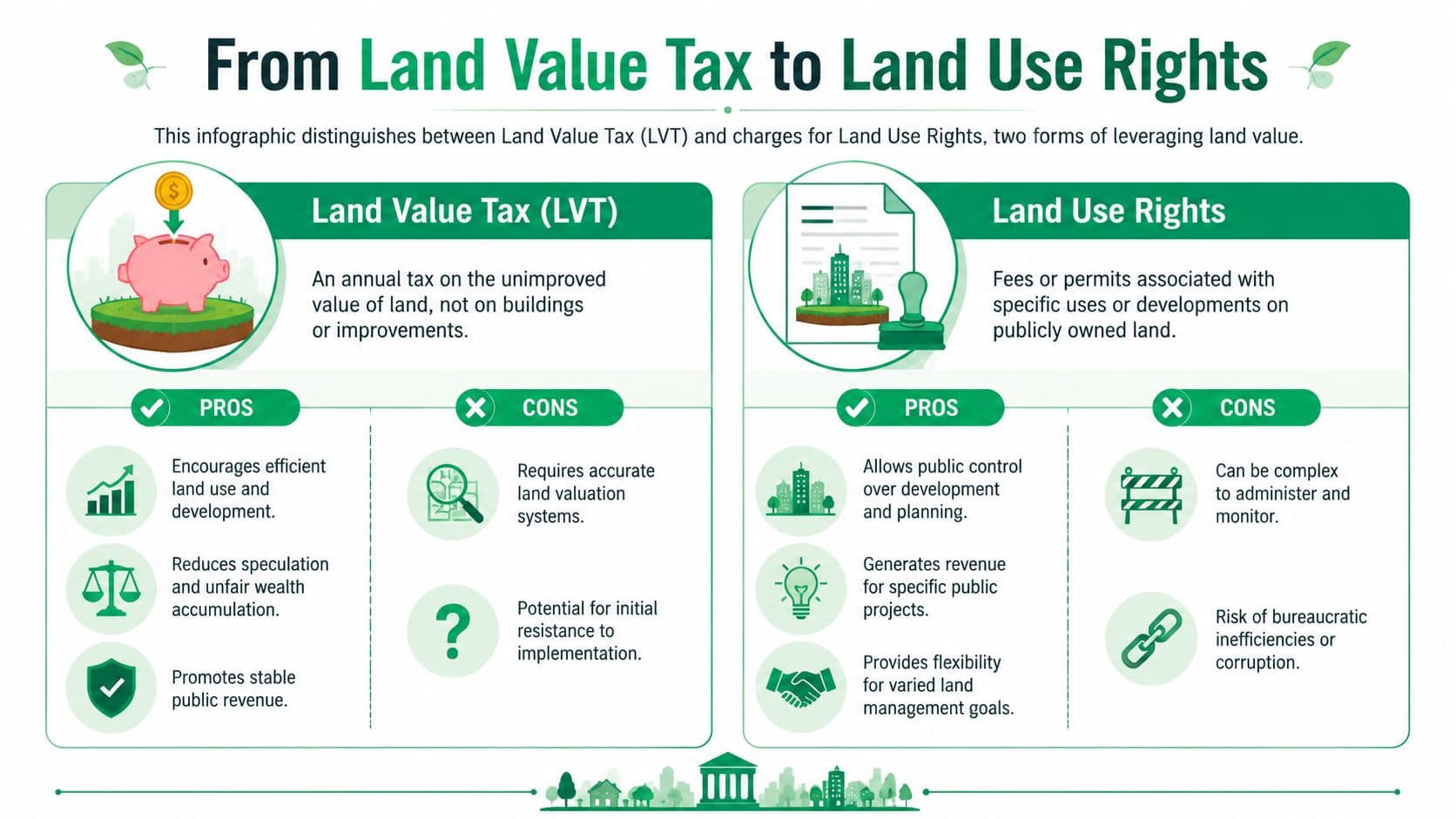
Two ways to capture public value
A land value tax works within a private freehold framework. The state recognizes private title, then taxes the unimproved site value on a recurring basis. That can improve incentives relative to conventional property taxes because it does not penalize repair, redevelopment, or more intensive use of scarce urban land.
A land-use rights system starts earlier in the chain. The public retains superior title to land and grants long-term, secure rights of occupation, development, or leasehold use, subject to payment and conditions. For a concise explanation of that model, see this guide on the concept of land-use rights.
The difference is institutional, not merely fiscal. Under a land value tax, the state recovers part of site value after private ownership has already been defined. Under land-use rights, the state defines the terms of access at the outset. That gives policy makers a more direct way to separate the value of location from the value of improvements.
Why land-use rights are often stronger
Singapore illustrates the logic clearly. As described in a UN-Habitat discussion of land and property taxation, the state retains ownership of most land and allocates long-term leasehold interests. That structure allows the public sector to recover land value through lease premiums and renewal terms while still supporting private development, financing, and dense urban use.
This design has an administrative advantage. It reduces reliance on repeated valuation disputes over unimproved land values, which can become politically and technically difficult in fast-changing urban markets.
It also has a policy advantage.
| Instrument | Main strength | Main limitation |
|---|---|---|
| Land value tax | Preserves private title while discouraging idle holding and avoiding taxes on buildings | Requires accurate valuation and recurring administration |
| Land-use rights | Links allocation, planning, and public revenue at the point rights are granted | Requires capable land administration and credible long-term rules |
In many contexts, the second route is stronger for three reasons.
- It addresses speculation before price gains are capitalized. Development conditions, time limits, and renewal terms can be written into the right itself.
- It joins planning and revenue in one framework. The same legal instrument can govern density, permitted use, infrastructure obligations, and public payment.
- It reflects the economic character of land more accurately. Since no private actor produced the location, public retention of the underlying claim is easier to justify than equivalent claims over buildings, equipment, or other capital.
For a finance ministry, the practical choice is rarely all or nothing. A land value tax can be a large improvement where freehold ownership is firmly established and administrative capacity is limited. But where legal institutions can support it, land-use rights fit the underlying theory more closely: private parties should keep returns from investment and improvement, while the community retains a stronger claim over the value attached to exclusive control of land.
Conclusion Redefining Rights for a Thriving World
The usual definition of private property rights is too broad to guide modern policy. It groups together two very different claims: a claim over what people produce, and a claim over a location no one produced. Once those are separated, several persistent policy failures become easier to explain.
The distinction between land and capital is the hinge. Capital deserves strong protection because investment, maintenance, and innovation depend on predictable returns. Land is different. Its value is heavily shaped by population growth, public infrastructure, legal permission, and the simple scarcity of desirable locations. Treating both under the same heading of ownership blurs where private reward is justified and where public recovery is justified.
That error has consequences. It inflates urban land prices, pushes housing policy toward subsidies that miss the source of the problem, and leaves governments taxing work and construction while under-collecting the value created around transport links, schools, and planning decisions. Fiscal strain and housing strain often share the same root.
For ministers, the practical implication is straightforward. Protect ownership of buildings, equipment, and other improvements with clarity. Define rights over land more carefully so the community retains a stronger claim on location value, especially where that value arises from collective action rather than private effort. In jurisdictions with the legal capacity to do so, land-use rights often serve that objective better than a generic freehold model because they align development control, public revenue, and private investment in one instrument.
A thriving economy rests on well-defined property rights. It does not require giving the same legal and fiscal treatment to land and capital.
If you're exploring how to translate these ideas into tax reform, valuation systems, or land-use policy, Unitism® offers research, practical guidance, and implementation support focused on sharing the rental value of land and nature while reducing taxes on work and productive capital.