Does property tax increase every year? Learn how assessments, tax rates, and exemptions shape your bill — and what you can do when it jumps.
August 1, 2026
Does Property Tax Increase Every Year? a Homeowner's Guide
Does property tax increase every year? Learn how assessments, tax rates, and exemptions shape your bill — and what you can do when it jumps.
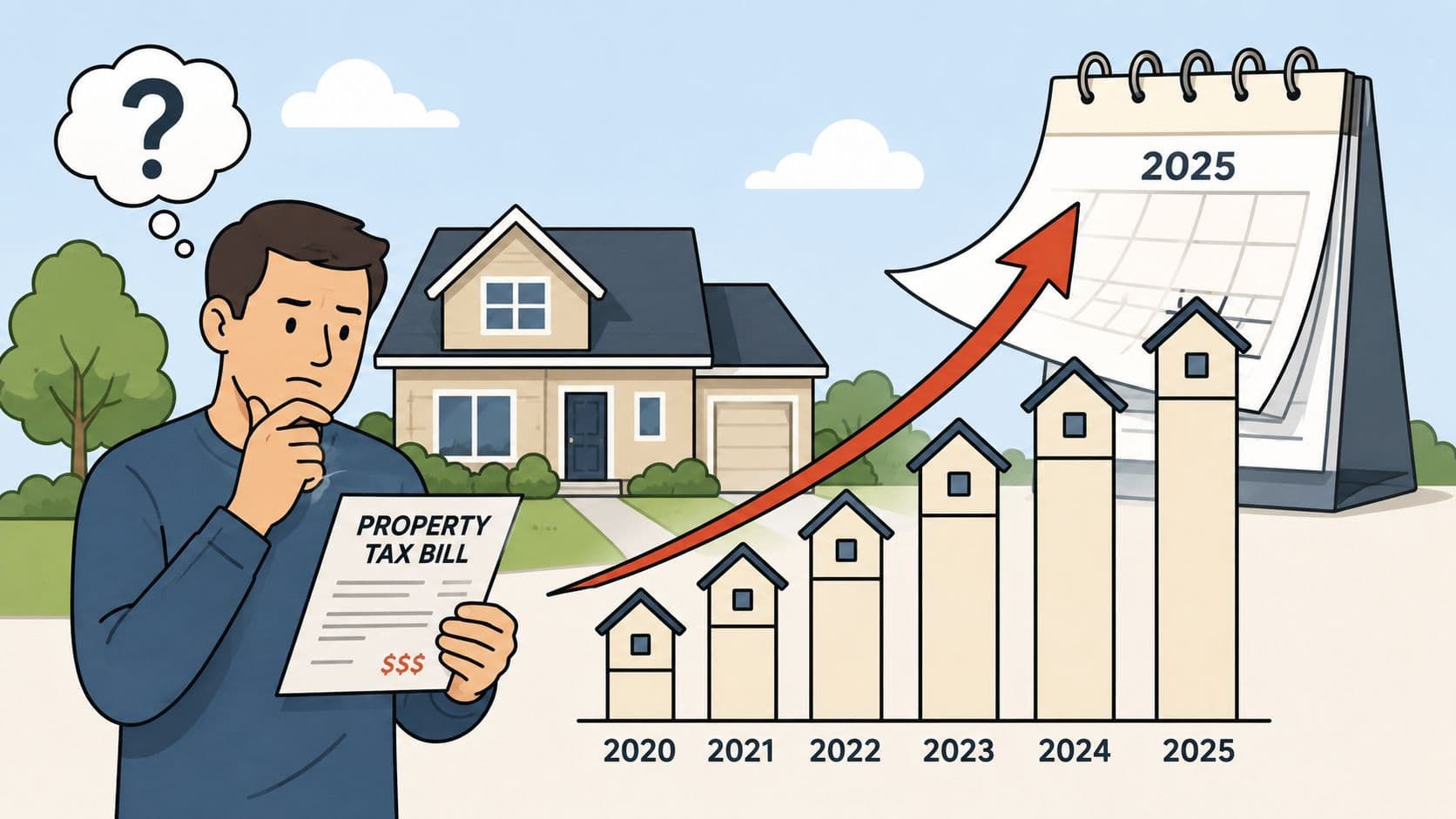
Property taxes do not have to increase every year, but in 2023 the U.S. median property tax for all properties reached $2,826, and the median for reassessed properties reached $2,943. In many places, the bill has climbed year after year because home values, reassessments, and local levy decisions have moved upward together.
Why does a bill that feels like a fixed monthly reality keep changing so much from one year to the next? The answer starts with the bill itself, not the tax policy headline many people read.
Table of Contents
- The Short Answer and What a Property Tax Bill Actually Is
- How Your Bill Is Calculated Step by Step
- The Recent Pattern Across the United States
- Why Property Tax Bills Jump in Some Years and Stay Flat in Others
- Caps, Freezes, and Exceptions That Change the Answer
- What Homeowners Can Do When the Bill Keeps Climbing
- Rethinking the Base From Land Value to Land Use Rights
The Short Answer and What a Property Tax Bill Actually Is
No, property tax does not increase every year by law everywhere. The bill changes when the taxable base, the tax rate, or a special assessment changes, so a flat year is possible, even though many homeowners see a rise more often than not. Illinois explains that the bill is built from equalized assessed value and tax rates set by levy ordinances, and Montana State University notes that changes can come from new spending, higher levies, fixed mill rates applied to rising values, or added special assessments (Illinois Department of Revenue).
That's why a property tax bill feels less like a subscription and more like a moving calculation. Counties, municipalities, school districts, and special districts all play a role in the final amount, and each one can change its part of the formula on a different schedule.
Think of it as a local bill, not a national rule
If you buy groceries in one city, you don't expect every store to charge the same total, or for the total to stay fixed forever. Property tax works the same way, except the “cart” is your home, and the local governments around you decide how much revenue they need.
In practice, the bill is a recurring charge on the taxable value of real property, usually the land plus the structures on it. What confuses homeowners is that the bill can rise even when they didn't renovate, move, or refinance. That happens because the local tax system is built to track value and local budgets, not to freeze the bill at the moment you bought the house.
Practical rule: if the assessment changed, the rate changed, or an exemption disappeared, the bill can change too.
A good way to read any property tax question is to start with the bill, then work backward to the value and the rate. Once you do that, the rest of the system becomes much easier to follow.
How Your Bill Is Calculated Step by Step
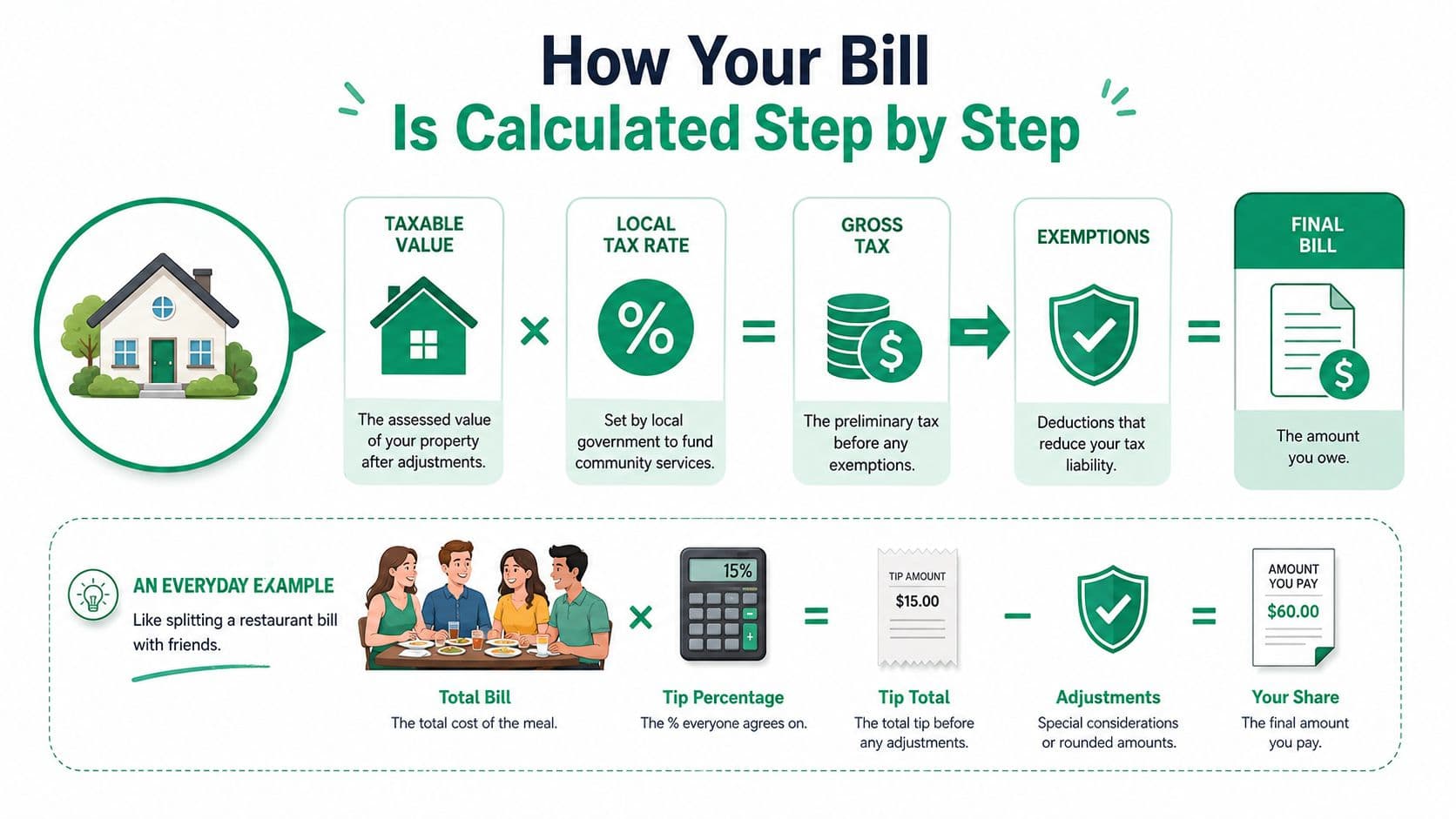
The core math is simple. Taxable value multiplied by the local tax rate, minus exemptions, equals your final bill. The hard part is that each piece can be labeled differently depending on the state or county, which is why one neighbor's statement can look nothing like another's.
Value comes first, then the rate
Start with assessed value, which is the government's estimate used for taxation, not necessarily the price someone would pay in a quick sale. In some places, that figure is then adjusted into equalized assessed value, which helps line up assessments across jurisdictions that don't assess in exactly the same way. After that comes the mill rate or local tax rate, the number that tells you how much tax is charged per unit of value.
A restaurant bill analogy makes this easier. If four friends split a table, each person pays based on what they ordered, not on who happened to sit closest to the door. Property taxes work similarly, because two homes on the same street can have different bills if one is assessed higher, one has an exemption, or one falls in a different taxing district.
Exemptions change the total before the bill is printed
A homestead exemption can reduce the taxable amount before the rate is applied. That's one reason a homeowner-occupant may pay less than a nearby rental property, even if both look similar from the curb. The same logic helps explain why a neighborhood search about buying a home near quality schools can't stop at asking whether the house is “affordable” in the listing sense. The tax line matters too.
For a line-by-line example of how assessment terms can appear on local records, this DC real estate assessments overview is useful because it shows how valuation language often differs from the way homeowners talk about their house.
A bill is usually the result of three questions, what value did the assessor place on the property, what rate did the local government apply, and what exemptions were credited.
Once you can identify those three ingredients, you can usually tell which part of the bill changed and why. That's the skill most homeowners need before they can tell whether an increase is normal, mistaken, or worth appealing.
The Recent Pattern Across the United States
Homeowners often ask the question in the bill itself, because the answer shows up there first. If the local formula stays the same, a bill can still rise when the assessed base rises, and that is what has happened across much of the country. The rule is local, but the recent direction has been upward.
CoreLogic reported that median property taxes for all properties reached $2,826 in 2023, up $539 from 2019, a 23.6% increase over four years, or about 5.9% per year on average. For reassessed properties, the median reached $2,943, up 26.3% since 2019, or 6.6% per year (CoreLogic).
What the latest national numbers show
LendingTree found that the median U.S. property tax payment was $3,119 in 2024, rising 5.1% from 2023, and that property taxes increased in every one of the largest U.S. metros between 2023 and 2024. That finding came through national reporting on the LendingTree analysis. For homeowners, this helps explain why a bill can feel like it moves in jumps instead of in a smooth drift, the tax base gets repriced, then the next notice catches up all at once.
| Source | Year | Median U.S. Property Tax | Year-Over-Year Change | Coverage |
|---|---|---|---|---|
| CoreLogic | 2023 | $2,826 | Up $539 from 2019, 23.6% over four years | All properties |
| CoreLogic | 2023 | $2,943 | Up 26.3% since 2019 | Reassessed properties |
| LendingTree | 2024 | $3,119 | 5.1% from 2023 | National median payment |
A broader historical lens shows the same direction. A national analysis from the National Association of Realtors found that between 2019 and 2023 the national median annual property tax rose 23%, from $2,480 to $3,045, and that all states saw increases in median annual property tax while 3,001 of 3,144 counties recorded higher medians (National Association of Realtors).
Those numbers matter because they point to a policy question as well as a household bill question. If the tax is tied to rising home values, then owners are not only paying for local services, they are also feeling the pressure of how a community lets land and housing value appreciate, which is why debates about land-value taxation and land-use rights keep coming back into property-tax reform. A property tax reform overview helps show why that argument appears in so many county-level discussions.
The important comparison is not whether one year rose, but whether the local pattern keeps pushing bills upward over several years.
Why Property Tax Bills Jump in Some Years and Stay Flat in Others
A bill usually doesn't drift up in a smooth line. It tends to sit still for a while, then jump when something in the formula changes. That's why homeowners often open the envelope and feel blindsided, even though the underlying system was moving in the background.
The four common triggers
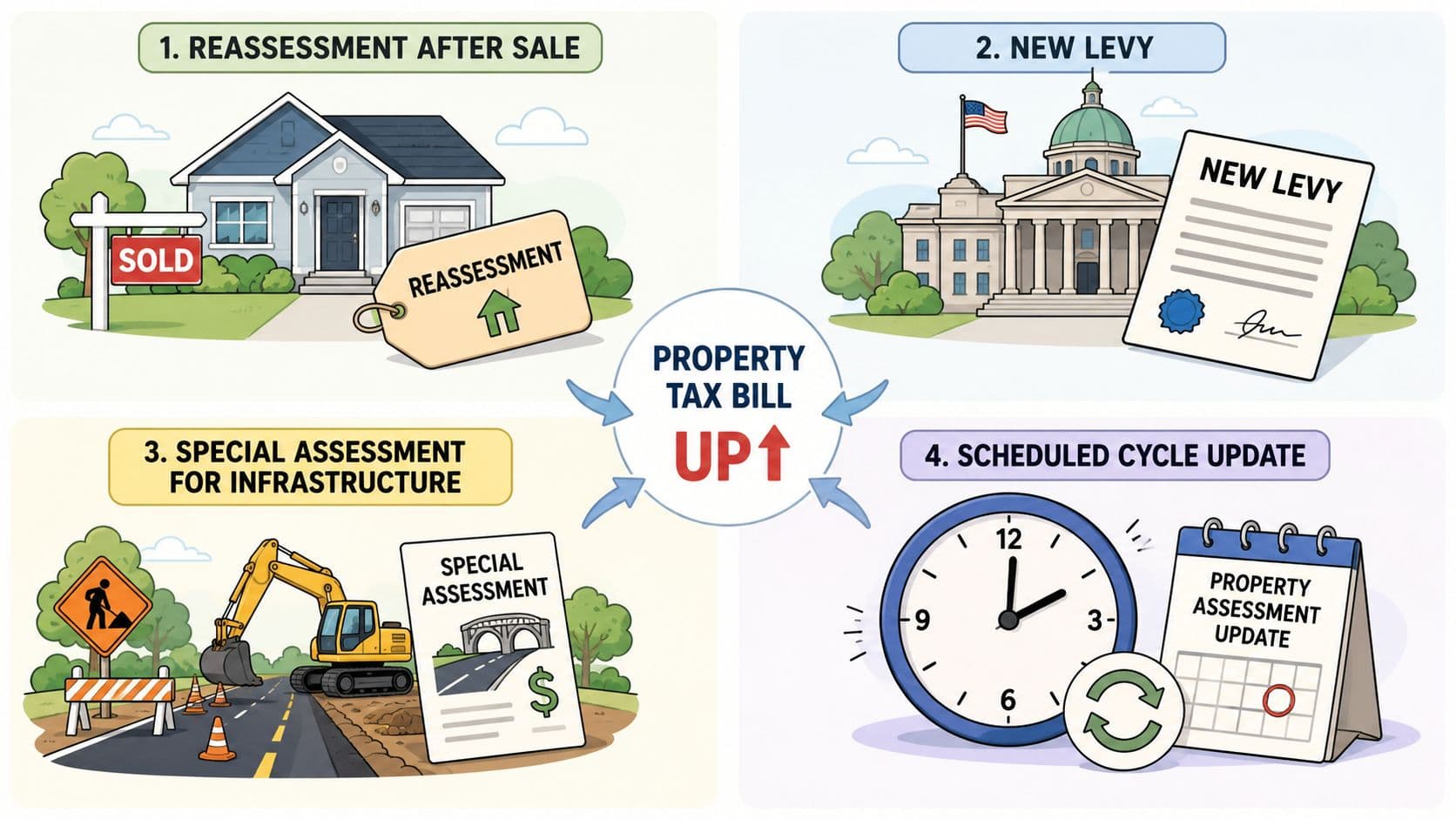
A reassessment after a sale or a scheduled cycle can reset the taxable value. A new levy can raise the rate because a city, county, or school district needs more revenue. A special assessment can add a charge for something specific like sidewalks or sewer work. A lost exemption can also push the bill higher, because the taxable base expands even if the home itself didn't change.
Why the increase often lands all at once
Reassessment lag matters. Some places reassess annually, while others do it every few years, so the market value change gets bundled into one tax notice instead of arriving in tiny pieces. If a home's market value climbed over several years while the assessor waited to catch up, the homeowner can see a sharp jump in the next cycle rather than a gentle series of increases.
A short example makes this easier to see. Say a reassessment year arrives after a local market has climbed, and the county also adopts a higher levy to cover its budget. The owner gets hit by both changes at once, so the bill can rise more than either change would have caused alone. That stacked effect is why people describe some tax years as a shock, even when the bill's formula still followed the rules.
For a compact look at how local hearing notices and rate changes fit into that process, this truth in taxation explanation is a useful companion.
A homeowner usually feels the jump in one year, but the causes often built up over several years.
Caps, Freezes, and Exceptions That Change the Answer
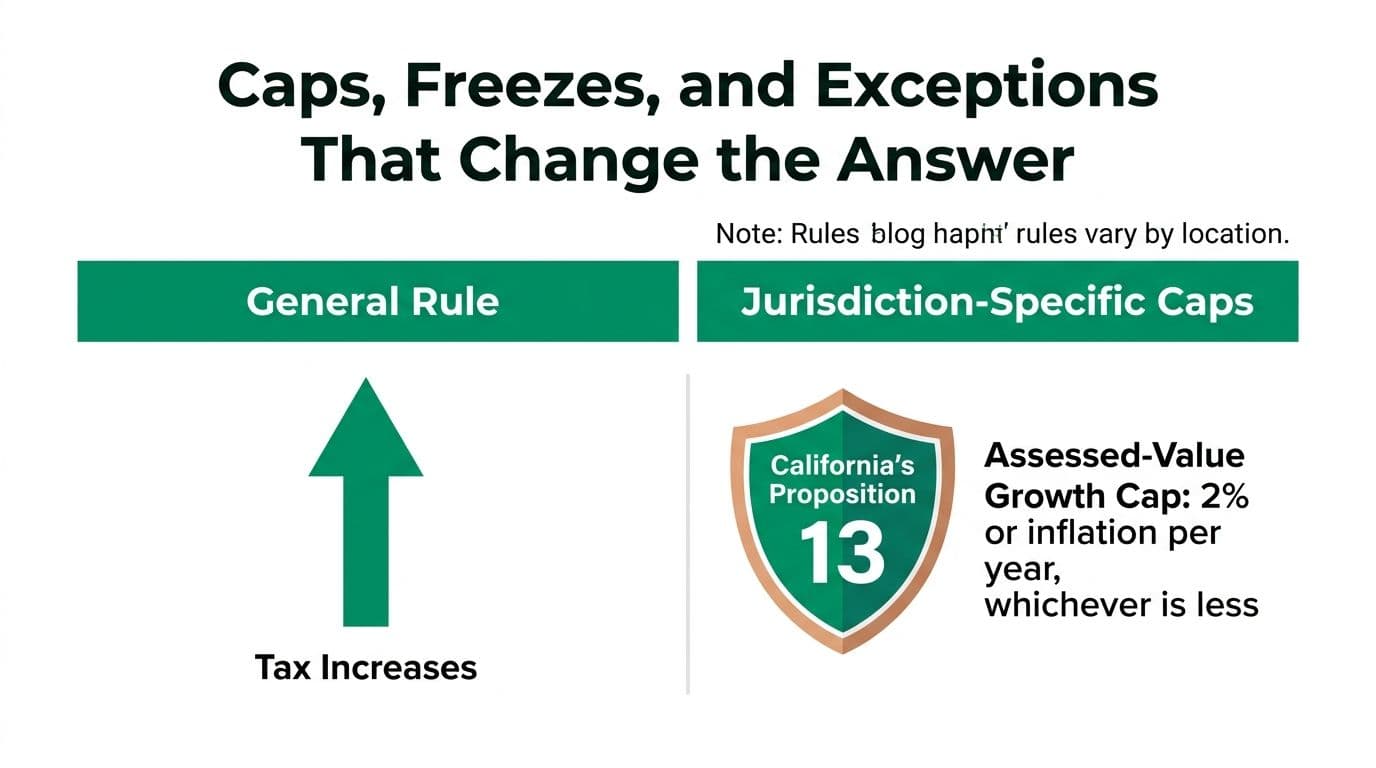
The headline question has no single national answer because states don't all treat assessments the same way. Some jurisdictions cap annual increases tightly, others cap only part of the formula, and some leave much more room for market swings. That's why two homeowners with similar houses can have completely different experiences after the same surge in local prices.
A comparison that shows why location matters
| State | Annual Assessment Cap | Reassessment Trigger | Levy or Rate Limit |
|---|---|---|---|
| California | Generally limited to the lesser of 2% or inflation each year | Sale or significant improvement | Proposition 13 framework |
| Washington | No uniform statewide assessment cap stated here | Reassessment rules vary by district | Individual taxing districts limited to 1% annual levy growth plus new construction and additions |
| South Carolina | Assessed value increases capped at 15% over five years unless sold | Sale changes the treatment | Annual tax-rate growth limited to population growth plus inflation |
| Kansas | No statewide cap on annual assessment increases | Market movement can flow through more directly | No statewide cap noted |
California's Proposition 13 is the classic exception most homeowners have heard of. It generally keeps assessed-value growth to the lesser of 2% or inflation per year unless ownership changes or new construction occurs. Washington uses a different model, limiting individual taxing districts to 1% annual levy growth plus growth from new construction and certain additions, while South Carolina combines an assessed-value cap with a limit tied to population growth plus inflation (Tax Foundation comparison).
Kansas shows the other end of the spectrum. With no statewide cap on annual assessment increases, bills can move more sharply when market values rise. That doesn't mean every homeowner there gets hit every year, but it does mean the system gives market change more room to show up on the bill.
To compare local calculators and billing language, this Alp Perez calculator for buyers is a practical reference point for people who want to see how property taxes can be estimated before they buy.
What Homeowners Can Do When the Bill Keeps Climbing
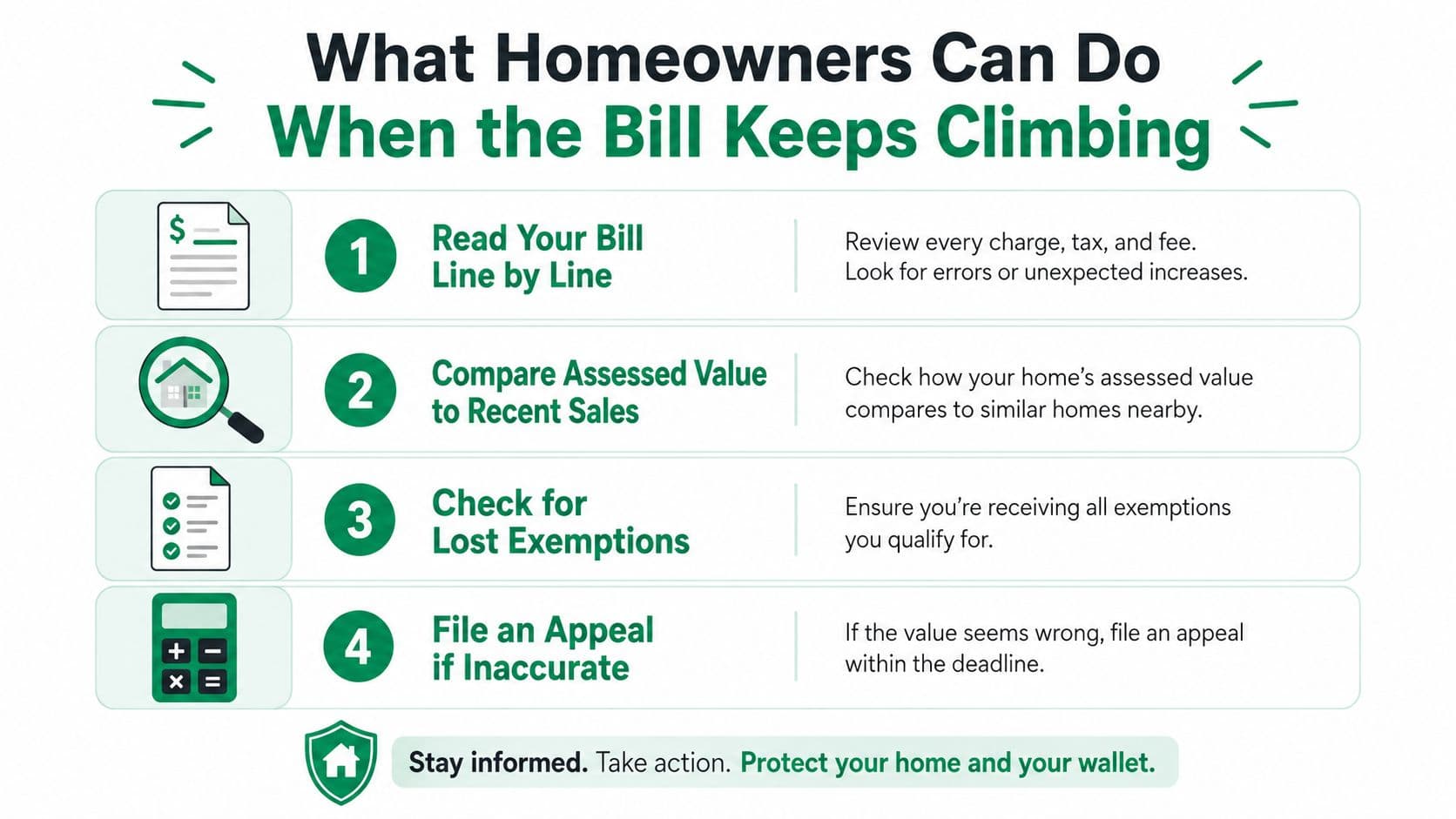
Start with the notice in front of you, not with the fear it creates. The most useful question is simple, what part of the bill changed, and does the paper trail support that change? Once you know that, you can decide whether the rise was expected, explainable, or worth challenging.
Read the bill like a worksheet
Look for the assessed value, the tax rate, the exemptions, and any special assessments. If the bill includes a reason code or assessor note, read that first because it often explains whether the increase came from market revaluation, a rate change, or a lost exemption. For homeowners who want a quick way to think about whether they may have been charged too much, this finding out if you overpaid guide can help organize the basic check.
Compare the assessment to recent sales
If your assessed value seems too high, compare it with recent sales of similar homes nearby. Add repair estimates, photos, and any independent appraisal if you have one, because those documents help show whether the assessor's number fits your property's condition and market position. When there's a big mismatch, the evidence matters more than frustration.
Check exemptions and deadlines before you appeal
A missing homestead exemption can create an avoidable increase, so verify whether one dropped off the bill. Appeal deadlines are strict and vary by jurisdiction, so homeowners need to act quickly once they receive the notice. The safest approach is to gather your paperwork first, then file the appeal before the clock runs out.
For a more technical look at how land value fits into the assessment picture, this calculate land value guide is a helpful companion.
An appeal works best when it targets a specific error, not when it simply protests that taxes feel too high.
Rethinking the Base From Land Value to Land Use Rights
The homeowner's question leads to a bigger policy question, what exactly should be taxed, the building, the land underneath it, or something else entirely? Land-value taxation shifts more of the burden onto the underlying site value instead of the house itself, which rewards construction and improvements while making speculative holding less attractive. That's one reason reformers keep returning to it when they talk about housing affordability and urban land use.
Land value is not the same as land use rights
Land-value taxes and land-use rights are related ideas, but they are not the same thing. Land-use rights are land leases that are repriced annually with no expiration dates, and because they are repriced every year, people can buy and sell those rights at a low cost. The key difference is that the annual repricing strips out much of the speculative appreciation that usually gets attached to land ownership.
That distinction matters because a tax is a public charge, while a land-use right is a form of tenure and access. One changes what gets taxed, the other changes how land is held and transferred. Both can reduce the reward for sitting on valuable land unused, but they do it in different ways.
If you want the policy logic in plain language, this guide to what a land use right is is a useful next read.
Why the debate keeps coming back
For most homeowners, caps, freezes, and exemptions are the immediate concern because they shape the bill this year. For policymakers, the deeper question is whether the tax base itself encourages the right kind of land use. Once you understand that distinction, the property tax conversation stops being only about notices in the mailbox and becomes a broader discussion about how cities, neighborhoods, and public revenue should work.
If you want a clearer reading of your own property tax situation, visit Unitism® to explore plain-language resources on land value, assessments, and reform. Unitism® helps people and public agencies make sense of the policy mechanics behind land and property taxes, and it offers tools and guidance for anyone trying to understand how the system affects housing costs and local revenue.