Learn how the Santa Fe Community Housing Trust expands affordable homeownership, runs key programs, and shapes local policy.
August 12, 2026
Santa Fe Community Housing Trust: Programs & Impact
Learn how the Santa Fe Community Housing Trust expands affordable homeownership, runs key programs, and shapes local policy.
If you're renting in Santa Fe and watching listings disappear before you can even schedule a showing, you already know the problem. The city's housing market can make a stable mortgage feel out of reach, even for households that work, save, and do everything “right.” That's where the Santa Fe Community Housing Trust comes in, as a local institution built to close the gap between ordinary families and the kind of housing market this city produces.
Table of Contents
- A Trust That Keeps Santa Fe Within Reach
- What the Trust Actually Does
- Programs That Move Residents from Renter to Owner
- Who Qualifies and How to Apply
- Three Decades of Impact and the Rental Gap That Remains
- Funding, Partnerships, and the Land-Value Question
- What Residents and Policymakers Should Do Next
- Frequently Asked Questions About the Trust
A Trust That Keeps Santa Fe Within Reach
A family can do everything right and still get priced out. They can have steady jobs, decent credit, and a plan for the future, then discover that the monthly payment on a market-rate home in Santa Fe is too high for their budget. That moment is exactly why the Santa Fe Community Housing Trust exists.
The Trust started in 1991–1992 as a land-trust model meant to expand affordable homeownership in northern New Mexico, and it has grown into one of the region's major housing intermediaries, according to the City of Santa Fe's housing page, which also notes its expansion into homebuyer training, counseling, reverse mortgage financing, rental assistance for special-needs populations, and real estate development. For readers trying to understand the institution quickly, that matters because it is not just a single program. It's a layered housing organization with a long operating history and a broad public role. What a land trust is in plain language
Practical rule: if a housing organization helps people prepare to buy, helps finance the purchase, and also helps create the homes themselves, it influences both access and supply.
That mix is the reason the Trust keeps showing up in local housing conversations. It serves households that need education, households that need financing, and the broader community that needs more stable, affordable homes to exist in the first place. In a city where land, construction, and monthly payments all pull in the same expensive direction, the Trust's model matters because it works on more than one pressure point at once.
Readers usually come to this topic with a few basic questions. What does the Trust do every day? Who can use it? How do you apply? What has it achieved, and where does it still fall short? Those are the right questions, because the Trust is best understood as a working system, not a slogan.
What the Trust Actually Does
The easiest way to understand the Santa Fe Community Housing Trust is to stop thinking of it like a bank or a city office. It's a nonprofit community development organization that combines technical help and financial help with a production pipeline that includes homebuyer counseling, homeowner lending, single-family development, multifamily operations, and land development. That integrated structure matters because it lets the Trust work on the demand side and the supply side of housing at the same time. Santa Fe housing action resource on the Trust's structure
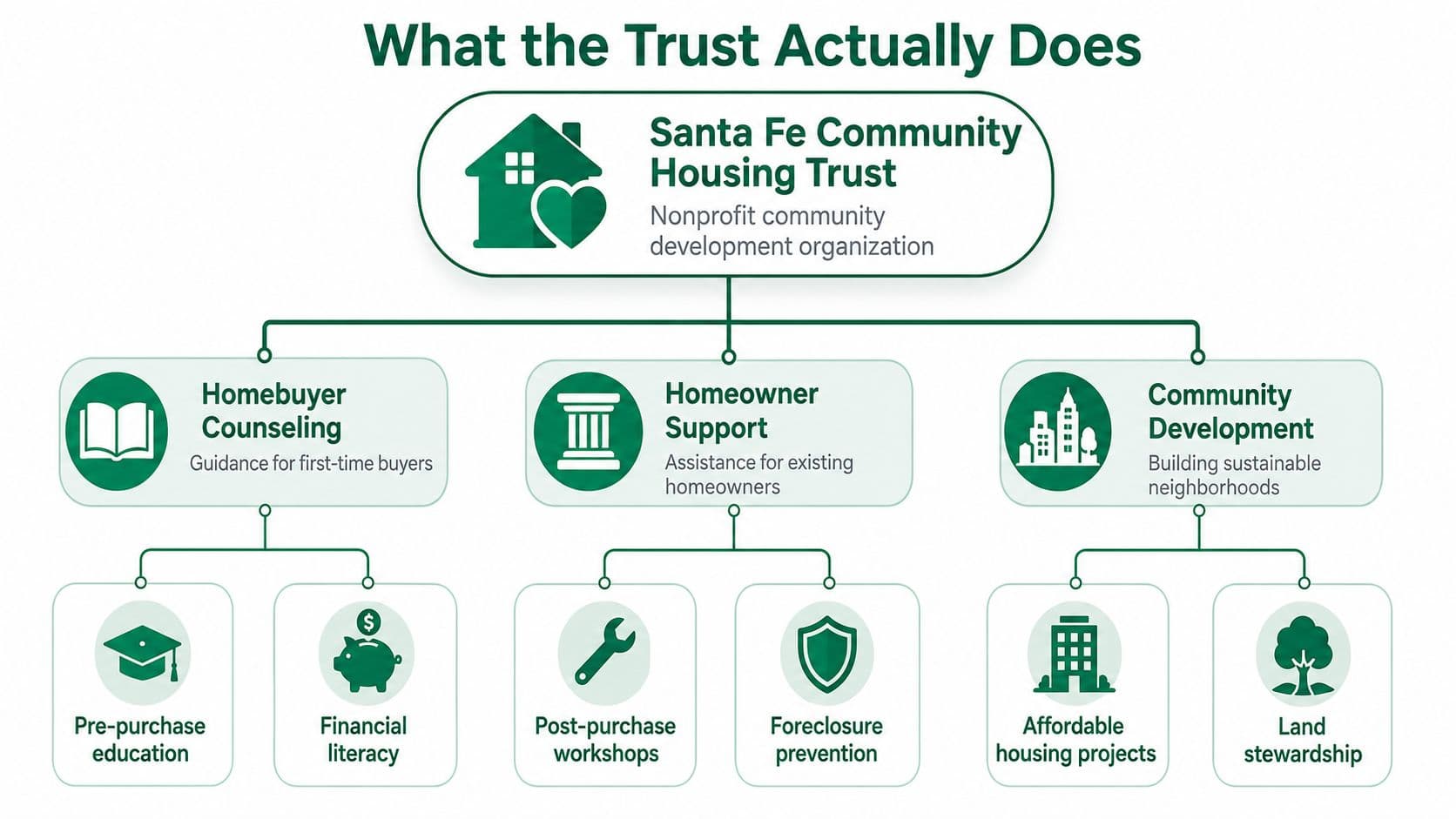
Demand side and supply side, in plain terms
On the demand side, the Trust helps households get ready to buy. That can mean counseling, education, and lending that makes the path to ownership more realistic. On the supply side, it helps create or steward the homes themselves through development and land work. In practical terms, that means a household might get help becoming mortgage-ready while the organization is also building or assembling the kind of property that household can afford.
That combination is rare and useful. A typical agency may focus on advice, while a developer focuses on construction. The Trust does both. For a buyer, that can reduce the gap between “I'm ready” and “there's a home I can get into.”
A regional operator, not just a local office
The Trust's reach extends beyond Santa Fe proper. RCAC says it has administered the Los Alamos County Homebuyer Assistance Program and Home Renewal Program under contract, which shows that its role is regional, not neighborhood-bounded. The same RCAC profile also notes a delivery platform that includes HUD-approved housing counseling, homeowner lending, single-family development, multifamily operations, and land development, plus down-payment assistance of up to $50,000. Those service lines fit together because they allow the Trust to handle both front-end preparation and downstream housing creation. PadPulse on affordable housing software is useful context for readers who want to compare how housing organizations track counseling, property operations, and intake across multiple programs.
The important takeaway is simple. The Trust is both a service provider and a producer.
It doesn't just tell people how to buy. It also helps shape the housing pipeline they're trying to enter.
Programs That Move Residents from Renter to Owner
A renter usually starts with uncertainty, not a perfect plan. Maybe they're saving, maybe they're juggling kids and work, or maybe they've found out that their current lease won't last forever. The Trust's programs are built to meet people at that point and move them step by step toward a stable purchase.
The buying path starts with counseling
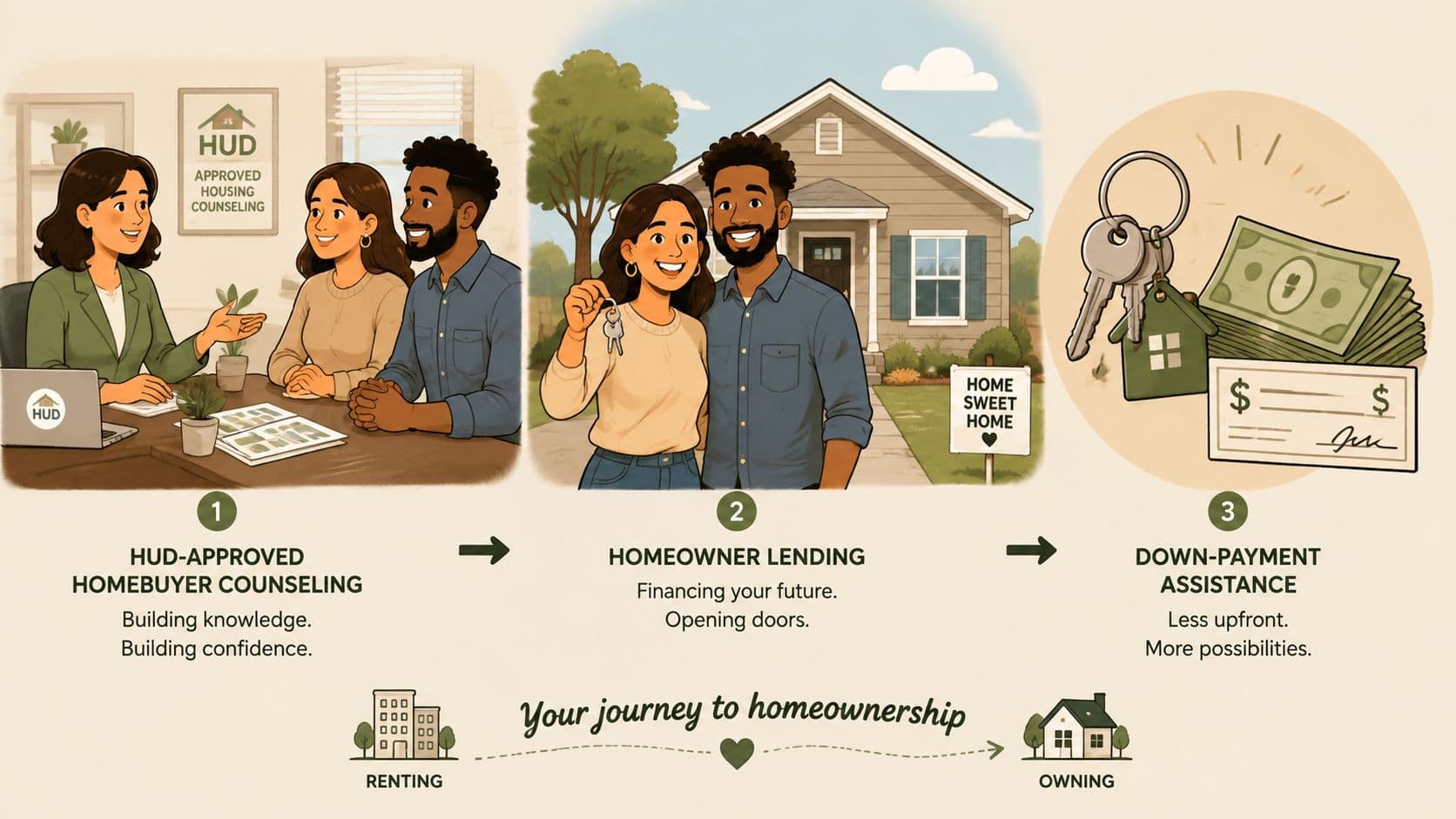
The first stop is HUD-approved housing counseling. That's where a household learns what it can afford, what documents matter, and what kind of program fit makes sense. The City of Santa Fe says the Trust expanded beyond its original land-trust model into homebuyer training and counseling, and that training function is one of the clearest ways it helps residents move from hope to action. Homestead community land trust overview
From there, the Trust's homeowner lending and down-payment assistance of up to $50,000 can make the leap to ownership possible in a high-cost market. RCAC also notes the organization's current capacity includes this kind of lending support, which matters because down-payment barriers are often the first thing that stops qualified buyers. In Santa Fe, the Trust isn't handing out a generic brochure. It's building a path that includes preparation, financing, and access to the actual home.
Ownership, rentals, and aging in place all sit in the same service mix
The Trust's menu is broader than first-time buying. It also works in single-family development and multifamily operations, and the City of Santa Fe notes it provides rental assistance for special-needs populations as well as reverse mortgage financing. That tells you something important about how the organization thinks. It's not only trying to create new owners. It's also trying to stabilize households at different stages of life.
For an older homeowner, reverse mortgage financing can be part of the picture. For a family that isn't ready to buy, rental support may matter more. For someone who's eligible but not yet prepared, counseling is the entry point.
How the pieces fit together
The Trust works best when the household sees the full sequence.
- Start with counseling: get a realistic view of what you can afford.
- Move into financing: use lending and down-payment support to close the gap.
- Buy into a property model that preserves affordability: the Trust's development work helps keep those homes in circulation for the long term.
That sequence is why the Trust's services feel more like a pathway than a single product. It's housing access, not just housing advice.
Who Qualifies and How to Apply
The application process is less mysterious than many people expect, but it does require preparation. The Trust's public service information lists its office at 6005 Jaguar Drive, Ste. 101 in Santa Fe, with weekday hours of Monday through Thursday, 8 a.m. to 5 p.m., and Friday, 8 a.m. to 4 p.m. You can also reach the office at 505-989-3960 or info@housingtrustonline.org. The Trust's public contact page is the best place to confirm those details before you call.
What usually happens first
The first move is simple. Contact the office, ask about the program that fits your household, and be ready to describe your income, savings, and housing goals. After that, the Trust typically pairs applicants with the right counseling or financing track and asks for the documents needed to review eligibility.
A common bottleneck is incomplete paperwork. If income statements, household details, or asset records are missing, the process slows down. Missed counseling sessions can slow it too, because HUD-approved education is often part of the readiness step.
Practical rule: bring your documents early, not after the first appointment. That one habit saves a lot of back-and-forth.
How the program fit is usually decided
The Trust doesn't appear to work as a one-size-fits-all intake desk. Instead, the household is matched with a combination of counseling, lending, and down-payment aid based on need and program fit. That matters in a city where some buyers need affordability help, some need credit preparation, and some need a different housing pathway altogether.
County-administered contracts can feed into the same pipeline. RCAC says the Trust has administered the Los Alamos County Homebuyer Assistance Program and Home Renewal Program under contract, which suggests a similar intake logic can be used across partner programs even when the funding source changes. That makes the Trust more than a single-point nonprofit. It becomes a local access channel for multiple housing tools.
For residents, the next move is straightforward. Call, email, or walk in during office hours, ask what documents are needed, and complete the counseling steps as soon as you're scheduled. If you're serious about ownership, that first conversation is usually the one that turns a vague plan into a real file.
Three Decades of Impact and the Rental Gap That Remains
The Trust has a track record that's hard to ignore. A county needs assessment reports that since 1991 its homebuyer program trained 5,000 people and helped purchase 1,500 homes. A later organizational profile says it has built more than 700 homes in 24 neighborhoods over roughly two decades. Together, those figures show a repeatable housing model, not a one-off project. Unitism on west Hennepin affordable housing land trust ideas
What those numbers really say
Training thousands of people matters because housing access starts with readiness. Helping purchase 1,500 homes matters because counseling only becomes meaningful when it connects to an actual closing. Building more than 700 homes across 24 neighborhoods matters because it shows the Trust has moved beyond isolated development into neighborhood-scale production.
The profile's emphasis on quality design, construction, and resource efficiency also points to a long-view strategy. That kind of language usually signals homes built to last, with an eye on lifecycle costs instead of only lowest upfront cost. In a market as expensive as Santa Fe, durability matters almost as much as entry price.
The city's deepest rental problem, though, sits in a different place on the housing ladder. The Consolidated Plan says the largest quantified gap is in rental units priced below $500 per month for households earning under $20,000, with a shortage of 1,627 units. It also says 50% of voucher holders in the county are not housed because they can't find an appropriate unit. That is a serious reminder that ownership tools and rental tools are not interchangeable. Tiny Home State's New Mexico listings and rentals may help readers explore alternative housing formats, but it doesn't change the scale of the affordability gap the city describes.
Affordable Housing Impact at a Glance
| Indicator | Scale or Gap |
|---|---|
| Homebuyer program training since 1991 | 5,000 people |
| Homes helped to purchase since 1991 | 1,500 homes |
| Homes built over roughly two decades | More than 700 homes |
| Neighborhoods served | 24 neighborhoods |
| Lowest quantified rental shortage | 1,627 units below $500 per month for households under $20,000 |
| Voucher holders not housed | 50% |
The policy lesson is blunt. The Trust has delivered real ownership outcomes, but the city's hardest shortage still sits at the bottom of the rental market, where affordability is thinnest and options are scarcest. That's why the Trust matters as part of the system, not the whole system.
Funding, Partnerships, and the Land-Value Question
The Trust's work doesn't happen in a vacuum. The City of Santa Fe uses the Affordable Housing Trust Fund to support eligible activities like construction and rehabilitation, land acquisition, financing, and infrastructure, and the city updates its housing needs assessment every five years. That policy structure matters because land and infrastructure are often the hardest parts of affordable development to pay for. Housing Communities buyers resource on local housing frameworks
Why the funding design matters
When city money can help with land acquisition and infrastructure, it removes some of the most expensive bottlenecks in housing production. That's especially relevant for an organization like the Trust, because its model depends on putting homes where the market won't do it alone. The city's five-year assessment cycle also gives policymakers a way to update the playbook as conditions change instead of freezing policy around old assumptions.
That's where the land-value conversation comes in. A land-value tax is an annual charge based on the assessed value of the land itself. It targets the location value, not the building. Land-use rights are different. They're land leases repriced annually with no expiration dates, so people can buy and sell those rights for a low cost because the repricing absorbs most of the speculative gain. That difference matters because both tools aim to limit land speculation, but they work through different mechanisms.
A community can keep homes affordable over time by separating the value of the building from the value of the site underneath it.
That idea connects directly to the Trust's land-trust roots and to broader reform frameworks. Unitism's tri-factor economics separates labor, capital, and nature, which helps explain why land value behaves differently from buildings or work. In that frame, land-value capture can help keep the benefit of publicly supported land in public circulation, so homes stay tied more closely to construction cost and use, not speculative land gains. Unitism's land-value capture guide
The Trust, then, is not only a neighborhood housing producer. It's also a practical example of how city funding, nonprofit delivery, and land policy can work together when the goal is long-term affordability.
What Residents and Policymakers Should Do Next
If you're a resident, the next step is simple. Call the Trust, ask which program fits your household, and start counseling and pre-qualification now, not later. If you're waiting for the “right time,” the market probably won't wait with you. Unitism on housing affordability policy
If you're part of a nonprofit, foundation, or local business coalition, the useful move is to support the Trust's pipeline where it needs it most, infill sites, counseling support, and gap financing for the homes that can get built. If you want to help at scale, back the pieces that facilitate land, infrastructure, and service delivery together.
If you're a policymaker, treat the Trust as a delivery vehicle for broader land reform. The same city tools that support acquisition and infrastructure can also preserve affordability longer when they're aligned with land-use-right repricing and other land-value strategies. That keeps the conversation focused on the underlying constraint, not just the visible symptom.
Frequently Asked Questions About the Trust
Is the Santa Fe Community Housing Trust a government agency, and where is it located? No, it's a nonprofit community development organization. Its public office is at 6005 Jaguar Drive, Ste. 101 in Santa Fe, New Mexico, with weekday office hours and contact information listed on its site.
How much down-payment assistance can a qualified buyer receive? RCAC says the Trust offers up to $50,000 in down-payment assistance.
Does the Trust help renters, or only buyers? It helps both. Beyond homebuyer counseling and lending, the City of Santa Fe says the Trust also provides rental assistance for special-needs populations and works in multifamily operations.
How does the Trust fit into broader housing policy? It sits inside a wider system of city funding, county contracts, and land policy. Its work complements the Affordable Housing Trust Fund, local housing needs assessments, and land-trust strategies that aim to keep affordability from being lost after the first sale.
Unitism® works with governments, cities, and organizations on land-value capture, housing policy, and practical implementation tools. If you're trying to connect affordable housing delivery with the land policy underneath it, visit Unitism® to explore research, guides, and advisory support built for that exact challenge.