Learn how the West Hennepin Affordable Housing Land Trust preserves homeownership opportunities through community-led strategies and proven outcomes.
August 4, 2026
West Hennepin Affordable Housing Land Trust: A Guide
Learn how the West Hennepin Affordable Housing Land Trust preserves homeownership opportunities through community-led strategies and proven outcomes.

A family in suburban Hennepin County can do everything right on paper, steady jobs, decent credit, kids in local schools, and still get priced out of buying a home. That's the gap the West Hennepin Affordable Housing Land Trust, known as Homes Within Reach, was built to close, and it's why the model matters far beyond one county. It takes a problem that looks like a normal housing-market issue and treats it as a land-ownership issue, which is a very different way to think about affordability.
Table of Contents
- Why West Hennepin's Affordable Housing Land Trust Exists
- How the Community Land Trust Model Works
- Programs, Portfolio, and Affordability Mechanics
- Funding Sources and Land Acquisition Strategy
- Measurable Outcomes and Scalability Limits
- Partnership Opportunities and Land-Value Reform Connections
- Next Steps and Resources for Replication
Why West Hennepin's Affordable Housing Land Trust Exists
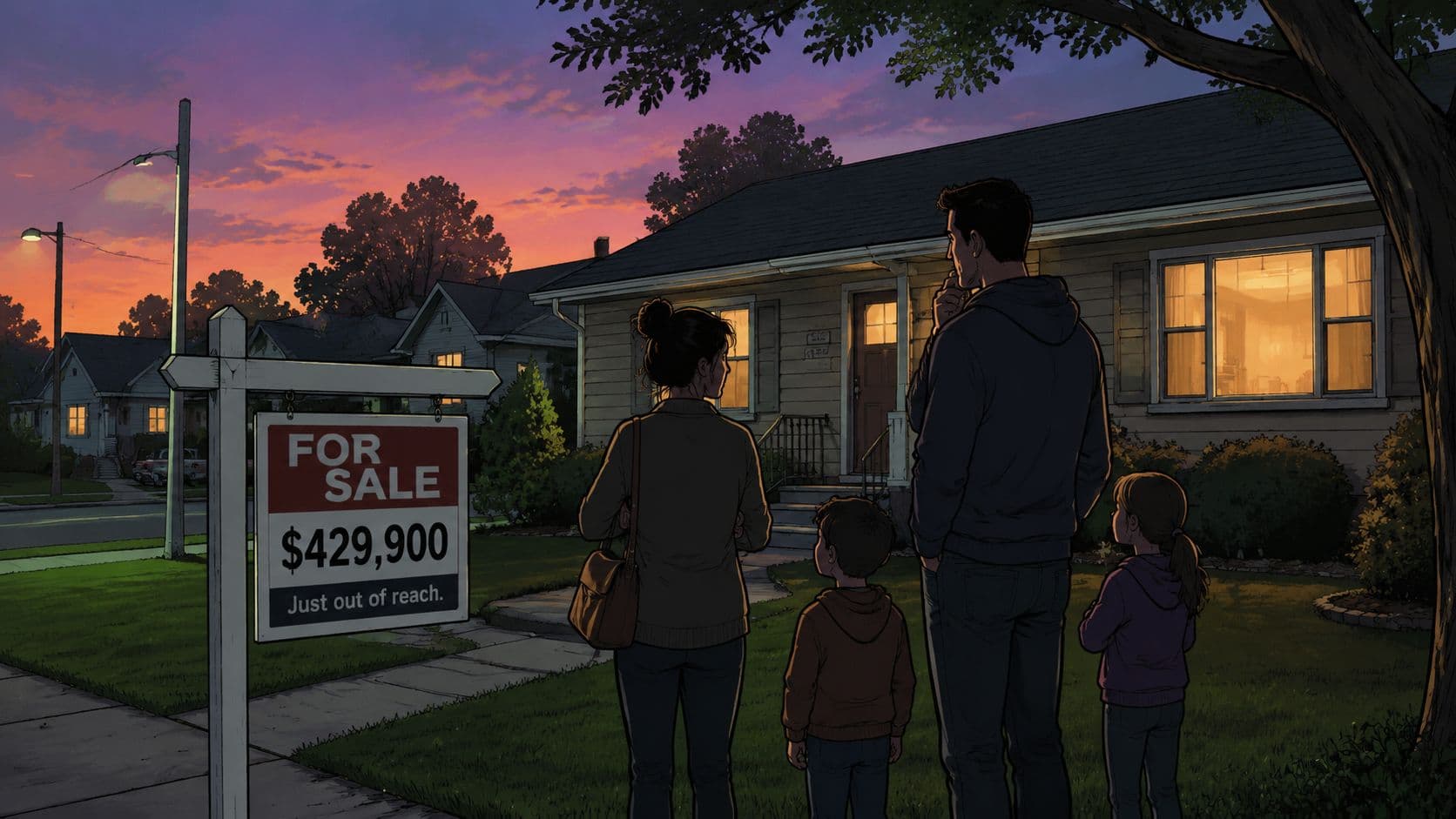
A working family can earn too much for subsidy programs and still not enough to buy at market price in western Hennepin County. That's the everyday pressure that pushed local leaders toward a community land trust model, and why WHAHLT was established in 2001 to create affordable homeownership opportunities in suburban Hennepin County, Minnesota givefreely.com. The problem wasn't a lack of demand for ownership, it was the way land prices and speculative pricing pushed starter homes out of reach.
The suburban contradiction is easy to miss. These communities offer jobs, schools, and infrastructure, yet the households that keep them running often can't buy in them. WHAHLT, which does business as Homes Within Reach, responds to that mismatch by preserving a path into ownership for households that would otherwise be shut out.
The model matters because it treats affordability as something that can be built to last, not just granted once at closing. In other words, the trust isn't trying to solve the housing problem with one discounted sale and then walk away. It's trying to keep the home affordable for the next qualified buyer too.
That's the central question behind the west hennepin affordable housing land trust, and it's the right one to ask before talking about leases, financing, or resale rules. If the market keeps pushing land prices up, a conventional subsidy can disappear into the sale price. A land trust changes who controls the land, and that changes what the buyer is paying for.
How the Community Land Trust Model Works
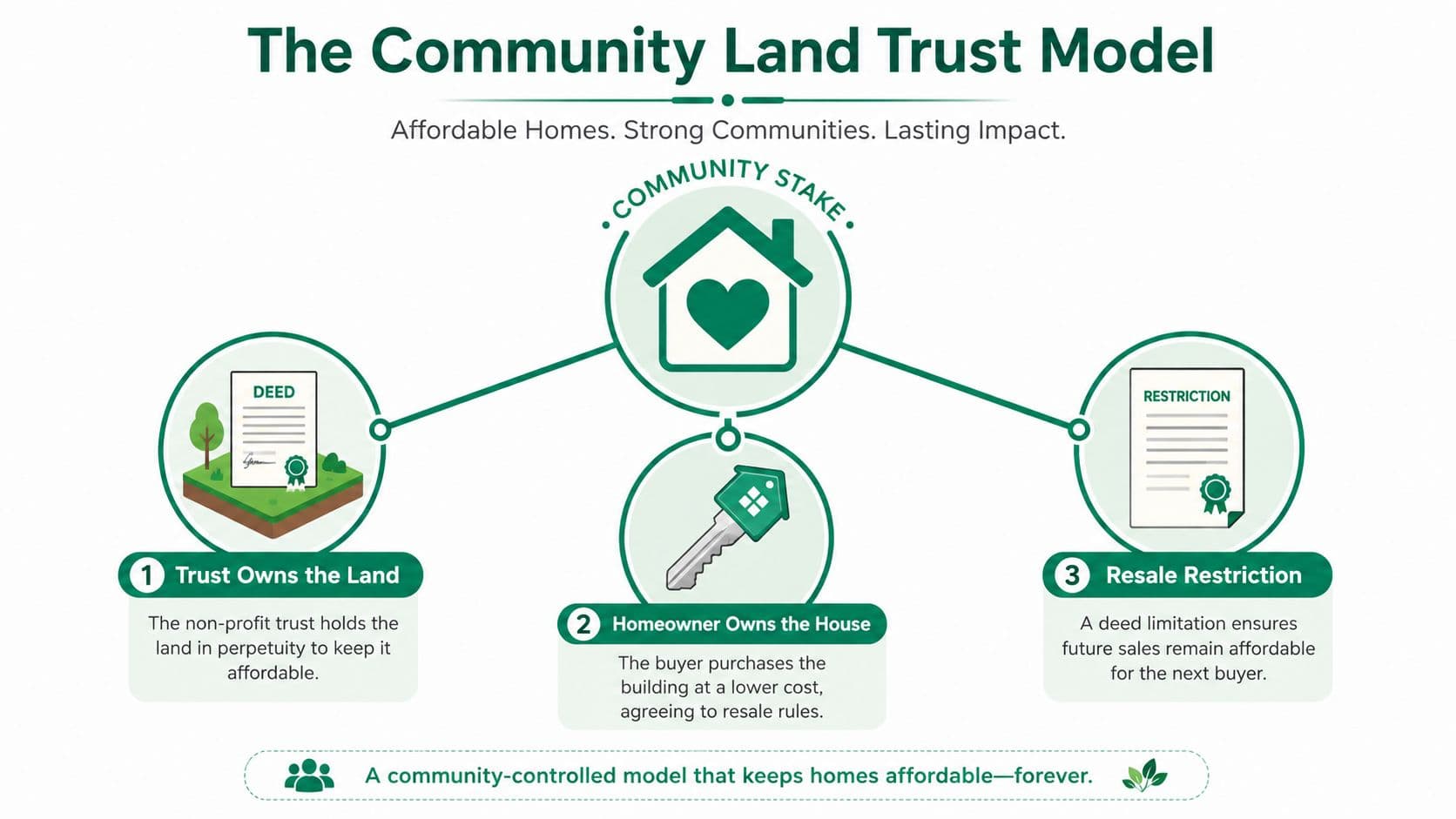
The best way to understand the community land trust model is to separate the house from the land under it. The homeowner buys the house. The nonprofit trust keeps the land. Those two facts sound simple, but they change the economics of ownership in a major way.
Under Hennepin County's housing plan, WHAHLT uses a 99-year ground lease that keeps the land in trust, restricts resale to qualified buyers, and limits the equity a departing homeowner can capture Hennepin County housing plan. That means the affordability subsidy sits in the title structure, not just in the purchase price. The land stays protected for the next household, and the discount doesn't vanish when the first owner sells.
A simple way to picture it
A family owns the roof, walls, kitchen, and yard improvements they live in. The trust owns the land those improvements sit on, and the lease sets the rules that keep the home within reach for the next buyer. That's different from ordinary down-payment help, because the affordability isn't a one-time grant that gets spent and lost.
This is also where the distinction between land-use rights and land-value taxes matters. Land-use rights are lease arrangements, and in the framing used by Unitism, they are repriced annually with no expiration dates, which makes them tradable at a low cost while the underlying right to use land remains organized through a lease structure. A land-value tax is different, because it's a public levy on the value of land, not a private lease between a trust and a homeowner. The two ideas both try to reduce speculation, but they work through different institutions and with different legal tools.
For a broader conceptual bridge, the Homestead community land trust overview helps readers compare CLT mechanics with land-economics thinking. The useful insight is that both approaches separate land value from the building, but they do it in different ways.
Practical rule: If the land stays affordable, the home can stay affordable across resale. If the land is sold into the market, the subsidy usually walks away with the transaction.
Programs, Portfolio, and Affordability Mechanics
A household buying through Homes Within Reach is not getting a normal market purchase. The organization has already done the work that usually makes a starter home unaffordable, buying the property, rehabilitating it when needed, and then holding the land in trust so the next buyer does not pay for speculative land value. That is why the portfolio matters. It shows a repeatable acquisition, rehab, and resale process, not a one-time demonstration.
Late-2023 materials said WHAHLT had reached 213 homes in its portfolio, served 16 suburban communities, helped 253 families through resales, and held $22,829,800 in land in trust as of December 2023 Long Lake presentation. Earlier reporting described a smaller but already functioning regional program, with 172 families assisted by December 31, 2018 across 12 Hennepin County suburban communities 2019 annual report.
What the program does in practice
The organization acquires homes, rehabilitates them when needed, and resells them to qualified buyers at an affordable price. The land stays out of the open market, so the affordability rules keep applying at the next sale. That is the practical heart of a community land trust. It keeps the subsidy attached to the unit instead of letting it disappear when the first buyer moves on.
Maple Grove's housing-program page explains the financing in plain terms, the trust removes the market value of the land from the mortgage equation, so the buyer purchases only the home and leases the land for a monthly fee Maple Grove housing programs. That arrangement can make the difference when conventional financing falls short. The mortgage is tied to the building, while the land remains under a long-term ground lease, which is the same basic logic that sits behind land-value separation in Unitism-style reform frameworks.
For readers who want a related but different example of how site constraints shape housing choices, CozyCube's 2026 ADU building guide shows how careful planning can make small or constrained sites work better. The model is not the same as a land trust, but both force the same question, how should land be structured so the cost of the ground does not overwhelm the cost of the home itself?
| Homes Within Reach Key Metrics | Value | Notes |
|---|---|---|
| Established | 2001 | Created to expand affordable ownership in suburban Hennepin County |
| Homes in portfolio | 213 | Reported in late 2023 materials Long Lake presentation |
| Communities served | 16 | Late 2023 materials |
| Families served through resales | 253 | Late 2023 materials |
| Land held in trust | $22,829,800 | As of December 2023 |
| Average AMI served | 58% | Late 2023 materials |
For municipal staff, the key point is the title structure. A below-market sale by itself does not hold affordability in place. The resale restriction and the land lease do that work together, so the unit can remain affordable for the next household instead of reverting to full market pricing. A land trust is closer to a long-term stewardship tool than a simple subsidy program, and that is why it connects so cleanly to land-economics ideas about separating land value from housing cost. For a broader explanation of the stewardship side of that logic, the land bank overview is a useful companion reading.
The point of the lease isn't to block ownership. It's to make ownership durable in a market that would otherwise erase the subsidy on resale.
Funding Sources and Land Acquisition Strategy
A community land trust can only keep homes affordable if it can keep acquiring land and existing houses without depending on a single funding source. WHAHLT's financing shows that public programs do most of that work, because the model has to cover acquisition, rehabilitation, and long-term resale oversight before a buyer ever takes title. Hennepin County's 2023 action plan identifies $349,284 in CDBG funds and $496,223 in HOME funds flowing through the model Hennepin County housing plan. That mix is not just bookkeeping. It reflects the reality that private capital rarely wants to carry the extra steps that make permanent affordability possible.
A Metro Council project filing for 4 single-family units shows the same pattern in a more concrete way. It listed a total development cost of $2,496,000, with $1,620,660 in public financing and only $5,000 in private funds Metro Council filing. That is not a conventional for-sale project built to maximize return. It is a preservation transaction, where the public sector helps convert existing market-rate housing into ownership that stays affordable after resale.
Why the acquisition strategy matters
Speed is one of the main advantages of a land trust acquisition strategy. If a house already exists, the trust can step in faster than a new construction pipeline, which matters in western Hennepin County where entry-level homes can draw heavy competition. The trust does not wait for the private market to produce affordability on its own. It buys into the market, then changes the ownership structure so the subsidy stays with the home instead of disappearing at the first resale.
That same logic helps explain why transaction costs matter to staff and board members who are comparing tools. A land transfer tax calculator can show how title and transfer costs change the math for a buyer, even though a CLT works through a different mechanism. The comparison is useful because both approaches start from the same basic fact, land and title costs shape who can stay in a community and who gets priced out.
For a broader policy frame, Unitism's land and water resource framework offers a way to think about stewardship, scarcity, and the separation of land value from housing cost. WHAHLT's structure makes that abstract idea practical. Local governments provide the upfront public support, the trust holds the land, and the resident buys the home under rules that keep the next sale within reach.
Measurable Outcomes and Scalability Limits
A community land trust can do two things at once, create real ownership paths and still leave room for the question of scale. The Homes Within Reach materials show that the program had helped 172 families become homeowners by December 31, 2018, since it began in May 2002, across 12 Hennepin County suburban communities. Other public materials describe an average buyer AMI of about 59%, and 39% of homeowners identified as people of color.
Those numbers matter because they show who the model serves, not just how many homes moved through it. The pattern points to lower-income households staying attached to homeownership over time, including buyers who would likely face more pressure in a conventional purchase. It also shows how a CLT can support workforce households that need a payment structure they can hold onto, even when a full subsidy is not available.
A second set of materials from Edina reported an average AMI of 58%, 51.2% underserved households, and 58% single-head households. Read together, these figures suggest that the trust is reaching households that often sit farther from the center of the private market and face more barriers at the closing table.
The harder issue is scale. Hennepin County still identifies affordability and availability as its most prevalent housing need, and recent planning materials say rising construction, staffing, insurance, and interest-rate costs have made affordable housing harder to produce and operate 2019 CAAP action plan. That is why a community land trust can be strong at preserving ownership opportunities while still being limited in how quickly it can add units. A CLT can hold a home in the affordability system for the next buyer, but it still needs land to buy, homes to acquire, and public capital to make the deal work.
Useful caution: a land trust is usually better at keeping affordability in place than at producing large volumes of new homes in a high-cost suburban market.
That caution does not weaken the model. It clarifies the job. If the policy goal is long-term retention, the structure fits well. If the goal is mass output, a CLT cannot act like a large production pipeline, because its pace depends on acquisition opportunities and the amount of support available.
For analysts, Unitism's fiscal impact analysis guide is a useful way to sort through those tradeoffs. It helps frame the basic question, not whether the model has value, but where its advantage sits inside a constrained housing system.
Partnership Opportunities and Land-Value Reform Connections
A city, county, or nonprofit that wants to work with WHAHLT usually starts with a practical question, where does land trust ownership add the most value without trying to do everything at once. That question matters because the model works best when it is matched to a specific local need, such as keeping a small set of homes affordable over time, rather than being asked to solve every housing problem at once. A recent Metro Council pilot showed that partnership with WHAHLT brought 18 Eden Prairie homes into the land trust, which is a concrete example of how targeted local agreements can carry real weight even when the overall scale is modest. Those partnerships can support broader housing goals tied to racial equity, geographic choice, and long-term affordability.
The connection to land-value reform is easy to see once the pieces are separated. Unitism's tri-factor economics framework separates labor, capital, and nature, which helps explain why land costs can rise without any change to the building itself. The CLT's ground lease does a private version of that separation by keeping land under shared control while the home can be owned, while a land-value tax does a public version by taxing land separately from improvements. The ideas point in the same direction, even though the policy tools are different.
Where the connection becomes practical
A local government can use the land-trust model to preserve ownership, then use land valuation tools to identify where speculation is pushing the market hardest. That means land assessment, fiscal modeling, and policy design support become useful together, because they show where a subsidy is likely to hold and where it may be swallowed by rising land prices. For a clear overview of that policy logic, see Unitism's guide to land value capture, which explains how communities separate land value from the housing someone lives in.
The broader lesson is straightforward. If a community wants affordability to survive beyond the first sale, it has to manage land, not just subsidize a mortgage. If it wants to reduce speculative pressure across the system, it can pair land trusts with stronger land-value policy thinking. Those tools work side by side, one preserving homes at the ground-lease level, the other changing how land itself is treated in public policy.
Next Steps and Resources for Replication
A good replication effort starts with the land, not the press release. Review local values, identify neighborhoods where affordable ownership is slipping away, and study how a ground lease would fit your zoning and financing rules. Then compare that with the operating model that WHAHLT already uses, so you're adapting a real structure instead of inventing one from scratch.
For background reading, use the organization's own FAQ, Hennepin County's 2023 housing action plan, the Family Housing Fund case study, and the Schumacher Center's Minnesota CLT directory. If you're a planner or nonprofit leader, start by asking whether your local market needs preservation, new production, or both, because the right answer changes the partnership design.
If you want a technical partner that works on land-value research, valuation methods, and implementation support for public agencies and community organizations, Unitism® focuses on those policy and planning questions. Bring them into the conversation when you're comparing land-trust mechanics, fiscal impacts, and long-term affordability strategies for your city or county.