Explore how payments in lieu of taxes work across federal, municipal, and international contexts, plus design tips for land-value capture and Unitism reforms.
August 26, 2026
Payments in Lieu of Taxes: A Complete Policy Guide
Explore how payments in lieu of taxes work across federal, municipal, and international contexts, plus design tips for land-value capture and Unitism reforms.
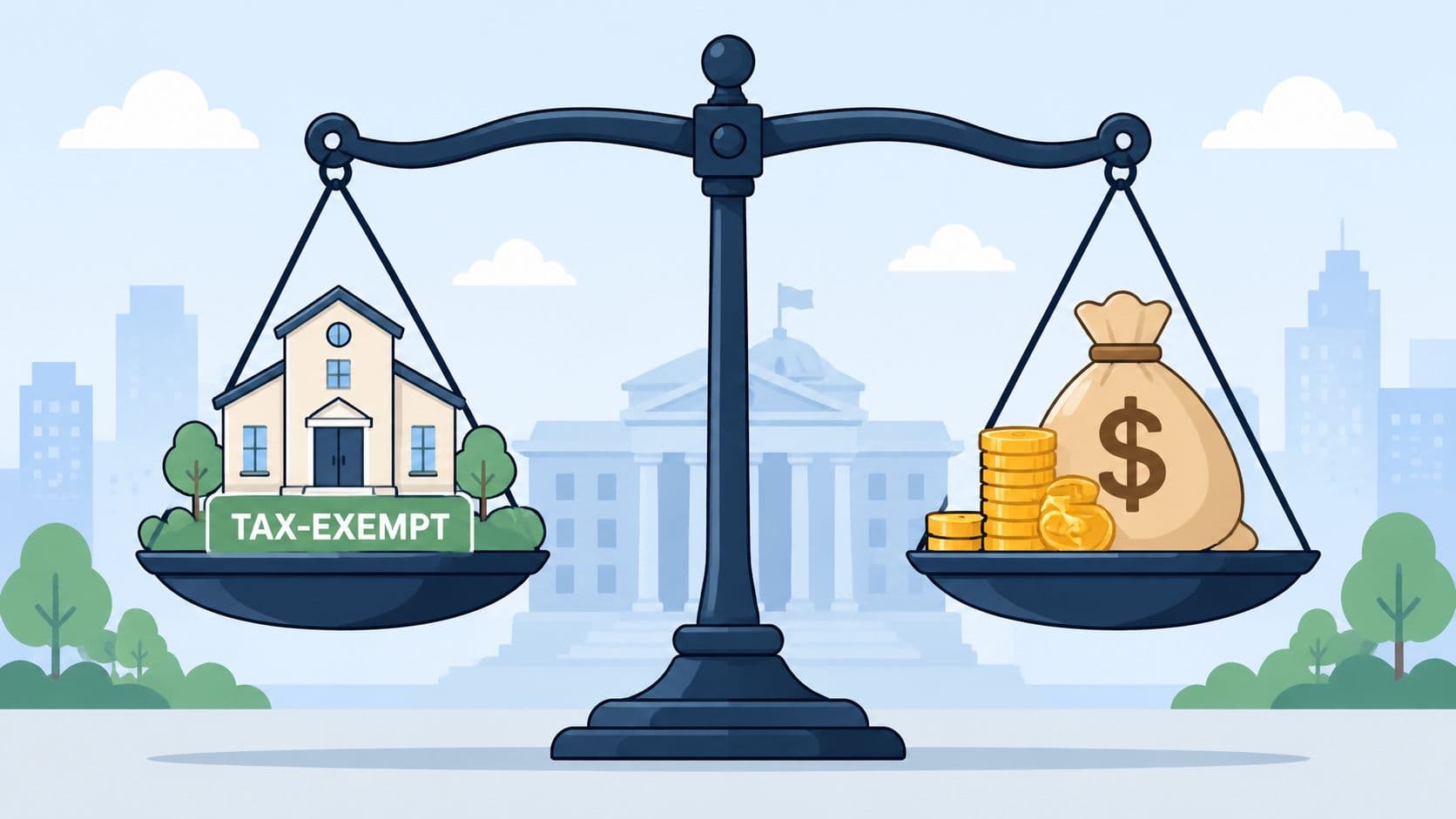
Federal PILT payments reached $733 million in a single June 23, 2026 distribution, reaching more than 1,900 local governments. That figure reframes “in lieu of taxes” as more than a tax-policy footnote. It's a fiscal architecture for places where tax-exempt land, subsidized development, or public ownership removes property from the ordinary tax base.
The central policy question isn't whether a PILOT can produce revenue. It's whether the payment tracks the value and service cost created by land, who absorbs the shortfall when it doesn't, and whether accountants disclose that trade-off clearly. A formula that looks stable on a municipal ledger can still transfer risk to counties, school districts, future taxpayers, and smaller businesses that lack negotiating power.
Table of Contents
- Defining Payments in Lieu of Taxes
- Land Leases Versus Land-Use Rights and Tax Substitutes
- How Municipal PILOT Formulas Work in Practice
- Hidden Fiscal Trade-Offs Behind PILOT Incentives
- Designing Payments in Lieu of Taxes for Land-Value Capture
- International and Municipal Precedents Worth Studying
- Moving From Ad Hoc PILOTs to Transparent Land Charges
Defining Payments in Lieu of Taxes
The federal payment in lieu of taxes, or PILT, compensates local governments when federal land is exempt from local property taxation. The U.S. Department of the Interior reports that the program began in 1977 and had distributed $13.4 billion by 2026 to 49 states, the District of Columbia, Puerto Rico, Guam, and the Virgin Islands. On June 23, 2026, it reported $733 million in payments to more than 1,900 local governments (Department of the Interior PILT information).
Federal PILT is one form within a broader group of tax substitutes. A payment in lieu of taxes can replace all or part of a conventional tax obligation through a statutory formula, negotiated agreement, administrative arrangement, or intergovernmental transfer. The underlying policy may involve federal ownership, nonprofit exemption, affordable housing, industrial redevelopment, or another decision that removes property from ordinary taxation.
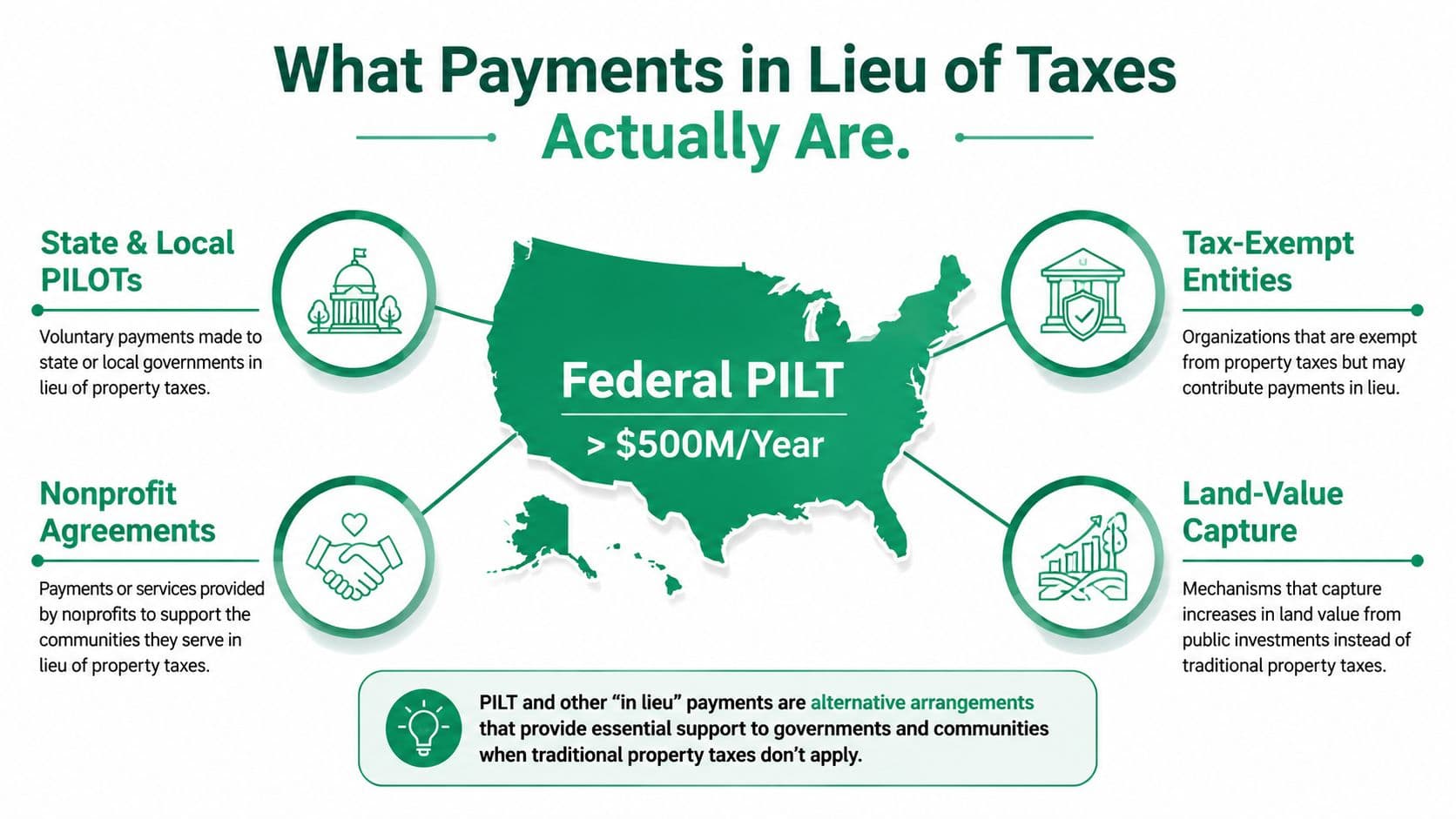
A useful taxonomy
Officials can evaluate a PILOT by asking three questions:
- Who pays: The federal government pays federal PILT. Municipalities, nonprofits, developers, and other exempt or subsidized entities may make local PILOT payments.
- What triggers payment: The obligation may follow government ownership, tax-exempt status, a development agreement, or a statutory incentive.
- How the amount is set: The amount may use a statutory formula, taxable-value proxy, appraisal, negotiated percentage, or available-funding proration.
These categories identify the accounting risk. Federal PILT is an intergovernmental transfer intended to offset local consequences of federal landholdings. It is not negotiated market rent. A municipal PILOT may approximate foregone property taxes, yet discounts, caps, proration, and bargaining can move the burden among a city, county, school district, and private enterprises that remain fully taxable.
The Lincoln Institute reported that, since 2000, nonprofit PILOTs had reached at least 218 localities in at least 28 states, with collective payments exceeding $92 million per year (summary of the Lincoln Institute research). The same research found that such payments represented less than 0.25% of general revenues in 70% of localities with available data, while only 11% received more than 1% of general revenues from them. A small aggregate share can still carry political weight, especially where a large exempt institution concentrates service demands or where annual repricing is absent.
For property owners contesting an assessment, the relevant baseline is the ordinary property-tax obligation that a PILOT may replace. A practical guide for property owners in Riverside helps clarify that baseline. Readers assessing how land ownership, use, and public revenue interact can consult the principles of land economics. The distinction matters because a fixed PILOT can preserve yesterday's valuation while an annually repriced land-use right would transmit changes in land value to public revenue.
Land Leases Versus Land-Use Rights and Tax Substitutes
Fixed-term land leases and annually repriced land-use rights solve different problems, even when both give a private party access to land. A fixed-term lease establishes a price for a defined period. It may be renewable, or it may end without an assured renewal. Either way, the contractual price can diverge from current land value while the term remains in force.
A renewable lease offers certainty only until renewal. If the lease rate falls below market value during the term, renewal can close the accumulated gap through a concentrated repricing event. A non-renewable lease creates a different pressure. As expiration approaches, buyers and lenders must assess whether the right can be extended, refinanced, or sold without a severe value adjustment. Fixed leases don't eliminate risk. They postpone it.
China illustrates the distinction. Urban land-use rights are granted for fixed statutory terms of 70 years for residential land, 50 years for industrial land, and 40 years for commercial or retail land (JunHe guide to land-use rights in China-20230228.pdf)). Residential rights have an automatic-renewal rule under the Property Law, while commercial and industrial rights don't receive the same automatic treatment (analysis of Chinese land-use-right renewal). That makes the legal and financial risk materially different by use.
New Taipei City demonstrates another model. Its land tax formula bases tax payable on taxable land value, applies a 1.5% rate above a threshold, and uses a cumulative-difference adjustment tied to standard land value (New Taipei City land tax formula). Annual reassessment keeps the charge connected to land value instead of freezing a price at the beginning of a long term.
| Feature | Fixed-Term Land Lease | Municipal PILOT | Annual Land-Use Charge |
|---|---|---|---|
| Legal basis | Contractual lease right | Statute, agreement, or incentive program | Recurring charge on land-use rights or land value |
| Price reset | Renewal, expiry, or renegotiation | Formula revision, appraisal, or political decision | Annual reassessment |
| Main risk | Deferred repricing or refinancing pressure | Fiscal leakage and classification uncertainty | Valuation and administration quality |
| Treatment of improvements | Depends on lease terms | Often linked to total taxable property value | Can focus on land value rather than capital improvements |
| Fiscal visibility | May be recognized upfront or over the term | Can be recorded outside ordinary tax revenue | Recurring and visible in public accounts |
PILOTs sit between these systems. They mimic a tax, but many don't automatically recalibrate to changing land values. The accounting can also distort the comparison: lease revenue may arrive upfront, while tax-equivalent revenue flows annually. A jurisdiction can therefore report a strong initial receipt while transferring future fiscal exposure to later administrations.
For a deeper comparison of long-duration leases and public revenue, see the analysis of 99-year land leases. The broader policy endpoint is an indefinite land-use right with an annual charge, rather than a fixed lease price that hides a future reset.
How Municipal PILOT Formulas Work in Practice
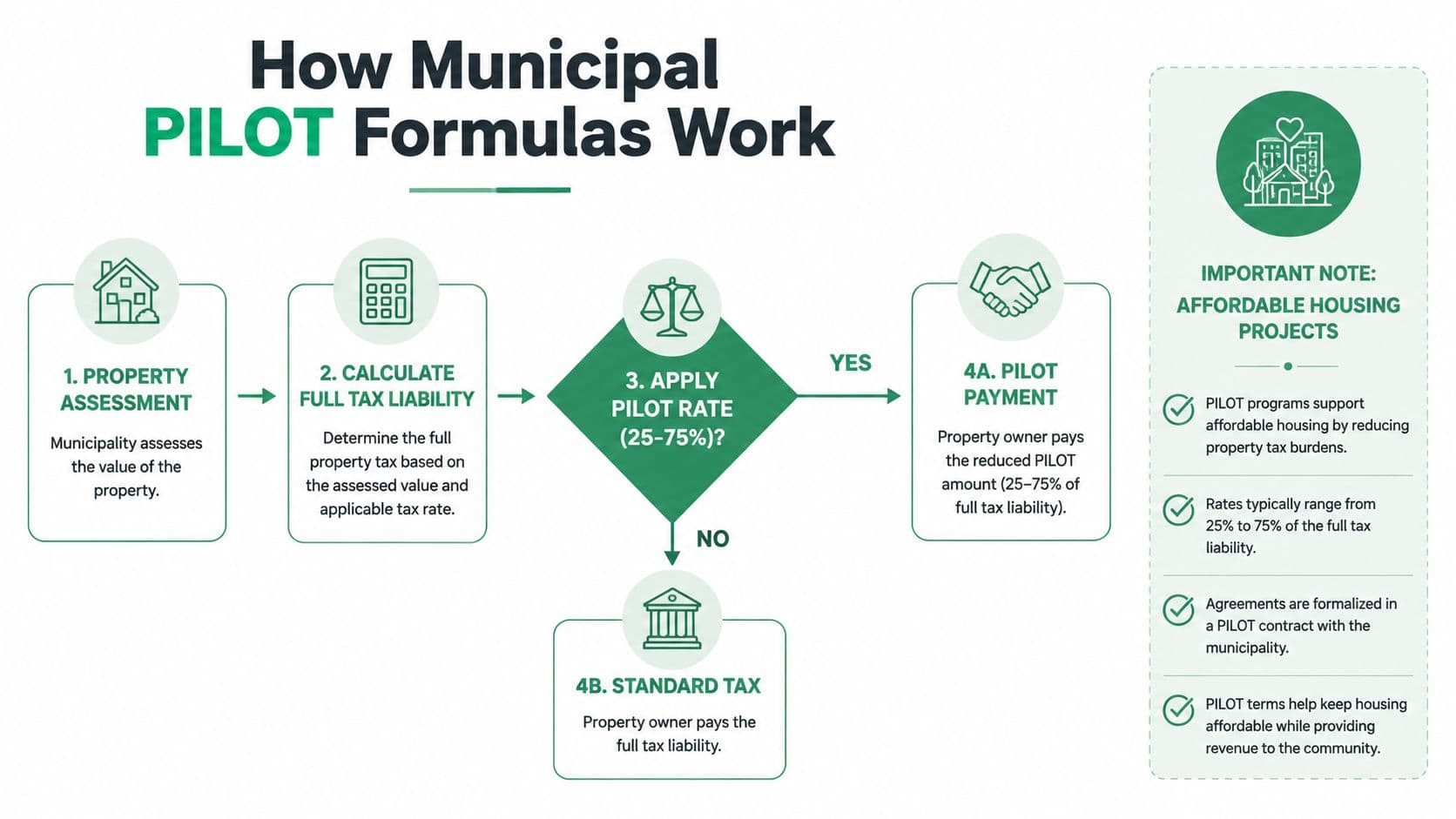
A municipal PILOT usually starts with a counterfactual: estimate the property tax that would apply if the project were taxable, then adjust that amount through a discount, fixed schedule, appraisal method, or statutory proration. New York City describes PILOTs as recurring payments made instead of traditional property taxes for exempt projects, with most payments calculated, billed, and collected by the city's finance department (New York City PILOT explanation and comparative analysis).
The counterfactual is useful only if officials define its inputs clearly. Vermont converts the value of state-owned buildings into taxable grand-list value through the local common level of appraisal, applies an adjusted municipal tax rate, and prorates the resulting full PILOT according to available funding. Vermont's FY2025 distributions were $11.48 million.
The formula is only the beginning
Collection and allocation determine who ultimately bears the difference. A property may fall within a municipality, county, school district, and special-purpose authority, each operating under different rates, assessment rules, and legal claims. If the PILOT is collected centrally but distributed differently from ordinary taxes, its headline amount can obscure which governments receive less than the full taxable equivalent.
Connecticut's Tiered PILOT system illustrates how statutory design changes fiscal incidence. Some municipalities receive 33%, 43%, or 53% of the formula amount according to grand-list criteria, while certain nonprofit hospital and higher-education properties receive compensation equal to 77% of foregone local taxes. The comparison is documented in the New York City Independent Budget Office's discussion of Connecticut's PILOT system.
Practical rule: Never approve a PILOT from the municipal ledger alone. Build a parallel account for the county, school district, authorities, and service obligations that would have applied under full taxation.
Accounting classification adds a separate risk. The Government Finance Officers Association reported that proposed GASB guidance examines whether PILOTs qualify as subsidies in proprietary and business-type reporting, depending on the payment's structure and receiving entity (GFOA discussion of proposed PILOT accounting guidance). A payment recorded as “other revenue” can improve cash flow while still representing a concession from the tax base. It can also make comparisons with annually repriced land-use rights less visible, especially when the PILOT schedule does not track changes in site value.
Officials should publish the full-tax counterfactual, PILOT amount, distribution formula, and services that remain publicly funded. Separating land from buildings can show whether a concession is shielding productive improvements or fixing the value of the underlying site. Our guide to calculating land value provides a starting point for that distinction.
Hidden Fiscal Trade-Offs Behind PILOT Incentives
A PILOT can support a project that wouldn't proceed under ordinary taxation, but that conclusion requires evidence about the counterfactual. If the project would have proceeded without the discount, the PILOT doesn't create development. It transfers part of the project's tax obligation to other taxpayers or public providers.
The burden often falls outside the negotiating room. A municipality may approve a project while a county provides services under a separate budget, and a school district may have no direct role in setting the payment. The result is a fiscal bargain in which the government granting the incentive receives visible investment while another government absorbs the foregone revenue.
A PILOT is not a free benefit. It's a choice about who receives the discount and who finances the remaining public obligation.
Appreciation creates the quiet cost
A fixed schedule can protect a developer from rising assessments, but it also prevents the public sector from sharing fully in land-value appreciation. That matters when a project benefits from public infrastructure, zoning capacity, transit access, or broader neighborhood growth. The public sector may continue paying for services while its revenue remains tied to an outdated base.
The contrast with annually repriced land-use rights is direct. A recurring land charge can respond to changes in site value without taxing the construction or operation that uses the site productively. Fixed leases postpone the adjustment, and PILOTs can reproduce the same delay when their payment schedule ignores reassessment.
Distribution also matters. Large developers, hospitals, universities, and major energy projects can negotiate complex agreements. A small enterprise usually faces the published millage rate and ordinary assessment process. That asymmetry can make a PILOT program look neutral in aggregate while favoring entities with the legal, financial, and political capacity to seek special treatment.
Affordability mandates deserve the same scrutiny. A project can include designated units without demonstrating that the overall land subsidy is proportionate to the public benefit. Officials should test household eligibility, rent restrictions, duration, operating compliance, and the opportunity cost imposed on schools and counties. The fiscal impact analysis resource can help structure that comparison without treating the PILOT payment as the entire fiscal outcome.
Designing Payments in Lieu of Taxes for Land-Value Capture
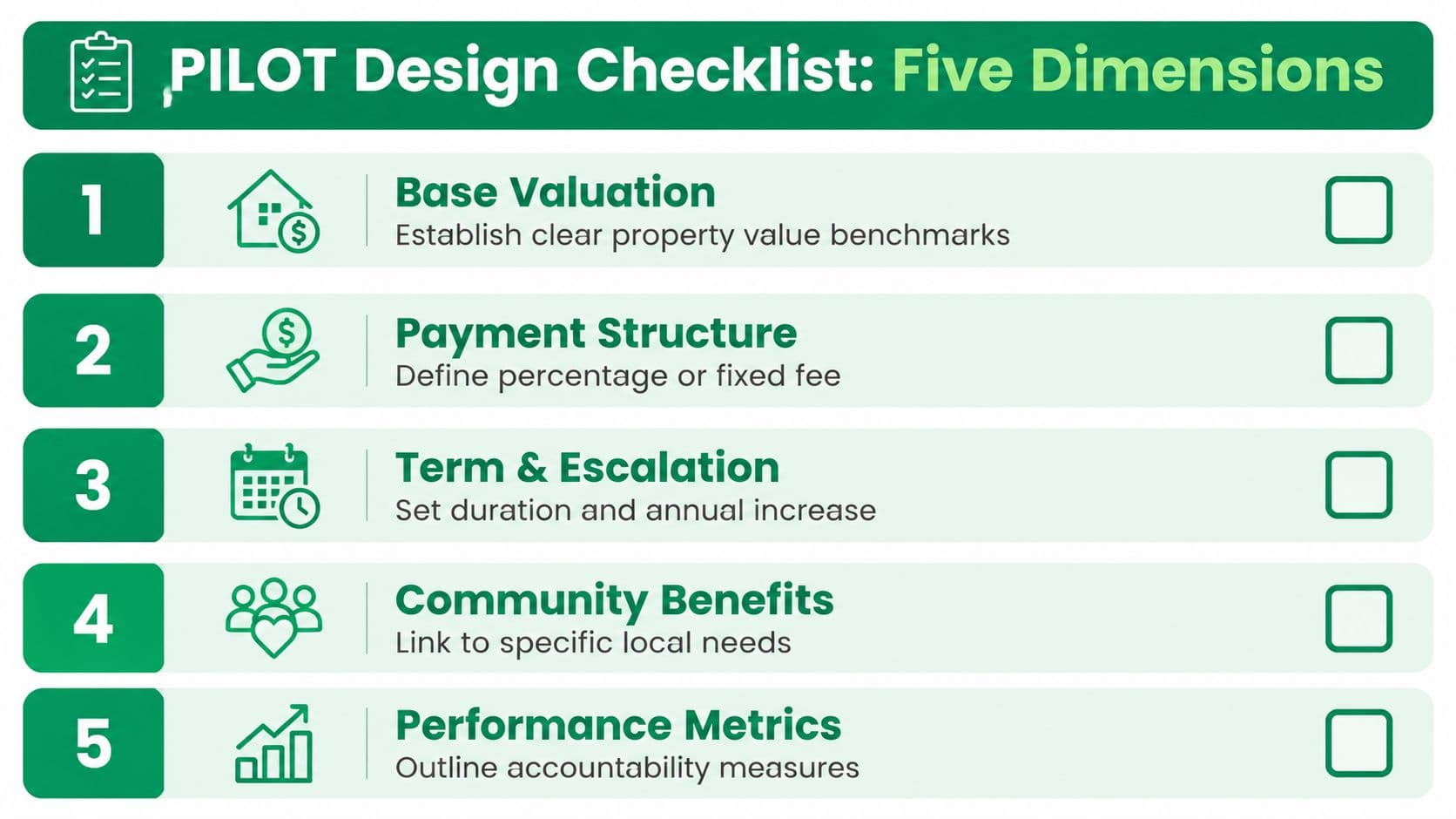
A defensible PILOT should begin with a written design standard, not a negotiated number. Policymakers need to specify what value is being measured, which public costs remain, and how the payment changes when the land or project changes.
Five design decisions
-
Base valuation: Decide whether the payment uses assessed property value, a land-residual appraisal, a statutory proxy, or a combination. A land-residual method can separate site value from improvements, which matters if the policy aims to avoid penalizing construction.
-
Escalation: State whether payments rise under a fixed schedule, a CPI-linked rule, or periodic reappraisal. A fixed schedule is easy to administer but can drift from land-market conditions. Reappraisal is more responsive but requires reliable assessment capacity.
-
Revenue sharing: Write the allocation among municipality, county, school district, and special authorities into the agreement. Don't let distribution become an afterthought once the project has been approved.
-
Performance protection: Tie benefits to measurable obligations, such as construction, occupancy, affordability, environmental performance, or job commitments. Add sunset and clawback provisions for non-performance.
-
Tax-system integration: Decide how the PILOT interacts with a conventional property tax, a split-rate system, or a broader land-value charge. Without this step, a temporary PILOT can become a permanent parallel tax regime.
Model before approving
A revenue model should test absorption, valuation, discount rates, timing, and hold periods. Net-present-value comparisons are especially important when one option produces an upfront lease receipt and another produces recurring land charges. Scenario analysis should show what happens when land values rise, construction is delayed, occupancy changes, or a project exits earlier than expected.
Stakeholder engagement is a fiscal control, not public-relations decoration. Assessors can test the valuation method, bond counsel can identify pledge and disclosure issues, and community representatives can challenge whether promised benefits match local needs. Early consultation can also expose conflicts between municipal incentives and county or school-district obligations.
PILOTs can serve as transitional tools while governments move from taxing buildings and transactions toward charges on location value. The policy objective should be explicit: capture a share of land rent while allowing labor, construction, and productive capital to operate without additional penalties. The land-value capture guide provides a framework for comparing these instruments.
International and Municipal Precedents Worth Studying
The strongest precedents reveal no universal PILOT model. They show how payment design follows ownership, assessment practice, and the division of fiscal responsibility among governments.
The federal PILT program illustrates a transfer system rather than a negotiated land-rent charge. Payments use statutory formula factors for tax-exempt federal holdings, which standardizes treatment but does not reprice payments with local land values or service costs. For FY2025, the Department of the Interior reported about $644.8 million paid to more than 1,900 local governments across 49 states, the District of Columbia, Guam, Puerto Rico, and the Virgin Islands (Department of the Interior FY2025 PILT information). A separate review of the program describes cumulative payments since its creation in the late 1970s as roughly $9.2 billion in current dollars (the Lincoln Institute's comprehensive report on PILOTs). The accounting risk is easy to miss: a formula can deliver predictable cash while leaving the relationship between payment, site value, and local service burden opaque.
Municipal precedents expose different allocation choices. New York City uses recurring payments for exempt projects, while Vermont converts taxable value through an appraisal method and prorates funding. Connecticut's tiered system varies reimbursement by municipality and exempt property type, shifting fiscal incidence across local governments. New Jersey's 2025 law tightened county collection and reporting for long-term PILOTs, demonstrating that administration and intergovernmental accountability can become legislative matters.
New Taipei City provides a useful comparison, not a direct template. Its recurring land-value charge links public revenue to assessed land value through annual reassessment. That mechanism limits the repricing gap created when a fixed lease or fixed PILOT remains unchanged as surrounding land appreciates. The transferable principle is the valuation cycle, not the legal form. Annual repricing can also reveal whether a productive enterprise is being charged for site value or indirectly penalized through taxes on buildings, equipment, or operations.
| Jurisdiction | Program Type | Valuation Basis | Term Length | Key Outcome |
|---|---|---|---|---|
| United States federal government | Federal PILT | Statutory formula for tax-exempt federal lands | Annual appropriations and formula cycle | Transfers revenue to local governments affected by federal land ownership |
| New York City | Municipal PILOT | Tax-equivalent calculation for exempt projects | Project-specific | Centralized calculation, billing, and collection |
| Vermont | State PILOT | Building value converted through appraisal methodology | Annual distribution framework | Full PILOT is prorated to available funding |
| Connecticut | Tiered municipal PILOT | Formula amount adjusted by municipal and property criteria | Statutory framework | Reimbursement varies by municipality and property type |
| New Taipei City | Recurring land-value charge | Taxable land value and standard land value | Annual reassessment | Keeps the charge connected to changing land values |
Model legislation should disclose the full taxable equivalent, payment schedule, valuation method, recipients, service effects, and performance conditions. Independent valuation panels can constrain political overrides. Annual compliance reports can show whether a project still satisfies its public-purpose rationale and whether counties, schools, and other service providers receive adequate compensation. These safeguards require administrative capacity, but opaque agreements can conceal fiscal exposure until debt obligations, land values, or project conditions have changed.
Moving From Ad Hoc PILOTs to Transparent Land Charges
Ad hoc PILOTs create three problems at once. They obscure the public subsidy, encourage jurisdictions to compete through private negotiation, and shift costs toward counties, schools, and service providers that may not control the agreement. A payment can be lawful and cash-positive while still leaving the public sector underpaid for the land value and services supporting the project.
A transparent, annually repriced land-use charge offers a different relationship. The charge remains visible, responds to changing site value, and can be shared among the governments that provide services. It also separates land rent from the return to labor and capital, which is central to tri-factor economics. Productive improvements shouldn't face a larger burden merely because a public policy has failed to distinguish the value of the site from the value created by construction or enterprise.
The transition can be practical:
- Audit existing PILOT agreements and publish their full-tax counterfactuals.
- Add sunset provisions to new agreements rather than allowing automatic continuation.
- Pilot annual repricing in one district with independent valuation review.
- Publish shadow accounts showing what full-value land charges would produce.
- Use on-budget appropriations for deliberate development subsidies.
Fiscal honesty requires a clean distinction between revenue and subsidy. If a jurisdiction wants to support housing, redevelopment, or a strategic industry, elected officials should appropriate that support openly instead of hiding it inside a discounted tax substitute.
Unitism® offers land valuation, fiscal-impact modeling, and implementation support for governments comparing PILOTs with transparent land-value charges. Visit Unitism® to examine policy design, distributional effects, and practical transition paths for sharing land rent while reducing reliance on taxes that burden work and productive capital.