Explore value capture vs value creation in land policy, with clear comparisons of land leases and land-use rights, real case studies, and reform
August 31, 2026
Value Capture vs Value Creation in Land Policy
Explore value capture vs value creation in land policy, with clear comparisons of land leases and land-use rights, real case studies, and reform
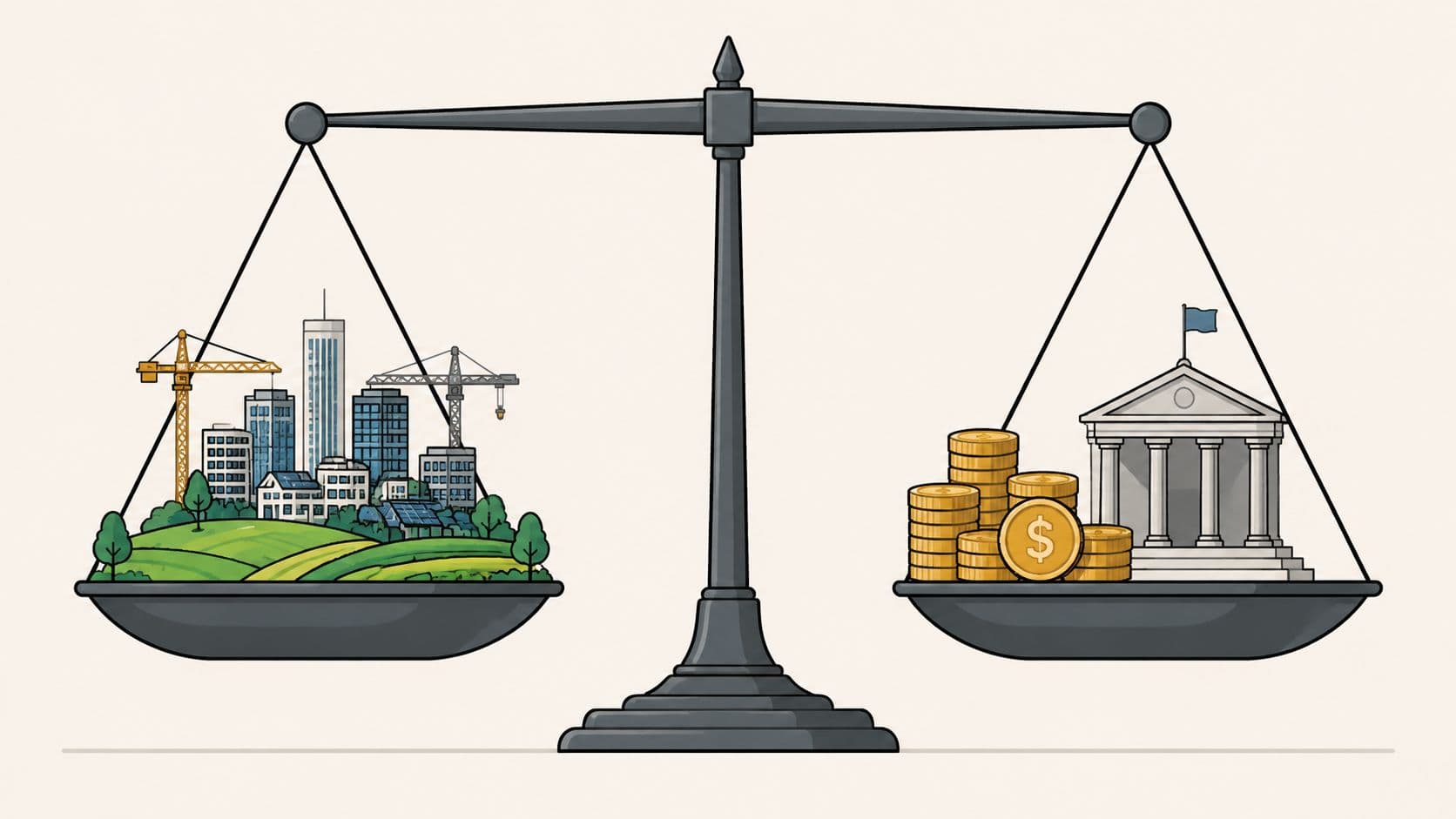
The popular advice around land policy is too blunt. It treats value creation and value capture as if they were the same thing, then wonders why one reform spurs development while another freezes it. They're different tasks, and the distinction matters most when governments are deciding whether to tax movement, tax improvement, or price land in a way that doesn't punish work.
| Dimension | Value Creation | Value Capture |
|---|---|---|
| Core question | Who adds productive value? | Who receives the uplift that value and public action generate? |
| Main driver | Labor, capital, enterprise, infrastructure, ecosystem improvement | Fiscal and regulatory tools that recover some of the unearned locational rent |
| Best outcome | More useful land, better buildings, stronger businesses | Public revenue or social benefit without discouraging productive investment |
| Policy risk | Under-investment if rewards are weak | Mispricing risk if the wrong instrument defers repricing |
The difference is not academic. A city can create value through a transit line, a rezoning decision, or a public park, and still fail to capture any of the uplift that follows. It can also capture revenue through a one-time charge while leaving future risk hidden inside a lease structure that explodes later. That's why analysts should ask a sharper question than “How do we capture value?”, they should ask what kind of value is being created, who created it, and how often the land price is reset.
A practical policy lens helps here. In management research, value creation and value capture can be separated analytically by comparing created surplus with realized returns, which makes the distinction measurable rather than rhetorical (Harvard Kennedy School framework on value creation and capture). In land policy, the same logic applies, except the uplift often comes from public decisions rather than private effort. For a concise primer on the land-economics baseline, see Unitism's land economics overview.
Table of Contents
- What Value Creation and Value Capture Mean
- How Land Economics Shaped Modern Capture Tools
- Land Leases vs Land-Use Rights Compared
- How to Tell a True Land-Use Right from a Fixed Lease
- Case Studies from Denmark, Singapore, Hong Kong, and Estonia
- What Capture Instruments Mean for Housing and Public Revenue
- Recommendations for a Phased Land-Value Reform
- Frequently Asked Questions for Policymakers
What Value Creation and Value Capture Mean
Policy debates often blur a productive gain with a claim on that gain. That confusion leads to poor design. A road, zoning change, or station upgrade can raise the usefulness and market value of nearby land, but the landowner did not create all of that uplift. Public action and private investment together changed the asset's position.
Two different economic events
Value creation is the productive act. Builders add structures, entrepreneurs open businesses, engineers improve access, and planners shape the surrounding environment. The result is a site that can support more activity, more utility, or more output than before.
Value capture is the separate question of how a public authority or community recovers part of the rent that comes from scarcity, location, or collective action. The distinction matters because the same policy can support one while weakening the other. A recurring land charge can recover a share of uplift without discouraging construction, while a transaction tax adds friction each time ownership changes. If the land charge is tied to annual assessment, it can track location value continuously instead of waiting for a sale or renewal event.
Practical rule: if a policy improves the asset but delays repricing for years, the gain is created now and captured later, often in a lump.
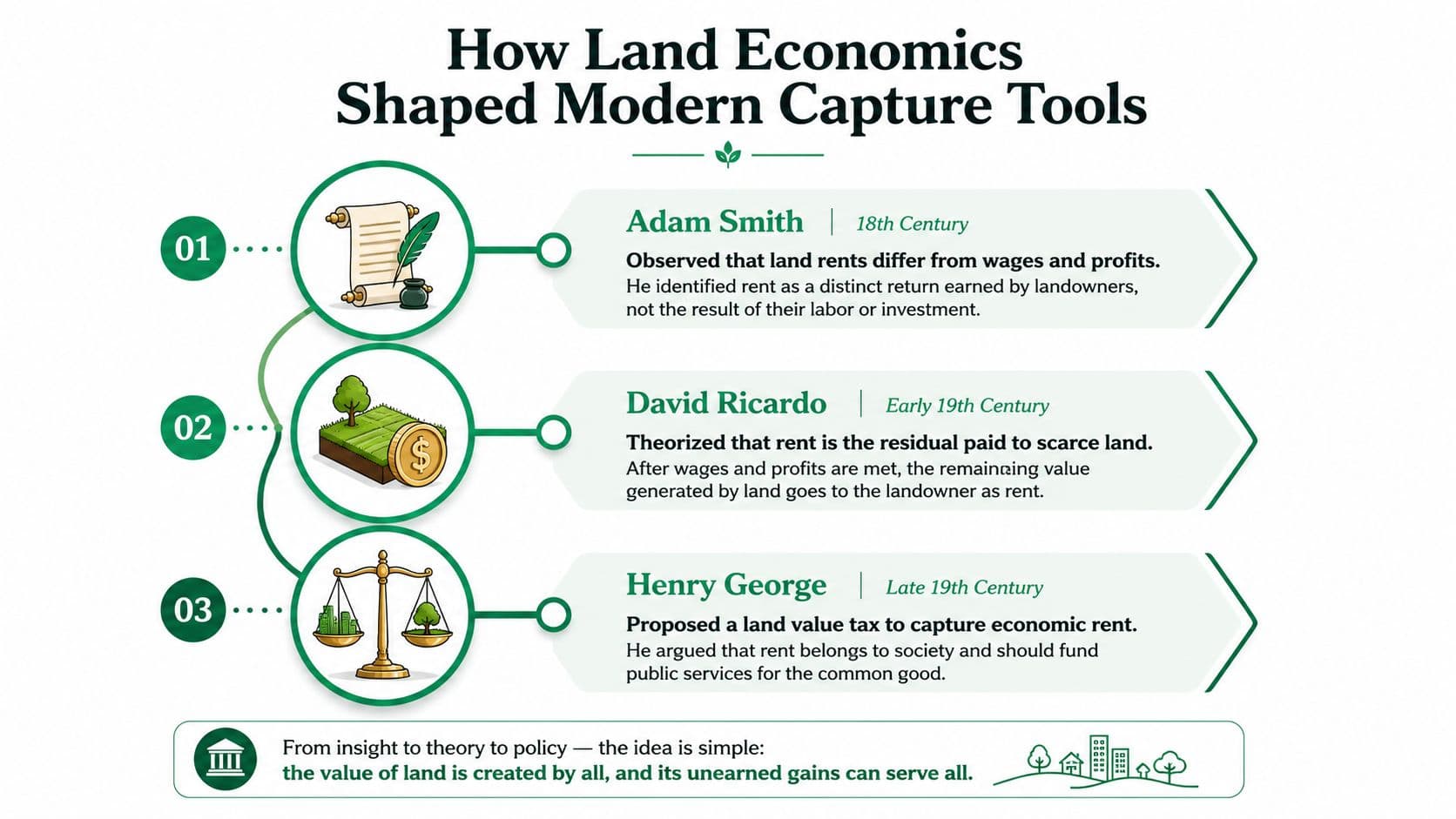
The idea has a long history. Classical economists such as Adam Smith, David Ricardo, James Mill, and John Stuart Mill treated land rent as a product of scarcity and social progress, not the owner's labor. That line of thought later shaped twentieth-century land-value taxation and betterment taxes, and it still appears in debates over rezoning gains and infrastructure uplift. For a concise land-economics baseline, see Unitism's land economics overview.
Why the instrument matters more than the slogan
A community can capture value by transaction, such as when a premium is paid at a lease modification or sale, or by recurring assessment, such as an annual charge on site value. Those are not interchangeable. Transaction-based capture postpones the fiscal reckoning until someone buys, refinances, or renews. Recurring capture prices the land more like a living asset, with the public claim updated as conditions change.
That difference matters most where policy makers market fixed leases as if they were true land-use rights. A fixed lease may postpone payment and push risk into the future, but it does not reprice land as conditions change. An annually repriced right does. That is why analysts comparing Denmark, Singapore, and Estonia focus less on the label and more on the cadence of repricing.
The broader logic is clear. Value creation can happen without effective capture, and capture can happen without ongoing creation. The first leaves public gains on the table. The second can become a financing trap if the charge is badly timed or locked to a stale valuation. Good policy separates the two, then decides how much uplift to recover and how often to reset the land price.
How Land Economics Shaped Modern Capture Tools
Land policy did not invent these ideas yesterday. It inherited them from land economics. Adam Smith and David Ricardo treated land rent as distinct from wages and profits, and later reformers turned that insight into fiscal tools. The basic logic still holds, if land gains value because surrounding public investment and growth make it more useful, public policy should recover part of that rent instead of leaving the full increment to the titleholder.
From rent theory to fiscal mechanism
The United Kingdom's Land Tax introduced in 1692 was initially based on annual rental values, though after the first valuation no more were carried out. By 1733, taxation on personal income and movable goods had largely been abandoned, leaving the tax almost entirely land-based. Its share of total revenue fell from 35% at the start to 17% in the 1790s and 11% by the 1820s, before the tax was abolished in 1963. The pattern, recorded in a historical UK land tax record, shows how quickly a land-based system weakens when valuation is allowed to go stale.
Later British betterment tools followed the same line of thought. The Land Commission Act betterment levy in 1967 and the Development Land Tax in 1976 were both designed to recoup part of land-value gains created by planning decisions, before being repealed or abolished by 1985. These were not isolated experiments. They were responses to the same policy question, who keeps the rent when public action raises land value?
The core policy issue is never whether value exists. It is who captures the increment when infrastructure, rezoning, or broader growth raises rents.
Modern tools are old ideas in new form
The U.S. Federal Highway Administration describes land value capture as recovering and reinvesting land value increases generated by public investment and government action, and it explicitly notes that value capture requires prior value creation and a plan (FHWA value capture framework). For a plain-language overview of the mechanics, see Unitism's guide to land value capture.
The historical record in the same framework points to Kiauchau, China in 1898, Great Britain in 1909–10, and Jamaica in 1956 as early examples of policy systems trying to recoup socially generated land gains.
If the names change from century to century, the argument does not. Modern land-value taxation, betterment levies, and development charges are all descendants of the same rent theory. The tools differ, but the underlying question remains stable, and so does the political conflict around it.
Land Leases vs Land-Use Rights Compared
A fixed lease and a genuine land-use right can look alike on paper, which is why policy debates blur them so easily. The difference appears in how each one prices risk, handles transfer, and treats time. A lease that expires and must be renewed creates a repricing cliff. A right that is indefinite and repriced annually behaves like a continuously priced land interest.
Side by side
| Dimension | Fixed Land Lease | Genuine Land-Use Right |
|---|---|---|
| Term structure | Expires on a known date | Indefinite, no expiration |
| Repricing mechanism | Fixed at grant, then reset at renewal | Repriced annually |
| Transferability | Trades with a discount because of the remaining term | Transfers more cleanly because there's no forfeiture horizon |
| Risk pricing | Defers risk to the renewal cliff | Prices risk continuously |
| Effect on entrepreneurship | Can burden refinancing and sale near expiry | Better for productive enterprise because the land is kept properly priced |
Why the renewal cliff matters
Renewable leases only look stable until the term ends. At that point, the gap between market value and the old lease rate closes at once, often through a major repricing. Non-renewable leases create a different problem, because refinancing and sale become harder as expiry approaches. In both cases, the lease postpones risk instead of pricing it.
That is why the legal label matters less than the mechanics. Some instruments are sold as “land-use rights” even though they are fixed leases with a different name. If the instrument expires, needs renewal, and is not repriced each year, it does not function as a true land-use right for enterprise.
Practical rule: annual repricing is not a tax trick. It stops location risk from building into a refinancing shock.
The distinction also helps explain why annual pricing supports productive use. A buyer or lender can assess a site when the carrying cost is transparent and stable. A developer cannot build a long-term business on an asset that looks fixed for decades and then resets at the end of the term. The problem is financial as much as legal.
For a closer look at the lease model often used in public debate, see Unitism's guide to 99-year land leases.
How to Tell a True Land-Use Right from a Fixed Lease
A genuine land-use right is usually easier to spot in practice than in marketing. The label matters less than whether the instrument prices land continuously and leaves productive users without a renewal cliff. For a closer explanation of the term itself, see understanding what qualifies as a genuine land-use right.
The six-question test
- Does the land price reset every year? If not, the system is deferring repricing.
- Can the right be transferred and used as reliable collateral? Weak transferability usually means the market is discounting expiry risk.
- Does the term ever end? If a renewal is required, the holder is facing a future valuation cliff.
- Is the fee structure transparent? Hidden premiums and discretionary renegotiation make planning harder.
- Is rent separated from capital value? If the price of land is bundled with improvements, the system risks taxing construction instead of site value.
- Who is accountable for service delivery? If public services are supposed to justify the charge, there has to be a clear institutional link.
A true land-use right scores well because the annual rent is visible, the term does not expire, and the holder can plan without treating renewal as a speculative event. A fixed lease can look similar on paper, but it fails the continuity test. The legal form may be neat, while the economics still penalize long-horizon investment.
The simplest filter is this. If the holder must think about refinancing or renegotiating because the term is running down, the right is behaving like a lease.
The same diagnosis applies to the cases policymakers keep citing. A 99-year Hong Kong lease fails on repricing and term. A 50-year Estonian residential right fails on transferability limits. A Danish municipal ground-rent contract fits the annual assessment model better because the rent is tied to land-value assessments rather than to a one-time grant. That is why understanding what qualifies as a genuine land-use right matters in Copenhagen, Tallinn, and Singapore. The legal vocabulary changes, but the incentive effects do not.
Case Studies from Denmark, Singapore, Hong Kong, and Estonia
The strongest reforms do one thing well. They price land in a way that does not push users toward a future cliff. The weaker ones postpone the problem and then describe that delay as caution. The difference matters for housing, for finance, and for whether public value is recycled into infrastructure or locked inside titles. For a closer look at the design choices behind these systems, see a deeper look at land-use policy design.
| Jurisdiction | Instrument | Term | Repricing Mechanism | Share of Public Revenue | Equity Outcome |
|---|---|---|---|---|---|
| Denmark | Municipal ground rents | Ongoing | Tied to land-value assessments every two years | Not specified in verified data | More stable capture, better alignment with public services |
| Singapore | Leasehold land and recurring property tax | 99-year leasehold on much state land | Auction-determined premiums, plus annual property tax tied to market rent | Not specified in verified data | Recovers uplift through both entry pricing and recurring charges |
| Hong Kong | Lease premium, property rates, government rent | Mixed leasehold structure | One-time premium for lease modification, recurring annual charges on rateable value | Not specified in verified data | Captures value, but with more reliance on fixed-term pricing |
| Estonia | Residential and commercial land-use rights with limits | Varies by right | Limited transfer rights and constrained market behavior | Not specified in verified data | Rights can behave like leases when repricing is weak |
Denmark and Singapore, closer to annual repricing
Denmark is the cleaner example of a ground-rent system tied to land-value assessments, which is exactly what a serious capture regime should do. Regular reassessment keeps the public claim linked to current conditions rather than to an old grant price. That makes the charge easier to defend because it follows the site, not the building.
Singapore uses a different mix. It relies on leasehold land with auction-determined premiums, and its annual property tax adds a recurring charge tied to market rent (Hong Kong comparison source also noting Singapore's structure). That combination captures value both at entry and through ongoing assessment. It is often read as a disciplined way to keep public and private incentives aligned.
Hong Kong and Estonia, capture without full repricing
Hong Kong's one-time land premium gives the government a direct way to recoup value when a lease is modified, but the system still rests heavily on fixed-term pricing. The annual property rates and government rent help, yet the core lease structure still creates a different risk profile from an annualized right.
Estonia sits in another category. Its rights can be legally constrained in ways that make them behave more like leaseholds than indefinite land-use rights. That is the point that gets lost when fixed leases are marketed as if they were continuous rights.
The common lesson is straightforward. Where repricing is continuous, speculation is harder to bank on. Where repricing waits for renewal, the asset carries a hidden calendar risk that markets eventually price in.
What Capture Instruments Mean for Housing and Public Revenue
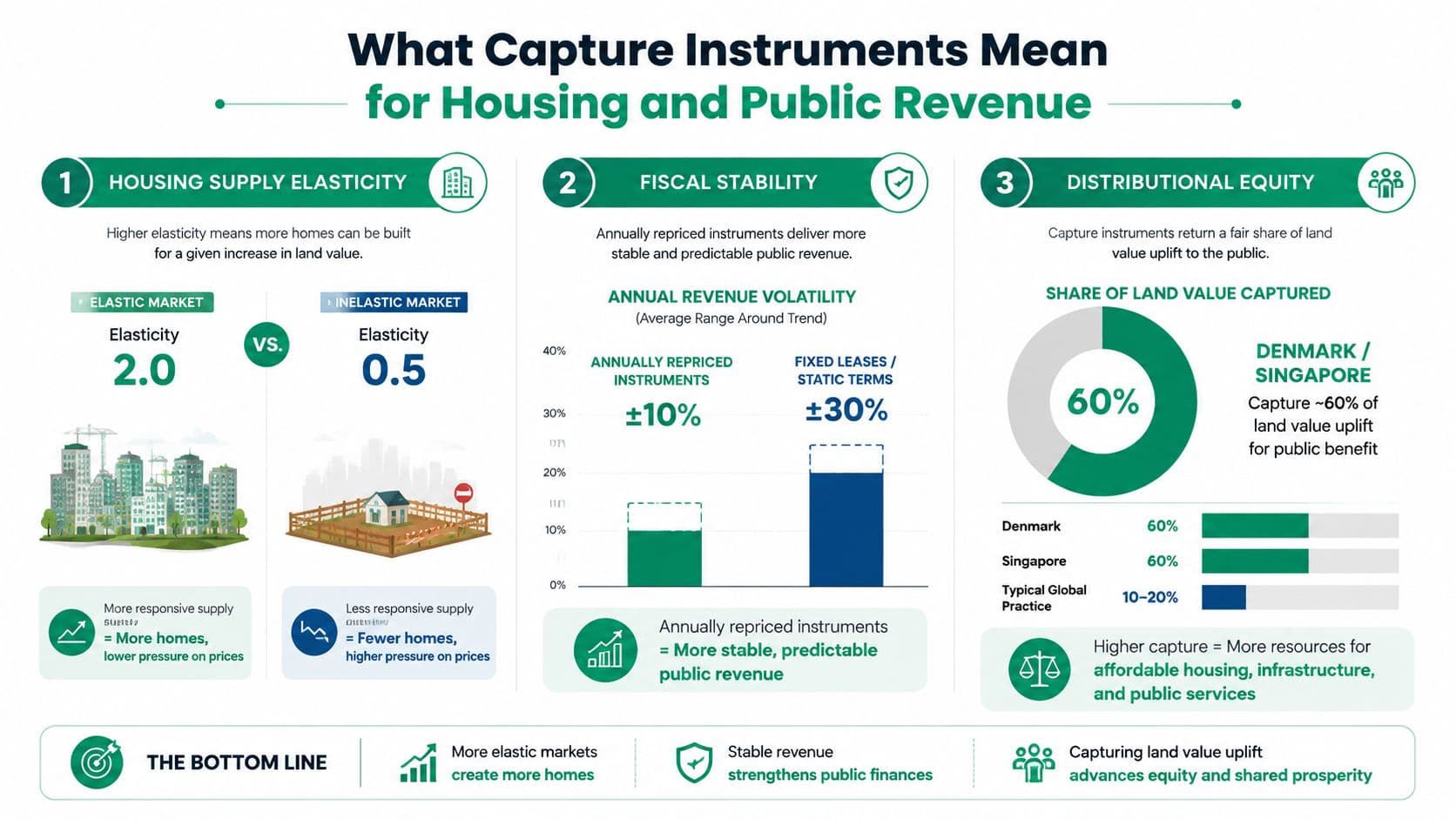
The policy argument gets sharper when you look at how instruments shape housing delivery, fiscal steadiness, and distributional fairness. If the land price is reset continuously, developers and owners can't base their strategy on a future windfall that arrives at renewal. That changes behavior before the first shovel hits the ground.
Three transmission channels
Housing supply. When land is annually repriced, holding idle sites becomes less attractive. That tends to support steadier development pipelines because owners can't wait for the lease cliff or a speculative uplift event to decide when to build. Fixed-lease systems, by contrast, often encourage timing games near expiry.
Fiscal stability. Mature capture regimes can produce recurring public revenue in ways that are more stable than once-off lease events. The verified data here doesn't give a universal cross-country percentage for public revenue, so the right conclusion is qualitative, annual repricing typically smooths receipts better than episodic renewals.
Distributional equity. Recurring charges tend to fall more heavily on speculative holders than on active users when exemptions are designed carefully. That's because people sitting on underused land carry the cost of delay, while households and productive users who occupy and improve sites are less likely to bear the burden in the same way.
Policy insight: capture revenue is strongest when it is visibly recycled into the infrastructure that raised land value in the first place.
The bigger point is that design determines whether land reform supports housing or just rearranges ownership claims. Denmark and Singapore show the advantage of recurring repricing. Hong Kong and Estonia show what happens when the system relies more on fixed terms and delayed adjustment. The public still captures something, but the timing of capture changes the behavior of owners, lenders, and builders.
If you want the reform to produce both housing and revenue, don't start with the slogan. Start with the repricing schedule. That's where the key policy influence lies.
Recommendations for a Phased Land-Value Reform
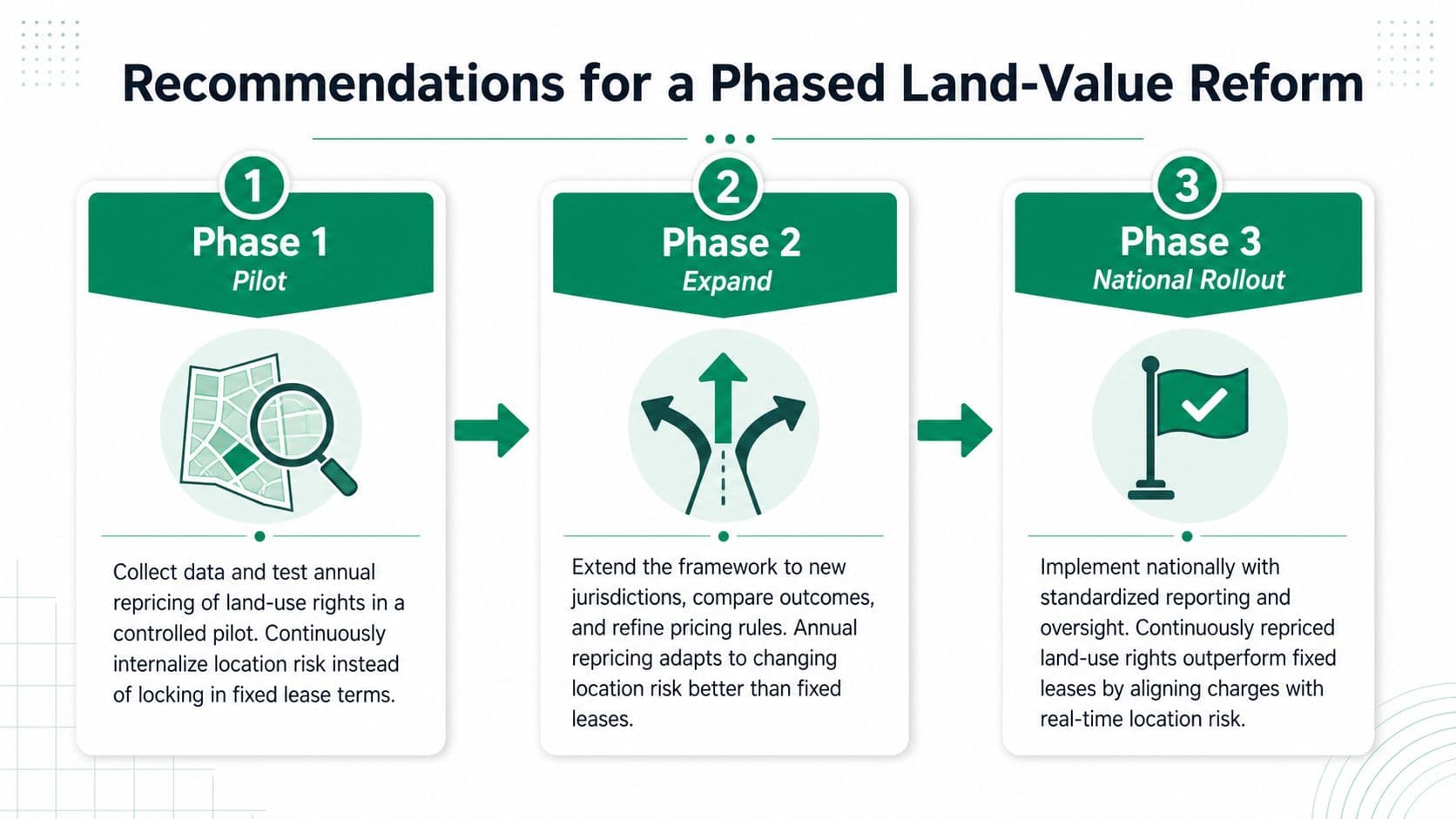
A serious transition shouldn't begin with a sweeping legal overhaul. It should begin where the valuation system is most legible and the political risk is lowest. That gives investors a clear signal, while giving government a path to improve pricing without triggering a sudden shock.
A phased sequence
- Pilot one municipality. Use a transparent valuation method and publish the assumptions.
- Build the register. List state and municipal land in a cadastral system that the public can inspect.
- Convert expiring ground leases. Move them into indefinite use rights with annual reassessment tied to a published index.
- Ring-fence revenue. Put the captured funds into infrastructure and affordable housing so residents can see the return.
- Create an appeal path. Independent tribunals reduce fear of arbitrary assessment and protect tenure.
This order matters because it separates administrative learning from political commitment. A pilot shows whether the valuation method is trusted. A register makes the base visible. Conversion of expiring leases reduces renewal shocks. Ring-fencing revenue helps the public connect the charge to a tangible benefit.
Unitism® fits naturally in that work because it provides land valuation assessments, policy design for land-value capture instruments, and implementation support for transition planning and stakeholder engagement. Used well, that kind of support helps a municipality move from theory to administration without pretending the valuation problem can be solved by rhetoric.
The central judgment is straightforward. Annually repriced land-use rights are better for productive enterprise than fixed leases because they internalize location risk continuously instead of deferring it to renewal. That makes land cheaper to buy and sell in practical terms, because the market isn't pricing a hidden expiry shock into every transaction.
Frequently Asked Questions for Policymakers
How do we start without alarming current leaseholders? Begin with voluntary pilots and convert only expiring leases first. That preserves continuity, gives officials time to build valuation credibility, and avoids forcing every holder into a sudden repricing event.
What if land transactions are thin and valuations are hard? Use cadastral data, published assessment methods, and a clear appeal process. Thin markets call for better administrative capacity, not frozen pricing.
Does annual ground rent deter investment? It usually deters speculation more than productive building. The user can model a recurring land charge more easily than a renewal cliff hidden inside a long lease term.
How do we handle compensation rules and constitutional limits? Work within existing compensation clauses by separating private improvements from socially created land uplift. The historical betterment idea, and later UK instruments, show that governments have long recovered part of the gain without treating all property value as untouchable.
If you are weighing land reform, ask whether the system prices land continuously, protects productive users, and turns public uplift into visible public benefit. Unitism® works on these questions through valuation methods, policy design, and implementation support for land-based reform. Visit Unitism® policy support for land reform to explore a phased land-value approach for your city or agency.