Understand development impact fees, their legal basis, calculation methods, and equity impacts. Learn how they compare to land-value capture tools and best
September 2, 2026
Development Impact Fees Explained for Public Policy
Understand development impact fees, their legal basis, calculation methods, and equity impacts. Learn how they compare to land-value capture tools and best

The most popular advice about development impact fees is too simple: abolish them because they raise housing costs. That recommendation confuses a poorly designed fee with the entire policy instrument. A fee can price growth-related infrastructure responsibly, or it can function as an opaque surcharge that delays projects, penalizes smaller homes, and undermines affordable housing. The difference lies in the nexus, the calculation, the exemptions, and the speed with which a city turns collected revenue into usable infrastructure.
Municipal officials should ask a harder question than whether fees raise prices. They should ask when fee design changes project mix, approval speed, land prices, and housing supply. The answer determines whether a fee program funds serviced growth or becomes another barrier to building.
Table of Contents
- Rethinking Development Impact Fees Beyond Cost Burdens
- Legal and Economic Rationale for Impact Fees
- How Impact Fees Are Calculated and Where Revenue Goes
- Comparing Impact Fees to Alternative Land-Value Capture Tools
- Distributional and Fiscal Impacts on Housing Markets
- International and Local Precedents for Impact Fee Design
- Implementation Steps for Public-Sector Audiences
Rethinking Development Impact Fees Beyond Cost Burdens
Development impact fees are often presented as unambiguously anti-housing. That conclusion is too blunt for public policy. Fees can increase development costs, but they can also help a city provide the roads, water systems, sewer capacity, parks, and other facilities that make additional homes possible. If new projects face uncertain infrastructure obligations, developers may avoid sites altogether. A transparent, predictable fee can be easier to finance than an improvised negotiation during permitting.
The incidence also depends on local land-market conditions. Where buyers have few alternatives and landowners can capture part of the value created by development permission, fees may pass through into higher sale prices and lower residual land prices. Where infrastructure financing is the principal obstacle and the fee schedule makes approvals more predictable, the same instrument may support construction rather than suppress it.
The relevant question is project mix
Empirical work in Florida found that some non-water and non-sewer impact fees were associated with more suburban construction, particularly for small and medium homes, suggesting that fees can be pro-housing under specific land-market and permitting conditions. The finding doesn't mean every fee promotes supply. It means officials shouldn't assume that a fee's existence proves that it reduced construction. The Florida evidence on impact fees and suburban construction points toward a more useful policy test, namely whether the fee removes an infrastructure constraint, improves certainty, or merely adds cost without expanding service capacity.
A city should therefore evaluate fees against actual development decisions:
- Approval speed: Does a published schedule reduce negotiation and uncertainty?
- Service capacity: Will collected revenue deliver facilities needed for the permitted growth?
- Substitution options: Can builders move to another site, jurisdiction, housing type, or project scale?
- Project economics: Does the charge make a marginal affordable or infill project infeasible?
- Timing: Does payment at permit issuance create a financing problem before revenue begins?
Policy test: A fee is defensible when it connects a defined growth impact to a defined facility response. It is destructive when the city uses it as general-purpose revenue.
Waivers can be more important than headline rates
Affordable housing needs a different treatment from speculative or high-margin development. A full waiver, partial waiver, deferral, or payment at certificate of occupancy can preserve a project's feasibility while keeping the underlying infrastructure obligation visible. The jurisdiction should publish eligibility rules, require affordability protections where appropriate, and model the fiscal effect before adoption.
The right reform isn't automatically a lower fee for everyone. It is a calibrated schedule that distinguishes service demand, location, unit type, and ability to absorb cost. Officials should measure whether the program produces serviced homes, not merely whether it produces fee receipts.
Legal and Economic Rationale for Impact Fees
Development impact fees can support housing when they replace opaque, negotiated charges with a predictable and properly calibrated funding system. Cities adopted them to address a practical fiscal problem: new growth requires public facilities, while existing residents often resist paying for infrastructure that primarily serves incoming development. A fee assigns part of that growth-related cost to the projects creating additional demand, instead of relying entirely on general revenues.
The policy became widely used in the United States during the 1970s and 1980s. By 2000, about 60% of U.S. cities with more than 25,000 residents imposed impact fees to help fund infrastructure for new growth, according to the Federal Highway Administration's discussion of development impact fees. Adoption shows political appeal, not automatic legality or economic merit. Officials should treat that history as context, then test their own schedule against local housing and infrastructure conditions.
The legal guardrails
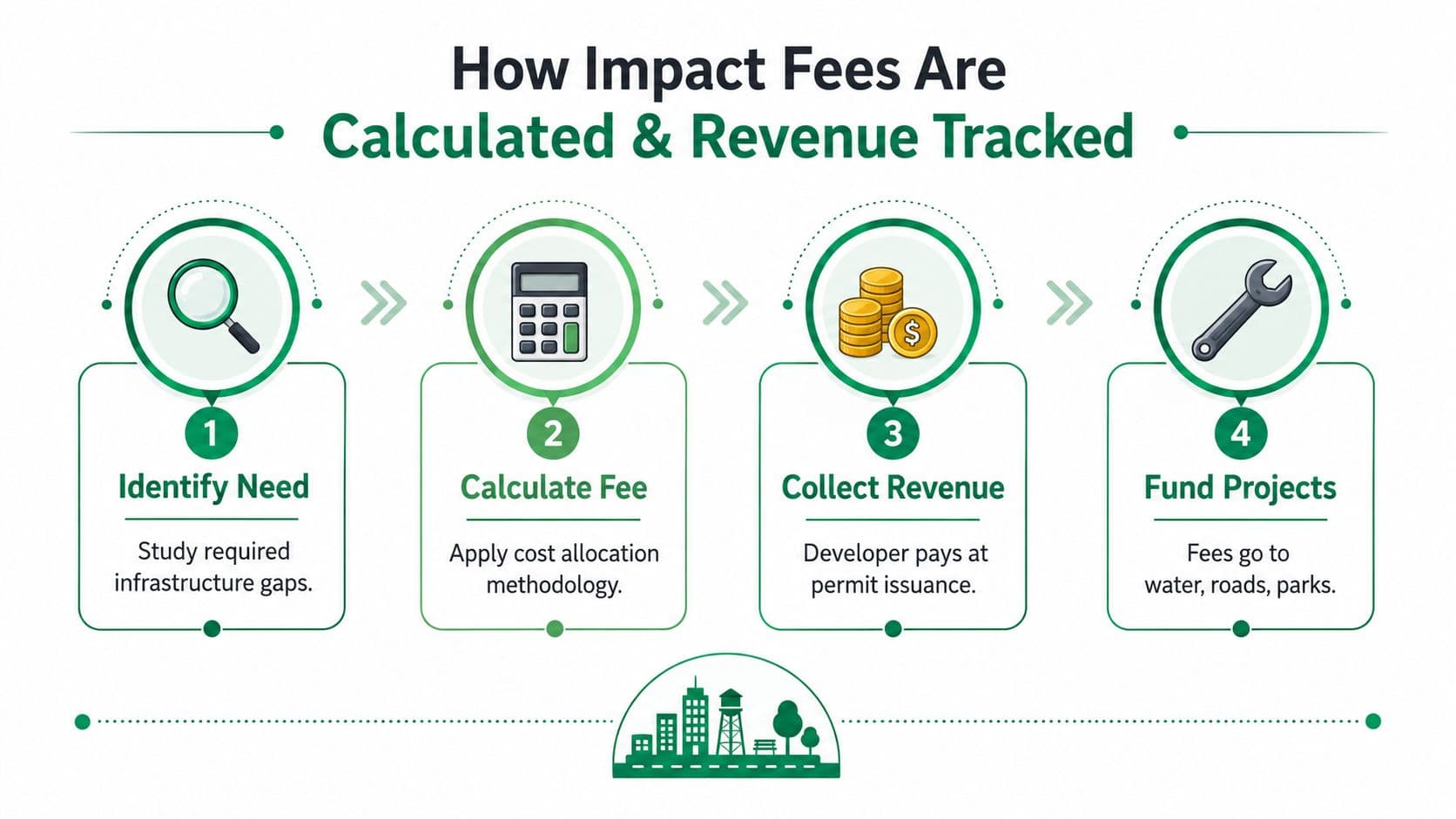
A defensible program needs a rational nexus between new development and the facility need it creates. The charge must also remain proportionate to that impact. A city should not use a development fee to recover unrelated historic deficits, finance broad municipal operations, or make one project pay for benefits serving other users.
Officials should answer four questions before adopting the schedule:
- What facility is needed? Identify the infrastructure gap attributable to projected development.
- Why does this development create the need? Show how the project type affects expected service demand.
- How much should the project pay? Allocate only the share reasonably connected to that development.
- Where will the money go? Establish a restricted account, eligible projects, reporting procedures, and a delivery schedule.
The fee study must be readable to elected officials, applicants, residents, and a reviewing court. A complicated methodology cannot replace evidence. For broader context on the relationship between sites, improvements, and public finance, consult Unitism's overview of land economics.
The economic logic has limits
Impact fees can assign some growth costs to the development creating them, but they also affect land prices, project timing, and the distribution of gains among owners, builders, buyers, and existing taxpayers. A uniform charge can burden smaller units, infill projects, or lower-margin housing more heavily than high-value development. Use separate schedules, exemptions, partial waivers, or payment deferrals where service demand and public priorities justify them.
Administration matters as much as the rate. A city that collects a fee but fails to reserve the money for the promised facility creates legal exposure and weakens public trust. The sound policy is to charge only for documented marginal infrastructure needs, protect clearly prioritized housing, and publish the evidence before adoption. Measure success by serviced homes and delivered facilities, not fee receipts alone.
How Impact Fees Are Calculated and Where Revenue Goes
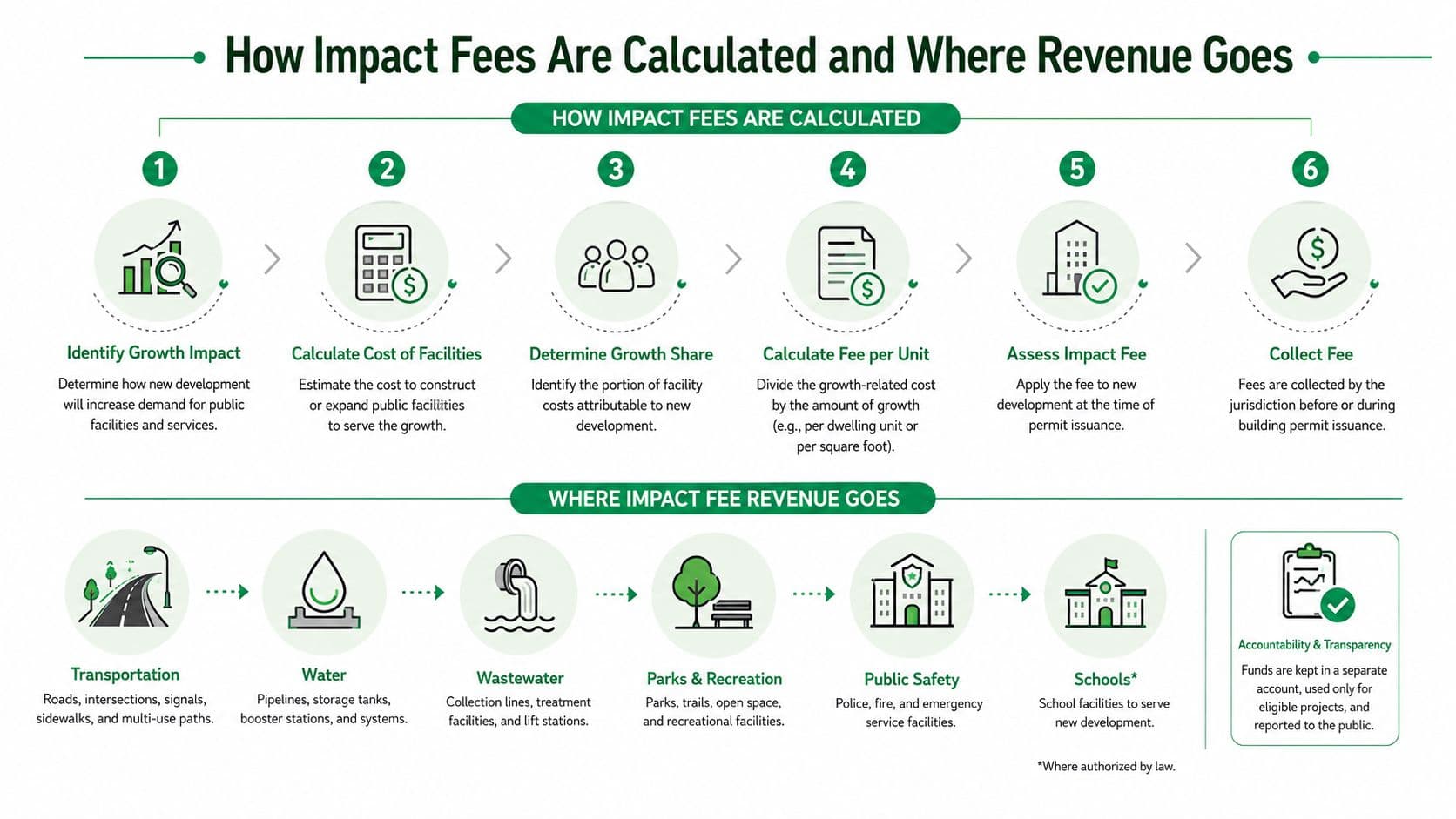
A fee schedule should start with service demand, not a revenue target. Staff must identify planned growth, existing capacity, and the facilities needed for additional residents, workers, vehicles, or users. The study then assigns eligible costs to development categories and converts those allocations into charges applicants can understand.
The calculation must separate new capacity from maintenance of existing service. A subdivision may require expanded sewer capacity or a road connection, but it should not finance replacement of aging assets that serve the established community. Charge new development for documented growth-related needs, then test whether the schedule supports the housing types the city wants to add.
A practical calculation sequence
A municipal fee study should follow a clear sequence:
- Define the service unit: Use a defensible measure such as dwelling units, floor area, vehicle trips, water demand, or student generation.
- Inventory capacity: Document current facilities, committed projects, available capacity, and adopted service standards.
- Forecast growth demand: Estimate how each land-use category will affect the relevant system.
- Allocate eligible costs: Assign only the growth-related share to new development, with credits for facilities already funded by applicants or other revenues.
- Set the schedule: Translate the allocation into charges by use, location, and project type.
- Test feasibility: Apply the schedule to representative residential, commercial, infill, multifamily, and affordable projects.
Publish the assumptions with the fee. If staff change a service standard, project list, cost estimate, or land-use classification, show the effect on each applicant category. Use exemptions, partial waivers, or deferrals where lower-cost housing or smaller infill projects face disproportionate burdens and the public purpose supports relief.
Revenue categories need discipline
Communities commonly apply impact fees to sewer facilities, water facilities, roads, parks and recreation, and schools. A national survey reported shares of 36.6% for sewer, 33.5% for water, 30.8% for roads, 30.8% for parks and recreation, and 13.5% for schools, as documented by the Federal Highway Administration. Those figures describe common uses, not permission to charge every project for every public facility.
Revenue controls determine whether the program remains credible. Track collections, expenditures, balances, project commitments, and delivery status in a restricted account and public dashboard. Update construction costs and development assumptions on a regular schedule, while giving applicants enough stability to underwrite projects. Officials estimating the underlying site component can consult Unitism's guide to calculating land value. Judge the program by homes served and facilities delivered, not by fee receipts alone.
Comparing Impact Fees to Alternative Land-Value Capture Tools
Impact fees and land-value capture tools address different fiscal problems. A development impact fee is generally a one-time charge linked to a development event. A land-value tax is a recurring charge based on the rental value of a site, including the value associated with its permitted use. A land lease fixes the payment for a term, while a true land-use right, under the definition used here, has no expiration, requires no renewal, and is repriced each year.
That distinction matters. Policymakers shouldn't use the same label for systems with radically different risk profiles.
Fixed leases postpone risk
Land leases can be renewable or non-renewable fixed-term arrangements with a fixed price. A renewable lease provides certainty only until its term ends. At expiry, the accumulated gap between the lease rate and the market can close through a major repricing. A non-renewable lease becomes progressively harder to refinance and sell as the remaining term shortens. Fixed leases don't correctly price risk. They postpone it.
Land-use rights, by contrast, are indefinite and repriced annually. Because the charge is updated each year and the right doesn't expire, holders can buy and sell those rights without the refinancing cliff associated with a fixed term. The annual repricing captures land value while leaving productive activity, construction, and enterprise separate from the site charge.
Some fixed leases are called “land-use rights,” but that terminology is wrong. A fixed-term arrangement remains a lease unless it is repriced each year, doesn't require renewal, and doesn't expire.
China illustrates the difference between a fixed-term regime and an indefinite annual system. Its statutory maximum terms are 70 years for residential land, 50 years for industrial land, and 40 years for commercial land, and the cited legal analysis says the holder must eventually reacquire the right at the then-current market value for the next term. The legal analysis of China's land-use regime describes a term-based structure, not an indefinite annually repriced right.
Choose the instrument for the job
| Tool | Timing | Revenue Use | Risk Profile | Best For |
|---|---|---|---|---|
| Development impact fees | At development or a defined payment milestone | Growth-related facilities | Project-specific and cyclical | Funding infrastructure attributable to new growth |
| Land-value tax | Recurring | Broad public services or land-based programs | Ongoing valuation and enforcement risk | Capturing site value across developed and undeveloped land |
| Fixed-term land lease | Contract term with repricing risk at expiry | Lease-defined public purposes | Repricing cliff or declining saleability | Situations requiring contractual site access |
| Indefinite annually repriced land-use right | Annual repricing without expiry | Public revenue tied to site value | Valuation and administration risk, without renewal cliff | Pricing land while protecting productive investment |
A city considering a broader capture system should first clarify whether it wants facility cost recovery, land speculation reduction, general revenue, or a combination. Unitism's guide to land-value capture provides a useful conceptual comparison, but local officials still need a fiscal model and legal review before changing instruments.
Distributional and Fiscal Impacts on Housing Markets
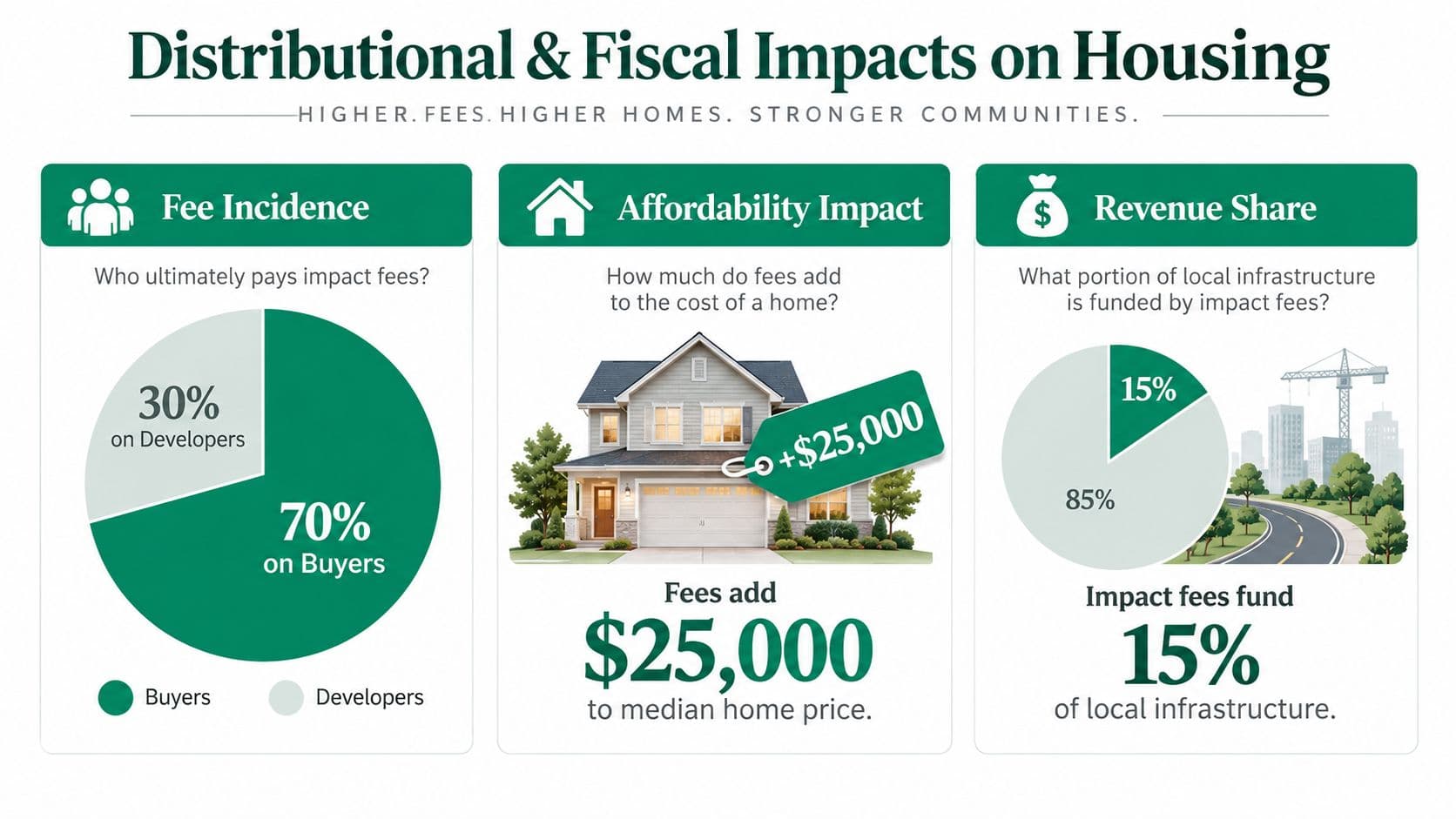
The developer usually writes the check, but the developer isn't necessarily the final payer. Fees can be passed into home prices and rents, capitalized into lower land prices, absorbed through lower returns, or distributed across all three channels. The balance depends on competition, supply constraints, project alternatives, and the bargaining position of landowners.
One empirical study concluded that each additional $1.00 of fees raised the price of new and existing housing by about $1.60 and reduced land prices by about $1.00. That result, summarized in the peer-reviewed housing research, shows why officials shouldn't describe impact fees as a cost borne by developers alone. Buyers and landowners can carry substantial portions of the burden.
Affordable housing faces a sharper feasibility test
Aggregate averages can hide marginal failures. California research on low-income housing tax credit development found that almost all of 691 new construction projects paid impact fees, with fees averaging nearly $20,000 per unit. The same research found that about 13,660 affordable units across 134 projects were charged more than $30,000 per unit. The Terner Center analysis of California LIHTC projects documents why a fee that appears manageable in an aggregate development-cost calculation can still break a subsidized project's financing gap.
The policy response should target feasibility, not merely public relations:
- Waivers: Remove charges where a project delivers legally protected affordability or a clearly documented public benefit.
- Deferrals: Move payment to a later milestone so construction financing isn't burdened before occupancy.
- Credits: Recognize infrastructure that the applicant builds and dedicates for public use.
- Calibration: Charge by actual service demand rather than applying a blunt per-unit amount.
- Transparency: Publish who receives relief, why the relief applies, and how the city replaces deferred cash flow.
Revenue stability is part of the design
Impact fees rise and fall with development activity. During a building surge, collections may support capital programs. During a downturn, infrastructure needs continue while fee revenue weakens. A responsible capital plan therefore treats fees as a growth-linked source, not as the only dependable source for essential facilities.
Officials should maintain a reserve or identify backup funding before granting broad deferrals. They should also test whether exemptions shift costs to existing taxpayers, utility ratepayers, or other development categories. Distributional analysis methods can help officials show who gains, who pays, and which project types face the greatest feasibility risk.
International and Local Precedents for Impact Fee Design
No jurisdiction can copy an impact fee program from another place and expect the same result. Service standards, land markets, cadastral systems, permitting rules, and political institutions determine whether a fee is predictable or punitive. The useful lesson from international and local precedents is not a single model. It is the importance of matching the charge to the service, the location, and the type of development.
Singapore is often used as a contrast to more fragmented administrative environments because its land and planning systems support clearer coordination. Alaska provides a cautionary example in the supplied comparison, where bureaucratic complexity can make obligations difficult for applicants and agencies to interpret.

What officials should borrow
The relevant precedents include Denmark, Estonia, Singapore, Alaska, Canberra, Norway, and Allentown, Pennsylvania. Their value lies in the policy questions they raise:
- Denmark and Norway: How can public institutions connect land and infrastructure decisions without treating every charge as a project penalty?
- Estonia: What administrative advantages emerge when land records, valuation, and public finance use compatible data?
- Singapore: How does centralized planning improve the clarity of infrastructure obligations and development sequencing?
- Canberra: What happens when public control of land development is used to coordinate urban expansion?
- Alaska: How can a technically valid charge become ineffective when applicants face confusing procedures and overlapping requirements?
- Allentown: What can a local government learn from applying land and value-capture concepts in a specific municipal setting?
These examples don't prove that one tool works everywhere. They show that administrative design is policy design. A fee schedule that staff can't explain, applicants can't forecast, and residents can't audit won't produce durable legitimacy.
Integrate records and public communication
A modern program needs a reliable parcel database, clear service areas, consistent land-use classifications, and a compliance workflow that follows the fee from adoption through expenditure. The city should give applicants a single schedule, a calculation worksheet, an appeal path, and a project list tied to each account.
Officials should also distinguish impact fees from tax increment financing districts and other value-capture mechanisms. An explanation of tax increment financing districts can help stakeholders understand why a district-based financing tool shouldn't replace a project-specific nexus analysis.
Public education belongs in the implementation budget. Residents need to know which growth costs the fee covers, which costs remain a general obligation, and why a waiver supports a defined housing or infrastructure objective.
Implementation Steps for Public-Sector Audiences
A municipality should not adopt a development impact fee because neighboring jurisdictions have one. It should adopt a fee only after identifying a real infrastructure need, establishing a defensible allocation method, and confirming that staff can administer the program. The following sequence keeps policy, finance, law, and delivery aligned.
Start with evidence, not a target
- Map the service problem. Identify capacity constraints, planned growth, existing commitments, and the facilities that new development will require. Separate expansion from deferred maintenance.
- Build the nexus study. Connect each fee to a defined development impact, eligible facility, cost allocation, and service area. Use assumptions that elected officials can test and the public can review.
- Model project types. Run the schedule against small homes, large homes, multifamily projects, infill, outer-suburban development, market-rate housing, and affordable housing. Flag projects that fail at the margin.
- Choose payment timing. Collect at the point that protects municipal cash flow without imposing unnecessary financing pressure. Deferral can support feasible housing, but the city must plan for delayed receipts.
- Draft exemptions and credits. Define affordability, small-project, infill, infrastructure-credit, and hardship rules in objective language. Avoid discretionary waivers that invite unequal treatment.
Make administration auditable
Create separate accounts for each fee category, publish the calculation methodology, and assign responsibility for project delivery and reporting. Staff should maintain a live register showing collections, balances, commitments, expenditures, and remaining facility obligations. A fee that can't be tracked shouldn't be collected.
Phase in major changes where an immediate increase would disrupt projects already in underwriting. Freeze or transition schedules only under a clearly published rule. Give applicants enough information to calculate the charge before land acquisition and enough notice to revise designs.
Administrative rule: If staff can't explain the fee on one page, the council shouldn't vote on it yet.
Build the political case with distributional modeling
Public hearings should present more than a revenue forecast. Show which households may face higher prices, which landowners may absorb lower residual values, which projects receive exemptions, and how the city will replace delayed infrastructure revenue. That evidence gives residents a basis for judging trade-offs instead of leaving the debate to slogans.
Unitism® works with governments, cities, and organizations on land valuation, land-value capture policy design, distributional and fiscal impact modeling, legislative drafting, cadastre integration, compliance workflows, and public education. Visit Unitism® to assess how land-value evidence and transparent impact modeling could improve your jurisdiction's development fee decisions.