Explore 8 current business monopolies across search, cloud, app stores, payments, and real estate, with market power, antitrust cases, and key takeaways.
October 27, 2026
8 Current Business Monopolies Shaping Markets in 2026
Explore 8 current business monopolies across search, cloud, app stores, payments, and real estate, with market power, antitrust cases, and key takeaways.

A federal court found Google held a market share above 89% in general search, supported by entry barriers that included capital, brand, scale, and control of distribution, according to the Congressional Research Service summary of the Google search ruling. That concentration defines the question behind Current Business Monopolies: who controls a gate that buyers, sellers, workers, or developers cannot realistically bypass? Size explains less than the gatekeeper's power to charge for passage.
The eight chokepoints covered here span search, e-commerce and cloud, mobile software, AI hardware, payments, property data, wireless towers, and rental housing. Each firm or pair faces an antitrust case, regulatory review, or public policy challenge, though for some of them the scrutiny is policy debate rather than a formal lawsuit. The extracted toll may be user data, seller listings, developer work, merchant sales, or rising land values in growing neighborhoods. In each case, outside activity helps create the value while the gatekeeper controls where it is collected.
How to Read This List
Ask three questions every time. Who must pass through the gate? What fee, rent, or data does the gatekeeper extract? What remedy would actually change who captures that value?
The remedy question is decisive. A remedy matters when it changes the gatekeeper's power over access or redirects rent to users, merchants, workers, developers, or the wider community.
The final section connects platform and infrastructure tolls to land. Fixed-term leases and annually repriced land-use rights allocate community-created rent differently, so land-pricing design can keep concentrating market power or return more of that value to public use.
Table of Contents
- How to Read This List
- 1. Alphabet Google Search and Digital Advertising
- 2. Amazon E-commerce and Cloud Infrastructure
- 3. Apple App Store and Mobile Platform Gatekeeping
- 4. Nvidia AI Accelerator Chips and Software Ecosystem
- 5. Visa and Mastercard Card Payment Networks
- 6. CoStar Group Commercial Real Estate Data and Listing Platforms
- 7. American Tower and Crown Castle Wireless Tower Ground Leases
- 8. Invitation Homes and Institutional Single-Family Rental Landlords
- How the eight current business monopolies compare on market position, power sources, and antitrust exposure
- Turning Market Chokepoints Into Public Revenue Strategy
1. Alphabet Google Search and Digital Advertising
Google runs the dominant general search gate and large parts of the open web display ad chain that joins publishers to advertisers. Search power comes from default placements, query scale, and a feedback loop: more users create more data, data improves results, and stronger results pull in advertisers. Ad tech adds a second gate because Google sells tools used by publishers, advertisers, and intermediaries inside the same transaction.
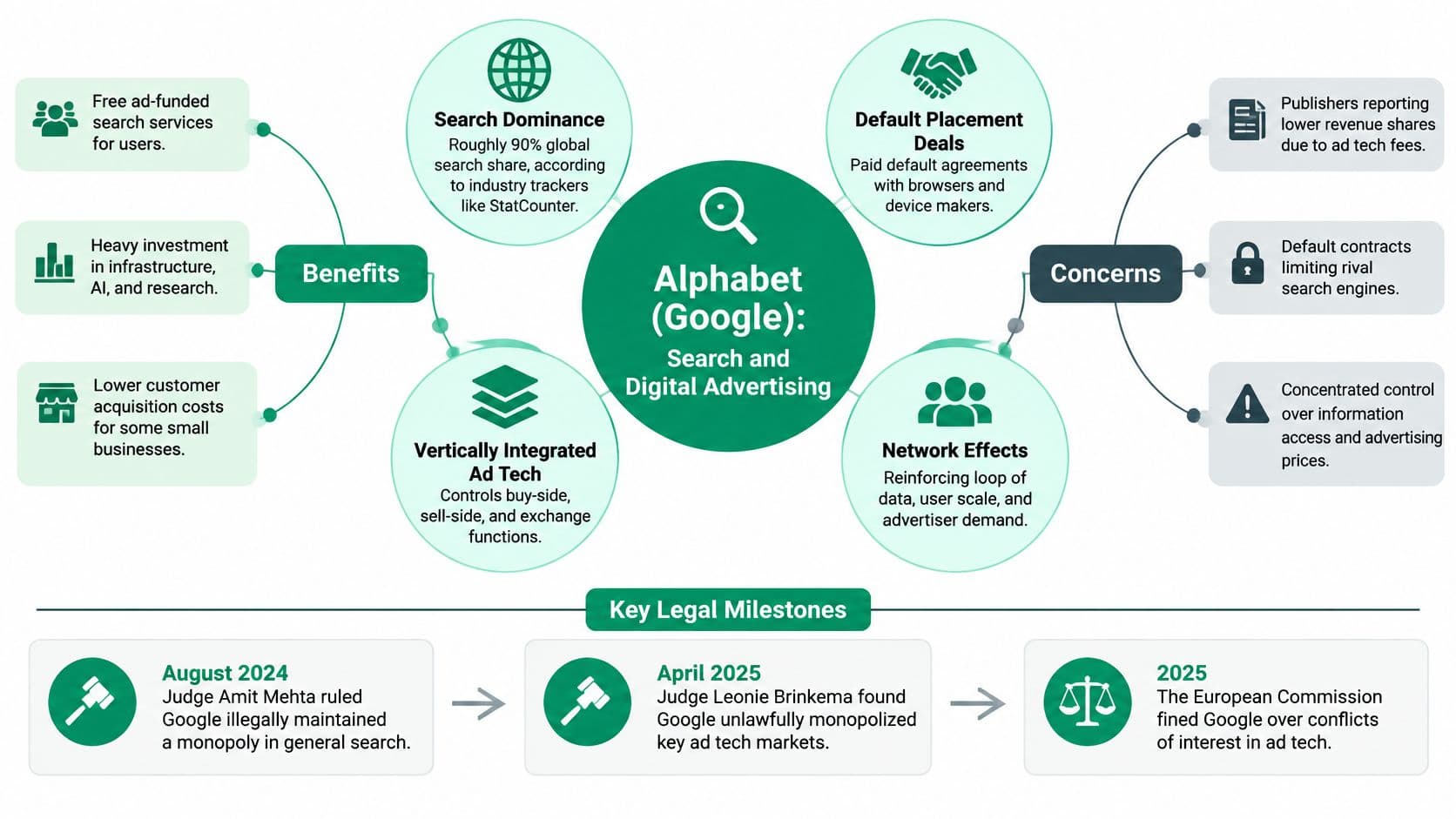
U.S. District Judge Amit Mehta ruled that Google illegally maintained a monopoly in general search. Judge Leonie Brinkema separately found unlawful monopolization in publisher ad server and ad exchange markets. The European Commission has also acted on ad tech conflicts of interest, treating each layer as a market with its own toll.
Who Captures the Value
Recent U.S. remedies restricted exclusive search distribution agreements and required sharing certain search data, while courts did not order Google to divest Chrome, according to coverage of the Google antitrust remedies. The rent question is narrower than the headline. If defaults remain sticky and ad fees stay opaque, access for rivals can expand while the gatekeeper still captures much of the value created by queries, listings, and publisher content.
A local news site shows the stack. It depends on search ranking and defaults for readers, then loses margin again inside programmatic ad tools before revenue reaches reporters.
- Track the remedy more than liability by checking whether distribution and data access terms change.
- Audit dependence on search referrals, Google ad tools, and paid search.
- Build exits through subscriptions, newsletters, and direct public information portals.
- Read beyond headlines by weighing what earnings summaries miss against the court docket and agency filings when assessing remedy risk.
2. Amazon E-commerce and Cloud Infrastructure
Amazon combines a leading U.S. online marketplace with Amazon Web Services, fulfillment, logistics, and seller advertising. A third party seller can technically list elsewhere, yet Prime eligibility, search placement inside Amazon, and fulfillment speed pull that seller toward Amazon's bundled services. The toll isn't one commission. It's referral fees, fulfillment charges, storage, returns handling, and ads bought to stay visible to shoppers who start on Amazon.

The Federal Trade Commission and state attorneys general sued Amazon over pricing and seller policies that allegedly maintain monopoly power. Cloud creates a parallel concern for governments and large buyers. Once data, identity controls, and application architecture sit inside one provider's tools, switching becomes an engineering project rather than a procurement choice, which is why questions about whether data centers are bad for the environment also belong in siting and procurement reviews.
Concentration Can Hide in Layers
OECD research reported a 3.3 percentage point increase in industry concentration in the United States over the period examined, while product level concentration was nearly flat, in its OECD Employment Outlook analysis of concentrated markets. Amazon fits that warning. Product choices can look abundant while the marketplace, logistics, and cloud layers underneath become harder to escape.
Say a city hosts permitting software on AWS and buys supplies through Amazon Business. It should model exit costs, data export formats, and contract renewal bargaining power before renewal, not after.
- Price the whole bundle, including ads and fulfillment, not just referral fees.
- Require portability for data, workloads, and seller records in contracts.
- Use multi vendor planning, informed by practical cloud governance from MR2 Solutions.
3. Apple App Store and Mobile Platform Gatekeeping
Apple runs iOS and the App Store, the authorized route for most iPhone app distribution. Developers don't just pay for payment processing. They accept Apple's review process, ranking rules, commission structure, and limits on telling users about cheaper payment options elsewhere. Control of the operating system therefore becomes control over customer relationships for music, news, games, dating, transport, and public services.

Epic Games challenged those rules in litigation that produced an injunction on steering users to external payments. A federal judge later found Apple in contempt of that injunction and barred commissions on those external purchase links. The European Union's Digital Markets Act has pushed alternative app marketplaces in Europe, while Dutch and Japanese actions have targeted payment choice in narrower categories.
A Classic Form of Rent Seeking
Apple built valuable hardware and software, and it should earn returns on that work. The competition question starts when ownership of the device platform lets Apple tax transactions it didn't create, a pattern explained in the Unitism guide to rent seeking in economics. A developer who writes the app, acquires the customer, and provides the service still pays because Apple controls the doorway.
Practical rule: If an app is your only route to users, you don't own your distribution. You rent it on terms the landlord can rewrite.
Say a transit agency releases a fare app. It should also offer a progressive web app, account based web payment, and clear in station alternatives.
- Review fee exposure before building a subscription model.
- Keep a web channel for payments, notices, and account recovery.
- Watch EU and Japanese rules as early signals of payment and marketplace reform.
4. Nvidia AI Accelerator Chips and Software Ecosystem
Nvidia's power sits at the meeting point of scarce hardware and default software. Its graphics processing units run much large scale AI training and inference, while CUDA gives developers libraries, tools, and habits built over years of research code. A rival chip can match a benchmark and still lose the sale because a buyer's models, staff skills, and debugging stack already assume CUDA.

Authorities in the United States, European Union, and China have examined AI chip market practices. Cloud providers and national research labs keep buying Nvidia systems because delivery schedules, networking, and software support reduce project risk. Open alternatives such as ROCm and OpenCL based projects aim to loosen that lock in, but they must persuade developers and procurement teams at the same time.
Supply Concentration Is Not Just a Tech Issue
UNCTAD reports a concentration index of 0.20 for manufactured products by exporting economy, compared with 0.11 for food, in UNCTADStat data on trade concentration. AI accelerators show why manufactured supply can concentrate around a few producers, suppliers, and locations. The gate includes fabrication capacity, advanced packaging, memory, electricity, and suitable land near grid connections.
Say a university plans an AI cluster. It shouldn't specify one vendor's proprietary stack as the requirement. It should define workloads, portability tests, and total power costs, then let multiple architectures compete.
- Require interoperability in public AI procurement and test code portability.
- Budget with alternatives where a second vendor can handle inference or smaller training jobs.
- Plan land and power together, since data centers compete for scarce sites and grid capacity.
5. Visa and Mastercard Card Payment Networks
Every card payment sends a cut of the sale to companies that neither issued the card nor funded the purchase. Visa and Mastercard run the networks, write the rules banks and merchants follow, and shape the interchange and acceptance conditions that decide what a transaction costs. A merchant can dislike the fee and still accept the cards, because customers arrive expecting to use them. That expectation is the toll booth.
U.S. antitrust enforcers have challenged Visa's debit network practices, a reminder that network rules shape which payment routes reach scale. Merchants have also litigated interchange fees for years, while European and UK regulators have reviewed scheme and interchange charges. These cases separate two questions. Is the network useful infrastructure, and does its rulebook stop cheaper routes from reaching scale?
The Invisible Toll at Checkout
Card fees spread into retail prices, government service charges, charitable donations, and transit fares without much notice. Small merchants hold the least bargaining power and the least ability to steer customers toward cash, account to account payments, or lower cost debit routing. A café's card costs never appear on the menu, yet they sit inside every price. The rent flows to the network owners while the sellers generating the transactions absorb it.
Say a municipality accepts cards for permits and utility bills. It should compare card acceptance costs with instant payment and bank transfer options, publish the surcharge logic clearly, and avoid contracts that block new rails. Retailers making the same comparison can start with a retailer's guide to card payment charges.
Infrastructure looks neutral until you ask who writes its access rules and who can set the price of passing through.
- Offer public payment rails for government receipts where they're cheaper and reliable.
- Negotiate collectively through merchant associations or public procurement groups.
- Monitor debit routing rulings, because small fee changes apply to huge transaction volumes.
6. CoStar Group Commercial Real Estate Data and Listing Platforms
CoStar's gate is information. Brokers, lenders, appraisers, and institutional investors use its property database for lease rates, sales, tenants, and building details, while LoopNet and Apartments.com shape which spaces and homes searchers see. When one company gathers the data, sells the analytics, and operates major listing venues, smaller participants pay for visibility and for the evidence needed to negotiate.
CoStar built that position through proprietary research, subscriber contracts, and acquisitions, including Apartments.com's expansion into rental listings. Litigation with smaller listing platforms over copyright and data use shows the strategic value of the underlying records. Market transparency was supposed to discipline pricing. Concentrated ownership of market data can instead make transparency a subscription product.
What De Beers Shows About Distribution Control
De Beers controlled roughly 80% of the global diamond market until 1977, and its rough diamond share later fell to 45% after new supply and direct producer relationships weakened its channels, according to a Columbia University case study on De Beers. The lesson for property data is direct. Market share falls when alternative supply and distribution reach buyers, and it persists when exclusive channels control access.
Say a city values land for tax or redevelopment policy. It should cross check private databases with assessor records, registered sales, and cadastral maps, using a transparent commercial property valuation method it can explain to owners and appeal boards.
- Build public land datasets from assessor and registry records.
- Require open data standards in valuation and planning contracts.
- Audit exclusive data clauses before subscribing or renewing.
7. American Tower and Crown Castle Wireless Tower Ground Leases
American Tower and Crown Castle own or operate towers that mobile carriers need for coverage, and many of those towers stand on land controlled through ground leases or easements. Zoning limits, height rules, backhaul access, and neighborhood opposition make a nearby replacement site hard to assemble. The scarce asset is often the permitted location; the mast, radios, and steel can be rebuilt or moved once rights to the site are secured. Each carrier payment therefore contains a toll for access to a place whose value comes from spectrum demand, network maps, roads, power, and public permission.
Singapore's Land Authority states that state leases have specific tenures and renewal isn't automatic, with renewed terms and premiums decided under planning intentions, in the Singapore Land Authority lease policy. Where a tower sits on leased land, the same fixed term logic can appear: scheduled escalators, renewal options, and contract rent that lags current site value until reset. A long lease is a contract claim for a period, rather than an annual claim on the location value the surrounding market keeps creating.
Fixed Leases Postpone the Pricing Problem
Fixed terms can leave contract rent below site value for years, then concentrate the adjustment at expiry. A municipality considering 99 year land leases faces the same design choice over a longer horizon: stretch the discount, or reset closer to current use value. That design shapes who holds power at renewal, the landowner who controls access or the carrier whose network cannot easily leave.
Say a rural landowner receives a lump sum offer for a tower lease. She should compare it with the site's current rental value, remaining term, escalator, and the bargaining power each side holds at renewal.
- Value the site separately from the tower structure before renewing or selling.
- Cap one sided renewal advantages on public land and record escalator terms clearly.
- Consider annual repricing where public land value should track current use value.
8. Invitation Homes and Institutional Single-Family Rental Landlords
Invitation Homes is a large institutional owner of single family rentals, concentrated in fast growing U.S. markets such as Phoenix, Atlanta, Dallas, and Southern California. Blackstone founded the company after the housing crisis, when bulk purchases of distressed homes helped create the modern institutional rental sector. No single landlord needs a national majority to matter locally. Concentrated buying in a few school zones or entry level neighborhoods can affect bids, rents, and how many starter homes remain available to owner occupiers.
The Chicago Fed explains that land has fixed, perfectly inelastic supply, so a pure land-value tax reduces rent received by landowners without reducing the quantity of land supplied, in its Chicago Fed Letter on land value taxation. That mechanic matters here. A tax on buildings can discourage repairs or new homes, while a charge on site value targets location gains created by jobs, schools, transit, and neighborhood demand.
Tax the Site and Stop Penalizing the Home
A Lincoln Institute review reports that a metropolitan Boston model found a revenue neutral shift toward heavier land-value taxation would produce higher population density and lower housing prices, in its Lincoln Institute review of land value taxation in U.S. cities. Applied to rental portfolios, that points policy toward speculative holding rather than management scale alone. It also gives cities tools for the wider housing affordability crisis without taxing renovations as if they were the problem.
Say a city maps investor purchases by census tract. If a few tracts show rapid conversion of starter homes to rentals, officials can test a split rate tax, vacancy charge, or first look program for nonprofits and owner occupiers.
- Track ownership by neighborhood, not just citywide totals.
- Shift charges toward land value and away from buildings and improvements.
- Give households first access where public programs dispose of homes or land.
How the eight current business monopolies compare on market position, power sources, and antitrust exposure
| Item | Market Position | Core Source of Power | Notable Antitrust Action |
|---|---|---|---|
| Alphabet (Google): Search and Digital Advertising | Dominant global search provider; major open-web ad tech player | Default agreements, user data, network effects, and integrated ad tech | U.S. courts found unlawful monopolization in search (2024) and ad tech (2025); EU also fined Google over ad tech conflicts |
| Amazon: E-commerce and Cloud Infrastructure | Leading U.S. online retailer and largest global cloud provider | Marketplace, logistics, fulfillment, and AWS scale | FTC and 17 states filed a monopolization lawsuit in 2023 |
| Apple: App Store and Mobile Platform Gatekeeping | Controls iOS app distribution and platform rules | Integrated hardware, software, payments, and app review | Epic Games litigation led to a 2025 contempt ruling over external payment links |
| Nvidia: AI Accelerator Chips and Software Ecosystem | Estimated to supply most AI data center accelerators | CUDA ecosystem, chip supply, and integrated hardware and software | U.S., EU, and Chinese authorities examined its market practices in 2024–2025 |
| Visa and Mastercard: Card Payment Networks | Two dominant card payment networks | Network rules, interchange frameworks, and merchant acceptance | DOJ sued Visa in 2024 over alleged debit transaction monopolization |
| CoStar Group: Commercial Real Estate Data and Listing Platforms | Leading commercial real estate data provider | Proprietary data, research staff, listings, and subscriber contracts | No major antitrust action specified; acquisitions and competition have drawn scrutiny |
| American Tower and Crown Castle: Wireless Tower Ground Leases | Among the world's largest wireless tower owners | Tower portfolios, scarce local sites, and barriers to new construction | No major antitrust action specified; local market power is shaped by siting constraints |
| Invitation Homes and Institutional Single-Family Rental Landlords | Largest U.S. single-family rental company; large institutional sector presence | Concentrated home ownership, bulk purchasing, and institutional capital | No major antitrust action specified; policy proposals have targeted institutional home purchases |
Turning Market Chokepoints Into Public Revenue Strategy
Each case follows the same economic pattern with different technology. Google controls discovery, Apple controls app access, Visa and Mastercard control payment acceptance, CoStar controls property evidence, tower firms control permitted sites, and large landlords control homes in places people already want to live. The gatekeeper captures value created by a wider network of users, businesses, public infrastructure, and community growth.
Standard Oil remains a warning against expecting structure alone to redistribute that value. The company controlled at least 80% of U.S. refining capacity by 1880, and its later dissolution into 38 separate companies became a landmark under the Sherman Antitrust Act, as summarized by the U.S. Department of Justice history of monopolization and innovation. Breakups and conduct rules can restore contestability, but they don't by themselves decide whether consumers, rival firms, workers, or the public receive the released rent.
The Land Pricing Choice Underneath Market Power
A pure land-value tax applies to the site and excludes buildings. That design must be distinguished from both a fixed term land lease and a genuine land-use right. Land leases are renewable or non-renewable fixed term leases at a fixed price. Renewable leases give certainty only until expiry, when the accumulated gap between lease rent and market rent closes in one major repricing. Non-renewable leases become progressively harder to refinance and sell as the remaining term shrinks. Fixed leases therefore don't price risk correctly. They postpone it.
Land-use rights are different. They're indefinite, they do not expire, they require no renewal, and they're repriced annually. Because repricing happens each year, people can buy and sell land-use rights at low cost, land is priced appropriately, and productive enterprise isn't burdened by a looming renewal shock. Sometimes fixed leases are called land-use rights, but the label doesn't change the contract. Unless a right is repriced each year, never expires, and needs no renewal, it's still just a fixed lease.
Decision test: Does the charge adjust each year without a renewal event? If not, someone is storing up land rent or repricing risk for later.
That test extends beyond land. Probe platform contracts for renewal traps, data export fees, default placements, and prices that stay artificially calm until switching becomes impossible. Economic rent is value created by everyone, yet it flows to a few people. When communities collect that rent for public purposes, they can fund services, reduce taxes on labour and business, and reduce inequality. Our core idea at Unitism is simple, people keep the profit from their own business, while value created by the surrounding community flows back to that community.
Start with three actions this quarter. Audit one dependency from this list and price every fee, data transfer, and exit barrier. Ask procurement teams to require interoperability, open standards, and usable data exports. Then evaluate whether local land rent could fund services while cutting taxes on work, buildings, and productive capital.
If you're weighing an antitrust response, a land-value tax, or a switch from fixed leases to annually repriced rights, Unitism® can help you estimate site rental values, model who gains and who pays, and design a phased transition. Visit us to explore valuation frameworks, fiscal modelling, and implementation support for reforms that return community created value to the community.