Progress and Poverty explained: how Henry George's land-rent theory shaped modern land-value reform, Unitism, and today's housing and tax debates.
October 18, 2026
Progress and Poverty: Henry George's Case for Land Reform
Progress and Poverty explained: how Henry George's land-rent theory shaped modern land-value reform, Unitism, and today's housing and tax debates.
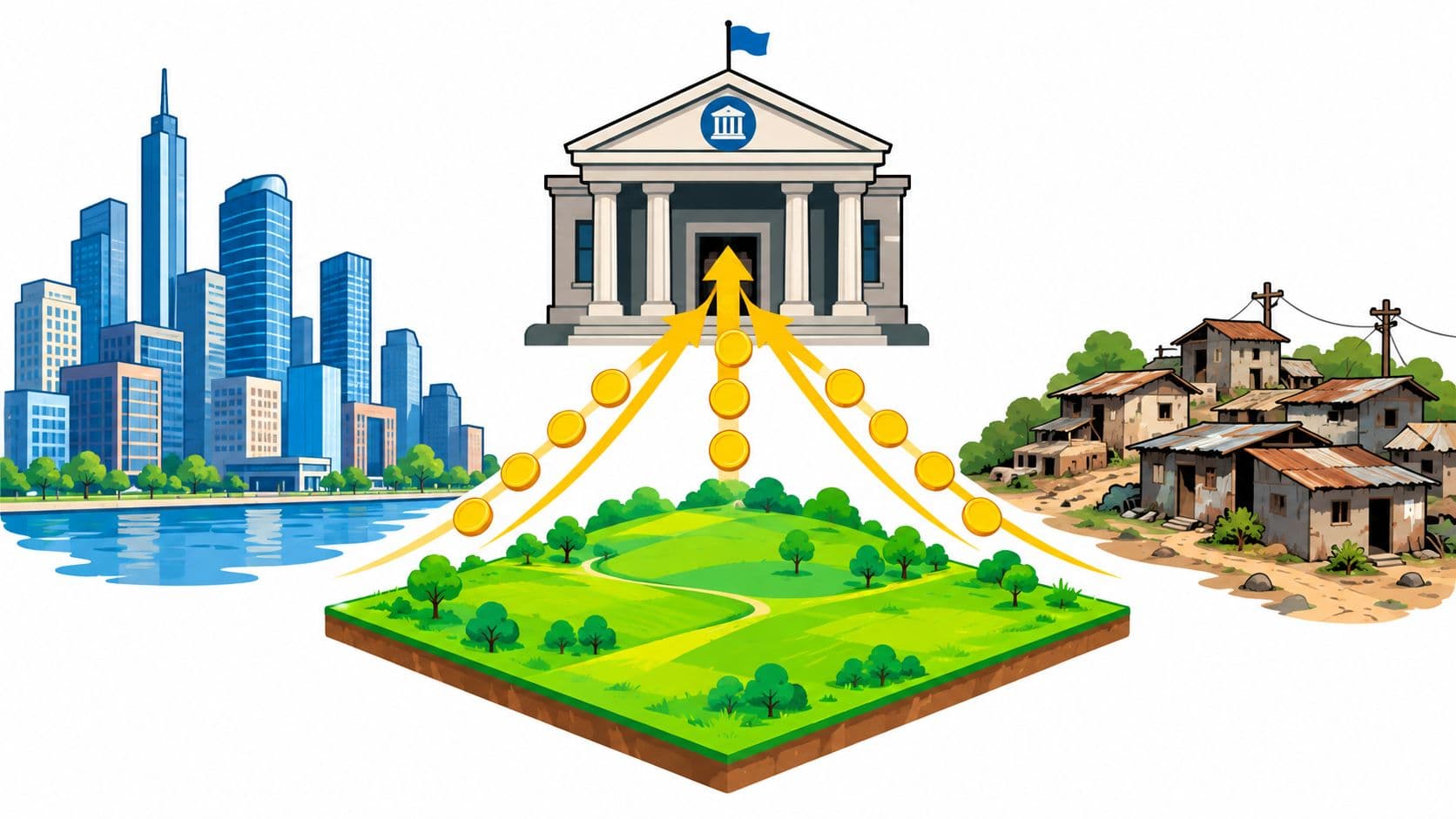
A household can escape measured income poverty without gaining secure access to a home. The World Bank's updated poverty framework tracks money, education, and basic infrastructure, but doesn't directly measure land access or housing affordability, leaving a gap between higher income and practical economic security, as its 2025 poverty and inequality update explains. That gap makes Henry George's Progress and Poverty a useful starting point for understanding why prosperity and hardship can exist on the same street.
Table of Contents
- Why a Book from 1879 Still Matters
- The Core Argument About Land and Rent
- What George Proposed to Do About It
- Land Leases versus Land-Use Rights versus Land-Value Taxes
- Where Land Rent Has Actually Been Shared Publicly
- The Strongest Objections and How Reformers Respond
- Unitism, Tri-Factor Economics, and What to Do Next
Why a Book from 1879 Still Matters
A palace beside a hovel is the unsettling image associated with the closing argument of Henry George's Progress and Poverty. The contrast isn't between rich people and poor people. It's between the promise of a growing civilization and the insecurity of people who help sustain it.
George's question remains disarmingly plain: Why doesn't greater productive power reliably deliver greater security for everyone? A city can attract businesses, improve transport, and support better-paid work while residents struggle to secure a place within it. Progress and poverty aren't necessarily opposites when access to valuable locations comes at an increasing price.
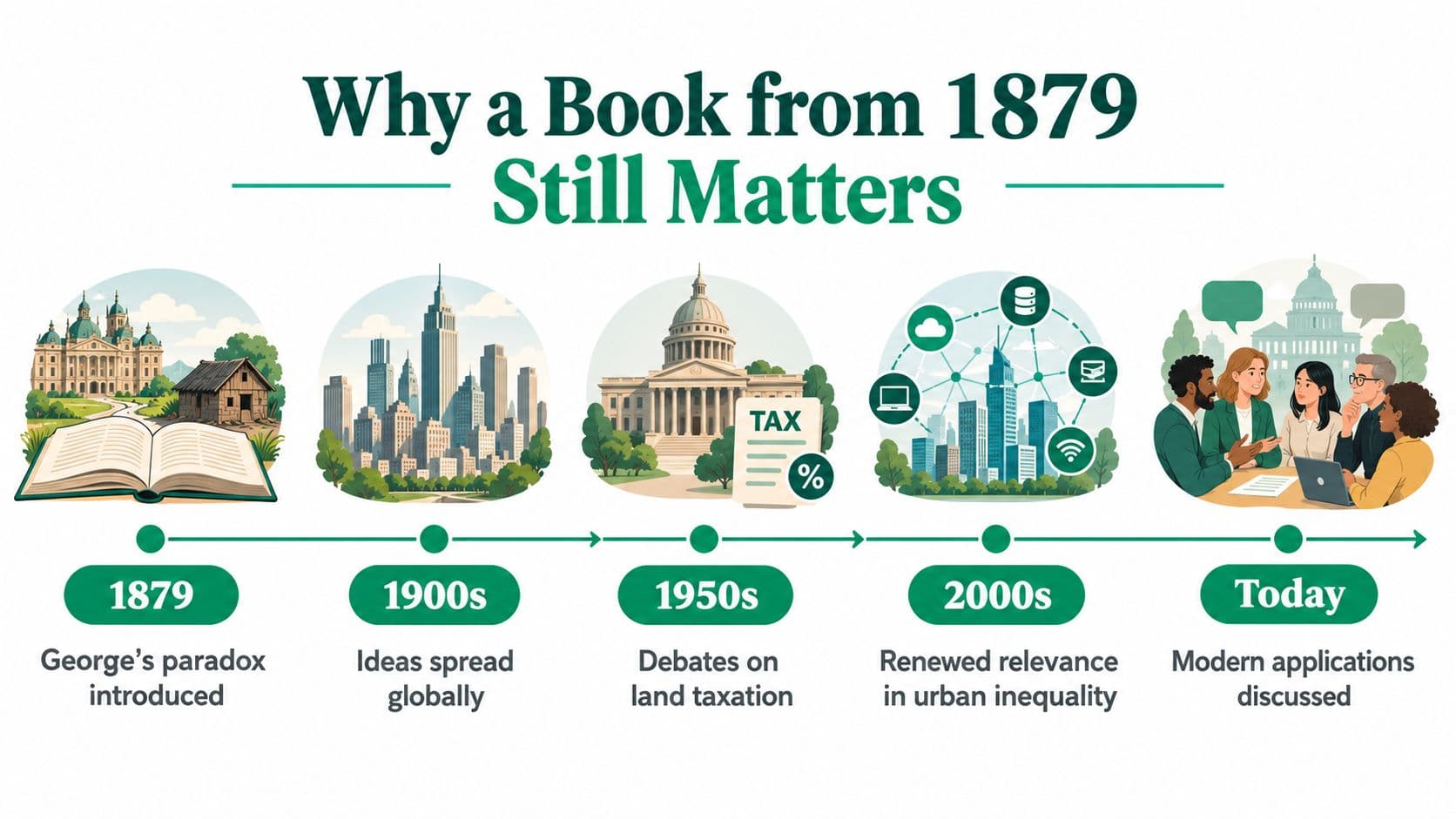
Progress Is Real, but Averages Aren't Enough
George's question shouldn't become an excuse to dismiss economic development. Using the historical international poverty threshold of $2.15 per person per day, extreme poverty fell from approximately 2 billion people in 1990 to roughly 648–660 million in 2019, an approximate two-thirds reduction, according to the World Bank's explanation of its poverty-line adjustment.
Those gains matter enormously. They also don't answer every question about who can afford shelter, remain near employment, or benefit from public investment.
Consider a hypothetical neighborhood that receives a new transit connection. Residents gain easier access to jobs, and businesses gain access to customers. But a tenant whose housing payment rises may surrender part of that benefit to the owner of the location, even though the owner didn't build the transit system.
A useful test of progress is not only whether people earn more, but whether they can retain access to the places and services that make those earnings possible.
An Old Question for Housing Policy
That distinction helps explain the relevance of land economics to the housing affordability crisis. Building homes and distributing access to desirable sites are related problems, but they aren't identical.
The attraction of Georgist and Unitist thinking lies in this diagnostic approach. Rather than treating technology, entrepreneurs, or growth itself as the enemy, it asks which institutions determine who receives the benefits.
Read this way, Progress and Poverty isn't merely an old polemic. It offers a way to investigate the connection between productive success, property rights, and the cost of belonging to a community.
The Core Argument About Land and Rent
Start with a factory. Its machinery, walls, and roof exist because people worked, saved, organized, and invested. In classical economic vocabulary, these produced assets are capital.
The site beneath the factory belongs to a different category: land, meaning nature and location rather than something manufactured. People can construct another factory, but they can't manufacture another identical position beside the same port, railway, customers, and workforce.
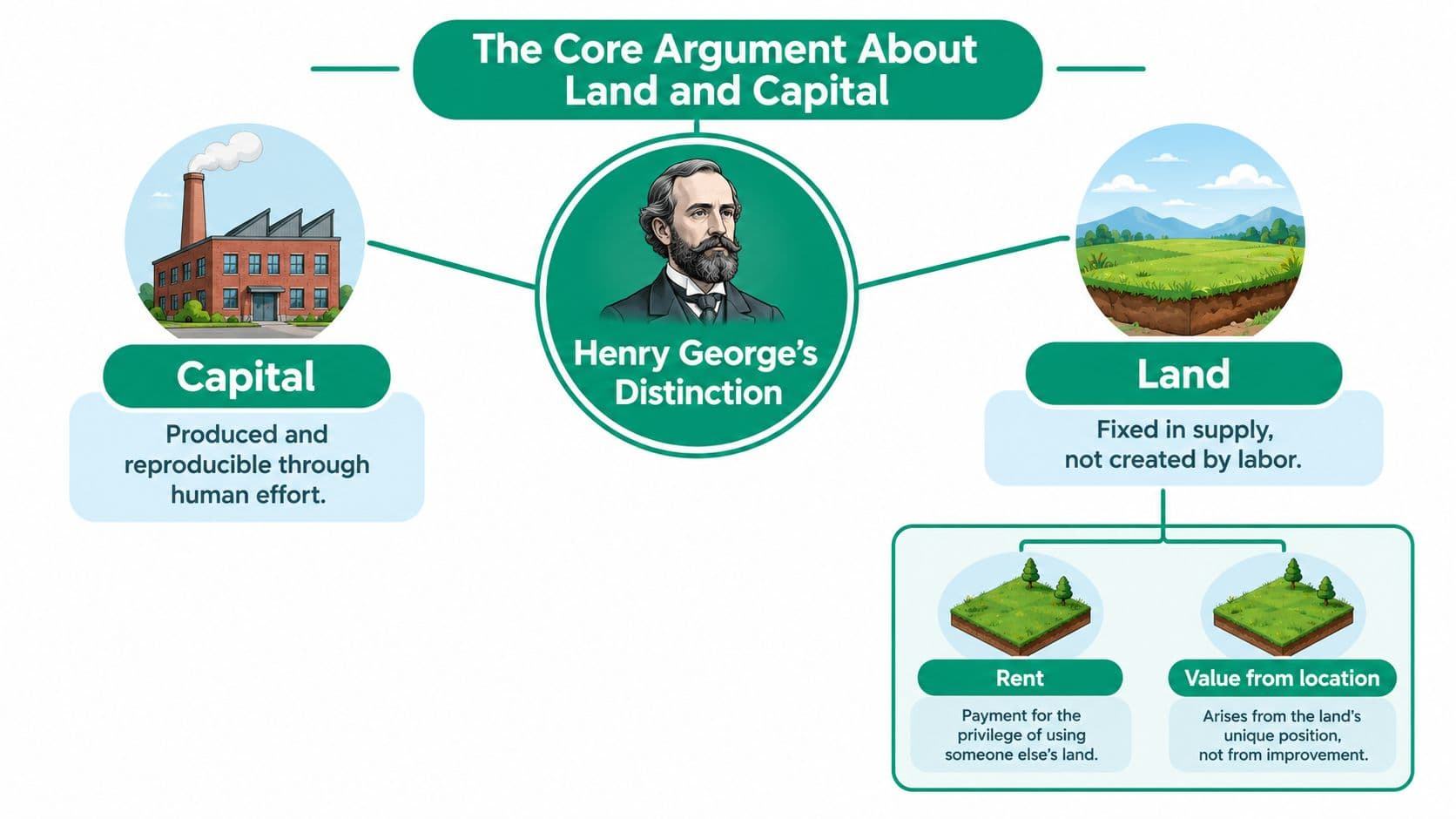
Why Location Commands a Payment
George's explanation of economic rent begins with alternatives. Suppose a shopkeeper can operate on a convenient central site or on a less convenient site farther from customers. If the central location permits better business after accounting for comparable labor and equipment, the shopkeeper can afford to pay more to occupy it.
The less advantageous available location provides the comparison point, sometimes called the margin. Rent reflects the advantage of the better site relative to that alternative. It isn't whatever a landlord chooses to demand, because prospective occupants still have alternatives and limits on what they can pay.
This also clarifies a common vocabulary problem:
- A tenant's rent payment may pay for a building, maintenance, equipment, and the site together.
- Land rent refers specifically to the value of access to the location or natural opportunity.
- Returns to capital compensate the provision of produced assets, which shouldn't be confused with ownership of the ground.
Now hold the building constant and improve the surrounding neighborhood. Better public services, nearby customers, and useful infrastructure can make its site more desirable without any corresponding effort by its owner. In George's reasoning, much of that location value is socially created.
Why Land Is a Different Tax Base
Taxing an activity can change how much of it people undertake. A charge on construction may alter whether a developer builds; a charge on wages may affect the reward for working.
A charge on the value of an existing site cannot make its physical location disappear. That's the central efficiency argument for collecting land rent rather than penalizing production.
Economic distinction: Protecting the return to a newly built workshop is different from protecting the unearned increase in the value of its address.
This isn't a claim that every land-related charge is harmless. Assessment errors, insecure rights, or taxes mistakenly applied to improvements can create problems. George's argument depends on keeping the categories separate: reward what people produce, and consider sharing the value that comes from nature and community.
What George Proposed to Do About It
George's remedy was to collect land rent for public purposes while reducing taxes on labor and productive capital. His broader reform logic favored productive investment and exchange rather than treating private enterprise as the source of the problem.
The distinction matters for a small business. A baker who buys an oven, trains employees, and improves a shop creates productive capacity. A tax system that charges more because those improvements exist can discourage the very behavior policymakers want.
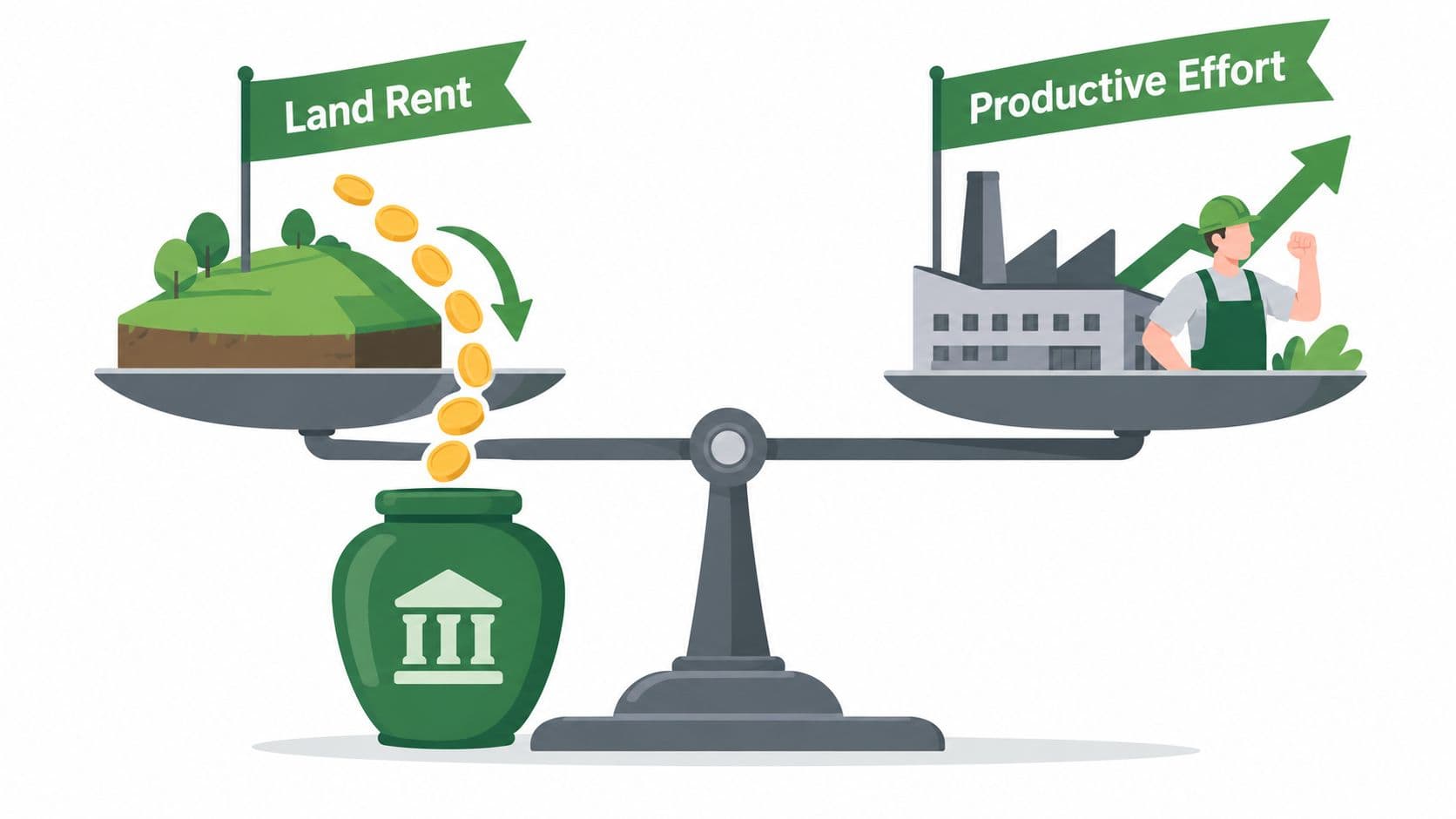
Change What Government Charges For
A land-value tax is a statutory charge on site value, excluding buildings and other produced improvements. The plain-language explanation of land-value taxation is useful because ordinary property-tax language often combines these separate components.
This tax must also be distinguished from land leases, which are contractual arrangements with fixed terms, and land-use rights, which, in the vocabulary used here, continue indefinitely and are repriced annually. Sharing land rent is the objective; these are different legal routes, not interchangeable names.
Consider a hypothetical vacant urban parcel beside established services. If its holder pays mainly when selling or constructing, leaving it idle may avoid some charges. If the public charge instead follows site value regardless of improvements, holding the location unused no longer receives that particular advantage.
That doesn't guarantee immediate construction. Planning permission, demand, infrastructure, and finance still matter.
A Reform Program with Testable Questions
The strongest modern interpretation of George's proposal treats it as a set of hypotheses rather than a promise that one instrument solves everything.
- For housing agencies, test whether lower building taxes and higher site charges change development feasibility and speculative holding.
- For finance ministries, compare recurring land revenue with existing transaction-dependent receipts under favorable and adverse scenarios.
- For business policy, examine whether reducing taxes on equipment and improvements strengthens the return to investment.
Redistribution remains relevant alongside structural reform. Across OECD countries, average relative poverty was 27% before taxes and transfers and 11% afterward, demonstrating a substantial fiscal effect without eliminating poverty, according to the OECD's poverty and inequality assessment.
George's contribution is to ask whether governments can improve the underlying distribution of opportunity as well as redistribute income afterward. Why hasn't this become universal policy? Existing ownership interests, transition losses, assessment requirements, and political choices all complicate reform, even when the underlying distinction is clear.
Land Leases versus Land-Use Rights versus Land-Value Taxes
The word “lease” does not reveal who bears the risk of changing land values. To see the difference, check three terms: expiration, renewal, and repricing. A lease sets rights through a contract; a land-value tax is imposed under tax law. A land-use right, as used here, describes a continuing right with an annually adjusted land charge.
A fixed-price lease resembles a locked price on a meter that keeps running: the payment stays set for a term, even as the site's market rent changes. Some leases instead adjust charges during a fixed term, so annual changes alone do not make a lease indefinite. The details of fixed-term land leases and expiration risk show why a long term is not the same as permanent continuity.
Fixed Leases Postpone Risk
A renewable fixed-price lease offers payment certainty until renewal. If market rent has risen, the difference may be addressed in a single large reset. The risk has been deferred, not erased.
With a non-renewable lease, the remaining term shrinks as expiration approaches. Buyers and lenders have less time to recover their investment, which can make resale and refinancing harder. A steady payment today may therefore sit alongside uncertainty about tomorrow's renewal price or the end of the right.
What Makes a Land-Use Right Different
Here, a land-use right has three defining features: its land charge is repriced annually, it requires no renewal, and it has no expiration as long as the holder meets the obligations. It grants use and occupation, much like a lease, but avoids a contractual renewal cliff and a fixed end date.
The annual charge also changes what the buyer must pay upfront. Rather than buying the full future stream of land rent in the purchase price, the buyer takes on an ongoing charge. That can keep the transfer price of the right itself low. It does not make buildings free: structures retain value, and legal fees may still apply. The intended distinction is between the value of the location and the value of productive improvements. Assessing them separately is necessary if the charge is to reflect land without burdening construction or other investment.
| Instrument | Duration and renewal | Repricing |
|---|---|---|
| Renewable fixed-price lease | Fixed term; renewal required | Major reset may occur at renewal |
| Non-renewable fixed-price lease | Fixed term; no automatic continuation | Payment stays fixed during the term |
| Adjustable fixed-term lease | Expires despite changing charges | Adjustments follow contract terms |
| Indefinite land-use right | No expiration or renewal | Land charge repriced annually |
| Land-value tax | Does not itself determine tenure duration | Assessment follows statutory rules |
The distinction matters in Hong Kong. For qualifying government leases, government rent equals 3% of property rateable value, changes when that value changes, and is collected quarterly whether the property is occupied or not, according to the government's rent guidance.
That rent is a contractual government charge, not automatically a land-value tax or an indefinite land-use right. Rateable property value should not be confused with the value of bare land. Annual adjustment shares one feature with the land-use right described here, but a fixed expiration still makes the arrangement a lease. Thus, the practical vocabulary is clear: tenure describes how long the right lasts, repricing describes how its charge changes, and a tax derives from legislation rather than the lease contract.
Where Land Rent Has Actually Been Shared Publicly
Public collection of land-related payments takes different forms. Hong Kong offers a useful example, provided we read the arrangements lease by lease rather than treating them as one system. The details show how governments can collect land rent while private parties occupy and invest in property.
Some older Hong Kong Island and Kowloon leases run for 75 years plus another 75 years. Rent for the second term is set at renewal and then stays unchanged until redevelopment, according to the Rating and Valuation Department's guide to rates and government rent. The timing matters: payment is reset at a contractual milestone, not continuously as land values change.
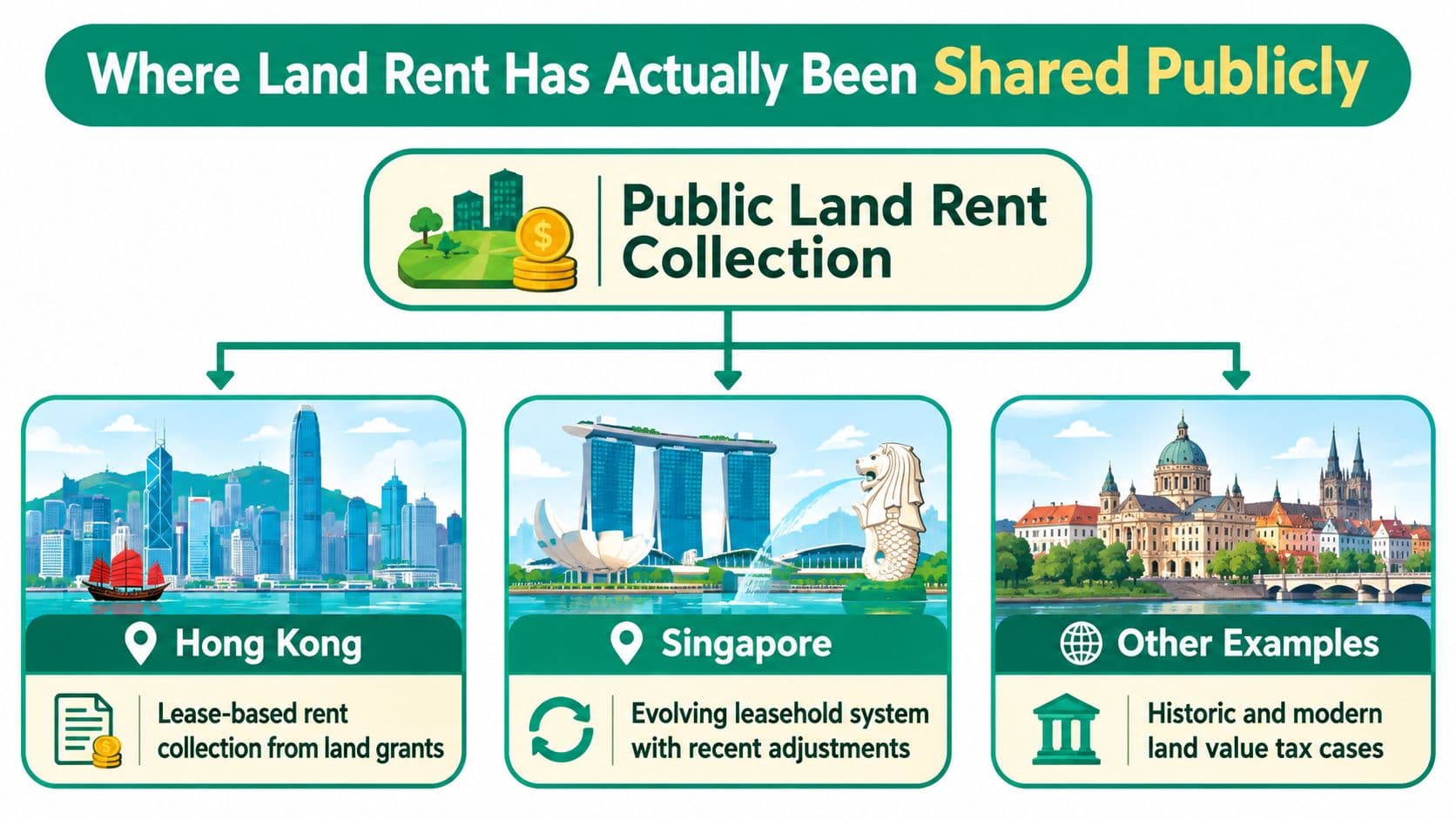
New Hong Kong leases are generally granted for 50 years, with an upfront premium and an adjustable annual government rent. Under the stated policy, qualifying non-renewable leases may be extended for 50 years without an additional premium, as the Lands Department's land-tenure explanation describes.
An extension policy is not the same as an automatic contractual right. For an investor, the difference shapes expectations about continued possession. For the government, it affects when payment terms can change. These are institutional details, not evidence that Hong Kong has adopted George's entire program. They do show that public authorities can collect recurring land-related payments while allowing private occupation and investment.
Singapore offers a different lesson: a proposal can clarify an idea without proving it has been implemented. Discussion of perpetual leases considers rights that continue while holders pay regularly reassessed ground rent, ideally reassessed annually. The discussion of the perpetual-lease proposal contrasts that model with ordinary leases that expire. The proposal shifts adjustment from an approaching end date to an ongoing payment obligation.
Estonia and Denmark also warrant comparison, but naming them alone tells us little about results. To assess effects on affordability or public revenue, we would need to examine each system's tax base, exemptions, valuation practices, and treatment of improvements.
A useful comparison asks what was collected: site rent, a property-based charge, or an upfront premium. It also examines how assessments are updated, challenged, and collected. Those distinctions help separate a revenue mechanism from its outcomes. Public collection, by itself, does not prove that housing became affordable.
The guide to land-value capture offers vocabulary for examining these choices. For readers of Progress and Poverty, the modern question is whether land's publicly created value returns to the public, and through which institution. Precedents help answer that question when treated as design examples, not slogans.
The Strongest Objections and How Reformers Respond
A land-value tax can target a stable, immovable base, yet its success depends on difficult choices: how to value sites fairly, phase in new charges, and maintain confidence in property and lending institutions. The tax base may look attractive in theory; poor administration can still make it unfair.
Consider a parcel with a building on it. Assessors must estimate the value of the site separately from the structure, even though sales usually combine the two. Comparable transactions, location, permitted uses, and estimates of building value can help, but none guarantees a precise result. Public assumptions, evidence checks, and accessible appeals give owners a way to question assessments. The Hong Kong arrangements described earlier show that an assessment-linked charge can operate; they do not show that every jurisdiction has the same administrative capacity.
Valuation is only half the transition problem. An owner may have purchased land expecting to keep its future income, while a lender may have made a loan based partly on that expected value.
Transition principle: Reform can improve future incentives while imposing losses on people who made decisions under earlier rules.
Those effects need to be examined by group. Indebted buyers, long-standing owners, tenants, developers, and land-rich but cash-poor households may face different consequences. An average estimate can hide serious pressure on one group.
Policy design can reduce some of the strain, though each choice brings trade-offs. Phasing in charges gives owners, lenders, and public budgets time to adjust. A dual-rate system taxes land and buildings at different rates, allowing a gradual shift. Deferrals or targeted relief can help households with limited cash flow, while broad exemptions may weaken revenue and create unequal treatment. Mortgage stress tests can examine collateral values, repayment capacity, and construction finance under different scenarios.
Political opposition also has a material basis: some owners expect to lose income or asset value. Clear models will not remove that conflict, but they can show who bears costs and why.
Nor does changing the tax guarantee affordable housing. Lower land purchase prices cannot by themselves resolve restrictive planning, inadequate infrastructure, or construction bottlenecks. Public revenue also remains exposed to falling demand, even with annual assessments.
A credible reform therefore needs a defined instrument, careful impact modeling, and protections for legitimate occupancy. Its results should be judged against explicit objectives, including fairness, revenue stability, and housing access.
Unitism, Tri-Factor Economics, and What to Do Next
Tri-factor economics separates labor, capital, and nature rather than treating all property as one category. The Unitist framework uses that distinction to connect housing policy, public revenue, and the distribution of economic opportunity.
Its relevance to Progress and Poverty is practical. A finance ministry needs to know which revenue changes affect productive activity; a city needs to understand which site values arise from public investment. The explanation of land, labor, and capital makes those categories accessible without requiring specialist vocabulary.
Start with Institutional Readiness
The case for reform cannot assume a stable property register or capable administration everywhere. More than 1 billion people live in fragile or conflict-affected countries, and approximately 43% of the world's poor in 2024 lived in countries experiencing intermittent fragility, according to the World Bank's poverty-measurement overview.
In such settings, a land-based revenue proposal needs safeguards against insecure claims, exclusion, and displacement. Collecting public rent could potentially support services, but collection without legitimate tenure protections could worsen insecurity.
A useful starting agenda is concrete:
- Review local contracts for expiration dates, renewal provisions, and rent-adjustment rules.
- Assess cadastre readiness by checking parcel records, occupancy claims, and unresolved disputes.
- Compare tax bases with explicit treatment of buildings, transactions, wages, and natural-resource rents.
- Commission scenarios covering revenue, household burdens, lending, and administrative costs.
Judge Progress by Access as Well as Income
For civic groups, the next question is who can remain near jobs and services after public investment improves a neighborhood. For policymakers, it's whether the public receives a fair return from the location value it helps create.
Publicly sharing land rent is an underused lever worth evaluating, not a substitute for every other anti-poverty policy. The enduring insight of Progress and Poverty is that productive success and shared security require different institutional questions, and governments need to ask both.
Unitism® offers land-valuation assessments, policy design, distributional and fiscal modeling, and implementation support for governments and organizations considering land-value reform. Visit Unitism® to explore its educational resources and discuss how a local assessment of tenure, tax bases, and administrative readiness could turn George's argument into a workable policy proposal.