What is transition planning? Learn its purpose, key components, frameworks and timelines, plus land-value tax shift examples and lease structures explained.
September 26, 2026
What Is Transition Planning in Public Finance Reform
What is transition planning? Learn its purpose, key components, frameworks and timelines, plus land-value tax shift examples and lease structures explained.
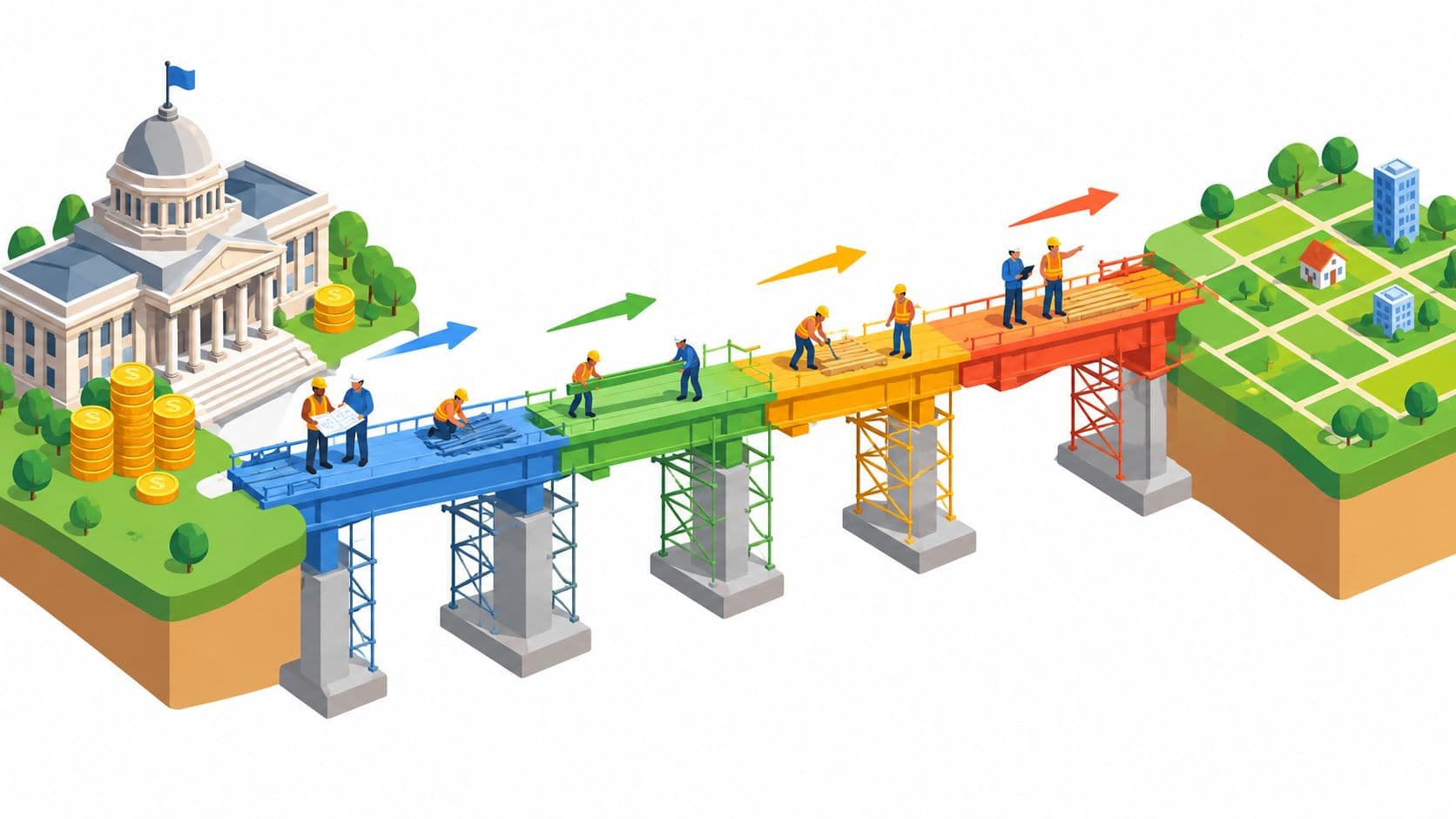
Transition planning is the coordinated, multi-year process of setting targets, actions, resources, and governance for moving from one policy or fiscal system to another, so the shift happens on a schedule rather than as a shock. In climate policy, expert guidance frames a credible plan around halving greenhouse-gas emissions by 2030 and reaching net zero by 2050 at the latest, while public-finance reform applies the same planning logic to taxes, land values, and public revenue.
You may be looking at a tax system that everyone agrees needs changing, yet nobody can explain how the change will work in practice. A finance ministry has approved a new revenue direction. A city council wants to reduce taxes on buildings or productive activity. Officials now face the difficult questions: who pays during the adjustment, when will rates change, which agency updates the records, and what happens if expected revenue arrives late?
That gap between a policy destination and a workable route is where transition planning matters. It turns a public announcement into an operating programme with milestones, decision rights, administrative preparation, and safeguards for people affected by the change.
Table of Contents
- Why Transition Planning Decides Whether Reform Succeeds
- Understanding the Core Concept of Transition Planning
- Key Components of an Effective Transition Plan
- Frameworks and Timelines That Structure the Transition
- How Land Leases and Land-Use Rights Actually Differ
- Transition Planning for a Shift to Land-Value Taxation
- Testing Credibility and Avoiding Common Transition Pitfalls
Why Transition Planning Decides Whether Reform Succeeds
A finance ministry announces a shift from taxes on buildings and work toward charges based on land value. The announcement may be popular with some groups and alarming to others. Property owners want to know how their bills will change. Employers want certainty about investment. Municipal treasurers want assurance that essential services won't lose funding during the switch.
The government doesn't yet need another slogan. It needs a route from the current system to the intended one.
Transition planning is that route. It is a coordinated, multi-year process for setting the outcomes, actions, resources, responsibilities, and governance needed to move from one policy or fiscal system to another. It answers practical questions that a policy announcement leaves open: what happens first, what depends on what, who has authority to act, and how officials will respond when the results differ from the model.
A useful comparison is rerouting a train while it's moving. The destination may be clear, but passengers still need service, tracks must connect, signals must work, and engineers need authority to stop or redirect the train if conditions change. A government that changes rates before its valuation system, legislation, appeals process, and revenue monitoring are ready is trying to rebuild the track beneath a moving train.
The distinction is explained well by the difference between phased implementation and a one-time policy change. Phasing isn't hesitation. It's a way to keep public services operating while institutions, households, and businesses adjust.
Practical rule: A destination describes the reform. A transition plan explains how people, money, law, data, and authority move together.
This article examines the anatomy of a credible plan, the frameworks that give it a timetable, and the land-value taxation example in detail. It also separates fixed-term land leases from true annually repriced land-use rights, a distinction that can determine whether a fiscal system recognises risk accurately or merely postpones it.
Understanding the Core Concept of Transition Planning
The phrase can sound technical, but the underlying idea is familiar. A school prepares a student for life after graduation. A company prepares for a leadership change. A government prepares to replace one revenue source with another. In each case, the organisation must preserve continuity while building the capabilities needed for a different future.
Transition planning is an ongoing, coordinated, multi-year process that connects defined outcomes with assigned responsibilities, sequenced actions, resources, governance, and measurable milestones.
That definition is broader than a document. A document can record intentions and still leave nobody responsible for delivery. A plan becomes operational when officials can identify the baseline, the next milestone, the decision-maker, the dependency, and the evidence that will show whether the transition is working.
Special-education transition planning makes this structure especially clear. State and technical-assistance guidance describes it as a coordinated process involving the student, family, school district, and other agencies, based on strengths, preferences, and interests and organised around post-school outcomes such as education and employment (New York State Education Department guidance). The policy area differs from public finance, but the mechanics are similar: the people affected participate, responsibilities are shared, and actions connect to an outcome beyond the immediate institution.
Climate transition planning uses the same logic at a larger scale. IFRS S2 defines a climate-related transition plan as part of an entity's overall strategy, setting out targets, actions, and resources for moving toward a lower-carbon economy. CDP guidance makes credibility more operational by framing a plan around time-bound action aligned with halving greenhouse-gas emissions by 2030 and reaching net zero by 2050 at the latest (transition-planning guidance from Accounting for Sustainability).
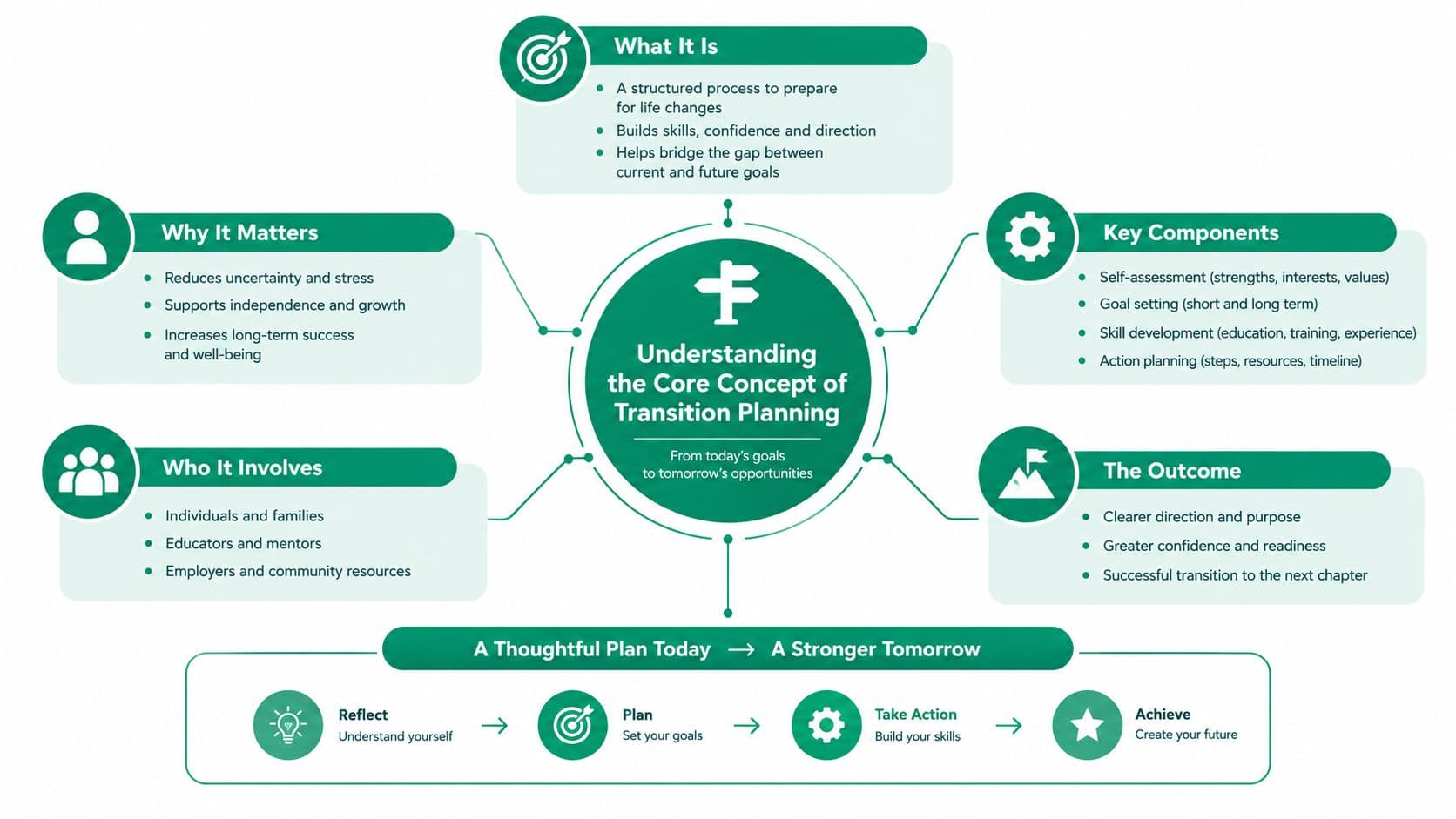
The bridge between two systems
Public-finance reform resembles rebuilding a bridge while traffic continues to cross it. The old tax system funds services today. The new system must become accurate, lawful, understandable, and administratively reliable before it can carry a larger share of the load.
Start with three terms:
- Baseline: The current tax base, rates, revenue pattern, legal authority, administrative capacity, and distribution of costs.
- Milestone: A dated, testable point such as completing a valuation audit, passing enabling legislation, or publishing a reassessment method.
- End state: The intended system and the conditions that define successful arrival.
Phasing matters because abrupt reform creates immediate winners and losers, even when the long-term design is sound. A planned sequence gives officials room to correct valuation errors, explain new bills, adjust exemptions or temporary protections, and monitor revenue before expanding the change.
The key question isn't merely whether a government has written a plan. It's whether the plan keeps traffic moving while the bridge is rebuilt.
Key Components of an Effective Transition Plan
A draft plan should be possible to audit. If a reader can't tell who acts, what changes, when it changes, and how officials will detect failure, the document is closer to a policy narrative than an implementation plan.
A fiscal transition normally needs four connected components. Stakeholder engagement identifies the groups affected and creates channels for objections, evidence, and revision. Phased revenue shifts prevent a single year from carrying the entire burden of change. Legal and administrative preparation converts the policy into enforceable rules and workable processes. Governance and measurement assign authority and track results.
The working parts
Stakeholder engagement starts with exposure, not public relations. Officials should map who gains, who pays, who may face a temporary cash-flow problem, and who holds information needed for implementation. A municipal government changing property charges might consult homeowners, renters, builders, lenders, employers, assessors, tax officers, local service providers, and elected representatives. The process should distinguish genuine design questions from objections that merely protect an existing advantage.
Practical stakeholder engagement strategies help officials move from a meeting schedule to a decision process. Each consultation should record the issue raised, the evidence supplied, the responsible authority, and the point at which the issue can still change the design.
Phased revenue shifts change the composition of revenue over time. If a city intends to reduce a tax on buildings while increasing a levy on unimproved land, officials can model the combined effect before changing either rate. They can then establish staged adjustments, publish the sequence, and specify what evidence would trigger a review.
Legal and administrative steps include legislative drafting, valuation rules, cadastre integration, billing arrangements, appeals, compliance workflows, staff training, and data governance. A legally valid tax can still fail if the authority can't identify the taxable land base or explain how an assessment was reached.
Governance and measurement give the plan an operating centre. A finance ministry may own the fiscal model, a valuation authority may own assessments, a legislature may control legal changes, and municipalities may administer collection. The plan should state who resolves conflicts and which indicators show whether revenue, distribution, compliance, and administrative quality are on track.
| Component | Purpose | Typical Owner | Common Failure Mode |
|---|---|---|---|
| Stakeholder engagement | Identify impacts, concerns, evidence, and workable protections | Reform ministry, municipality, public consultation team | Consultation becomes a checkbox after the design is fixed |
| Phased revenue shifts | Move the tax mix without concentrating the adjustment in one period | Finance ministry and treasury | Officials announce the destination but omit the rate path |
| Legal and administrative steps | Make the reform lawful, assessable, billable, and enforceable | Legislature, tax authority, valuation agency | Rates change before records, appeals, and staff processes are ready |
| Governance and measurement | Assign decision rights and test delivery against milestones | Cabinet, treasury, oversight body | No owner can act when assumptions or results change |
A strong plan also shows dependencies. For example, a new land charge may depend on a separate land-and-improvements valuation, which may depend on reliable cadastral records, which may depend on legal access to data. Naming those links exposes the actual schedule.
Frameworks and Timelines That Structure the Transition
A land-value tax reform can fail even when its destination is clear. Suppose a government plans to replace part of a building tax with a charge on land value. Valuers need time to separate land from improvements, taxpayers need time to understand new bills, and officials need evidence that revenue will not fall unexpectedly. The timetable is therefore part of the policy, not an administrative appendix.
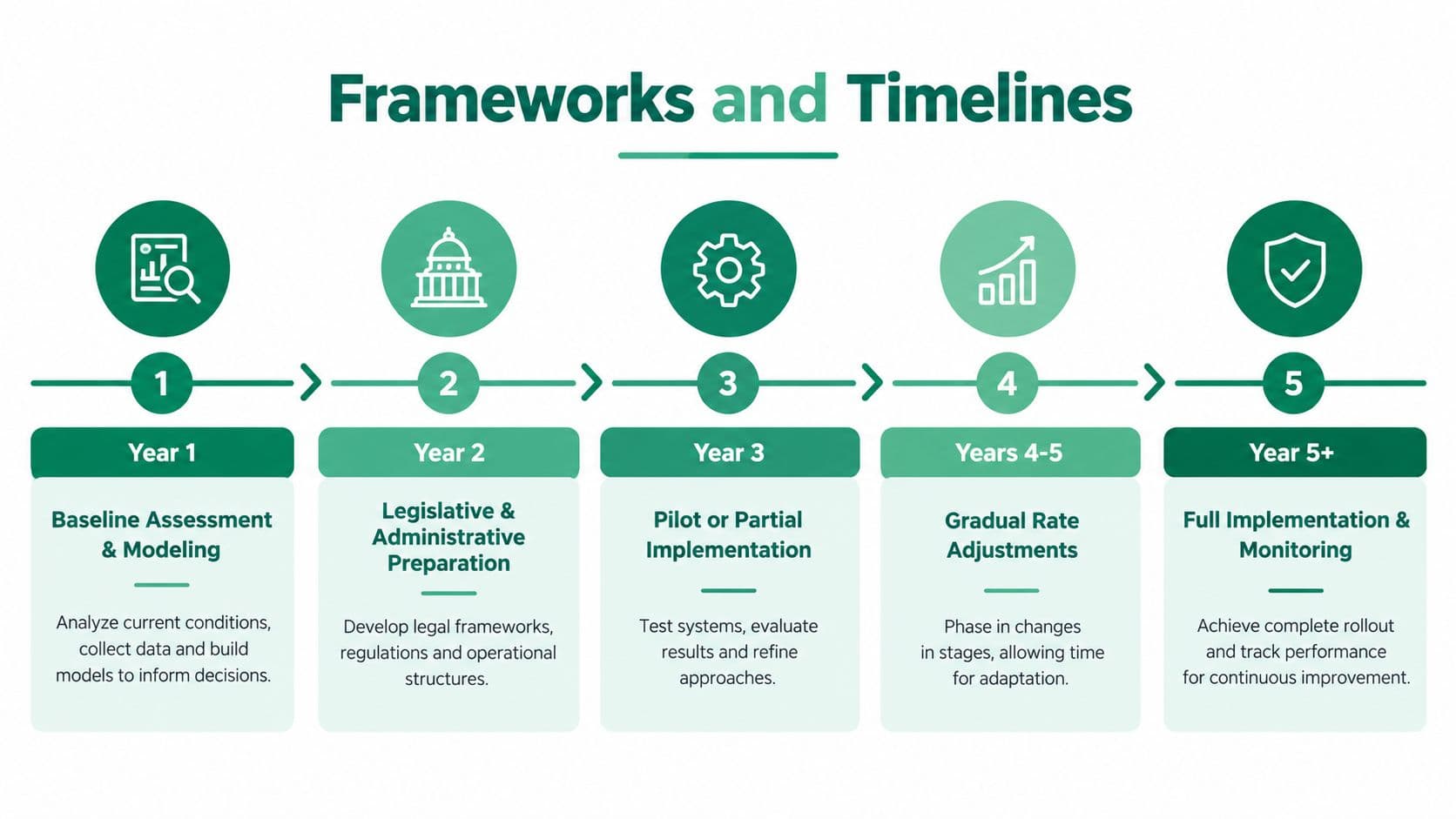
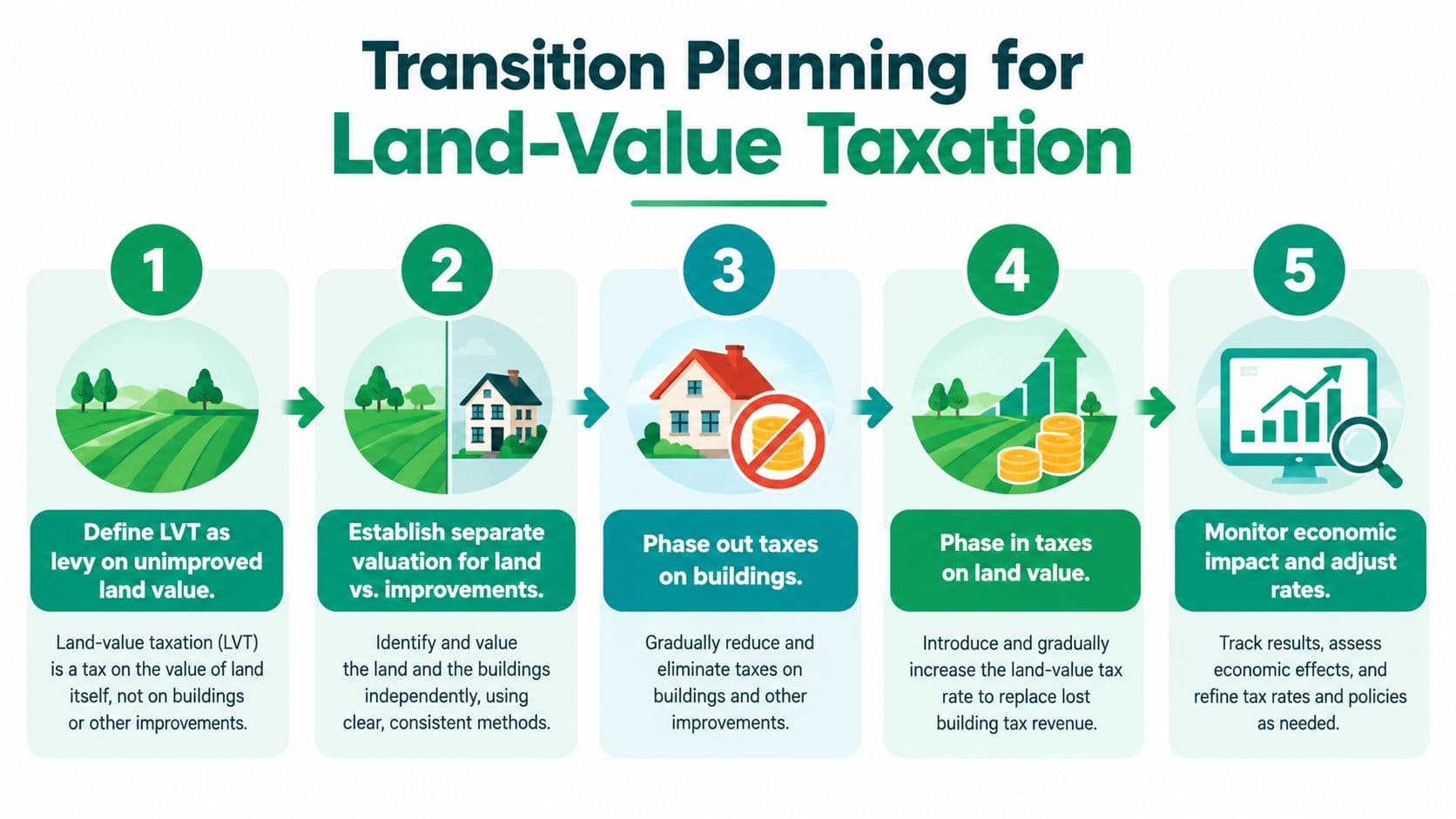
A practical public-finance roadmap can use five phases:
- Baseline assessment and modelling: record the current tax base, revenue flows, land records, legal powers, distributional effects, and administrative capacity. Model how different rate paths would affect households, businesses, and public income.
- Legislative and administrative preparation: draft the law, define valuation rules, assign responsibilities, prepare systems, train staff, and publish clear explanations.
- Pilot or partial implementation: test assessments, billing, appeals, data exchange, and public communication in a limited area or controlled part of the system.
- Scaled rollout with gradual rate adjustments: expand coverage while shifting revenue in stages. Monitor collection, compliance, affordability, and valuation disputes.
- Stabilisation and monitoring: correct errors, maintain valuations, review outcomes, and update the plan after the first milestone.
Why the timetable tests credibility
A list of phases without dates leaves the hardest choices unresolved. A credible timetable names the responsible institution, required inputs, decision gate, and contingency for each major step. Officials can use scenario-modelling software to compare revenue paths and distributional effects before selecting a rate sequence.
The schedule also needs room for failures that appear after launch. A valuation method may work in a pilot but become difficult to administer nationally. A tax authority may issue accurate bills yet lack staff to settle appeals. A government may model the first adjustment carefully while leaving later rate changes, reassessments, and protections undefined.
Reviews of corporate transition plans identify recurring weaknesses such as limited planning beyond 2030, vague blockers, poor disclosure of dependencies, weak opportunity analysis, and unclear governance (Transition Plan Project report). The same lesson applies to fiscal reform. Each phase should state what must happen first, who can approve the next step, and what changes if an assumption fails.
Singapore's Monetary Authority finalised transition-planning guidelines for banks, insurers, and asset managers in March 2026. The guidelines require a transition blueprint connected to business, risk, and finance, supported by governance, data, and metrics. A public-finance reform needs comparable discipline. Without dated decisions and accountable owners, a timetable describes intentions rather than controlling implementation.
How Land Leases and Land-Use Rights Actually Differ
Land-value tax discussions often become confused because people use lease, land-use right, and property interest as if they mean the same thing. They don't.
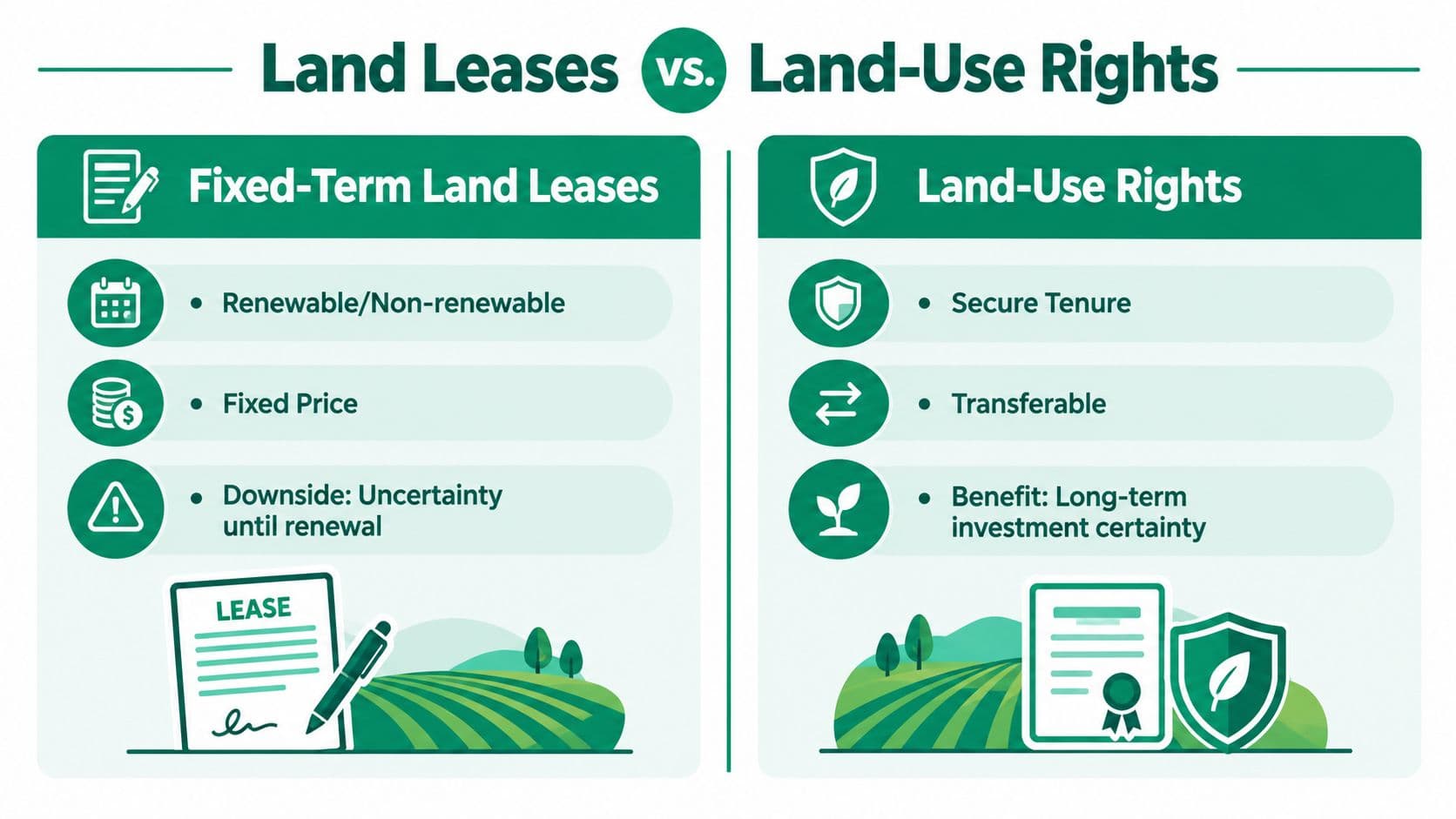
A land lease is a fixed-term arrangement. It can be renewable or non-renewable, and its price is fixed during the term. The arrangement may give the occupant contractual access for a period, but it doesn't remove the risk created by the expiry date or the gap between the fixed price and the land's market value.
A renewable lease provides certainty only until renewal. If the lease price has fallen below the market value during the term, renewal can close the accumulated gap through a major repricing. A non-renewable lease becomes progressively harder to refinance and sell as expiry approaches because the remaining term becomes shorter. Fixed pricing postpones risk. It doesn't price that risk away, as the explanation of fixed-term land lease risks makes clear.
Three tests for a true land-use right
A true land-use right, as used in this policy framework, differs from a fixed lease in three decisive ways:
- It has no expiration. The holder doesn't face a final expiry date.
- It requires no renewal. Continued use doesn't depend on negotiating a new term.
- It is repriced annually. The payment reflects current land value rather than a historical fixed price.
Annual repricing allows people to buy and sell land-use rights at low cost because buyers don't need to purchase a dwindling lease term or absorb a hidden repricing cliff. The right prices the land appropriately while leaving productive enterprises free to make long-term decisions about buildings, equipment, employment, and services.
| Question | Fixed-term land lease | True land-use right | Mislabelled “land-use right” |
|---|---|---|---|
| Does it expire? | Yes | No | Yes |
| Is renewal required? | Sometimes, including at the end of a renewable term | No | Often |
| Is the price repriced annually? | No, the price is fixed during the term | Yes | No |
| Where does risk appear? | At renewal, refinancing, sale, or expiry | Through regular annual pricing | Hidden until the fixed term creates pressure |
| Does the label settle the issue? | No | Only if all three criteria are met | No |
Sometimes a fixed lease is called a “land-use right.” That label doesn't change the legal or economic substance. If the arrangement expires, requires renewal, and keeps a fixed price rather than repricing annually, it's still a fixed lease under the criteria above.
This distinction matters for reform design. A government that treats a fixed-term lease as secure land tenure may underestimate refinancing and resale risks. A government that creates annually repriced, non-expiring rights can make land access more transferable and transparent, while collecting the changing rental value through a public charge. Discussions of 99-year land leases illustrate why the stated term alone doesn't answer the deeper question of how land value and risk are priced.
China's urban state-owned land-use rights show another important variation. Commercial land is typically granted for 40 years, industrial land for 50 years, and residential land for 70 years, with renewal requiring payment of a new premium and a new grant contract (China lease-agreement guidance from JunHe-20230228.pdf)). In the terminology used here, a fixed statutory term remains a fixed-term arrangement. It shouldn't be conflated with an indefinite right that is repriced annually.
Transition Planning for a Shift to Land-Value Taxation
A government considering land-value taxation starts with a mechanical definition. A land-value tax, or LVT, is a levy on the unimproved value of land, not on buildings or other improvements (Federal Highway Administration explanation of land-value tax). The distinction is practical: the tax base is the site and its location, while construction and productive improvements are treated separately.
The transition begins with information. Officials need a valuation framework that separates land value from improvement value, a cadastre that identifies parcels and interests, data on location and permitted use, and a process for updating assessments. They also need distributional and fiscal modelling. A reform can look attractive in aggregate while creating serious cash-flow problems for particular households, businesses, or local authorities.
The revenue path should then be staged. The government can phase down selected taxes on buildings or productive activity while phasing in the land-based charge, subject to the legal powers and fiscal needs of the jurisdiction. A revenue-neutral design may seek to keep total revenue stable while changing its source, but neutrality must be tested rather than assumed. Officials should model different rate paths, publish the assumptions, and identify temporary protections where the evidence supports them.
From policy design to administration
Legislative drafting must define the tax base, valuation method, liability, collection process, appeals, exemptions or reliefs, and review powers. Administrative teams must connect those rules to the cadastre, billing systems, taxpayer records, compliance workflows, and public guidance. Stakeholder education is part of delivery, not a final communications exercise. People need to understand why a building may not increase the tax base in the same way as the land beneath it, and how assessments can be challenged.
Documented precedents from Denmark, Estonia, Singapore, Canberra, and Pennsylvania practice show that land-value approaches can be incorporated into real fiscal systems. Their institutional settings differ, so they aren't plug-in templates. They are useful reference points for identifying valuation methods, rate structures, administrative choices, and political safeguards.
The lease distinction keeps the reform conceptually honest. If land payments remain fixed until a renewal cliff, the system still postpones risk. If land-use rights have no expiry, require no renewal, and are repriced annually, the public charge can track changing site value while productive investment remains distinct from the value of the location. A government designing a revenue-neutral tax reform should therefore test not only the headline rate, but also the timing and pricing mechanism beneath it.
Testing Credibility and Avoiding Common Transition Pitfalls
Having a transition plan doesn't prove that the transition is credible. A reviewer should ask whether the document can guide a real decision when revenue, data, politics, or administrative capacity diverges from the original model.
Use these tests:
- Check the phases: Are the actions dated, sequenced, and assigned to named institutions?
- Check the money: Does the plan show how revenue shifts in each phase, rather than only describing the final tax mix?
- Check dependencies: Does it identify the legal, data, valuation, staffing, and systems work required before rates change?
- Check authority: Can readers see who decides, who implements, and who can pause or revise the programme?
- Check the horizon: Does planning continue beyond the first milestone, including later reassessment and stabilisation?
- Check the pricing: Does the arrangement distinguish fixed-term lease risk from an annually repriced, non-expiring land-use right?
The common pitfalls are predictable. Symbolic plans describe ambition without delivery mechanics. Fixed prices postpone risk until repricing, refinancing, or expiry creates a cliff. Stakeholder engagement becomes a consultation checkbox. Administrative systems arrive after the legislation, leaving officials to issue new bills before they can explain or defend them.
The core lesson is simple: sequencing determines whether reform succeeds. A credible plan connects the destination to dated actions, responsible people, usable data, lawful authority, and feedback from those affected.
Unitism® helps governments and policy teams design land-value reform through valuation assessments, fiscal and distributional modelling, legislative drafting, cadastre integration, stakeholder education, and implementation monitoring. If your organisation is assessing a shift in the tax base or needs a practical roadmap for phased reform, visit Unitism® to explore its advisory and policy-design work.