What is market speculation? A clear guide to how it works, why it inflates land and housing prices, and the policy tools that curb speculative behaviour.
September 29, 2026
What Is Market Speculation and How It Moves Markets
What is market speculation? A clear guide to how it works, why it inflates land and housing prices, and the policy tools that curb speculative behaviour.

Market speculation is buying an asset to profit from future price changes rather than from its use or income, so the speculator's return depends on finding another buyer at a higher price. Its documented history runs from ancient Rome in the second century B.C. through Dutch tulips in 1620 and Miami condos in 2006, showing that the behavior repeatedly appears when expected resale gains overshadow underlying cash flows (IMF review).
Why can two people buy identical houses on the same street, yet only one be called a speculator? One buyer wants shelter. The other wants the next buyer's money. The building is the same, but the economic purpose is different.
That distinction matters far beyond stock markets. In land and real estate, speculation can influence housing costs, urban development, and public budgets because owners can gain from rising site values without producing additional housing or infrastructure. Understanding land economics and property rights makes the difference between productive investment and passive price betting easier to see.
Table of Contents
- What Is Market Speculation
- Investing Versus Speculating in Plain Terms
- How Speculation Works in Land and Real Estate
- Economic Impacts of Speculation on Prices and Cycles
- Land Leases Versus Land-Use Rights
- Policy Levers That Curb Speculative Behaviour
- Speculation Today in Faster Markets
- Key Takeaways on Market Speculation
What Is Market Speculation
What makes a purchase an investment rather than a speculative bet? The answer lies in what the buyer expects to produce the return. An investor values the asset's use or income. A speculator mainly expects its price to rise before a future buyer takes over.
Core definition: Market speculation is purchasing an asset primarily for capital gains from a future price change, rather than for productive use, consumption, or income.
Consider two people buying vacant lots. One plans to build apartments and earn rent. The other leaves the lot unused, waiting for neighborhood growth to support a higher resale price. Both may profit, yet the second person's return rests mainly on finding a buyer willing to pay more.
The asset itself does not have to be poor. It may be useful, scarce, or well located. Speculation describes the buyer's strategy, not necessarily the asset's quality. Success depends on a later price shaped by stronger expectations, easier credit, increased attention, or another shift in market sentiment.
A transaction record rarely reveals that strategy by itself. The same property can serve different economic purposes under different ownership plans. An owner-occupied house provides shelter. A rented house provides income. An empty house held only for resale reflects a different purpose, even though all three may look identical from the street.
Land makes the distinction especially important. Its physical supply is limited, while its value can change after a community adds roads, transit, parks, schools, utilities, or jobs. Owners may capture that increase without creating the public improvements behind it. Examining land economics and property rights clarifies how land-use decisions, public investment, and ownership rules shape speculative gains.
In real estate, a speculative bet is often a bet on the next buyer rather than on the asset itself. Lease structures and land-use rights can determine whether that risk is priced into a transaction or postponed until a later sale. That is why land provides a particularly clear setting for understanding market speculation.
Investing Versus Speculating in Plain Terms
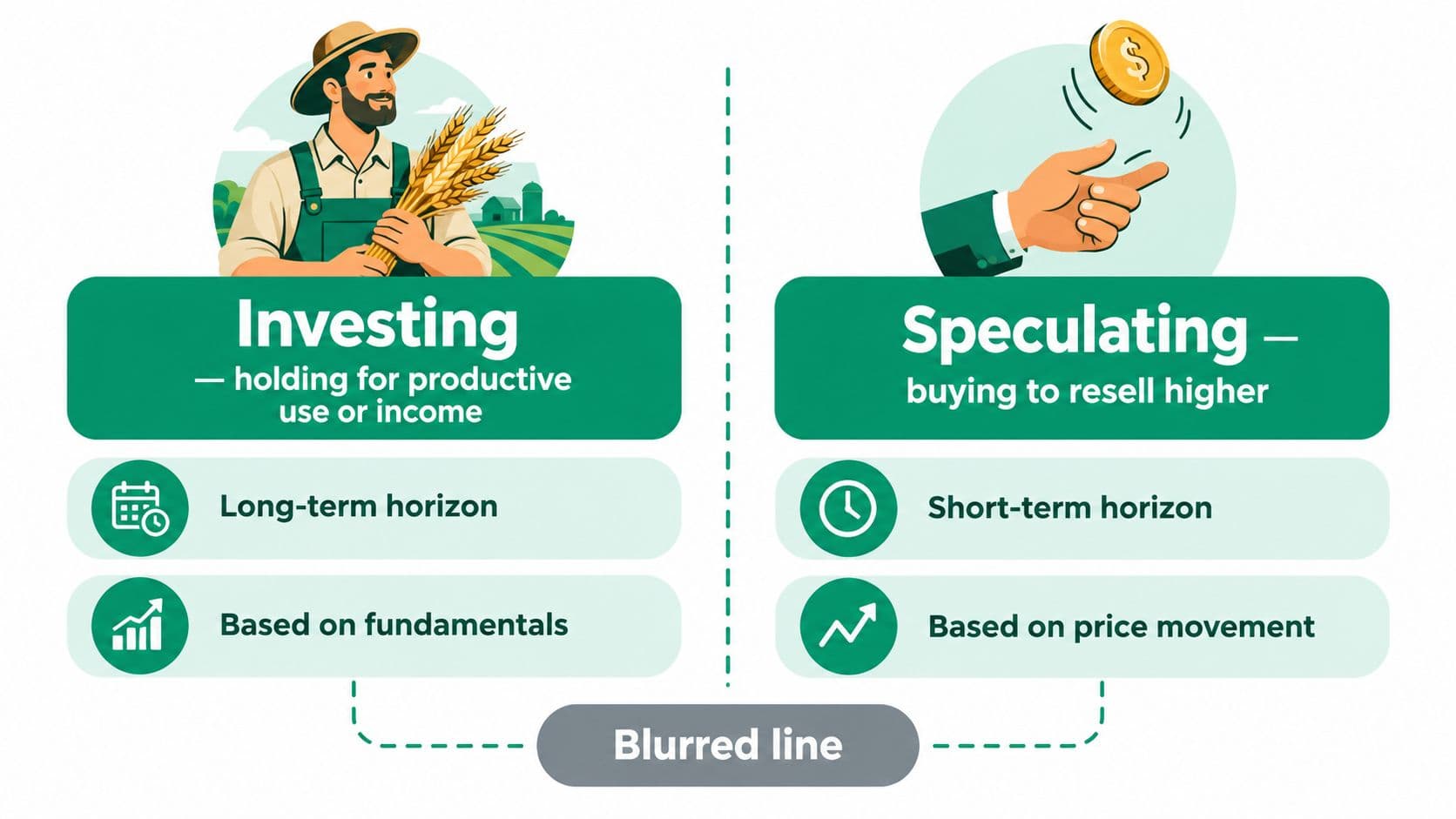
The clearest distinction begins with the source of the expected return. An investor asks what an asset will produce during ownership. A speculator focuses on what a later buyer might pay. The first is a claim on use or income. The second is closer to a bet on the next buyer than on the asset itself.
A farmer purchasing land to grow crops invests in productive capacity. Harvests, farm income, and continued use support the purchase. A farmer buying the same land only because a developer may later offer more is speculating on resale value. The land is unchanged, but the expected return comes from a future transaction rather than production.
This distinction also helps separate land, labor, and capital as different sources of economic value. An investment may expand production by combining them. Speculation can instead seek a price increase tied to scarcity, expectations, or a change in who controls an asset.
A practical test
Use three questions to classify a purchase:
- What produces the return? Rent, dividends, harvests, or operating income suggest investment. A hoped-for resale increase suggests speculation.
- What happens if prices stop rising? A productive asset may still justify its cost through use or income. A purely speculative position loses much of its appeal.
- What information drives the decision? Evidence about future earnings supports investment. Rumors, momentum, and expectations about the next buyer support speculation.
The boundary often blurs. A property owner may collect rent while expecting appreciation. A share buyer may value dividends but trade mainly on price movements. The useful question is whether capital appreciation is the dominant reason for holding the asset.
Market institutions have also changed how speculation appears. A market-history account describes late nineteenth-century speculation as investment in companies with little or no information, later shifting toward securities with uncertain dividends, and by the 1960s toward betting on higher resale prices (market-history discussion). The source identifies four epochs in the history of speculation in the United Kingdom, before about 1825, about 1825 to 1890, about 1890 to 1967, and from about 1967 onward.
More liquid markets made capital gains a larger part of trading decisions. Speculation is not automatically harmful. Traders who accept risk can provide liquidity and help incorporate information into prices. Their activity can also move prices away from underlying value, especially when each buyer relies on the expectation that another buyer will pay more. The outcome depends on whether trading improves price discovery or reinforces that expectation.
How Speculation Works in Land and Real Estate
Why can land speculation be so powerful? Land has a fixed physical supply, while households and businesses need access to it. Its value can also rise when nearby communities become more productive. Transport links, zoning decisions, utilities, and public services may create part of that increase, even when the owner has made no improvement.
A vacant city lot beside a planned transit connection shows the mechanism. An investor buys the site, leaves it unused, and waits. If the district becomes more desirable, developers compete for nearby locations and a later buyer may offer more. The investor is betting on the next buyer's willingness to pay, rather than earning a return by building, operating, or improving the property. This is the central pattern in speculation in land and real estate.
Why idle land can be a rational choice
The decision depends on holding costs and expected appreciation. If taxes, maintenance, and financing costs remain low compared with the expected price gain, delaying construction can appear financially sensible. The owner may wait while residents need homes and local firms need premises.
The effects are visible:
- Vacant sites stay unused as surrounding land becomes more valuable.
- Buildings may be underused when resale prospects appear better than rental or productive use.
- Development moves outward when central sites are withheld, adding pressure for sprawl.
- Housing prices include site expectations, not only construction costs and rents.
Lease structures and land-use rights determine who bears this waiting cost. A short lease, a use deadline, or a right that expires without development can make delay expensive. A long, transferable right with weak obligations can let the holder retain the location while waiting for a higher bid. These rules therefore price speculative risk into the site, or postpone it until renewal, resale, or development approval.
Officials should separate the building's value from the location's value. Construction creates a reproducible asset. Land value reflects access to a particular place and advantages produced by nature, community activity, and public action. When buyers capitalize expected appreciation into purchase prices, entry becomes more expensive for households and productive enterprises.
Historical episodes show that this pattern is not modern. An IMF review traces documented speculation to ancient Rome in the second century B.C. and discusses manias from Dutch tulips in 1620 to Miami condos in 2006 (historical review of speculation). For housing officials, a lending strategy from market data can organize evidence on credit conditions and local behavior. The policy question is who benefits from waiting, and who pays for land remaining idle.
Economic Impacts of Speculation on Prices and Cycles
Why can a price rise faster than the income or service an asset produces? Speculation shifts attention from the asset's present use to its expected resale value. A buyer may be betting less on the land, building, or stock itself than on finding the next buyer willing to pay more. That expectation can prompt earlier purchases and higher bids, making the original belief appear correct.
Experimental evidence supports more than a plausible explanation. Markets with more speculative traders show statistically and economically significant overpricing relative to fundamental value, indicating a measurable relationship between speculative behaviour and bubble formation (experimental evidence on speculation and bubbles).
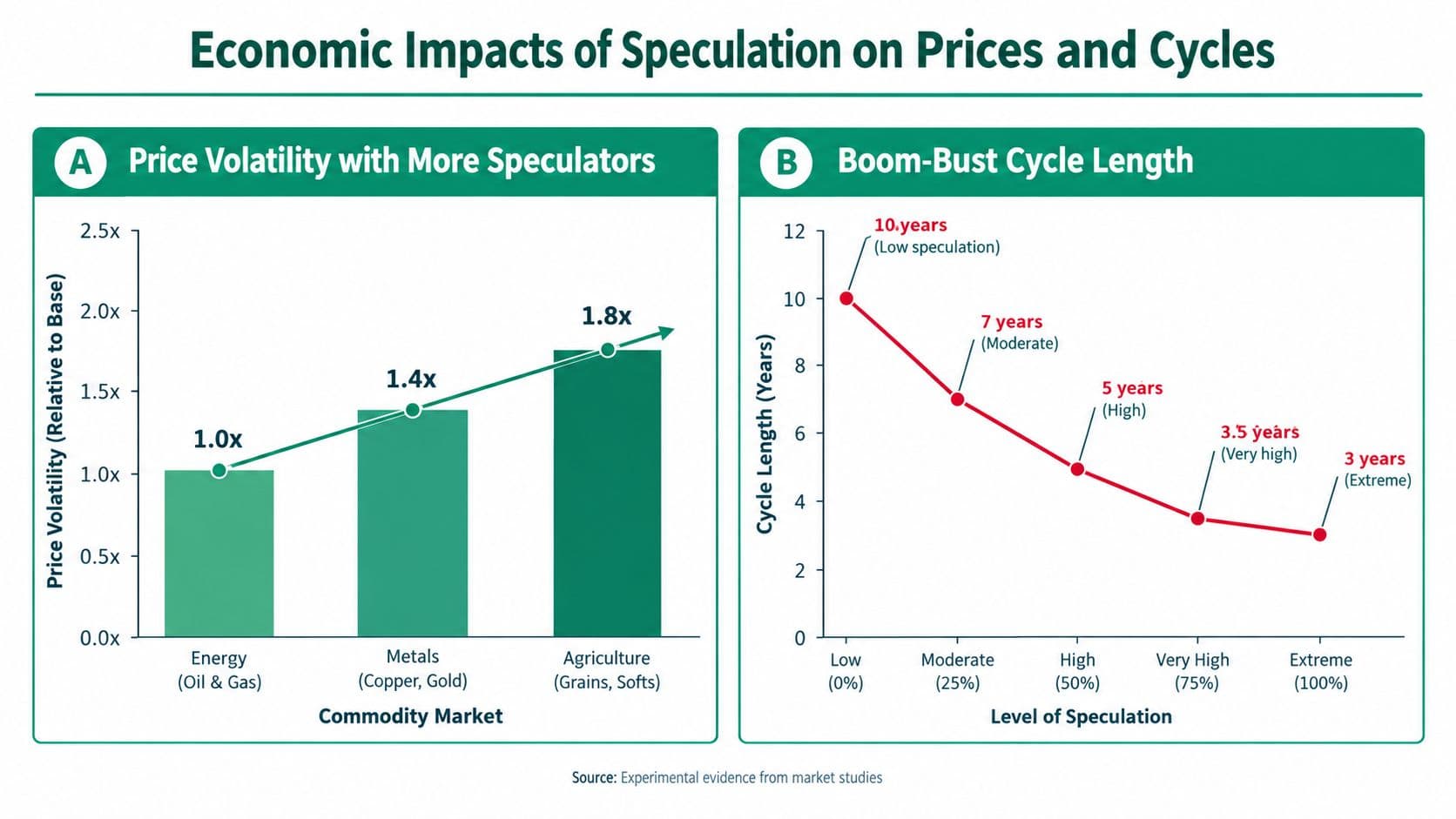
A boom-and-bust cycle often begins with a genuine improvement, such as a new transport route, easier credit, or stronger employment. Buyers then price in future appreciation as well as current rents or income. Rising quotations attract more traders, and each purchase appears to confirm the upward story. In land and real estate, the gap can widen when site values rise ahead of rents, wages, operating income, or construction costs.
The reversal can be equally self-reinforcing. Buyers withdraw or financing tightens, while owners who expected resale gains need to sell. If many hold the same expectation, forced sales push prices down together. Lease terms and land-use rules affect who bears this risk, because a deadline or repricing can force recognition of an inflated site value, while weak obligations can allow delay.
Public finance can follow the same cycle. A property boom may increase revenue from property-linked taxes, transaction charges, and development activity. A downturn can weaken those sources while demands for housing support, debt management, and public investment remain. Governments dependent on volatile property activity may therefore face budget pressure as economic conditions deteriorate.
Price movements also depend on the time horizon. A major review finds positive serial correlation at high frequency, weak negative serial correlation at long horizons, and predictive mean reversion when prices move away from fundamental proxies across stocks, bonds, foreign exchange, real estate, collectibles, and precious metals (evidence on return patterns and mean reversion). A short rise does not prove that underlying income has improved. Policy analysis should examine price movement and fundamental value separately.
Land Leases Versus Land-Use Rights
Could a land contract make speculation visible every year, or postpone it until the agreement ends? The answer depends on how the arrangement treats changing site value. A lease grants use and occupancy for a defined term and transfers only some property rights, such as use and income rights, rather than full ownership (land tenure concepts).
A fixed-term land lease sets an agreed price for that period. A renewable lease provides certainty only until renewal. If the site becomes more valuable while the payment stays fixed, the accumulated difference may be settled through one large repricing. A non-renewable lease creates a different pressure. As expiry approaches, refinancing and resale become harder because buyers face a shrinking period of use. Fixed pricing therefore postpones speculative risk rather than eliminating it, as explained in this analysis of land lease economics.
A true land-use right follows another model. It is indefinite, requires no renewal, does not expire, and is repriced annually. The annual update keeps the current site charge closer to changing market conditions. Buyers and sellers then have less reason to place a large premium on a distant renewal decision or an approaching expiration cliff. The contract prices land risk continuously, rather than leaving it for the next buyer to resolve.
Comparison of the two structures
| Feature | Fixed-Term Land Lease, Renewable | Fixed-Term Land Lease, Non-Renewable | True Land-Use Right |
|---|---|---|---|
| Duration | Defined term, with renewal possible | Defined term, with no guaranteed renewal | Indefinite |
| Price treatment | Fixed during the term | Fixed during the term | Repriced annually |
| Renewal | Required to continue | Not available as a right | No renewal required |
| Expiration | The lease term ends, then terms may change | Expiry creates a growing refinancing and resale problem | No expiration |
| Risk timing | Accumulated gap can be repriced at renewal | Risk becomes harder to sell or refinance near expiry | Risk is recognized continuously |
| Marketability | Can be affected by renewal uncertainty | Can deteriorate as expiry approaches | Interests can be traded at comparatively low cost |
The label alone does not settle the question. A fixed-term contract may be called a “land-use right,” yet still operate like a lease if its price remains fixed and its term ends. It qualifies as a true land-use right only when it is repriced each year, requires no renewal, and doesn't expire. This guide to long-term land leases shows why a long duration still differs from indefinite tenure.
Policy Levers That Curb Speculative Behaviour
A practical policy objective is to price land risk continuously instead of postponing it. An annual charge linked to current site value keeps the user's payment closer to what the location is worth. It also avoids the expiry scramble that can arise when a fixed lease nears renewal or termination.
The mechanism is simple. A vacant site with a charge reflecting its current rental value becomes costly to hold while waiting for appreciation. The owner must develop it, sell it to someone who will, or accept the continuing cost of delay. Speculation becomes a carrying-cost decision rather than a free option.
Aligning revenue with the source of value
Land-value capture instruments and site-value taxation apply this principle through different designs. They collect part of the rental value created by a location, instead of placing the main burden on wages, buildings, or productive investment.
A carefully designed system can:
- Tax the site separately from improvements, so construction does not automatically face the same burden as passive land holding.
- Capture publicly created value, including gains associated with infrastructure, planning decisions, and community growth.
- Support infill and redevelopment, because underused sites have a stronger financial reason to enter productive use.
- Reduce dependence on transaction booms, giving public budgets a broader and potentially steadier base.
- Protect productive enterprise, by shifting part of the burden away from work and capital used to build, operate, and employ.
The distinction between land and capital determines who bears the charge. A building results from labour, materials, finance, and management. A location is not produced by its individual owner in the same way. Charging for site value can therefore target the return from exclusive access to land while leaving more of the return from useful construction and enterprise intact.
Lease design determines whether that policy works immediately or only after a difficult adjustment. A true land-use right supports annual site charges because its price is updated each year, rather than fixed until a renewal or expiry event. The sourced commercial property valuation framework states that indefinite, non-expiring rights with annual repricing can be bought and sold at comparatively low cost, since their prices do not need to absorb years of mispricing or a looming expiration.
Implementation can combine valuation assessments, site-value maps, fiscal modelling, administrative safeguards, and phased transitions. The choice is institutional: annual price updates discourage speculative holding as part of the contract, while long fixed prices defer the risk until someone later has to absorb it.
Speculation Today in Faster Markets
The definition hasn't changed, but the venues have. NYDIG identifies three connected trends, an expanding supply of speculation markets, rising demand for speculative activity, and faster markets (analysis of speculation in attention-constrained markets).
Prediction markets, ultra-short-dated derivatives, and amplified retail products can make price betting feel immediate and app-like. Pew reports that combined monthly global trading volume on prediction markets rose from under $5 billion in September 2025 to about $24 billion in April 2026 (Pew analysis of prediction-market activity).

A contract on an election outcome, weather event, or short-lived price movement may look different from a vacant lot, but the central behavior is familiar. The participant seeks a gain from a change in price or probability, not from using the underlying event or asset.
That speed creates harder questions for regulators. Do these markets improve price discovery by aggregating dispersed information, or do they mainly monetize attention and encourage repeated risk-taking? Faster access can widen participation, but it can also make the distinction between investing, gambling, and information trading less visible to retail users.
Key Takeaways on Market Speculation
Market speculation is a bet on price change rather than productive use or income. The speculator buys because another buyer may pay more later.
Land is especially vulnerable because location is scarce, demand is broad, and public investment can raise site values without equivalent private production. Holding an empty or underused site can therefore become a rational strategy when the owner expects appreciation and faces little cost for waiting.
Fixed-term leases postpone this risk. Renewable leases can produce a repricing shock at renewal, while non-renewable leases become more difficult to refinance and sell as expiry approaches. True land-use rights do something different. They're indefinite, require no renewal, don't expire, and are repriced annually.
For policy makers, the practical direction is to capture land value continuously through suitable land-based charges, while avoiding unnecessary taxes on work, construction, and productive capital. Speculation will remain a feature of market economies, but its damage depends heavily on whether institutions price risk today or leave it for a future boom, renewal, or crash.
Unitism® helps governments and organizations assess land values, design land-value capture policies, model distributional and fiscal effects, and prepare implementation systems. To evaluate how annual repricing and land-based revenue could work in your jurisdiction, visit Unitism® and explore its research and advisory resources.