What is squatter settlements? This guide explains why they form, their impact on cities, and how land-use rights and policy reform can create lasting solutions.
July 11, 2026
What Is Squatter Settlements: A Guide to Causes & Solutions
What is squatter settlements? This guide explains why they form, their impact on cities, and how land-use rights and policy reform can create lasting solutions.
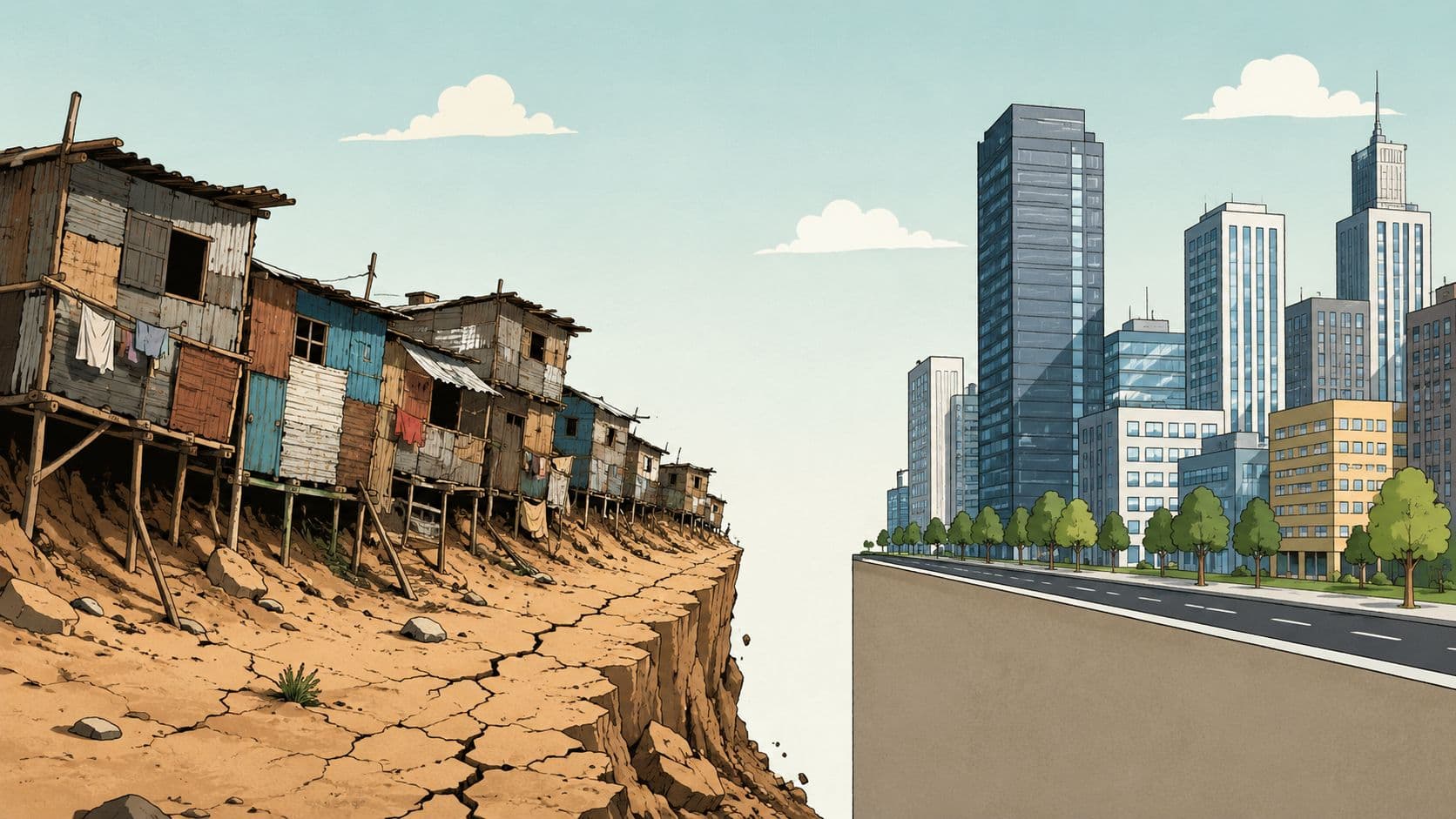
Squatter settlements are residential areas where people live without legal land rights, and they now house over 1 billion people worldwide. They are best understood not only as a housing problem, but as the visible outcome of urban land markets that price low-income residents out of lawful access to land.
Most public discussion still treats squatter settlements as a humanitarian emergency at the edge of the city. That framing is incomplete. When migration into cities runs ahead of formal housing supply, and when land is held or priced according to speculative value rather than productive use, informal occupation becomes a predictable response. For policymakers asking what is squatter settlements, the useful answer is not just definitional. It is economic. These settlements emerge where the formal system withholds affordable, secure access to urban land.
Table of Contents
- A Billion People on Borrowed Ground
- What Defines a Squatter Settlement
- The Root Causes of Informal Urban Growth
- The Human and Environmental Impacts
- The Legal Maze of Land Tenure Security
- From Temporary Fixes to Systemic Solutions
- A Solvable Problem of Land Economics
A Billion People on Borrowed Ground
The scale of the issue should change how governments think about it. The global population residing in squatter settlements has surged past 1 billion people, with Eastern and South-Eastern Asia at 370 million, sub-Saharan Africa at 238 million, and Central and Southern Asia at 227 million, together accounting for 80% of the total. Over two decades, that population increased by 165 million, a pattern documented in the UN SDG Goal 11 reporting.
That isn't a marginal urban phenomenon. It is a central feature of contemporary urbanization. Once a city absorbs people faster than it makes serviced land and lawful housing available, informal occupancy stops being exceptional. It becomes one of the main ways the city houses labor.
A housing lens alone misses the mechanism. Cities do not lack roofs alone. They fail to allocate land at terms low-income households can practically use. The result is a dual urban system. Formal land is rationed by price, procedure, and speculation. Informal land is accessed by occupation, negotiation, and risk.
Squatter settlements are often described as disorder. In practice, they are evidence that urban land still has users even when formal markets exclude them.
This is why policymakers should read the issue alongside the positive aspects of urbanization. Urban growth itself isn't the problem. The problem is that the gains from location, infrastructure, and rising site value are captured in ways that don't translate into affordable access for the people whose work sustains the city.
Three implications follow:
- The issue is structural: When informal settlement expands across multiple regions at this scale, it can't be explained as isolated illegality.
- The issue is fiscal: Cities often create land value through roads, transit, and public services, yet fail to recover that value for public benefit.
- The issue is political: If tenure remains insecure, residents stay exposed to eviction and underinvestment even when they occupy valuable urban sites.
What Defines a Squatter Settlement
A squatter settlement is not merely a poor neighborhood. Its defining characteristic is occupation without secure legal tenure. Buildings may be modest or durable, communities may be temporary or long-established, and incomes may vary. But the legal relationship to land is the decisive factor.
The legal test comes first
The most reliable definition starts with land rights. As summarized in the Wikipedia overview of squatting, squatter settlements are characterized by the absence of legal land tenure. That lack of secure rights matters because it prevents residents from accessing credit or investing in permanent improvements, even when the underlying land has substantial urban value.
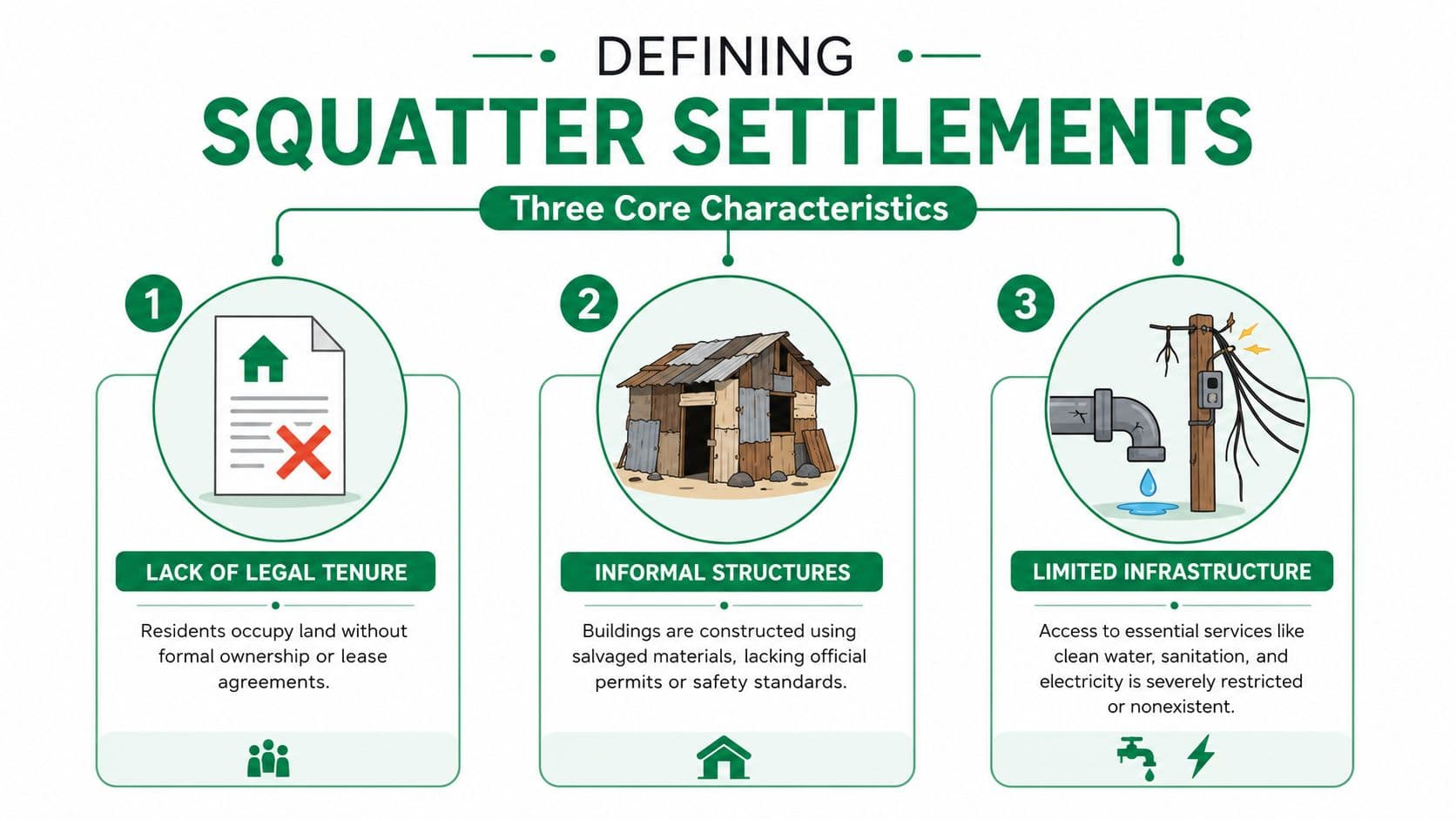
Three features usually appear together:
- No legal tenure: Residents occupy land without formal title, lease, or recognized long-term right of use.
- Informal structures: Homes are often built outside formal permit systems and without recognized compliance pathways.
- Limited infrastructure: Water, sanitation, roads, drainage, and electricity are unreliable, improvised, or absent.
A useful analogy is a house built on quicksand. The walls may stand for years. Families may improve them carefully. Shops may operate from the front room. Yet every investment sits on unstable legal ground. That instability changes household decisions. People choose what can be moved, hidden, or rebuilt, not what is most productive in the long run.
Why tenure insecurity changes everything
Many general guides on what is squatter settlements stop too early. They describe visible deprivation but not the institutional logic underneath it. Tenure insecurity does more than raise eviction risk. It distorts the entire local economy.
Consider the practical consequences:
| Condition | Immediate effect | Longer-term consequence |
|---|---|---|
| Insecure land rights | Residents can't prove lawful occupancy | Credit access stays limited |
| No recognized address or parcel status | Utilities and service extension become harder | Infrastructure arrives late or not at all |
| Informal building status | Home upgrading stays incremental and defensive | Capital formation remains weak |
Practical rule: If a household can lose the land, it won't invest in that land the same way a secure household would.
That is why tenure separates a squatter settlement from other low-income districts. Poverty can exist in legal housing. Poor infrastructure can exist in neglected formal neighborhoods. A squatter settlement combines hardship with a missing legal foundation.
The Root Causes of Informal Urban Growth
The common mistake is to treat squatting as a personal choice detached from institutions. In most cities, it is a rational response to exclusion. People move because urban labor markets offer income opportunities. They settle informally because formal land and housing systems don't offer an entry point they can afford.
A market exclusion problem, not a moral failure
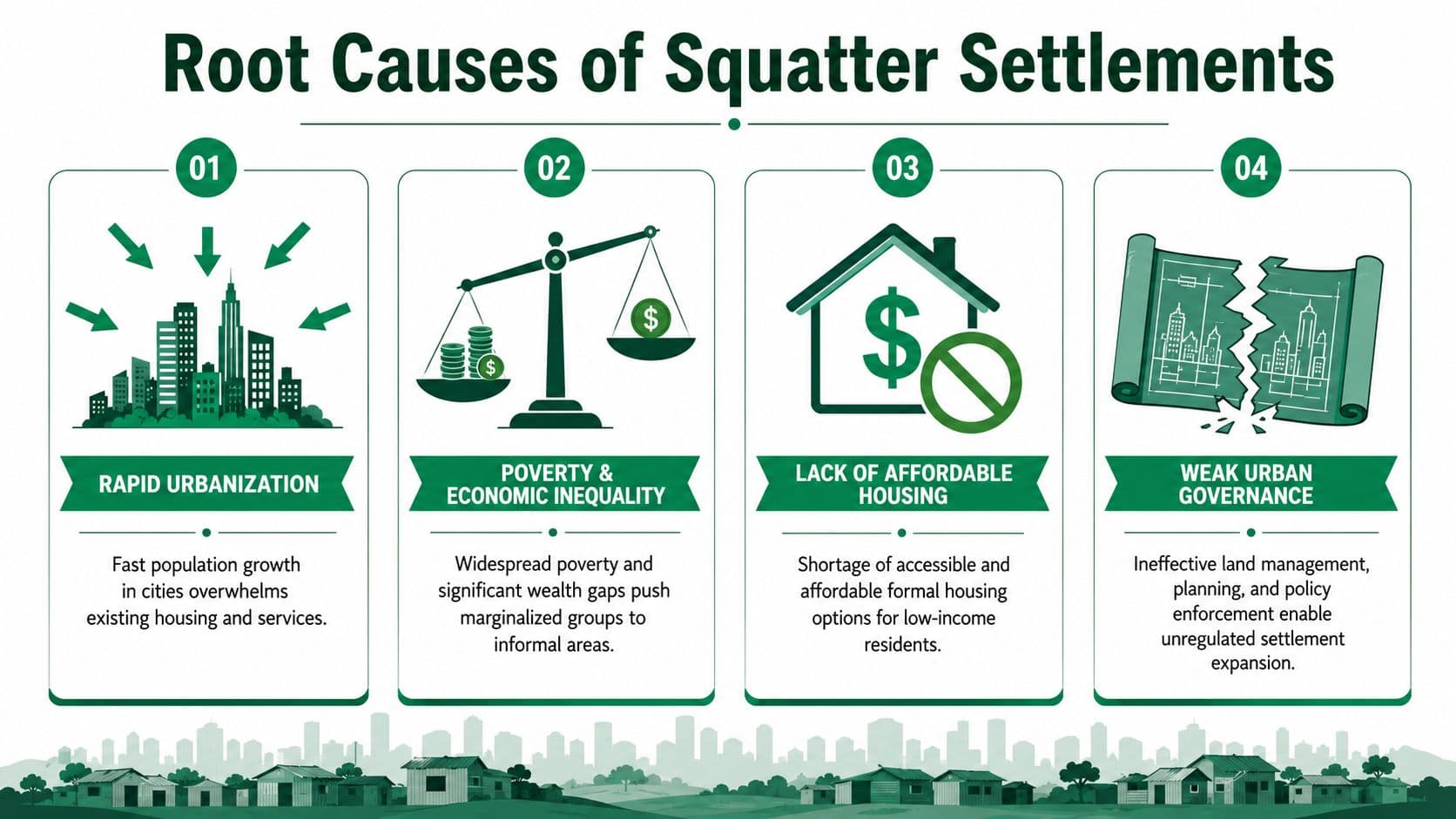
Several drivers recur across countries. Migration into cities often outpaces housing production. Formal land prices rise beyond what low-income migrants can pay. Municipal approval systems are slow or inaccessible. Public housing programs frequently miss those with the lowest and least documented incomes.
The result is straightforward. If lawful entry into the city requires money, documentation, and waiting periods that a household cannot meet, then occupation of vacant or weakly enforced land becomes the fallback option. That's why the deeper issue isn't just construction volume. It is access to land on workable terms. The analysis of why housing is unaffordable is relevant here because housing prices often reflect land scarcity, speculation, and regulatory barriers more than the cost of building itself.
What Addis Ababa shows clearly
A useful empirical example comes from Addis Ababa. In a study of new squatter households summarized by Albert, 49% were driven by site-related pulling factors such as land availability, while unaffordable formal land prices also played a major role. The same account notes that the problem was compounded by urban policy failures and by the inaccessibility of government housing schemes for households living near the poverty line.
That case matters because it reveals the mechanism. The key signal is not solely poverty. It is where land is available and under what terms. When households cluster around available sites, policymakers should ask why those sites are the only land they can reach.
Three root causes stand out in policy terms:
- Land availability without legal access: Vacant or underused land exists, but lawful pathways into it are blocked.
- Formal prices detached from use value: Land is priced for exchange, holding, or speculative gain rather than for immediate residential use.
- Administrative exclusion: Households near the poverty line often can't enter official schemes that require deposits, paperwork, or waiting periods.
The informal city usually appears where the formal city withholds affordable land, not where people reject legality for its own sake.
This is why simplistic enforcement rarely works. It targets the visible outcome while leaving the land market incentive intact.
The Human and Environmental Impacts
Once a settlement forms without legal security and without networked infrastructure, the costs spread well beyond shelter quality. They shape household finance, public health, land use, and city resilience.
The poverty trap is institutional
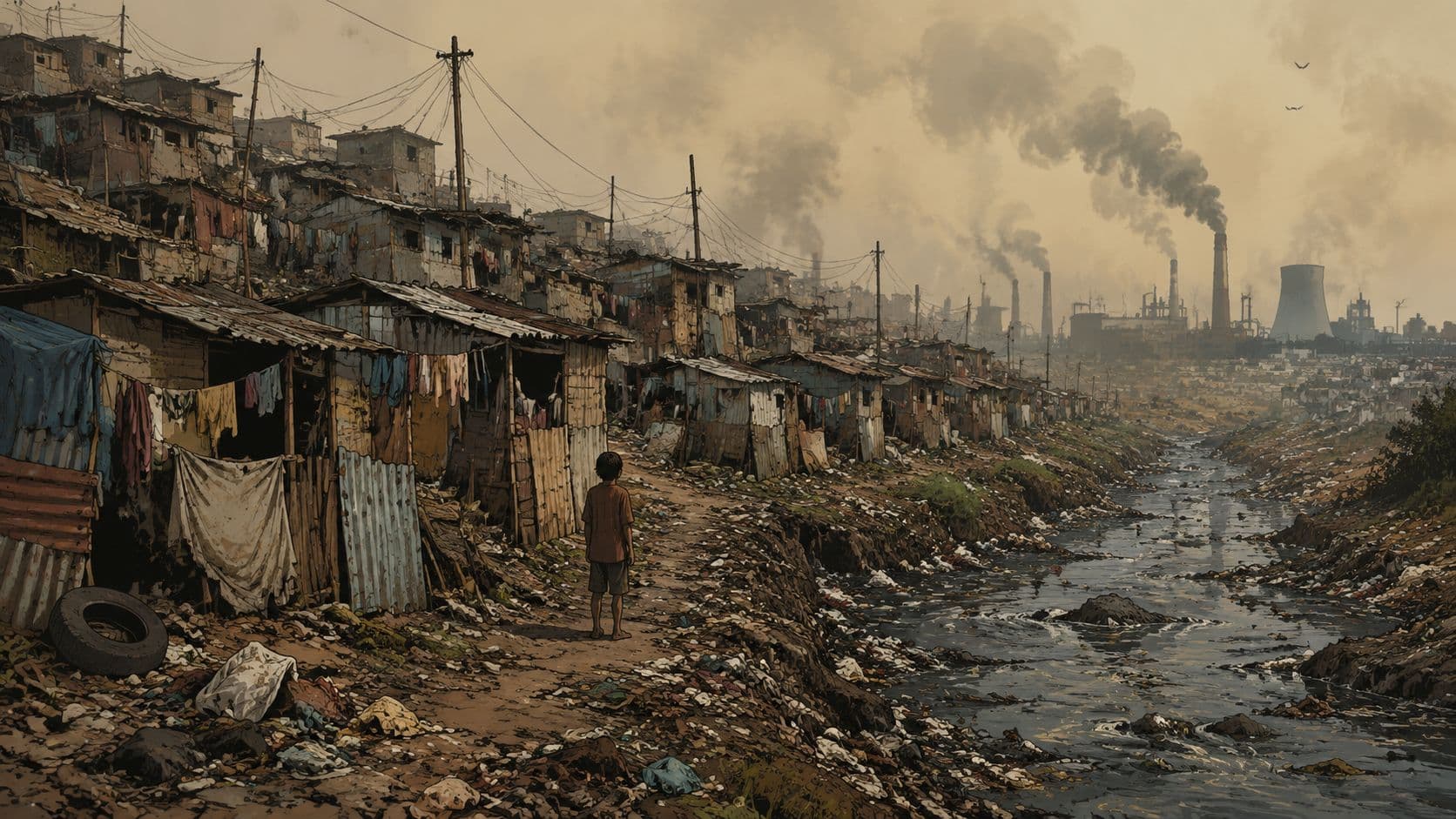
The most damaging feature isn't always visible in a photograph. It is legal exclusion from the formal economy. According to the Anthropology and development analysis published through ARF Journals, the lack of secure tenure and basic infrastructure such as water, sanitation, and roads leads to severe flooding risks, poor housing conditions, social instability, and uneconomic land use. The same source notes that the absence of legal status prevents residents from converting dormant land capital into liquid financial capital.
That phrase matters. If a family has occupied and improved a plot for years, but the legal system does not recognize their claim, the property cannot reliably function as collateral, a transferable asset, or a secure base for business expansion. Labor remains informal because land remains informal.
A policymaker should read the impacts through four channels:
- Household finance: Families struggle to borrow, insure, or plan long term.
- Service delivery: Utilities and roads are harder to extend when parcels and rights are unclear.
- Public order: Uncertainty over occupancy encourages conflict, patronage, and selective enforcement.
- City productivity: Valuable urban land remains under-serviced and legally frozen.
Hazardous land becomes the default option
Informal settlements often occupy steep slopes, flood-prone land, river buffers, or other locations the formal sector has avoided. That pattern isn't random. Unsafe land is often the only land left accessible to households who cannot buy, lease, or enter state housing channels.
The environmental and urban planning consequences are cumulative:
- Flood exposure rises when drainage is absent and settlement expands into water-sensitive areas.
- Health risks deepen when water and sanitation systems remain improvised.
- Land use becomes inefficient because settlement occurs where the legal system is weakest, not where infrastructure can be delivered best.
A city pays for informal land allocation twice. First through exclusion, then through emergency response.
This is why humanitarian responses, while necessary, can't be the endpoint. If governments improve services without fixing the tenure and land-access problem, they treat the symptom while leaving the production line of informality intact.
The Legal Maze of Land Tenure Security
Tenure security sounds simple until governments try to implement it. In practice, land rights sit on a spectrum. Some residents have no recognized claim. Others may hold customary, community, or tolerated occupancy rights. A smaller group may eventually obtain registered title. The legal challenge is that cities often have to govern this spectrum long before they can fully formalize it.
Tenure is a spectrum
Policy debates often collapse everything into a false choice between illegality and title. That's too crude. Urban land systems can recognize graded rights of occupancy, use, transfer, inheritance, and development. A family does not need full freehold title on day one to gain practical security.
The more useful question is this: what right does the resident need now in order to invest, remain stable, and connect to infrastructure legally?
That is where land-use rights become important. A land-use right gives a person or household legally recognized authority to occupy and use land under defined conditions, even if the state or another entity retains underlying ownership. For low-income urban settlements, that can be more workable than immediate full privatization.
A staged tenure framework can include:
- Occupancy recognition, which reduces arbitrary eviction.
- Use rights, which permit residence, upgrading, and service connection.
- Transfer or inheritance rules, which stabilize family planning.
- Full title where appropriate, once mapping, valuation, and planning catch up.
Why governments hesitate
Governments often hesitate for understandable reasons. Land records may be incomplete. Competing claims may exist. Officials may fear rewarding recent occupation, triggering political backlash, or losing control over future planning. Municipal finance systems may also depend on legal categories that informal areas don't fit.
Residents face a different dilemma. They know that investing in stronger structures without legal protection can increase the value of something they still might lose. So both sides wait. The city withholds recognition. The household withholds investment. The settlement hardens in limbo.
Secure tenure isn't a symbolic gesture. It is the minimum legal platform required for infrastructure, finance, and orderly urban development.
That is why “just give titles” is too simplistic, but “wait for perfect cadastral order” is also a mistake. The practical path sits between those extremes.
From Temporary Fixes to Systemic Solutions
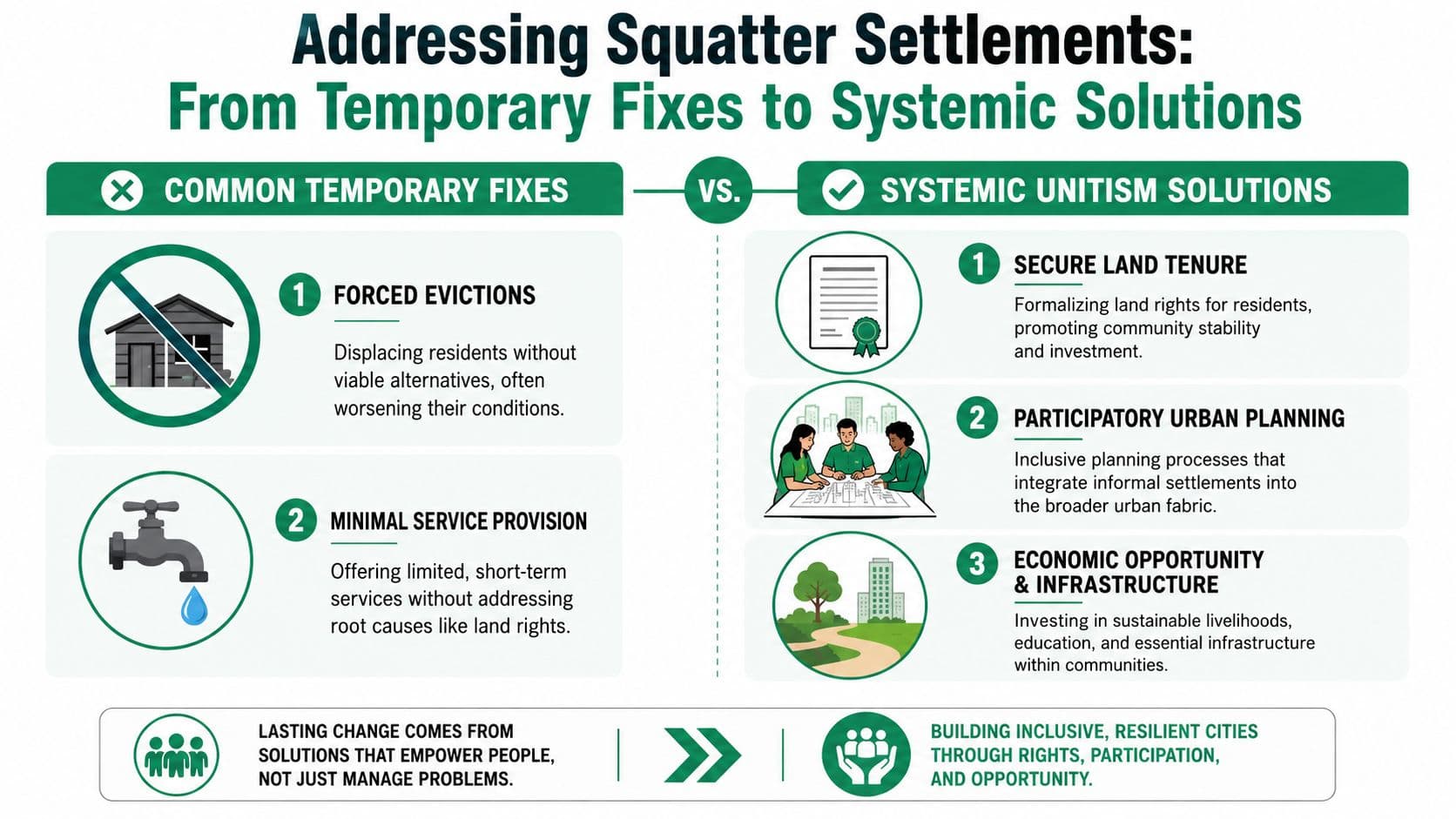
The standard policy menu is familiar. Evict, relocate, or upgrade basic services in place. Each tool has a role in limited circumstances, but none is sufficient if the city keeps producing land scarcity for the poor.
Why emergency responses keep falling short
Forced eviction can clear a site, but it doesn't create lawful affordability elsewhere. Minimal service provision can ease immediate hardship, but if tenure remains insecure, residents still face a weak basis for investment and credit. The deeper problem is that these responses rarely alter the economics of land access.
The GDRC discussion of squatter settlement dynamics identifies a neglected point. Current approaches often fail to explain how granting secure tenure converts dormant capital into liquid assets for the poor. It also highlights that 49% of new squatters were driven by site-related pulling factors, pointing to land availability and speculation as the core issue. That matters because a city cannot upgrade its way out of a land market that keeps excluding new entrants.
For policymakers, the first discipline is diagnostic. Ask what produced the settlement:
| Response | What it addresses | What it leaves unresolved |
|---|---|---|
| Eviction | Immediate legal conflict over a site | Affordability and land access |
| Basic upgrading | Current service deficits | Future informal expansion |
| Tenure reform | Investment incentives and legal security | Needs fiscal and planning integration |
| Land policy reform | Speculation and site access | Requires administrative capacity |
Why land-use rights should come first
My view is that governments should prefer land-use rights over land-value taxes as the first step in settlement reform. That doesn't mean abandoning land-value capture. It means sequencing policy correctly.
Land-use rights are the legal rights to occupy and use land for a defined purpose, often without requiring full private title. They matter because they can lower entry barriers and stabilize households before a city tries to optimize taxation. In fragile informal areas, rights to use land productively are more urgent than immediate taxation of site value.
Virginia offers a useful analogy. In its use-value taxation system, agricultural land must be at least 5 acres and forestal land at least 20 acres to qualify, and the land is taxed according to its class of use rather than speculative fair market value, as explained in the Virginia land use-value assessment FAQ. The lesson isn't that urban squatter settlements should copy those acreage thresholds. It is that governments already know how to value land according to use rather than speculative price.
That principle has direct urban relevance:
- Use-based recognition lowers barriers: Residents gain lawful standing tied to occupancy and improvement.
- Speculative withholding becomes less attractive: The system favors active use over passive holding.
- Infrastructure planning becomes easier: Utilities can connect to recognized users, not just disputed plots.
Policy test: If a reform raises legal certainty for actual users without rewarding idle speculation, it is moving in the right direction.
A related precedent comes from split-rate property taxation. The Chicago Fed's discussion of split-rate tax systems notes that over 100 U.S. municipalities have adopted them, and that Pittsburgh used a 2:1 split taxing land at twice the rate of improvements. The relevance is mechanical. Tax systems can separate the treatment of land from buildings, reducing penalties on construction while increasing pressure on underused sites.
How land-value capture fits after use rights
Once residents hold secure use rights and the city invests in roads, drainage, sanitation, and legal recognition, land values usually rise. That uplift should not be privatized entirely. It was created partly by public action and by the surrounding city.
Here is where land-value capture enters, but as a second move rather than the opening move. A city should first secure use. Then it should recover part of the site value generated by public investment and urban growth to fund continued services.
Canberra is an important precedent. The Local Housing Solutions overview of land-value taxation describes how Canberra implemented a system in 1992 that taxes the unimproved value of land while disregarding buildings and improvements. The policy has been credited with increasing housing supply by reducing the cost of new construction and discouraging land hoarding. That logic is directly relevant to cities struggling with speculative vacancy and inaccessible land.
Denmark shows the fiscal side. The Wikipedia entry on land value tax notes that Denmark's ejendomsskat has been levied since 1920 at approximately 1.5% to 2.0% on the unimproved value of land, excluding structures. The significance for policymakers is not ideological. It is operational. A land-based revenue instrument can fund public services while reducing the incentive to sit on appreciating sites.
The sequencing is the key insight:
- Recognize and secure land use.
- Regularize settlement form and service delivery.
- Capture part of the resulting land value uplift for the public.
- Reduce reliance on taxes that punish building, labor, and productive investment.
That sequence avoids a common error. If governments start with value extraction before residents gain legal security, reform will look punitive. If they secure use rights first, then recover part of the publicly created site value, reform becomes legible, fair, and durable. The broader debate on housing affordability policy sits inside this same logic. Affordable cities need more than housing programs. They need land systems that reward use and recapture socially created value.
A Solvable Problem of Land Economics
Squatter settlements aren't an unavoidable byproduct of poverty. They are the recurring result of land systems that protect speculative gain more reliably than lawful access for users. Cities can change that. Secure use rights first, then capture land value for public benefit, and the informal housing crisis becomes far more governable.
Unitism® helps governments, cities, and policy teams design practical land-based reforms that improve housing affordability, reduce speculation, and fund public services more fairly. If you're working on tenure reform, land-value capture, or the fiscal architecture behind urban inclusion, explore Unitism® for research, policy design support, and implementation guidance.