Discover the powerful positive aspects of urbanization, from economic growth to social innovation. Learn how smart policy can build thriving, equitable cities.
July 4, 2026
Positive Aspects of Urbanization: Building a Better World
Discover the powerful positive aspects of urbanization, from economic growth to social innovation. Learn how smart policy can build thriving, equitable cities.
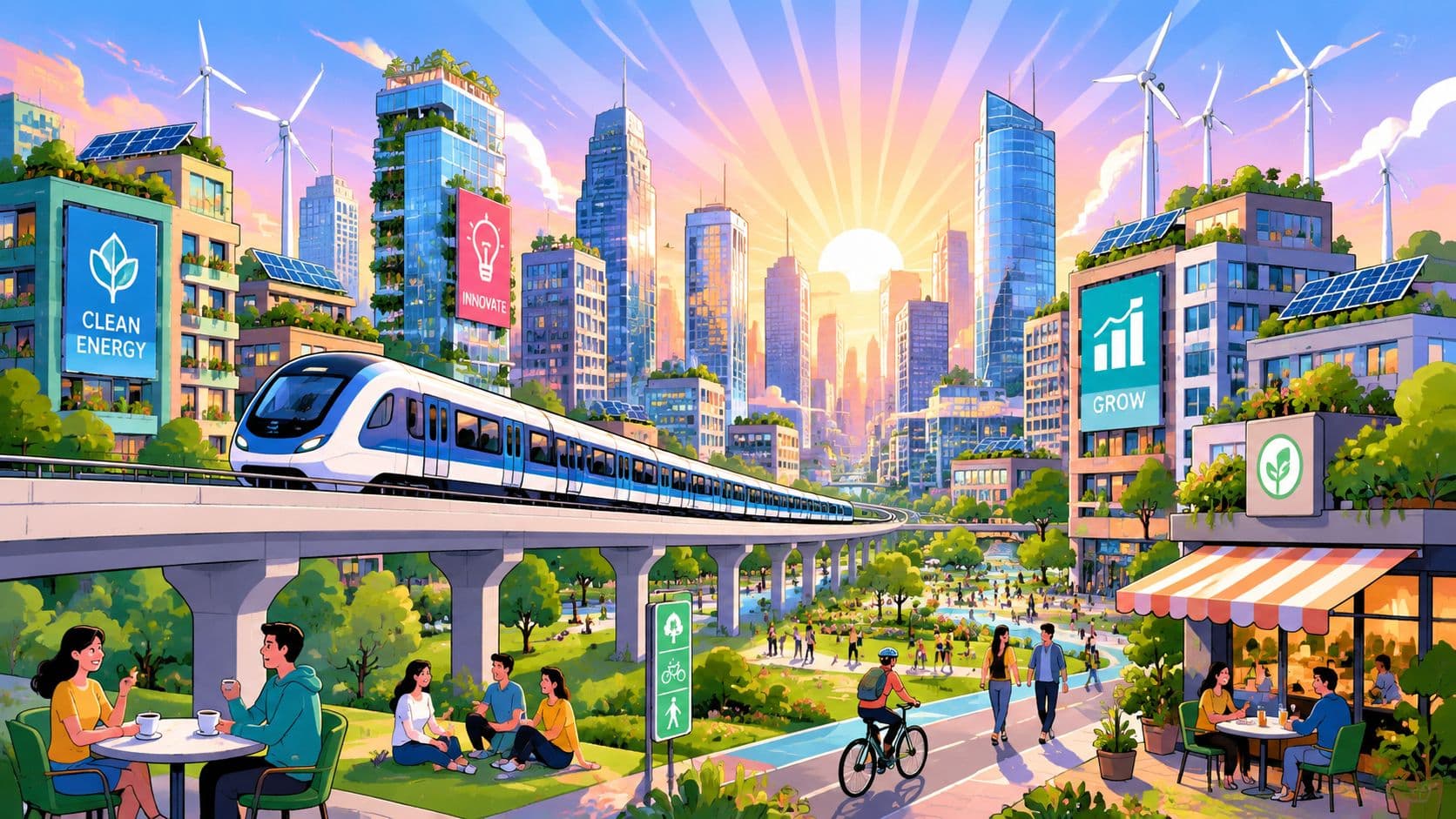
By 2050, nearly 7 out of every 10 people in the world will live in urban areas, adding another 2.5 billion people to cities. That projection changes the usual conversation about urbanization. The question isn't whether cities matter. It's whether we'll shape them well enough to turn growth into shared prosperity.
Many people hear “urbanization” and picture congestion, high rents, and stressed infrastructure. Those problems are real. But they aren't proof that cities fail. They're signs that the rules governing land, housing, transport, and public finance are often misaligned with how cities create value.
The positive aspects of urbanization become much clearer when we stop treating cities as accidental piles of buildings and start seeing them as coordination systems. Cities bring people, tools, services, ideas, and institutions into closer reach. That closeness can make life more productive, more creative, and more sustainable. It can also make life more expensive when public value gets diverted into rising land prices instead of recycled back into the community.
A practical urban economics view starts with optimism and ends with policy. Cities can be our greatest tool for progress, but only if we get the ground rules right.
Table of Contents
- Cities as Our Greatest Hope
- The Economic Engine of Agglomeration
- The Innovation Factory of Culture and Progress
- The Efficiency Advantage in Services and Environment
- The Urbanization Paradox and Its Root Cause
- Unlocking Urban Potential Through Land Value Capture
- Forging the Equitable and Thriving Cities of Tomorrow
Cities as Our Greatest Hope
Urbanization is often framed as a burden to manage. A better frame is this. It's humanity concentrating its problem-solving capacity. When people live and work near each other, they can build more together than they can apart.
That doesn't mean every city works well. Some are exclusionary. Some are fragmented by bad transport, speculative landholding, or weak public finance. But those are failures of design and governance, not evidence that cities themselves are a mistake.
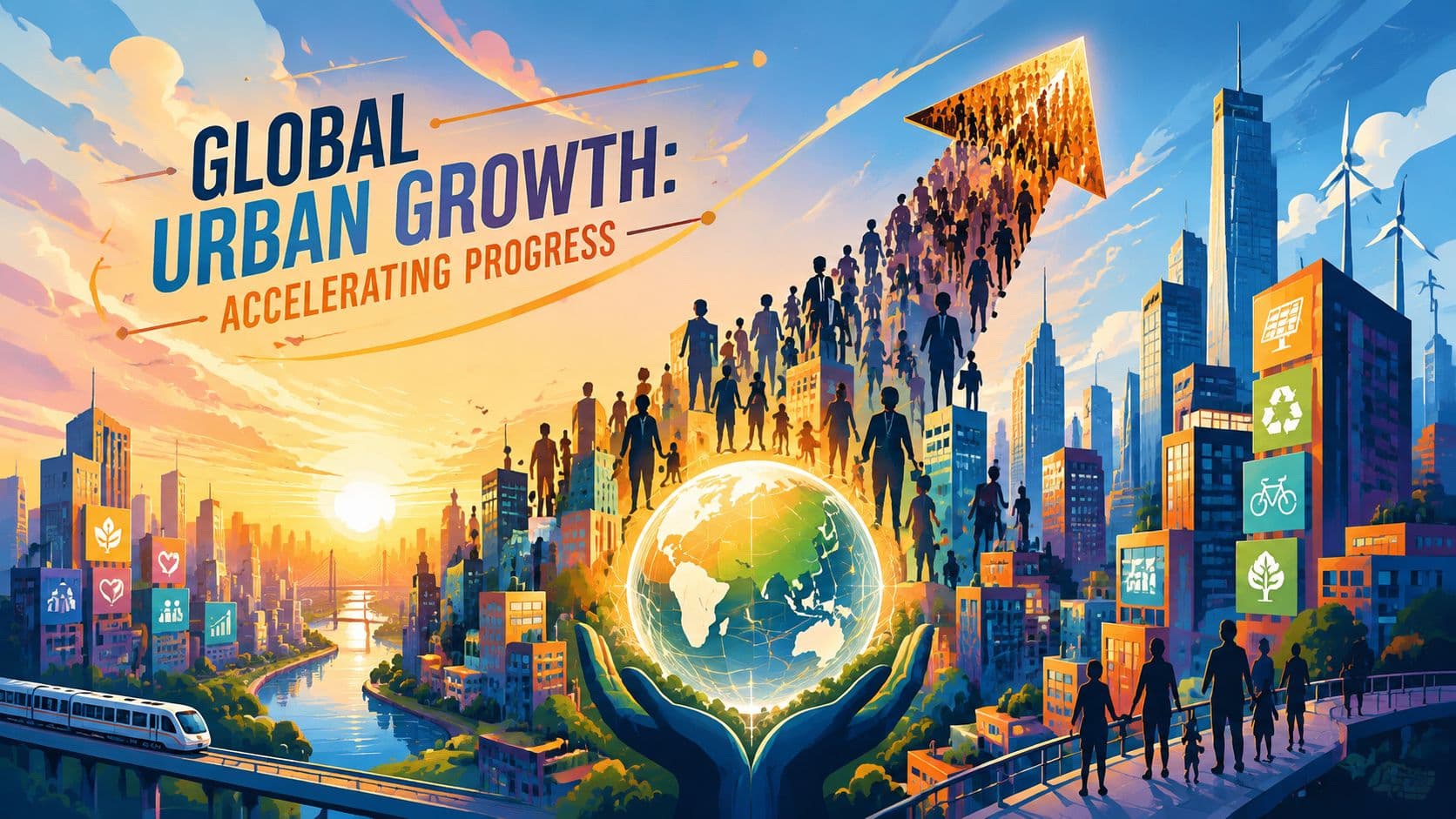
A city is one of the few human inventions that can improve opportunity and reduce resource use at the same time. It can shorten commutes, connect workers to jobs, support local businesses, and make public services easier to deliver. It can also support cleaner transport, smaller living footprints, and richer civic life.
Well-designed urban growth doesn't ask people to sacrifice prosperity for sustainability. It gives them a better chance at both.
That's why the positive aspects of urbanization deserve a more confident defense. The right question isn't “How do we stop cities from growing?” It's “How do we make urban growth work for the people creating its value?”
Part of the answer lies in technology, especially tools that help cities manage transport, infrastructure, and public space more intelligently. For readers interested in that side of the story, Virtual Tour Easy's city tech insights offer a useful look at how digital systems can support more responsive urban management.
Still, technology alone won't solve the core economic puzzle. A smart traffic system helps. Better sensors help. Digital twins help. But if land gains flow mainly to passive owners while workers, renters, and productive firms face rising costs, the city starts undermining itself.
Cities remain our greatest hope because they concentrate possibility. Whether they deliver on that promise depends on rules that reward use, building, exchange, and stewardship rather than speculation.
The Economic Engine of Agglomeration
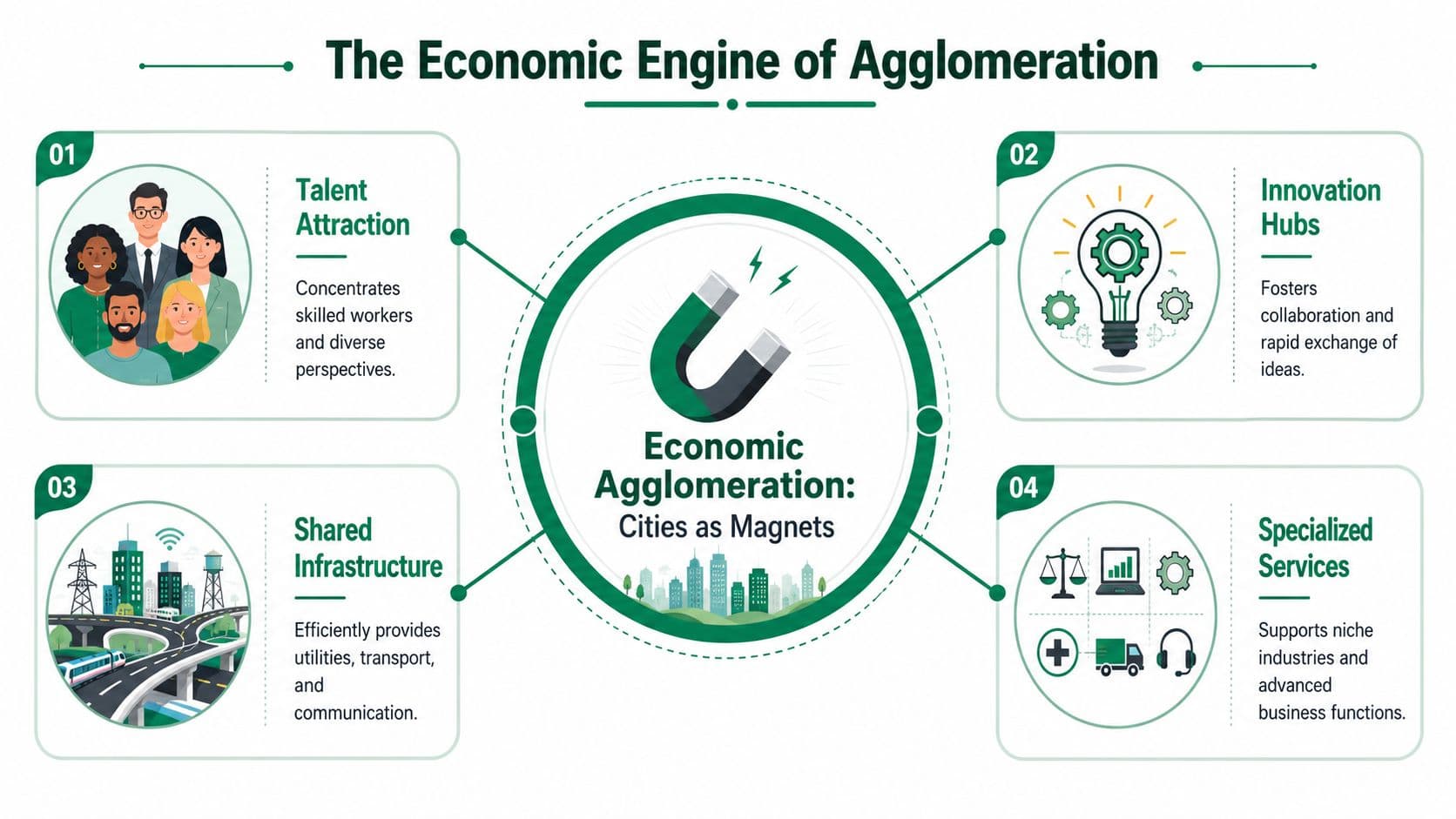
The most important economic advantage of cities has a technical name, agglomeration. The plain-English version is simpler. People and firms become more productive when they're near one another.
Why proximity multiplies value
Think about a thousand musicians spread across isolated villages. Each one may be talented, but coordination is hard. They can't easily rehearse, specialize, or perform together. Put them in one city, and suddenly you can form orchestras, teach students, repair instruments, host venues, and create a whole ecosystem around music.
Cities work like that for almost every industry.
A designer can meet a manufacturer. A startup founder can hire a specialist. A restaurant can rely on nearby suppliers, repair services, and foot traffic. A hospital can draw from a deep labor pool and connect with research institutions, labs, and equipment providers. Proximity turns isolated effort into a working system.
For readers who want to see how urban design supports these patterns in practice, this collection of new urbanism examples shows how built form can reinforce local commerce, walkability, and everyday economic exchange.
Three ways cities raise productivity
Urban economists often describe agglomeration through sharing, matching, and learning. Those terms sound abstract, so it helps to translate them.
-
Sharing lowers friction. Firms can use common infrastructure, logistics networks, public transport, and specialized services that would be too costly or too thinly spread in a dispersed setting.
-
Matching improves fit. Workers have more employers to choose from, and employers have more candidates to choose from. A stronger match means fewer wasted skills and fewer roles filled by people who are only “close enough.”
-
Learning spreads faster. Ideas move through formal meetings, job changes, supplier relationships, and casual conversation. People copy what works, adapt it, and improve it.
Here's why that matters. Productivity doesn't rise only because people work harder. It rises because cities reduce search costs, shorten feedback loops, and allow deep specialization. One firm can focus on what it does best because nearby firms handle other tasks.
Practical rule: A productive city isn't just dense. It's connected. Density without access creates crowding. Density with mobility creates opportunity.
You can see this logic in well-known industry clusters. Tech firms often gather near other tech firms. Financial services tend to cluster. Creative industries do the same. Businesses are not solely driven by fashion. They're locating near talent, clients, suppliers, and information.
This is one of the strongest positive aspects of urbanization. Cities don't just collect economic activity. They organize it into networks that make each participant more capable.
The Innovation Factory of Culture and Progress
Cities don't produce only goods and services. They also produce new ways of living together. That's one reason urbanization has shaped not just economies, but culture, science, politics, and everyday social life.
Where diversity becomes discovery
A city street brings unlike people into contact. A public library serves students, job seekers, retirees, and recent arrivals. A market mixes languages, tastes, and habits. A university district spills ideas into cafes, workshops, studios, and local businesses. Those encounters aren't a side effect of city life. They're part of the mechanism.
New ideas often come from combining things that were previously separate. A chef borrows from another cuisine. A software team learns from architecture. A neighborhood arts space becomes a meeting place for civic organizing. The city's diversity creates more chances for those combinations to happen.
Public spaces matter here. Parks, plazas, sidewalks, transit stops, museums, community centers, and shared workspaces all act as low-barrier platforms for social mixing. When they're open and welcoming, they widen the circle of participation.
A good example of how physical design can support civic and cultural life is found in this design-led architectural project from FP Architects, which shows how a carefully shaped public structure can encourage gathering, visibility, and shared use.
Why culture matters economically
Some readers get skeptical at this point. Culture can sound soft compared with jobs, housing, or infrastructure. But culture is part of economic capacity. It builds trust, identity, experimentation, and community memory. Those things affect whether people collaborate, invest effort locally, and stay engaged in public life.
Capital formation depends on more than machines and finance. It also depends on institutions, habits, education, and social cooperation. That broader view is useful when thinking about cities, and this discussion of capital formation helps clarify why productive development includes human and civic capabilities, not just physical assets.
Cities have long served as launch pads for reform movements, artistic breakthroughs, and new social norms because they gather people who can compare experiences and act together. A person in a small, isolated setting may feel alone in a problem. In a city, they're more likely to find others working on the same issue.
Dense urban life can be noisy and messy, but that same friction often produces creativity, tolerance, and institutional change.
That doesn't mean every dense place becomes open-minded or inventive. Exclusion can harden in cities too. But when urban rules support access, mixing, and public participation, cities become factories of progress in the best sense. They help societies test, refine, and spread better ideas.
The Efficiency Advantage in Services and Environment
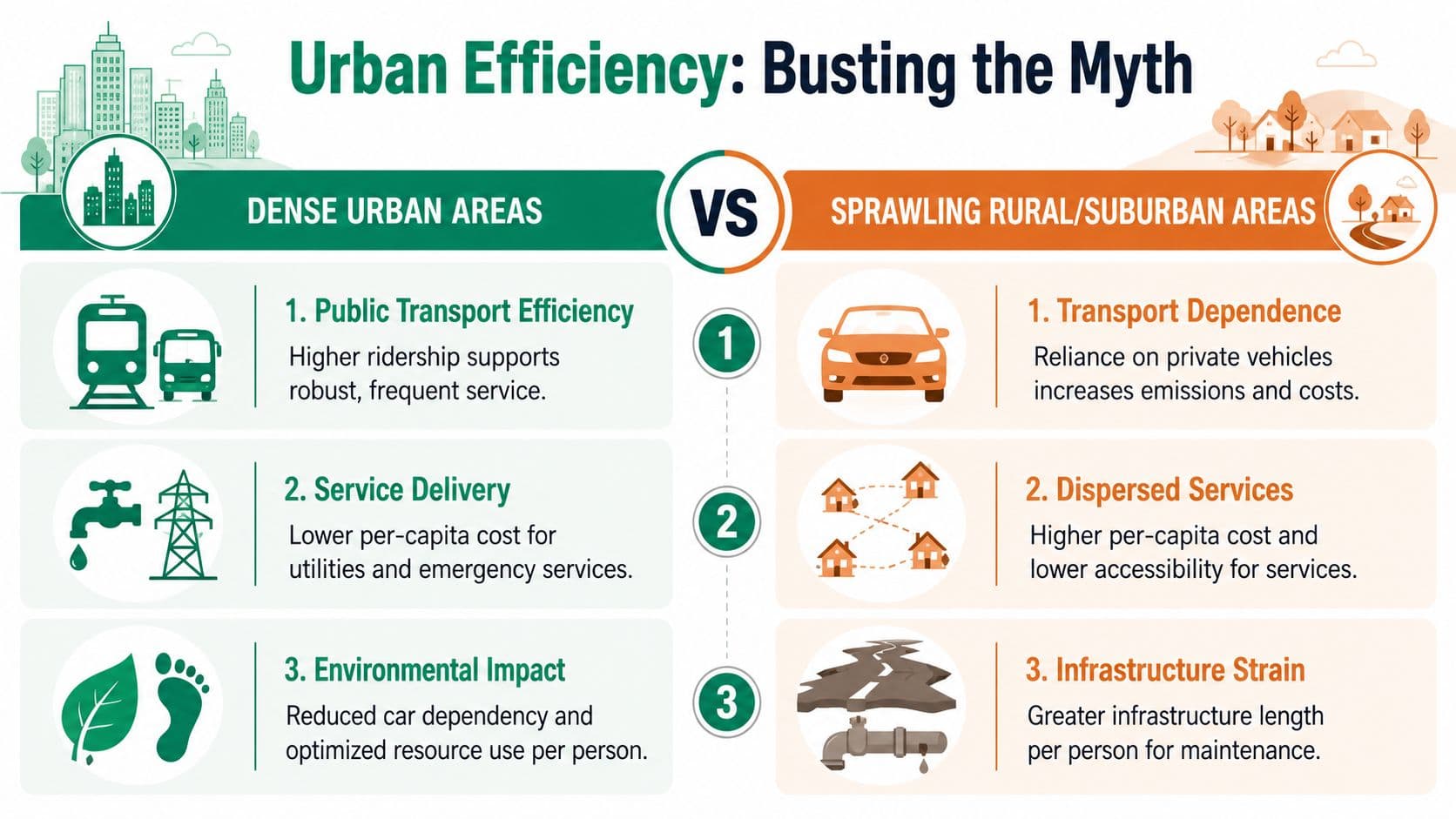
Cities are often accused of being wasteful. In many cases, the opposite is closer to the truth. Well-structured urban density lets communities deliver more services with fewer duplicated networks and shorter distances.
Why dense places deliver more with less
If homes, businesses, schools, and clinics are spread far apart, every service has to stretch farther. Pipes run longer. Roads cover more ground. Power lines, emergency response routes, and utility maintenance systems all become more dispersed. That usually means higher costs and weaker access.
Compact urban form changes the math.
A bus route works better when more riders live and work along it. Water systems serve more users within a smaller area. Fire stations and hospitals can reach more people quickly. Shops can survive on foot traffic instead of large parking fields and long car trips. Density, when paired with decent planning, acts like a multiplier for public investment.
A short comparison makes this clearer:
| Urban pattern | Typical service outcome |
|---|---|
| Compact and connected | Easier to support frequent transit, nearby services, and efficient infrastructure maintenance |
| Spread out and car-dependent | Harder to serve consistently, with longer networks and greater reliance on private vehicles |
That's one reason tax design matters so much. When cities tax building and productive improvement heavily but leave land gains undertaxed, they can end up encouraging underuse in high-value areas and pushing growth outward. This broader discussion of taxation and efficiency is useful if you want to see how fiscal rules shape land use outcomes.
Urban living can cut environmental impact
The environmental case for cities is stronger than many people assume. Dense living doesn't automatically make a place green, but it creates the conditions for lower resource use per person.
The clearest example is transport. When homes, jobs, shops, and services are close together, people can walk, cycle, or use transit more often. Housing can also be smaller and more energy-efficient when walls, systems, and infrastructure are shared.
residents of dense, transit-rich neighborhoods have a carbon footprint that is, on average, 66% lower than that of residents in car-dependent suburbs. That finding should reframe the debate. Urban density isn't merely compatible with climate goals. In many places, it's one of the most practical ways to pursue them.
- Less driving: Shorter distances and better alternatives reduce routine car dependence.
- Shared systems: Infrastructure serves more people without repeating the same footprint over and over.
- Land conservation: Compact development can reduce pressure to spread outward into natural or agricultural areas.
A city becomes environmentally strong when it makes the low-impact choice the easy choice.
The positive aspects of urbanization aren't only economic or cultural. They're ecological when cities are built to support everyday efficiency.
The Urbanization Paradox and Its Root Cause
If cities can be so productive, creative, and efficient, why do so many successful ones become unaffordable, unequal, and frustrating to live in?
That's the urbanization paradox. The very success of a city can make it harder for ordinary people and productive businesses to remain there.
When success makes a city less accessible
A neighborhood improves. Transit arrives. Streets become safer. Shops, jobs, parks, and public institutions make the area more desirable. But instead of those gains flowing broadly to the people who helped create them, much of the value gets capitalized into land prices.
Readers often get confused here, so it helps to separate two things. A building is something people produce. Land value, by contrast, often rises because of location, public investment, and surrounding community activity. When those gains are privatized while wages and enterprise remain taxed, cities can punish the very behavior they need most.
The result shows up in familiar ways:
- Housing costs rise faster than comfort. People pay more not because walls got better, but because location became scarcer and more desirable.
- Local businesses get squeezed. Independent firms face higher occupancy costs even when they contribute to street life and neighborhood identity.
- Workers get pushed outward. Long commutes and displacement separate people from opportunity.
- Prime sites sit underused. Owners may wait for land values to rise rather than build promptly or use land intensively.
Why land speculation distorts urban growth
A healthy city should reward building, maintaining, hiring, producing, and serving. Speculative landholding rewards waiting. That's the distortion.
Think of a city like a garden with a limited amount of fertile soil. If the best plots are held idle because owners expect future gains, everyone else has to crowd into worse plots or move farther away. The garden still grows, but less efficiently and less fairly.
The problem isn't urban growth itself. The problem is allowing socially created land value to be captured privately while the public pays for the conditions that created it.
This is why debates about housing often stall. One side blames growth. The other blames regulation alone. Both can miss the deeper issue. If rising land values absorb the benefits of urban success, then even useful reforms can be weakened or reversed by the land market.
That's the root cause policy needs to address.
Unlocking Urban Potential Through Land Value Capture
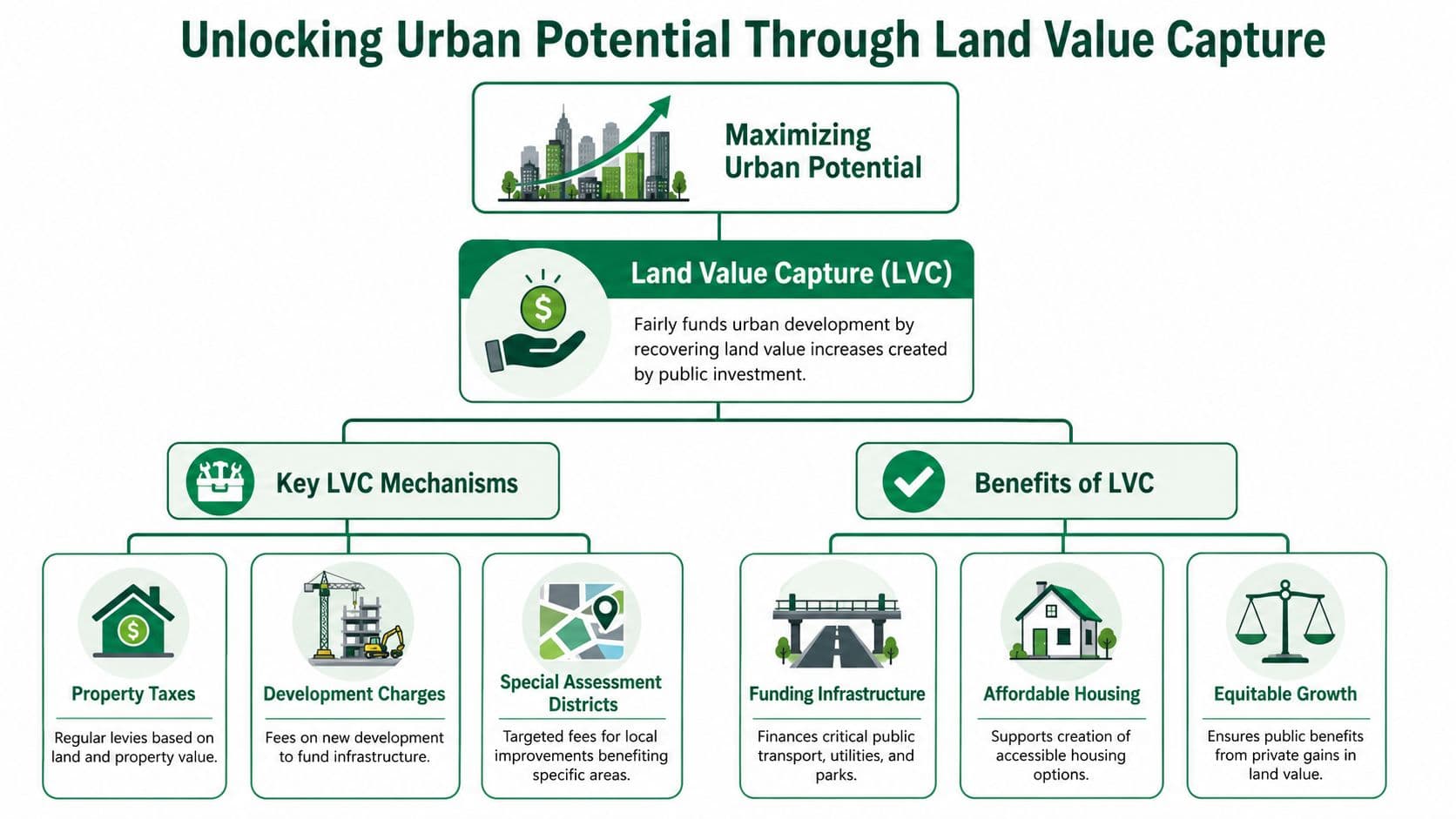
The most practical answer to the urbanization paradox is land value capture. The idea is straightforward. When the community creates land value through public investment, legal order, infrastructure, and economic activity, the community should recover part of that value for public use.
A simple way to think about land value capture
Imagine two identical buildings. One sits in an isolated area. The other sits beside transit, jobs, parks, schools, and thriving commerce. The second site commands more value, but that extra value usually didn't come from the owner's effort alone. It came from the surrounding city.
Land value capture asks a fair question. If public action and community presence create that advantage, why should the public tax wages and construction first while leaving location value largely untouched?
In practice, cities can use land-based revenue tools to fund transport, utilities, public space, and other services. The logic is circular in the best way. Public investment raises location value, and part of that value returns to fund more public investment.
For readers tracking land market signals, RealEstateCRM market analysis resources offer a practical view of how location dynamics, inventory patterns, and local conditions shape real estate outcomes on the ground.
Why tri-factor economics changes the policy conversation
Tri-factor economics proves useful in this context. It separates labor, capital, and nature rather than blending land into capital as if they were the same thing.
That distinction matters because good policy shouldn't treat all value sources alike.
- Labor is human effort.
- Capital is produced wealth such as buildings, machinery, and tools.
- Nature, including land, is not produced by the owner. Its value often reflects community activity and legal privilege over location.
When policymakers tax buildings heavily, they can discourage improvement. When they rely more on land value, they tax a value stream that owners didn't create alone. That can reduce speculation and encourage better use of scarce urban land.
A clear explainer on this policy logic is available in this guide to land value capture explained, which breaks down the mechanisms in plain language.
A real world signal from Allentown
This isn't only theoretical. In Allentown, Pennsylvania, a shift towards land value taxation spurred a "building boom," with the value of new construction permits increasing by over 600% and the number of blighted properties significantly reduced.
That example matters because it shows the direction of incentive change. Taxing land value more heavily and improvements less heavily can push owners toward use, redevelopment, and maintenance instead of passive holding.
Policy insight: When cities stop punishing construction and start charging more consistently for valuable locations, they give growth somewhere productive to go.
The positive aspects of urbanization become easier to realize under those rules. More infill. Less idle land. Stronger public revenue. Better alignment between private incentives and public goals.
Forging the Equitable and Thriving Cities of Tomorrow
Urbanization is not a threat to be endured. It's a historic opportunity to build places that are more productive, inclusive, and sustainable than the settlements we've inherited.
The promise of cities comes from concentration. Concentrated talent. Concentrated exchange. Concentrated infrastructure. Concentrated culture. But concentration only works for the many when the value created by urban life doesn't leak away into speculative land gains.
That's why the choice isn't between growth and fairness. It's between good rules and bad ones. Cities can welcome newcomers, support enterprise, reduce environmental harm, and broaden opportunity. But they need fiscal and land policies that reward use over hoarding and public benefit over private windfalls.
Housing is central to that challenge. When urban land is treated mainly as a speculative asset, affordability slips away even in otherwise prosperous places. Sound housing affordability policy has to deal with land economics, not just construction volume or subsidies in isolation.
A pragmatic optimism is the right stance. We already know many of the ingredients of a thriving city. Compact growth. Transit access. Public space. Mixed-use neighborhoods. Strong civic institutions. Land rules that recycle socially created value back into the places that generated it.
Cities are still our best platform for shared prosperity. If we align the incentives underneath them, they can also become our best platform for justice, resilience, and human flourishing.
If you're working on tax reform, housing affordability, land valuation, or city finance, Unitism® provides research, policy design, valuation methods, and practical implementation support grounded in tri-factor economics. Their work helps governments and organizations understand how sharing the rental value of land and nature can fund public services while reducing taxes on work and productive capital.