Explore 10 powerful new urbanism examples from around the world. See how cities use land value, density, and design to build more livable, equitable places.
June 28, 2026 — last updated June 29, 2026
10 New Urbanism Examples Shaping Future Cities
Explore 10 powerful new urbanism examples from around the world. See how cities use land value, density, and design to build more livable, equitable places.
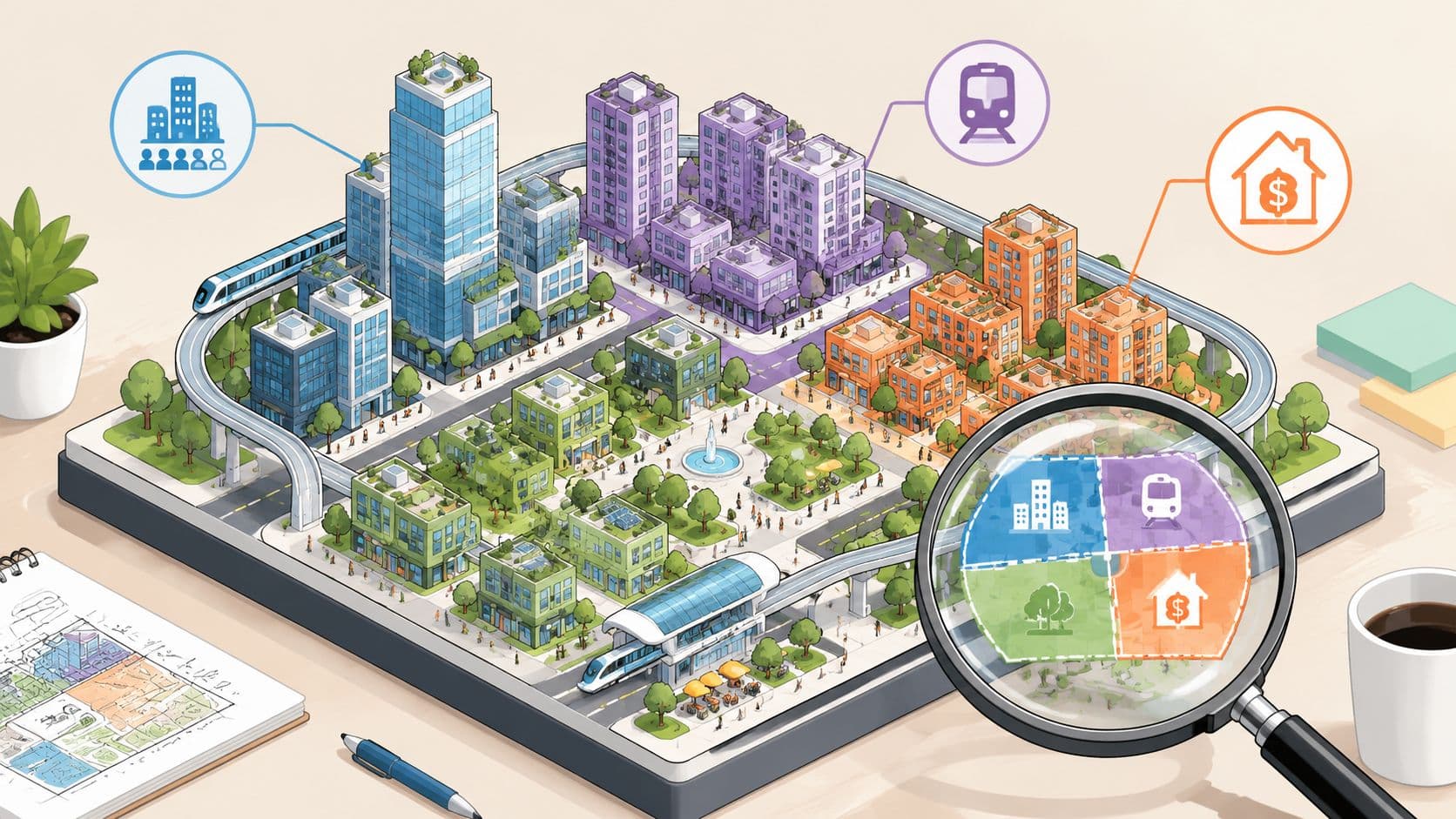
New Urbanism succeeds or fails on public finance. Streets, blocks, and mixed-use zoning matter, but they do not explain why some walkable districts remain affordable, well maintained, and politically durable while others become expensive showcase projects with weak fiscal capacity.
Across the field, the recurring pattern is straightforward. Public decisions, transit investment, zoning changes, and infrastructure upgrades raise land values. If that increase flows mainly to private landowners, cities get higher housing costs and stronger displacement pressure without a matching revenue base. If some of that uplift is captured through leases, land policy, or tax reform, the same urban form can fund infrastructure, support affordability, and reduce taxes on productive activity.
A tri-factor economics lens clarifies the mechanism. It separates returns to labor, capital, and land, then asks who receives the gains created by location and public action. That question matters because New Urbanist design often increases the value of place faster than it increases the supply of publicly recoverable revenue.
The examples in this article are selected for that reason. Some are familiar New Urbanist case studies. Others sit adjacent to the movement but offer stronger lessons for planners because they show the institutional side of urbanism: ground leases, land-value taxation, public land assembly, growth management, and community land governance. For a related framework on how cities compound social and economic performance over time, see 12 thriving cities and the systems that sustain them.
The policy takeaway is sharper than the usual praise for walkability. Good urban design changes land values. Durable urban policy decides whether that value funds the public realm or is privatized. That is the standard used throughout the ten cases below.
If you're also thinking about access and usability at the district scale, the principles behind inclusive design for transit hubs and campuses belong in the same conversation.
Table of Contents
- 1. Vauban, Freiburg (Germany)
- 2. The Pocket Neighborhoods (Seattle, WA, USA)
- 3. Vienna's Social Housing Program (Gemeindebau & Ground Leases)
- 4. Singapore (National Land-Value Capture)
- 5. Allentown, Pennsylvania (Land-Value Taxation)
- 6. Toronto's Laneway Houses & Infill Reform
- 7. Canberra, Australia (Capital City Land Leasing)
- 8. Portland, Oregon's Urban Growth Boundary
- 9. Copenhagen's FN-Byerne (Denmark)
- 10. Christiania, Copenhagen (Community Land Governance)
- Comparison of 10 New Urbanism Examples
- From Example to Action Implementing Land-Value Urbanism
1. Vauban, Freiburg (Germany)
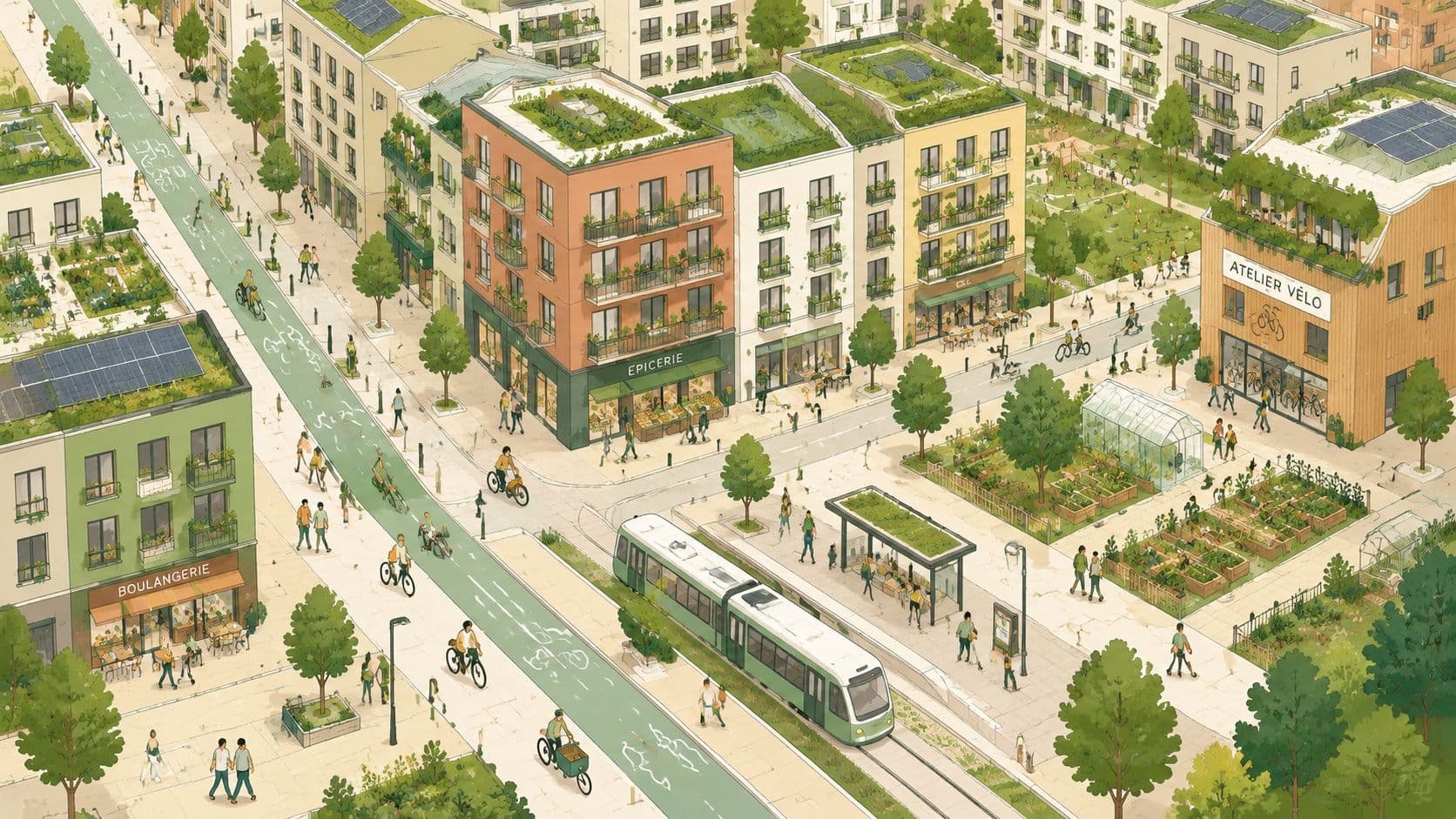
Vauban is one of the clearest examples of why land economics should sit beside urban design in any serious planning discussion. The neighborhood is widely cited for low-car living and compact form, but the deeper lesson is institutional. A city can shape outcomes more effectively when it controls the land pipeline rather than reacting after private speculation has already priced in future public improvements.
The verified case-study data attached to Freiburg/Vauban describes a neighborhood with extensive car-free and traffic-calmed streets, abundant green space, and low-energy and passive-house construction standards. Reporting on the district notes that a large share of households are car-free, that private vehicles are concentrated in neighborhood garages, and that many buildings—including former military barracks—were retrofitted to energy-efficient standards.1 Even if one treats some cross-city claims in that source cautiously, the broad policy signal is still useful: coordinated land assembly and use controls let a municipality align environmental goals with long-term site management.
Why Vauban matters fiscally
Vauban's real value for policymakers is that it points toward public land retention, lease-based tenure, and staged development. That mix lets government separate the value of the site from the value of the building on it. In tri-factor terms, that distinction matters. Labor builds the homes. Capital finances and constructs them. Public action and location create much of the land value.
"Practical rule: Secure strategic sites before major transit and public-realm investments are fully capitalized into land prices."
For planners trying to adapt the Vauban logic, the sequence matters more than the aesthetic:
- Acquire early: Public agencies gain a significant advantage when they control land before rezoning and infrastructure upgrades.
- Lease rather than sell: Long leases can preserve public influence over affordability, use mix, and stewardship.
- Write covenants clearly: Affordability terms and sustainability rules need to run with the land interest, not depend on goodwill.
- Model recurring revenue: Lease income can support maintenance and services over time.
That's why Vauban belongs in any serious list of new urbanism examples. It shows that compact, green urbanism is strongest when the public sector keeps a hand on the land question. Unitism's framing of thriving cities through better land economics fits this case closely.
2. The Pocket Neighborhoods (Seattle, WA, USA)
Pocket neighborhoods look modest compared with master-planned districts. That's their strength. They reveal what New Urbanist logic looks like when applied parcel by parcel in an already-built city.
In Seattle-style pocket housing, the design move is simple: cluster small homes around shared open space, reduce the amount of land consumed by private yards and parking, and turn an overlooked lot into a livable micro-neighborhood. The policy move is harder. Cities have to allow enough density, enough flexibility, and enough site aggregation for these projects to pencil out.
The policy lesson from small sites
The financial insight is that infill reform changes the productivity of urban land. A parcel that zoning once treated as a single detached-house site can become multiple homes with a shared courtyard. That doesn't just add units. It changes the land-to-housing ratio, which is often the hidden driver of urban housing costs.
Pocket neighborhoods also expose a common tax problem. If a city taxes building improvements heavily while allowing underused land to sit lightly taxed, it rewards delay. Owners can hold valuable sites and wait. A more land-focused fiscal approach does the opposite, because higher taxes weighted toward land value tend to discourage speculative holding and encourage construction.2 It nudges owners toward use, reuse, or sale.
"Small infill works best where zoning, permitting, and taxation all point in the same direction."
For city planners, the pocket-neighborhood playbook is practical:
- Map underused parcels: Tax assessment data and aerial review can identify lots where existing land use falls short of location value.
- Cut parking mandates: In walkable areas, parking minimums often consume the very land needed for viable small-scale housing.
- Use shared open space: Courtyards and common gardens reduce duplication and improve social life.
- Bring neighbors in early: Small projects get blocked less often when design concerns are addressed before formal hearings.
Among new urbanism examples, this one matters because it scales through repetition, not spectacle. A city doesn't need a single mega-project to gain New Urbanist benefits. It needs rules that let many small actors build better on valuable urban land.
3. Vienna's Social Housing Program (Gemeindebau & Ground Leases)
Vienna is often discussed as a housing case. It should also be discussed as a land-governance case. The city's enduring significance lies in how public institutions shape the land market over decades instead of relying on one-off affordability programs.
That makes Vienna especially relevant to New Urbanism. Walkable, service-rich neighborhoods require more than good block structure. They require long-term control over who can build, under what tenure, and with what obligation to future residents.
What planners should borrow
Vienna's social housing system demonstrates the value of patient public land strategy, municipal coordination, and partnerships with mission-driven housing actors. In a tri-factor economics frame, that's powerful because it keeps a larger share of location value within the public and cooperative sphere instead of allowing it to be fully privatized.
The policy lesson isn't that every city can recreate Vienna in full. Most can't. The lesson is that land policy compounds over time. A city that acquires strategically, leases carefully, and ties approvals to long-duration affordability creates options that a purely reactive city never has.
A few takeaways stand out:
- Stay in the land market continuously: Cities are at a disadvantage when they buy only during emergencies.
- Separate site value from building finance: Ground leases can reduce the pressure to recover land acquisition costs through high rents or sale prices.
- Bundle housing with services: Schools, transit, healthcare, and public space should be planned as neighborhood structure, not afterthoughts.
- Keep affordability rules legible: Residents need transparent succession and renewal rules.
This is also where many celebrated new urbanism examples fall short. The built form may be admirable, but access is narrow. For policymakers looking at the affordability side of the equation, Unitism's work on housing affordability policy speaks directly to the problem Vienna has managed better than most cities.
4. Singapore (National Land-Value Capture)
Singapore belongs on this list because it operates at a scale most New Urbanist projects never reach. It shows what happens when land-value capture isn't a district tool or financing add-on, but part of the national operating system.
Its relevance to New Urbanism is structural. Walkable, mixed-use, transit-oriented development becomes easier to sustain when the state has strong influence over land disposition, lease terms, and long-term infrastructure sequencing. That doesn't mean every element is transferable. It means the fiscal architecture deserves attention. Public housing alone houses the large majority of Singapore's resident population, typically on long leasehold terms.3
Why the model changes the revenue base
The central lesson is that governments can rely more on land-related revenue and less on taxes that discourage building or productive activity. In tri-factor economics, that's the major shift. If public decisions create much of the locational premium, public finance should recover part of it.
Singapore demonstrates an extensive version of that logic through public land ownership, leasehold development, and coordinated urban renewal. Through aggressive use of its 1966 Land Acquisition Act and related policy, the share of land owned by the state rose substantially over the post-independence decades, and analysts report that the great majority of land in Singapore is now publicly owned and made available to private users through leases.4 For planners elsewhere, the practical implication is not to copy the whole state apparatus. It's to ask whether public agencies are giving away too much future site value when they sell land outright, underprice leases, or fail to recalibrate charges after major infrastructure investment.
"Institutional insight: The most effective land-value capture tools are usually embedded in routine governance, not treated as exceptional interventions."
Cities can adapt parts of this model by:
- Using leasehold tenure for strategic sites: Especially around transit nodes, waterfronts, and redevelopment districts.
- Aligning approvals with public benefit: Housing, public space, and service obligations should be negotiated before uplift is fully private.
- Treating land valuation as core infrastructure: Weak valuation systems undermine every downstream policy.
- Reducing taxes on productive effort where land revenue can substitute: That improves incentives for construction and enterprise.
For a policy primer on that mechanism, Unitism's explanation of land value capture is directly relevant.
5. Allentown, Pennsylvania (Land-Value Taxation)
Allentown matters because it puts the tax instrument itself at the center. Many new urbanism examples depend on design codes, public-realm investment, or greenfield master planning. Allentown shows that a city can change development behavior by changing what it taxes.
The verified record states that Allentown adopted a land-value tax in 1996 that separated land value from building improvements, establishing dual rates with the land tax rate set far higher than the rate on buildings.5 That matters because standard property taxation often punishes the very activity cities say they want. Improve a building, add units, modernize a storefront, and the tax bill can rise because you invested productively. Hold a valuable lot in underused condition, and the system may be relatively forgiving.
Why tax structure matters more than design codes
A two-rate approach changes that incentive. By leaning more heavily on land and less on buildings, a city tells owners that passive holding is costly while construction and rehabilitation are less penalized. Split-rate taxation, in which land and buildings are valued and taxed separately, is recognized as a practical reform that can discourage speculative holding and encourage construction.6 Pittsburgh's earlier shift toward taxing land more than buildings was associated with a marked downtown building boom.7 That's why tax reform belongs in a discussion of New Urbanism. You can write a perfect form-based code and still get too little infill if the tax system rewards idleness.
Allentown is especially instructive for post-industrial cities with vacant lots, shallow markets, and infrastructure they already paid for. In those conditions, the tax shift can support redevelopment without requiring massive subsidy. Evidence from Pennsylvania more broadly suggests that land-value taxation can raise density and help curb urban sprawl.8
Key policy implications include:
- Assessment quality is everything: If land assessments are weak, the reform loses legitimacy.
- Phase-ins matter: Gradual transitions reduce political shock and give owners time to adapt.
- Pair tax reform with zoning reform: A city can't invite infill fiscally while prohibiting it legally.
- Use public communication well: Residents need to understand that taxing land more heavily and buildings less heavily changes incentives, not just bills.
Among new urbanism examples, Allentown is one of the best reminders that fiscal design often matters more than visual design.
6. Toronto's Laneway Houses & Infill Reform
Toronto shows that a city can add housing capacity block by block, through property law and zoning reform rather than megaprojects. That matters for New Urbanism because the hardest growth problem in high-demand cities is often not urban design. It is the legal and fiscal system that keeps well-served land locked into detached-house patterns long after transit, schools, parks, and utilities have raised the underlying site value.
Laneway suites, garden suites, secondary suites, and other small-scale infill address that constraint at the parcel level. They lower the minimum scale of development, which changes who can participate. Instead of relying on large firms assembling multiple lots, the city lets households, small builders, and long-term owners add units incrementally on land already connected to public infrastructure.
A useful household-scale reference point is planning a backyard accessory dwelling unit.
The policy strength here is not only added supply. It is capital efficiency. Infill on serviced residential lots usually requires less new public spending per unit than fringe expansion, because roads, pipes, schools, and transit access are already in place; reviews of the comparative literature tend to favor infill over greenfield development on cost grounds.9 From a tri-factor economics perspective, that distinction matters. Labor builds the unit, capital finances it, but the gain in land value often comes from location advantages created by the surrounding community and past public investment.
That is also Toronto's fiscal problem.
If reform legalizes more units without a matching capture tool, a portion of the benefit appears as higher site values for owners of eligible lots. The city has still improved the housing system. But it has also enlarged a private claim on publicly created locational value. For planners and policymakers, the relevant question is not whether laneway housing is good. It is whether the value created by legalization should be shared more systematically through development charges, inclusionary rules where legally appropriate, betterment mechanisms, or a tax structure that places more weight on land than on improvements.
Toronto therefore works best as an example of partial alignment. The urban form logic is strong. Gentle density in established neighborhoods supports walkability, local retail demand, school enrollment stability, and more efficient use of existing infrastructure. The financing logic is less complete when zoning liberalization is not paired with land-value capture.
That gap has distributional consequences. In strong markets, small-scale infill can broaden tenure options and add rental supply, but it can also raise expectations about future redevelopment potential on low-rise lots. The result is a familiar pattern in reforming cities. Housing production becomes easier at the margin, while affordability gains are partly absorbed into land prices.
The lesson for other cities is sharper than "legalize more housing." Legalization changes the development equation. Tax and capture policy determine who keeps the resulting land value uplift. Among new urbanism examples, Toronto is one of the clearest cases where good physical planning needs stronger fiscal architecture to become durable and equitable.
7. Canberra, Australia (Capital City Land Leasing)

Canberra is one of the clearest large-scale demonstrations of leasehold urbanism in practice. For planners interested in the mechanics of value capture, it offers a powerful contrast with cities that privatized most urban land early and now struggle to recover value created by public investment.
The key point isn't just that the public retains ownership over much urban land. It's that leasehold tenure allows governments to think in long time horizons. Instead of taking a one-time land sale receipt and surrendering future influence, the public can structure recurring claims, renewal terms, and development conditions.
The strategic value of leasehold urbanism
This matters for New Urbanism because coordinated neighborhood centers, infrastructure phasing, and transit-supportive density all require a long planning horizon. Freehold fragmentation makes that harder. Public leasehold can make it easier, especially in a purpose-built city.
Canberra also illustrates a policy principle that's underappreciated in planning debates: tenure form affects fiscal resilience. A city that depends heavily on transaction-based revenue is exposed to market cycles. A city that captures recurring land value has a more stable base for infrastructure and services.
For policymakers, the transferable lessons are practical:
- Retain strategic land where possible: Once sold outright, strategic advantage is hard to regain.
- Index lease structures sensibly: Terms should reflect changing location value without creating arbitrary shocks.
- Link land policy to infrastructure sequencing: Lease revenue and capital planning should be modeled together.
- Communicate renewal rules clearly: Uncertainty about lease terms can undermine public trust.
Canberra deserves a place among leading new urbanism examples because it demonstrates that the most important planning decisions may happen in cadastral and lease systems long before they appear in urban design renderings.
8. Portland, Oregon's Urban Growth Boundary
Portland shows a hard policy truth: constraining sprawl can raise land values faster than it improves access if the city does not also reform how those values are taxed and shared.
The urban growth boundary is usually discussed as a planning instrument. It is also a price signal. By limiting where greenfield development can occur, the region changes the expected scarcity of buildable land inside the line and increases the premium on well-located sites. That dynamic can support compact, transit-oriented urbanism. It can also reward landholders who did little more than hold property while public regulation, infrastructure, and regional growth increased its value.
Tri-factor economics sharpens the analysis. Labor builds housing. Capital finances construction and infrastructure. Land gains value largely from collective action and location. Portland's boundary affects the third factor most of all. If policy raises the exchange value of urban land, a city then has to decide whether that uplift stays private, is partly socialized, or is converted into lower housing costs and better public services.
A boundary changes development economics
That distinction separates design success from fiscal success. A growth boundary can support shorter trips, stronger main streets, and more efficient service provision. None of those outcomes automatically create an equitable revenue system. Without broad upzoning, faster infill approvals, and some mechanism to recover publicly created land value, scarcity can harden into higher rents and higher barriers to entry; land-use regulation, rather than construction cost or physical scarcity alone, accounts for a large share of high house prices in constrained markets.10
Portland therefore belongs on this list for a reason that goes beyond urban form. It demonstrates that growth management without land-value capture is an incomplete model of New Urbanism. As noted earlier, the broader movement gained institutional legitimacy in the United States through federal housing and planning practice. Portland reveals the unresolved question inside that success story. Who captures the gains when public rules make urban land more valuable?
"A growth boundary allocates scarcity. Tax policy determines who benefits from it."
For city planners and state policymakers, the practical lessons are more economic than aesthetic:
- Pair containment with enough internal capacity: Legal room for apartments, missing-middle housing, and mixed-use redevelopment has to expand where demand is strongest.
- Tax land more effectively than buildings: A stronger land-based tax framework reduces the incentive to sit on underused sites and wait for appreciation.8
- Capture transit and zoning uplift: Public investment and entitlement changes create location value—proximity to rail stations, for example, raises nearby residential and commercial property values—that can help fund affordability, infrastructure, or land acquisition.11
- Treat preservation outside the boundary as a fiscal commitment: Farmland and open-space protection last longer when conservation funding is stable, not merely mapped.
Among new urbanism examples, Portland is one of the clearest cases where the planning tool is sound but the distributional question remains open. The lesson is not that containment fails. It is that containment works best when the public also claims part of the land value it creates.
9. Copenhagen's FN-Byerne (Denmark)
FN-Byerne is less famous than some showcase districts, which makes it useful. Policymakers can study it without the noise that surrounds iconic developments. Its importance lies in the combination of public land, long leases, and cooperative housing structures.
That institutional mix is one of the strongest available tools for keeping a walkable neighborhood from becoming purely speculative. It doesn't eliminate market pressure, but it changes the way gains are distributed and governed.
Why cooperatives matter here
When a city uses ground leases and works with cooperatives, it creates an intermediate form between full state provision and pure market allocation. Residents gain stability and participation. The public retains some influence over land use and long-term value. Developers still build, but within a more structured framework.
This is a strong fit with tri-factor economics because it recognizes that buildings are produced privately while land value is socially generated. Cooperative and leasehold models can translate that idea into governance.
For planners, the operational lessons are clear:
- Use long leases to preserve public claims on location value.
- Partner with cooperatives that can govern housing over time, not just deliver units once.
- Build services and retail into the plan from the start: Mixed-use value is easier to preserve than retrofit.
- Review lease terms transparently: Long-horizon trust depends on predictable rules.
Copenhagen's broader relevance is that it shows how seemingly technical tenure decisions affect social outcomes. Many new urbanism examples succeed physically but drift upscale quickly. FN-Byerne suggests a better way to anchor neighborhood quality in institutions, not just design codes.
10. Christiania, Copenhagen (Community Land Governance)
Christiania matters because it shifts the policy question from design to control of land rents. Many new urbanist examples produce attractive public space, mixed use, and low-car living. Fewer show how a community can hold the underlying site in ways that slow speculation and preserve access over time.
Its history is unusual, and cities should not copy its legal path. They can study its institutional logic. Christiania demonstrates that urban land can be governed by a collective body with social goals that differ from both conventional private ownership and direct state management. That makes it relevant to planners focused on land-value capture, because the core issue is not only who builds, but who retains the rise in location value created by the city around the site.
That distinction matters in high-demand districts. Once walkability, culture, and central access increase land value, standard ownership models tend to convert those gains into higher prices, higher rents, or windfall sales. Community stewardship changes the distribution mechanism. It does not erase market pressure, but it can limit private extraction and keep more of the socially created land value tied to resident use, affordability goals, and local decision-making.
Christiania also broadens the tri-factor economics lens used across this article. Labor and capital produce buildings, services, and maintenance. Land value grows for a different reason. It rises because of shared public investment, regional demand, and neighborhood reputation. A governance model that treats land as a collective asset is one of the few ways to align that reality with local institutions.
The policy lesson is practical. Cities that want the social benefits associated with New Urbanism, without a predictable slide into exclusivity, need legal vehicles that separate stewardship from pure speculation. That usually means community land trusts, limited-equity cooperatives, or special-purpose nonprofit entities with clear rules, audited accounts, and enforceable resale terms. Community land trusts typically retain ownership of the land while selling or leasing the housing on it at below-market prices, commonly through long-term ground leases, to keep homes permanently affordable.12 A concise explanation of how a land trust works in practice is useful here because the administrative design matters as much as the ideal.
Christiania's value as an example lies in that governance question. It shows that the strongest anti-displacement tool is often not a design code or an affordability set-aside. It is a land regime that decides, in advance, who gets the future value of a place once the wider city makes that place more desirable.
Comparison of 10 New Urbanism Examples
| Project | Implementation complexity 🔄 | Resource requirements ⚡ | Expected outcomes ⭐ | Ideal use cases 📊 | Key advantages & tips 💡 |
|---|---|---|---|---|---|
| Vauban, Freiburg (Germany) | High, needs public land, legal ground-lease setup, strong community process | High upfront land & infrastructure costs; long payback | Strong affordability, low-car mobility, dense sustainable urbanism | Cities with public land capacity and transit-ready networks | Use ground leases to capture land value; engage community early |
| The Pocket Neighborhoods (Seattle, WA) | Low–Medium, small projects, zoning approvals required | Low per-project capital; financing at scale can be challenging | Efficient infill, moderate affordability, tight-knit communities | Underused urban parcels in high-demand neighborhoods | Pilot small sites, reduce parking minimums, consider CLTs for capture |
| Vienna's Social Housing Program | Very High, decades-long political commitment, large admin capacity | Very high sustained public investment and land acquisition | Exceptional long-term affordability and social mixing | Cities willing to build public housing systems at scale | Use ground leases + cooperatives; integrate services and clear covenants |
| Singapore (National Land-Value Capture) | Very High, centralized planning and strong state capacity | Very high: near-universal public land ownership and sophisticated admin | Stable revenue, broad homeownership, coordinated citywide renewal | City-states or governments with strong planning authority | Link leases, taxes, and redevelopment strategically; transparent valuation |
| Allentown, PA (Land-Value Taxation) | Medium, tax reform and valuation systems required; political resistance possible | Moderate administrative capacity for assessments; limited capital needs | Boosted infill, reduced vacancy, modest revenue gains | Post-industrial cities seeking revitalization incentives | Phase in rates, ensure transparent land-value assessments, pair with zoning reform |
| Toronto Laneway Houses & Infill Reform | Low–Medium, zoning changes and neighborhood engagement | Low public cost; relies on private investment and builders | Increased small-scale supply; benefits largely to lot owners | High-demand single-family areas near transit | Map underused lots, set inclusionary targets, remove parking minimums |
| Canberra, Australia (Land Leasing) | High, lease system design, long-term master planning, public ownership | High public land acquisition and administrative overhead | Predictable lease revenue, coordinated planning, limited speculation | Planned new cities or greenfield capital developments | Index leases, publish renewal rules, link revenue to infrastructure |
| Portland, Oregon UGB | Medium, requires regional coordination and regulatory enforcement | Moderate (planning/regulation focused rather than capital-intensive) | Contained sprawl, higher inner-land values, stronger TOD potential | Metropolitan regions aiming to limit sprawl and promote transit | Pair UGB with land-value capture (LVT, CLTs, inclusionary zoning) |
| Copenhagen FN-Byerne (Denmark) | High, public land + cooperative partnerships, complex lease terms | High municipal investment and long-term management capacity | Stable mixed-income neighborhoods and long-term affordability | Cities with cooperative housing traditions or public land stocks | Use 99‑year leases, partner with co-ops, ensure transparent pricing |
| Christiania, Copenhagen (Community Land Governance) | Low formal complexity but high legal/political risk; informal governance | Low capital needs; high social capital and self-management capacity | Strong community cohesion and cultural autonomy; limited scalability | Experimental communities, cultural precinct pilots, CLT pilots | Formalize CLT/legal status for scalability; combine autonomy with standards |
From Example to Action Implementing Land-Value Urbanism
The common thread across these 10 cases isn't architecture. It's control over land value. Some examples use leaseholds. Some use tax reform. Some rely on public land, cooperative governance, or zoning changes that make available underused sites. But all of them, in one way or another, turn the planner's attention from buildings alone to the economic structure beneath them.
That shift matters because New Urbanism has always had a double character. On one side, it offers a physical corrective to sprawl. Narrower streets, mixed uses, better blocks, transit-supportive density, and public space designed for daily life. On the other side, it has often struggled with affordability and inclusion. The movement's successes can produce premium places, and premium places can easily become exclusionary if governments don't retain tools to recover and recycle publicly created land value.
The strongest evidence in the record points in both directions. Verified summaries describe successful projects with strong market performance, including large-scale examples such as Daybreak in Salt Lake City, Stapleton in Denver, and Mueller in Austin, along with celebrated places like Baldwin Park, Rosemary Beach, Alys Beach, I'On, and Kentlands. That matters because these projects suggest demand for walkable urban form is durable. Yet the same source also notes that only a relatively small share of new urban projects has delivered significant affordable housing, and academic analysis of the first New Urbanist town finds a measurable walkability premium capitalized into property values.13 Good design, in other words, can raise value without solving access.
Seaside, Florida captures that tension. Verified case material describes it as a seminal project with design guidelines that mandate front porches and varied housing types, and academic study of Seaside finds that higher walkability is capitalized into higher office, retail, and apartment values.13 Those are the kinds of outcomes many local governments want. But if the public doesn't capture part of the land value produced by those results, the place becomes a consumption good for those who can pay the premium.
That's where tri-factor economics gives policymakers a more disciplined framework. It asks them to treat labor, capital, and nature differently because they function differently. Taxing work and construction can suppress the very activity cities want. Allowing land rents to be privately absorbed can reward passive gain over productive effort. Rebalancing that system changes incentives. It can support infill, reduce speculative holding, strengthen municipal finance, and create room for affordability tools that aren't permanently dependent on subsidy.6
The practical agenda is clear. Cities should acquire strategic land earlier. They should evaluate leasehold models for transit corridors, redevelopment districts, and public land. They should modernize valuation systems so they can distinguish site value from improvement value. They should consider tax reforms that stop penalizing construction. They should tie zoning liberalization to public capture mechanisms where site values are likely to rise. And they should build institutional capacity, because land-value urbanism fails when assessment, administration, and public communication are weak.
That's also why implementation matters as much as theory. Serious reform needs valuation methods, legal drafting, fiscal modeling, and public education. For practitioners looking to move from inspiration to execution, even adjacent disciplines can help clarify sequencing and risk. A solid guide to feasibility in architecture and development is a useful reminder that good urban outcomes depend on what can be delivered, financed, and administered, not just imagined.
The best new urbanism examples don't just teach planners how to draw a neighborhood. They teach governments how to govern land.
Unitism® helps governments, agencies, and policy teams turn land-value theory into workable reform. Its advisory work covers land valuation, site-value taxation, land-value capture, fiscal modeling, implementation design, and public communication, all grounded in tri-factor economics. If your city is trying to connect walkable urbanism with affordability, stronger public revenue, and less speculation, explore Unitism®.
Frequently Asked Questions
What is the main difference between New Urbanism and land-value urbanism?
New Urbanism is primarily a design movement focused on walkable streets, mixed uses, compact blocks, and transit-supportive density. Land-value urbanism extends that framework by asking who captures the economic gains that good urban design creates. A neighborhood can look and function like a New Urbanist project while still funneling most of its locational value to private landowners. The cases in this article argue that durable, equitable urbanism requires both: the physical design that makes places worth living in and the fiscal or tenure tools that prevent those places from becoming exclusionary over time.
Why do New Urbanist neighborhoods sometimes become unaffordable even when they're well-designed?
Good design tends to raise land values, and if there's no mechanism to capture or redistribute that uplift, higher prices follow naturally. When a walkable district succeeds, it becomes desirable, and desirability gets priced into the land beneath the buildings.13 Without ground leases, land-value taxation, community land trusts, or similar tools, that value flows mostly to whoever holds the site, whether they built anything productive or not. The result is that the neighborhoods celebrated for livability often become the least accessible to the people who need housing most. That's the core tension this article is designed to surface for planners and policymakers.
Which of these new urbanism examples is most practical for a mid-sized city to adapt today?
That depends on the city's existing tools and political context, but land-value taxation reform along the lines of Allentown's two-rate model is often the most accessible starting point. It doesn't require a city to own land, build public housing, or redesign whole districts. It works through the existing property tax system by shifting more of the fiscal burden onto land and less onto buildings and improvements.6 The effect is to discourage speculative holding and encourage infill and rehabilitation on underused sites.2 Paired with basic zoning reforms that permit gentle density, it can change development patterns incrementally without large upfront public investment.