Unlock national productivity improvements using land value capture & tri-factor economics. Essential guide for sustainable, equitable growth.
July 7, 2026
Boosting Productivity Improvements with Land Value Capture
Unlock national productivity improvements using land value capture & tri-factor economics. Essential guide for sustainable, equitable growth.

The biggest productivity mistake in public policy is hiding in plain sight. Governments keep chasing better workers and better machines while ignoring the asset that often absorbs the gains those workers and machines create: land.
That blind spot matters because the old formula is no longer delivering the old results. U.S. labor productivity rose at an annual rate of close to 3 percent from 1948 to 1973, slowed to about 1.5 percent between 1973 and 1995, then rebounded to about 3 percent per year since 1995, with output per hour increasing more than 5 percent annually in the most recent two-year period according to the Federal Reserve's historical productivity review. Yet stronger output hasn't reliably translated into stronger pay for typical workers, and public investment still struggles to deliver its full economic return.
Finance ministries should stop treating this as a mystery. It's a design failure. When the state funds infrastructure, education, and research, it often creates value that is then capitalized into land prices rather than recycled into broader productive capacity. If you want durable productivity improvements, you need to manage labor, capital, and land together. Most governments still manage only two of the three.
Table of Contents
- The Productivity Paradox Why Growth Has Stalled
- Decomposing Productivity A More Complete Picture
- The Tri-Factor Solution Why Separating Land Matters
- How Land Value Capture Unlocks True Productivity
- Global Evidence From Theory to Proven Results
- A Policy Roadmap for National Prosperity
The Productivity Paradox Why Growth Has Stalled
Productivity growth has stalled because policy has been aimed too narrowly. Governments keep backing the standard package of skills, technology, business investment, and innovation grants. Those measures help, but they do not explain why costly public improvements so often produce weak fiscal returns, strained budgets, and public frustration.
The immediate problem is not effort. It is capture.
Analysts at Third Way, in this analysis of missing drivers of U.S. productivity growth, argue that public goods such as education, infrastructure, and research support stronger productivity performance, yet public investment has been allowed to weaken. That failure matters because it creates a damaging cycle. The state pays to improve the productive capacity of the economy, but too little of the resulting value comes back to the public balance sheet to fund the next round of investment.
That helps explain why the public debate is often confused. Firms can adopt better tools. Workers can put in more effort. Cities can add infrastructure. Yet national performance still disappoints if the gains from those improvements are diverted into rising site values rather than recycled into new productive assets. For a practical summary of the symptoms, TimeTackle's piece on understanding the productivity paradox is useful.
A significant policy blind spot
Most productivity frameworks still treat land as a passive backdrop. That is a policy mistake. Land is the channel through which transport links, school quality, planning decisions, public safety, and urban density are converted into private asset gains.
Build a rail line, upgrade a business district, or permit more housing near jobs, and productivity can improve. But location values also rise. If those gains accrue mainly to landowners, the state has socialized the cost of improvement and privatized a large share of the return.
Public investment can improve productivity and still leave the public sector fiscally constrained if land policy allows value to leak away.
This is why so many productivity gains fail to translate cleanly into broader prosperity. The problem is not only how much growth an economy generates. The problem is who captures it, how it is taxed, and whether the state can reinvest it. The productivity wage gap explainer is useful on this point because it shows why growth can coexist with weak wage outcomes when the distribution of gains is badly structured.
Decomposing Productivity A More Complete Picture
Productivity policy fails when it measures output correctly but classifies its causes badly. A finance minister needs a sharper framework than the standard labor-and-capital story.
What the standard model gets right
Start with the metrics governments already use.
Labor productivity tracks output per hour worked. It matters because it links directly to wages, fiscal capacity, and international competitiveness. Capital deepening measures how much productive equipment, software, infrastructure, and other assets support each worker. Total factor productivity measures how efficiently the economy combines inputs through management quality, technology, coordination, institutions, and public systems.
These are useful categories. They explain why a country can raise output by training workers better, improving management, modernizing logistics, or increasing investment in tools and infrastructure. For firm leaders trying to translate that logic into operations, resources on how to achieve business process efficiency can help connect economic efficiency to workflow design and execution.
A simple table clarifies the standard view:
| Measure | What it tracks | Typical policy focus |
|---|---|---|
| Labor productivity | Output per hour worked | Skills, management, labor market quality |
| Capital deepening | Better tools and assets per worker | Investment, equipment, software, infrastructure |
| Total factor productivity | Efficiency of combining inputs | Innovation systems, institutions, public goods |
The problem is not that this framework is wrong. The problem is that it is incomplete.
Where the standard model breaks down
The omission is land.
Most productivity analysis either buries land inside capital or ignores it as a passive background condition. That is a basic economic error. A machine is produced. A building is produced. A location is not produced. Its value comes from access, legal rights, infrastructure, nearby demand, public services, and the wider concentration of economic activity.
That distinction changes policy.
A factory owner can add new equipment. A government can improve workforce capability. Neither can produce another city center, another port frontage, or another well-connected urban site. Land is fixed in supply. Location value is largely created by society and public action.
Once that point is clear, the policy failure becomes obvious. Governments often tax labor income, business investment, and building activity more heavily than location rents. That suppresses work and investment while allowing gains from public infrastructure, zoning changes, and urban growth to flow into private land values.
Use this rule instead: tax bases that do not shrink when taxed, and protect the ones that drive production.
The standard model also misses a second effect. High land costs can absorb productivity gains that should have appeared as higher wages, lower business costs, or stronger public revenue. A more efficient firm may produce more, then lose a large share of that gain to higher rents in productive locations. At national scale, that is not a side issue. It is a transmission problem.
For a concise explanation of output generation at the edge of production, the margin of production overview is a useful reference. Read it with one correction in mind. Land is not just another input in the production function. It sets the terms on which labor and capital can operate.
The Tri-Factor Solution Why Separating Land Matters
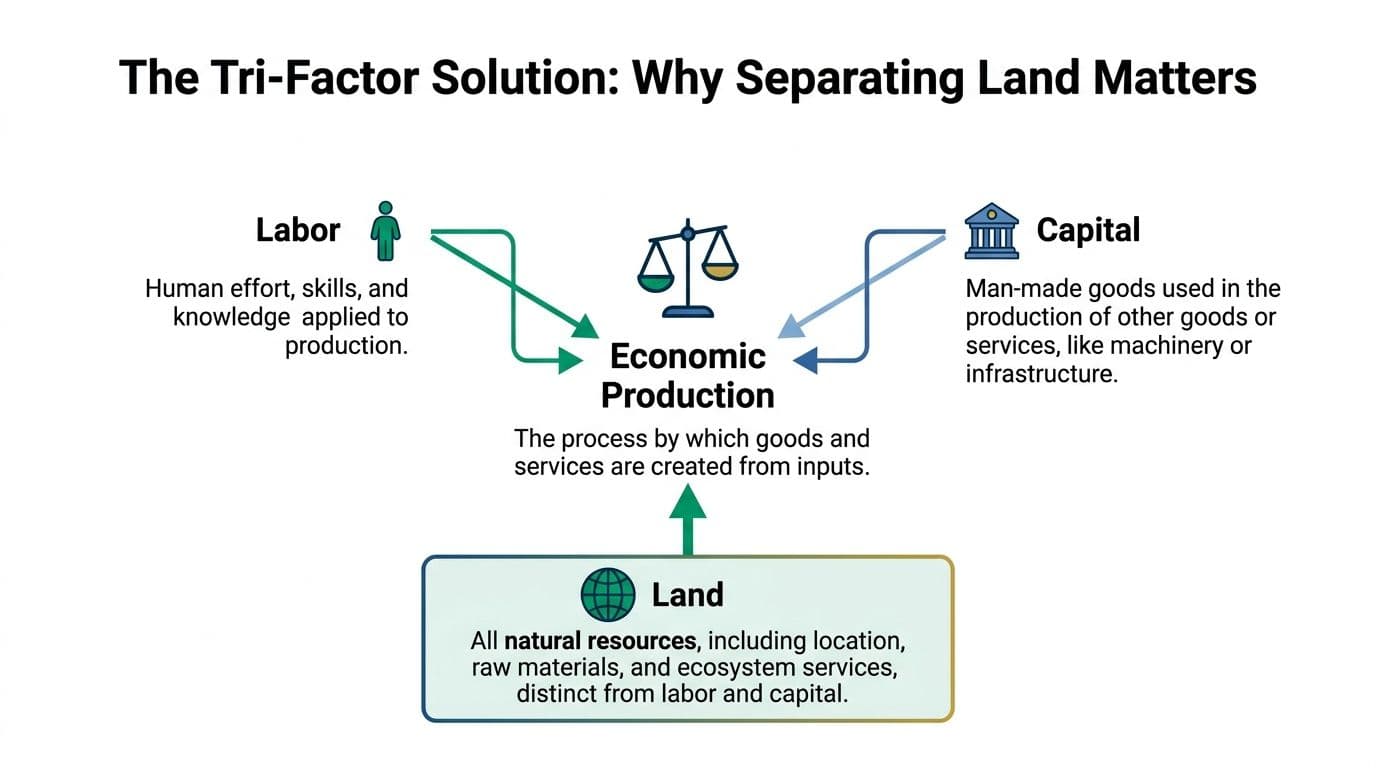
The two-factor model keeps producing avoidable policy mistakes because it blends unlike things together. A finance ministry should use a tri-factor model instead: labor, capital, and land.
Land is not capital
The distinction is intuitive once you stop using accounting categories as economic categories.
Take an office tower. The steel, concrete, lifts, and HVAC systems are capital. People built them. They depreciate. Owners can improve them. The parcel under the tower is different. Nobody produced the location. Its market value reflects access, legal rights, neighborhood demand, public infrastructure, and surrounding economic activity.
That difference has policy consequences:
| Factor | Created by | Supply response | Best policy instinct |
|---|---|---|---|
| Labor | Human effort and capability | Can improve over time | Invest in people |
| Capital | Savings and production | Can expand with incentives | Reward investment |
| Land | Nature plus location value shaped by society | Fixed in supply | Capture socially created value |
When states confuse land with capital, they often subsidize speculation without meaning to. They lower taxes on holding valuable sites, then tax buildings, wages, transactions, and enterprise more heavily to make up the revenue. That suppresses construction, raises costs, and locks valuable locations into underuse.
For planning and valuation officials, the idea of highest and best use matters because land policy should push sites toward their most productive lawful use, not reward leaving them idle while waiting for prices to rise.
Why this matters for wages and fairness
This isn't only about urban form. It's about distribution.
The gap between productivity growth and typical worker compensation has widened dramatically since 1979, with productivity rising substantially without commensurate pay growth for the typical worker, according to the Economic Policy Institute's review of the productivity-pay gap. That divergence has many causes, but land is one of the least discussed channels through which gains are siphoned away from wages and productive investment.
If infrastructure and agglomeration gains are capitalized into land values, owners of scarce locations can capture returns that don't come from producing more themselves. Workers may become more productive, firms may adopt better tools, and cities may become more efficient, yet a significant share of the value shows up in rents and site prices.
A country can improve output while still misallocating the gains from that output.
That's why separating land matters. It clarifies where value is created, who captures it, and which tax base can fund the next round of growth without punishing work or construction.
How Land Value Capture Unlocks True Productivity
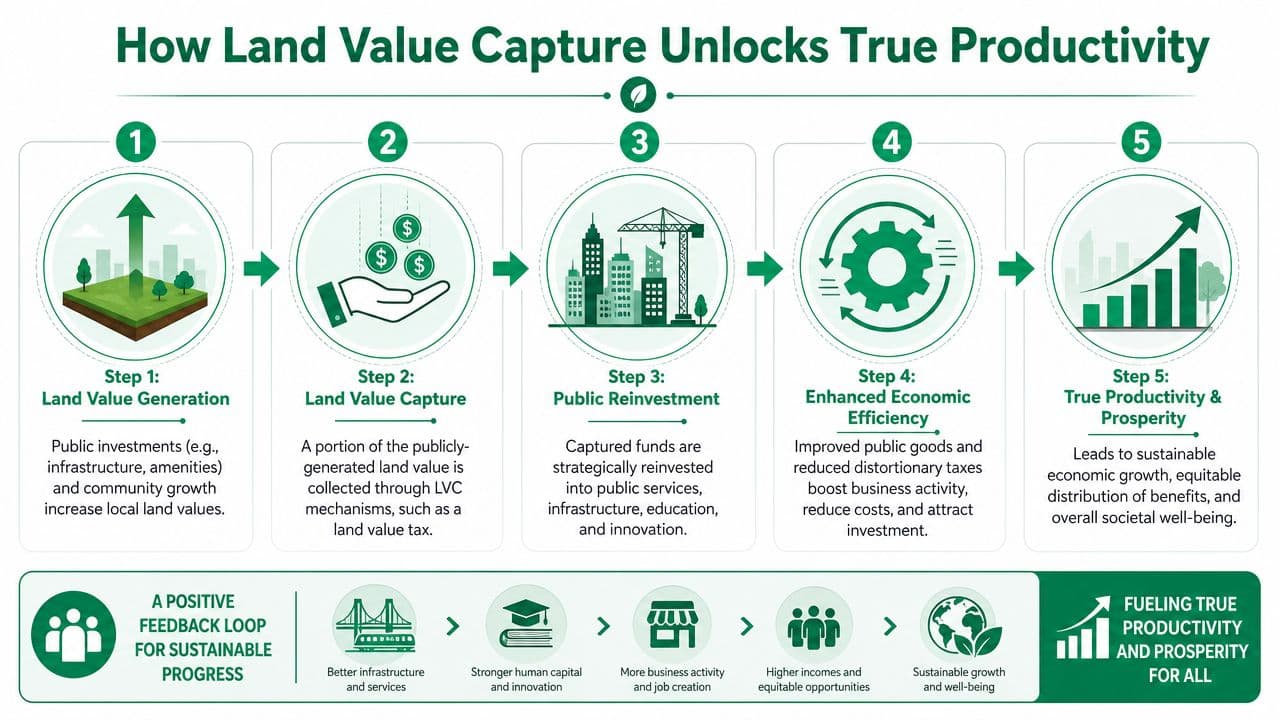
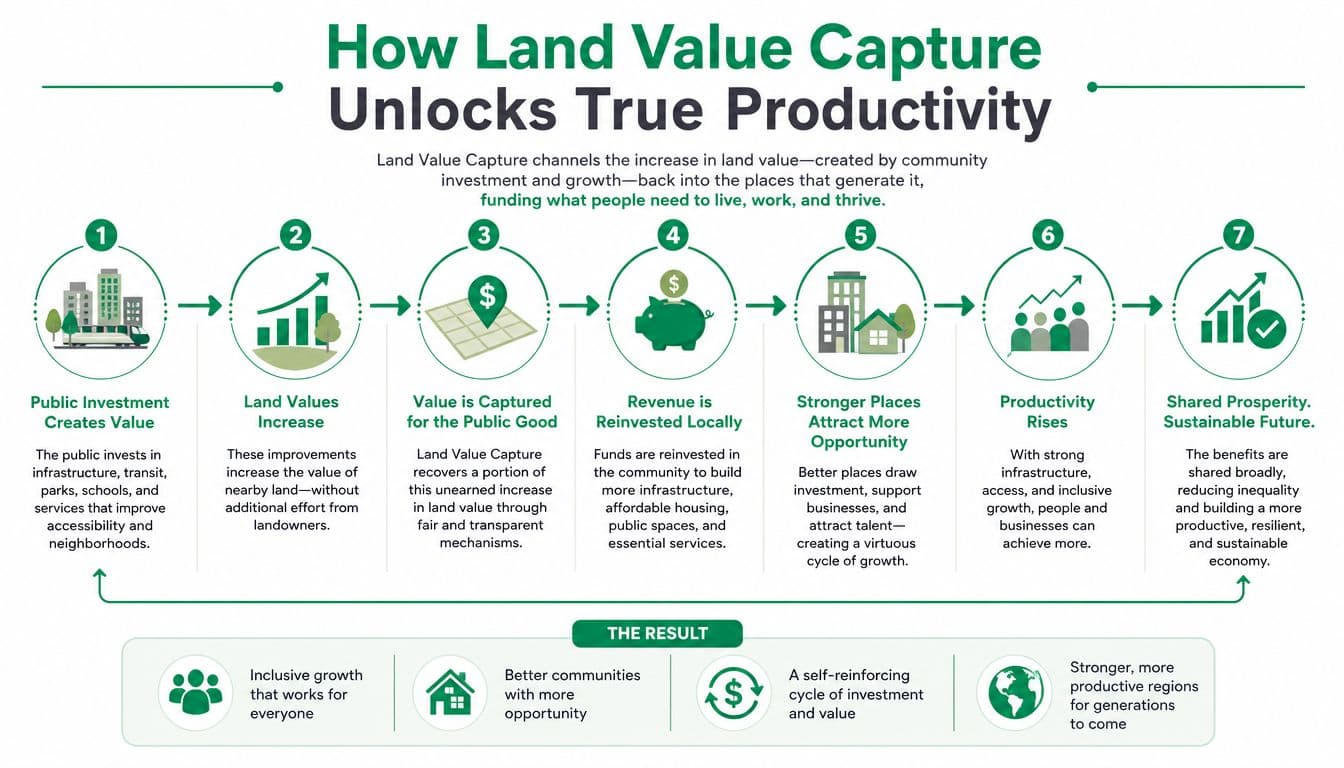
Once you separate land from capital, the policy answer becomes straightforward. Land value capture lets the public recover part of the location value that public action and community growth create, then reinvest it where productivity rises.
The mechanism policymakers should focus on
Here is the chain ministers should keep in view.
-
Public action creates land value. New transport links, school upgrades, utility extensions, safety improvements, and rezoning all raise the usefulness of specific locations.
-
That uplift appears in site prices. Owners gain because society improved the place around them.
-
Land value capture recovers part of that uplift. The state can do this through betterment levies, land value taxation, tax increment tools, and related mechanisms.
-
Recovered value funds further public investment. That supports transport, housing, sanitation, education, and other productivity drivers.
-
Taxes on work and productive capital can be reduced or contained. The economy gets a cleaner incentive structure.
The most powerful feature of this approach is incentive alignment. A levy on land value doesn't punish adding a floor to a building, renovating a shopfront, or putting an idle parcel into use. A tax on buildings often does.
Why betterment levies deserve serious attention
The strongest immediate use case is around planning gain and rezoning. Land value capture can generate up to 600% appreciation in land value following rezonings that permit denser development, and capturing even a fraction of that publicly created increment allows municipalities to reinvest in public services and reinforce a virtuous cycle of efficiency, according to this discussion of land value capture and rezoning uplift.
That matters because zoning decisions are not private acts of entrepreneurship. They are public permissions. If the state grants new development rights and creates a large uplift in site value, it should recover part of that gain.
A minister should judge LVC instruments against three criteria:
- Administrative clarity. Betterment levies are often easier to explain because they tie collection to a visible public action such as rezoning or infrastructure delivery.
- Economic neutrality. Well-designed land-based charges don't penalize new construction in the way transaction taxes or building taxes can.
- Revenue recycling. The best schemes earmark funds for the systems that raise productivity next, including transit, utilities, public realm upgrades, and affordable housing.
You can also strengthen implementation by improving valuation. Tools that help officials calculate land value are not technical side issues. They are central to political credibility and fiscal design.
Don't ask taxpayers to fund the same uplift twice. First through infrastructure spending, then again through higher housing costs and distorted taxes.
The strategic gain is larger than the revenue gain. LVC discourages speculative withholding of well-located land, pushes underused sites toward development, supports compact urban form, and creates a recurring funding base for productivity-enhancing public goods.
Global Evidence From Theory to Proven Results
Skeptics usually ask the same question: does this work outside theory? Yes, but not because every jurisdiction copied one identical model. The successful cases share a logic, not a script.
What successful jurisdictions have in common
Consider the examples often cited in land reform discussions: Estonia, Singapore, Canberra, and Allentown. Their institutions differ. Their legal systems differ. Their housing markets differ. What they have in common is more important than what separates them.
They moved policy attention away from taxing productive behavior and toward capturing location-based value more effectively. In practice, that tends to produce several changes at once. Idle or underused sites face stronger pressure to come back into use. Building activity faces fewer tax penalties. Public finance relies less on volatile or distortionary bases. Urban centers become easier to revive because landholders can't sit indefinitely on strategic sites at low carrying cost.
That package changes behavior. Developers respond. Owners reassess holding strategies. Local governments gain a firmer basis for infrastructure planning. Businesses get a cleaner signal that investment in structures and operations will be rewarded rather than taxed harder.
A short comparison makes the point:
| Jurisdiction type | Core reform pattern | Likely result |
|---|---|---|
| Fast-growing city-state | Capture location value to support coordinated development | Stronger infrastructure and land-use alignment |
| Capital city territory | Shift tax burden away from buildings and transactions | More neutral incentives for construction and mobility |
| Post-industrial city | Reduce penalties on improvement and reactivate sites | Stronger downtown renewal and reuse |
| National reform setting | Use land-based revenue to broaden the fiscal base | More stable public finance and cleaner growth incentives |
What ministers should take from these examples
Don't get distracted by labels. One jurisdiction may call it rate reform. Another may use a betterment charge. Another may rely on state land management. The policy question is simpler: who captures the value created by public action and collective growth?
Where governments answer that badly, they get familiar symptoms. Expensive land. Weak infill. speculative holding. Pressure to tax payrolls, transactions, and buildings. Political frustration that infrastructure spending raises private windfalls faster than public capacity.
Where governments answer it well, they gain room to fund transport, utilities, public services, and urban renewal without constantly raising taxes on productive effort. That is the practical test. Not ideological purity. Not textbook elegance. Better incentives, stronger revenue design, and more development where infrastructure already exists.
The lesson from real-world reform is not that one instrument solves everything. It's that land must be treated as a separate policy domain.
A Policy Roadmap for National Prosperity
Productivity policy fails when ministers treat land as a side issue. It is a core production factor, and reform should start there.
Start with valuation and pilots
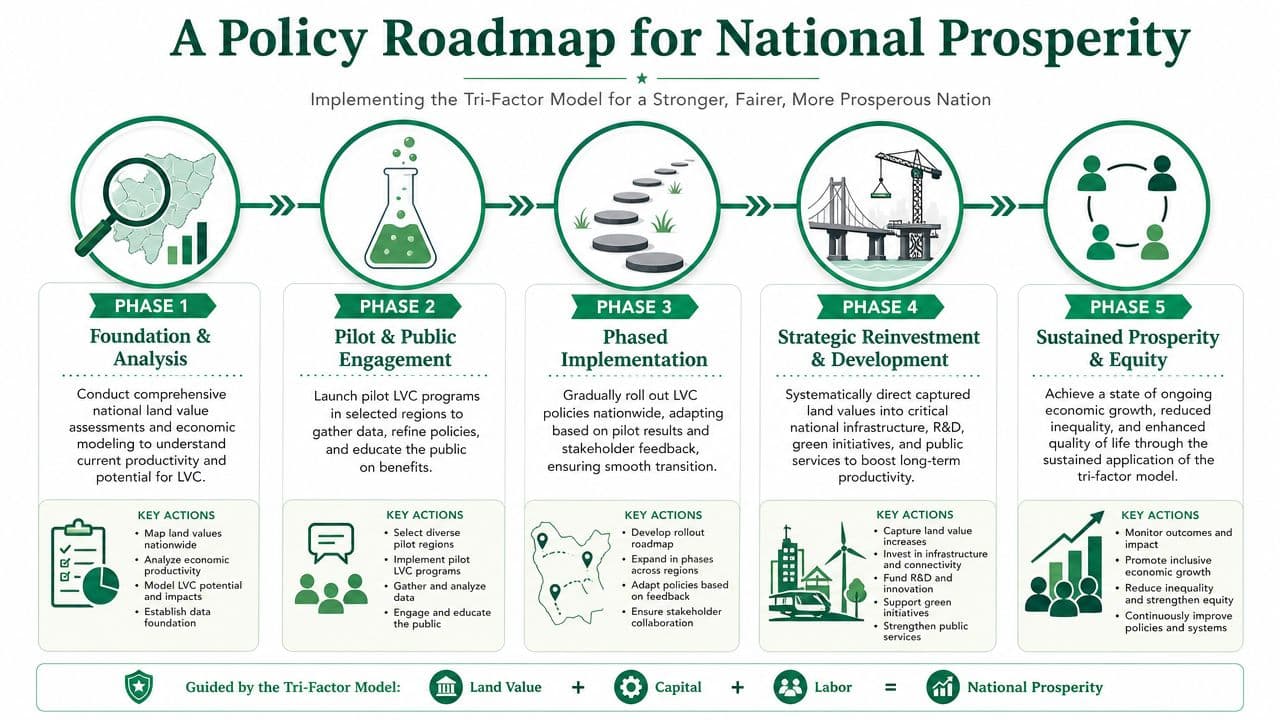
Begin with administrative capacity. A government cannot price, tax, or capture land value well if it cannot distinguish site value from the buildings sitting on it. Build that capability first at national or metropolitan level, then use pilots to prove that the system works under real political and operational conditions.
The first phase should do three jobs at once:
- Build parcel-level valuation. Map land values alongside infrastructure access, planning permissions, constraints, and the public decisions that shape location value.
- Audit the tax base. Identify how heavily the current system taxes wages, structures, transactions, and business activity compared with land.
- Choose reform zones. Pick a small number of visible places where transport upgrades, rezoning, redevelopment pressure, or chronic underuse make the gains easy to observe.
Pilots are not a communications exercise. They are a state-capacity exercise. They test valuation quality, billing, appeals, compliance, hypothecation rules, and interagency coordination before national rollout. They also show the public a concrete bargain. Higher public capture of rising land values in exchange for lower taxes on productive activity and better infrastructure where demand is already strongest.
Execution matters. Ministries should keep pilot administration simple, time-bound, and transparent. Even basic workflow systems can reduce delays across approvals and reporting. MyMentions' guide to automation offers a practical example of how teams can coordinate alerts and routine processes with less manual effort.
Move to transition and reinvestment
The second phase is fiscal design. Keep it plain enough to explain in one briefing note and strong enough to survive a budget cycle.
- Select the right instrument. Use betterment levies where land values rise sharply from rezoning or infrastructure. Use broader site-value taxation or split-rate reform where the goal is system-wide efficiency.
- Publish the incidence clearly. Show which owners, sectors, and places pay more, which pay less, and how the shift reduces taxes that penalize work, building, and exchange.
- Cut anti-productive taxes in parallel. Reduce taxes on buildings, transactions, or business inputs as land-based revenue expands.
- Reinvest where the public can see results. Prioritize transport links, serviced land, utilities, and place improvements that raise usable capacity in existing urban areas.
- Protect implementation quality. Maintain accurate cadastres, regular revaluations, workable appeal systems, and disciplined enforcement.
A useful reference at this stage is detailed property tax reform analysis, especially for governments that need a staged transition rather than a single legislative break.
The final phase is political discipline. Ministers must repeat one point until it becomes common sense. The state should tax unearned location value more consistently and tax productive effort less. That is the route to stronger investment signals, better land use, and a broader fiscal base.
Done properly, this agenda raises productivity without relying on endless subsidies, narrow sector favors, or another round of generic tech policy. It treats labor, capital, and land as distinct drivers of national performance, then fixes the one factor governments have handled worst.
If your government wants to turn this framework into policy, Unitism® can help with land valuation assessments, fiscal and distributional modeling, reform design, implementation planning, and public education. For finance ministries and city leaders who want productivity improvements that are durable, equitable, and fiscally credible, that support can accelerate the path from theory to execution.