Learn what is phased implementation, when to use it, and how to design sequenced rollouts that lower risk and build momentum for land-value reform.
August 21, 2026
What Is Phased Implementation and Why It Works
Learn what is phased implementation, when to use it, and how to design sequenced rollouts that lower risk and build momentum for land-value reform.

Phased implementation is a staged rollout in which a change moves through planning, adoption, execution, evaluation, and revision before wider expansion. In practical terms, it introduces a reform in waves, tests each wave, and uses evidence to decide whether the next phase should proceed.
Why do conventional reform plans still treat launch day as the main event? A finance ministry can approve a new land charge, publish the rules, and set one effective date, yet approval doesn't make valuation data accurate, billing systems reliable, or taxpayers ready. Implementation is the work of turning an adopted policy into action, not a ceremonial date on the legal calendar.
A mid-sized city introducing a land charge across every parcel at once would quickly expose this distinction. Valuation teams might face more cases than they can review carefully. The appeals office could receive a sudden concentration of disputes. Errors in land classification, ownership records, or site valuation would appear across the system at the same time, creating politically damaging clusters that are difficult to explain or correct.
A phased rollout changes the order of events. The city might begin with a manageable group of commercial parcels, review valuations and billing, correct weak procedures, and then extend the charge to other cohorts. Taxpayers receive clearer information, administrators learn from actual cases, and elected officials can respond to evidence rather than speculation. For readers looking for broader orientation before dealing with policy mechanics, a simple introduction offers useful background on the wider ideas behind institutional change.
The question isn't whether phasing sounds cautious. The question is whether the reform team has designed controlled learning, with explicit conditions for moving forward. That matters especially in land policy, where the choice among leases, land-use rights, and land-value charges determines what administrators must measure and how often they must update it. A useful grounding in land economics can help officials distinguish the value of land from the value created by labor and capital.
Table of Contents
- What Is Phased Implementation and Why It Works
- The Core Mechanics of a Phased Rollout
- Land Leases, Land-Use Rights, and Annual Land Value Charges
- Designing a Phased Implementation That Actually Works
- Risks, Trade-Offs, and When Phasing Slows You Down
- Applying Phased Implementation to a Unitism Land-Value Transition
- Metrics and a Practical Wrap-Up for Your Rollout
What Is Phased Implementation and Why It Works
What happens when a government introduces a land charge across an entire city on one day? Phased implementation offers a controlled alternative: divide the reform into defined waves, give each wave a clear scope, measure what occurs, and expand only when the evidence supports expansion.
The method separates political approval from administrative execution. A public-policy framework identifies five stages, agenda setting, formulation, adoption, implementation, and evaluation, placing implementation after formal approval (University of Texas policy model). Approval establishes authority. Implementation converts budget, jurisdiction, and staffing into working procedures, records, bills, payments, and decisions.
That distinction matters in land reform because sequencing depends on the instrument being changed. Moving from land leases to land-use rights creates different administrative tasks from introducing an annual land-value charge. Officials must know which rights already exist, which records support them, and which value the new system is meant to assess. A clear grounding in land economics helps separate the value of land from value created by labor and capital. Readers seeking broader orientation can also start with a simple introduction to the wider ideas behind institutional change.
Why a single launch date creates avoidable pressure
Consider a city introducing a land charge. A big-bang launch makes several departments solve different problems at once:
- Valuation teams classify parcels, estimate taxable land values, explain methods, and correct records at scale.
- Revenue offices calculate liabilities, issue bills, receive payments, and reconcile accounts.
- Appeals staff process challenges while initial data may still contain systematic errors.
- Political leaders defend the policy as residents encounter unfamiliar bills and inconsistent outcomes.
A repeated error in thousands of records can weaken trust before administrators understand its pattern. Phasing limits the initial population exposed to the new procedure. The team can then determine whether a problem comes from valuation, ownership records, software, communication, or legal interpretation.
The EPIS implementation framework separates change into Exploration, Preparation, Implementation, and Sustainment. Its implementation stage is the initial rollout, followed by course correction based on early feedback (Implementation-Minded Policy Making). A pilot has value only when its findings alter the next decision.
Practical rule: A phase should be small enough to control, but serious enough to expose problems that would matter at full scale.
Each wave needs an objective, an accountable owner, a review point, and a route for correction. Without those conditions, a sequence of delays is not phasing. It is uncertainty given a schedule.
The Core Mechanics of a Phased Rollout
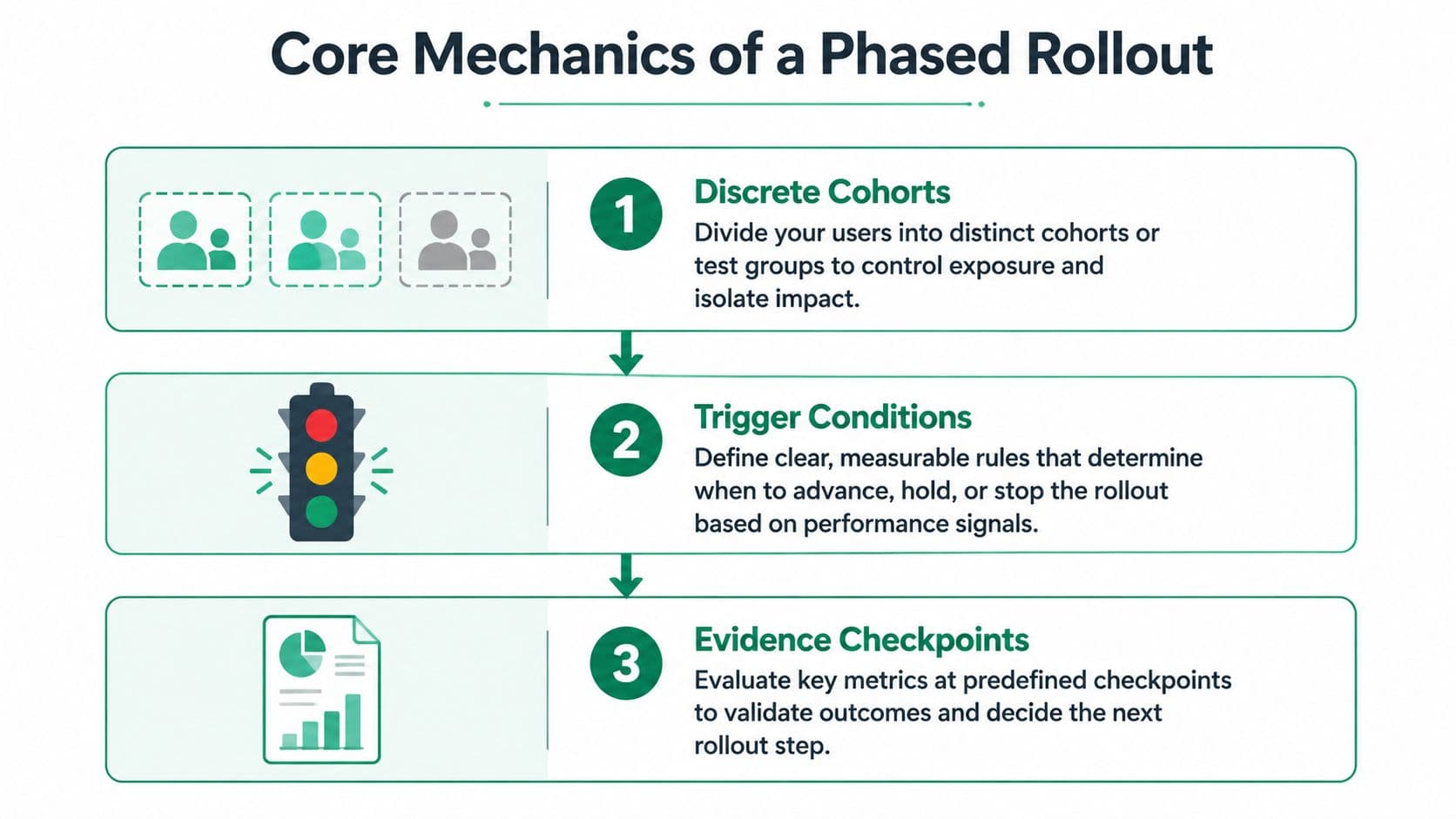
A workable rollout has three connected parts: discrete cohorts, trigger conditions, and evidence checkpoints. These parts turn a broad reform into a sequence of governed decisions. The sequence matters especially in land policy, where the administration may be moving from one tenure instrument to another. A district may be ready for new land-use rules even when its valuation, billing, or records systems are not ready for annual land value charges.
Cohorts create a manageable field of action
A cohort is a defined group that enters the new regime together. It could be a district, a parcel category, a group of public agencies, or users of one system. The boundary must be deliberate. Officials should know who is included, which rules apply, and which results belong to that wave.
For a land reform, readiness may be a better boundary than geography alone. A district with reliable ownership records and experienced valuation staff may be a sound starting point, while a larger district with incomplete cadastral information may create avoidable confusion. The cohort then operates as a bounded administrative exercise, with its own objectives, timeline, training needs, and performance review.
This design also protects the comparison between existing leases or land-use rights and the proposed charging method. Officials can observe whether problems arise from tenure rules, valuation practice, billing, or public communication before extending the change to districts with different conditions.
Triggers should describe evidence, not dates
A date tells the team when to look. A trigger states what must be true before the next cohort proceeds. Useful signals include reliable payment processing, the rate and type of valuation disputes, differences between preliminary and reviewed valuations, system availability, and the time required to update a parcel record.
Each trigger needs an owner. The valuation director might certify data quality, the revenue commissioner might certify billing performance, and the legal office might confirm that unresolved disputes do not create unacceptable exposure. Officials can test these conditions before rollout with scenario modeling software, particularly where changes in land values or tenure treatment could affect different groups unevenly.
Checkpoints turn monitoring into a decision
A checkpoint is a formal gate where officials review evidence and choose whether to expand, pause, redesign, or accelerate. It should produce a written decision, not only a meeting record. The review must separate a correctable operational defect from a weakness in the policy design.
Phasing places evaluation inside implementation through repeated operational gates. Managers can therefore identify machinery that is failing while the reform remains limited enough to correct, rather than waiting until the entire tenure transition has been applied.
Land Leases, Land-Use Rights, and Annual Land Value Charges
A land reform's rollout cannot be designed properly until officials understand what the existing tenure instrument does. Fixed land leases, land-use rights, and annual land-value charges distribute timing and repricing risk differently, so they create different administrative workloads.
A fixed-term lease sets a contractual relationship for a defined period. The FAO describes building leases as long-term instruments, often lasting 99 or 125 years, because that duration gives a developer time to amortize construction costs and earn a return on invested capital (FAO land-tax chapter). The same source notes that rent may remain fixed for the term, allowing the contractual price to lag changing market conditions until renewal or renegotiation.
Hong Kong illustrates how renewal can concentrate repricing. Many New Territories leases were extended to 2047, while policy also allowed certain non-renewable leases to be extended for 50 years at the government's discretion, with rent reset to 3% of rateable value from the extension date (Hong Kong government rent overview). Renewable leases can instead receive a new rent tied to fair and reasonable rental value at renewal.
Japan provides a different mechanics contrast. Ordinary land leasehold rights last 30 years by default, with renewals generally set at 10 years, or 20 years for the first renewal, unless the parties agree to longer periods. Special fixed-term rights include business-use leases of 10 years or more but less than 50 years, and general fixed-term leaseholds of 50 years or more, expressly without renewal (Japanese law translation).
Land-use rights can resemble leases in allowing occupation without transferring the underlying land value, but the institutional design described here treats them as indefinite rights with annual repricing. UN-Habitat distinguishes leasehold interests from ownership and notes that leaseholders may transfer their interests while paying recurring, tax-distinct amounts to government for the right to occupy and use land (UN-Habitat land and property tax guide).
| Dimension | Fixed Land Lease | Land-Use Right | Annual Land-Value Charge |
|---|---|---|---|
| Term | Renewable or non-renewable fixed term | Indefinite, with no expiration in this model | Ongoing public charge linked to land value |
| Repricing | Fixed until renewal or contractual adjustment | Annual repricing | Annual repricing |
| Transferability | Transfer can become difficult as expiry or repricing risk approaches | Rights can be bought and sold at relatively low cost because no expiry premium must be negotiated | Transfer depends on clear titles, valuation, and billing rules |
| Risk location | Risk is postponed and concentrated at renewal, or embedded in declining resale and refinancing prospects | Risk is made visible through recurring valuation | Risk and land value are made visible through recurring charges |
| Administrative requirement | Registry and contract administration, with valuation pressure at renewal | Continuous valuation and rights administration | Continuous valuation, clean titles, billing, appeals, and enforcement |
The central policy distinction is practical. Fixed leases don't correctly price risk, they postpone it. Renewable leases offer certainty only until expiry, when the gap between the lease rate and the market can close through a major repricing. Non-renewable leases can become progressively harder to refinance and sell as expiry risk approaches.
Land-use rights, by contrast, are treated here as lease-like but indefinite and annually repriced. That structure can support lower-cost transfer because buyers aren't purchasing a wasting term. Annual land-value charging exposes the market signal more regularly, but it also requires stronger valuation and registry capacity. A detailed discussion of 99-year land leases helps clarify why duration alone doesn't remove adjustment risk.
Designing a Phased Implementation That Actually Works
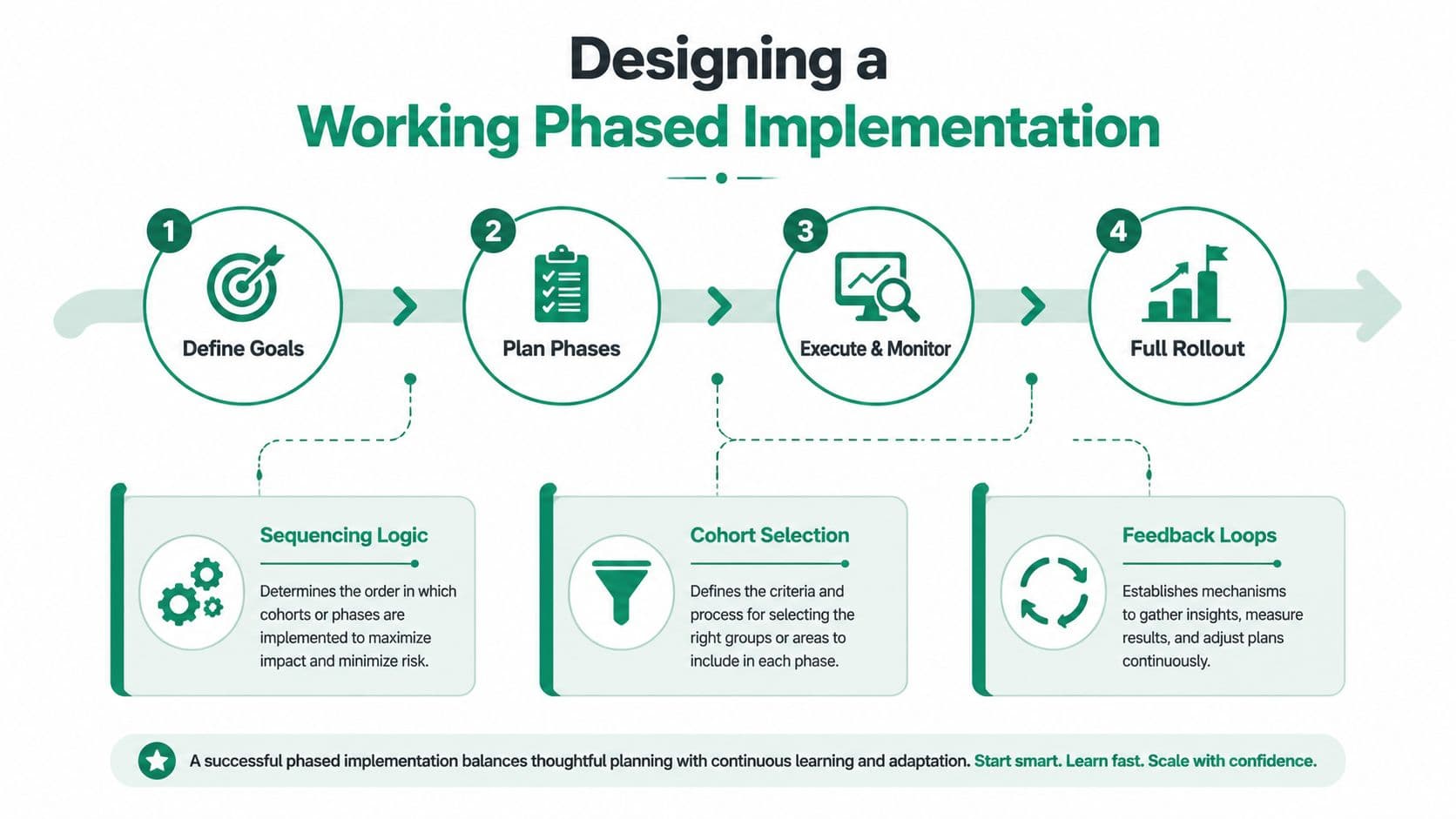
Start with the decision, not the calendar. A ministry should select the first cohort because it offers a useful combination of readiness, representativeness, and controllable exposure. A politically convenient pilot that excludes difficult parcels may produce reassuring results that don't survive expansion.
Choose the sequence deliberately
Officials can sequence cohorts by region, parcel type, market maturity, data quality, or administrative capacity. High-value commercial parcels may provide strong transaction evidence, while a district with reliable records may be easier to administer. The choice should also test a condition that later waves will face, rather than selecting only the easiest cases.
Write down why each cohort comes before the next. That record protects the program from pressure to select groups for political reasons and helps reviewers assess whether the sequence is still producing useful learning.
Set conditional gates
A gate should define the evidence required for expansion. Possible measures include:
- Revenue performance: Confirm that bills are issued correctly, payments are recorded, and reconciliation works.
- Compliance behavior: Track filings, payment timing, and recurring misunderstandings.
- Valuation stability: Review variance between initial assessments, quality checks, and successful appeals.
- Complaint patterns: Separate individual hardship from systematic errors affecting a parcel class or ward.
- System readiness: Confirm that the registry, billing platform, payment channels, and reporting tools work together.
Don't set a trigger as “expand after the pilot period.” Set it as a condition, such as “expand after valuation disputes have been reviewed and the authority can explain the remaining cases.” The exact threshold belongs in the program's governing documents and should be published before results arrive.
Run old and new systems with discipline
A transition often needs a period of parallel running. The old lease or charge may remain relevant for existing accounts while the new valuation and billing process is tested. That creates real cost, so the reconciliation rules must be explicit. For every parcel, the team should be able to show the old obligation, the new calculation, any transitional credit or adjustment, and the legal basis for the difference.
Stakeholder engagement should follow the operational workflow. Landlords need briefings on liability, valuation, and transfer. Tenants need notices that explain how the reform may affect occupancy costs without confusing rent with a public land charge. Municipal counsel needs the evidence trail, appeal rules, and authority for each transition step.
A practical guide for OKR governance can help a team connect objectives to owners and review points, but it shouldn't replace legal controls or financial reconciliation.
Monitor continuously, audit at the gates
During an initial rollout, staff should review operational indicators frequently enough to catch failures before they spread. Gate reviews should audit samples of valuations, ownership records, notices, appeals, payment postings, and system changes. The next cohort's design should record what changed because of that evidence.
Risks, Trade-Offs, and When Phasing Slows You Down
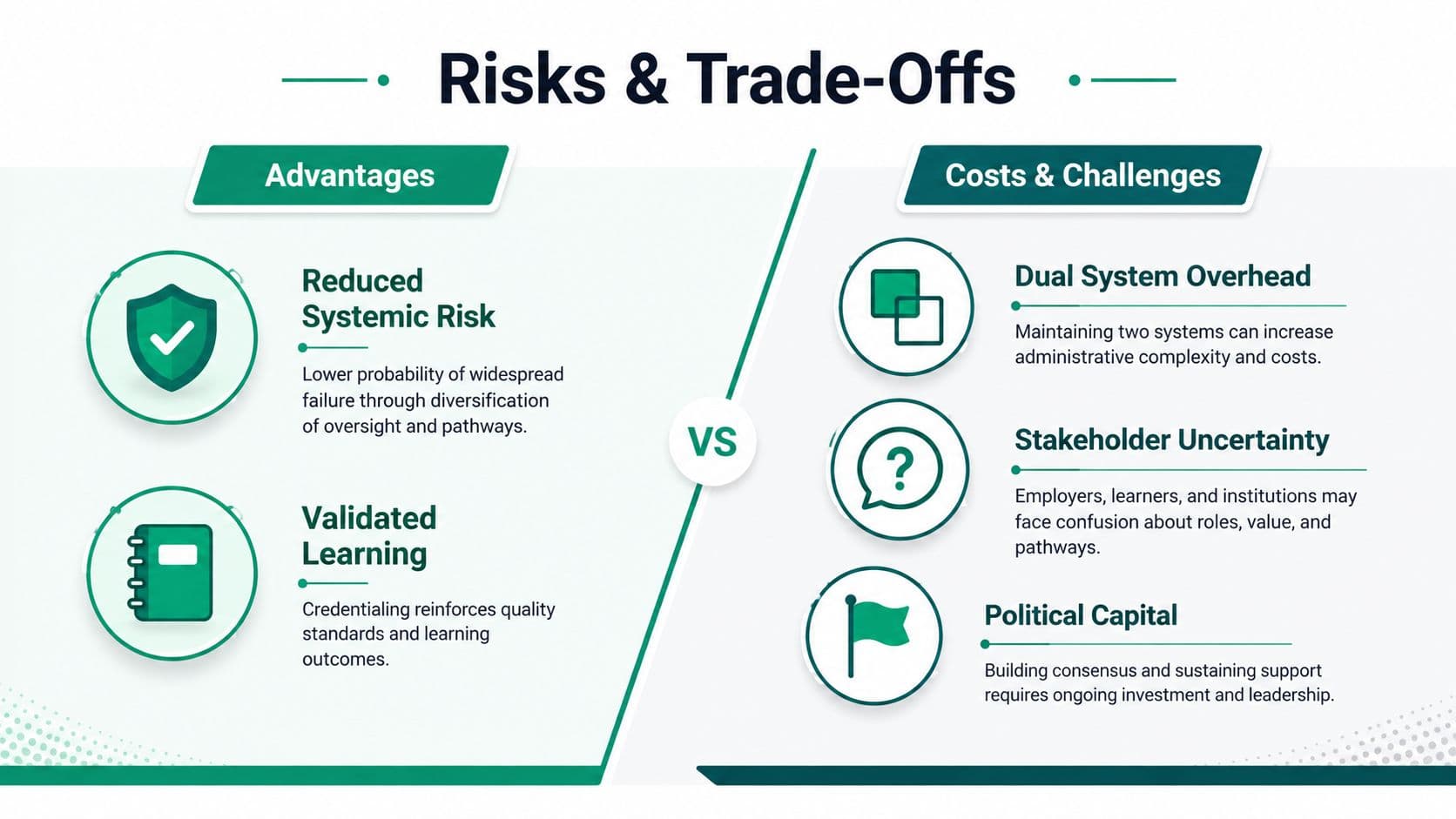
Phasing reduces the initial blast radius, but it doesn't make reform inexpensive. A government may need to operate old and new administrative arrangements at the same time, train staff for both, answer questions from different cohorts, and explain why neighbors face different rules during the transition.
Stakeholders also endure uncertainty for longer. A homeowner, landlord, developer, or local council may delay a decision while waiting to learn how the next phase will affect them. Political leaders must defend a reform repeatedly instead of absorbing the political cost in one launch.
Recognize the warning signs
Phasing has become a delaying tactic when officials keep changing the gate criteria, extend pilots without new learning, or allow scope creep to preserve the incumbent arrangement. The team should ask four direct questions at every review:
- What did this phase teach us? If the answer is only that more consultation is needed, identify the specific uncertainty and the test that will resolve it.
- Which problem is blocking expansion? Name the responsible process, department, or legal question rather than describing “readiness” in general terms.
- Are the costs still proportionate? Compare dual-running effort, staff time, communication burden, and delayed benefits with the remaining risk.
- Who benefits from another delay? Review whether well-organized incumbents can use repeated exceptions to protect a favorable position.
Land reforms face particular failure modes. Valuation methods may drift between cohorts, creating unequal treatment. Early adopters may face legal challenges because their records receive more scrutiny. Organized interests may learn the gate criteria and adjust behavior to pass formal tests while preserving the underlying advantage. The broader issue of rent-seeking in economics provides useful context for why beneficiaries of an existing allocation may resist transparent repricing.
A pause is justified when evidence shows a material design defect. It isn't justified merely because the next phase is politically uncomfortable.
Accelerate when the evidence is stable, the remaining issues are local and correctable, and the administrative team can support the next cohort. Pause when errors are systematic or legal authority is unclear. Restructure when the pilot itself was too narrow to answer the questions that matter.
Applying Phased Implementation to a Unitism Land-Value Transition
A Unitism-style transition from fixed-term land leases toward annual land-value charges illustrates why a generic rollout template isn't enough. The reform changes not only the amount collected, but also the timing of valuation, the treatment of tenure, the transfer economics, and the work required from the registry and revenue authority.
A sensible sequence would begin with high-value commercial and industrial parcels where valuation evidence and professional property data are relatively reliable. These parcels can test annual assessment, billing, appeals, and compliance processes without immediately exposing every household or every customary tenure arrangement to a new system.
Residential parcels could follow once the authority has improved its valuation bands, communication materials, hardship rules, and dispute handling. Agricultural and customary-held land may require later waves because rights, use patterns, records, and community consultation can differ materially from urban commercial property.
Lease-expiry events provide natural transition points. They allow officials to address repricing where the existing contract already requires review, while protecting the integrity of existing arrangements during the period in which legal and accounting rules are clarified. Prepaid lease premiums also need transition accounting so that the authority doesn't charge twice for the same economic period or create unexplained gains and losses for holders.
| Wave | Cohort | Trigger to Expand | Key Readiness Check |
|---|---|---|---|
| Initial wave | High-value commercial and industrial parcels with strong records | Valuation reviews, billing reconciliation, and appeals show controllable defects | Registry links each parcel to a liable party and the valuation authority can explain the assessment |
| Next wave | Residential parcels in administratively prepared districts | Communication, payment, and hardship processes operate consistently | Notices, payment channels, relief rules, and appeal capacity are tested |
| Later wave | Agricultural land and customary-held land | Legal, community, and valuation questions have documented resolutions | Rights are recorded appropriately and local consultation supports lawful administration |
| Expansion gate | Additional regions and parcel classes | Evidence confirms that the authority can maintain annual valuation and enforcement | Staff, systems, data governance, and audit controls are funded and assigned |
The destination described in the transition brief treats land-use rights as indefinite and annually repriced. That differs from a fixed lease because the right doesn't waste away toward an expiry date, and it differs from a one-time land charge because valuation remains visible through recurring assessment. People can buy and sell such rights at lower cost when they aren't forced to price an approaching expiration into every transaction.
Annual land-value charges also change the capabilities required from government. The registry must maintain clean titles and rights records. The valuation authority must update assessments consistently. The finance ministry must design relief for genuine hardship without creating permanent exemptions that undermine the base. The legal team must define appeals, enforcement, and the treatment of existing lease obligations.
The Unitism and Georgism guide provides context for the policy rationale behind shifting public revenue toward land and nature while reducing taxes on work and productive capital. The implementation lesson is narrower and more concrete: the tenure instrument determines the gate sequence.
Metrics and a Practical Wrap-Up for Your Rollout
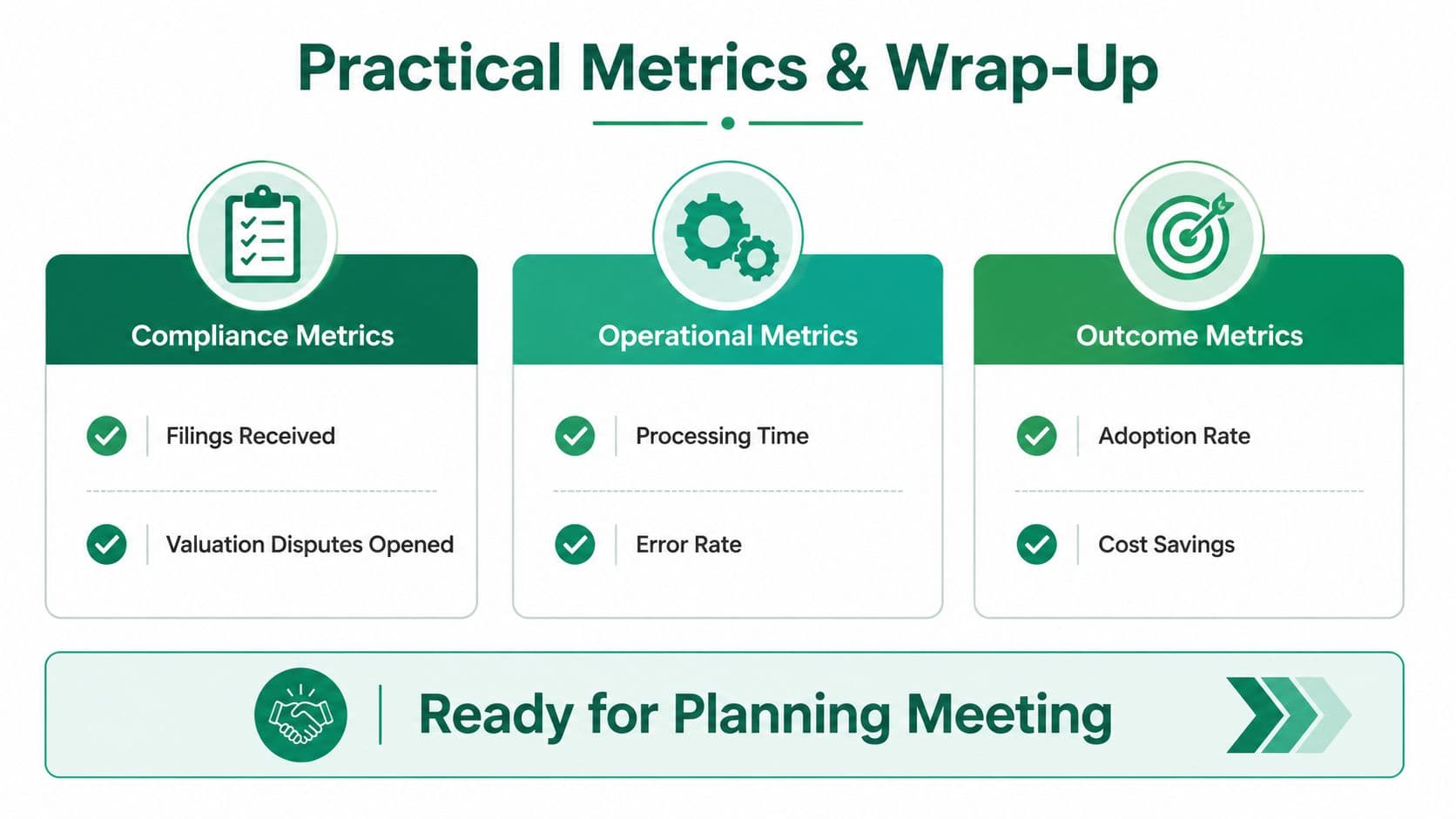
Take the following checklist into the planning meeting. Every metric should have an owner, a baseline, a review date, and a decision attached to it.
Compliance metrics
- Filings received: Review whether liable parties are submitting required information. Expand only when missing filings are understood and enforcement can handle the next cohort.
- Valuation disputes opened: Examine both volume and concentration. Hold when disputes reveal a recurring classification or valuation defect.
- On-time payment rates: Confirm that billing instructions, payment channels, and relief procedures work before increasing coverage.
Administrative health
- Land-register update time: Measure how quickly ownership and parcel changes reach the operational system.
- Parallel-run cost ratio: Track the resources required to operate old and new arrangements together.
- Staff hours per parcel: Use this to identify whether the process can scale or needs automation, training, or simpler rules.
Political and economic outcomes
- Price-to-value ratios on transacted land: Review whether assessed values remain connected to observed market conditions.
- Speculative holding patterns: Look for changes in vacant, underused, or delayed-development behavior.
- Complaint volume by ward: Map complaints to detect geographic or administrative inequality rather than treating every case as isolated.
Set a milestone gate for each group. If compliance is weak but administrative systems are sound, improve notices or enforcement. If administrative health is weak, pause expansion and fix the workflow. If outcomes differ sharply across locations, investigate valuation consistency and distributional effects before treating the result as policy failure.
Use a clear decision rule: if two consecutive phases miss the compliance gate, pause expansion and re-baseline valuation bands before proceeding. Phasing is a learning tool, not a delay tactic. The final phase should include a sunset plan for transitional grandfathering clauses, with a defined review of which protections expire, which become permanent, and how the authority will communicate the change.
Unitism® offers land valuation assessments, policy design, distributional and fiscal modeling, and implementation support for governments moving from land-reform ideas to workable administrative systems. If your team is planning a phased transition involving leases, land-use rights, or annual land-value charges, visit Unitism® to explore its research, guides, interactive models, and advisory support.