99 year land leases offer many benefits over fee simple ownership, but come with a range of unindented consequences and side-effects.
July 2, 2026 — last updated July 6, 2026
99 Year Land Leases
99 year land leases offer many benefits over fee simple ownership, but come with a range of unindented consequences and side-effects.

What exactly is secured by a 99 year land lease. A long but wasting claim to use land, or a durable social framework for governing land across generations?
For many practitioners, the 99 year lease is presented as a sophisticated middle path between outright private ownership and full public control. It is certainly better than fee simple ownership where rising land value is privatized almost entirely. But that does not make it the best model. In practice, the 99 year structure often produces avoidable distortions: end-of-term anxiety, speculative politics around extension, declining asset values as expiry approaches, and only partial public recovery of land's socially created value.
A more coherent alternative is the land-use rights model. Properly designed, land-use rights can preserve the public or common claim to land while granting stable, secure, and potentially indefinite rights of use. That is a better fit for stewardship, clearer for households and businesses, and more faithful to the principle that land value should return to the community while improvements remain privately rewardable.
If you're new to leasehold thinking, it also helps to ground the concept in first principles. A lease grants defined rights to use land for a period of time. It isn't the same as full private ownership, and it doesn't have to be vague or insecure. This short guide on land use rights is a good starting point.

Table of Contents
From Contract to Comparative Framework
The central policy mistake is to treat a 99 year lease as if length alone solves the governance problem. It does not. A long lease may reduce some short-term uncertainty, but it still creates a wasting asset. Every year that passes shortens the claim, narrows the financing window, and changes incentives in ways that often undermine stewardship.
By contrast, land-use rights can be structured to give users stable, inheritable, mortgageable, and effectively indefinite use, while keeping land itself within a public or commons-based framework. That distinction matters. It allows society to protect long-term use without forcing occupants, businesses, or institutions into a countdown toward expiry.
Why duration is not the same as security
A 99 year term sounds generous, especially at the moment of grant. But policy should be judged across the whole life of the instrument, not only at inception. Once a right is time-limited, the clock becomes economically significant. At the front end, occupants often feel secure enough to treat the property like a permanent asset. At the back end, they discover that the value of the right can fall quickly as the remaining term becomes too short for buyers, lenders, or long-horizon users.
This is one of the model's deepest defects. It encourages people to feel asset rich for decades, only to discover later that the asset was always structurally wasting.
A tenure system should not encourage households to mistake a declining term asset for a durable store of value.
Why land-use rights are structurally stronger
Land-use rights handle the problem more cleanly. They can separate use from ultimate title without imposing an arbitrary expiry cliff. If the public objective is stewardship, active use, and fair recovery of land value, then indefinite or automatically renewable use rights are generally more coherent than a lease that must eventually expire or be politically renegotiated.
That is also why the distinction between land and improvements is so important. Under a land-use-rights framework, the community can retain the ground claim while users keep secure rights in what they build and maintain. This short guide on land use rights remains a useful primer.
The Core Policy Question, What Is the System For
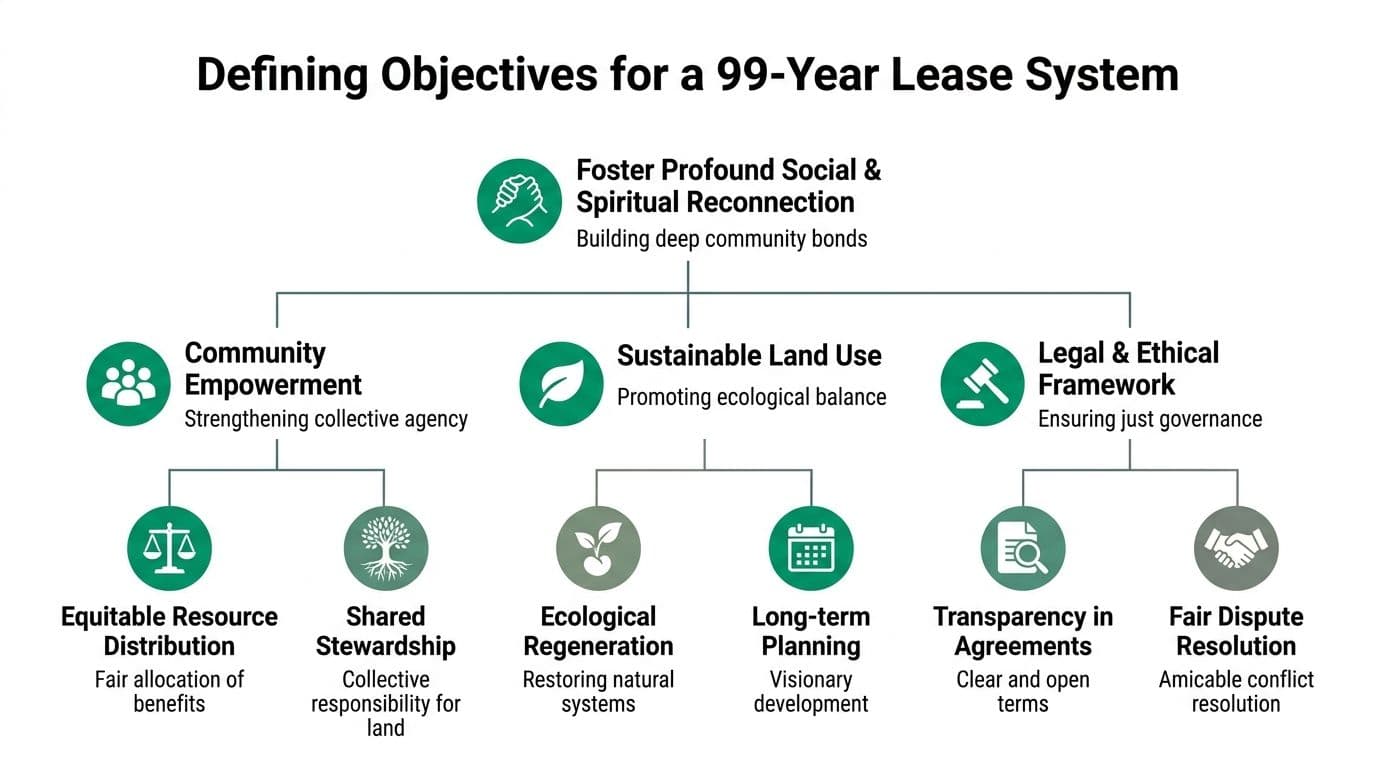
Before drafting any tenure document, policymakers need to answer a basic question: what is the system designed to accomplish. If the purpose is only to monetize access to land, the result will usually be a blunt leasing regime. If the purpose is to support long-term use, preserve public claims to socially created land value, and avoid speculative windfalls, then the design logic changes.
99 year leases are better than fee simple, but still flawed
It is important to be precise here. A 99 year land lease is usually preferable to fee simple ownership. It preserves some public leverage over the land, creates an opportunity to collect rent or premiums, and at least in theory allows the community to revisit terms over time. That is better than allowing private titleholders to absorb almost all future land appreciation by default.
But the improvement over fee simple should not be confused with adequacy. In many real systems, 99 year leases capture only a small fraction of the land value that emerges over time from public infrastructure, agglomeration, legal permissions, and surrounding community activity. If the land value rises dramatically over several generations, a lease granted on fixed or weakly adjusting terms will leave most of that uplift in private hands until a politically charged renewal or redevelopment event.
Hong's classic framework for public leasehold identifies four common points of value capture: initial tender, annual land rent, revised terms at modification, and revised terms at renewal in this Lincoln Institute paper on public land leasing. The problem is that many actual lease systems rely too heavily on the first event, some premium at allocation, and too weakly on continuous public recovery thereafter.
A useful companion is this explanation of land value capture, especially for readers who want a clearer distinction between charging for location value and taxing buildings or labor.
Land-use rights align better with stewardship
A land-use-rights model can do better because it does not depend on a dramatic end-of-term event to restore public control. The public claim already remains in force. Users keep secure tenure for productive, residential, civic, or commercial use, but the system can reassess land value, usage conditions, and stewardship obligations on a recurring basis rather than waiting for expiry.
In that sense, land-use rights are not softer than long leases. They are often more disciplined. They can combine indefinite use with periodic review, clear obligations, transparent valuation, and an explicit rule that the unearned rise in location value belongs primarily to the community.
Real-World Failures of the 99 Year Lease Model
The case against 99 year leasehold is not theoretical. The weaknesses appear repeatedly in practice: lease decay, financing constraints, extension politics, weak recurring value capture, and confusion between occupancy wealth and enduring land wealth.
Singapore, lease decay in an expensive market
Singapore is often cited as proof that 99 year leasehold can support national development. It is true that Singapore has used leasehold at scale and has achieved strong state capacity in planning. But as a model of long-run value capture and user security, it is much less persuasive.
First, Singapore is one of the most expensive property markets in the world, which by itself should caution anyone against treating 99 year leasehold as a cure for land price inflation. Second, the system openly confronts the reality of lease decay. Research published in the International Real Estate Review found that, for Singapore private residential leaseholds, a 1 percent increase in remaining lease term was associated with roughly a 1.46 percent increase in transaction price, clear evidence that the market prices the wasting term itself (GSS, lease decay study).
As expiry approaches, financing constraints intensify. Public guidance and market analysis in Singapore note that shorter remaining leases can sharply reduce mortgage availability and CPF eligibility, which pushes resale values downward and narrows the buyer pool (99.co on lease decay, NUS Institute of Real Estate and Urban Studies).
This creates the familiar social problem: occupants can feel asset rich for many years, then watch value erode rapidly as the lease shortens. The issue is not merely financial. It is ethical. A system that markets long leases as quasi-ownership can leave ordinary households with a false sense of permanence.
The end-of-term issue is equally serious. Singapore's public position is that land is generally recovered at lease expiry, not automatically renewed, and without compensation for the leasehold interest itself. That reality creates recurring pressure for political exceptions, selective redevelopment schemes, and public speculation about who will be rescued, who will not, and on what terms. That is exactly the kind of ethically questionable behavior a sound tenure model should avoid encouraging.
The core lesson is straightforward. Singapore demonstrates that a 99 year lease can coexist with strong planning capacity. It does not demonstrate that the model is an ideal instrument of justice, affordability, or durable land value capture.
Hong Kong and Canberra, limited capture and political leakage
Hong Kong is often admired for its public leasehold framework because the government has historically raised large sums from land premiums. But the details are more sobering. Research discussed by the Lincoln Institute reports that Hong Kong recaptured about 39 percent of increased land values between 1970 and 1991 through its leasehold system, enough to finance a substantial share of infrastructure, but still far short of full recovery of socially created land value (Lincoln Institute discussion, Lincoln working paper).
That matters because even one of the world's most centralized and land-conscious leasehold systems did not come close to capturing all of the publicly generated uplift. It also relied heavily on up-front premiums and politically sensitive lease modifications. In the New Territories, many leases were extended to 2047 without additional premium under statutory arrangements, showing how public value capture can leak when renewal becomes politically constrained (LegCo overview).
Canberra provides a different warning. The city is famous for public leasehold in theory, yet in practice annual land rent was long weak, residential land rent was abolished in 1970, and later efforts to capture uplifts through charges such as the Lease Variation Charge recovered only part of the gain and were repeatedly revised amid controversy (Lincoln Institute analysis, Prosper Australia overview).
These cases show a recurring pattern. Leasehold systems often look powerful on paper, yet fail to capture value consistently over time because governments undercharge at the outset, under-index annual payments, or retreat when extension and modification become politically difficult.
The UK leasehold lesson, insecurity and extraction
The United Kingdom offers another cautionary example. Its residential leasehold system is not identical to a classic public 99 year lease regime, but it illustrates how time-limited tenure combined with ground rent and reversionary claims can turn housing into a vehicle for extraction rather than stewardship.
Ground rents and escalating lease terms became so controversial that the UK moved to ban most new residential ground rents through the Leasehold Reform (Ground Rent) Act 2022. Government impact assessments and sector reporting indicate that existing reform proposals could wipe out billions in freeholder asset values while saving leaseholders billions, a sign of just how much value had been captured by intermediaries rather than justified by productive contribution (Leasehold Knowledge Partnership summary, QuotedData report).
The UK case is a reminder that leasehold can drift into opacity and rent extraction unless carefully constrained. Duration alone does not make a model fair.
Designing a Better System with Land-Use Rights
If the objective is long-term productive use without private enclosure of land value, then land-use rights are generally the superior framework.
Indefinite use avoids the expiry cliff
The first advantage is conceptual clarity. Land-use rights allow for indefinite use, or for renewal rules that function so predictably that users are not forced into recurrent cliff-edge politics. The user's right is secure so long as agreed conditions are met. That is much closer to what residents, farmers, institutions, and long-term businesses actually need.
A useful comparison comes from China's treatment of urban land. China does not permit private freehold ownership of land, yet it separates building ownership from the public ownership of land and provides statutory land-use rights, with residential rights subject to automatic renewal in principle under the legal framework, even though some implementation details remain debated (Vanderbilt Journal of Transnational Law discussion, ScienceDirect abstract on expiring land use rights).
China's system is not a perfect template, and its legal ambiguities should not be ignored. But it does point toward a more mature idea: public ownership of land need not require households to live under a steadily expiring claim.
Value capture should be recurring, not postponed
The second advantage is fiscal and ethical. A strong land-use-rights system can recover land value on a recurring basis through transparent assessments, annual charges, or periodic recalibration of use rights. That is preferable to relying on one initial lease premium and then hoping future governments will have the political will to charge properly at renewal.
For valuation work, teams also need a method for estimating the site's distinct land value apart from structures. This guide on how to calculate land value gives a practical foundation for that step.
The larger principle is simple. If land value rises because transit arrives, density is permitted, jobs cluster, and public order is maintained, then the public should capture that increase as it occurs. A 99 year lease often captures only a slice. A land-use-rights framework can be designed to capture it systematically.
Administration, Cadastres, and Accountability
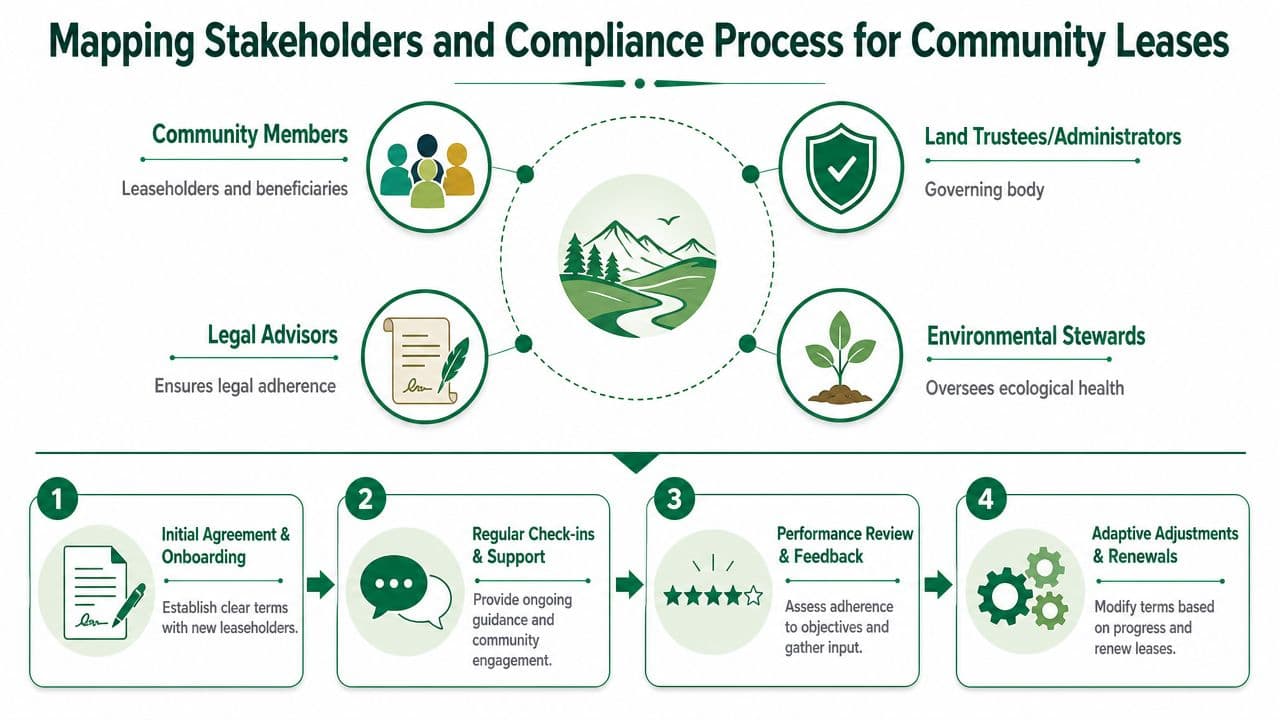
Any serious tenure system still depends on robust administration. The legal form matters, but so do the records, valuation methods, enforcement processes, and public reporting standards.
A cadastre must distinguish land from improvements
A land governance system should always record the parcel, the right of use, the ownership of improvements, and the payment obligations as separate but linked layers. In the United States, long ground leases commonly give the tenant ownership of improvements while the landlord keeps the fee interest in the land, and that distinction remains important for tax treatment, financing, and liability, as explained in Holland & Knight's ground lease analysis.
At minimum, the record should show:
- Parcel identity: boundary, legal description, and mapped site
- Use-right record: duration or renewal basis, amendment history, and transfer rules
- Improvement record: what has been built, by whom, and under what ownership status
- Financial record: land charges, review dates, arrears status, and adjustment logic
- Stewardship record: environmental duties, restoration obligations, and compliance history
Data integration is not a technical luxury. It is the institutional memory that prevents discretion from becoming arbitrariness.
KPIs should test integrity, not only revenue
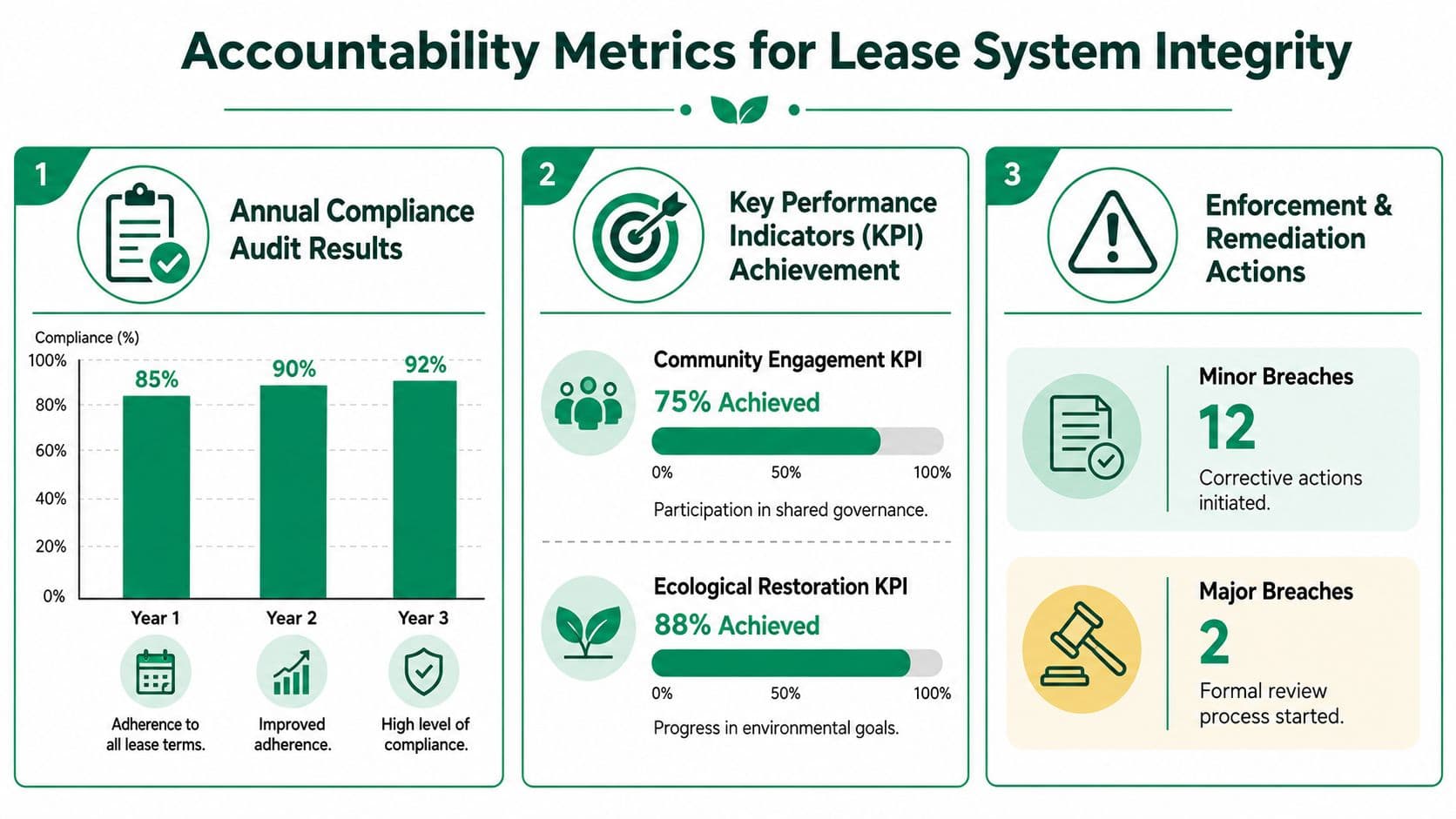
A good accountability framework should test more than collections. It should ask whether the tenure system is stable, legible, fair, and fiscally honest.
A broader KPI set might include:
- Value-capture ratio: how much of assessed land value uplift is actually returned to the public
- Term-risk exposure: whether users face approaching finance or transfer cliffs
- Equity consistency: whether similar users are treated under similar rules
- Cadastre accuracy: whether land, improvements, and obligations are correctly matched
- Stewardship compliance: whether land care duties are met and documented
- Appeal transparency: whether modifications, renewals, and remedies are understandable
Key test: If a resident, lender, and public auditor reviewed the file today, would they describe the same asset and the same obligations?
For teams designing checklists and periodic reviews, a practical operations reference like Superdocu's property management guide can help translate broad duties into recurring administrative tasks.
This work also benefits from fiscal transparency. If a government or trust is capturing land value, it should be able to show where that value goes and who is affected. That kind of public reasoning is strengthened by tools for fiscal impact analysis, especially when reforms are politically contested.
From Transitional Leasehold to Durable Land Governance
The right conclusion is not that all 99 year leases are useless. In some settings they may be a politically feasible step away from fee simple ownership. They can preserve some public claim, create some recovery of land value, and support development where outright private title would be worse.
Where a 99 year lease still has a role
A 99 year lease may still make sense where:
- governments need a transitional instrument that is familiar to lenders and investors
- a project has a genuinely finite public purpose or concession period
- the administrative capacity for a more advanced land-use-rights system does not yet exist
- the alternative on the table is fee simple privatization
That is why some governments continue to use the model. Reuters reported that in September 2025 the Philippines extended the maximum foreign land lease term to a continuous 99 years, replacing the older 50 years plus a single 25-year renewal model in an effort to improve long-term investment certainty (Reuters on the Philippine reform).
But that kind of reform should be understood for what it is: a second-best response to the limitations of private land ownership rules, not the endpoint of tenure design.
Why the long-term destination should be land-use rights
For long-term justice, stewardship, and fiscal integrity, land-use rights are usually the better destination.
They allow indefinite use. They avoid the wasting-asset psychology built into the 99 year term. They reduce the incentive for ethically questionable bargaining near expiry. They make it easier to distinguish real wealth created by labor and improvements from speculative gains driven by location scarcity. And they can be paired with recurring, transparent land value capture rather than relying on politically fragile renewal events.
Readers thinking about the broader social implications may also want to explore this piece on housing affordability policy.
The core comparison is therefore clear:
| Model | Main strength | Main weakness |
|---|---|---|
| Fee simple ownership | Strong private control | Privatizes land value and entrenches speculation |
| 99 year land lease | Better than fee simple, retains some public claim | Time-limited, politically fragile, weak at recurring value capture |
| Land-use rights | Secure use with retained public claim to land | Requires stronger administration and clearer valuation systems |
A 99 year land lease is not a final answer. At best, it is a partial corrective to fee simple ownership. At worst, it creates the appearance of security while embedding decline, lobbying pressure, and under-capture of land value into the system itself.
Land-use rights provide the stronger foundation. They are more honest about what should remain public, more secure for those who actually use land, and better suited to a world that needs stewardship rather than timed privatization.
If this way of seeing land feels both practical and subtly radical, Unitism® offers a deeper path into the argument. You can begin with Land: A New Paradigm for a Thriving World or explore the broader library of insights for a fuller picture of how land value, stewardship, and public life can be woven back together.