Explore what is a tif district and how Tax Increment Financing (TIF) drives urban growth. This 2026 guide covers mechanics, impacts, risks, & alternatives for
July 20, 2026
What Is a TIF District? Your 2026 Guide to TIFs
Explore what is a tif district and how Tax Increment Financing (TIF) drives urban growth. This 2026 guide covers mechanics, impacts, risks, & alternatives for

You're probably here because a planning memo, council packet, news story, or redevelopment proposal mentioned a TIF district, and the term sounded more technical than it needed to be. That's common. TIFs sit at the intersection of property tax law, redevelopment policy, and municipal finance, so people often hear strong opinions about them long before they get a clear explanation.
The short version is simple. A Tax Increment Financing district, or TIF district, is a defined area where a city captures the future growth in property tax revenue and uses that growth to pay for improvements inside that same area. The tax rate itself doesn't change just because a TIF is created. What changes is where the increase in tax revenue goes for a limited period.
If you've ever asked, what is a TIF district, the best way to understand it is to think like a city council member reviewing a redevelopment plan. What problem is the city trying to solve? Where does the money come from? Who benefits? And who gives something up while the district is active?
Table of Contents
- The Engine of Urban Renewal
- How a TIF District Works The Financial Mechanics
- Creating and Managing a TIF District
- Common Uses and Real-World Examples
- Distributional Impacts and Common Criticisms
- TIFs vs Other Land-Value Capture Tools
- FAQ for Policymakers and Practitioners
The Engine of Urban Renewal
A neglected downtown block usually doesn't stay neglected because nobody cares. It stays that way because the economics don't work. A developer may want to rehabilitate upper-floor apartments, a lender may worry about risk, and the city may know the streetscape, sidewalks, utilities, or site conditions need work before private investment becomes realistic.
That's the environment where TIF usually enters the conversation. TIF districts are typically established in blighted or underperforming areas where development would not occur without public financing, leveraging the anticipation of future property value increases to fund present-day community investments like revitalization efforts and economic development incentives, as explained by Habitat for Humanity's overview of why TIF districts matter.

Why cities reach for TIF
A city doesn't use TIF because it has unlimited cash. It uses TIF because it wants to fund improvements now and repay that effort with the added tax value that redevelopment may create later. In plain terms, the city is saying: if this area improves, part of the resulting gain will help cover the cost of making improvement possible.
That can mean public works, site preparation, cleanup, or rehabilitation support. It can also mean making a hard site financeable when the private market alone won't do it.
Practical rule: TIF works best when the public investment solves a real barrier to redevelopment, not when it simply rewards a project that was already likely to happen.
A useful analogy is a garden bed in poor soil. You don't fertilize the whole area. You target the patch that won't produce without help. Cities use TIF with that same logic. They focus on a specific geography, hoping that public reinvestment will stimulate private activity and raise value over time.
Of course, TIFs aren't the only way to capture the value that public investment creates in a district. For a deeper look at how recovering land value can fund urban improvements without the risks TIFs sometimes carry, the Progress and Poverty Institute's work on land value return offers a compelling alternative framing. Considering these approaches side by side can help you weigh which financing tools genuinely serve long-term community growth.
The real promise and the real tension
The promise is attractive. A city can support redevelopment without creating a new tax rate just for the district. The tension is equally real. If future tax growth is being committed to one area, then that growth isn't available right away for every other public purpose.
That's why TIF debates are rarely just about finance. They're also about priorities. Is the district distressed? Is the public investment essential? Will the gains justify the temporary redirection of revenue? Those questions sit at the center of every serious TIF discussion.
For a broader perspective on how cities benefit from concentrated redevelopment and reinvestment, see positive aspects of urbanization.
How a TIF District Works The Financial Mechanics
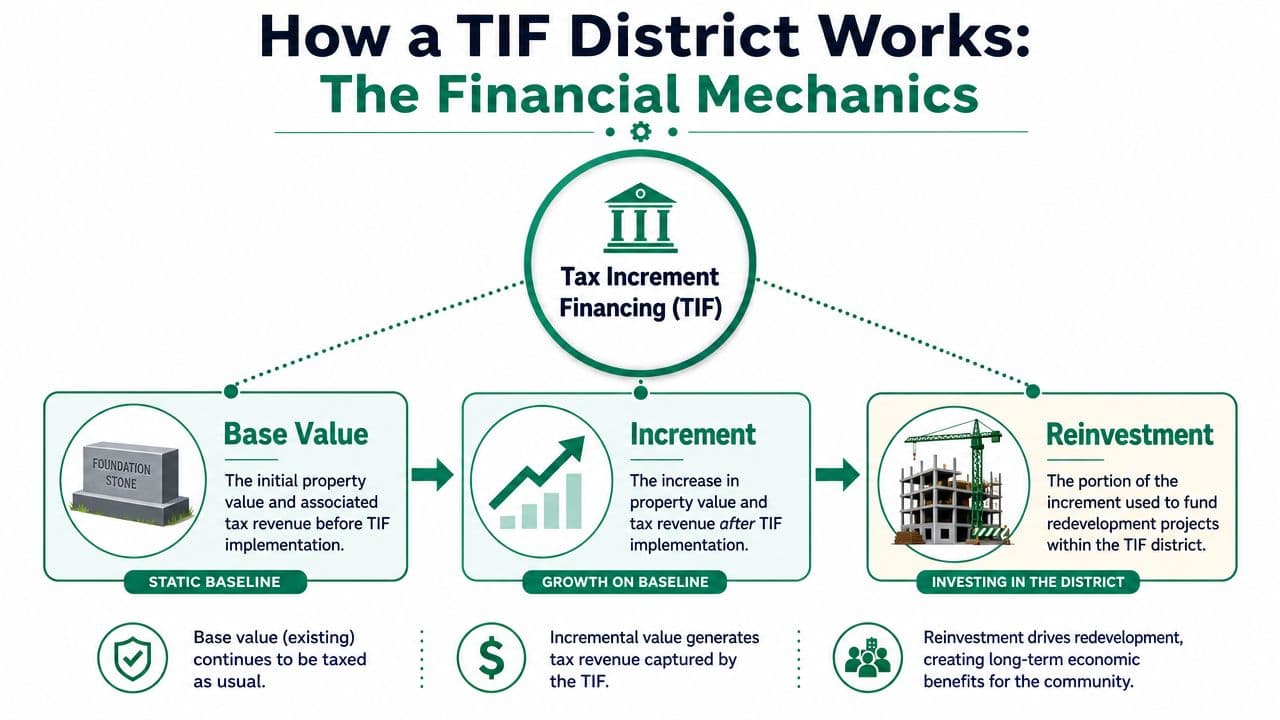
The easiest way to understand a TIF is to separate the money flow into three parts: base value, increment, and captured revenue. Once those are clear, the rest stops feeling mysterious.
Start with a frozen base
When a TIF district is created, the city identifies the area and fixes the starting property tax base. In Illinois terms, the existing Equalized Assessed Valuation is determined and frozen for distribution to various taxing bodies. The Village of Roselle's explanation of TIF describes it this way and also explains that the tax increment is the difference between property tax revenue before the designation and the revenue generated after redevelopment, with that increment collected into a special city-managed fund.
Here's the part many readers miss. The TIF doesn't create a new property tax. It changes what happens to the growth above the base inside the district.
Think of a bakery.
- The original daily sales are the base.
- The added sales after renovation and better foot traffic are the increment.
- The slice of added sales reserved to pay for the renovation is the captured value.
The bakery still sells bread. The city still levies property taxes. But the growth above the starting line is set aside for a particular use.
Follow the redirected growth
Once redevelopment begins, property values may rise. If they do, the taxes generated from that increase above the frozen base are redirected into the TIF fund instead of flowing immediately through the normal pattern.
That special fund may support several kinds of eligible activity, depending on state law. Typical uses include property acquisition, building rehabilitation, public works, site preparation, relocation assistance, administration, and job training. The practical point is that the increment becomes a financing stream tied to the district itself.
If you're reviewing a TIF proposal, follow the increment like a dedicated revenue pipe. The question isn't whether money appears from nowhere. The question is where future growth is being routed, for how long, and for what purpose.
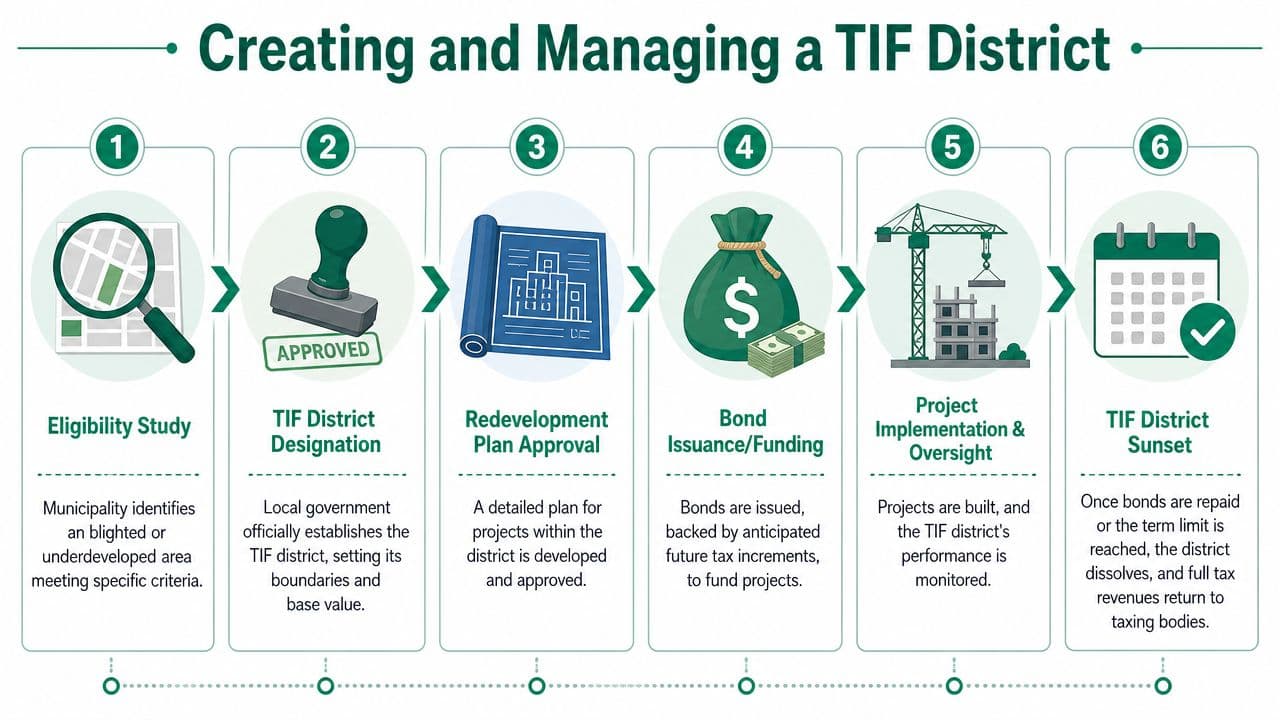
Cities also use that expected increment to back borrowing. A municipality can issue bonds and repay them from the future captured revenue, which helps fund infrastructure and other up-front costs before the private value increase fully materializes.
For readers comparing tax systems, land-value tax vs property tax is a helpful companion because TIF doesn't replace the property tax system. It sits on top of it as a targeted redirection mechanism.
Creating and Managing a TIF District
A TIF district isn't supposed to be improvised. It is a formal legal tool, and the process matters because weak process often leads to weak public trust.
How a district gets created
In most places, the city begins with an eligibility review. The area must satisfy standards under state law, usually tied to blight, decline, underuse, or weak market performance. That legal threshold is important because TIF is meant for places where redevelopment is not likely to happen on ordinary market terms.
The municipality then draws narrowly defined geographic boundaries and prepares a redevelopment plan. That plan usually identifies the conditions to be addressed, the public improvements to be funded, and the private response the city expects to catalyze.
A public hearing typically follows. That's the point where residents, property owners, school representatives, and other affected parties should ask direct questions:
- Why this area: What evidence shows the district is underperforming?
- Why TIF: What barrier won't be solved without public intervention?
- Why these projects: Are the funded items tied to redevelopment, or are they just convenient add-ons?
How it is managed over time
Once established, the district runs for a limited period. TIF districts are legally authorized to reallocate newly generated tax dollars for a specific duration, typically up to 25 years, to support redevelopment in blighted, declining, and underperforming areas, according to Oklahoma Commerce's TIF FAQ.
Management then becomes a discipline, not a slogan. Staff need to track project eligibility, monitor revenue, manage contracts, and decide whether to issue bonds against future increment. The city also needs a clear record of what has been committed, what has been spent, and what outcomes are reasonably attributable to the district.
A responsible TIF district has a clear map, a defined term, a redevelopment plan tied to legal purposes, and regular public reporting. If any of those are missing, governance risk rises fast.
Cities that want to think carefully about the capital side of the equation should also study broader approaches to infrastructure funding, because TIF is only one way to pay for public improvements.
Common Uses and Real-World Examples
When people ask what a TIF district pays for, the practical answer is usually the gap between a desirable project and a financeable one. TIF revenue often goes toward the public improvements or enabling costs that private capital won't absorb by itself.
What cities usually fund with TIF revenue
State laws vary, but the common pattern is familiar. Municipalities use TIF for things that make a stalled site buildable or a declining district investable.
Typical uses include:
- Public works: Streets, sewer systems, water lines, sidewalks, bike lanes, and similar infrastructure that supports redevelopment.
- Site preparation: Demolition, assembly of fragmented parcels, and preparation for industrial or commercial reuse.
- Building rehabilitation: Repairing or adapting older structures so they can return to productive use.
- Relocation and related redevelopment costs: Helping clear obstacles that prevent a project area from moving forward.
- Environmental cleanup: Addressing polluted or compromised sites that private lenders may otherwise avoid.
That list matters because TIF is not just a subsidy check. At its best, it funds the groundwork that changes the development equation.
What a successful TIF often looks like on the ground
One common example is a historic downtown where vacant upper floors remain empty because the block needs coordinated public investment. The city may use TIF to improve sidewalks, utilities, or public spaces while helping fund rehabilitation of obsolete buildings. The visible result can be new housing, active storefronts, safer streets, and stronger occupancy.
Another example is a former industrial site that needs cleanup and basic infrastructure before any private employer will touch it. In that setting, TIF helps convert dead land into usable land.
The Federal Highway Administration describes TIF as a value capture tool that uses taxes on future gains in real estate values to fund infrastructure improvements within a geographically bounded district, after which the property returns to the normal tax rolls at its updated value. That framing appears in the FHWA value capture FAQ on TIF.
A good TIF project usually leaves behind more than a finished building. It leaves behind a stronger block, better infrastructure, and a property tax base that, once the district ends, can support ordinary public services at a higher level than before.
Distributional Impacts and Common Criticisms
TIF is often sold as a redevelopment tool. It is also a distributional choice. That's where the sharpest criticism comes from.
Why supporters use TIFs
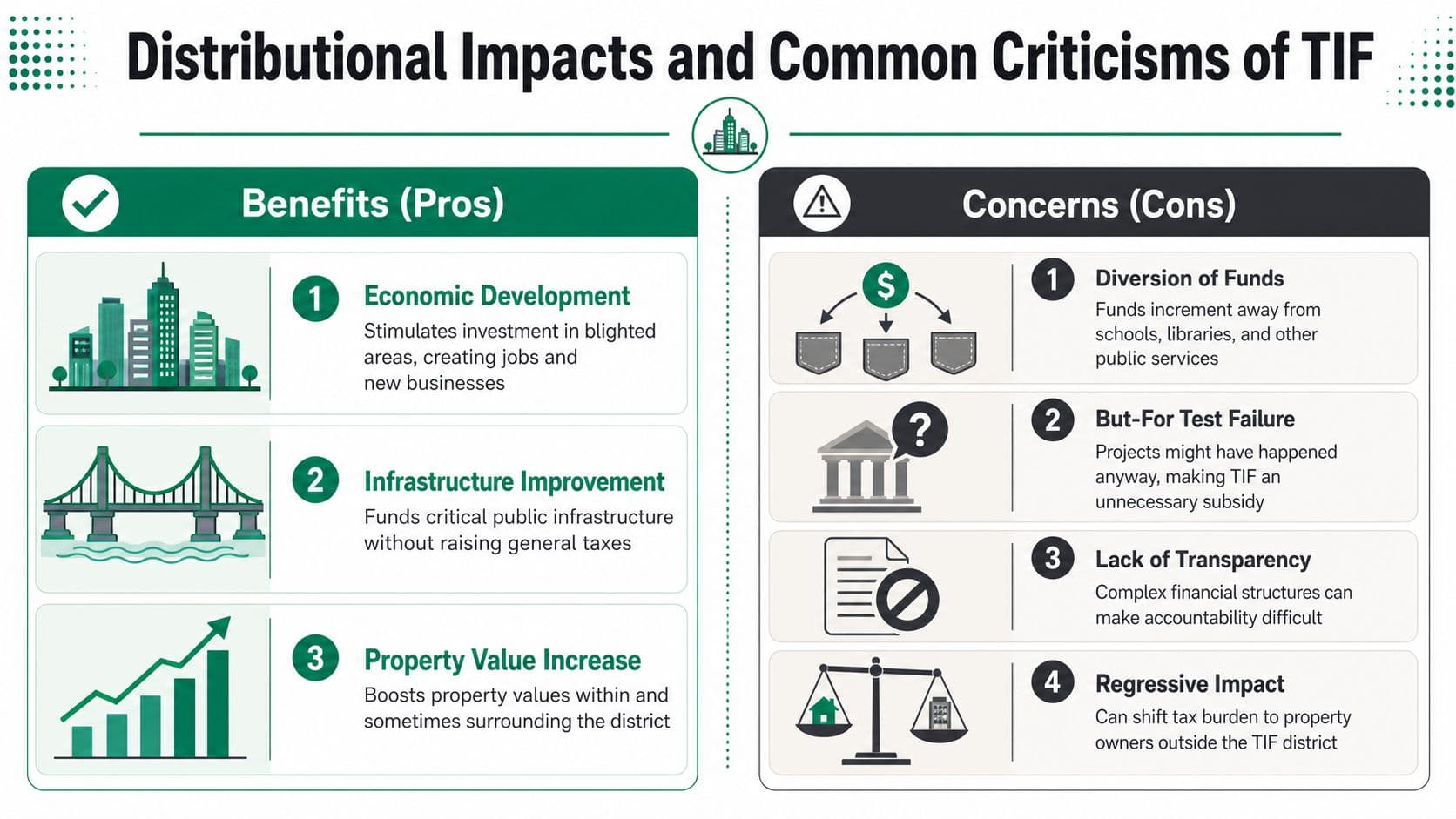
Supporters aren't wrong to see TIF as useful. It can concentrate resources where market failure is obvious. It can fund infrastructure before redevelopment fully occurs. It can also help a city act in a targeted way rather than trying to spread limited capital dollars across every neighborhood at once.
In many places, that targeted approach is exactly why TIF became popular. A district with vacant lots, obsolete utilities, and weak private lending conditions may need a structured financing tool that aligns future value growth with present improvement costs.
Why critics push back
The criticism starts with the fiscal diversion. TIF creates a diversion where local public services lose the new revenue they would normally receive, potentially worsening fiscal imbalance, according to the Lincoln Institute report on improving tax increment financing. That same source notes emerging evidence from Dallas and Connecticut showing TIF funds often flowing to suburban commercial zones, which can contradict the blight rationale and reinforce land-value speculation.
That criticism is easy to understand in local government terms. Schools, libraries, parks, and other taxing bodies still serve the area. But during the TIF period, they don't automatically receive the increment that new development generates.
The central public finance question isn't whether redevelopment is good. It's whether redirecting incremental revenue to one place is the best use of that money compared with the claims of schools, parks, libraries, and other services.
There's also the but-for issue. Would the project have happened anyway? If the answer is yes, then the TIF didn't enable development. It merely transferred value to a project that didn't need the help.
Other concerns are social rather than strictly fiscal:
- Displacement risk: Revitalization can raise rents and property costs, pushing out long-time residents or small businesses.
- Opacity: TIF accounts, reimbursements, and project agreements can be hard for the public to track.
- Sprawl concerns: If cities direct TIF toward edge-area commercial projects instead of distressed inner areas, the tool may support outward expansion rather than repair existing urban fabric.
- Tax burden shifts: If value growth is carved out inside the district, pressure can build elsewhere in the system.
For a deeper look at the political economy behind these patterns, rent-seeking in economics is useful. Many TIF controversies aren't accidents. They reflect competition over who gets access to publicly created land value.
TIFs vs Other Land-Value Capture Tools
TIF is one member of a larger family of land-value capture tools. All of them try, in different ways, to recover some of the value created by location, public investment, and community growth. But they do it through very different mechanisms.
The core difference in one sentence
A TIF district is a geographically bounded redevelopment zone where the property tax base is frozen at a designated base year value, so taxing jurisdictions temporarily lose out on the incremental revenue. That is a key difference from other value capture tools that may provide more immediate and broader revenue flow, as described in the FHWA discussion of TIF as a value capture tool.
That distinction matters because TIF is selective and temporary. Other tools can be broader and more continuous.
If you mention land-value taxes, it's important to distinguish them from land-use rights. A land-value tax is a recurring tax on the value of land itself rather than on buildings or improvements. Land-use rights are different. They are land leases that are repriced annually with no expiration dates. Because they are repriced annually, people can buy and sell land-use rights for a low cost. In policy design terms, that means land-use rights separate access to land from a large speculative purchase price in a way that a tax alone does not.
Comparison of Land-Value Capture Instruments
| Feature | Tax Increment Financing (TIF) | Site-Value Taxation | Land-Use Rights |
|---|---|---|---|
| Revenue basis | Future growth in property tax revenue within a defined district | Ongoing charge based on site value | Ongoing lease payments for the right to use land |
| Geographic reach | Limited to a designated area | Can apply broadly across a jurisdiction | Can apply wherever the land-rights system is used |
| Timing of public revenue | Deferred and tied to increment over time | More immediate and system-wide | More immediate through annual repricing |
| Effect on buildings | Uses existing property tax framework | Targets land rather than improvements, which can reduce the penalty on building activity | Separates use rights from speculative land sale values |
| Speculation control | Mixed. Can reduce blight, but can also reward favored projects | Stronger at discouraging idle land holding | Stronger when annual repricing keeps access costs tied to current land value |
| Administrative style | Project finance and district management | Tax assessment and rate design | Lease administration and regular repricing |
| Main trade-off | Redirects incremental revenue away from general taxing bodies for a period | Requires solid land valuation and political support for tax reform | Requires a different legal and institutional framework than conventional fee simple ownership |
From a Unitist perspective, the biggest critique of TIF is that it captures land value after a city has chosen to carve out a district and dedicate the gain. Site-value taxation and land-use rights are more structural. They don't wait for a blight designation and they don't depend on a special district to recover publicly created value.
That doesn't make TIF useless. It means TIF is often a patch, while broader land-value capture tools aim to change the underlying fiscal architecture.
FAQ for Policymakers and Practitioners
When is a TIF district most defensible
A TIF is most defensible when the area is clearly underperforming, the legal eligibility case is strong, the redevelopment barriers are specific, and the city can explain why ordinary market financing won't solve the problem.
What should a council member ask first
Ask for the but-for case in plain language. What exactly won't happen without the TIF? Then ask what schools, parks, libraries, and other taxing bodies give up during the district's life.
How do you reduce the downside risk
Require narrow boundaries, a clear redevelopment plan, transparent reporting, and a credible sunset strategy. Keep the funded items tightly tied to redevelopment needs instead of letting the district become a flexible pot of money.
When might another tool be better
If the city's problem is broad land speculation, weak infill, or a tax system that punishes building activity across the whole jurisdiction, a district-by-district TIF may be too narrow. In those cases, broader land-value capture tools can be a better fit.
If your team is evaluating TIFs, site-value taxation, or land-use rights, Unitism® provides research, policy design, valuation frameworks, implementation support, and plain-language education to help governments capture land value more transparently and with fewer distortions to work, construction, and productive investment.