Comprehensive guide to capitalism as an economic system. Explore mechanics, variants, critiques, and the role of land in creating a more equitable future.
July 12, 2026
Understanding Capitalism as an Economic System: A 2026 Guide
Comprehensive guide to capitalism as an economic system. Explore mechanics, variants, critiques, and the role of land in creating a more equitable future.

Most explanations of capitalism start with the wrong simplification. They tell readers to think in two factors only: labor and capital. That advice is tidy, familiar, and often useless when policymakers confront housing inflation, land speculation, or wealth gains that arrive without corresponding productive effort.
A better starting point is capitalism as an economic system built not on two factors, but on three: labor, capital, and land. Once land is separated from capital, several persistent puzzles become easier to diagnose. Why can construction technology improve while housing stays unaffordable? Why do cities accumulate vacant or underused sites in high-demand locations? Why do gains from growth often pool around ownership of place rather than productive investment?
Historically, capitalism also has to be judged against what came before it. Prior to the 19th century, approximately 90% of the global population lived in extreme poverty, and the transition to capitalist economies helped drive the economic growth and wage gains that reduced that share over time, as discussed in this historical analysis of poverty and development. That record matters. But it doesn't settle the policy question facing governments now. The live issue isn't whether capitalism produced growth. It's whether officials are using the right model to govern its distortions.
Table of Contents
- Understanding Capitalism Beyond the Textbook
- The Three Pillars of Capitalist Economies
- The Historical Evolution of Capitalist Systems
- Persistent Critiques and Unintended Consequences
- The Missing Third Factor Land vs Capital
- Reforming Capitalism with Land-Use Rights
- Toward a More Stable and Equitable Economy
Understanding Capitalism Beyond the Textbook
Most textbook definitions focus on private ownership, markets, and investment. That's accurate as far as it goes. The problem is what gets collapsed into the word capital.
Existing content on capitalism rarely distinguishes land or nature from capital as separate factors of production, which leaves a gap in explaining housing unaffordability and speculative land bubbles even when productive capital keeps growing, as outlined in this overview of capitalism and economic systems. When analysts treat a downtown site and a factory machine as the same category, they blur two very different economic realities.

Why the standard definition underperforms
Capital is produced. A firm can build more machines, software, warehouses, or tools. Land isn't produced. A location, mineral deposit, harbor frontage, or city-center plot has a fixed physical basis and derives much of its value from legal access, public infrastructure, and surrounding community activity.
That distinction changes policy diagnosis. If officials assume all returns are returns to capital, they may reward gains that come from location scarcity and public investment spillovers as if they were earned through productive enterprise. A more serious treatment of capital formation and productive investment requires separating what people build from what they merely control.
Practical rule: If a policy can't distinguish returns from production and returns from privileged access to land, it will struggle to address speculation without harming investment.
Why this matters for real economies
Finance ministries don't manage an abstract doctrine. They manage tax bases, land markets, transport networks, housing systems, and fiscal risk. In that setting, a two-factor model doesn't just omit nuance. It can misclassify the source of economic pressure.
Three policy failures often follow:
- Housing policy failure: Governments subsidize demand or construction while leaving site speculation largely intact.
- Tax policy failure: States lean on labor and produced capital while under-collecting land-related gains.
- Stability failure: Officials monitor credit and output, yet miss the role of escalating site values in asset cycles.
Capitalism works best when it rewards work, enterprise, and investment. It works worse when it lets gains from scarcity in land ownership masquerade as productive success.
The Three Pillars of Capitalist Economies
A practical definition of capitalism as an economic system still needs its classic core. Three pillars matter most: private property rights, markets for exchange, and capital accumulation driven by profit. These aren't slogans. They are operational rules that shape how firms form, produce, and expand.
A local bakery makes the structure visible. Someone secures premises and equipment, hires workers, buys flour and electricity, sells bread to customers, and reinvests earnings. That's capitalism in motion.
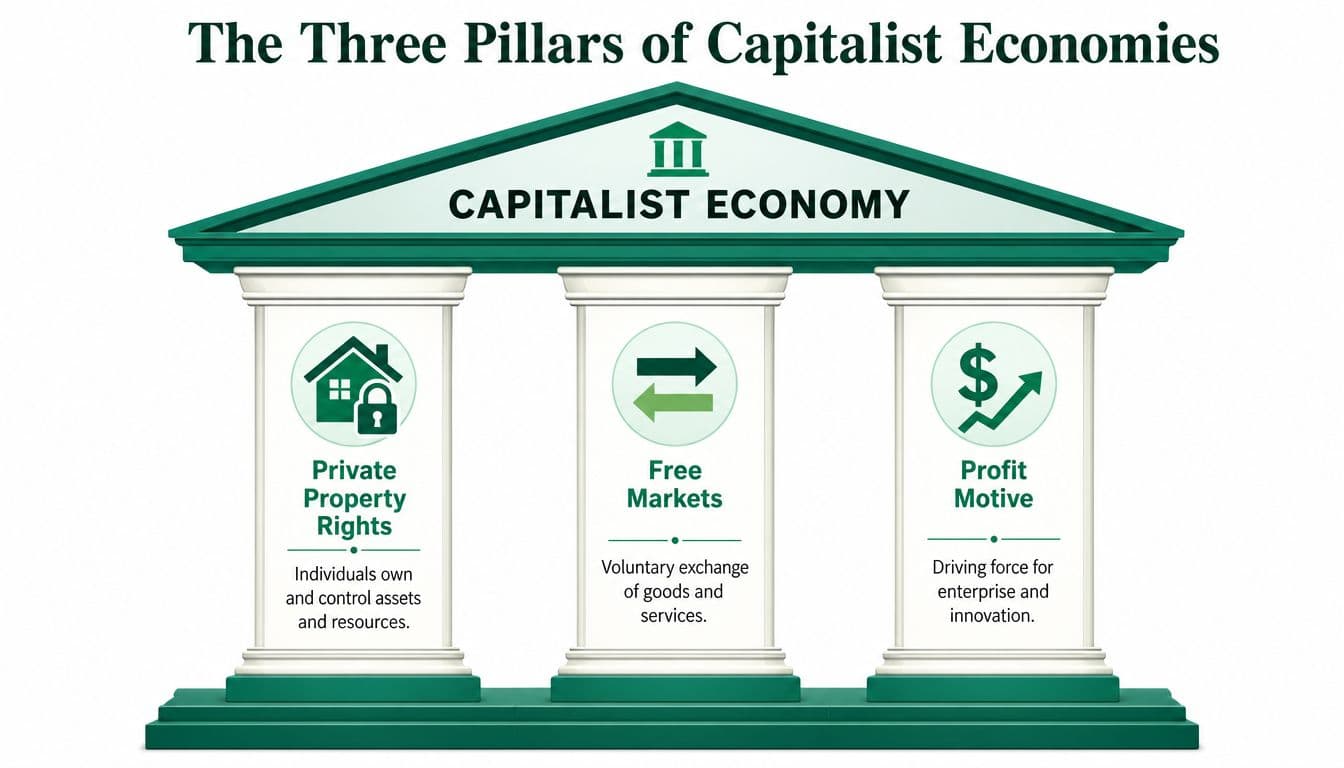
Private property gives decision rights
The bakery owner needs legally recognized control over ovens, mixers, delivery vehicles, recipes, retained earnings, and leased or owned premises. Without property rights, investment becomes fragile because the expected return can be arbitrarily removed.
This is why capitalism historically developed with legal systems that protected ownership and contracts. Property rights don't guarantee fairness, but they do make long-horizon planning possible.
Markets coordinate exchange
The bakery doesn't need a ministry to decide how many loaves to bake each morning. It observes demand, supplier prices, wage costs, and competing offers nearby. Customers choose whether the product is worth the price.
Markets are powerful because they aggregate scattered information through voluntary exchange. But they are only as clean as the institutions around them. Monopoly power, information asymmetry, and privileged control over strategic land can all warp market signals.
Profit and accumulation expand productive capacity
If the bakery earns a surplus, the owner can add another oven, train staff, open earlier, or launch a second location. That's the accumulation function. It is central to why capitalist systems have generated large-scale increases in output and productivity.
The language of capital as a distinct economic factor matters here. A delivery van, a point-of-sale system, and a dough mixer are produced assets. They differ fundamentally from the site under the shop.
A market economy becomes more productive when it lowers barriers to useful investment. It becomes less productive when it rewards passive capture of rising location values more than enterprise.
How the pillars interact
The three pillars are mutually reinforcing:
| Pillar | What it does | Bakery example |
|---|---|---|
| Private property rights | Secures control over assets and returns | Ownership of equipment and contractual control of premises |
| Markets | Enables exchange and price discovery | Buying inputs and selling bread to customers |
| Profit motive | Encourages reinvestment and expansion | Using surplus to improve output or open another branch |
This standard framework is still necessary. It just isn't sufficient. Once land is folded back into the analysis, the bakery example changes. Two identical bakers can perform equally well, yet one gains windfall wealth because a transit line or school improvement raises the site value under the shop.
The Historical Evolution of Capitalist Systems
Capitalism didn't arrive in a single finished form. It evolved through distinct institutional arrangements, each with a different balance between market coordination, state direction, and social protection.
Modern capitalism formally emerged in the early 19th century in Western Europe and overseas offshoots, and the system later developed through recognizable stages. One useful summary identifies Capitalism 1.0 in the 19th century as largely unregulated market capitalism, Capitalism 2.0 in the post-World War II era as a more regulated order with stronger welfare states, and Capitalism 2.1 in the late 20th century as a blend of market liberalization and globalization, as described in this historical overview of capitalism.
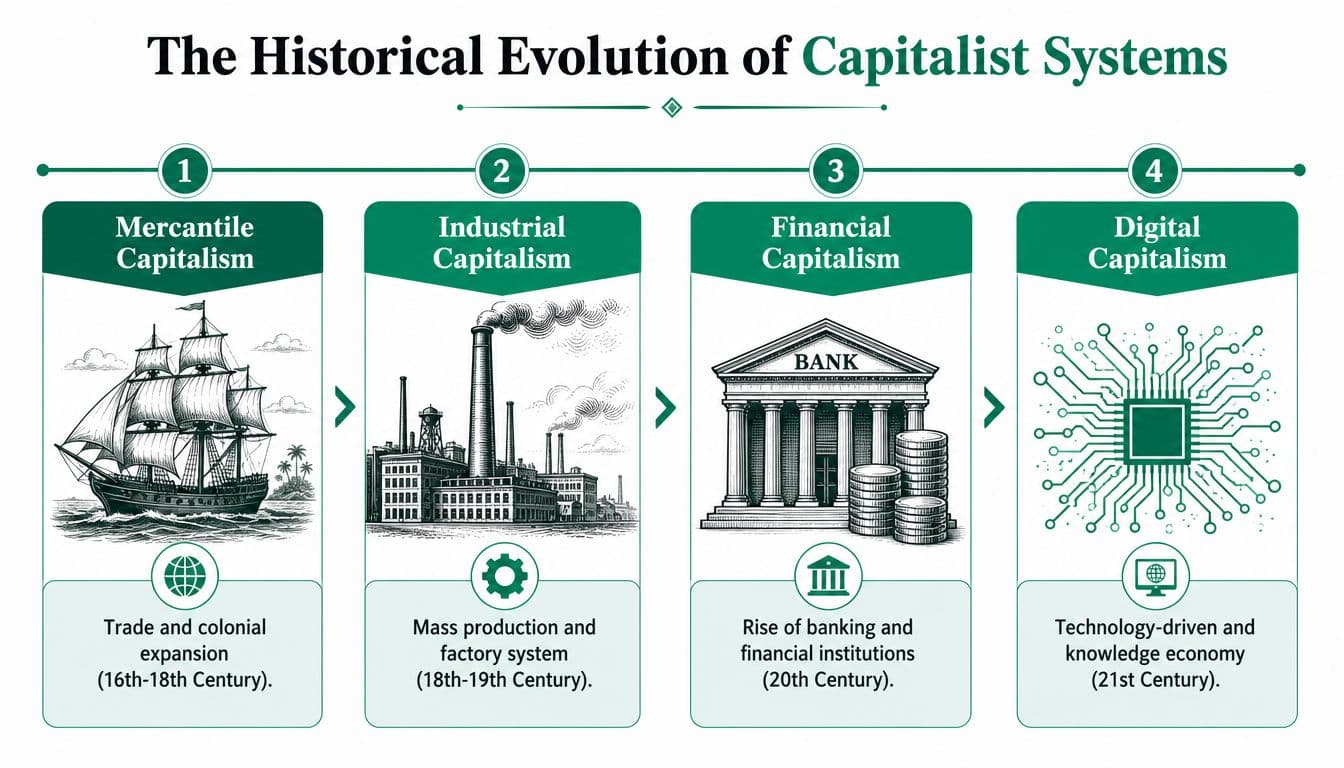
Capitalism changes when states change the rules
The common mistake is to treat capitalism as either synonymous with laissez-faire or inseparable from a specific national model. In practice, capitalist systems vary according to how governments define ownership, regulate finance, provide welfare, police competition, and manage infrastructure.
A simple comparison helps:
| Variant | State role | Typical policy emphasis |
|---|---|---|
| Laissez-faire capitalism | Limited intervention | Contract enforcement, property protection |
| Welfare capitalism | Larger fiscal and regulatory role | Social insurance, labor standards, countercyclical policy |
| State capitalism | Direct state participation in allocation or ownership | Strategic sectors, industrial policy |
| Neoliberal capitalism | Liberalized markets with global integration | Deregulation, privatization, cross-border capital mobility |
These types overlap. Real countries combine elements of several at once.
Why the stages matter for policy analysis
The move from earlier laissez-faire arrangements to postwar welfare states showed that capitalism could coexist with stronger public institutions. The later turn toward deregulation and globalization showed that those arrangements were reversible.
That matters for today's debates. Many current problems are often framed as proof that capitalism itself cannot be governed. History points to a narrower conclusion. Capitalism is highly sensitive to legal and fiscal design.
Institutions decide which form of capitalism a country gets. Markets don't write their own constitutions.
What historical evolution still leaves unresolved
Even when the state expanded under welfare capitalism, mainstream policy analysis usually retained the labor-capital frame. That left land issues partly hidden. Governments regulated wages, taxed income, and managed aggregate demand, yet often allowed land gains to accumulate privately through planning decisions, public transport investment, and urban growth.
The result is a strange pattern. A country can modernize its welfare state and still leave one of the largest value flows in the economy poorly governed. That omission becomes more costly as urban land grows more strategic, housing systems tighten, and infrastructure spending capitalizes into site prices.
Persistent Critiques and Unintended Consequences
The strongest critiques of capitalism aren't objections to exchange or entrepreneurship. They target a narrower claim: that if output rises, social welfare will reliably improve. That proposition is weaker than many official narratives assume.
A 2025 OECD study found that in 22 major economies, happiness indices declined 4.3% while GDP rose 2.1% annually, highlighting a gap between material expansion and lived well-being, as reported in this study on capitalism and well-being. For policy professionals, the point isn't philosophical. It is evaluative. GDP is a measure of production, not a complete measure of welfare.
Output growth and public welfare can diverge
That divergence can emerge for several reasons. Income gains may be unevenly distributed. Congestion, insecurity, debt pressure, and housing stress may intensify even during growth periods. Consumption can expand while people feel less stable about access to time, space, and basic services.
This doesn't mean growth is unimportant. It means growth is an incomplete policy target.
Three critiques recur because they describe recurring institutional patterns:
- Inequality in gains: Returns often concentrate around ownership positions, especially in scarce assets.
- Externalized costs: Environmental and social burdens can be shifted onto households, local communities, or future budgets.
- Instability through speculation: Asset markets can pull credit and attention away from productive activity.
The problem isn't only distribution
Public debate often treats capitalism's flaws as a distribution issue alone. Tax after the fact, the argument goes, and the system becomes fairer. Redistribution matters, but this approach can miss how the market generates pre-tax imbalances in the first place.
A city where households bid against one another for access to fixed locations will produce pressures that welfare payments alone won't resolve. A tax code that burdens payroll and buildings while lightly treating location rents can amplify those pressures. That isn't a failure at the edge of the system. It's a design choice in the core.
Rent-seeking in economics is the right lens here. The central question is who captures value that no individual actor created alone.
Growth that capitalizes into land prices can leave households richer on paper, poorer in access, and less secure in daily life.
Why standard criticism still stops short
Many critics correctly identify inequality, financial excess, and welfare loss. Fewer isolate the institutional mechanism that links them. When land and capital are merged, analysts can see the symptoms but misread the transmission channel.
That is why critiques of capitalism often remain morally persuasive yet operationally weak. They condemn outcomes without identifying the factor structure that reproduces them.
The Missing Third Factor Land vs Capital
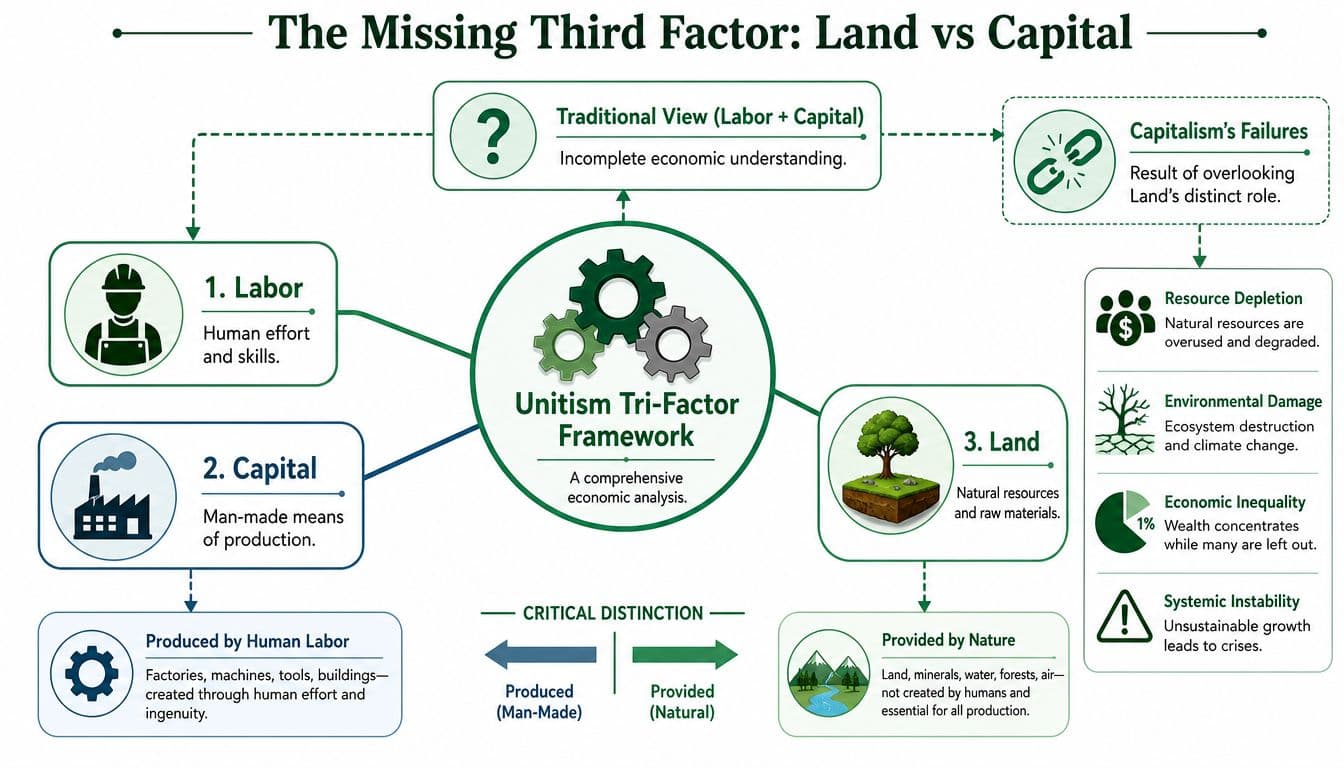
The distinction between land and capital is not semantic. It is the analytical hinge on which housing policy, urban form, and a large share of modern inequality turn.
Capital consists of produced means of production: buildings, machinery, tools, logistics systems, software, and other assets created through effort and investment. Land consists of natural opportunities and locations: sites, natural resources, spectrum, forests, waterways, mineral deposits, and the legal right to exclude others from their use.
Why the conflation matters
When a government taxes a building, it taxes something people produced. When a city upzones a district, installs a rail station, or improves public safety, the site values in that area can rise even if the owner contributes nothing additional. Those are different objects of policy.
A tri-factor framework clarifies this:
| Factor | What it includes | Supply characteristics | Policy relevance |
|---|---|---|---|
| Labor | Human effort and skill | Responsive to incentives and conditions | Wages, training, employment, migration |
| Capital | Produced assets | Expandable through saving and investment | Productivity, innovation, industrial growth |
| Land | Nature and locations | Fixed in supply | Rent, speculation, access, spatial inequality |
The reason this matters for capitalism as an economic system is that only one of these factors is fixed in supply. That creates a different class of returns.
What land-based analysis explains better
Empirical spatial modeling and general equilibrium simulations indicate that shifting from uniform property taxation to land value taxation reduces urban sprawl and increases earnings and tax revenue relative to traditional property taxes, according to this research on land value taxation and urban outcomes. Even if one ultimately prefers a different instrument, the finding is revealing. Taxing land and taxing improvements do not produce the same economic behavior.
That helps explain several policy puzzles:
- Housing crises: Construction can be efficient while site values absorb the gains.
- Idle urban land: Owners can hold strategic parcels while waiting for publicly generated appreciation.
- Boom-bust cycles: Credit often flows toward collateralized land gains rather than new production.
The glossary definition of economic land as distinct from capital is more than terminology. It is a way to recover causal clarity in policy design.
Why conventional reform often disappoints
Governments often respond to housing stress with subsidies, tax credits, or construction incentives. Some of these help. But if the underlying land mechanism stays untouched, part of the benefit can be capitalized into higher site values.
Separate the site from the structure, and several policy failures stop looking mysterious.
This is why the dual-factor model underperforms. It can describe production, but it has trouble explaining unearned gains attached to location. Once land is restored as a distinct factor, capitalism's recurring failures look less like random malfunctions and more like predictable outcomes of misclassification.
Reforming Capitalism with Land-Use Rights
The cleanest theoretical answer to privately captured land rents is often framed as land-value capture. But in administrative and political practice, land-use rights can be a stronger instrument than annual land-value taxes.
The key distinction is straightforward. A land-value tax collects recurring charges based on assessed site value. A land-use rights system allocates rights to use land for defined purposes and durations, allowing the public sector to capture value through leases, premiums, conditions, or renewal structures.
Why land-use rights deserve preference
The strongest case for land-use rights is institutional, not ideological. They can align public revenue, planning control, and development sequencing in a single mechanism. They also make the public claim on location value explicit at the point of allocation, instead of relying on recurring valuations that can become politically contested or administratively uneven.
Singapore offers the clearest practical reference point. In Singapore's land system, the state allocates land-use rights for specific durations, typically 99 years, with defined conditions, and this model generates 15% to 20% of central government revenue through land sales and lease premiums rather than annual land-value taxation, as summarized in this explanation of land-use rights and land-value taxation.
What this changes in policy terms
Land-use rights can do several things at once:
- Capture publicly created value: The state recovers part of the value tied to infrastructure, agglomeration, and planning permission.
- Guide development form: Lease conditions can shape timing, density, use class, and compliance.
- Reduce pressure on distortionary taxes: Revenue from land can substitute for heavier reliance on taxes on work or productive investment.
The approach is especially attractive where cadastres are incomplete, valuation capacity is uneven, or political resistance to annual site taxation is high. In those contexts, a rights-based framework may be more workable than attempting immediate full annual taxation of land values.
Land-use rights are not just a legal technicality
Officials sometimes treat land-use rights as a niche property-law device. They are better understood as a fiscal and planning architecture.
A ministry or city using land-use-right frameworks in practice can shape who gets access, for how long, under what conditions, and with what payment structure. That gives policymakers influence over speculation and sequencing in ways that a standard tax instrument sometimes doesn't.
There is still a place for land-value taxation in theory and in some jurisdictions. Economic theory gives it a powerful efficiency case. But if the goal is practical reform under real administrative constraints, land-use rights often provide the better route. They allow governments to recover land value, manage urban development, and reduce pressure on labor and capital taxation without waiting for ideal annual valuation systems.
Toward a More Stable and Equitable Economy
The most useful reform of capitalism doesn't begin by rejecting markets. It begins by describing the system correctly. Labor and capital are indispensable. But without land as a distinct third factor, officials will keep misreading housing inflation, spatial inequality, and speculative volatility.
That shift in analysis points toward a different reform agenda. Reward production. Lower burdens on work and genuine investment. Capture more of the value attached to exclusive control over land and natural opportunities. Where implementation matters as much as theory, prefer land-use rights when they offer a clearer administrative path than annual land-value taxes.
For policymakers looking beyond generic stimulus debates, broader discussions of strategies to boost the economy are useful when they connect growth to institutional design rather than treating output expansion as self-justifying. The next phase of reform should do exactly that.
A more stable capitalism is possible. A more equitable one is possible too. But both depend on one analytical correction: stop treating land as if it were just another form of capital.
Unitism® helps governments, researchers, and public institutions apply tri-factor economics to real policy problems, including land valuation, land-value capture design, fiscal modeling, and implementation planning. If you're working on housing affordability, tax reform, urban land policy, or revenue stability, explore Unitism® for practical tools and policy support grounded in the distinction between labor, capital, and land.