Expert answers to legal drafting questions on bill design, delegated powers, land leases, implementation and plain language, with checklists and examples.
November 6, 2026
Legal Drafting Questions: Answers with Examples
Expert answers to legal drafting questions on bill design, delegated powers, land leases, implementation and plain language, with checklists and examples.

What if a bill says exactly what policymakers want, passes without trouble, and still can't be administered on the first morning it takes effect? That gap is where most drafting work succeeds or fails. A statute isn't only a statement of intent. It's an operating instruction for agencies, courts, businesses and residents who weren't in the room when the policy was agreed.
Good legal drafting questions close that gap before anyone writes a clause. They force a team to decide who must act, what counts as compliance, which data proves it, and what happens when someone disagrees. If those answers are left vague, elegant language won't save the reform.
Table of Contents
- Start Here With Legal Drafting Questions
- Quick Answers to Common Legal Drafting Questions
- Core Questions Every Bill Must Answer Before Drafting
- How Much Discretion a Bill May Delegate
- Land Leases, Land-Use Rights and Land-Value Charges Compared
- How to Draft for Implementation Before Enactment
- How to Test Plain Language for Real Comprehension
- Common Drafting Pitfalls and How to Fix Them
- Key Terms and Related Guides
Start Here With Legal Drafting Questions
A legal drafting question is any question you ask when you turn a policy objective into operative law, meaning the words that create a duty, a power, a permission or a prohibition. You're not asking whether the policy sounds good. You're asking what the rule must do, who it binds, who administers it, how it's enforced, and when it starts.
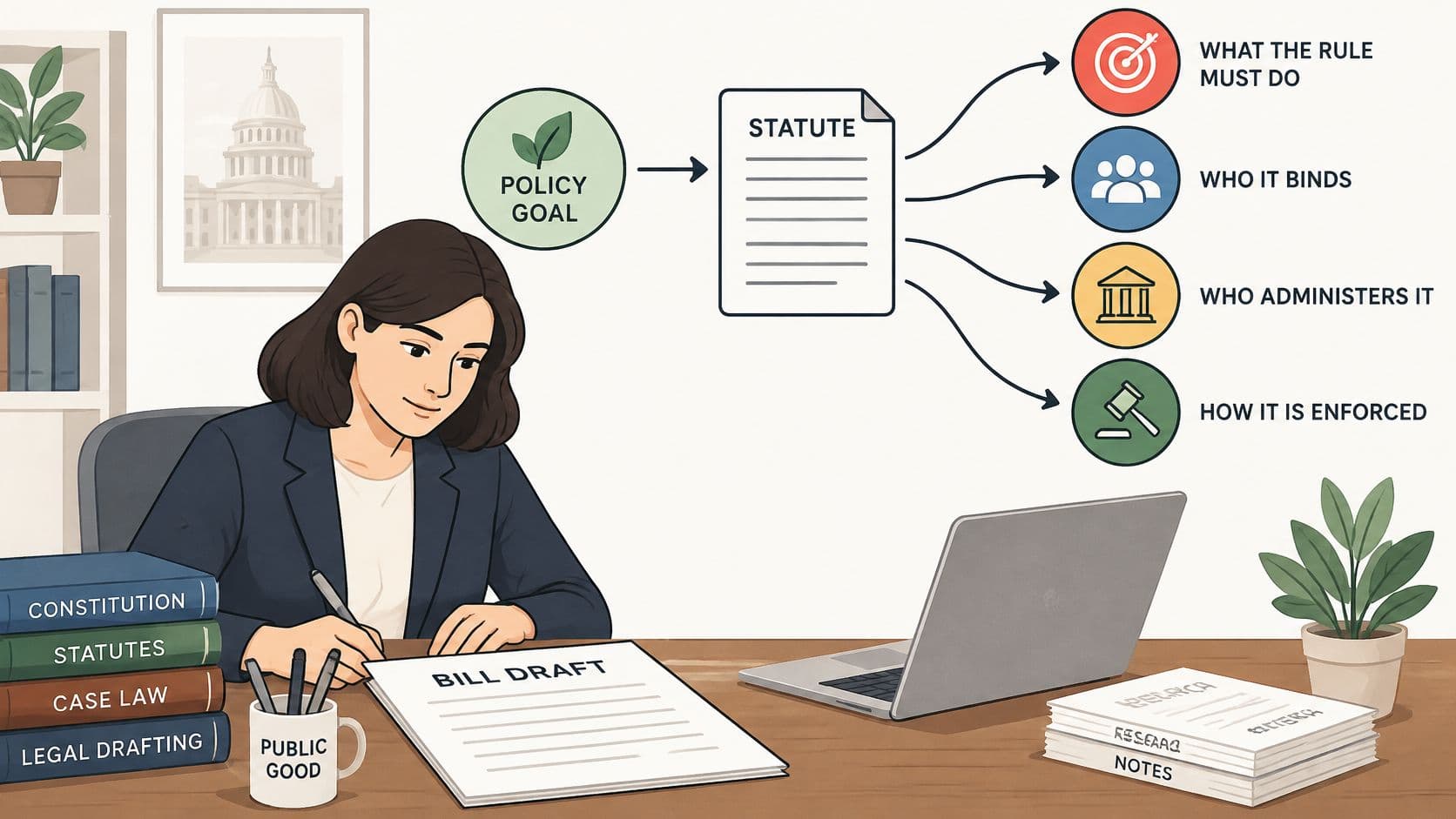
Every bill serves two audiences at once. During enactment, it must explain the intended change to lawmakers. After enactment, it must work as the authoritative statement of law for the public, lawyers and judges. Those audiences need different things, and a draft that only persuades legislators may leave administrators without a workable rule.
Why This Matters Beyond Parliament
Ministries and municipalities face the same problem in tax, housing, planning and land-value reform. A minister can agree to charge for land value, speed up housing or tighten a permit rule in an afternoon. Turning that agreement into precise language without gaps, contradictions or interpretive disputes takes longer, because each word can shift liability, cost or jurisdiction.
You don't need prior drafting training to use this guide. Terms such as operative provision, delegated power and commencement rule are defined when they first appear. Read in this order. Take the quick answer first, then learn how and why the method works, then check the special cases on delegation, land tenure and implementation, then use the pitfalls and key terms to decide your next step.
Quick Answers to Common Legal Drafting Questions
| Question | Short answer | Covered in |
|---|---|---|
| Which questions must a bill answer before clause drafting? | Problem, regulated parties, administrator, enforcement, commencement and existing law | Section 3 |
| How much discretion can a bill delegate? | Only within a stated standard, decision-maker, procedure and remedy | Section 4 |
| Is a fixed lease a land-use right? | No, unless it's repriced each year, needs no renewal and does not expire | Section 5 |
| What must be ready on the day a law takes effect? | Institution, dataset, procedure, budget, deadline, remedy and responsible minister | Section 6 |
| How should plain language be tested? | Representative users, comprehension questions and scenario-based application tests | Section 7 |
| Why do drafts fail after passage? | Missing administrative detail, undefined terms or no correction and appeal route | Section 8 |
How to Use This Table
Find your question, take the short answer, then go to the section that holds the method. The table tells you the destination. It doesn't do the drafting work for you, and treating a one-line answer as a finished clause is how gaps enter a bill.
Say you're drafting a land-value charge and you stop at the second row. You now know delegation needs a standard and a remedy. You don't yet know what valuation data you require, what happens when evidence is stale, or who hears an appeal. Those choices change taxpayer liability and agency workload, so they belong in the drafting brief, not in a later improvisation.
The tenure row works the same way. A team that calls a fixed lease a land-use right because both involve paying for land will draft the wrong duration, renewal and repricing clauses. Apply the three tests in the land section before you choose any label, because the label drives the operative provisions that follow.
Practical rule: If a row changes who pays, who decides, or when a right ends, don't draft the clause until you've worked through its full section.
Use the table again at review stage. Read each short answer against your draft and ask whether a stranger could find that answer in the text. If they have to infer it from a speech, a press release or a policy paper, the bill doesn't yet say it.
Core Questions Every Bill Must Answer Before Drafting
Start by converting policy intent into testable design requirements. That means writing each objective so a reviewer can check whether the bill delivers it. The U.S. House Office of the Legislative Counsel quick guide frames the starting set this way, and it's a sound order to follow.
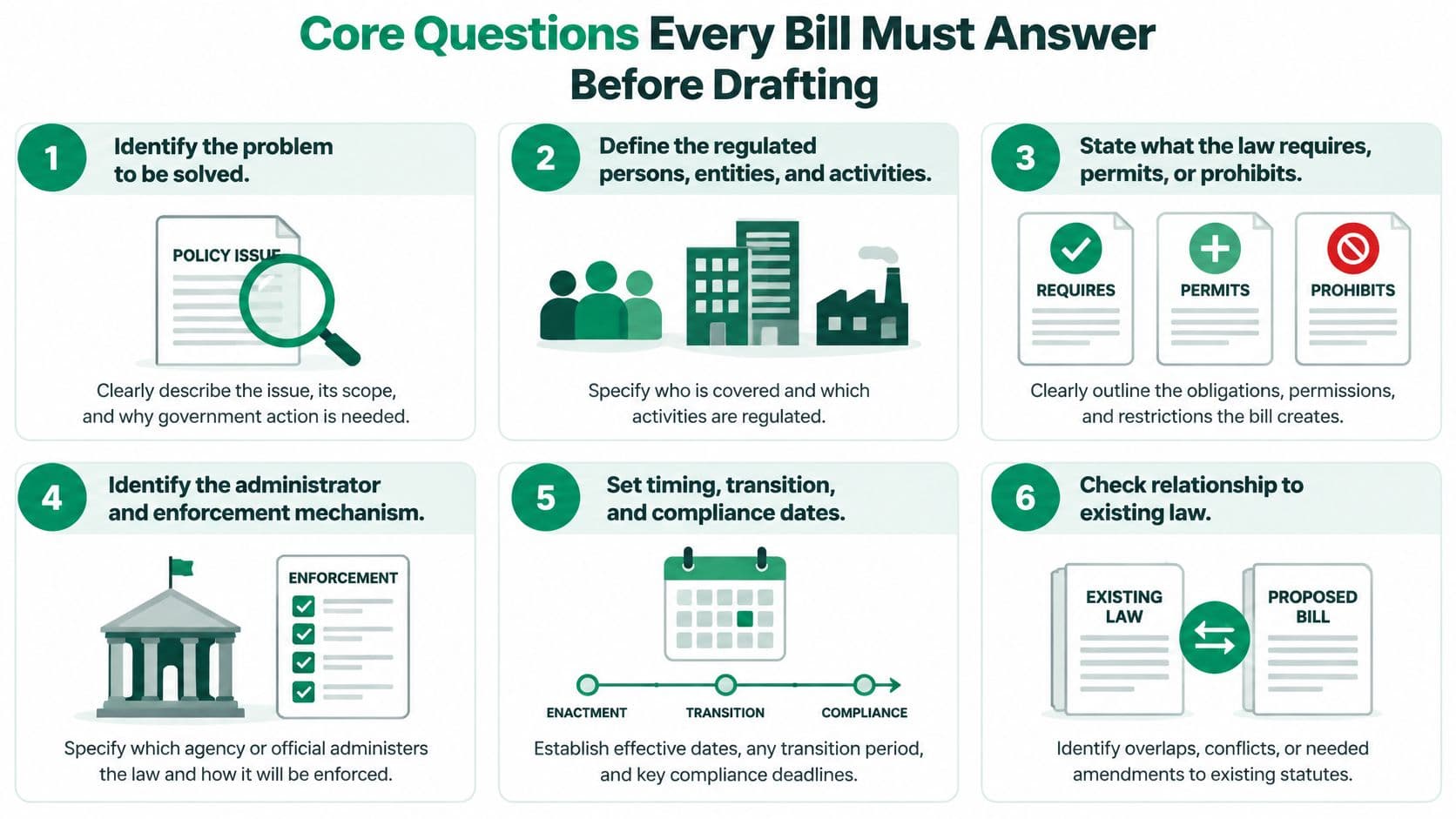
The Six Core Questions
- Identify the problem: Name the specific harm or gap, with an example a reader can picture, not a general ambition like improving fairness.
- Define who's regulated: List the persons, entities, activities or land interests covered, and those deliberately excluded.
- Assign administration: Name the authority that assesses, permits, collects or decides, and state whether it's national, municipal or shared.
- Specify enforcement: State the consequence of non-compliance, who imposes it, and how it's proportioned to the conduct.
- Set commencement and transition: Give the start date, what happens to existing cases, and which old rules keep applying during the changeover.
- Map existing law: Decide whether current statutory definitions, enforcement provisions and construction rules should apply, or whether this bill needs its own.
For land-value reform, those questions become concrete items. What's the tax base, site value alone or site value plus improvements? Who holds valuation authority, how often are assessments made, and what appeal rights exist? Which exemptions apply, how is the charge collected, where does revenue go, how are arrears treated, and how does the bill interact with property, income, building, planning and local-government statutes? Planners who need the wider fiscal picture can consult our explainer on tax reform design before locking those choices.
Each item can change institutional competence, taxpayer liability, administrative cost and rule-of-law risk. That's why you settle them before drafting clauses, not during. Our support for clients includes assessing land values, designing the policies that collect them, and modeling who gains and who pays, because those answers shape the law itself.
Build the Question Matrix
Turn the answers into a question matrix. Give every policy objective one row that links it to an operative provision, the responsible authority, its data source, a decision deadline, a review route and a fallback rule if data or agreement is missing. Flag in the same row any delegated power, tenure label, implementation item and plain-language test the objective needs.
Don't start clause drafting until every row of the matrix is complete. An empty cell isn't a detail to settle later. It's an unanswered legal drafting question that will resurface as an amendment, a dispute or a stalled rollout.
How Much Discretion a Bill May Delegate
How much can a bill hand over before the policy stops being the legislature's? The test is not whether the policy is popular. It is whether the discretion is bounded by a standard, a named decision-maker, a procedure and a remedy. A program missing any of those four produces decisions that affected people cannot predict and courts cannot review, even when the underlying policy is sound.
The working rule is straightforward. A delegation should state the job to be done, name who does it, and define how far their authority reaches, with safeguards that keep the power inside that boundary. A statutory standard works like a riverbank. Implementation flows within it. A power that crosses it has carried a legislative choice into an agency office, where no one votes on it again.
What a Bounded Delegation Looks Like
Apply that to a land-rent or land-value charge, where officials must put a number on land and defend it. The bill should specify the following items, or state the bounded power and the conditions for setting them in regulation:
- Valuation methodology: The method itself, or a legally bounded power to make one, so assessments don't depend on an individual valuer's habit.
- Required data inputs: The sales, rental, cadastral or other evidence a valuer must use.
- Missing or conflicting evidence: How absent, stale or contradictory data is handled, so gaps don't become guesswork.
- Publication and explanation: The duty to publish assessments and explain how each figure was reached.
- Correction and appeal: How an error is fixed and how a taxpayer challenges a result.
- Integrity controls: Conflict-of-interest rules, audit access, and measurable conditions that must be met before regulations are issued.
Six items, one purpose. Each converts a judgment into a record that someone outside the agency can inspect.
Where a numeric cutoff decides who is charged or exempt, such as a minimum parcel size or a value band, treat that threshold as a legal choice to be settled in the statute itself. IamVera.AI on decision thresholds examines how cutoff design shapes decisions in a different field, and the drafting consequence here is narrower. A threshold written into the statute is visible, debatable and amendable by vote. The same threshold left to regulation can move without one, and the people it newly charges will first learn of it from an assessment notice.
Place definitions where they improve clarity, brevity and consistency, and place penalties where regulated parties can see the prohibited conduct next to its consequence. Then run a clause-by-clause review. Trace each delegated power to its statutory standard, procedural safeguard, accountability mechanism and remedy. If you can't draw that line, you've probably transferred a core legislative choice rather than permitted implementation discretion.
One last check before the clause is final. Write out the administrative package the delegation will produce: the form on which the assessment arrives, the office that answers an appeal, the deadline for filing one, the notice that announces a change. If any of those is still undecided, the bill is delegating more than its text admits.
Land Leases, Land-Use Rights and Land-Value Charges Compared
| Feature | Fixed-term lease | Land-use right | Land-value charge |
|---|---|---|---|
| Duration | Fixed term, renewable or non-renewable | No expiration | Recurring while the liability lasts |
| Repricing | Fixed price for the term, with a gap to market | Repriced each year | Assessed on the cycle set in the statute |
| Renewal | Needed at expiry or extension | Not required | Not applicable |
| Transfer and refinancing | Harder as the term shortens, especially if non-renewable | Low cost, because the right does not expire | Set by the statute, not by the tenure |
| Drafting label | Fixed lease, even if rent is reviewed | Land-use right only if all three tests are met | Tax, rent or consideration, stated separately |
Why Fixed Leases Postpone Risk
Land leases are renewable or non-renewable fixed-term leases at a fixed price. A renewable lease gives certainty only until the term ends. At renewal, the gap that accumulated between the lease rate and market value closes all at once in a major repricing. A non-renewable lease takes the other path. As the remaining years shrink, the interest becomes progressively harder to refinance and sell, because a buyer or lender is acquiring a wasting term.
Fixed leases, in effect, don't price risk correctly. They postpone it. Singapore shows the mechanics clearly. The Singapore Land Authority leasehold table, known as Bala's Table explains that a leasehold purchaser receives only a temporary right, usually 99 years for residential titles and commonly 60 or 30 years for industrial titles, and that value depends on the remaining term and the stream of future rental income rather than declining at a constant annual rate.
Hong Kong is a different fixed-term mechanism, not an exception to it. The Hong Kong Lands Department government rent guidance describes leases extended for 50 years after expiry, subject to annual government rent of 3% of the property's prevailing rateable value, assessed annually. The extension changes what happens at expiry. It doesn't make the lease indefinite from the start, so don't draft it as if it did.
What Makes a Land-Use Right Different
Land-use rights are like land leases in one respect only. The holder pays for the use of land. They differ because they're indefinite, with no expiration, and repriced annually. Because repricing happens each year, no large gap builds up to be settled in a single renewal shock, and people can buy and sell land-use rights at low cost. The buyer pays mainly for the buildings and ongoing use, not for a long prepaid term.
That structure prices land appropriately as conditions change. It doesn't burden entrepreneurship and other productive enterprises with a huge upfront lease premium or a looming expiry that complicates a loan. Readers who want the economics behind the distinction can work through our guide to land value theory alongside their drafting brief.
A land-value charge is neither of the above. It's a recurring public charge assessed on land value or rental value, and it can apply across different tenures. Drafting must therefore state duration, renewal, pricing formula and payer separately, and say whether the payment is tax, rent or consideration for the use right.
Sometimes fixed leases are called land-use rights, but they aren't. Don't use that label unless the right is repriced each year, requires no renewal, and does not expire.
How to Draft for Implementation Before Enactment
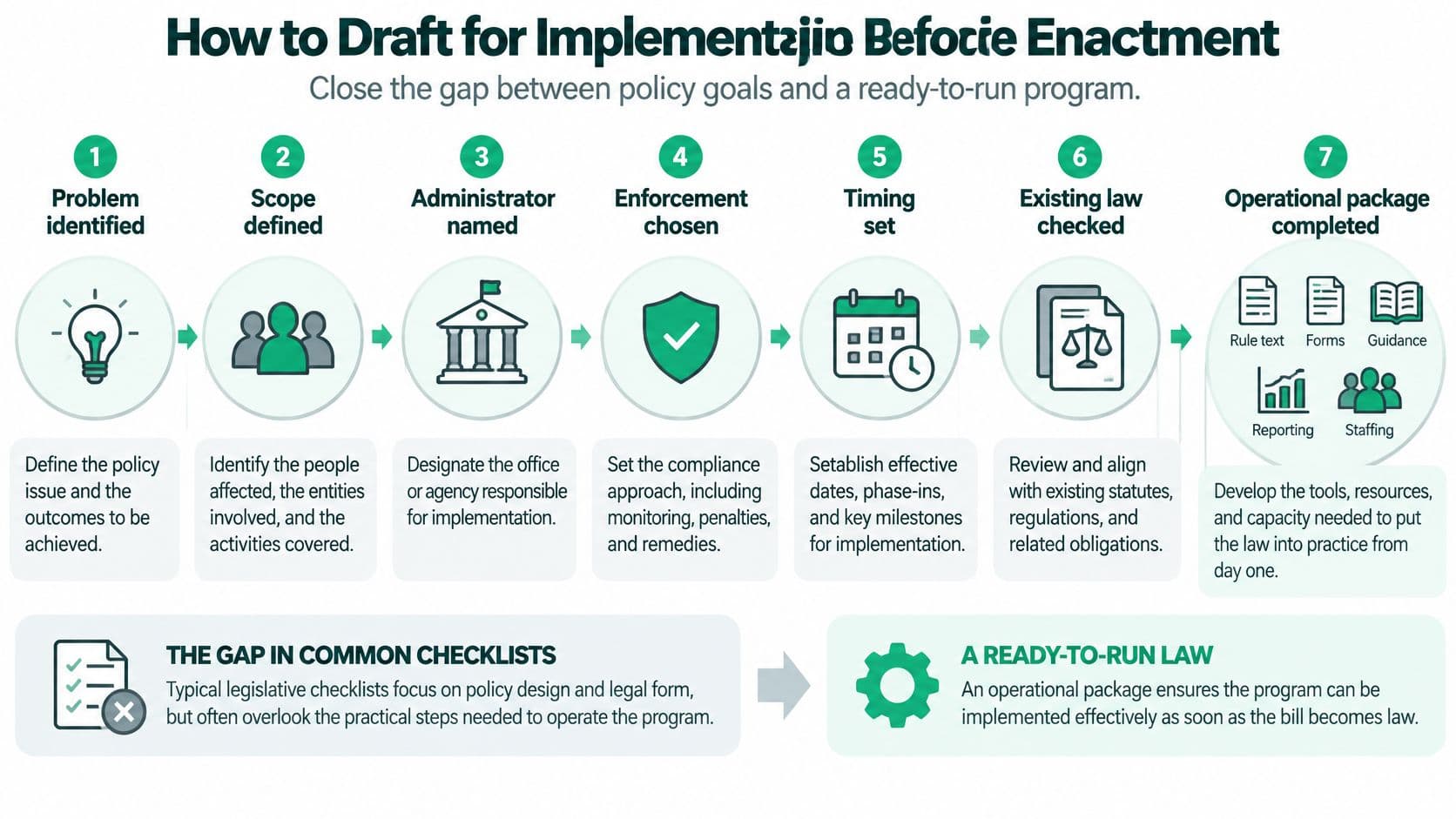
A bill that reads cleanly on the page can still reach commencement day with no systems, staff or guidance ready to run it. Most legal drafting checklists stop where a bill has identified the problem, scope, administrator, enforcement, timing and existing law, then treat enactment as the finish line. Strong bill teams keep going: they arrange implementation guidance for businesses and civil society and, where appropriate, publish it before the bill receives Royal Assent, so readiness does not wait until commencement.
Eight Steps to a Law an Agency Can Run
- List every duty: Write down each duty the bill creates and name the institution that carries it. This prevents the classic failure where everyone assumes another agency owns the task.
- Attach a dataset: Pair each duty with its cadastre, valuation roll or taxpayer register, plus the data standard that lets systems share it. Legal authority alone doesn't create interoperable records.
- Write the procedure: Set out how notices are sent, assessments issued, payments made and corrections handled. Without this, frontline staff invent inconsistent local practice.
- Fund the first day: State the budget and staffing needed when the law starts. An unfunded duty won't happen.
- Set deadlines and review: Give each duty a date and a review route for when it's missed, so delay has a consequence and a record.
- Name the remedy and minister: Identify what an affected person can claim or appeal, and which minister answers for delivery. Accountability needs a name, not a department.
- Choose the right instrument: Decide what belongs in primary legislation, what belongs in regulation, what belongs in official guidance and what belongs on a form. Where a minister is given power to set valuation rules or data standards, the clause should say what the exercise of that power must satisfy, such as a published criterion or a consultation step, so accountability and legal certainty survive at every level.
- Test readiness before enactment: Run the matrix as a dry exercise. Ask the agency to process a sample assessment, notice and appeal using only the draft package.
Steps four and five are where drafts most often fail. A duty with a deadline but no budget, or a budget with no dated duty, gives an agency nothing to plan against. The package has to be answerable as a whole before introduction, not assembled after it.
Our walkthrough of the legislative drafting process follows that sequence from instruction to enacted text. Use it to check your bill team's timetable against these eight steps.
A technically elegant statute can fail because its administrative architecture is missing, not because its policy is wrong. Draft delegated powers, valuation rules, data standards, reporting duties, appeals, transitional provisions and funding as one delivery system, and the law a legislature passes is the law residents meet on day one.
How to Test Plain Language for Real Comprehension
Can a resident read a short assessment notice and still not know whether she must pay, object or do nothing? Yes. Many legal drafting questions about accessibility stop at swapping archaic words and trimming sentences. Word substitution leaves conceptual confusion untouched, because the reader meets a new label, a conditional rule and a deadline all at once.
The evidence supports that caution. A 2025 Spanish self-paced reading experiment reported in the International Journal of Applied Linguistics study, involving 117 participants, found that plain terminology significantly improved comprehension but did not reduce reading time, while word length, frequency and comprehensibility also affected performance. Comprehension, not speed, is what the draft must earn.
For implementation design, test the documents residents meet after enactment: the assessment notice, the correction and appeal form, the guidance note on delegated valuation standards, and the label attached to a land-use right or lease. A plain word in the statute can become a puzzle on the form if the two use different terms for the same obligation.
A Testing Method That Measures Understanding
- Test with representative users: Recruit readers across literacy levels, languages and disabilities, not colleagues who already know the policy.
- Ask comprehension questions: After reading, have each person explain the obligation, deadline and consequence in their own words. If the reader says "I think I might have to," the text has not settled the required action.
- Run scenario tests: Give a realistic case, such as a landowner who misses a valuation notice, and ask the reader to apply the rule and choose the correct next step.
- Review every language version: Check multilingual texts separately. A clear English notice does not guarantee a clear translation, so confirm that the translated form keeps the same tenure label and appeal deadline.
- Revise and retest: Rewrite the passages readers got wrong, then test again with fresh readers.
Readability scores measure sentence length and word difficulty. Legal accessibility measures whether a reader can identify the trigger, the duty, the deadline and the remedy. That distinction matters for tax notices, land-value assessments, planning rules and appeal rights, where a misunderstanding produces non-compliance or unequal access.
Plain language is not necessarily faster to read. It works when plain words are paired with explanatory structure, worked examples, visual hierarchy and definitions that real readers have tested. Measure whether people can act correctly, not whether the sentence count fell.
Common Drafting Pitfalls and How to Fix Them
| Symptom | Likely drafting cause | Fix |
|---|---|---|
| Courts or agencies read a key term differently | Term used but never defined | Add a definition where it improves clarity and consistency |
| Agency has no workable way to value land | Valuation method left to regulation with no standards | Set the methodology or a bounded power, with data inputs and evidence rules |
| Taxpayers cannot challenge an assessment | No correction or appeal route | Specify notice, correction and appeal steps with deadlines |
| Officials cannot start the law | No commencement or transition rule | State the commencement date, transitional provisions and a fallback rule |
| Rates clash with an existing statute | Existing definitions and construction rules not mapped | Check which existing definitions, enforcement and construction rules apply |
| A lease is called a land-use right | Label applied without the tests | Apply the three tests, annual repricing, no renewal and no expiry |
Which Fixes Come First
Fix failures that block administration before you polish wording. A missing commencement rule, a missing valuation standard and a missing appeal route can stop a law from functioning at all, while an undefined term or a wrong tenure label creates disputes that grow over time. Both matter, but they're not equally urgent on commencement day.
Sequence your repair work accordingly. First, confirm the law can start, be calculated and be challenged. Second, tighten definitions and labels so those working parts mean the same thing to every agency, court and taxpayer who reads them.
After each fix, re-run the question matrix. A change to one clause can move a deadline, shift a duty to a different authority or break a cross-reference elsewhere in the bill. Checking the whole matrix after each repair stops a local fix from creating a new gap two chapters later. Teams building that review habit may find our legislative drafting training overview useful when assigning who checks what.
Key Terms and Related Guides
A reform bill carries its own vocabulary across clauses, agencies, notices and appeal letters. The entries below point from each term to the part of the drafting process where it does real work.
- Economic rent and land value: The Glossary defines key terms such as economic rent and land value in simple language. Use it when a land-value charge needs one shared vocabulary across the finance ministry, the valuation office and the public notice.
- Drafting question and operative provision, Section 3: Return here when a policy objective is still a sentence of intent. The operative provision turns that objective into a testable requirement that an agency can administer and a court can review.
- Delegated power and standard, Section 4: Use this when an agency needs room to set rates, forms or thresholds. The standard is the boundary that keeps that room from becoming an unstated policy choice.
- Fixed lease, land-use right and land-value charge, Section 5: Apply the three tests before any tenure label enters a bill: annual repricing, no renewal and no expiry. The In-Depth Guides are plain-language explainers covering topics from land-use rights to why housing is unaffordable, and our in-depth guide to land-use rights supports that choice.
- Commencement rule and implementation readiness, Section 6: Return here to test whether an agency could run the law on day one. A commencement date without staff, data and forms is a deadline the administration cannot meet.
- Comprehension testing, Section 7: Use this when notices, forms or appeal letters must work for non-lawyers. A term that survives legal review can still fail at the counter.
- Fix priority, Section 8: Use this to order repairs when time before introduction is short. Start with failures that stop commencement, valuation or challenge, then tighten definitions and labels.
The Colorado Legislative Drafting Manual, U.S. House Office of the Legislative Counsel guidance, UK bill-team implementation guidance and Singapore Land Authority leasehold material cover the path from first drafting question to an enacted rule people can follow.
If you're turning a land-value reform into legislation, Unitism® supports policy design, valuation methods and implementation work, including plain-language explainers that help stakeholders follow the design. Visit Unitism® to explore policy design, valuation and legislative drafting support, and start your bill with a complete question matrix rather than a blank clause.