Explore water rights valuation methods, data requirements, and policy uses. Learn how economic, legal, and hydrological approaches shape pricing and allocation.
August 30, 2026
Water Rights Valuation Methods and Policy Uses
Explore water rights valuation methods, data requirements, and policy uses. Learn how economic, legal, and hydrological approaches shape pricing and allocation.

More than A$34.2 billion is the estimated current market value of water entitlements in New South Wales, according to the 2023 NSW water values update. That figure changes the policy question. Water rights aren't merely inputs consumed by farms, cities, or factories. They are legally defined claims to a variable physical supply, and their value depends on what the holder can receive, when delivery occurs, and whether the right can survive a regulatory or hydrological shock.
A credible water rights valuation therefore starts with the entitlement as a heterogeneous bundle, not a uniform unit. Seniority, reliability, source quality, conveyance losses, transfer restrictions, treatment costs, return-flow obligations, and end use can all create material price differences. The central analytical mistake is to value the paper volume while ignoring the conditions attached to it.
Table of Contents
- Why Water Rights Valuation Matters Now
- Four Core Methods for Appraising Water Rights
- Economic Legal and Hydrological Approaches Compared
- Data Requirements That Drive Valuation Accuracy
- Institutional Resets and the 2026 Market Reality
- Jurisdictional Examples From Global Water Markets
- Building Scenario-Based Valuation Frameworks
Why Water Rights Valuation Matters Now
Water-right valuation has become a public-finance issue because scarcity rents increasingly sit inside private entitlements. In the western United States, researchers examined more than 7,000 market transactions across 13 river basins in 8 states from 2002 to 2019. Their analysis estimated annual price appreciation of about 2.8% using a pooled-period method and 5.1% using an adjacent-period method. Both methods indicated that water-right prices rose at roughly the same pace as the general price level during that period. The peer-reviewed western U.S. price analysis supports the use of observed trades while showing that basin conditions, scarcity, and transaction design affect the reference value.
The policy question is larger than the price paid in a private trade. A water entitlement can carry a scarcity rent because its legal priority and delivery reliability give the holder access to supply that others cannot obtain on equal terms. That rent may accrue privately, be captured through public charges, or be transferred through compensation when governments acquire rights for environmental or municipal purposes.
Price is a policy variable
Valuation choices determine who bears scarcity and who receives compensation. An appraisal that ignores reliability can overstate the value of a junior right. An appraisal that treats every restriction as permanent can understate a transferable entitlement that can move toward municipal or industrial use. Underpricing may encourage extraction or speculative accumulation, while overpricing can block reallocations that generate greater public value.
For finance ministries, the issue reaches public accounts. Governments need defensible values when acquiring entitlements, compensating affected users, designing environmental buybacks, recording public assets, or assessing the distributional effects of reform. The value recorded for a public water asset also affects how policymakers interpret fiscal capacity and the cost of future supply commitments.
As noted in the NSW water values update cited earlier, the aggregate value of entitlements is large enough to matter for balance-sheet analysis, even though this section defers the report's market-price figures to the jurisdictional discussion. The accounting treatment must distinguish a perpetual legal claim from an allocation that depends on annual hydrology, administrative decisions, or changing transfer rules.
A valuation is therefore a set of institutional assumptions, not only a number. It reflects expected supply, enforceability, legal duration, priority, permitted users, and the prospect of regulatory change. Unitism's analysis of land and water is useful for separating scarcity rent from the cost of physical delivery. A meter records usage, but it does not by itself reveal the value created by legal access to a scarce source.
The central finance task is to record the bundle accurately. Reliability, seniority, transferability, and public obligations should be visible in the valuation rather than compressed into a single volume figure. That distinction becomes more important when governments consider compensation or prepare for institutional resets.
Four Core Methods for Appraising Water Rights
A water right is a heterogeneous bundle, so the defensible method depends on what is being valued. Expert guidance identifies four principal approaches: comparable sales, before-and-after land value differentials, replacement cost, and income capitalization, as set out in the water-rights appraisal guidance. Each method handles reliability, seniority, transferability, and institutional constraints differently.
A quick selection rule helps. Frequent trades with comparable terms support comparable sales. A right attached to land points toward before-and-after analysis. A public or municipal entitlement with little market evidence may require replacement cost. A right whose value appears in production or operating capacity calls for income capitalization.
Comparable sales
Comparable sales start with completed transactions. The analyst adjusts for priority date, reliability, source, season, quantity, transferability, place of use, and conveyance losses. The method is strongest when trades are frequent and the rights share material characteristics.
A reported volume and price are insufficient if the registry omits drought performance, delivery conditions, or restrictions on changing use. The relevant test is comparability, not merely market activity. Seasonal allocations mixed with long-term entitlements can produce a misleading benchmark even in an active market.
Income capitalization
Income capitalization converts the expected economic benefit of water into present value. For agriculture, that benefit may come from higher yields, expanded planting, or lower production risk. For industrial users, it may reflect the ability to keep a facility operating rather than an incremental crop return.
The analyst must separate water value from land, labor, structures, and management. The calculation also requires reliable deliverable water, not only the volume stated in a decree. Frequent curtailment should reduce expected income and reflect greater variability in the capitalization analysis. Seniority matters because a higher-priority right may preserve operations when junior supplies are reduced.
Replacement cost
Replacement cost estimates the expense of securing an equivalent supply through infrastructure, treatment, storage, conveyance, or another legally available source. It can assist with municipal and public-purpose rights when observable market evidence is limited.
Construction expense does not automatically equal market value. An alternative may cost more while offering weaker reliability, lower legal priority, or less operating flexibility. Existing infrastructure may also be worth less than its construction cost when regulation, source depletion, or operating limits reduce its useful service.
Before-and-after land value differentials
This approach compares land value with the right against value without it, while controlling for other attributes. It fits rights closely tied to productive land when comparable land observations are available.
Double counting remains the main control problem. If irrigated land prices already incorporate the entitlement, adding a separate water premium inflates the result. Mass appraisal methods can organize adjustments across parcels, but they cannot replace legal review of the underlying right.
Practical rule: Define the bundle before selecting the formula. Priority date, firm yield, transfer restrictions, and treatment obligations can determine which method remains defensible.
The three lenses converge at the end of the appraisal. Economic analysis estimates benefits, legal analysis tests enforceability and conditions, and hydrological analysis tests physical delivery. Used together, they prevent a paper volume from being mistaken for a perpetual, uniformly reliable asset.
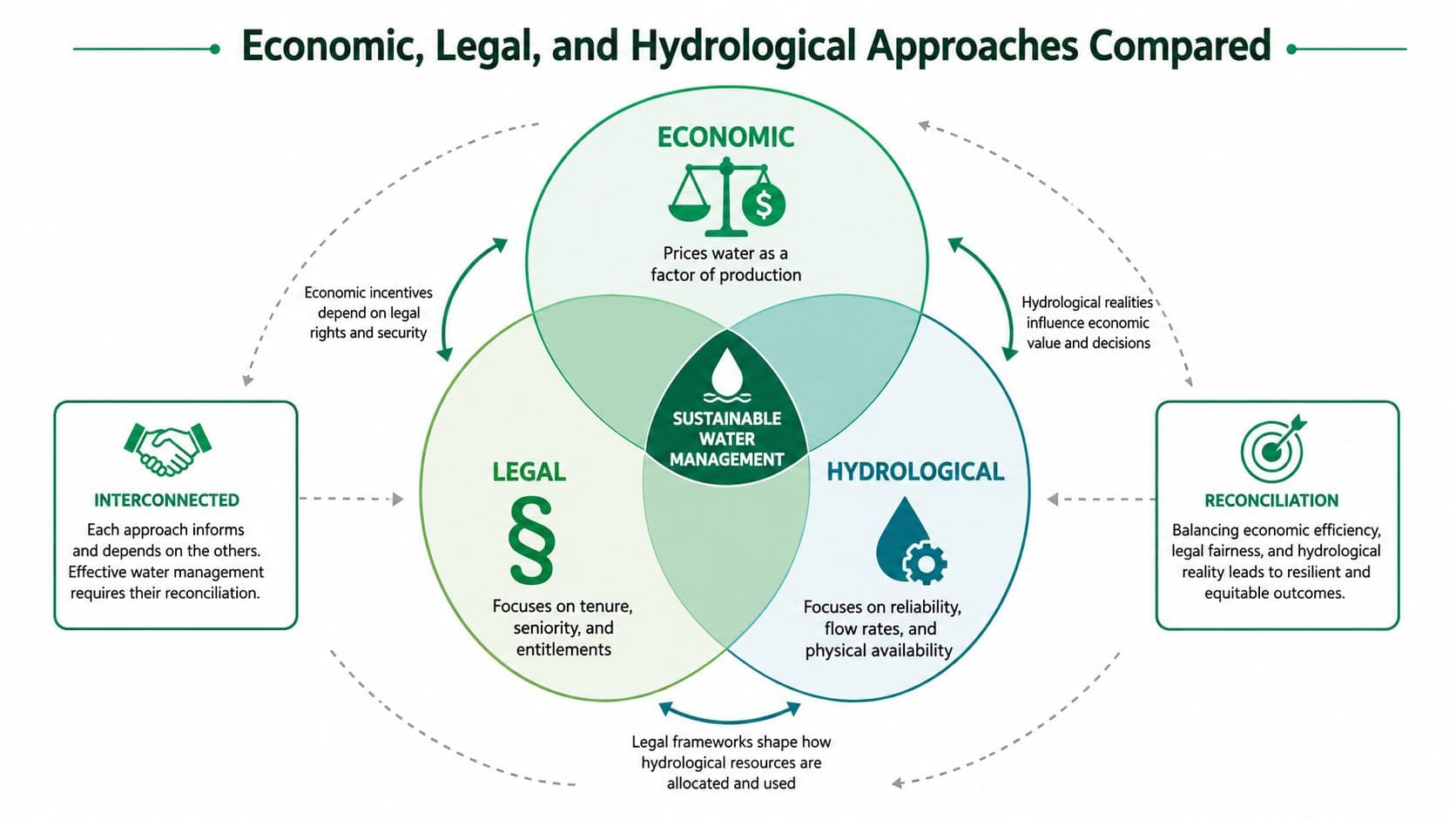
Economic Legal and Hydrological Approaches Compared
A water right is a heterogeneous bundle, not a uniform perpetual asset. Its appraisal should begin by testing three linked questions: what economic benefit the holder can capture, what legal claim can be enforced, and what quantity the physical system can deliver. Reliability, seniority, timing, transferability, storage access, and shortage exposure determine how those components combine in value.
The economic analysis estimates income, avoided costs, or scarcity rents from the water that can support authorized uses. The legal analysis examines priority, enforceability, transfer approval, beneficial-use conditions, third-party protections, and the possibility of curtailment or forfeiture. The hydrological analysis converts the paper entitlement into expected delivery by accounting for source conditions, return flows, conveyance losses, aquifer behavior, and drought. These are not interchangeable adjustments. A senior right may retain substantial value during shortage because its priority limits curtailment, while a nominally larger junior right may deliver less and face greater uncertainty.
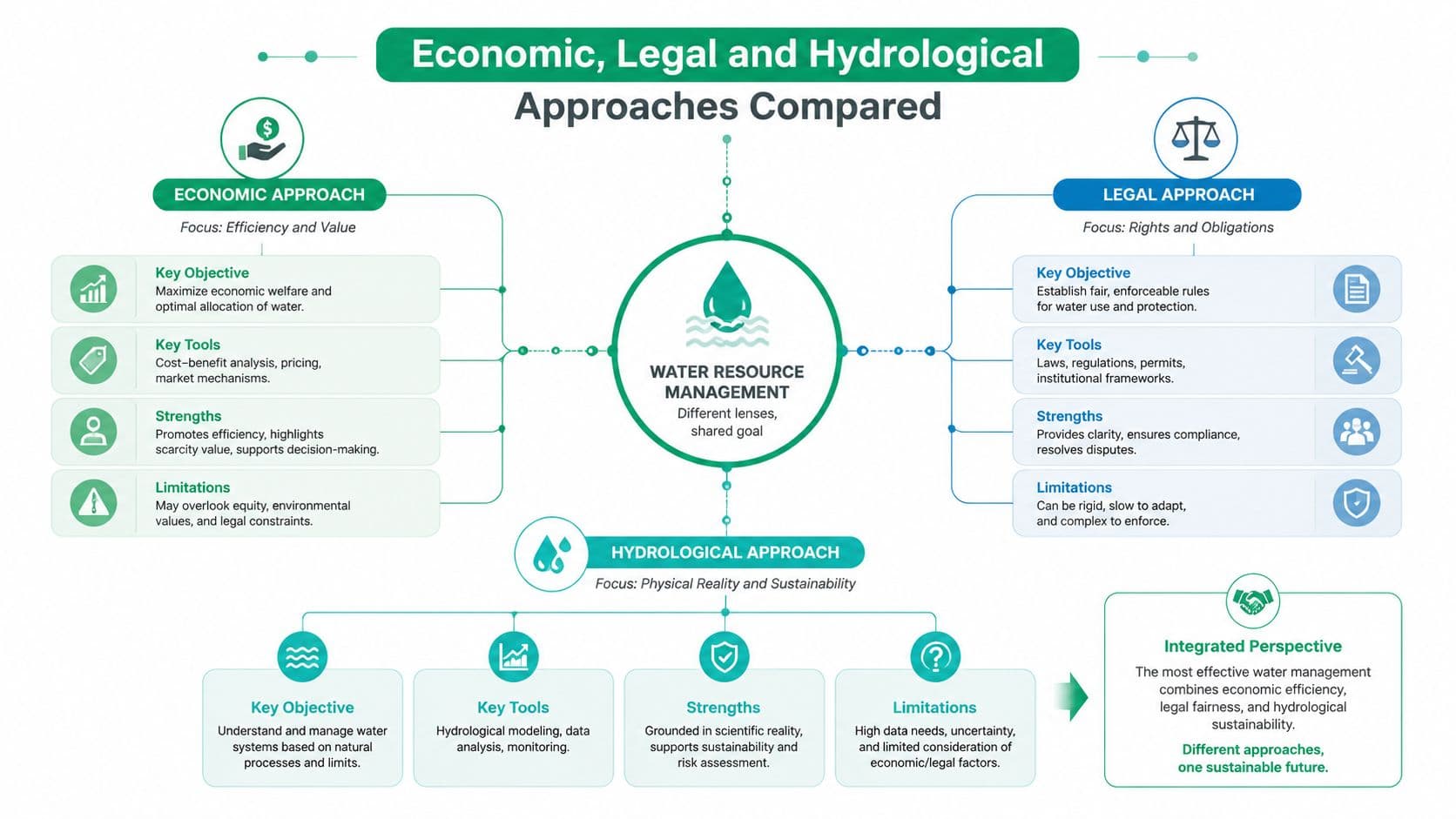
A practical appraisal checklist follows from this convergence. First, define the entitlement bundle and distinguish the stated volume from expected delivery. Second, test reliability across ordinary and shortage conditions, including how seniority changes the probability and timing of supply. Third, identify legal constraints that affect exchange value, such as transfer review, injury claims, place and purpose of use, and continuing beneficial-use duties. Fourth, model the economic benefit of the deliverable water, rather than capitalizing the paper volume alone. Finally, run scenarios for changes in curtailment practice, source conditions, and institutional rules. The result should show which assumptions drive value and which risks remain outside the holder's control.
The distinction matters for public acquisition as well as private transactions. Valuing only legal priority can cause an agency to pay for water that the system cannot deliver. Valuing only modeled flow can understate a senior claimant's protection during scarcity. The relationship between the intersection of enforceable claims and economic allocation in water rights reinforces the same point: exchange depends on legally recognized control, but that control is bounded by public rules, physical scarcity, and obligations to other users. A defensible valuation therefore reports economic benefit, enforceability, and hydrological yield separately before reconciling them into a final figure.
Data Requirements That Drive Valuation Accuracy
Valuation accuracy depends on whether analysts measure the right bundle of attributes. Water rights are not uniform perpetual assets. Their economic value varies with hydrological records, legal-institutional records, and market transaction records, because each layer addresses a different component of delivery and control.
Hydrological records should cover source flows, groundwater conditions, recharge, return flows, delivery losses, and performance during shortages. Legal records should establish priority, authorized diversion, place and purpose of use, transfer conditions, beneficial-use requirements, and forfeiture or curtailment provisions. Market records should identify price, volume, timing, buyer and seller type, entitlement class, and transaction terms. Together, these records distinguish stated volume from expected delivery and enforceable priority.
Missing data creates directional bias
An incomplete priority record can make junior rights appear stronger than they are. A stationary climate baseline can make future yield look more stable than the physical system supports. A private trade with undisclosed conditions may appear comparable even when its price reflects bundled land, a strategic buyer, or a negotiated restriction.
Each appraisal method responds to different gaps. Comparable sales become unreliable when transaction attributes are hidden. Income capitalization becomes sensitive to uncertain yield, production response, operating costs, and future use. Replacement cost can misstate value when alternative infrastructure lacks equivalent reliability or legal approval. Before-and-after land differentials can double count value if analysts cannot separate water from soil, access, improvements, or development potential.
Data discipline: A valuation should identify which inputs are observed, which are inferred, and which are assumptions. Unlabeled assumptions turn uncertainty into false precision.
| Valuation Method | Essential Data Inputs | Common Data Gaps | Typical Error Range |
|---|---|---|---|
| Comparable sales | Recorded prices, volumes, entitlement class, reliability, priority, restrictions | Private terms, thin markets, delayed registries | Not established in verified data |
| Income capitalization | Net income attributable to water, reliable yield, operating costs, discount assumptions | Drought performance, production response, future use | Not established in verified data |
| Replacement cost | Alternative supply design, construction and treatment requirements, operating conditions | Equivalent reliability, legal approval, environmental constraints | Not established in verified data |
| Before-and-after land differential | Comparable land values with and without the right, site attributes | Double counting, weak comparables, bundled transactions | Not established in verified data |
Even basic household or enterprise payment records require careful interpretation. A utility bill, as explained in define utility bill, clarifies what was paid and what consumption was recorded, but it does not establish whether the payer held senior priority rights, could transfer the entitlement, or would receive water during a drought. Consumption evidence and legal title answer different valuation questions.
For a regulatory or litigation appraisal, the minimum viable dataset should include the governing instrument, ownership chain, historical use evidence, hydrological performance, transfer history, and directly comparable transactions where available. A land-value calculation framework can help isolate site-based value, but the analysis must keep land, legal priority, delivery reliability, and physical yield separate before reconciling them into a valuation.
Institutional Resets and the 2026 Market Reality
Water rights are heterogeneous bundles, not static, perpetual assets. Their value depends on priority, expected delivery, transferability, and the rules governing shortages. In the Colorado River system, the 2007 Interim Guidelines and 2019 Drought Contingency Plans expire at the end of 2026, and a replacement consensus has not yet been reached, according to current market commentary in The Hidden Asset. A valuation based on historical deliveries may therefore price yesterday's institutional arrangement rather than the right's prospective cash flows.
Rules can change the bundle
A regulatory reset can reduce value without cancelling the entitlement. It may lower delivery reliability, restrict transfers, redefine beneficial use, increase environmental obligations, or impose mitigation costs. Each adjustment changes the economic bundle that the original appraisal was meant to price.
California's groundwater sustainability regime illustrates the point. Under the Sustainable Groundwater Management Act, local agencies may adopt plans that require pumping controls or other measures to bring an overdrafted basin into balance. A pumping right that supported a particular historical yield can consequently produce less saleable water, face higher compliance costs, or become less transferable. The legal label remains, but the expected income stream changes.
The Murray-Darling Basin presents the same issue through a different institutional structure. Sustainable diversion limits and related policy settings determine the volume and reliability associated with entitlements. Prices consequently reflect scarcity and the credibility of the framework defining what can be traded and delivered.
A valuation model should therefore test three exposures:
- Rule exposure: Which allocation guidelines, compacts, plans, or administrative conditions can change during the valuation horizon?
- Volume exposure: Can legally recognized or physically available supply fall because of new diversion limits or environmental requirements?
- Transfer exposure: Can the right move to the higher-value use assumed in the appraisal, or could approval, injury, or political constraints block that transfer?
These exposures should be represented as scenarios rather than buried in a single discount rate. A right with high seniority but uncertain future administration may warrant a different value from a junior right with lower priority but clearer operating rules.
Fixed leases and water rights are not interchangeable
Land-tenure comparisons can obscure the feature that matters most for water appraisal: water rights are defined by a changing combination of legal priority, physical availability, reliability, and conditions on use. A fixed-term land lease is a contract whose expiry and renewal terms determine repricing risk. Those concepts do not establish that a water entitlement has a fixed life or a stable annual yield.
The relevant question is whether the water bundle can deliver the volume, timing, and location assumed by the valuation. A right may be formally valid yet lose value when shortage rules, environmental requirements, groundwater controls, or transfer standards alter those attributes. Institutional reset risk belongs in the projected delivery and income assumptions, not in a separate land-tenure analogy.
For finance ministries, investors, and public agencies, the 2026 Colorado River deadline is therefore a valuation event, not merely a policy milestone. Appraisals should distinguish historical performance from forward-looking entitlement value, identify which assumptions depend on unresolved rules, and test outcomes under alternative allocation and transfer regimes. This approach recognizes that seniority alone does not determine price. Reliability and institutional durability determine how much of the nominal right can become usable, transferable economic value.
Jurisdictional Examples From Global Water Markets
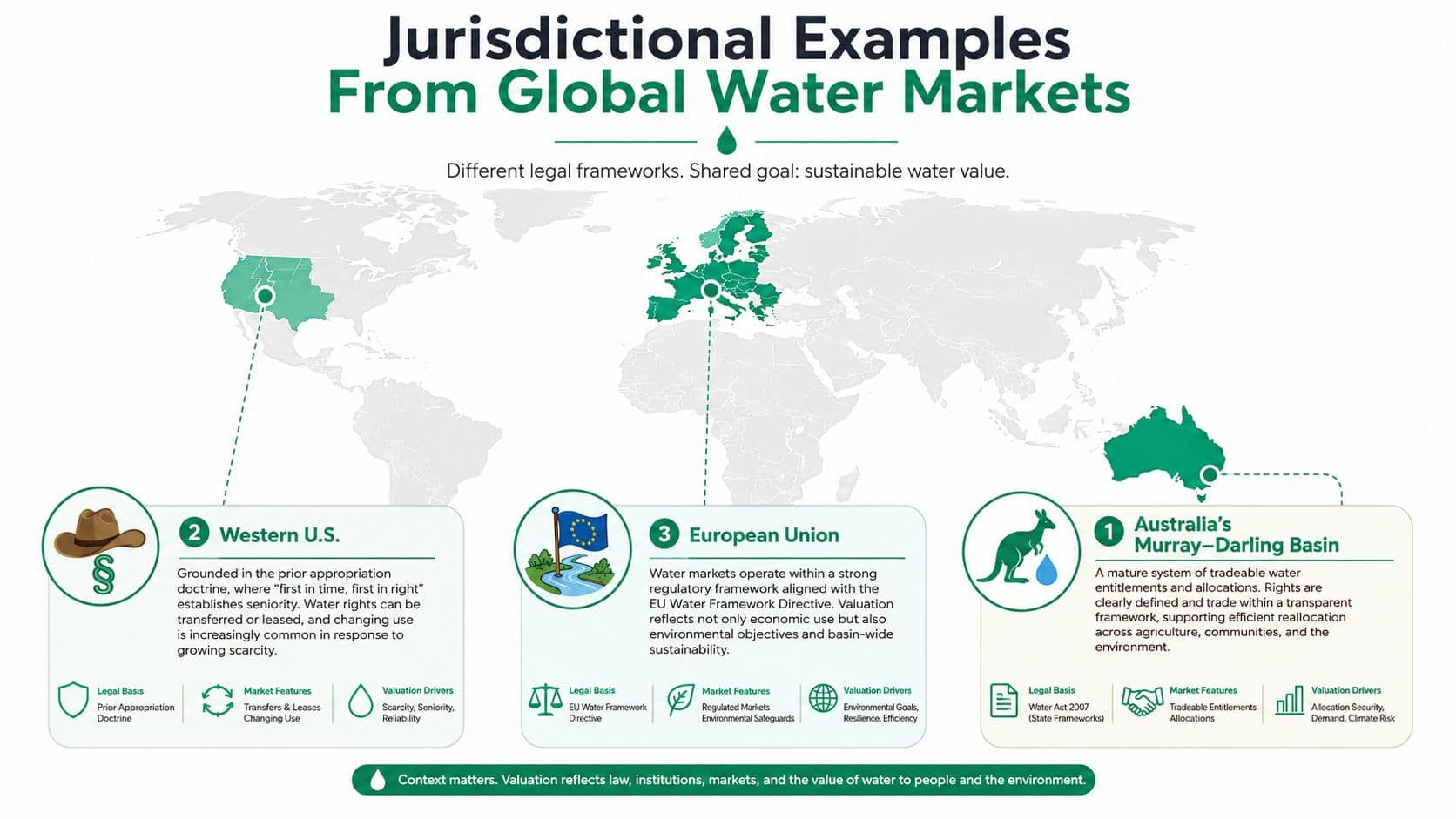
Jurisdiction determines which attributes become financially decisive. The same nominal volume can receive very different treatment depending on whether the system emphasizes priority, reliability classes, administrative allocation, environmental protection, or transfer freedom.
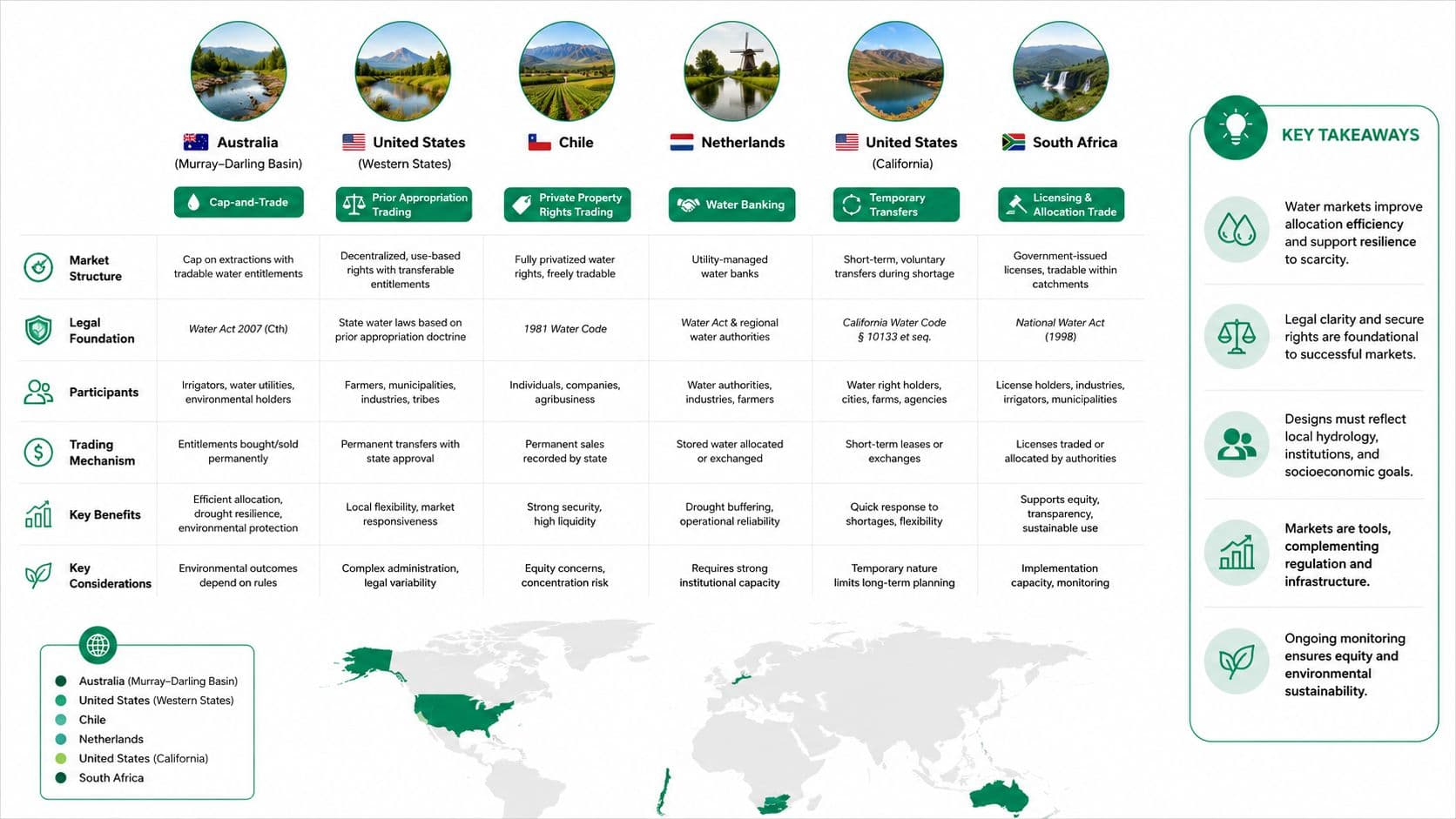
Australia
The Murray-Darling Basin is one of the clearest examples of an active entitlement market. Entitlements and seasonal allocations are treated as distinct economic objects, and prices reflect reliability, basin location, timing, and scarcity. The NSW valuation data show that seasonal prices can range from near A$7 per megalitre to as much as A$1,200 per megalitre under extreme scarcity, while more stable market conditions often sit between A$100 and A$500 per megalitre, as reported in the NSW water values update.
The policy consequence is important. A market-comparable model may be suitable for frequently traded entitlements, but it must distinguish long-term entitlement value from seasonal allocation value. Income capitalization may better capture a farm's production benefit, while replacement cost may be more informative for a town supply where the alternative is infrastructure rather than another trade.
Western United States
Western systems commonly attach substantial value to priority date and beneficial use. A senior right may receive water during conditions in which a junior right is curtailed, but legal priority doesn't eliminate physical scarcity or transfer risk. Appraisers must therefore examine the actual decree, source, historical use, transfer restrictions, and injury to other users.
The western U.S. evidence base is unusually useful because researchers studied more than 7,000 transactions across 13 river basins in 8 states and earlier federal research examined more than 2,000 transactions from 1990 to 2003, according to the western water-right price analysis. Those observations support market valuation, but they don't justify treating every right as interchangeable.
China and New Zealand
China's urban land-use system demonstrates the institutional importance of duration. State-owned land-use rights are leased for specified periods and tied to planning compliance under the Urban Real Estate Administration Law. The legal term, permitted use, and renewal structure affect the value of the land claim, but the arrangement shouldn't be conflated with an indefinite annually repriced land-use right.
New Zealand's renewable lease model, with its 33-year term and rent resets, shows another way governments can separate occupancy security from periodic repricing under the Land Act 1948. The comparison is useful for water policy because it exposes the difference between a right that expires or requires renewal and one that remains indefinite while its annual rental value is updated.
Building Scenario-Based Valuation Frameworks
Historical comparables provide evidence, not a forecast. They reflect earlier reliability, policy, and reallocation conditions. A water right is a heterogeneous bundle: its value depends on seniority, delivery reliability, usable volume, permitted uses, transferability, and the possibility of institutional change. A single historical price can therefore conceal material downside.
Scenario design should begin with the entitlement's cash-generating capacity. Model at least three states:
- Baseline allocation, where current rules and expected delivery conditions broadly persist.
- Moderate stress, where allocations are curtailed, reliability declines, or operating restrictions increase.
- Severe institutional reset, where priority treatment, transfer rules, environmental obligations, renewal conditions, or usable volume change.
Each state should convert nominal entitlement volume into expected deliverable water, then into agricultural, municipal, or industrial benefits. Assign probabilities through hydrological modeling and documented policy judgment. Show how value changes when those probabilities move. This sensitivity is more informative than a single discount-rate adjustment because it identifies which assumptions drive the appraisal.
The framework should also distinguish current use from conversion option value. An agricultural right may have limited present earnings but retain value because approval, infrastructure, or market conditions could permit municipal or industrial use later. That option is conditional, not automatic. Analysts should model the timing, probability, transaction costs, mitigation obligations, and regulatory constraints attached to conversion.
Risk belongs in the structure, not a footnote
Discount rates should capture ordinary time value and risks that remain after scenario modeling. A junior entitlement in an over-allocated basin may warrant a higher rate than a senior, reliable right, but the adjustment should be tied to observed market evidence, institutional analysis, and sensitivity testing. An unexplained premium hides rather than measures uncertainty.
Cross-sector transfer creates a distributional issue as well as an appraisal issue. If a municipal buyer can generate greater benefits than an agricultural user, the negotiated price determines how the surplus is divided. Bargaining power, approval risk, mitigation costs, and political constraints can leave more of that premium with the buyer or seller.
Scenario modeling software can expose these assumptions instead of compressing them into a point estimate. Investors and public agencies need to see the central value, the range produced by reliability and policy assumptions, and the legal or hydrological change that would invalidate it.
A finance ministry should require material appraisals to disclose the entitlement bundle, source data, scenario definitions, probability assumptions, transfer constraints, and sensitivity to reliability. That format makes valuation useful for allocation policy by showing who gains, who pays, and which institutional outcomes the government is pricing.
Unitism® helps governments and organizations build land and water valuation frameworks that separate scarcity rent, legal access, and productive use. For policy design, scenario modeling, and implementation support, visit Unitism®.