Explore the homestead community land trust model. Our guide explains shared equity, land-use rights, and how CLTs create permanent housing affordability.
July 13, 2026
Homestead Community Land Trust: A Guide to Shared Equity
Explore the homestead community land trust model. Our guide explains shared equity, land-use rights, and how CLTs create permanent housing affordability.
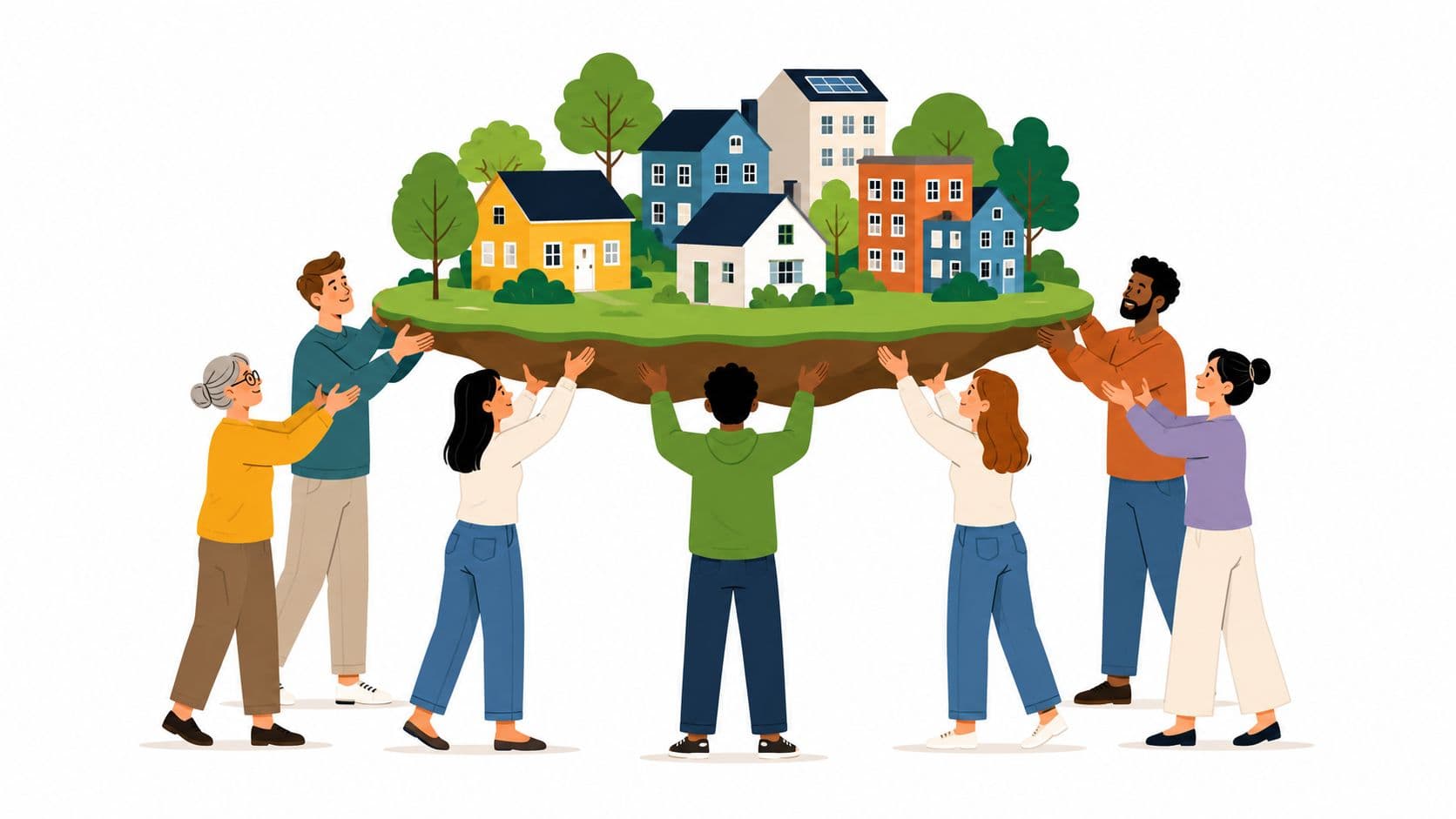
You may be in that familiar meeting where everyone agrees housing is unaffordable, but nobody agrees on what to do about it. A planner points to zoning. A community activist points to displacement. A first-time buyer asks why a modest home costs far more than the building itself seems worth. The conversation often stalls because people are talking about one price, but that price is really two things mixed together: the house and the land under it.
That split matters. When land prices surge, families can do everything right and still get priced out of their own neighborhood. A community land trust offers a different answer. Instead of asking each household to buy into the full speculative cost of land, it secures the right to live on and use that land through long-term community stewardship. In Seattle, Homestead Community Land Trust gives us one of the clearest real-world examples of how that can work.
Table of Contents
- Beyond the Market Price of a Home
- What Is a Homestead Community Land Trust
- The Mechanics of Shared Equity and Affordability
- CLTs as Community Land Value Capture
- Implementing a Community Land Trust
- Common Pitfalls and Critical Considerations
- Frequently Asked Questions about HCLTs
Beyond the Market Price of a Home
A family finds a modest house near a good bus line, a school they trust, and the jobs that keep their week together. The building itself is ordinary. The price is not. What pushes it out of reach is often the land beneath it, or more precisely, the location value created by the surrounding city.
That distinction matters because it changes the policy question. If a rising price comes from public transit, zoning decisions, nearby employers, parks, and the steady work of a neighborhood, then the full gain did not come from the homeowner's labor alone. A homestead community land trust responds by separating the home from the speculative price of land and placing that land under community stewardship.
This is one of the clearest real-world examples of non-tax land value capture. Instead of collecting location value through a tax bill, the trust secures land-use rights through a long-term ground lease and keeps the underlying land in community ownership. The family gets stable possession and the ability to build limited equity. The community keeps control of the part of the price that comes from place.
That structure lines up closely with Unitism's core idea that land and capital should not be treated as the same thing. Buildings come from human effort and investment. Land value largely comes from nature, public action, and surrounding community activity. If you want a plain-language foundation for that distinction, this explanation of how a land trust separates land from improvements is a useful reference.
A simple analogy helps here. In a conventional sale, a buyer purchases both the house and a ticket into future land appreciation. In a CLT, the buyer purchases the house and the right to use the land securely, while the trust holds the land itself for long-term community benefit. That one change can lower the upfront price and keep the home from being pulled fully into the cycle of rising site values.
For planners and housing advocates, the lesson is practical. Affordability is not only a subsidy question. It is also a control question. Who holds the land? Who captures the increase in location value? Who gets to decide whether that value serves one seller once, or many households over time?
Homestead's story matters because it shows that this model can be built through civic organization, not only through tax policy. Residents can create an institution that holds land for use rather than for extraction. That makes the idea easier to explain to the public. A family still owns a home. The community chooses not to privatize the full market value of the land underneath it.
Seen this way, a homestead community land trust does more than lower purchase prices. It redirects land value at the source, through ownership and lease design, and turns a volatile market asset into a stable housing platform for the next household too.
What Is a Homestead Community Land Trust
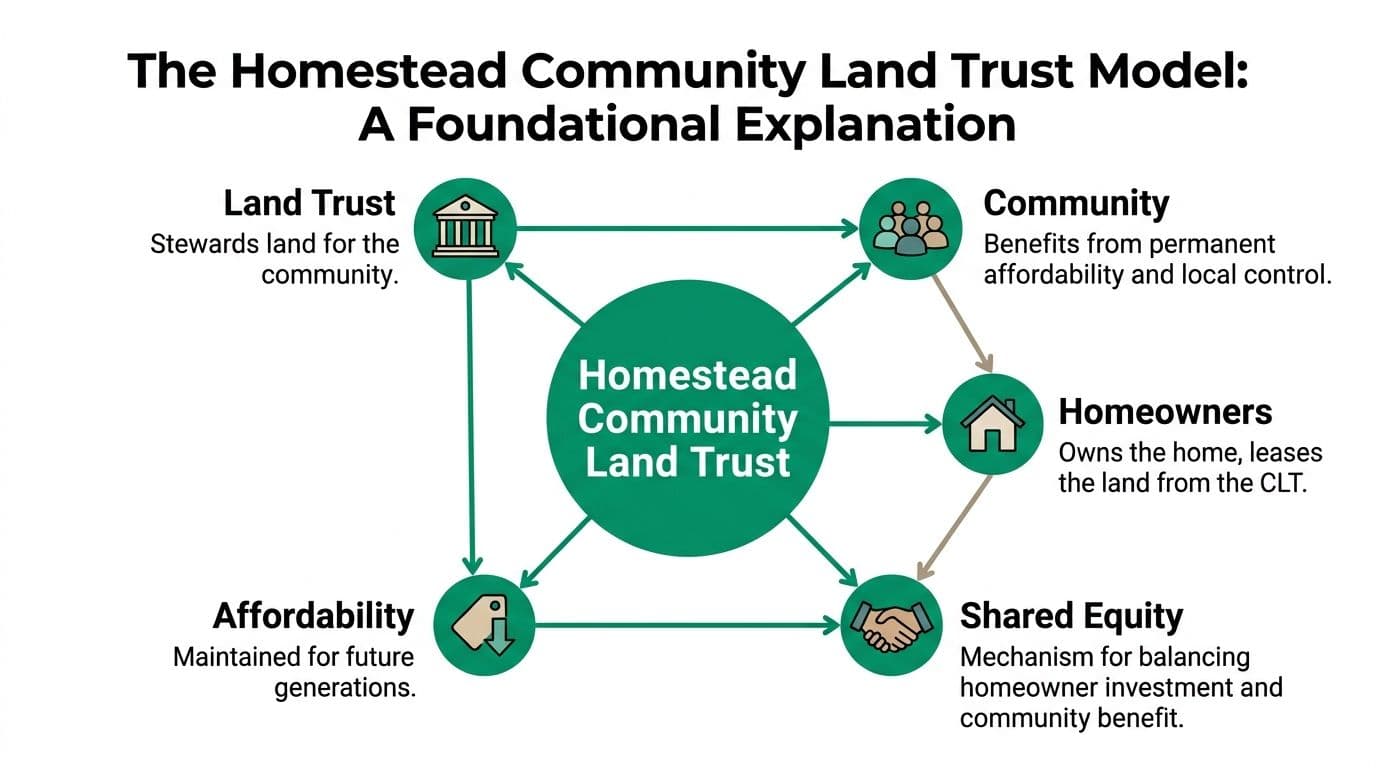
The basic idea is simple, but the wording can confuse people. In a Homestead-style model, the homeowner buys the home, but the trust keeps ownership of the land. The homeowner then leases the land through a 99-year renewable agreement, which gives secure land-use rights without exposing the buyer to speculative land price inflation, as explained in Homestead's overview of how the model works.
That phrase, land-use rights, is worth slowing down for. It means a household gets the long-term right to live on, use, improve, and pass along the home under agreed rules, even though the land itself remains in community ownership. In practice, that can feel more like stability than many people expect, because what most households need is not speculative land ownership. They need secure tenure.
A simple way to picture it
A useful analogy is apartment ownership inside a larger structure. You can own and control your unit while a larger entity controls the land and shared framework around it. A CLT applies that same separation to detached homes, townhomes, or other housing forms.
Here's the relationship in plain language:
- The trust holds the land: It stewards the site for long-term community benefit.
- The homeowner holds the structure: They buy the home and live in it as their residence.
- The ground lease defines the rules: It protects occupancy, resale terms, and long-run affordability.
If you want a broader primer on the institution itself, this guide to what a land trust is is a useful companion.
Why land-use rights matter more than land-value taxes here
For this model, I prefer land-use rights over land-value taxes as the main organizing idea. A tax approach tries to recapture land value after private ownership is in place. A CLT secures community benefit earlier by changing the ownership structure from the start.
That distinction lines up with Unitism's core principle of separating land from capital. The building is capital. People build it, maintain it, finance it, and improve it. The site itself is different. Its value often comes from nature, location, infrastructure, and the surrounding community.
A Homestead community land trust puts that principle into practice without requiring every city to begin with tax reform. It says: keep the land in shared stewardship, let residents own the home, and protect the right to use the land securely over time.
Land-use rights answer the question most families actually ask: “Can I stay here with security?” Tax design answers a different question: “How should the public collect land rent?” Both matter, but they aren't the same tool.
That's why CLTs are so often misunderstood. People hear “you don't own the land” and assume insecurity. In reality, the model is designed to replace speculative exposure with durable occupancy rights.
The Mechanics of Shared Equity and Affordability
A family buys a home through a CLT and gets something the conventional market rarely offers at the same time: a lower price today and protection against runaway prices tomorrow. That combination can feel counterintuitive at first. It makes more sense once you separate the house from the land underneath it.
In the Homestead model, affordability is built through structure, not left to promises. The homeowner purchases the home itself at a reduced price, while the trust continues to hold the land and grants long-term rights to occupy and use it. Under Unitism's logic of separating land from capital, that distinction matters. The building is a produced asset that a household can buy, maintain, and improve. The land is held in common stewardship so its location value is not fully privatized at resale.
Three moving parts that keep homes affordable
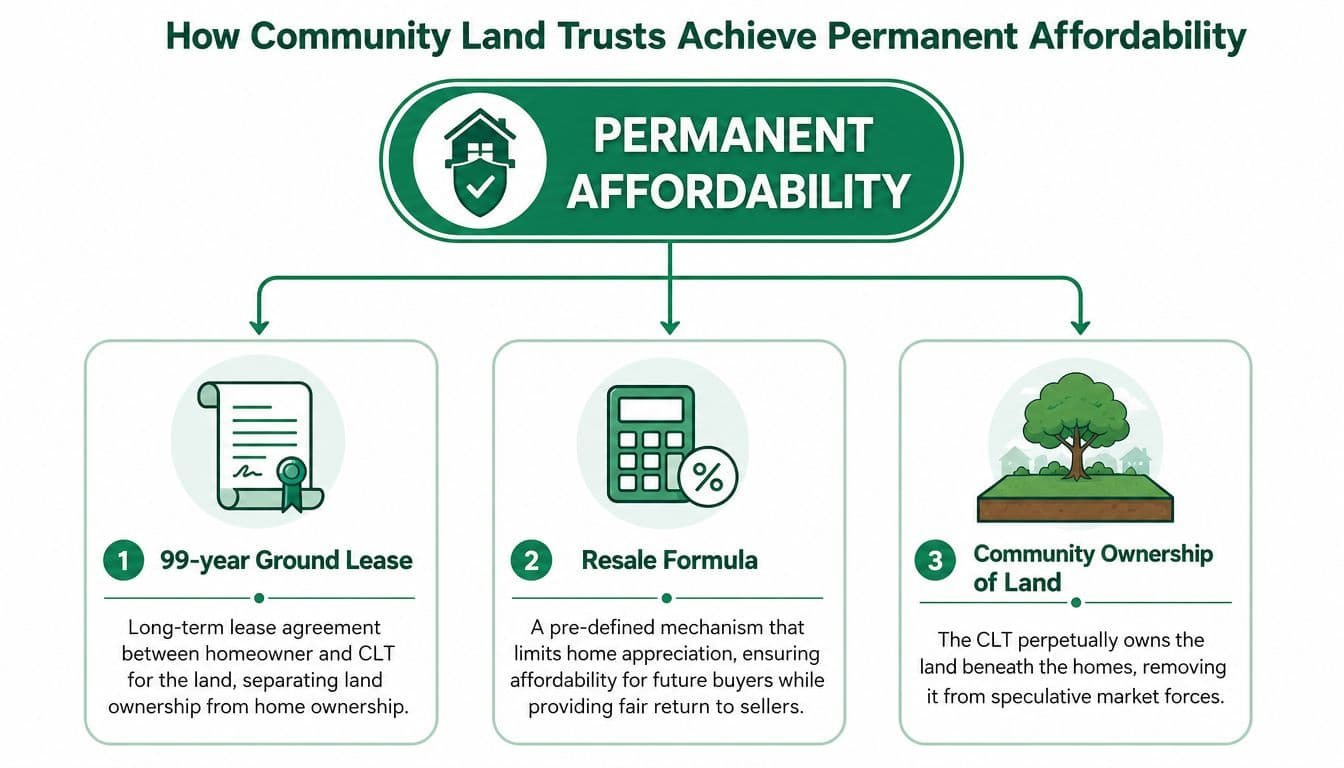
These trusts usually rely on three connected mechanisms.
-
Long-term site control
The land stays with the trust. Because the site never enters the speculative market as a conventional private asset, the community retains control over a major source of price inflation. -
A reduced purchase price The buyer pays for the home without paying full market price for the land beneath it. That lowers the barrier to entry in a very practical way. Monthly costs can line up more closely with what working households can carry.
-
A resale formula
The next sale is governed by rules rather than by whatever the hottest bidder will pay. That allows one assisted purchase to remain affordable for the next household instead of disappearing after a single resale.
A simple analogy helps. A CLT works like a community-held foundation under a privately occupied home. The resident owns and cares for the structure. The community keeps control of the ground so the value created by transit, schools, parks, and neighborhood demand does not fully turn into a windfall for one seller.
For readers comparing housing models, that is a different goal from direct speculation or portfolio exposure through fractional housing investment opportunities. A CLT is designed to secure stable tenure and preserve access across generations. It can help households build some equity, but it does so within rules that keep the home in reach for someone else later.
A wider policy frame helps here too. This housing affordability policy framework explains why land cost, financing rules, and local regulation shape affordability just as much as construction cost does.
What the resale formula actually does
The resale formula is the part many people misunderstand. It does not erase ownership. It sets terms for how appreciation is shared.
The homeowner still gains from paying down a mortgage, maintaining the property, and receiving limited appreciation under the program rules. What they usually do not receive is the full market gain tied to rising land values in the surrounding area. That foregone portion is what allows the home to remain affordable to the next buyer. In other words, some of the land value created by the wider community stays with the community through the trust's continuing control of the site.
That is why shared equity is best understood as a rule for dividing gains, not as a denial of gains.
A short table makes the sequence clearer:
| Element | What happens |
|---|---|
| Initial price | Buyer purchases the home, with land held by the trust |
| Ownership period | Buyer gains stability and builds limited equity |
| Resale price | A formula sets the allowable resale amount |
| Community outcome | The home remains within reach for another eligible buyer |
For planners, the mechanics are straightforward once the legal split is clear. The trust secures land-use rights over time. The household gets secure occupancy, a lower entry price, and a path to modest wealth building. The community keeps a durable claim on location value without relying solely on tax collection after appreciation has already occurred.
CLTs as Community Land Value Capture
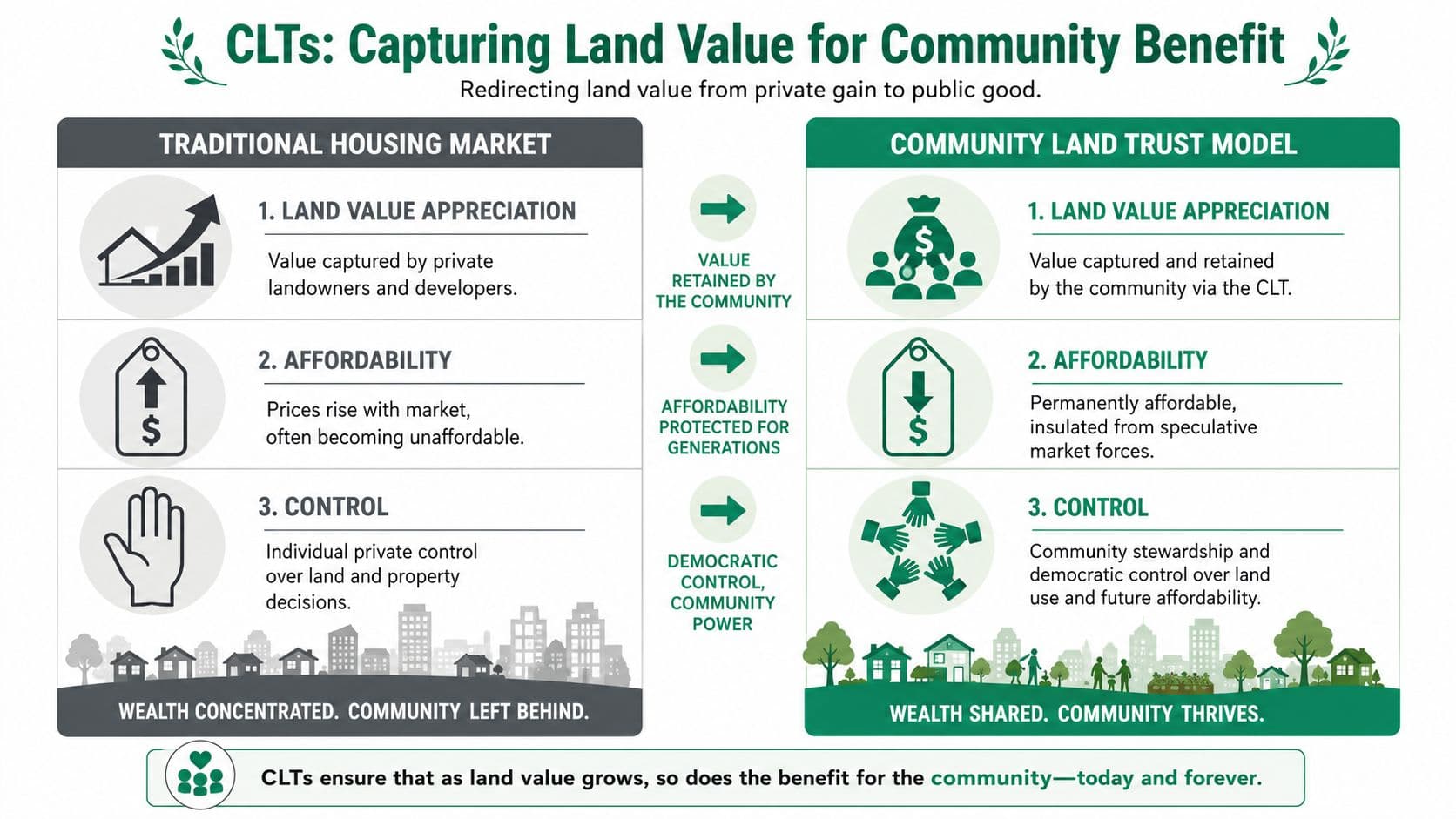
Many people talk about land value capture as if it only means taxation. That's too narrow. A community land trust captures land value by controlling the land itself and preserving its social use over time.
That's why CLTs matter beyond affordable housing. They are a form of non-tax land value capture. Instead of collecting value from private landowners after appreciation occurs, the community secures that value by retaining ownership and assigning long-term use rights.
Two ways to capture land value
A quick comparison helps.
| Approach | Core method | What the public secures |
|---|---|---|
| Land value tax | Public authority taxes site value | Revenue from privately held land value |
| Community land trust | Community entity retains land ownership | Ongoing affordability and long-term stewardship |
Both approaches start from the same economic insight: land value often comes from collective conditions, not from the individual owner's labor alone. But they differ in how they act on that insight.
For readers who want a policy-level overview, this guide explaining land value capture lays out the larger framework clearly.
Why a rights-based model changes the politics
A rights-based model can be easier to defend in neighborhoods facing displacement. Residents may resist new taxes, even when the economics are sound. But many will support a structure that keeps land in community hands and protects long-term residence.
That's also why I'd rather frame Homestead through land-use rights than through land-value taxes. Rights are tangible. Families understand them. Institutions can govern them. They align with the practical question of who gets to stay.
This framework also improves how we think about return. In conventional real estate, return often means private appreciation. In a CLT, part of the return is social and spatial. The neighborhood keeps an affordable unit in circulation. The public's earlier subsidy isn't lost. The land keeps serving use instead of speculation.
If you're comparing models of return more broadly, this piece on understanding housing investment potential can help clarify why financial return and community return often diverge.
A CLT doesn't abolish land value. It redirects that value away from windfall gain and toward lasting access.
That is very close to the Unitist separation of land from capital. The house remains a product of labor and investment. The land remains a common foundation whose value should not be fully privatized.
Implementing a Community Land Trust
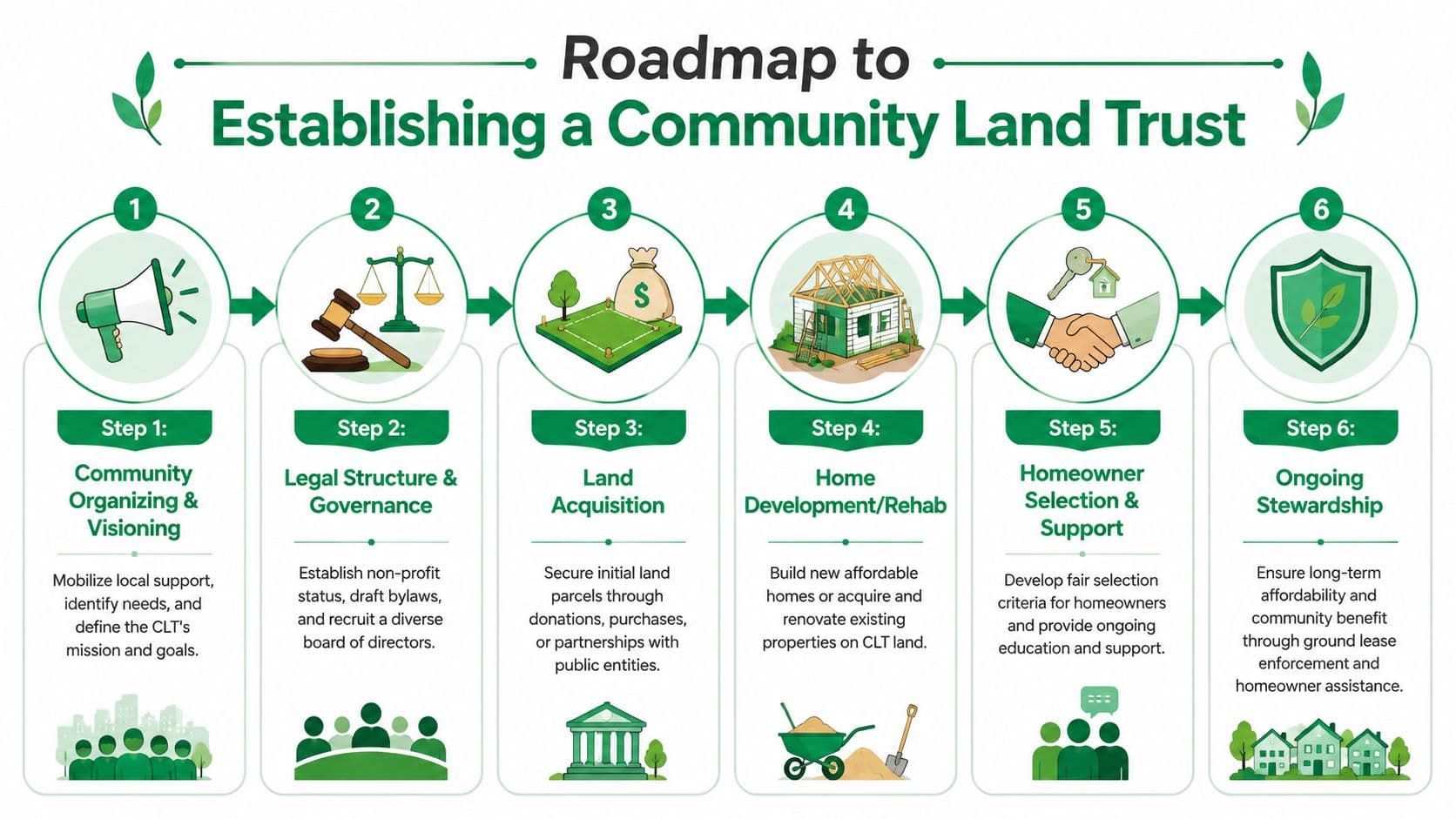
Starting a CLT can feel overwhelming because people often jump straight to legal complexity. In practice, the sequence matters more than the paperwork. Strong trusts usually begin with a coalition, not a filing.
Start with a civic coalition
The first task is to define the local housing problem in terms residents recognize. Is the pressure coming from displacement near transit, loss of family homeownership, land assembly by investors, or the disappearance of starter homes? A trust needs a place-based mission.
Then build a coalition that can carry the mission through setbacks:
- Residents and organizers: They bring legitimacy and on-the-ground knowledge.
- Planners and housing staff: They understand land use rules, site constraints, and public process.
- Legal and finance partners: They help shape governance, leases, and project feasibility.
- Mission-aligned landholders: Churches, nonprofits, and public entities can become key site partners.
If your coalition will be handling transfers, closings, or deed issues, a legal primer on trustee deed liability and risk can clarify distinctions that often confuse new organizers.
Build the trust before you build the homes
A CLT needs a governance model people believe in. That usually means a nonprofit structure, clear bylaws, and a board that reflects both professional capacity and community voice. A trust that looks purely technical may lose public confidence. A trust that is only symbolic may struggle to operate.
Land acquisition is often the hardest part. Cities and community groups usually pursue some mix of donated land, discounted land, partnership sites, or strategic purchase. Acquiring parcels is not the sole objective. It is to secure sites that can remain under stewardship for decades.
Infrastructure and enabling public investment also matter. Site readiness, utilities, street access, and public funding mechanisms can decide whether a project stalls or moves. This broader infrastructure funding perspective is useful because many housing plans fail on servicing and delivery, not on vision.
Plan for stewardship from day one
A CLT is not done when the homes are sold. That's when stewardship begins. Homeowner education, resale oversight, mortgage support, and ground lease enforcement are not side tasks. They are the model.
A practical roadmap often looks like this:
-
Define the mission and target community
Be precise about who the trust serves and what problem it is solving. -
Create governance that can survive leadership changes
Strong documents and board composition matter. -
Secure land with long-run use in mind
A hard site with weak location logic can become a burden. -
Develop or rehab homes that households can sustain
Affordability isn't only about purchase price. Ongoing costs matter too. -
Select and prepare homeowners carefully
Buyers need to understand both the opportunity and the resale limits. -
Steward the portfolio continuously
Monitoring, support, and compliance keep the homes affordable for the next generation.
A weak CLT treats stewardship as administration. A strong CLT treats stewardship as the product.
Common Pitfalls and Critical Considerations
Community land trusts deserve serious support, but they also deserve honest scrutiny. Too much advocacy writing treats them as if every benefit comes without a trade-off. That isn't fair to buyers or policymakers.
The wealth ceiling is real
The clearest trade-off is capped appreciation. In Seattle, a CLT homeowner who buys a $200,000 home and holds it for 10 years might gain $32,000 in equity, while a comparable market-rate home could have appreciated by over $150,000 in the same period, as reported by Next City's discussion of Seattle community land trusts. That gap is not a side issue. It is central to the model.
Some households will see that trade as worthwhile. They want stable housing, predictable resale terms, and a path into ownership that the open market denies them. Other households may decide the limit on appreciation doesn't fit their long-term goals for retirement or intergenerational wealth.
The honest pitch is not “buy this and get market gains.” The honest pitch is “buy this and trade some upside for security, access, and permanence.”
That's also why discussions of speculation matter. If you're thinking about the economic behavior CLTs are designed to prevent, this explanation of rent-seeking in economics is useful context.
Other issues planners should face early
The wealth ceiling isn't the only challenge.
- Land acquisition can be brutal: In expensive markets, assembling enough land to matter requires patience, subsidy, and partners with staying power.
- Governance can drift: A trust needs democratic legitimacy and technical competence. Losing either creates problems.
- Stewardship is long-term work: Ground leases, homeowner support, and resale monitoring require durable staffing and systems.
- Political messaging can backfire: If buyers don't fully understand the trade-off, disappointment can undermine trust in the institution.
A CLT is strongest when everybody enters with clear eyes. It is not a replacement for all housing policy. It is not the best fit for every household. It is a targeted structure that prioritizes staying power over windfall gain.
Frequently Asked Questions about HCLTs
Do homeowners in an HCLT own anything real?
Yes. The homeowner usually owns the house and the right to occupy and use the land through a long-term ground lease. The trust keeps title to the land itself.
A simple way to read this is to separate two different things that the conventional market bundles together. One is the building, which people improve, maintain, and live in. The other is the land value created by the surrounding community, public investment, and local demand. HCLTs split those pieces on purpose. That separation reflects a Unitist idea: land and capital are not the same asset and should not be treated as if they are.
Is this the same as a housing co-op?
No. A co-op usually gives residents shares in a corporation that owns the property. An HCLT home usually gives the resident direct ownership of the dwelling, while the trust retains the land underneath.
The difference matters because the legal and financial relationships are different. In a co-op, governance and occupancy often run through the shared entity. In an HCLT, the key division is between ownership of the structure and control of land-use rights.
Can owners still build equity?
Yes, though the path is narrower than in a market-rate home. Owners can usually gain equity by paying down their mortgage, and they may receive a limited share of appreciation under the resale formula.
That formula is the heart of the bargain. It lets one family get stable housing and some wealth-building, while preserving access for the next family. In policy terms, the model captures part of land value for ongoing public purpose without taxing it away after the fact. It does so by setting the land terms up front.
What happens if an owner wants to sell?
The resale process is governed by the ground lease and the trust's resale formula. Those rules usually set who can buy the home next and how the resale price is calculated.
This can feel restrictive if someone expects a home to function like a lottery ticket. It makes more sense if you view the subsidy as staying with the property rather than leaving with the first owner. The trust is holding open a door, not handing out a one-time windfall.
What if a buyer struggles financially?
Long-term stewardship is a major part of the model. Many land trusts do more than sign paperwork and step away. They often help owners understand the ground lease, prepare for resale rules, and address trouble early when a household is under financial strain.
That support matters because stable homeownership is not created by price alone. It also depends on counseling, clear rules, and an institution that stays involved after the sale.
Why do planners and activists keep returning to this model?
Because HCLTs address a problem that standard homeownership programs often leave unresolved. A one-time subsidy can help a family buy in, but it does not automatically keep the land affordable for the next buyer. An HCLT does.
That is why the model deserves attention as a form of community land value capture. Instead of waiting for rising land values to be taxed, recaptured, or priced back into the market, the trust secures long-term land-use rights at the parcel level. It turns appreciation pressure into lasting affordability. For families, that can mean a stable monthly payment and a realistic path into ownership. For communities, it means public and charitable investment stays in circulation rather than being absorbed into the next sale price.
Unitism® helps policymakers, planners, and civic organizations think clearly about land, housing, and public value. If you're working through questions like when to use land-use rights, when to use land-value capture, and how to separate land from capital in practical policy design, explore Unitism®.