A policy analysis of the DC homestead exemption, how it shapes inequality, housing stability, and tax fairness, and what reforms could better serve Washington in 2026.
July 8, 2026
A Case Study in Inequality and Urban Policy for Washington DC
A policy analysis of the DC homestead exemption, how it shapes inequality, housing stability, and tax fairness, and what reforms could better serve Washington in 2026.
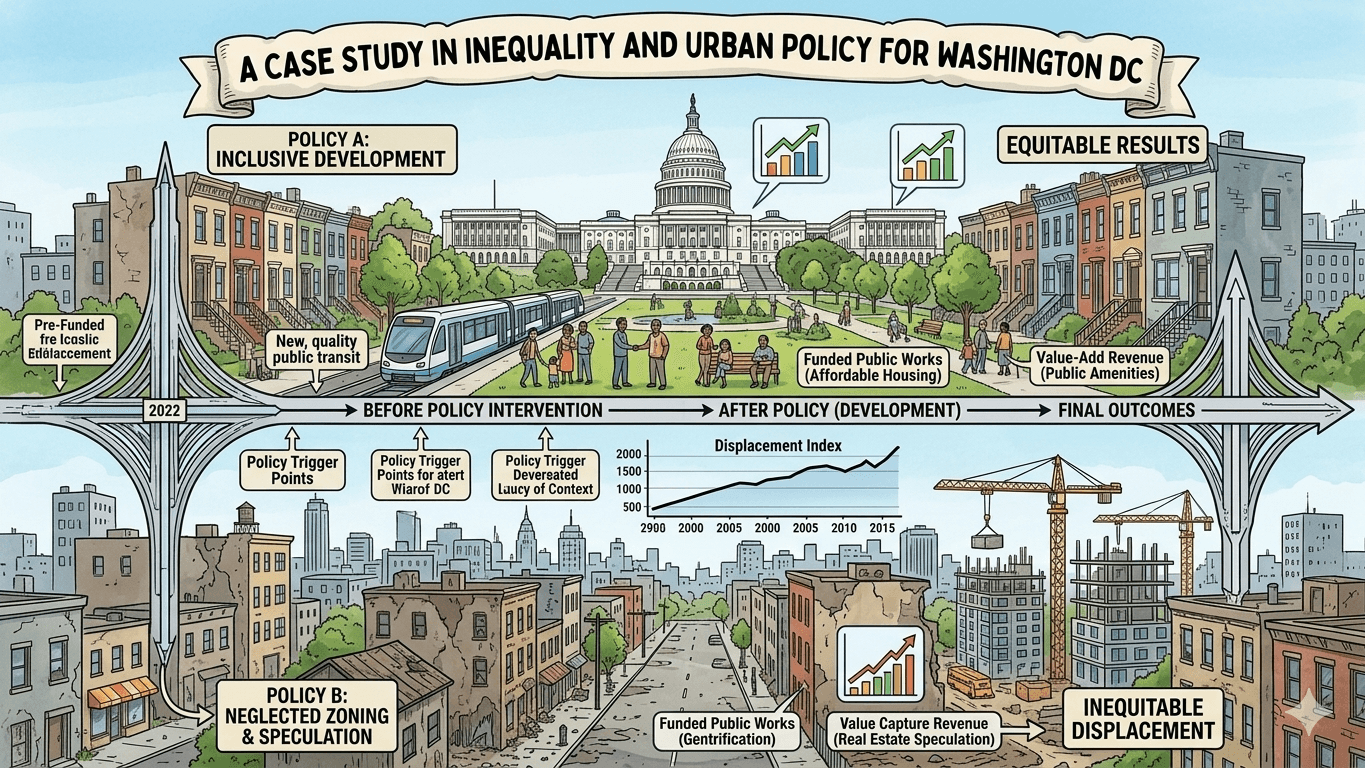
The District of Columbia homestead exemption is usually presented as a homeowner tax break. That is true, but it is also incomplete. In a city with some of the highest inequality in the United States, any broad property tax subsidy deserves a bigger question: does this policy make Washington fairer and more stable, or does it mainly protect already advantaged households?
That question matters because DC is not a normal housing market. It is a high income city with deep racial wealth gaps, sharp geographic segregation, and a tax base shaped by federal employment, professional services, and a long history of exclusion from land ownership. In 2024, DC again ranked at or near the very top nationally for income inequality, with the top 20% of households receiving 54.6% of all income and the bottom 20% receiving only 1.7% according to the DC Fiscal Policy Institute. The same analysis reports that the highest paid 5% captured nearly a quarter of all income.
Seen in that setting, the homestead exemption is more than a line item on a tax bill. It is a revealing case study in how cities try to soften the cost of homeownership without directly confronting the deeper structures that produce inequality in the first place.
The exemption does provide real help. The standard District homestead deduction reduces the taxable assessed value of a qualifying owner occupied home, and official District law places the program in D.C. Official Code § 47-850. The program was designed to encourage homeownership and reduce tax liability for residents who live in their homes, and it remains one of DC's largest real property tax expenditures, as summarized by the AARP Foundation's DC property tax overview.
The harder question is whether a broad owner occupant benefit is well targeted in a city where inequality is not just high, but structurally entrenched.
Table of Contents
- Why This Tax Break Matters Economically
- What the DC Homestead Exemption Actually Does
- Why Washington DC Is So Unequal
- Does the Homestead Exemption Help or Hurt DC
- What DC Could Do Instead or in Addition
- The Real Lesson of the DC Homestead Exemption
Why This Tax Break Matters Economically
A standard consumer guide asks whether a homeowner can save a few hundred dollars. A policy analysis asks something else: who receives the subsidy, who does not, and what incentives does the policy create across the whole city?
That broader lens matters in Washington because inequality here is not a side issue. It is one of the defining facts of the local economy. The DC Fiscal Policy Institute reports that Black residents faced a poverty rate of 27.9% in 2024, compared with 7.9% for white residents, and that Black residents earned just 36% of the median household income of white residents. Brookings has also described the Washington metro area as a place of major economic disparities with clear implications for policy design in housing, transportation, and opportunity, as explained in this overview of economic disparities in the Washington, DC metro region.
A tax break for owner occupants enters that environment with obvious political appeal. It says the city recognizes that people living in their homes are not the same as investors. That is reasonable. But a broad homeowner subsidy also raises a distributional concern. In a city where renters are generally less wealthy than homeowners, any tax benefit limited to owners starts with an unequal base.
That is why the homestead exemption is worth studying as a case, not just using as a form.
What the DC Homestead Exemption Actually Does
The District's homestead exemption lowers the taxable assessed value of a qualifying principal residence. It also interacts with a cap on annual taxable assessment growth for qualifying owner occupants. These features reduce the property tax burden on people who own and live in their homes.
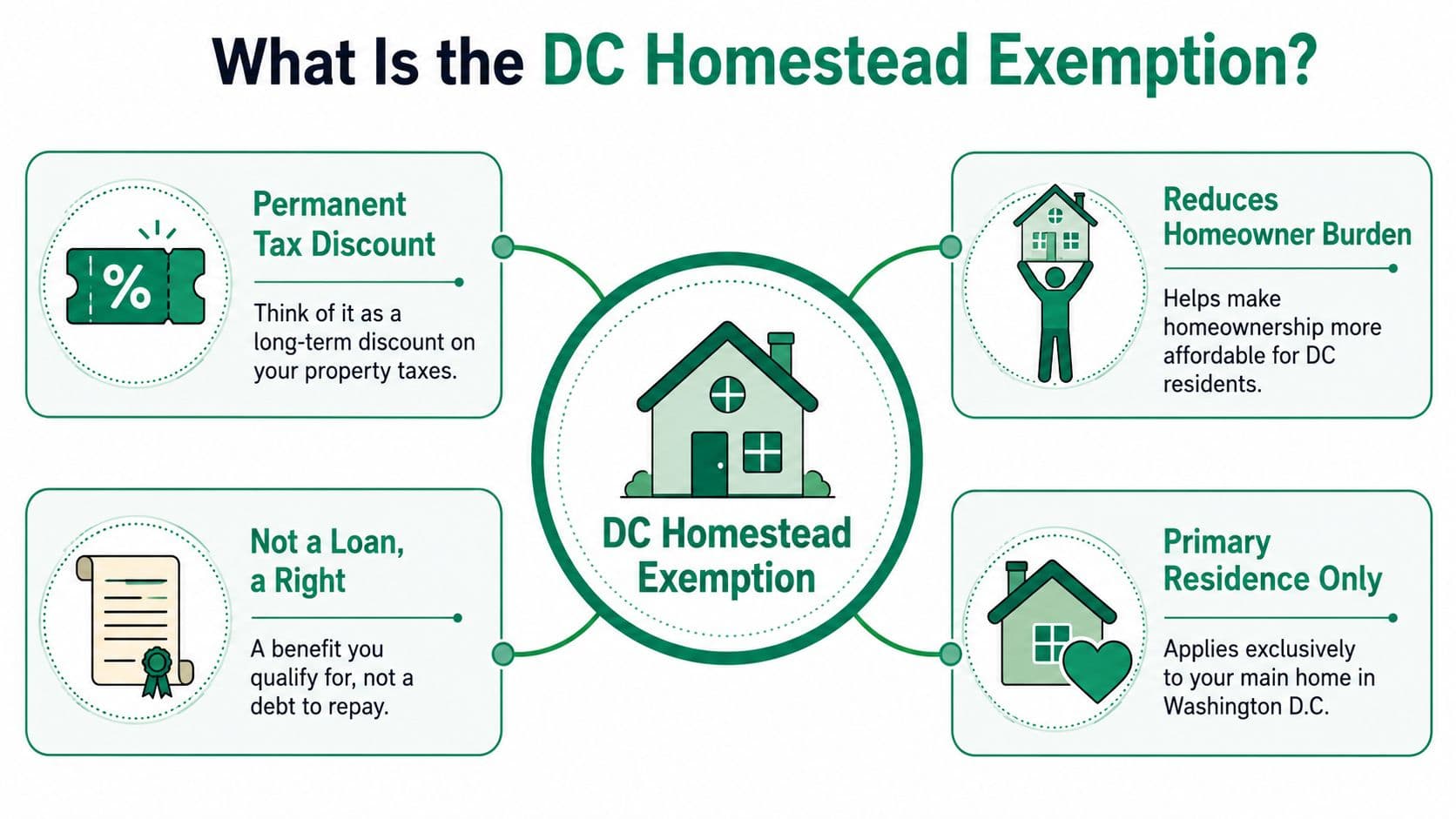
A homeowner subsidy built into the property tax base
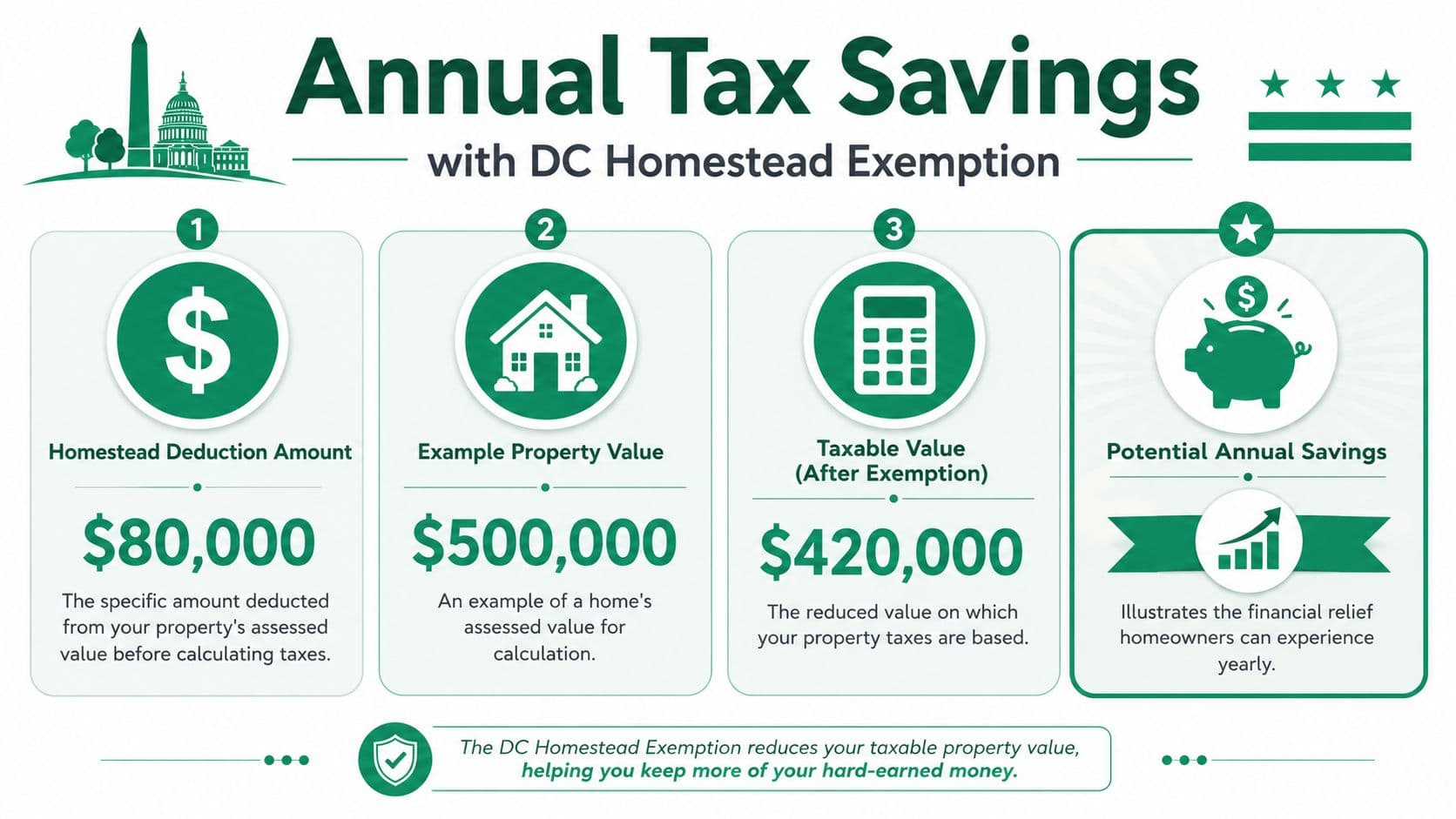
At the mechanical level, the policy is simple. A qualifying homeowner gets a deduction from assessed value before tax is calculated. The amount changes over time with adjustments, and secondary summaries report recent annual savings in the several hundred dollar range, depending on the tax year, as noted by the AARP Foundation's DC summary and other local writeups such as Federal Title's explanation.
Economically, though, this is not just an administrative detail. It is a subsidy to owner occupancy delivered through the property tax system. The city is choosing to tax one form of land use less heavily than another.
That distinction matters because property taxes shape who can afford to stay in appreciating neighborhoods. A homeowner who bought years ago may be asset rich on paper but cash constrained in reality. A tax break can help that household remain in place even as land values rise.
Why policymakers created it
The official logic is easy to understand. DC wants to encourage homeownership and reduce tax burdens on residents who actually live in their homes. That purpose is reflected in the statute and in the District's administration of the benefit through the Office of Tax and Revenue under D.C. Official Code § 47-850.
This is not unique to Washington. Many places give favorable treatment to a primary residence because elected officials view stable owner occupancy as socially valuable. A household that lives in the city may be more likely to invest in neighborhood life, schools, local civic institutions, and long term maintenance.
That logic connects with larger debates over property tax reform and public finance. It also mirrors tax systems elsewhere that distinguish between a main residence and investment property, as seen in this explanation of understanding Private Residence Relief.
Why this is really a distribution question
The main policy issue is not whether owner occupants deserve some protection. It is whether this particular design directs public resources to the people who need them most.
The standard DC homestead benefit is broad, not tightly means tested. A wealthy homeowner in an expensive neighborhood can qualify for the same basic exemption structure as a middle income homeowner in a more modest part of the city. That makes the program simple and politically durable. It also makes it blunt.
In a city with severe inequality, blunt tax relief can reduce pressure for deeper reform while leaving the core structure of inequality intact.
Why Washington DC Is So Unequal
To judge the homestead exemption fairly, it helps to understand the economy it operates inside.
A high wage economy with extreme income concentration
Washington has a powerful concentration of high earning sectors: federal administration, law, consulting, lobbying, contracting, technology, and nonprofit management. That creates a large pool of very high income households. At the same time, the city depends on large numbers of lower paid workers in care, hospitality, retail, maintenance, food service, and public facing work.
The result is a city with exceptional top end earnings and a very uneven middle. The DC Fiscal Policy Institute found that in 2024 the top 20% of households took 54.6% of all income, while the bottom 20% took only 1.7%. The State Science and Technology Institute summary also notes that DC was tied at the top nationally on income inequality.
This is one reason the city feels both affluent and fragile at the same time. Aggregate prosperity can hide the fact that prosperity is highly concentrated.
Housing scarcity and land values do the sorting
Inequality in DC is not just about wages. It is also about land. When a city has strong demand to live near jobs, transit, amenities, and political power, land values rise. If housing supply does not expand enough, those rising land values get capitalized into rents and home prices.
That dynamic sorts people by income. Higher earners outbid lower earners for central locations. Renters face higher monthly costs. Prospective first time buyers need more wealth to enter the market. Existing owners, by contrast, often receive rising home equity.
This is where a homestead exemption becomes economically interesting. It protects incumbent owners from some tax pressure created by appreciation, but it does nothing directly for renters and little for people locked out of ownership entirely.
If you want a framework for thinking about why land values matter so much in tax policy, this guide on how to calculate land value is useful background.
Racial wealth inequality turns price growth into displacement
Washington's inequality is also racialized. The city has a long history of segregation, exclusion from homeownership, unequal credit access, and uneven public investment. That means rising land values do not affect all residents the same way.
Households that already own valuable property can gain wealth through appreciation. Households without that starting asset base face higher barriers to staying in place. According to the DC Fiscal Policy Institute, Black families in DC hold dramatically less wealth than white families, and older DCFPI analysis emphasized how extreme these gaps have been over time in DC's inequality profile.
That helps explain why a policy that seems neutral on paper may still have unequal effects in practice. A homeowner exemption mostly reaches households who already crossed the ownership threshold. In a racially unequal city, that threshold is itself shaped by past injustice.
Does the Homestead Exemption Help or Hurt DC
The honest answer is that it does both.
The best argument for the exemption
The strongest case for the homestead exemption is that it protects residential stability in a city with volatile land values. Property taxes can rise because neighborhood demand rises, even when a homeowner's current income does not. For long time residents, especially older owners, that can create real displacement pressure.
By lowering taxable value and limiting some growth in taxable assessment for qualifying homeowners, the District reduces the risk that appreciation alone will force people out. That is a legitimate public purpose. If a city wants mixed income neighborhoods and long term residency, it cannot ignore the way rising assessments affect people on fixed or moderate incomes.
The exemption may also create modest economic spillovers. More stable owner occupancy can support neighborhood maintenance, local spending continuity, and civic participation. In that sense, the policy is not simply private relief. It can be defended as a stabilizer.
The best argument against the exemption
The strongest critique is that the policy is poorly targeted in a city where the most economically vulnerable residents are disproportionately renters, not homeowners. If public dollars are forgone through tax expenditures, the city should ask whether those dollars would do more good if redirected toward lower income renters, first generation homebuyers, public services, or housing production.
A broad homeowner tax break can also become capitalized into home values over time. In plain language, when ownership becomes more tax advantaged, some of that benefit can be absorbed into higher sale prices rather than remaining a pure windfall to current residents. That weakens the claim that the exemption is a clean affordability tool.
There is also an equity problem. The standard homestead structure does not sharply distinguish between a wealthy owner in an appreciating neighborhood and a cash constrained owner elsewhere. Both are owner occupants, but their need for relief is not the same.
What the policy gets right and wrong
The policy gets one important thing right: it recognizes that a city should not treat a principal residence exactly like a speculative asset. That is a real moral and economic distinction.
But it gets another thing wrong: it assumes ownership status is a strong enough proxy for need. In DC, it is not. Ownership matters, but so do income, inherited wealth, race, age, debt burden, neighborhood pressure, and whether a household would realistically be displaced without relief.
This is why the exemption is best understood as a partial corrective, not a solution. It softens one symptom of inequality, rising tax pressure on incumbent owners, while leaving the larger causes of inequality largely untouched.
The same tension shows up in broader debates over housing affordability policy and incentives and in the question of how local tax systems balance fairness with efficiency, a theme explored in taxation and efficiency.
What DC Could Do Instead or in Addition
If Washington wants to reduce inequality rather than merely cushion one group against it, the homestead exemption should be paired with deeper reforms.

Target relief more precisely
One option is to preserve basic homestead protection but make additional relief more sharply income based. DC already has targeted senior and disability related programs, including tax relief discussed in the AARP Foundation's DC overview. The city could go further by expanding circuit breaker style relief that ties property tax liability to household income.
That would better distinguish between owners who are house rich but cash poor and owners who are fully able to absorb higher taxes. A universal homeowner subsidy is simple, but precision matters when inequality is extreme.
Build more housing and tax land more intelligently
The exemption cannot solve housing scarcity. If DC wants less inequality, it needs more abundant housing near jobs, transit, and high opportunity neighborhoods. That means zoning reform, faster permitting, support for multifamily construction, and stronger tenant protection during neighborhood change.
It also means looking harder at how the city taxes land and improvements. A system that leans more heavily on land value and less on productive building can encourage development while discouraging speculation. For background on that line of thought, see property tax reform and public finance and how to calculate land value.
This matters because inequality in DC is reinforced by land scarcity. If policy protects existing owners without making room for more residents, it can stabilize some households while locking others out.
Treat inequality as a fiscal design problem
DC's inequality is not just the product of markets. It is also the product of policy choices about schools, transit, taxation, land use, wages, and wealth building. Tax expenditures should be judged the same way direct spending is judged: by who benefits, who is left out, and what long term incentives are created.
In that framework, the homestead exemption is defensible but limited. It helps some residents stay rooted. It does little for renters. It is broad where the city may need precision. And it cannot substitute for policies that address wage inequality, racial wealth gaps, or the undersupply of housing.
That is the larger lesson from fair urban finance. A city cannot tax and subsidize its way to justice unless the structure of land access and opportunity changes too.
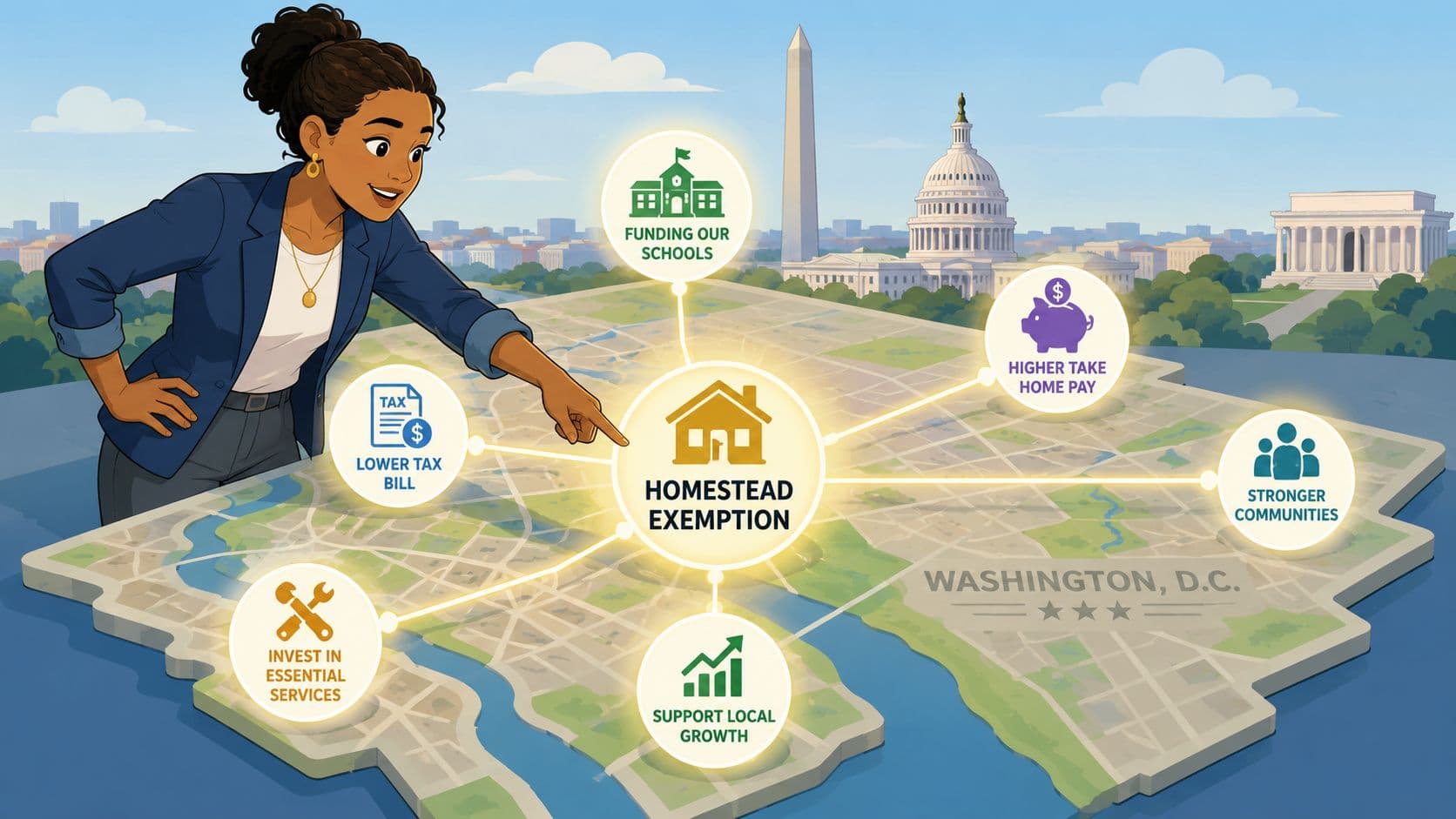
the District homestead deduction rules summarized here
The Real Lesson of the DC Homestead Exemption
The District of Columbia homestead exemption is neither a villain nor a cure. It is a useful illustration of how modest tax relief can be both sensible and insufficient.
It helps because it recognizes a real problem. Residents who live in their homes should not be pushed out simply because neighborhood land values rise faster than income. That is a sound reason for relief.
It falls short because DC's inequality runs much deeper than homeowner tax pressure. A city where the top 20% capture more than half of all income, and the bottom 20% receive just 1.7%, does not become fair through a broad homeowner deduction alone, as the DC Fiscal Policy Institute documents here.
So where does the exemption fit? It belongs as one small stabilizing measure inside a much larger agenda: more housing supply, better targeted tax relief, stronger renter protections, pathways to ownership for excluded households, and fiscal design that treats land value growth as a public issue, not merely a private windfall.
If Washington wants to remedy inequality, it has to do more than protect current owners. It has to widen access to the city itself.
For readers who want to keep exploring the larger policy framework around land, taxation, and fairness, you can contact Unitism®.
Unitism® helps governments, civic organizations, and policy leaders understand how land, taxation, and public finance fit together. If you want to explore fairer tax design, land-value reform, or clearer public education around housing costs, visit Unitism®.