Master ecosystem service valuation. Explore key methods, policy & finance applications, and capture nature's value for revenue in our guide.
June 27, 2026
Ecosystem Service Valuation: Unlock Nature's Economic Power
Master ecosystem service valuation. Explore key methods, policy & finance applications, and capture nature's value for revenue in our guide.

A finance ministry can ignore nature in its fiscal models, but it can't escape the cost of doing so. A landmark study put the total annual economic value of the world's ecosystems at approximately US $33 trillion in monetary terms that can be compared directly with policy and investment choices.1 That figure changes the frame. Nature isn't a side issue for environment departments. It's part of the productive base of the economy.
That's why ecosystem service valuation matters. It gives governments a way to see benefits that budgets often treat as free, even when public welfare, land prices, health outcomes, and infrastructure risks clearly depend on them. Clean water, flood buffering, cooling, recreation, carbon storage, and cultural significance all affect real economic decisions, whether or not they appear on a balance sheet.
The practical question isn't whether nature has value. It does. The policy question is how to identify that value, measure it credibly, and then convert it into better planning, better taxation, and more stable public revenue.
Table of Contents
- Why Placing a Value on Nature Matters
- The Four Pillars of Nature's Value
- A Toolkit for Valuing Ecosystem Services
- From Theory to Practice A Valuation Workflow
- The Price of Everything Strengths and Criticisms
- Capturing Nature's Value for Public Good
- Your Implementation Checklist
- Frequently Asked Questions
Why Placing a Value on Nature Matters
When governments leave ecosystem services unpriced, they don't create neutrality. They create a hidden subsidy for depletion. Developers, landholders, and public agencies then make decisions with incomplete cost signals, and the treasury absorbs the consequences later through higher infrastructure spending, disaster response, health burdens, or forgone revenue.
The purpose of ecosystem service valuation isn't to reduce nature to a commodity. It's to express nature's contribution in a language that budget officers, tax officials, and infrastructure planners can use. Monetary valuation helps ministries compare ecological gains and losses against capital projects, land-use changes, and tax reforms on the same decision table.
That matters because fiscal systems already price many things badly. Labor is taxed. Investment is taxed. Property transactions are taxed. Meanwhile, gains tied to location, ecological quality, and public infrastructure often flow into land values without systematic public capture.
Practical rule: If a public decision changes the flow of benefits from land, water, or ecosystems, the ministry should treat that change as economically material, even if the market hasn't priced it explicitly.
A stronger public finance approach starts by asking three questions:
- What service is being produced by nature: Is the asset supplying water, reducing flood risk, supporting food production, improving air quality, or creating recreational value?
- Who benefits and where: Are gains concentrated in nearby land values, in a regulated industry, in households, or across the whole jurisdiction?
- Can the resulting value be captured: Can the state reflect that value in land charges, resource rents, concession terms, or planning contributions?
Those questions shift valuation from academic reporting to fiscal design. Once nature's contribution is made visible, ministers can stop treating ecological quality as an external concern and start treating it as part of the revenue base, the cost base, and the national balance sheet of productive assets.
The Four Pillars of Nature's Value
A classification problem sits at the center of many bad environmental decisions. Officials often treat "nature" as a single asset with a single benefit stream, then struggle to compare it with roads, housing, drainage systems, or tax changes. Treasury work gets sharper once those benefits are separated into four economic channels, each with a different route into prices, public costs, and the tax base.
A wetland makes the categories visible
Take a coastal wetland.
It can supply fish, reeds, or freshwater inputs. Those are provisioning services. They resemble conventional outputs, so they are usually the easiest to value and the easiest to connect to licenses, user charges, or resource rents.
The same wetland can reduce storm surge damage, store carbon, filter pollutants, and moderate water flows. Those are regulating services. In fiscal terms, they often appear as avoided capital expenditure, lower insurance losses, reduced disaster recovery costs, or higher site values in protected areas.
A third category is cultural services. Recreation, tourism, education, spiritual meaning, and the character of a place sit here. These benefits are harder to price with confidence, but they often show up indirectly in visitor spending, amenity premiums, and political resistance to degradation.
Then come supporting services, such as nutrient cycling, soil formation, and habitat functions that maintain ecological productivity over time. These services rarely map cleanly onto a fee or market price. They matter because they sustain the other three categories and because their deterioration can lower the long-run productivity of land that governments tax, regulate, and service.
A finance minister does not need every ecological process converted into a tax line. The minister needs to know which benefits can support charges or rents now, which benefits should be capitalized into land values, and which benefits justify protection because markets and fiscal accounts miss them.
Why this classification matters for treasury work
The four-part structure reduces two common policy errors.
The first is double counting. If a ministry values water filtration, higher fish stocks, and downstream land price gains without checking the causal links, it can count the same ecological function several times. Supporting services are the main risk here. They often sit upstream of provisioning or regulating benefits, so they should usually be treated as enabling functions rather than added on top as separate monetary totals.
The second is instrument mismatch. Provisioning services may support concession design, royalties, or extraction charges. Regulating services often justify resilience spending, stormwater levies, or land-value capture around protected corridors. Cultural services may fit planning gains, tourism charges, or conservation easements better than a standard user fee. A government that forces all four pillars into one valuation model usually gets weak numbers and weaker policy.
Valuation becomes operational. A ministry can then use a natural asset value mapping tool to locate which benefits are site-specific, who receives them, and whether they are likely to appear in rents, property prices, avoided public costs, or broad social welfare.
The evidence base is now large enough to support this differentiated approach. The earlier global update of the Ecosystem Services Valuation Database reported 4,042 distinct value estimates from 693 peer-reviewed studies in the ESVD global update report.2 That same report found "Opportunities for recreation & tourism" accounted for 850 recorded value estimates, about 21% of the dataset, and Market Prices was the most frequently used valuation method with 941 estimates, almost 25% of recorded values in the ESVD global update report.2
That distribution has a policy implication. Analysts have spent more time pricing services that are visible in markets or politically salient to households, especially recreation. Governments should read that pattern as a warning, not as a hierarchy of importance. The easiest services to price are not always the services that matter most for fiscal stability, land productivity, or infrastructure planning.
For public finance, the practical conclusion is straightforward. Use the four pillars to sort benefits before assigning methods, agencies, and instruments. Then ask a harder question than standard valuation exercises usually ask. Which parts of nature's value should be protected from loss, and which parts should be captured through land and resource policy so the gains fund public services and reduce pressure to tax work and investment?
A Toolkit for Valuing Ecosystem Services
Different valuation methods exist because ecosystem services generate value in different ways. Some produce marketable outputs. Some alter property prices. Some save governments from replacement costs. Some matter because citizens care about them even when there is no market transaction at all.
Different methods answer different policy questions
Market-based methods work best when ecosystems generate goods already traded in markets, such as timber, fish, or water inputs. The logic is straightforward. Analysts use observed prices and quantities to estimate value. More advanced market-based work can go further. A valuation white paper explains that these methods can reverse-engineer demand functions through regression, incorporating factors such as location and environmental quality to estimate consumer and producer surplus. It also notes that when a full demand curve can't be estimated, analysts often approximate value by multiplying market price by quantity, though that can understate the true value in the Moore Foundation seminar paper on ecosystem valuation.3
Revealed preference methods infer value from actual behavior in related markets. Hedonic pricing examines how environmental quality is capitalized into property values. Travel cost methods infer recreational value from what visitors spend to reach a site. These methods are especially useful when a ministry wants to know whether parks, coasts, urban trees, or wetlands are already affecting site values and therefore could justify a land-based public charge.
Stated preference methods ask people directly what they would be willing to pay to secure an environmental benefit or avoid a loss. Contingent valuation and choice experiments are the usual examples. They're often used when no behavior-based market signal exists, but there is a policy question that still requires a public value judgment.
Cost-based methods estimate value through avoided damage, replacement cost, or restoration cost. If a wetland reduces flood damage or filters water that would otherwise require treatment, these methods estimate the economic significance of that function through the cost of replacing it with built infrastructure or paying for its loss.
Benefit transfer applies estimates from existing studies to a new location, adjusting carefully for context where possible. It is less precise than a bespoke valuation, but it can be useful for early screening, budget prioritization, and jurisdictions with limited analytical capacity.
For officials trying to structure a first-pass assessment, a practical starting point is a land and value mapping tool that helps identify where location, public investment, and ecological quality are likely shaping site value.
Comparison of ecosystem service valuation methods
| Method | Core Principle | Example Application | Key Challenge |
|---|---|---|---|
| Market Price Method | Uses observed prices for ecosystem-derived goods | Valuing fish harvests or water provision sold in markets | Misses non-market benefits |
| Productivity Method | Measures how ecosystem services affect production output | Estimating how pollination affects crop yields | Requires clear ecological-production link |
| Hedonic Pricing Method | Infers value from prices of related market goods | Measuring how nearby green space affects property values | Needs strong data and careful model design |
| Travel Cost Method | Uses visitor spending and travel effort as a proxy for recreational value | Valuing access to parks, coasts, or reserves | Captures use value better than non-use value |
| Contingent Valuation Method | Uses surveys to estimate willingness to pay or accept | Estimating value of river restoration or habitat protection | Sensitive to survey design and framing |
Choose the method by policy use, not by technical prestige. A rough estimate that supports a land-use or tax decision can be more useful than a perfect model that arrives too late.
For finance ministries, the key distinction is this: some methods identify welfare value, while others reveal where value is being capitalized into land, output, or avoided public cost. That second category matters most for revenue design. If ecosystem quality raises site rents or reduces public expenditure, those effects can inform land-value capture and budget reform.
From Theory to Practice A Valuation Workflow
A valuation exercise earns its keep only when it changes a budget, a tax base, a land-use rule, or an investment sequence. Starting with available datasets instead of a live policy decision usually produces a report that is methodologically respectable and fiscally irrelevant.
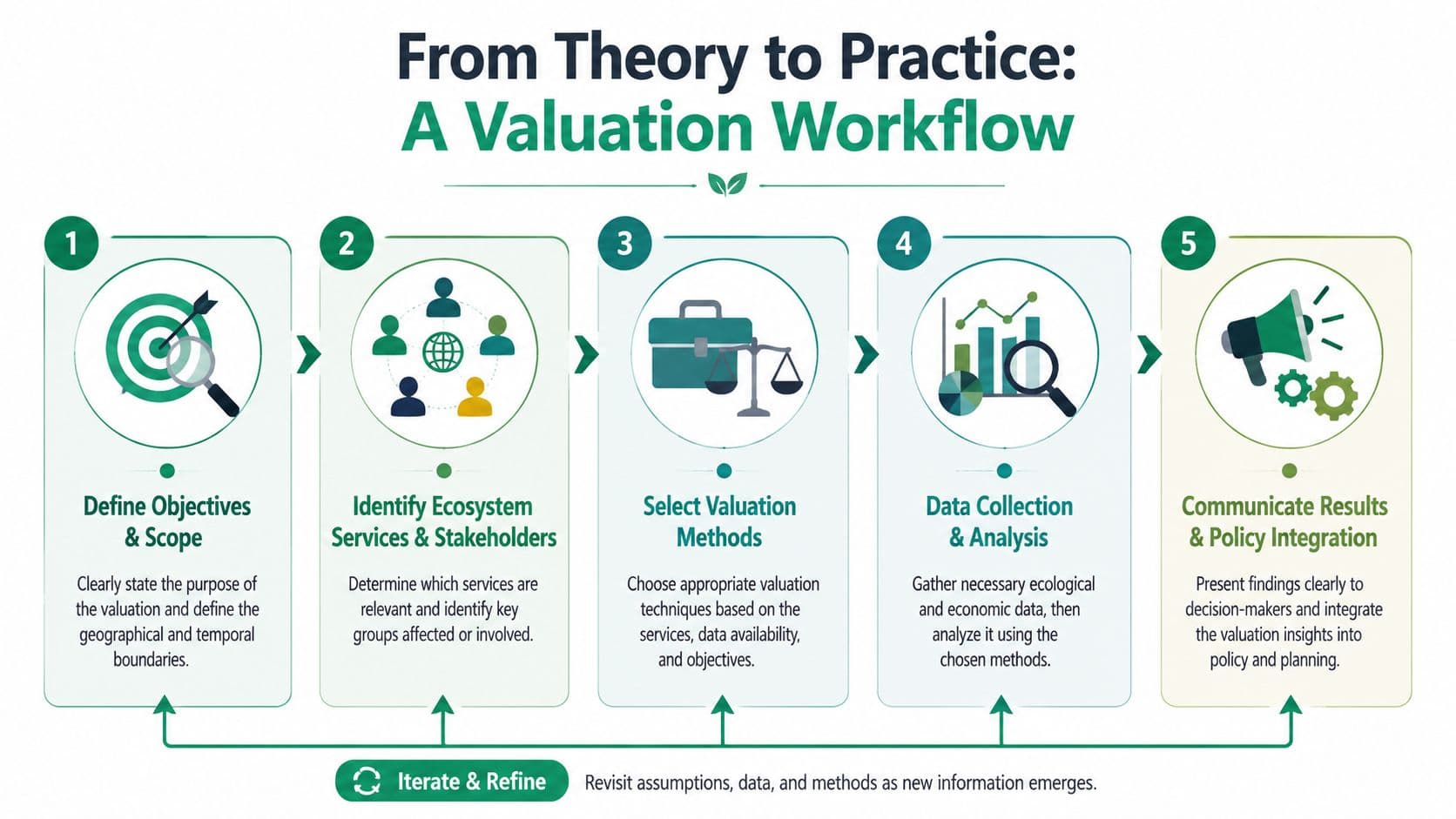
Start with the decision not the dataset
A useful workflow begins by specifying the fiscal or regulatory choice under review. A wetland conversion decision, an urban greening program, a watershed protection plan, and a reform to recurrent land taxation all require different boundaries, time horizons, and measures of value. The policy question sets the unit of analysis.
Then narrow the valuation to the ecosystem services that can materially affect that decision. Ministries do not need a full inventory of nature's benefits every time they act. They need to know which services change cash flow, land value, production risk, infrastructure cost, or public expenditure.
Method selection follows from that objective.
- Define the objective and boundary. Specify the decision, the geography, the time frame, and the agencies that can act on the result.
- Identify the services that matter to that decision. Focus on the services likely to shift welfare, site rents, avoided costs, or output in ways government can observe.
- Choose methods that fit the institutional use. Treasury departments estimating site uplift may prefer revealed-preference evidence. Planning agencies comparing green and gray infrastructure may use avoided-cost or replacement-cost estimates. Disputes involving cultural value or distributional conflict may require deliberative social methods alongside monetary analysis.
Match ambition to data and institutions
The quality of a valuation depends less on technical sophistication than on fit. Jurisdictions with weak property transaction data should be cautious about hedonic models. Places with strong hydrological monitoring but limited survey capacity may get more reliable results from biophysical measurement linked to avoided treatment costs or flood-control savings. Where the political problem is distribution, not just efficiency, stakeholder deliberation can matter as much as a price estimate.
Administrative capacity matters as much as analytical capacity. Before any ministry links ecosystem value to taxation, development charges, or public investment recovery, it needs parcel-level records, clear tenure information, and a way to observe how ecological quality varies across locations. A method for calculating land value at parcel level helps convert ecological effects into a tax base, an assessment rule, or a betterment charge rather than leaving them as abstract welfare gains.
The final steps are operational.
- Collect and analyze data: Combine ecological evidence with economic and administrative records that match the policy purpose.
- Test sensitivity: Show how results change under different assumptions, discount rates, and spatial boundaries.
- Translate findings into instruments: Present outputs in forms that revenue, planning, and budget officials can use, such as maps of value uplift, ranges for site-based charges, or estimates of avoided capital spending.
That last step is where many studies fail. If valuation does not identify who benefits, where value is capitalized, and which instrument can capture part of that gain for public use, it remains descriptive. The stronger workflow treats ecosystem service valuation as an input to fiscal design. It can support land-value capture, betterment levies, differential assessments, or infrastructure financing that reduces pressure to tax labor and enterprise more heavily.
The Price of Everything Strengths and Criticisms
Ecosystem service valuation is powerful because it forces environmental effects into the same arena as roads, tax expenditures, subsidies, and capital projects. That's also why it attracts criticism. The closer valuation gets to real policy power, the more its ethical and technical limits matter.
What valuation does well
Monetary estimates can improve public decisions in at least three ways.
- They reveal hidden dependencies: Ministries can compare ecosystem loss against infrastructure costs, budget risks, or forgone output.
- They improve prioritization: Agencies can identify which assets justify protection, restoration, or different land-use treatment.
- They support fiscal realism: If ecological quality is raising site value or lowering public cost, government has a stronger case for capturing part of that value rather than taxing labor more heavily.
Valuation also creates a common language across departments that don't normally cooperate well. Treasury, planning, water authorities, and environment ministries often use different frameworks. Monetary estimates won't solve that on their own, but they can reduce institutional fragmentation.
Where monetization reaches its limit
The hardest issue concerns cultural ecosystem services. A persistent debate exists because these services often have "no obvious material benefits," which makes standard monetary valuation controversial. The same literature points to a gap in many guides: they don't give enough weight to deliberative and social valuation methods such as citizens' juries and participatory GIS, even though those methods are better suited to non-material values in the study on cultural ecosystem services valuation.4
That criticism is valid. Sacred areas, identity-bearing places, and community relationships to land can't always be translated into a clean willingness-to-pay estimate without distorting the issue itself.
Some values should influence policy even when they resist pricing. The failure is not the absence of a market number. The failure is excluding those values from the decision.
There is also a political economy problem. Once governments produce a valuation, analysts may treat the number as the answer rather than as one input into judgment. That can create false confidence, especially when the estimate is built on weak transfer assumptions or sparse local data.
For ministries concerned about rent extraction, another caution matters. If governments don't distinguish productive returns from unearned gains tied to control of land and location, they can end up protecting private windfalls under the banner of environmental value. That's one reason any valuation linked to taxation should be paired with a clear understanding of rent-seeking in economics. Otherwise, the state may document nature's value but still leave most of the uplift in private hands.
Capturing Nature's Value for Public Good
The largest missed opportunity in ecosystem service valuation is fiscal. Governments often stop after proving that nature is valuable. They rarely ask the next question: where does that value show up in rents, concessions, land prices, and public revenue systems?
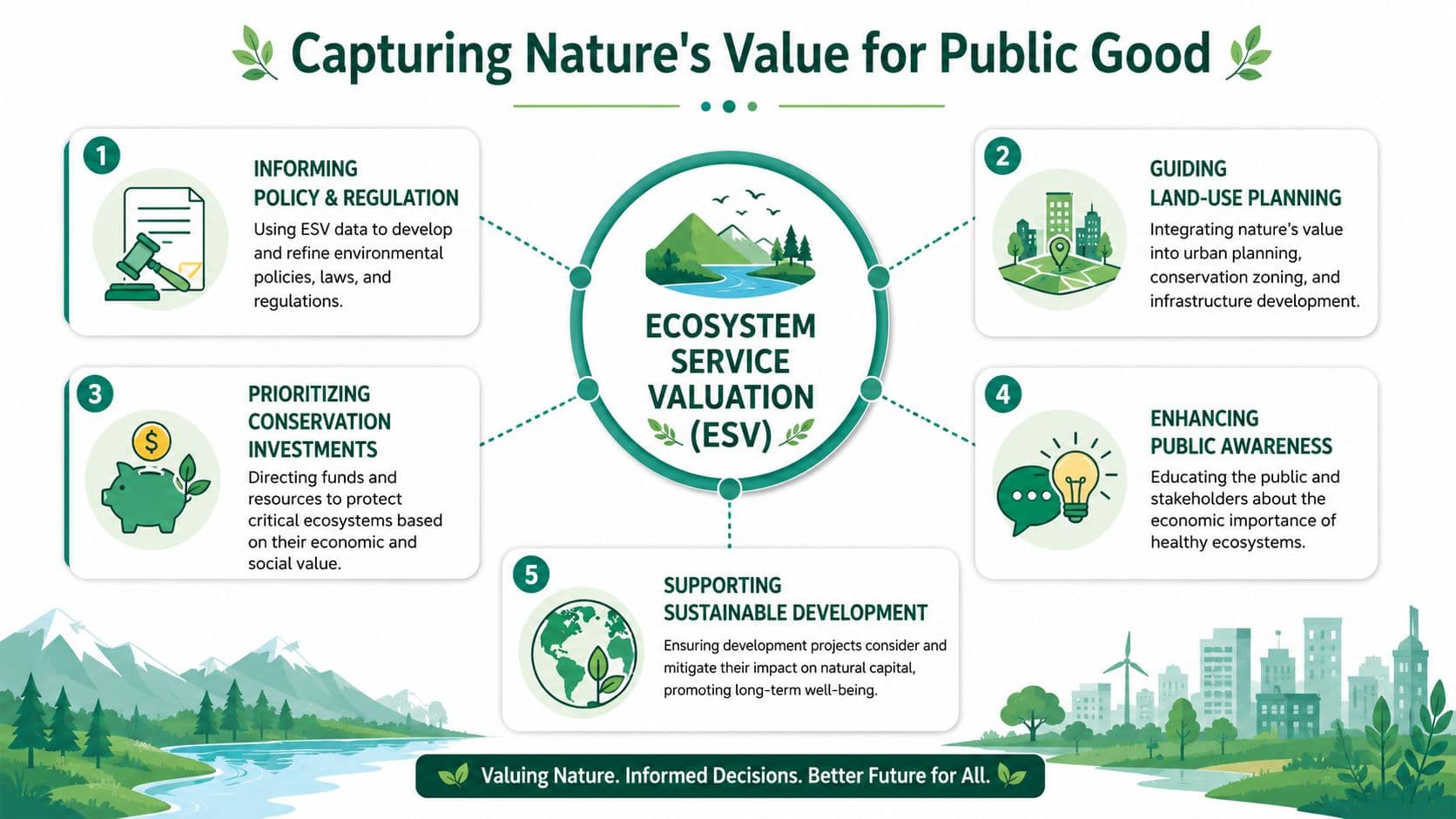
Valuation should feed the tax base
That omission is costly. Research drawing on global estimates reported that the average annual value of ecosystem services ranges from $490 per hectare for open oceans to $350,000 per hectare for coral reefs, yet policy discussion rarely connects such figures to land-value capture instruments that could stabilize revenue and reduce speculation in the De Groot et al. global estimates summary.5
For a finance ministry, the key insight is this: ecosystem value is not only a welfare concept. It often enters the economy as site rental value.
If a protected coastline improves nearby development value, part of that uplift is location rent. If watershed protection lowers treatment costs, that creates fiscal space. If access to high-amenity natural areas increases tourism-linked land demand, those gains are often capitalized into land prices. In each case, the state can choose whether to let private holders absorb the gain or whether to recover part of it for the public that sustains the asset.
What a finance ministry can actually do
A practical agenda would include several instruments, each suited to a different channel of value capture.
- Site-value taxation: Where ecosystem quality raises locational advantage, annual charges on site value can recover part of that benefit without penalizing construction or productive improvement.
- Resource dividends and royalties: Where ecosystems support extractive use or exclusive access, concession design can reflect the scarcity and public ownership dimension of the asset.
- Betterment capture around public ecological investment: When restoration, parks, flood defenses, or waterfront improvements raise surrounding site values, governments can recover a share through land-based charges.
- Planning and zoning conditions: Where land-use permissions convert ecological amenities into private development gains, valuation can inform contribution schedules or offset structures.
- Trust and stewardship arrangements: In areas with community ownership or conservation objectives, institutions such as a land trust model can help separate stewardship from speculative gain.
This approach does more than raise revenue. It can improve tax efficiency. Taxes on wages, transactions, and productive capital often discourage work, exchange, and investment. Charges on land rent and nature-based scarcity are harder to avoid and less distortive when designed well.
It also improves planning discipline. Once officials know that ecosystem quality feeds site rents, they can stop treating environmental protection and fiscal reform as separate agendas. The same wetland, forest edge, urban park network, or reef system can support both ecological resilience and a stronger revenue base, provided government captures the value where it appears.
The strategic shift is simple. Don't use ecosystem service valuation only to justify spending. Use it to redesign who receives nature's rents.
That's the move most standard explainers miss. Valuation is not the endpoint. It is the measurement layer for a different fiscal architecture.
Your Implementation Checklist
Most governments don't need a grand national reform on day one. They need a disciplined pilot tied to one real fiscal or planning decision, then a pathway to scale.
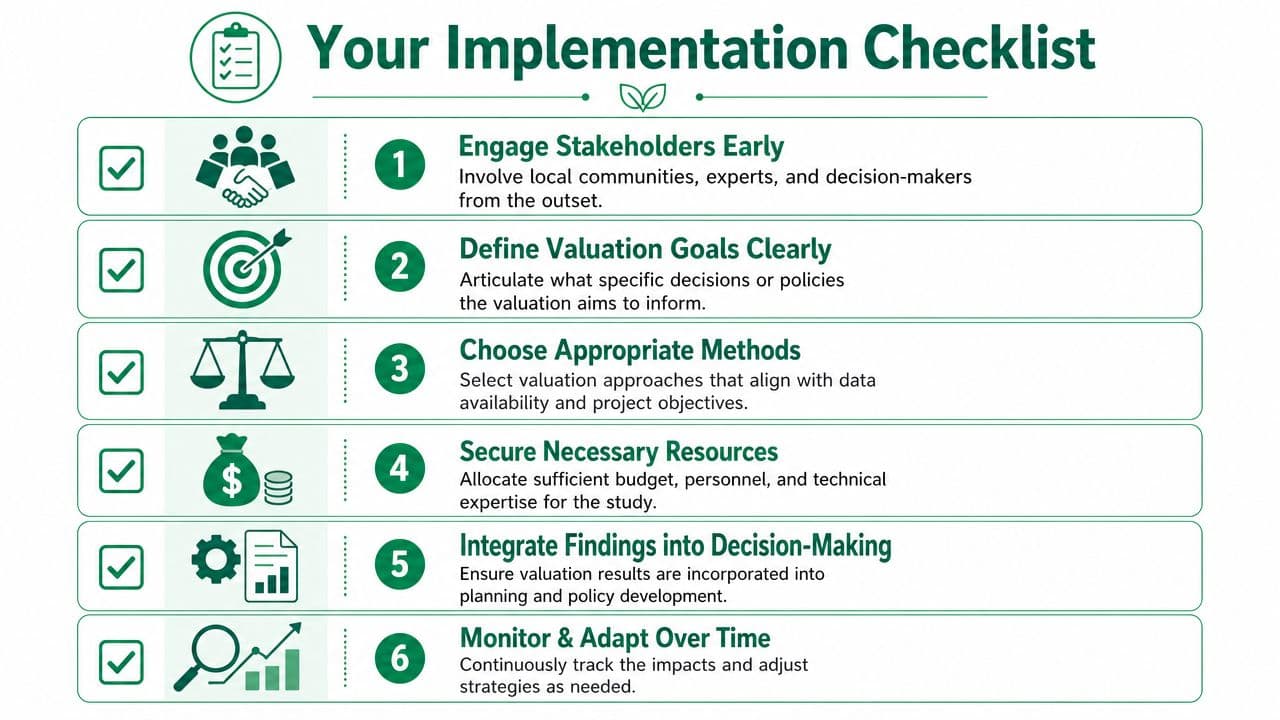
Use this checklist to start:
- Engage affected parties early: Bring in treasury, planning, land administration, environment agencies, and local stakeholders before methods are chosen.
- Define one decision clearly: Tie the valuation to a concrete issue such as flood mitigation, park investment, watershed protection, concession design, or land tax reform.
- Pick methods that fit capacity: Use the least complex method that can still answer the policy question credibly.
- Map where value lands: Identify whether benefits appear as avoided cost, output gains, amenity premiums, or site rent.
- Build the fiscal bridge: Decide in advance how results could inform charges, concessions, land-value capture, or spending priorities.
- Monitor and revise: Treat the first round as an administrative learning exercise, not as a final truth.
For teams moving from valuation into public finance, a concise primer on land value capture explained helps connect measurement to actual revenue instruments.
Unitism® helps governments, cities, and policy teams turn land and nature values into workable fiscal reform. If you're exploring ecosystem service valuation not as an academic exercise but as a route to stronger public revenue, lower taxes on work and investment, and better stewardship of natural assets, Unitism® offers research, valuation frameworks, policy design, and implementation support grounded in land economics.
Frequently Asked Questions
What is ecosystem service valuation and why does it matter for public finance?
Ecosystem service valuation is the process of estimating the economic worth of benefits that nature provides, such as clean water, flood protection, carbon storage, and recreational amenity. For public finance, it matters because these benefits routinely affect land values, infrastructure costs, and budget risks without appearing on any balance sheet. When governments leave those benefits unpriced, they create hidden subsidies for depletion and miss legitimate opportunities to capture value through land-based charges, resource rents, and planning contributions. Bringing ecosystem services into fiscal analysis helps ministries make better investment decisions, design more efficient tax instruments, and build a revenue base that doesn't rely so heavily on taxing labor and productive enterprise.
Which ecosystem service valuation method should a government use first?
The right method depends on the policy question being asked, not on technical prestige or methodological fashion. If a ministry wants to know whether a park or wetland is already raising nearby property values, hedonic pricing or a revealed-preference approach makes sense. If the question is how much a wetland saves in avoided flood-control spending, a cost-based method is more direct. For jurisdictions with limited data or analytical capacity, benefit transfer from comparable peer-reviewed studies can provide a credible first-pass estimate. The practical rule is to choose the simplest method that can still answer the decision at hand, then build analytical sophistication as institutional capacity grows.
How can ecosystem service valuation be connected to actual tax or revenue instruments?
The connection runs through land value. When ecosystem quality improves a location, whether through cleaner water, reduced flood risk, or better access to green space, that improvement tends to be capitalized into site rents and property prices. Governments can recover a share of that uplift through site-value taxation, betterment levies, development contributions, or resource royalties tied to ecological scarcity. The key step most valuation exercises skip is tracing where the benefit lands economically and identifying which fiscal instrument can reach it. Treating ecosystem service valuation as an input to revenue design rather than a standalone welfare measure is what converts ecological evidence into workable public finance reform.