Explore habitat conservation plans (HCPs), legal frameworks & best practices. Integrate HCPs with land rights for sustainable development.
July 15, 2026
Mastering Habitat Conservation Plans
Explore habitat conservation plans (HCPs), legal frameworks & best practices. Integrate HCPs with land rights for sustainable development.
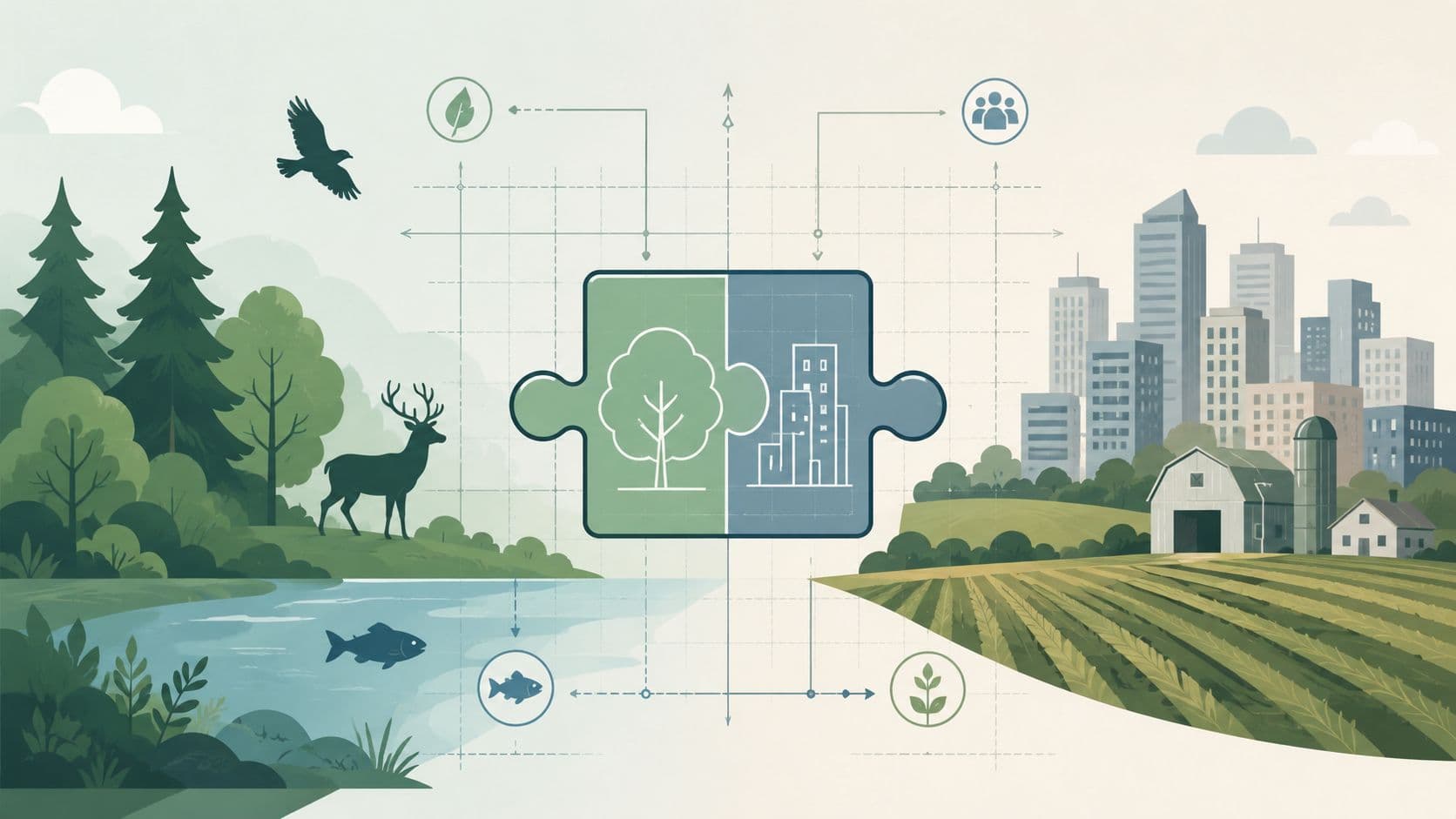
More than 17 million acres were covered by approved Habitat Conservation Plans by 2023, across over 1,000 plans nationwide, according to a comprehensive analysis of HCPs. That scale should change how finance ministries and city planning departments think about them. Habitat conservation plans are not a niche wildlife instrument. They are already a major land governance system operating at national scale.
Most public agencies still treat HCPs as an environmental compliance matter. That is too narrow. In practice, they sit at the intersection of permitting, infrastructure delivery, land markets, fiscal design, and long-horizon asset management. They decide where development can proceed, what mitigation must be funded, how land is mapped, and which obligations continue long after permits are issued.
That makes HCPs relevant far beyond environmental regulators. For planners, they shape urban expansion and infrastructure alignment. For treasury officials, they create enduring funding obligations and can either stabilize or distort land incentives. For land managers, they turn habitat protection into an operational program with mapped boundaries, monitoring duties, and enforceable implementation commitments. In some cases, they function much like a public interest covenant attached to development rights.
A more strategic approach is to connect HCPs with land policy itself, including instruments such as land trusts. But where governments need a scalable economic framework, land-use rights are often the stronger tool. They can guide development toward appropriate locations, restrict or price sensitive uses, and generate revenue streams that support conservation obligations over time.
Table of Contents
- Introduction Why Habitat Conservation Plans Matter
- Core Concepts and The Legal Framework of HCPs
- The HCP Development and Approval Process
- Designing Effective HCPs Best Practices
- HCPs in Action Case Studies and Emerging Trends
- Integrating HCPs with Land-Use Rights and Fiscal Reform
- Conclusion A New Framework for Conservation and Development
Introduction Why Habitat Conservation Plans Matter
The usual framing of habitat conservation plans is defensive. Developers need permits. Agencies need mitigation. Conservationists need habitat protection. That framing misses the larger point. HCPs are one of the country's most established mechanisms for organizing land use around ecological limits while still allowing lawful economic activity.
Their importance comes from their structure. An HCP doesn't merely prohibit harm. It converts ecological risk into a governed program of mapped land areas, funded actions, monitoring, and legal commitments. In budgetary terms, that means conservation isn't left to aspiration or goodwill. It becomes part of the operating logic of development itself.
For governments, that has two practical implications.
- Planning implication: HCPs can influence where growth occurs, where infrastructure corridors are viable, and where habitat continuity must be preserved.
- Fiscal implication: HCP obligations require durable financing, not one-time enthusiasm. If the revenue model is weak, the conservation promise is weak.
- Institutional implication: Environmental, planning, and finance teams can't work in separate silos if they want the permit system to produce stable land outcomes.
Practical rule: Treat an HCP as a land management contract with fiscal consequences, not as a permit attachment.
That perspective leads to a broader reform question. If a government already uses HCPs to condition development on conservation performance, what land policy should sit underneath that system? My view is clear. Prefer land-use rights over land-value taxes when designing the economic side of habitat governance. Land-use rights allow the state or public authority to separate ownership from permission to use, shape location-specific development incentives, and tie revenue directly to the privilege of occupying ecologically consequential land.
Core Concepts and The Legal Framework of HCPs
Section 10(a)(1)(B) of the Endangered Species Act allows a federal permit for incidental take, but only if the applicant submits a Habitat Conservation Plan that meets statutory standards. In practice, that turns species protection from a simple prohibition into a conditional land-use regime. The legal question is not only whether harm may occur. It is whether the proposed use of land can proceed under enforceable conservation terms.
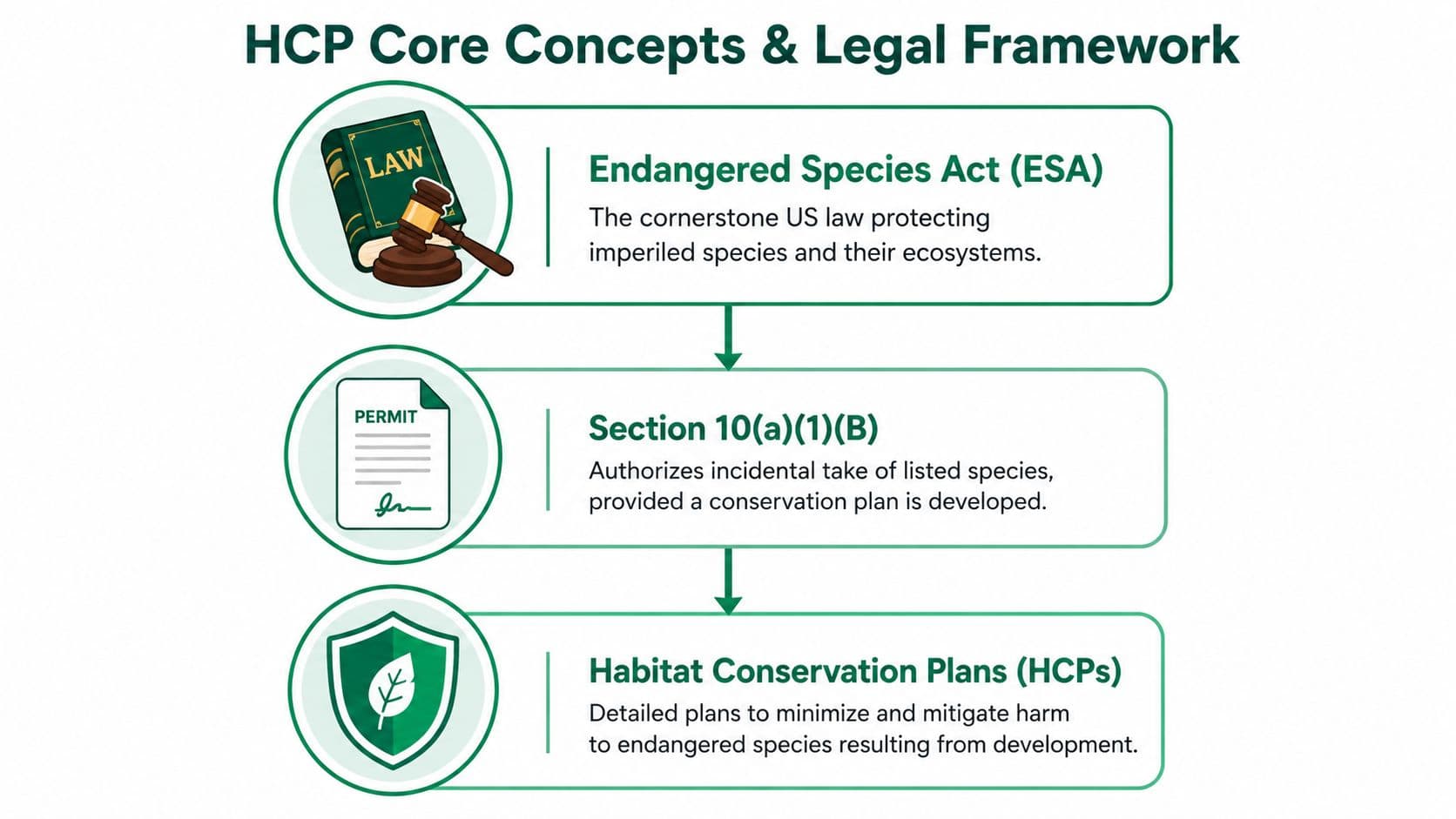
The legal bargain behind an HCP
An HCP sits inside a specific legal exchange. A developer, utility, landowner, or public works sponsor seeks permission to continue an otherwise lawful activity that may incidentally take a listed species. Federal law permits that outcome only if the applicant commits to minimizing and mitigating impacts and shows that those commitments can be carried out. The permit is therefore conditional, time-bound, and tied to performance.
For administrators outside wildlife agencies, incidental take is best understood as legally relevant side-effect harm. The project is not organized around harming a species, but activities such as grading, road construction, water diversion, vegetation clearance, or site conversion may still kill, injure, or disrupt protected wildlife. The HCP is the mechanism that converts that risk into a regulated set of duties.
Several concepts determine how costly and administratively demanding the plan will become:
| Term | Plain meaning | Why officials should care |
|---|---|---|
| Listed species | Species protected under the ESA | Their presence triggers federal permitting risk and can alter project feasibility |
| Incidental take | Unintentional harm linked to lawful activity | It determines whether the Section 10 permit pathway is required |
| Minimization and mitigation | Measures that reduce harm and offset remaining impacts | They create multi-year operational, land, and funding obligations |
| Monitoring | Tracking compliance and biological results | It determines whether agencies can verify performance and require corrections |
That structure has a direct governance consequence. HCPs regulate land through conditions attached to permission, not through ownership alone. This is why the concept of a land-use right matters. If the state treats development intensity and location as rights granted on stated terms, conservation obligations fit naturally into the economic architecture of planning. That is a better institutional match than relying mainly on land-value taxation, which raises revenue from landholding but does not by itself define the biological conditions under which development rights should be exercised.
The distinction matters for reform design. Land-value taxes can encourage efficient use of land in general, but HCP administration requires finer control. Agencies need to differentiate between parcels, corridors, habitat functions, seasonal constraints, and mitigation duties that vary by ecological impact. Land-use rights are more precise. They let governments price, limit, sequence, or withhold development permissions in ways that align conservation duties with location-specific land economics.
Who does what in the system
Institutional roles determine whether the legal design holds up under real development pressure. Applicants prepare the plan, assemble the science, and commit funding. Federal wildlife agencies decide whether statutory issuance criteria are satisfied. In marine and anadromous contexts, the National Marine Fisheries Service may lead or share responsibility. In many terrestrial and freshwater cases, the U.S. Fish and Wildlife Service is the principal federal reviewer.
Local governments are not secondary actors. Zoning decisions, infrastructure alignments, utility extensions, stormwater design, and growth phasing often determine whether avoidance and mitigation are affordable or politically feasible. A municipality that approves corridor choices before ecological constraints are integrated can make later HCP compliance more expensive for everyone.
Finance ministries, budget offices, and public authorities should read HCPs as long-duration liability documents.
- Applicants must identify impacts, propose minimization and mitigation measures, and show implementation capacity.
- Federal wildlife agencies test legal sufficiency, biological credibility, and the reliability of funding and monitoring commitments.
- Local governments and infrastructure authorities shape the land-use pattern that affects both habitat fragmentation and mitigation cost.
- Finance officials should assess whether conservation commitments have stable funding sources, reserve capacity, and enforcement mechanisms over the life of the permit.
A weak HCP usually reflects poor institutional alignment. The biology may be sound, yet the plan can still fail if land approvals, infrastructure sequencing, and long-term finance are organized on separate tracks.
The HCP Development and Approval Process
Permit review under the Endangered Species Act often turns on one question with fiscal consequences: can the applicant fund and carry out conservation duties for the full permit term? In practice, the HCP process works less like a routine filing and more like a long-horizon contract for land use, capital allocation, and ecological performance.
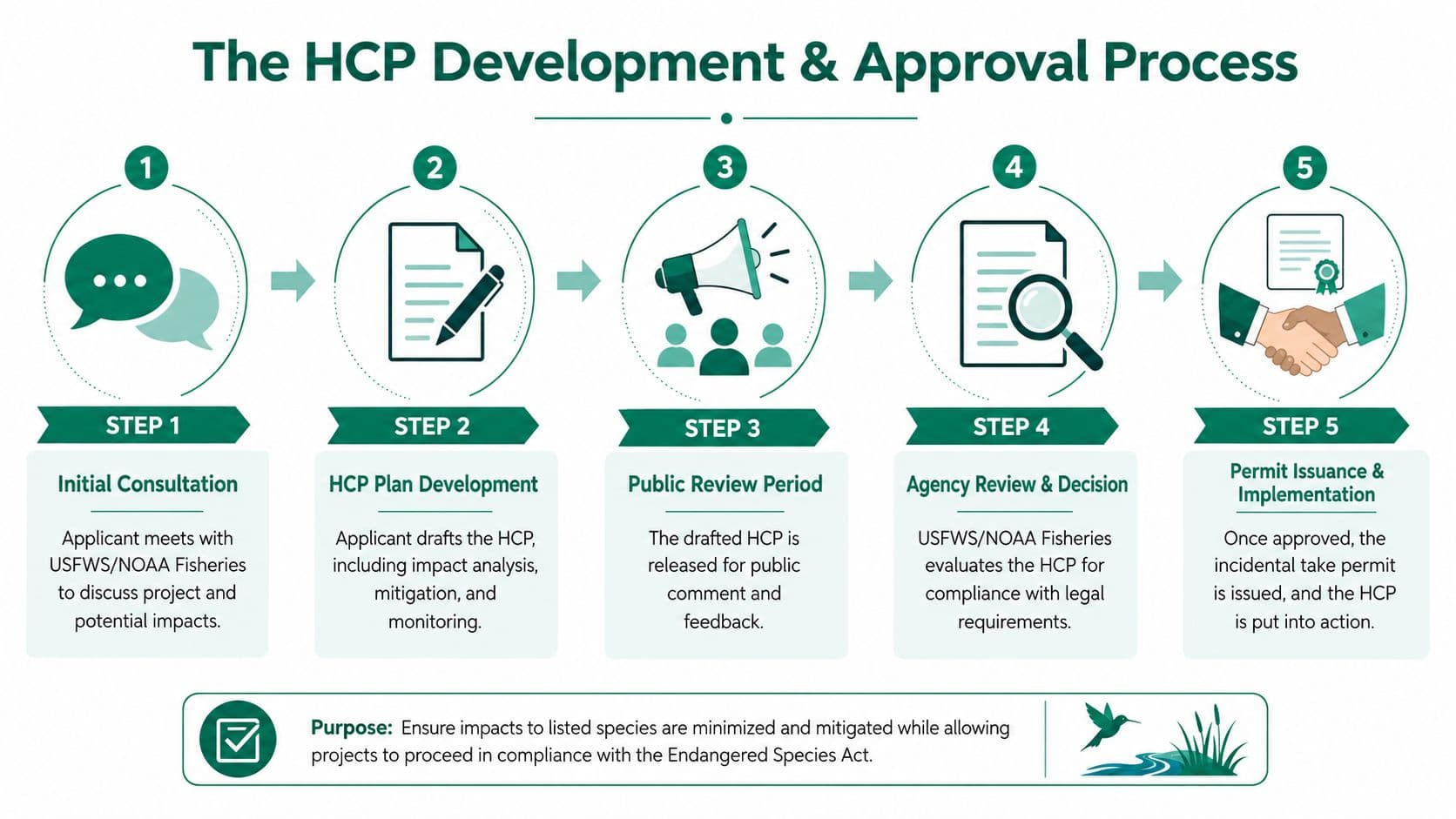
From early consultation to draft plan
Early consultation shapes the economics of the permit before it shapes the biology on paper. At that stage, an applicant can still alter site design, infrastructure alignments, access roads, construction timing, and project phasing. Those choices often determine whether conservation is absorbed as a manageable land-use constraint or carried later as a costly mitigation obligation.
The draft plan then has to convert those early choices into a document agencies can test. It must identify likely impacts, examine alternatives, specify minimization and mitigation measures, define monitoring, and show how implementation will be financed over time. Without that structure, the HCP remains a narrative of intent rather than an enforceable operating plan.
A practical sequence usually follows five decisions:
- Define the affected area and species exposure. Map where development pressure, listed species presence, and habitat function intersect.
- Reduce impacts at the project design stage. Modify layout, timing, construction methods, or operating conditions before residual impacts are calculated.
- Assign mitigation to specific land parcels or management actions. Agencies can review a commitment tied to place and duration. They struggle to review one tied only to future discretion.
- Set measurable monitoring and response rules. The plan should identify indicators, reporting intervals, responsible parties, and the actions triggered by poor results.
- Demonstrate durable financing. Conservation duties that outlast construction need funding sources that outlast construction as well.
Public review matters for more than procedural legitimacy. It exposes whether the HCP rests on assumptions that local planners, utilities, landowners, or nearby communities will not accept in practice. A mitigation strategy that works on a consultant map but conflicts with road expansions, drainage plans, or future growth areas is likely to be renegotiated later, usually at higher cost.
This is also the stage where the link to land policy becomes clearer. Jurisdictions that already use open space preservation strategies tied to growth management can lower HCP friction by identifying habitat corridors and conservation areas before site-level conflict intensifies. Under a Unitist approach, that advantage grows when governments rely on land-use rights, development permissions, and spatially specific obligations rather than broad land-value taxes. Rights-based tools let planners reserve, transfer, or condition development capacity with parcel-level precision. That is often better suited to habitat connectivity than tax instruments that change holding costs but do not by themselves determine where development goes.
Review, funding, and permit issuance
Formal review tests whether the plan can survive contact with administration, budgeting, and time. Agencies examine whether the biological analysis is credible, whether mitigation matches the stated impacts, whether monitoring can verify performance, and whether funding commitments are reliable enough to support the permit decision.
Funding deserves closer scrutiny than it usually receives. An HCP can create obligations that continue long after the initial project is completed. If land acquisition, habitat management, easements, restoration, stewardship, or reporting depend on future appropriations or unstable revenues, the public sector may face indirect exposure even when the permittee is private.
Budget discipline means matching the legal life of the obligation with a financing structure of similar duration.
That point has implications beyond compliance. Where governments use land-use rights well, they can reduce the cash burden of conservation by directing intensity away from sensitive land and toward areas already suited for growth. That lowers the amount of after-the-fact mitigation a project must buy. It also avoids one weakness of land-value taxation in conservation settings. A tax can encourage redevelopment in general, but it does not by itself secure habitat buffers, corridor continuity, or phased build-out conditions with the precision that HCP implementation often requires.
Permit issuance therefore marks the start of a management period, not the end of review. After approval, agencies and permittees need reporting systems, field verification, maintenance schedules, and decision rules for corrective action if ecological performance falls short. For planning departments and finance offices, the relevant question is straightforward: not whether the permit was issued, but whether the land pattern, funding stream, and enforcement structure can hold for the duration of the commitment.
Designing Effective HCPs Best Practices
The difference between a minimally compliant HCP and an effective one is rarely rhetorical. It is technical. Strong plans specify where actions occur, when they occur, how they are maintained, what risks could undermine them, and how agencies will know whether the biological logic is holding up.
One of the clearest indicators of seriousness is operational detail. The U.S. Fish & Wildlife Service spatial data specifications for Habitat Conservation Plans state that a well-developed HCP must include a detailed Implementation Agreement covering the operational and maintenance plan for each conservation practice, including the exact amount, location, and timing of implementation, and it must include a Resource Assessment with habitat assessments and risk analyses. That requirement should matter to finance officers as much as to ecologists. It tells you whether the plan can be administered.
What separates a durable plan from a weak one
A durable plan usually has four features.
- Spatial precision: Conservation areas and mitigation sites are mapped clearly. The same technical guidance requires conservation boundaries to be submitted as multi-polygon feature types. That sounds narrow, but it has major consequences. If geography is fuzzy, enforcement is fuzzy.
- Operational specificity: An implementation agreement should tell field staff exactly what practice occurs on which field or parcel, in what year, and under what maintenance standard.
- Biological logic tied to land actions: The resource assessment connects physical management choices to expected habitat outcomes, instead of treating restoration language as a generic promise.
- Contingency planning: The plan addresses unforeseen or extraordinary circumstances rather than pretending the physical environment will behave exactly as expected.
Weak plans fail in the opposite order. They rely on broad mitigation language, unclear site boundaries, thin maintenance obligations, and a monitoring regime that measures activity rather than results.
Operational disciplines that finance officials should demand
Planning departments often focus on entitlement risk. Ecology teams focus on species outcomes. Treasury teams should focus on delivery risk. These are the questions worth asking before supporting an HCP-backed development path:
| Question | Why it matters |
|---|---|
| Is the conservation geography exact enough to be auditable? | If not, disputes and compliance drift are likely |
| Are O&M duties assigned to named actors? | Undefined responsibility becomes deferred maintenance |
| Does the plan include risk analysis for habitat areas? | Without it, management may fail under normal variability |
| Can monitoring trigger management changes? | Otherwise the program collects data but doesn't learn |
Good monitoring doesn't just prove compliance. It tells managers whether the land is actually moving toward the intended ecological state.
There's also a valuation question. Public agencies routinely underestimate the economic importance of ecosystem functions until conflict arises over drainage, water supply, erosion, species movement, or site restrictions. A better planning culture treats those functions as part of the land asset itself, which aligns with broader thinking on ecosystem service valuation. You don't need to force every ecological value into a narrow pricing exercise. But you do need to acknowledge that habitat quality and connectivity affect both public costs and private development feasibility.
HCPs in Action Case Studies and Emerging Trends
The most useful way to understand habitat conservation plans in practice is to compare two planning logics. One is parcel-by-parcel and reactive. The other is regional and anticipatory. The legal instrument may look similar on paper, but the land outcomes can differ sharply.
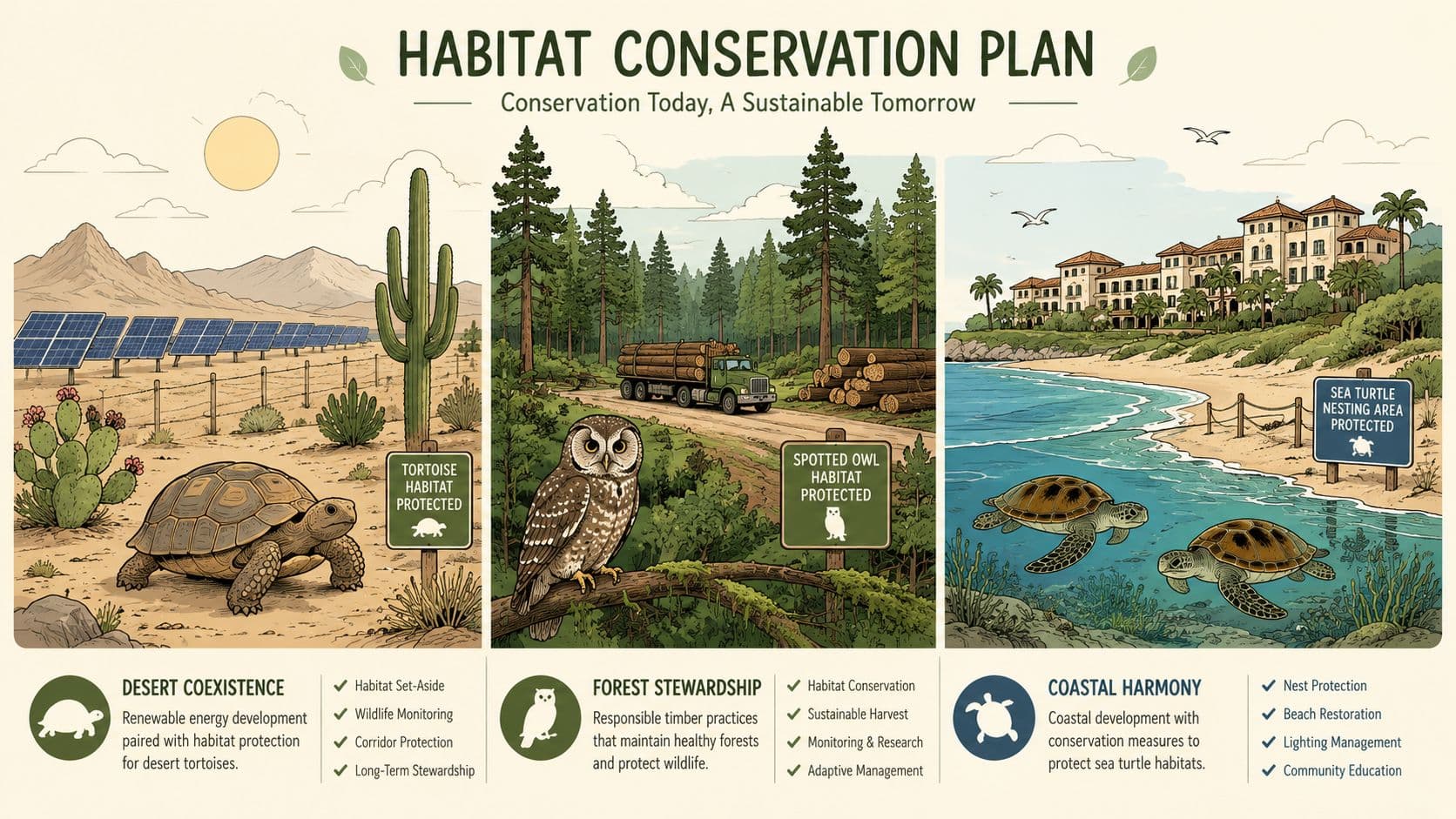
Two contrasting planning models
A single-project HCP is often driven by a discrete permit need. A commercial development, utility upgrade, or site-specific infrastructure project identifies expected impacts, proposes mitigation, and negotiates terms around that one footprint. This can work when impacts are localized and habitat systems are not heavily fragmented.
A regional HCP starts from the broader context rather than the parcel. It tries to organize many future actions within a broader conservation framework, reducing repeated conflict over each individual site. For planners, the attraction is obvious. Regional plans can align infrastructure, growth areas, and habitat corridors in one map instead of resolving the same tension repeatedly through ad hoc bargaining.
That difference mirrors a wider planning lesson familiar from new urbanism examples. When land use is planned as a connected system, not as a series of isolated decisions, public infrastructure and environmental performance usually become easier to coordinate.
What the regional shift means for public decision-makers
The federal guidance gap is important here. The draft HCP handbook notes that broad-scale Regional HCPs are increasingly adopted for infrastructure projects, but there is still a lack of public data comparing their economic efficiency with parcel-level HCPs. That absence matters because ministries and city planners need more than ecological theory. They need to know whether regional planning reduces administrative burden, stabilizes land expectations, and improves conservation performance relative to fragmented permitting.
This creates a paradox. Regional HCPs may be the more rational planning instrument, especially where edge habitat fragmentation and watershed connectivity matter, but the public evidence base on cost efficiency remains thin.
For now, decision-makers should proceed on the basis of governance logic rather than false precision:
- Regional HCPs are usually better suited to corridor infrastructure and metro-scale growth management.
- Parcel-level HCPs remain useful for isolated projects with limited external effects.
- The larger the connectivity problem, the weaker the case for site-by-site mitigation.
The absence of public cost comparisons doesn't mean regional planning lacks value. It means governments should build better reporting into the next generation of plans.
Integrating HCPs with Land-Use Rights and Fiscal Reform
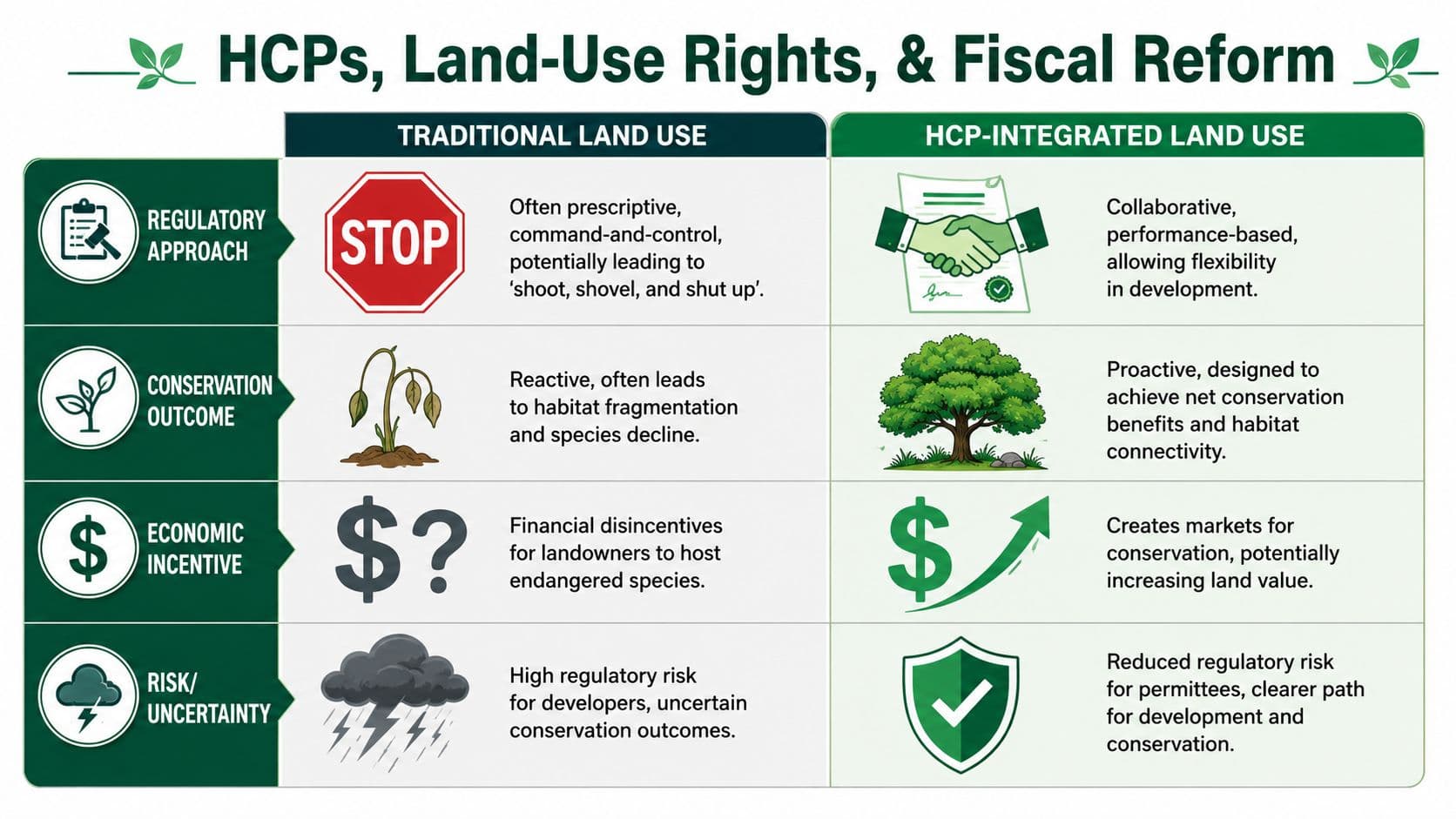
Habitat conservation plans become more than a compliance system. If governments pair them with the right land policy instrument, they can shape development patterns before conflict appears, fund long-run conservation obligations more credibly, and reduce the adversarial character of environmental permitting.
The instrument I would favor is land-use rights, not land-value taxes.
Why land-use rights outperform land-value taxes in this context
According to a UN-Habitat review of land and property tax systems, land-use rights grant the authority to occupy and use state-owned land for fixed terms while the state retains ownership, and that separation enables the state to capture land rent. The same source notes that this arrangement is often more flexible and politically viable than direct land-value taxation.
That distinction matters for habitat governance.
A land-value tax is a general fiscal instrument. It can improve efficiency and discourage speculative holding, but it doesn't naturally express ecological conditions with the same precision. It taxes the value of land. It doesn't intrinsically define differentiated permissions to use land according to habitat sensitivity, restoration obligation, corridor logic, or permit-linked restrictions.
Land-use rights can do all of that.
They allow governments to separate three questions that are often muddled together:
| Question | Land-value tax | Land-use rights |
|---|---|---|
| Who owns the land? | Not necessarily changed | Can remain separate from use authority |
| Who may use the land, and for what? | Indirectly influenced | Directly specified |
| How is public value captured? | Through taxation | Through priced rights, conditions, or lease structures |
In contexts where ownership is politically sensitive, legally fragmented, or publicly held, land-use rights are often the cleaner administrative route. They let the state or public authority price access, define allowable uses, restrict ecologically harmful activities, and preserve a continuing claim on land rent without reopening every ownership question.
How the integration works in practice
An HCP tells the applicant what conservation obligations must accompany permitted development. Land-use rights can decide, upstream, which locations are cheap to intensify, which are expensive to disturb, and which should remain under constrained use because their ecological value is too high.
That creates a stronger policy architecture than either tool alone.
- Location signals become clearer. Sensitive habitat areas can carry restrictive or costly use rights, while lower-conflict sites can be made more development-ready.
- Conservation funding becomes more durable. Revenue from land-use rights can support monitoring, maintenance, and habitat management over time.
- Regulatory conflict can fall. When the land market already reflects conservation conditions, fewer applicants enter the HCP process with unrealistic expectations.
- Public value capture improves. The state captures part of the land rent created by location and permission, rather than leaving all gains to private speculation.
This is preferable to relying on land-value taxes alone in an HCP context. A tax can raise revenue, but it doesn't by itself create a legally legible menu of rights and restrictions tied to habitat outcomes. Conservation planning needs more than revenue. It needs governance over use.
A policy architecture for ministries and planning departments
For a finance ministry or city planning department, the integrated model could be organized in five layers.
- Map ecological constraints first. Identify habitat cores, restoration zones, corridor needs, and areas where edge effects are especially damaging.
- Assign differentiated land-use rights. Some zones receive development-oriented rights, some receive conditional rights, and some remain conservation-priority with narrow permitted uses.
- Use HCPs where incidental take authorization is necessary. The HCP then becomes the operational agreement for minimizing, mitigating, monitoring, and adapting.
- Dedicate land-use-right revenue to long-term obligations. This is especially important where monitoring and O&M will continue after initial project delivery.
- Align planning, treasury, and environmental oversight. No agency should be able to approve land use assumptions that another agency will later have to rescue financially or ecologically.
The strategic benefit is not only better conservation. It is better public order in land markets. Developers receive a clearer path. Agencies reduce case-by-case improvisation. Habitat obligations become more financeable because the revenue instrument is linked to land permission itself.
When governments price and condition the right to use land, they can steer growth before ecological conflict turns into litigation, delay, or compensatory spending.
Conclusion A New Framework for Conservation and Development
Habitat conservation plans should be treated as part of a government's land and fiscal system, not as a narrow compliance document. They govern where development can occur, what mitigation must be financed, and which public institutions carry risk if ecological assumptions fail. In practice, those are the same questions that shape infrastructure planning, municipal balance sheets, and long-term land supply.
That broader view changes the policy test.
An HCP is strongest when it is linked to the public authority's control over land-use rights. That link matters because ecological constraints are spatial, specific, and long-lived. A land-value tax can raise revenue across a jurisdiction, but it does not by itself distinguish between a parcel with low habitat conflict and a parcel where development would fragment a corridor or increase edge effects. Land-use rights can do that directly. They allow governments to condition permission by location, timing, intensity, and ecological sensitivity, then tie those permissions to funding obligations that remain in place after project approval.
This has direct implications for public finance. HCP obligations often extend well beyond initial construction, especially where monitoring, restoration, and adaptive management are required over many years. If those obligations depend mainly on general revenue or ad hoc mitigation payments, governments increase the risk of underfunded stewardship later. If they are tied to the grant, sale, or conditioning of land-use rights, the revenue source is closer to the activity creating the obligation. That improves budget discipline and makes conservation commitments more credible to regulators, investors, and affected communities.
For planning departments, the administrative lesson is equally clear. Species conflict should not first appear when a project file reaches the permit desk. Ecological constraints need to be built into zoning logic, development rights, and site allocation before applicants commit capital to unsuitable land. That reduces delay, lowers legal uncertainty, and directs private investment toward areas where approval pathways are clearer.
The result is a more disciplined development model. Conservation is financed with a better match between obligation and revenue. Development is steered toward land that can absorb growth at lower ecological cost. Public authorities retain more control over scarcity rents created by permission to build, rather than relying mainly on downstream taxation to correct avoidable land-use errors.
If your agency is exploring how to align habitat conservation plans, land-use rights, and public revenue design, Unitism® offers research, policy design, valuation methods, and implementation support for governments and institutions working at the intersection of land economics, fiscal reform, and ecological stewardship.