Explore the power of highest and best use. This guide reveals how the HBU framework drives tax reform, housing affordability, and equitable growth in 2026.
July 3, 2026
Highest and Best Use: Unlock Growth & Equity
Explore the power of highest and best use. This guide reveals how the HBU framework drives tax reform, housing affordability, and equitable growth in 2026.

A block from city hall, there's often a parcel everyone knows. It may be a fenced lot near a transit stop, an aging one-story building in a growing district, or an empty office that no longer fits the market around it. Residents see waste. Owners see uncertainty. Staff see a difficult file. Council sees pressure from every direction at once: housing demand, tax constraints, neighborhood concerns, and a backlog of underused land.
The most useful question isn't “What is there now?” It's “What should this land become, given the rules, the site, the market, and the public interest?” That question sits at the heart of highest and best use.
This idea can sound technical, but it's really a disciplined way to think about urban potential. It helps explain why some sites remain stagnant, why others redevelop quickly, and why public policy often rewards the wrong behavior. It also helps city leaders connect appraisal practice to practical goals such as more housing, less speculation, stronger downtowns, and fairer taxation. Many of the design patterns people admire in new urbanism examples only become viable when land is used in a way that matches its real opportunity.
When policymakers understand highest and best use, they gain more than a valuation concept. They gain a lens for deciding whether a site is being wasted, whether regulation is blocking productive reuse, and whether the tax system is pushing owners to hold land idle instead of improving it.
Table of Contents
- Introduction Unlocking a City's Full Potential
- The Four Tests of Highest and Best Use
- From Theory to Value Data and Valuation
- HBU in Action Inspiring Case Studies
- Common Pitfalls and The Adaptive Reuse Paradox
- HBU as a Tool for Equitable and Efficient Cities
- Frequently Asked Questions About HBU
Introduction Unlocking a City's Full Potential
A city's future is often decided one parcel at a time.
Consider a central lot beside a new transit line. The surrounding blocks are adding apartments, storefronts, and foot traffic. Yet this parcel still sits empty, producing little local benefit and shaping the whole street with a sense of neglect. Residents ask why nothing happens. The answer is rarely simple. Zoning may be outdated. Infrastructure may be adequate for one use and not another. Construction costs may block a promising idea. The owner may be waiting for land values to rise further.
Highest and best use gives public officials a way to cut through that fog. The concept emerged in the early twentieth century with economist Irving Fisher, who described the aim as the “maximum productivity” of land. In modern appraisal practice, The Appraisal Institute defines highest and best use as the “reasonably probable and legal use of vacant land or an improved property that is physically possible, appropriately supported, financially feasible, and that results in the highest value” according to this overview of highest and best use and appraisal standards.
That definition matters because it shifts attention away from habit. A parcel isn't valuable because it has always hosted a certain use. It's valuable because of what it can credibly support now.
Key idea: Highest and best use is not a fantasy about the most intensive project imaginable. It is a disciplined judgment about the most supportable use in the real world.
For a city council, that distinction is powerful. It helps separate speculative claims from grounded analysis. It also helps frame hard choices. If a key site is underused, should the city change zoning, adjust fees, invest in infrastructure, or reform taxation so the land is put to work? Once you start asking those questions parcel by parcel, highest and best use stops being a niche appraisal term. It becomes a civic planning tool.
The Four Tests of Highest and Best Use
The discipline of highest and best use comes from its sequence. Appraisers don't start with profit and work backward. They move through four filters in order. A use that fails an early test never reaches the final one.
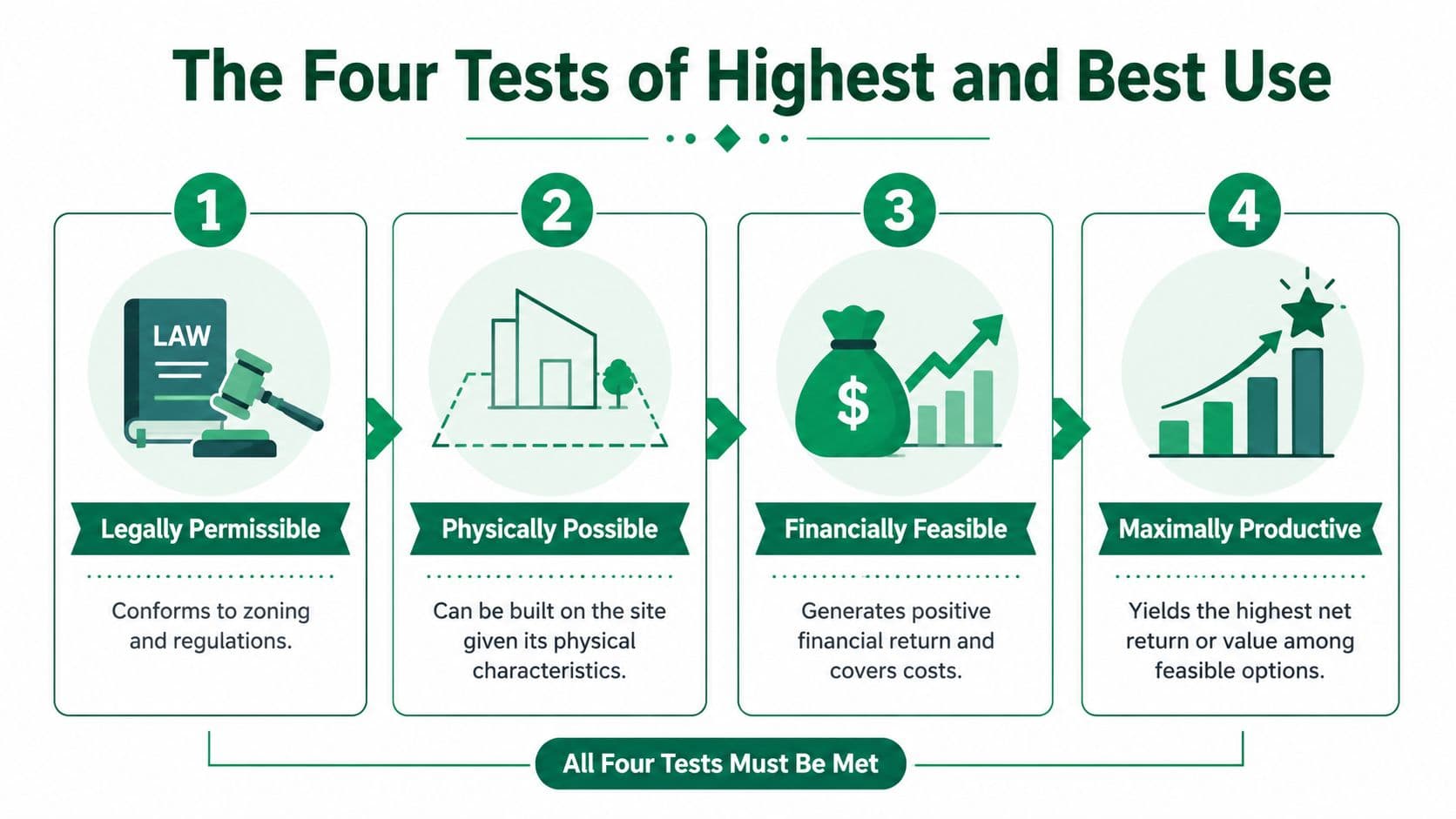
Start with what the law allows
The first question is legally permissible. Can the proposed use comply with zoning, land use controls, and related restrictions? If a site is zoned for low-intensity use, a tower may be physically and financially attractive but still fail immediately.
This sounds obvious, yet councils often see proposals discussed as though legal constraints are optional. They aren't. A serious analysis starts with the actual rulebook.
Then comes physically possible. This test asks whether the land itself can support the use. Size, shape, topography, access, and utility connections all matter. A site may be legally allowed to host a project and still be a poor fit because the parcel is shallow, oddly shaped, or difficult to serve.
Here is a simple way to think about the first two tests:
| Test | Core question | Typical council relevance |
|---|---|---|
| Legally permissible | Is the use allowed? | Zoning reform, overlays, permitting rules |
| Physically possible | Can the site support it? | Street access, utilities, lot depth, terrain |
For public officials, these first tests often expose self-inflicted barriers. A city may say it wants housing near transit while keeping rules that make the housing functionally impossible.
Then test the site and the economics
The third test is financially feasible. Here, many debates get muddled. A use is not highest and best merely because it sounds beneficial. The revenue or value created must justify the cost of getting there. In commercial practice, appraisers are also expected to document their reasoning. Under USPAP Standards Rule 2-2 (a) (x), they must “summarize the support and rationale for that opinion” when developing an HBU analysis, as noted in this summary of land value capture explained.
That requirement is healthy. It forces the analyst to show the logic rather than gesture toward it.
The last test is maximally productive. Suppose several uses are legal, buildable, and financially viable. The final step selects the one that yields the highest value. Not the loudest proposal. Not the most familiar use. The one that creates the strongest supportable outcome.
A council member can use the four tests like a checklist:
- Legal screen: Does current law permit it, or would reform be required?
- Site screen: Does the parcel's form and infrastructure support it?
- Feasibility screen: Would income or sale value justify development or conversion costs?
- Productivity screen: Among credible options, which one creates the highest value?
The order matters. If you skip ahead to profitability before checking law and physical reality, you're not doing highest and best use. You're doing wishful thinking.
This framework is also a guardrail against bad public policy. Some cities approve plans with no market support. Others block feasible uses that would clearly outperform the status quo. Highest and best use gives both planners and elected officials a common language for sorting realistic options from decorative ones.
From Theory to Value Data and Valuation
A highest and best use conclusion only earns trust when it rests on actual market evidence. That's where valuation work becomes less philosophical and more forensic.
Why vacant land is different
With a vacant parcel, the analysis carries unusual weight because there is no existing improvement to distract from the central question. In that setting, highest and best use largely drives the whole valuation. The site is worth what the market believes it can become, not what it currently contains.
Valuers therefore examine a broad market picture. According to Valbridge's explanation of highest and best use in valuation practice, that assessment includes sales, lease rates, absorption, number of sales, price per square foot, cap rates, and time-on-market trends. They also consider whether nearby sites are equally or better suited to the same use. If competing land in the same submarket is superior, that limits what buyers will pay for a given parcel.
That's one reason vacant land debates can become politically confusing. Residents often see only the site. Analysts have to see the alternatives too.
The data behind the judgment
A credible HBU analysis asks a blunt financial question: would the potential increase in value exceed the cost of the modifications necessary to reach the new use? If the answer is no, redevelopment isn't financially feasible and the current use remains the likely conclusion.
For non-specialists, a broader guide to demystifying property value can be beneficial. It clarifies how appraisers think across methods, and why land potential, income expectations, and replacement cost don't always point in the same direction.
A city team reviewing a strategic site should usually gather evidence in at least these categories:
- Market evidence: Comparable sales, current lease patterns, cap rate signals, and the pace at which similar projects are being absorbed.
- Site economics: Construction cost assumptions, likely conversion costs, and whether the uplift in value covers those costs.
- Competitive context: Whether another parcel nearby can deliver the same use more easily or more cheaply.
- Land-only perspective: A clean estimate of site value, especially when staff need a basis for calculating land value apart from the building on top of it.
Practical rule: If a site's story can't survive contact with sales data, lease data, and modification costs, it isn't an HBU conclusion yet.
This rigor is what makes highest and best use useful for policy. It doesn't ask cities to bet on slogans. It asks them to compare legal options, physical constraints, and market evidence in a disciplined way.
HBU in Action Inspiring Case Studies
The principle becomes easier to grasp when you watch it work on real urban problems.
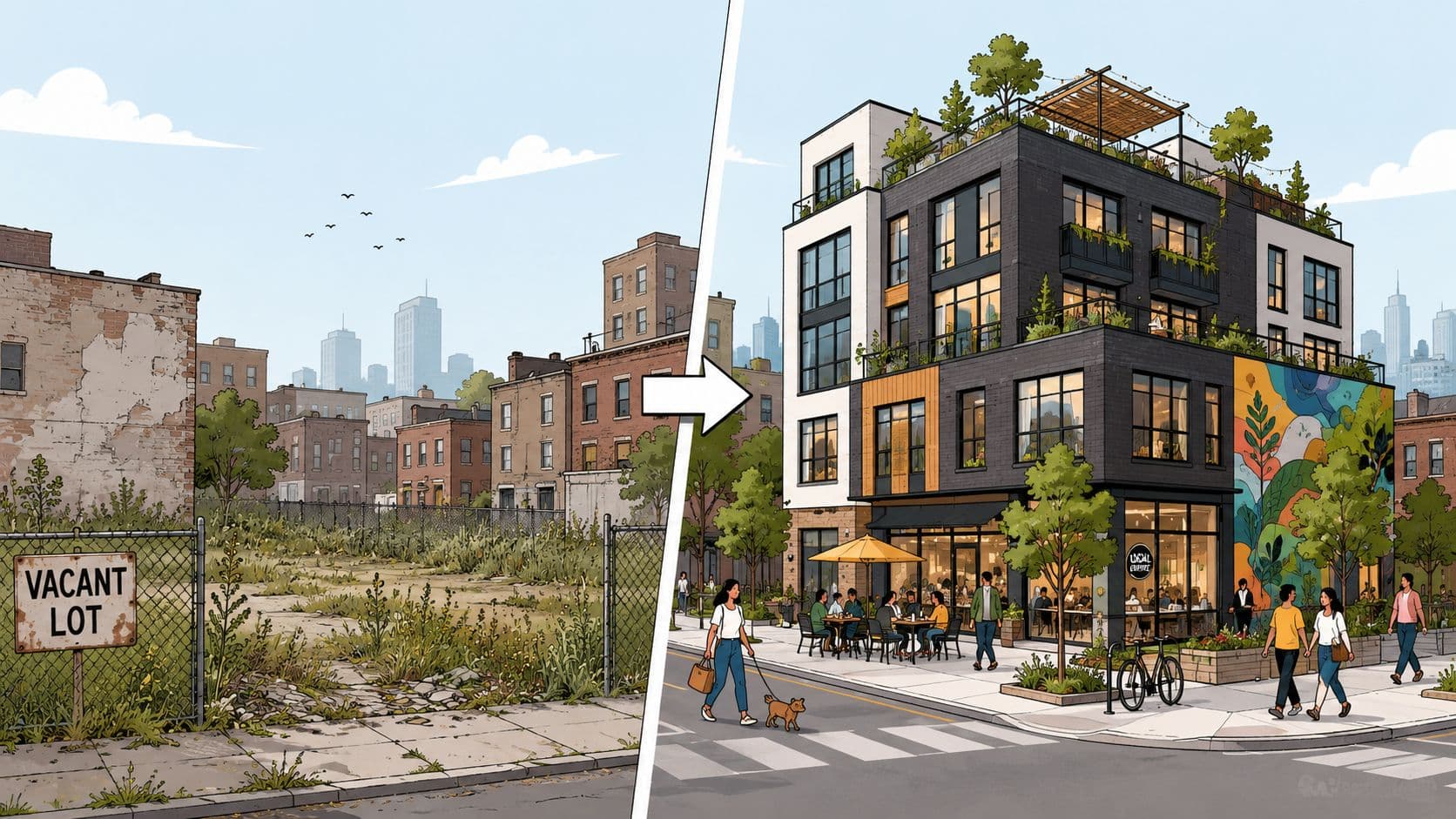
An infill lot that becomes a neighborhood asset
Take a surface parking lot on a commercial corridor with strong transit access. For years it may function as a low-risk holding pattern. Cars fit. The use is legal. Revenue arrives with little effort. Yet an HBU review can reveal that the lot is no longer the most productive use once surrounding demand changes.
If zoning allows housing above ground-floor retail, the physically possible and financially feasible options may shift decisively toward a mixed-use building. That outcome can add homes, create storefront frontage, and repair a gap in the street wall. The lesson is simple. Current use often survives because it is easy, not because it is best.
In long-hold areas, that same logic also shapes ownership strategy. Structures such as 99-year land leases can help align long-term stewardship with land that has strong future urban value.
An industrial site with a second life
Now consider a former industrial property near water, rail, or an edge-of-downtown district. Its old use may no longer match market demand, but demolition and blank-slate redevelopment aren't the only possibilities. Highest and best use can guide a more careful comparison among logistics, employment space, recreation, cultural uses, or mixed commercial redevelopment.
The key is not to force a fashionable answer. It is to compare alternatives that fit the parcel, the rules, and the surrounding market. On some sites, the most productive use is an employment district with upgraded infrastructure. On others, it is a phased district that combines commercial activity with public access and amenities.
A strong HBU analysis helps councils avoid two common mistakes:
- Romanticizing the past: Keeping obsolete land use patterns because they feel familiar.
- Overpromising the future: Backing a high-intensity proposal with weak market support.
- Ignoring sequence: Failing to see that some sites need an interim use before their ultimate use becomes feasible.
When preservation is the best use
Highest and best use does not automatically mean more concrete, taller buildings, or denser form. Sometimes the best use of a site is preservation.
That may happen where ecological value, physical constraints, legal protections, or market realities make conservation the most supportable outcome. A flood-prone tract, a habitat corridor, or an area with major public amenity value may produce greater long-term value through protection than through conventional development.
A mature understanding of highest and best use asks, “What creates the greatest supportable value here?” It does not ask, “How much can we build no matter what?”
That distinction matters for urban renewal. Smart cities don't maximize construction on every parcel. They match each parcel to the use that creates the strongest combination of lawful, feasible, and durable value.
Common Pitfalls and The Adaptive Reuse Paradox
Some of the most damaging land decisions happen when people think they are applying highest and best use correctly.
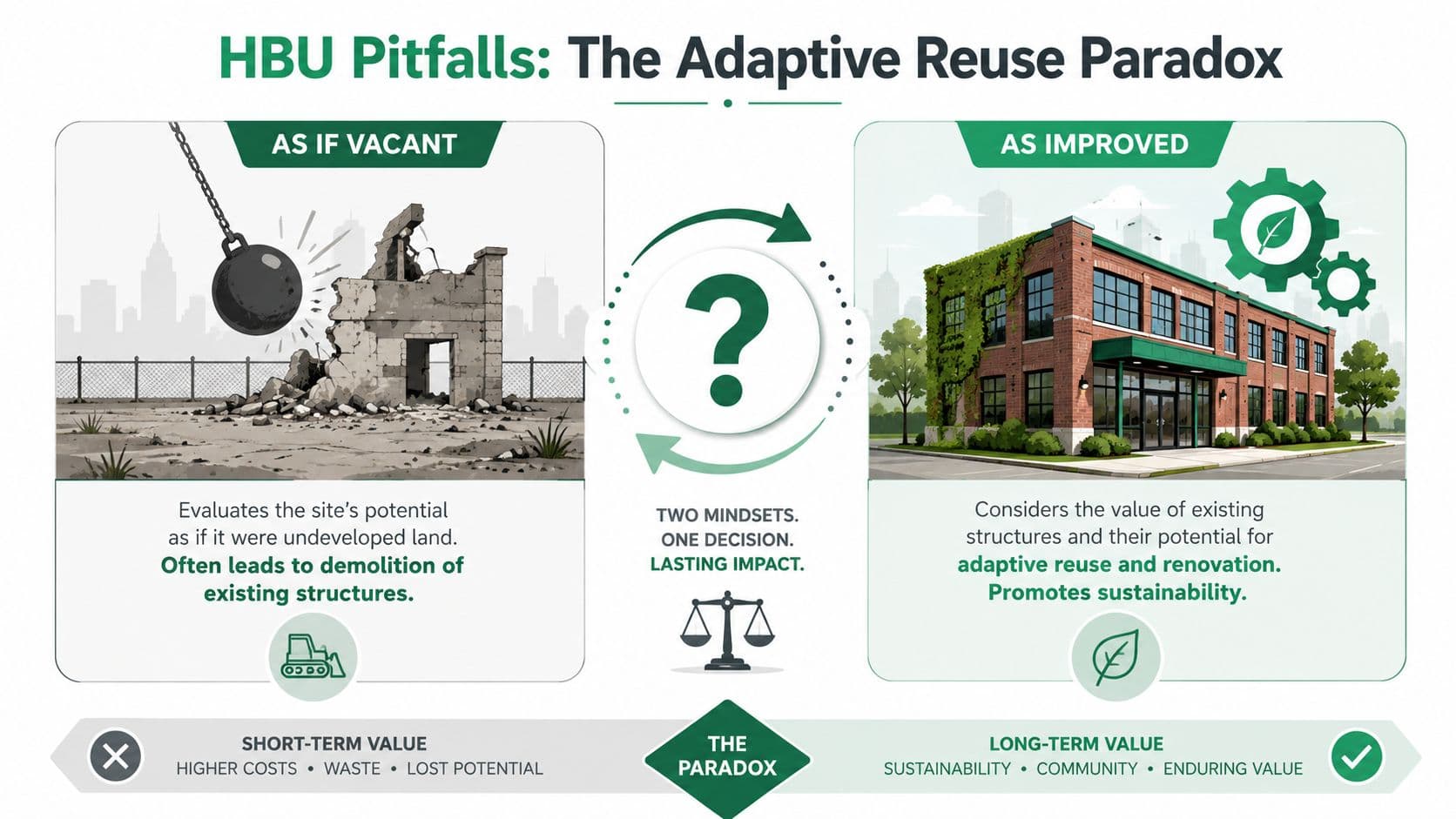
The two lenses that change the answer
Appraisers often distinguish between land analyzed as if vacant and property analyzed as improved. That sounds technical, but the policy consequences are major.
An as if vacant analysis asks what the land would support if the current building were absent. In a hot market, that can point quickly toward demolition and a more lucrative new use. An as improved analysis asks whether the existing structure, perhaps with renovation or conversion, still represents the best path.
Neither lens is wrong in itself. The problem comes when one dominates public decision-making. Cities with high office vacancy, for example, may keep treating obsolete buildings as demolition candidates while overlooking housing conversion, institutional reuse, or mixed-use adaptation.
Why this matters for housing and waste
The available data on this point should get every council's attention. A 2025 Urban Institute report found that 57% of US cities with significant office vacancy use HBU “as if vacant” to justify demolition, ignoring adaptive reuse. By contrast, 2024 World Bank data shows that cities adopting “adaptive reuse HBU” criteria cut demolition permits by 35% while boosting housing conversion permits by 28%, as summarized in this discussion of the adaptive reuse paradox in HBU practice.
Those figures reveal a policy choice hiding inside a valuation method.
A narrow approach can produce a perverse cycle:
| Lens | Likely result | Urban effect |
|---|---|---|
| As if vacant | Demolition appears more attractive | Waste, delay, loss of embodied value |
| As improved with adaptive reuse seriously tested | Conversion and renovation stay on the table | Faster reuse, preservation, added housing options |
This doesn't mean every aging office should become housing. Many buildings won't fit. Floor plates, light, servicing, and code issues can make conversion impractical. But cities shouldn't allow the appraisal frame itself to erase adaptive reuse before the analysis starts.
Policy question: Should local HBU guidance require explicit testing of adaptive reuse profitability before demolition is treated as the default answer?
That change would be modest in procedure and significant in impact. It would also bring valuation practice closer to what many cities say they want: less waste, more housing options, faster revival of struggling districts, and a stronger link between economic efficiency and sustainability.
HBU as a Tool for Equitable and Efficient Cities
Once you understand highest and best use, a deeper policy question appears. If public action helps create land value, who should benefit from that increase?

Why land policy belongs in the conversation
A transit line, a school upgrade, a rezoning decision, a streetscape project, or a new park can lift the value of nearby land. Highest and best use helps explain why. Public action changes what is legally possible, physically supportable, or financially feasible. In other words, the community often expands the site's productive potential.
That insight strengthens the case for land value capture and for tax systems that lean more on land value and less on buildings or work. If the public creates part of the uplift, it is reasonable for the public to recover part of it.
The logic also reaches housing affordability. Taxes on buildings can discourage renovation, infill, and new supply. By contrast, charges tied to land value put pressure on owners to use well-located sites productively rather than hold them idle and wait. That doesn't solve every housing problem, but it aligns incentives better.
For practitioners focused on operations, portfolio managers also think in terms of land productivity, occupancy, and asset strategy. Tools used to boost rental property ROI can help owners understand asset performance, but city policy still determines whether land itself is being rewarded for productive use or passive scarcity.
A practical agenda for city leaders
Councils don't need to rewrite the entire tax code overnight. They can start by using HBU as a decision lens across planning, assessment, and redevelopment policy.
A practical agenda could include:
- Review underused strategic sites: Identify parcels where current use plainly lags behind what the location can support.
- Audit legal barriers: Check where zoning and approval rules block feasible housing, mixed use, or adaptive reuse.
- Separate land from buildings analytically: Distinguish site value from improvement value when evaluating taxes, redevelopment, and public benefit.
- Reform incentives: Reduce penalties on construction and reinvestment while strengthening signals against land hoarding.
- Connect HBU to affordability goals: Use the framework when shaping housing affordability policy, especially around transit, downtown conversions, and infill corridors.
A city that adopts this mindset becomes more coherent. Planning, taxation, infrastructure, and redevelopment stop working at cross purposes. Sites with strong potential move toward use. Owners have fewer rewards for inactivity. Public investment is more likely to be matched by public return.
The central civic lesson is simple. Land value does not arise from owner effort alone. It is co-created by location, law, infrastructure, and community life. Policy should reflect that reality.
That is why highest and best use matters beyond appraisal. It helps cities see where value comes from, who is blocking it, and how better rules can turn hidden potential into broad public benefit.
Frequently Asked Questions About HBU
Does highest and best use always mean the most intensive development?
No. It means the use that is legally permissible, physically possible, financially feasible, and most productive. A taller or denser project may fail one of those tests. On some sites, preservation, open space, or lower-intensity use can be the better conclusion.
How do historic districts affect the analysis?
Historic controls shape the legally permissible test. If demolition or major alteration is restricted, the highest and best use must reflect those limits. In practice, that often makes rehabilitation or sensitive reuse more relevant than clearance and rebuild.
Can highest and best use change over time?
Yes. It changes when market conditions, infrastructure, regulations, or neighborhood demand change. A parcel near a new transit line may support a different conclusion after public investment than it did before.
What happens in a weak or declining market?
The framework still applies, but financially feasible options usually narrow. In that setting, an interim use may be reasonable until stronger demand appears. The best current use isn't always the ultimate future use.
Is highest and best use only for appraisers?
No. Appraisers formalize it, but planners, assessors, housing agencies, and elected officials can all use the concept. It is especially useful when a city must decide whether a site is underused because of market reality or because policy is holding it back.
Where do councils usually get this wrong?
They often confuse desirable use with feasible use, or they accept the current use as fixed when it is only convenient. They also miss the adaptive reuse question and treat demolition as the default path.
If your team is working through land valuation, land value capture, adaptive reuse, or tax reform, Unitism® offers policy research, educational tools, and implementation support to help governments connect land economics to practical reform.